HyperEVM Ecosystem Heats Up: Memes Fueling the Fire, the Next Robinhood?

marsbitPublicado a 2026-08-25Actualizado a 2026-08-25

Resumen

The HyperEVM ecosystem is heating up, driven by a surge in HYPE token price and a wave of meme coin activity. HYPE recently hit a new all-time high, with its rally partly attributed to endorsements. This has led to intense on-chain activity, causing HyperEVM's gas fees to spike above even Ethereum's. The article highlights key players in this frenzy. Meme coins like EGG and CHAMELEON saw explosive, though volatile, growth, capitalizing on community narratives. Platforms like Motion.meme, a launchpad similar to Pump.fun, are facilitating new meme coin launches. Beyond memes, fundamental projects are noted: Kinetiq (KNTQ) is a major liquid staking protocol, HyperLend (HPL) is the main lending market with high TVL, and Project X is a leading DEX on the chain. In conclusion, while the current hype is fueled by HYPE's performance and meme mania, the ecosystem's long-term viability depends on user retention and whether its core projects can generate sustainable utility and revenue. A significant ongoing challenge is the high transaction costs during peak activity, which could limit broader adoption.

Author: Biteye

Over the past few days, HyperEVM has abruptly transitioned from Hype's proprietary blockchain infrastructure to a "high-volatility trading arena" — against the backdrop of HYPE hitting a new all-time high and rapid meme rotation, on-chain gas fees on HyperEVM once skyrocketed to over ten dollars per transaction, far exceeding those on the ETH mainnet!

The underlying driver of the market movement stems first from HYPE's strong performance following Trump's public endorsement. HYPE is currently priced at approximately $79.65, up 35.4% over the past 7 days and 38.7% over the past 30 days, hitting a new all-time high of $83.27 yesterday.

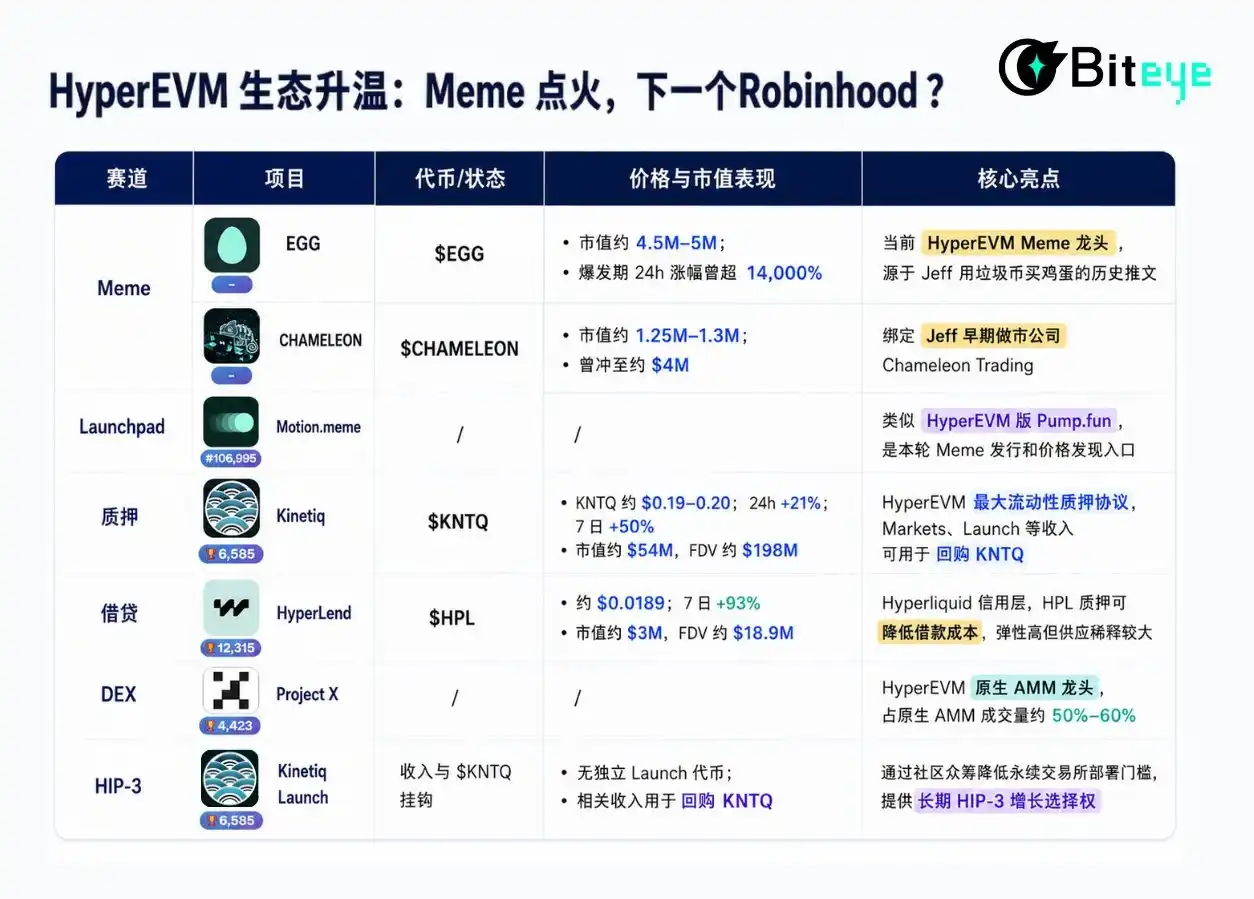
We've compiled a list of popular Memes and projects on HyperEVM for our readers:

Memes: EGG & CHAMELEON Ignite Sentiment

EGG: The Current Sentiment Leader on the Hype Chain

EGG originates from an early tweet by Jeff Yan: “Just buy eggs with your shitcoins.”

The community packaged it into a native HyperEVM Meme and created a mini-game and interactive website, eggonhype.com.

Contract: 0xb75d5ee14708e7efbea939311090061d72265608

Summary: During its explosive phase, EGG saw a 24h gain exceeding 14,000%, with its market cap once reaching approximately $8M–$9M, but it has since seen a significant correction.

CHAMELEON: Narratives from Jeff's Early Entrepreneurial History

CHAMELEON is tied to Jeff's real entrepreneurial experience. Before Hyperliquid existed, Jeff operated Chameleon Trading, and his X (formerly Twitter) handle remains @chameleon_jeff to this day.

Contract: 0xddfed493a114d610C5709FEFd22BAEF40DC23428

Summary: CHAMELEON's market cap once surged to approximately $4M but has since retraced by about 65%–70%.

Launchpad: Motion

Motion.meme is akin to a HyperEVM version of Pump.fun. Projects first undergo price discovery via a Bonding Curve before being listed for trading in HyperSwap V3 pools.

Its fee mechanism is:

· Token Launch Fee: 0.05 HYPE;

· Bonding Phase: Approximately 0.5% platform fee;

· HyperSwap Pool Fee: Approximately 0.01%;

Summary: Motion plays the "pickaxe seller" role in this Meme cycle. If the subsequent HyperEVM Meme Season proves sustainable, Motion stands to benefit significantly.

Staking: Kinetiq (KNTQ)

Kinetiq is the largest liquid staking protocol on HyperEVM. Users stake HYPE to receive kHYPE, gaining staking rewards while also being able to use kHYPE for lending and liquidity provision.

KNTQ's advantage lies in its clear value capture: Revenue from Markets, Launch, and a portion of validator revenue is used to buy back KNTQ, which is then distributed to sKNTQ stakers.

Summary: Overall, Kinetiq is the most well-rounded utility project in terms of fundamentals within this HyperEVM cycle.

HIP-3: Kinetiq Launch

Kinetiq Launch is a launch platform for HIP-3 perpetual exchanges.

Deploying a HIP-3 exchange requires staking over 500,000 HYPE, close to $40M at current prices. Kinetiq Launch allows the community to crowdfund this capital, isolating the risks of different exchanges through independent exLST tokens.

Summary: Launch revenue earned by Kinetiq is used to buy back KNTQ, adding a new narrative of "HIP-3 exchange incubator platform" to KNTQ.

Lending: HyperLend (HPL)

HyperLend is the primary lending market on HyperEVM, supporting collateral like HYPE and kHYPE, positioned as the credit layer for Hyperliquid.

· TVL: Approximately $570M

· Borrowed Balance: Approximately $308M

Summary: HPL can be staked as sHPL to reduce borrowing costs, with a rebate cap reaching up to 80%. The market views it favorably due to its "low market cap, high TVL" profile.

DEX: Project X

Project X is a leading concentrated liquidity AMM on HyperEVM by trading volume.

· TVL: Approximately $45.8M

· 24h Trading Volume: Approximately $152M

Summary: Among native HyperEVM AMMs, Project X commands a trading volume share of about 50%–60%.

Conclusion:

Currently, the heat around HyperEVM feels more like an ecosystem revaluation driven by HYPE's new highs. Whether this can evolve into a true HyperEVM Season depends on further observation: the retention rate of users attracted by Meme hype, and whether a series of utility projects can convert into real users and actual revenue.

Furthermore, every time HyperEVM's activity rises and on-chain transactions become lively, gas fees spike noticeably. During peak periods, the cost per transaction can easily reach $10–20. While this increases demand for HYPE gas and token burns, it also caps the potential ceiling for Meme trading and the long-term prosperity of the HyperEVM ecosystem.


Preguntas relacionadas

QWhat caused a significant spike in gas fees on the HyperEVM chain recently?

AThe recent surge in gas fees on the HyperEVM chain, reaching over $10 per transaction, was primarily driven by the robust performance of the HYPE token following an endorsement by Trump and the rapid rotation of Meme tokens like EGG and CHAMELEON, which attracted a large volume of speculative trading activity.

QWhat are the two Meme tokens highlighted in the article that drove the initial market sentiment on HyperEVM?

AThe two Meme tokens highlighted are EGG, which became the sentiment leader with a 24-hour surge of over 14,000%, and CHAMELEON, a token based on the founder Jeff's early entrepreneurial history, which also saw significant initial price appreciation before major corrections.

QWhat is the primary utility and potential benefit of the Motion.meme launchpad on HyperEVM?

AMotion.meme is a launchpad similar to Pump.fun on HyperEVM. It facilitates price discovery for new tokens via a Bonding Curve before they list on HyperSwap V3. It acts as a 'picks-and-shovels' play, set to benefit significantly if the Meme token season on HyperEVM proves to be sustainable, as it earns fees from token launches and trading.

QWhich project on HyperEVM is described as having the most complete fundamentals and a clear value capture mechanism?

AKinetiq (KNTQ) is described as the most fundamentally sound utility project. It is the largest liquid staking protocol, allowing users to stake HYPE for kHYPE. Its token, KNTQ, benefits from a clear value capture mechanism where revenues from Markets, Launch, and parts of validator income are used to buy back and distribute KNTQ to stakers.

QWhat are the two main challenges mentioned for the long-term prosperity of the HyperEVM ecosystem?

AThe two main challenges are: 1) User retention and the ability of practical projects to convert speculative Meme-driven traffic into real, sticky users and actual revenue. 2) The high and volatile gas fees, which can reach $10-20 per transaction during peak times, potentially capping the growth of Meme trading and the broader ecosystem despite increasing HYPE burn.

Lecturas Relacionadas

Yangtze Memory Earns Nearly 4 Billion Per Day, Can It Replicate ChangXin's 4 Trillion Yuan Myth?

Yangtze Memory Technologies (YMTC), a leading Chinese NAND flash memory chipmaker, has filed for an IPO after completing listing guidance. Its prospectus reveals a staggering Q1 2026 net profit of 33.38 billion yuan, averaging nearly 4 billion yuan daily, surpassing competitor ChangXin Memory Technologies (CXMT) during the same period. This follows CXMT's recent blockbuster科创板 debut, which saw its market cap briefly exceed 4 trillion yuan. YMTC's journey has been fraught with challenges, including the bankruptcy of its former major shareholder, Tsinghua Unigroup, and subsequent takeover by Hubei state-owned capital, followed by U.S. sanctions restricting equipment and technology access. Despite these hurdles, YMTC has grown its global NAND bit shipment share to 14% in Q2 2026, ranking third worldwide. However, the article highlights key differences from CXMT's "4 trillion yuan myth." While profitable, YMTC's earnings surge is closely tied to a cyclical boom, with Q1 2026 NAND prices ~173% higher than 2025's average. Furthermore, YMTC operates in the more crowded NAND market, whereas CXMT, as China's sole major DRAM producer, benefits more directly from AI server demand and holds a scarcer strategic position. YMTC's future valuation, the article argues, will depend less on replicating CXMT's hype and more on its success in transitioning to higher-margin enterprise SSD products, securing global client certifications (like Apple, amid U.S. pressure), and maintaining profitability after the current memory price cycle peaks, which analysts warn could happen as early as 2027-2028. The IPO aims to raise funds to accelerate this transformation amidst a tightening competitive window.

marsbitHace 7 min(s)

Yangtze Memory Earns Nearly 4 Billion Per Day, Can It Replicate ChangXin's 4 Trillion Yuan Myth?

marsbitHace 7 min(s)

From "Building the Body" to "Building the Brain": The Key Shift in Capital Investment for Embodied Intelligence

From Building Bodies to Building Brains: The Key Shift in Capital Investment for Embodied Intelligence As of August 2026, the embodied AI sector has shifted from a conceptual stage to a heavily invested domain, underscored by Unitree Robotics' successful IPO at a $480 billion market cap. Data from IT桔子 reveals explosive growth: 425 Chinese startups in the field, with 75% founded within the last three years, and total investment in the first eight months of 2026 hitting ¥124.5 billion, 11.6 times the 2023 annual amount. Over 850 institutions are now invested. A critical trend is the capital pivot from "building bodies" (humanoid robots) to "building brains" (embodied AI systems). While humanoid robots attracted the most cumulative funding (¥84 billion), the number of funding deals for AI brain systems surpassed them in 2026 (38.8% vs. 21.1%). This mirrors the smartphone industry, where the OS and chip, not just the hardware, define success. Investment in core components like dexterous hands also surged, signaling a maturing supply chain. The entrepreneurial landscape is concentrated, with Beijing, Guangdong, and Shanghai hosting 67% of companies. It is also academically driven, with nearly a quarter of founders from Tsinghua University, whose startups raised a median amount ten times higher than others. Industry giants like Baidu, Alibaba, and Tencent are heavily involved through strategic investments. Despite the capital frenzy, Unitree's founder cautions that the industry's "ChatGPT moment"—where a robot can handle 80% of tasks in an unfamiliar environment—is still 2-10 years away. The consensus is that capital is betting ahead of the true commercial inflection point. The window for new entrants, especially outside core tech hubs, is narrowing as the race evolves from lab demos to full-scale industrialization.

marsbitHace 8 min(s)

From "Building the Body" to "Building the Brain": The Key Shift in Capital Investment for Embodied Intelligence

marsbitHace 8 min(s)

U.S. 'Operation Economic Outcast' Targets Iran's Crypto Sector, Over $100 Million in Oil-Related Payments Allegedly Facilitated via Cryptocurrency

U.S. Treasury Launches "Operation Economic Outcast," Sanctions Iran's Crypto Sector On August 24, the U.S. Treasury Department initiated "Operation Economic Outcast," a government-wide economic campaign against Iran. As part of this, the Office of Foreign Assets Control (OFAC) issued a sectoral sanctions determination targeting digital assets under Executive Order 13902, significantly expanding its authority. The Treasury stated that Iran is increasingly using cryptocurrency as a "tool of choice" to evade sanctions and support transactions linked to the Islamic Revolutionary Guard Corps (IRGC). Concurrently, OFAC sanctioned Ukrainian-Emirati broker Ivan Obukhov and his company, Foscom FZE. The Treasury alleges that since 2023, Obukhov has processed over $100 million in cryptocurrency payments to facilitate oil sales on behalf of the IRGC-Quds Force. Nearly 60 other entities, individuals, and vessels involved in nuclear procurement, cyber operations, and oil revenue networks were also sanctioned. This move marks an escalation from prior actions against specific exchanges, now establishing a broad basis to sanction any foreign entity deemed to operate in or support Iran's digital asset sector. Treasury Secretary Scott Bessent warned that any entity engaging economically with the Iranian regime will face the full reach of U.S. power, calling the operation an "economic D-Day" aimed at isolating Tehran.

marsbitHace 32 min(s)

U.S. 'Operation Economic Outcast' Targets Iran's Crypto Sector, Over $100 Million in Oil-Related Payments Allegedly Facilitated via Cryptocurrency

marsbitHace 32 min(s)

Trading

Spot
活动图片