Crypto Market Structure Talks In Washington: Key Events To Follow This Week

bitcoinistPublicado a 2026-03-17Actualizado a 2026-03-17

Resumen

The Senate Banking Committee is preparing for discussions on the crypto market structure bill, the CLARITY Act, though no major developments suggest imminent passage. April is critical for the bill's prospects, as failure to pass by the end of the month could significantly reduce its chances this year. Key issues include stablecoin yield, with negotiations focusing on banning rewards for idle balances while allowing them for transactions. Senators Thom Tillis and Angela Alsobrooks are influential in addressing banking sector concerns about deposit flight. Even if a stablecoin deal is reached, other hurdles remain, including DeFi regulation, investor protections, and SEC authority. The bill faces partisan challenges, with limited Democratic input in earlier drafts.

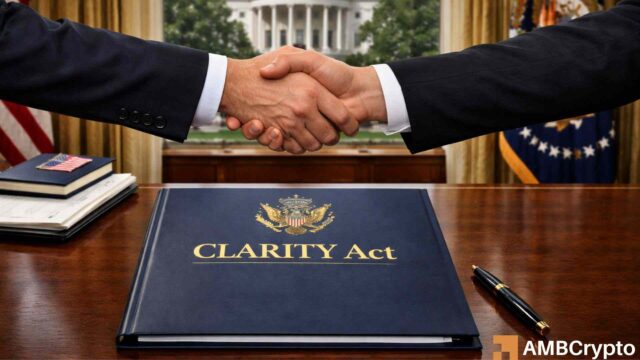
As the Senate Banking Committee prepares for a new round of discussions this Tuesday, anticipation builds around the long-awaited crypto market structure bill, known as the CLARITY Act. Yet despite ongoing negotiations, there have been no major developments indicating imminent passage of the bill.

With April fast approaching, the month is expected to be critical for the act’s prospects, as industry insiders warn that if it does not pass by the end of that month, the chances of it being approved this year will drop significantly.

Key Senators Work Towards Compromise

A Monday report from Crypto In America by journalist Eleanor Terret indicates that the committee chair, Senator Tim Scott, will kick off the event with a fireside chat. However, the schedule for this markup depends on finalizing the bill’s details, particularly around the contentious issue of stablecoin yield.

Negotiations have intensified around stablecoin rewards, a critical point in the ongoing discussions. Alex Thorn of Galaxy Digital’s Research team has emphasized that time is of the essence, suggesting that the odds of passing the bill this year will become “extremely low” if it fails to progress this month.

However, Cody Carbone, CEO of the Digital Chamber, expressed optimism about the negotiations, saying the parties are moving closer to a resolution.

The proposed settlement would ban yield on idle balances while allowing rewards for transactions. Carbone asserted, “They’re getting closer and closer to a deal, so I feel very confident we can reach a resolution in the next week.”

At the same time, Senators Thom Tillis and Angela Alsobrooks are emerging as influential figures. Both senators have shown sensitivity to concerns from the banking sector about the risk of deposit flight if crypto firms are permitted to offer high-yield options that could rival traditional savings accounts.

The report refers to Tillis and Alsobrooks as key gatekeepers. Once they are satisfied with the language of the legislation on both sides, the bill may proceed, clearing the way to address the remaining complexities around decentralized finance (DeFi) and token classifications.

A spokesperson for Tillis recently said he continues to engage with stakeholders in pursuit of a compromise, even though the senator will not attend the summit this week. Alsobrooks, however, is slated to discuss efforts related to the yield debate during her speech on Wednesday.

Multiple Obstacles In Crypto Bill

While the focus is currently on solving the stablecoin rewards issue, Thorn cautioned that even if a compromise is reached, other hurdles may emerge.

These could involve ongoing discussions about DeFi, investor protections, the authority of the Securities and Exchange Commission (SEC), and even broader ethical considerations.

It’s worth noting that the Senate Banking Committee’s draft from January aimed at bipartisanship, yet ultimately received little direct input from Democratic members, reflecting existing partisan divides.

As such, Thorn suggests that stablecoin rewards might not be the final obstacle, but rather a temporary flashpoint in what appears to be a more complex landscape of unresolved issues underlying the bill’s progression.

The daily chart shows the total crypto market cap’s rise to $2.5 trillion on Monday. Source: TOTAL on TradingView.com

Featured image from OpenArt, chart from TradingView.com

Preguntas relacionadas

QWhat is the name of the crypto market structure bill being discussed by the Senate Banking Committee?

AThe CLARITY Act.

QAccording to Alex Thorn, why is April a critical month for the bill's prospects?

ABecause if the bill does not pass by the end of April, the chances of it being approved this year will drop significantly, becoming 'extremely low'.

QWhat is the contentious issue in the bill's negotiations that specifically involves stablecoins?

AThe issue of stablecoin yield, specifically whether to ban yield on idle balances while allowing rewards for transactions.

QWhich two senators are identified as key gatekeepers whose satisfaction with the bill's language is crucial for it to proceed?

ASenators Thom Tillis and Angela Alsobrooks.

QBeyond stablecoin yield, what are some of the other potential hurdles for the bill mentioned by Alex Thorn?

AOngoing discussions about DeFi, investor protections, the authority of the Securities and Exchange Commission (SEC), and broader ethical considerations.

Lecturas Relacionadas

The Second Half of Stablecoins No Longer Belongs to the Crypto World

The article discusses the shift in the stablecoin market from the crypto sector to traditional finance, highlighted by Mastercard's acquisition of BVNK for up to $1.8 billion in March 2026. This move came after Coinbase abandoned a $2 billion deal for BVNK months earlier, signaling intensified competition for stablecoin infrastructure. BVNK specializes in cross-border payments using a "stablecoin sandwich" model: converting fiat to stablecoins like USDC for blockchain transfer, then back to local currency, reducing transaction times and costs. Its key asset is a suite of global licenses, including EMI from the UK FCA and CASP under EU MiCA, enabling compliance across 130+ countries. Mastercard's acquisition aims to integrate BVNK into its Multi-Token Network (MTN), a private blockchain for tokenized assets, addressing MTN's lack of connectivity with public chains. This enables atomic settlements, 24/7 B2B transactions, and programmable payments. The strategy contrasts with Visa’s partnership-focused approach, emphasizing direct control over infrastructure. The U.S. GENIUS Act (July 2025) provided regulatory clarity, defining stablecoins as non-securities under OCC oversight, which facilitated Mastercard’s move. The deal pressures players like Ripple and traditional correspondent banks, as Mastercard’s global network could disrupt cross-border payment fees. Ultimately, stablecoin evolution is becoming invisible to users—embedded in traditional finance for efficiency, not crypto adoption. Mastercard’s investment secures a foothold in the next-generation payment ecosystem.

marsbitHace 2 hora(s)

The Second Half of Stablecoins No Longer Belongs to the Crypto World

marsbitHace 2 hora(s)

Trading

Spot
Futuros
活动图片