UK Moves To Shut Down Crypto Exchange Tied To Iran’s Military

bitcoinistPublicado a 2026-03-21Actualizado a 2026-03-21

Resumen

A UK-registered cryptocurrency exchange, Zedxion, is being shut down after a TRM Labs investigation revealed that nearly 90% of its 2024 transactions, totaling around $1 billion, were linked to Iran’s Islamic Revolutionary Guard Corps (IRGC). The UK’s Companies House initiated a compulsory strike-off after discovering the firm filed false information, including a fictitious director named Elizabeth Newman, whose image was traced to a stock photo. The previous director was linked to Babak Zanjani, an Iranian businessman previously sentenced for corruption. The action follows US sanctions imposed in January against Zedxion and a related platform, Zedcex, for supporting the IRGC.

A blockchain analytics firm found that nearly 90% of money processed by a UK-registered crypto exchange in 2024 was connected to Iran’s most powerful military organization.

A Billion Dollars And A Fake Boss

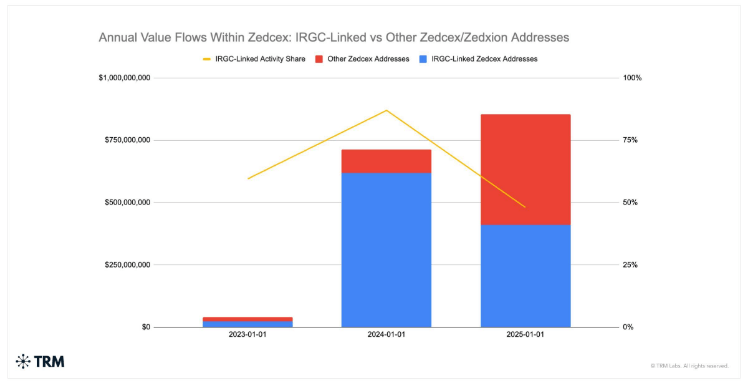
TRM Labs, which tracks cryptocurrency flows, reported that Zedxion Exchange and a related platform called Zedcex moved roughly $1 billion tied to Iran’s Islamic Revolutionary Guard Corps (IRGC).

In 2024, IRGC-linked payments made up about 87% of all transactions the two exchanges handled. Even as that share fell to roughly 48% in 2025, the raw dollar amounts connected to the Iranian military group remained massive.

Now the UK is shutting the exchange down.

Britain’s Companies House — the government body that registers businesses — has started a compulsory strike-off against Zedxion Exchange Ltd. Authorities say the company filed false information, including listing a director who never existed.
Stock Photo, Fake Name, Real Money

The fictitious director was registered under the name Elizabeth Newman, listed as a citizen of the Dominican Republic.

An investigation by the Organized Crime and Corruption Reporting Project (OCCRP) found that the woman behind the name was likely manufactured entirely — her image in company marketing videos traced back to a stock photo.

Babak Zanjani, an Iranian billionaire accused of corruption, previously voiced pride in his role helping Iran sidestep oil sanctions during periods of economic strain. Source: https://www.iranintl.com/

Before Newman appeared in company records, a man named Babak Morteza held the director position. His details matched those of Babak Zanjani, an Iranian businessman who had previously been sentenced to death in Iran for stealing state oil funds.

That sentence was reduced in 2024, and Zanjani resumed business operations. Morteza was listed as director and the person with significant control of Zedxion from October 2021 to August 2022.

Zanjani is also said to head DotOne Holding Group, a conglomerate with operations across cryptocurrency, foreign exchange, logistics, and telecommunications — sectors that have been used in the past to sidestep international sanctions.

Total crypto market cap currently at $2.4 trillion. Chart: TradingView

Washington Acted First

The UK crackdown follows US sanctions imposed in January by the Treasury Department’s Office of Foreign Assets Control (OFAC).

Both Zedxion and Zedcex were named in that action. OFAC said Zanjani helped fund projects supporting the IRGC and the Iranian government more broadly.

Company filings for the two exchanges also showed dormant accounts, a detail that stood in sharp contrast to the enormous transaction volumes blockchain analysts traced through them.

The UK passed the Economic Crime and Corporate Transparency Act in 2023, giving Companies House new authority to verify the identities of directors and check that registered businesses were set up for lawful purposes.

The Zedxion case marks one of the more visible uses of those powers.

Featured image from Unsplash, chart from TradingView

Preguntas relacionadas

QWhat percentage of transactions processed by Zedxion Exchange in 2024 were linked to Iran's IRGC?

AApproximately 87% of transactions processed by Zedxion Exchange and Zedcex in 2024 were connected to Iran's Islamic Revolutionary Guard Corps (IRGC).

QWhat was the fictitious name of the director listed for Zedxion Exchange Ltd. and what was her alleged citizenship?

AThe fictitious director was registered under the name Elizabeth Newman, who was listed as a citizen of the Dominican Republic.

QWhich US government agency imposed sanctions on Zedxion and Zedcex, and when did this action occur?

AThe US Treasury Department's Office of Foreign Assets Control (OFAC) imposed sanctions on Zedxion and Zedcex in January 2025.

QWhat is the name of the Iranian businessman previously sentenced to death, who was linked to the directorship of Zedxion under an alias?

ABabak Zanjani, an Iranian businessman previously sentenced to death for stealing state oil funds, was linked to the directorship of Zedxion under the alias Babak Morteza.

QWhat new UK legislation gave Companies House enhanced powers to verify company directors and lawful purposes, which was used in the Zedxion case?

AThe Economic Crime and Corporate Transparency Act, passed in 2023, gave Companies House new authority to verify the identities of directors and check that registered businesses were set up for lawful purposes.

Lecturas Relacionadas

$9.4 Billion: The Largest Robotics Funding This Year Has Emerged

Munich-based humanoid robotics company Neura has completed a $1.4 billion (approximately RMB 94.9 billion) Series C funding round, valuing the company at around $7 billion and positioning it among the global leaders in the sector. The investment round is notable not just for its size—reportedly the largest in robotics this year—but also for its strategic backers, which include tech giants like NVIDIA and Amazon, alongside established industrial players such as German engineering firms Bosch and Schaeffler. This mix of investors signals a significant shift in the industry's focus from technological demonstrations and general-purpose narratives toward practical, industrial deployment and commercialization. Neura's approach centers on developing humanoid robots for defined, high-value industrial tasks rather than pursuing a general-purpose model. Its early validation comes from a partnership with BMW, where its robots are being tested on actual production lines. The involvement of Bosch and Schaeffler, companies deeply embedded in global manufacturing, underscores a growing belief that humanoid robots are transitioning from labs to viable factory-floor solutions. The article highlights two converging trends driving investment: advancements in AI and large language models, which enhance robots' perception and decision-making in unstructured environments, and mounting pressure from labor shortages and rising costs in major manufacturing regions. The funding landscape is now bifurcating between companies like Figure AI, focusing on versatile general-purpose robots, and firms like Neura, targeting specific vertical industrial applications with clearer, shorter paths to ROI. While technical hurdles remain, the core challenges for widespread adoption are increasingly seen as engineering and commercial in nature: managing the high integration and customization costs for different factory environments and establishing robust, localized maintenance and service networks. The record investment in Neura, particularly from industrial capital, indicates the industry's growing confidence in moving from proving feasibility to solving the practical problems of scalability, reliability, and building sustainable business models around humanoid robots in real-world settings like automotive manufacturing and hazardous labor environments.

marsbitHace 33 min(s)

$9.4 Billion: The Largest Robotics Funding This Year Has Emerged

marsbitHace 33 min(s)

"119 to 176 Dollars": Behind SpaceX's Listing, MSX Once Again Successfully Executes the Pre-IPO Closed Loop

Following May's 300% gain on Cerebras, MSX delivered another outstanding performance during SpaceX's listing night. On June 12, SpaceX (SPCX) launched on Nasdaq, reaching a high of $176. This marked the successful culmination of MSX's Pre-IPO project launched in March, where users subscribed at $119, achieving gains of approximately 40-48%. This event validated MSX's complete Pre-IPO mechanism, a crucial advantage in a market where access to top-tier private company equity is typically limited to institutions. MSX's model provides a full cycle for users: subscription (at $119 for SpaceX), real-time on-chain portfolio tracking, optional early redemption, seamless conversion to tradable spot assets (SPCX.M) upon IPO, and final settlement in stablecoins. This end-to-end process distinguishes MSX from platforms that faced settlement issues during the SpaceX IPO, highlighting that the core challenge of Pre-IPO is not just access, but a clear exit and conversion path post-listing. This success with SpaceX is MSX's second major Pre-IPO verification, following the Cerebras listing in May, which yielded ~300% returns for early participants. These back-to-back achievements demonstrate MSX's capability to source, structure, and deliver real assets through a replicable on-chain model. The true barrier for Pre-IPO products lies not in providing an entry point, but in ensuring reliable fulfillment from subscription through to post-IPO liquidity. MSX's proven闭环 (closed-loop) process addresses this, offering Web3 users a structured way to access high-growth, pre-public companies in sectors like AI and frontier tech. MSX plans to continue expanding its Pre-IPO portfolio with this focus on authenticity, transparency, and post-listing execution.

Odaily星球日报Hace 13 hora(s)

"119 to 176 Dollars": Behind SpaceX's Listing, MSX Once Again Successfully Executes the Pre-IPO Closed Loop

Odaily星球日报Hace 13 hora(s)

Trading

Spot
Futuros
活动图片





