Late on July 23rd, the Fields Medal, the highest global award in mathematics granted every four years, was announced, with two Chinese mathematicians winning simultaneously: Wang Hong and Deng Yu.
They were both undergraduate classmates from the Peking University School of Mathematical Sciences class of 2007. One solved the century-old Kakeya conjecture in three dimensions that had perplexed the mathematical community, while the other resolved the narrow Hilbert's sixth problem.
This is the first time mathematicians who completed their undergraduate studies in mainland China have won the Fields Medal, and two in the same year at that.
Soon after the award results were announced, Shing-Tung Yau stated at a public event at Tsinghua University: "I sincerely invite scholars Wang Hong and Deng Yu to return and teach. The Yau Mathematical Sciences Center at Tsinghua University welcomes them at any time."
This is not the first time Yau has competed with Peking University for talent, nor is it the first time Tsinghua has clashed head-on with Peking University in mathematics.
These two top Chinese universities have been contending, overtly and covertly, for decades in mathematics, the most fundamental and rigorous discipline.
From vying for teenage prodigies in junior high to competing for established Fields Medalists; from undergraduate competition arenas to the new battlefield of AI; from the falling out between mentor Shing-Tung Yau and disciple Gang Tian, the rivalry has persisted all the way to today's Fields Medal award ceremony stage.
But the origin of all this traces back to a nationwide university department restructuring seventy years ago.
01
Why Have Peking University and Tsinghua Been Locked in a Mathematics Rivalry?
During the 1952 nationwide university department restructuring, the entire Tsinghua University mathematics department was transferred to Peking University. Teachers, library materials, everything moved to Yanyuan (Peking University campus). Tsinghua's mathematics program was effectively discontinued for nearly 30 years, not rebuilt until 1979 as the Department of Applied Mathematics.
After that adjustment, Peking University's School of Mathematical Sciences was the undisputed, singular top dog in China's mathematics community. The nation's best math prospects defaulted to Peking University.
It produced China's mathematics "Golden Generation": Yitang Zhang, Chenyang Xu, Zhiwei Yun, Wei Zhang. Later, young mathematicians winning the Sloan Fellowship, Ramanujan Prize, or New Horizons Prize were overwhelmingly Peking University graduates.
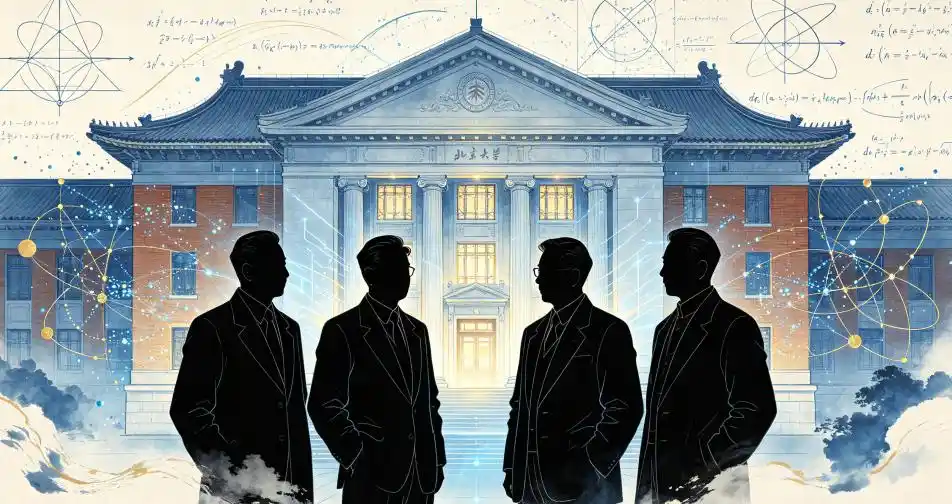
Gold medalists in the National Mathematics Olympiad, from the moment they filled out their college applications, defaulted to Peking University's School of Mathematical Sciences. Dongyi Wei, a two-time IMO gold medalist with perfect scores, being admitted to Peking University was the most natural thing at the time.
Initially, Shing-Tung Yau actually wanted to help Peking University. During his first return to China to give lectures in 1979, he first went to Peking University. Back then, he aimed to help build a world-class mathematics center in China. Gang Tian was a student he recruited domestically during this period, later taking him to Harvard for a Ph.D., becoming one of his most accomplished disciples.
For the next two decades, he shuttled back and forth, establishing mathematics institutes at the Chinese Academy of Sciences and Zhejiang University, donating books and giving lectures at Peking University. Even he assumed the roots of Chinese mathematics would inevitably be planted at Yanyuan.
Around 2000, Yau wanted to establish platforms meeting international standards, opposed academic inbreeding, felt Peking University kept too many of its own graduates, and that academic evaluation was based on seniority.
This conflict erupted completely in 2005, triggering an earthquake in the Chinese mathematics community. Yau publicly criticized Peking University's School of Mathematical Sciences,点名批评 his former doctoral student Gang Tian, whom he personally mentored at Harvard, accusing him of academic misconduct and problematic academic style, even directly stating Peking University's mathematics research center was "forming cliques."
A retired Peking University professor retorted: "Shing-Tung Yau wanted to be the overlord of China's mathematics community but didn't succeed." Mentor and disciple completely fell out, severing ties thereafter. Since then, Yau has never set foot in Peking University's School of Mathematical Sciences again.
In 2009, he directly landed at Tsinghua University, becoming the director of the Yau Mathematical Sciences Center. A detail worth noting: From Yau's first lecture tour in China in 1979, over forty-plus years of lecturing and establishing centers domestically, he has never taken a single cent of salary from China, even donating $1 million of his own money to Tsinghua to cultivate mathematical talent.
In 2010, he personally funded and established the Yau College Student Mathematics Contests, with a format directly对标 the most顶尖 Putnam Competition internationally, several levels more difficult than ordinary domestic undergraduate math contests.
Yau's goal was clear: to build a擂台 he controlled,吸引全国最好的数学苗子 to Tsinghua. To beat Peking University, Yau truly invested heavily.
In 2018, he started the Yau Mathematical Sciences Elite Class, admitting no more than 30 prodigies in their second or third year of high school annually, allowing them to enter Tsinghua without taking the Gaokao. In 2021, he went further, directly establishing the Qiuzhen College, launching the "Mathematical Sciences Leadership Program,"开始捞人 from as early as ninth grade. If your mathematical talent is sufficient, no Zhongkao, no Gaokao needed, an integrated eight-year bachelor's-to-doctorate program, admitting up to 100 students per year, providing the best faculty,全英文教学.
In July 2026, among 94 preparatory class students, 20% were dismissed for failing two core courses, Mathematical Analysis and Advanced Algebra. Over twenty parents protested at the school. Several deputy deans advised him to show leniency, saying it would hurt recruitment next year. He directly retorted: "People scoring 20 or 30 points, keeping them here is a waste of resources."
To beat Peking University, Yau truly went all out, showing no mercy.
But the decades-old foundation of Peking University's School of Mathematical Sciences isn't easily overtaken. 80% of annual National Mathematics Olympiad gold medalists eventually go to Peking University's School of Mathematical Sciences. Take the well-known "Wei God" Dongyi Wei: a two-time IMO gold medalist with perfect scores, a feat few worldwide have achieved. During his undergraduate years, he won awards at the Yau Contests effortlessly. A saying circulated then: "When Wei God competes, others can only vie for second."
After graduation, he directly stayed at the Beijing International Center for Mathematical Research where Gang Tian is director, now becoming a living招牌 for Peking University's School of Mathematical Sciences.
02
Competing for Students, Faculty, AI
The competition between the two schools extends from competing for junior high students, then to competing for faculty, funding, academic resources, and even the currently hottest field of AI mathematics, where sparks are flying.
First, competing for students. Tsinghua's Leadership Program lowered the admission threshold to ninth grade. Peking University immediately followed with its Mathematical Sciences Elite Class, also开始抢高二以前的天才. On the days when CMO (Chinese Mathematical Olympiad) results are released annually, Tsinghua and Peking University admissions staff wait outside the exam halls, surrounding gold medalists immediately, offering conditions on the spot,生怕晚一步被对面抢走.
Many participating students have爆料, just after exiting the exam hall, as Tsinghua teachers finish handing out business cards, Peking University teachers directly pull people into their cars.
Some students are轮番堵在酒店谈 by admissions staff from both sides,从下午谈到后半夜; there have even been admissions teams,为了抢人, directly promising "As long as you come,随便挑 major, we'll add an additional保送名额 to your high school alma mater."
After competing for students, they compete for faculty. In recent years, Tsinghua has recruited many young mathematicians from overseas, offering high salaries,编制, research startup funds. Peking University不甘示弱, relying on its decades-old alumni network, has invited back many top mathematicians who graduated from Peking University.
In 2021, Tsinghua recruited the 40-year-old Fields Medalist Caucher Birkar to the Yau Mathematical Sciences Center. This was the first time a domestic university directly recruited a Fields Medalist still in their academic prime, offering Tsinghua's highest-level待遇. It was like planting a金字招牌 right opposite Peking University.
Additionally, Tsinghua recruited a group of young mathematicians from overseas like Jun Liu, tenured professor of statistics at UPenn, Zhengwei Liu from Vanderbilt University, among whom Zhengwei Liu is also a Peking University undergraduate graduate.
In 2024, Peking University invited Jian Ding, tenured professor at the Wharton School of the University of Pennsylvania, back to the School of Mathematical Sciences as a chair professor. Ding is a Peking University class of '03 undergraduate, winner of the Rollo Davidson Prize, the highest award in probability theory. Tsinghua also offered him a position at the time, but he ultimately chose to return to Yanyuan.
Earlier, Peking University also invited back representatives of the "Golden Generation" like Chenyang Xu, Zhiwei Yun, and Wei Zhang. Although Xu later went to MIT, Peking University's alumni recall strategy has never stopped.
The two sides have even,为了抢一个刚拿了斯隆奖的年轻学者, offered almost identical conditions,最终就看谁跟对方导师的私交更好.
But the most intense new battlefield is currently the hottest field: AI.
Yau once said this: "Without mathematical breakthroughs, large language models will forever be绣花枕头堆参数."
In Yau's view, the reasoning capability bottleneck of current LLMs is essentially a mathematical capability bottleneck. Whoever can first enhance AI's mathematical ability will secure a ticket to the next generation of large models.
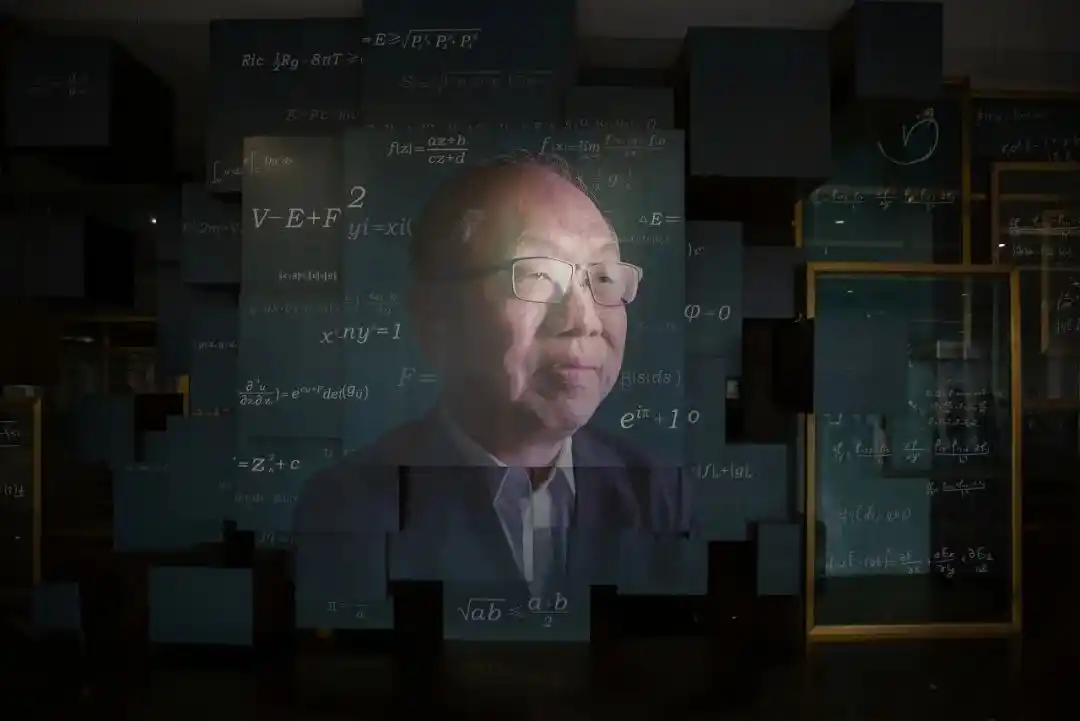
Image source: Visual China
Tsinghua acted fastest on this front. Collaborating with the Tencent Hunyuan team, they developed the STARE algorithm specifically addressing the old problem in LLMs solving math problems where "one wrong intermediate step leads to all subsequent calculations being wasted." On the most authoritative math competition benchmarks AIME24 and AIME25, it directly increased accuracy by 4% to 8%.
The ZhiPu AI developed by Tsinghua's Computer Science Department team led by Jie Tang has always been in the first tier of domestic LLMs in mathematical ability,背后撑着的就是清华数学系的一帮人.
On Peking University's side, collaborating with the Beijing Institute for General Artificial Intelligence, they developed the TongGeometry geometry large model, building the world's largest geometry theorem database,专门攻克IMO里最难的几何题, even capable of discovering new geometry theorems independently.
The core team behind the M3 model released earlier by MiniMax, which can win IMO gold medals, also includes people from Peking University's School of Mathematical Sciences.
At the 2025 WAIC World Artificial Intelligence Conference, Yau personally出题, putting several domestic leading LLMs through a closed-book exam on-site. In the end, the scores remained extremely close, with no clear winner emerging.
03
Ultimately, It's Still About AI
Twenty years ago, Chinese mathematics research couldn't rank globally. Good students went to the US after graduation. Domestically, there wasn't even a decent mathematics research center.
But looking at it now, on the ICCM (International Congress of Chinese Mathematicians) award list, 1/3 of awarded scholars are from mainland China, double the number from a decade ago. Tsinghua's Qiuzhen College and Peking University's School of Mathematical Sciences now annually produce papers published in the top four mathematics journals. Young scholars at the level of Sloan Fellowships emerge several per year.
Yau criticized Peking University harshly back then, but he himself knows clearly that precisely because there is such a strong opponent next door, Tsinghua拼命地建数学中心,拼命地培养学生.
And Peking University, precisely because Tsinghua is biting at its heels, has continuously reformed its training system,抢最好的苗子.
On June 28th, 2026, the award ceremony for the 17th Yau College Student Mathematics Contests was held at Tsinghua University's Meng Minwei Concert Hall. Yau himself stood on stage, with the smartest batch of mathematical geniuses in China seated below.
For the most prestigious individual all-around award, the "Yau Award," the gold went to Peking University's Haojia Shi; silver to Peking University's Junpeng Lu and Huankun Guo; bronze still to Peking University's Yuxing Ye. The top four spots were all taken by Peking University.
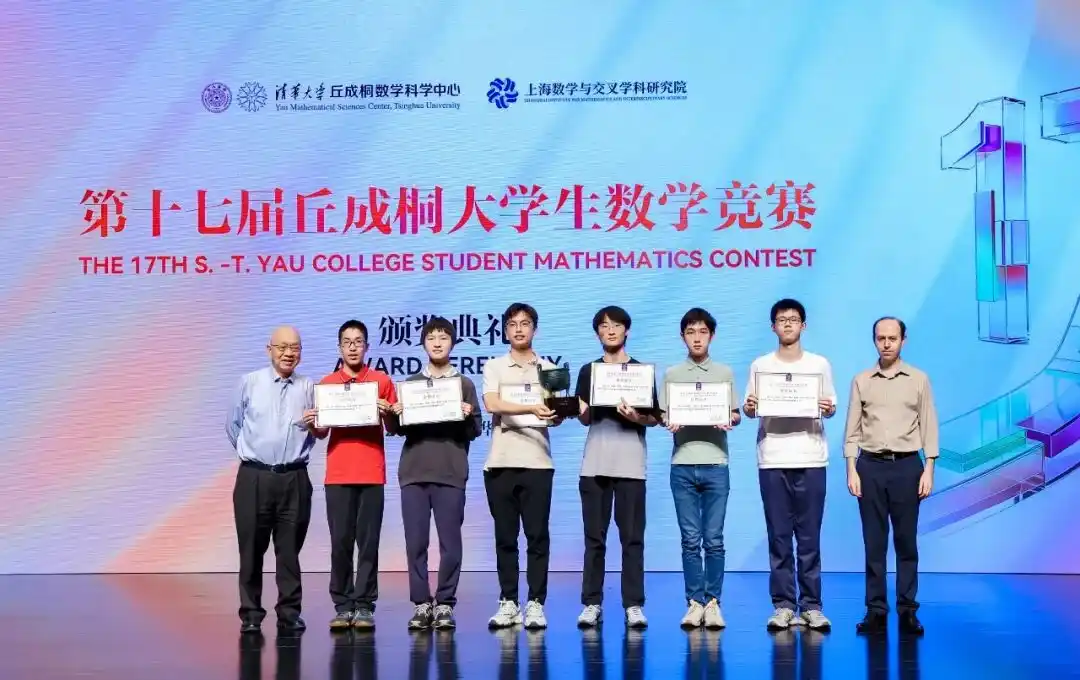
Image source: Tsinghua University官网
Six individual gold awards—Hua Luogeng Award, S.S. Chern Award, Chow Wei-Liang Award, Chia-Chiao Lin Award, Pao-Lu Hsu Award—加上 the all-around award, all went into Peking University's pocket. Even the team gold was jointly awarded to Tsinghua and Peking University.
But when Yau presented awards to Peking University's gold medalists, he was smiling,看不出生气的样子. He even呼吁 in his speech that domestic young students should collaborate across universities to jointly advance Chinese mathematics.
After all these years of rivalry, Yau understands clearly in his heart. What he wanted was never for Tsinghua to dominate alone; he wanted the entire Chinese mathematics community to stand up.
Years ago, he alone came from Hong Kong to the mainland, establishing one mathematics center after another, organizing one competition after another. Ultimately, it was all for one thing: for China to produce true mathematicians, to have its own Fields Medalists.
For over forty years, he hasn't taken a single cent of domestic salary,掏腰包办比赛、设奖学金, all for this one goal.
On July 20th, an Anthropic researcher, while watching the World Cup final, let the Fable 5 model compute for several hours, finally posting three lines of simple polynomials that directly推翻 the 87-year-old Jacobian conjecture, on which countless mathematicians had spent their lifetimes.
Yitang Zhang's doctoral thesis, stalled for seven years, was precisely in this direction.
To be fair, on the new battlefield combining AI and mathematics, it's Tsinghua that is ahead.
Currently, half of the first tier of domestic large models are Tsinghua-affiliated. For example, the aforementioned Jie Tang,以及他当年最得意的学生 Zilin Yang who founded Moonshot AI's Kimi. The latest K3 model's mathematical ability is already on par with Fable 5 and GPT-5.6 Sol, one of the best数学成绩 among current domestic models.
Peking University当然也不是没人做. But Peking University's teams are mostly偏纯学术研究, haven't produced commercially viable large models as competitive as ZhiPu and Kimi. In terms of industrial落地 and public recognition, they确实比清华差了一截.
Terence Tao foresaw this change in a speech at Stanford three months ago.
He said mathematics has moved from an era of "proof scarcity" to an era of "proof surplus." AI can generate dozens of top-journal-level proofs per day, an output速度 faster than human mathematicians can read and verify. He has already stopped trying to keep up with all newly published papers because it's simply impossible.
In fact, just over a year ago, Tao was still criticizing AI as too "dumb," getting 8 out of 10 problems wrong.
Decades of rivalry between Tsinghua and Peking University suddenly seem lighter in the face of AI. Regardless of who wins more gold medals, who recruits more professors, ultimately, they must stand on the same new starting line. The era of AI主导数学研究 has arrived. This is the future all mathematicians truly face.
This article is from the WeChat public account "字母AI," author: Miao Zheng, editor: Wang Jing