"Whenever I want to reset, I can reset anytime"
Just now, Cyber Godfather, aka the God of Codex Reset Quotas, Tibo confidently stated this in the latest episode of his podcast with Matthew Berman~
And the most impressive part is that for resets, Tibo has specially created a physical button.
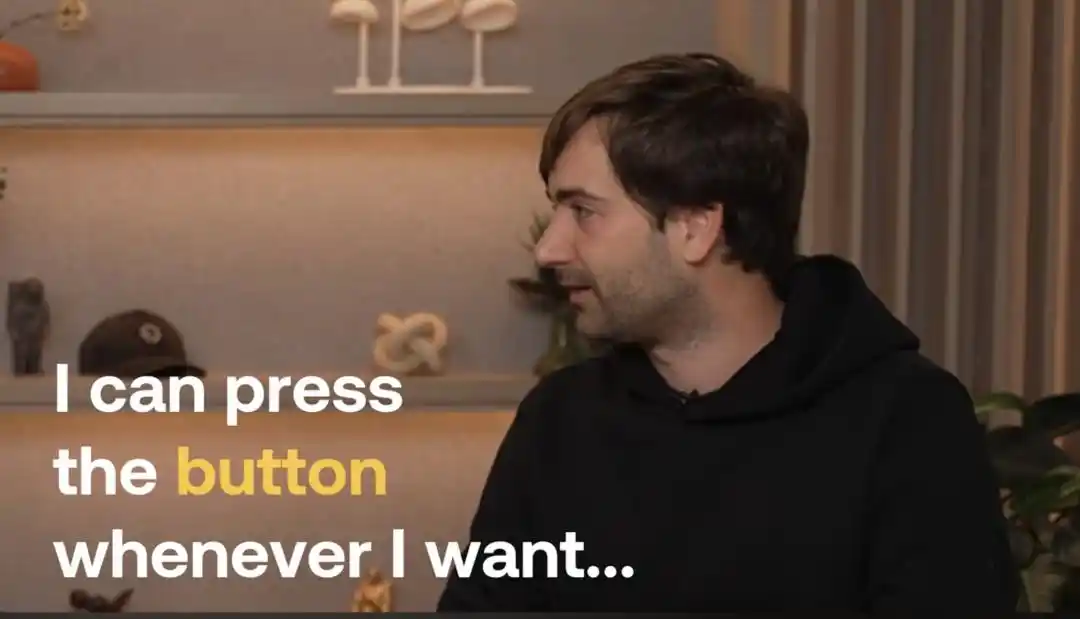
As the current head of Codex, besides explaining how to distribute benefits to everyone, Tibo also gave a detailed review of his previous career at Google in this podcast episode and revealed some important current work at OpenAI.
This is a rare opportunity for the outside world to get a deep understanding of this new product head at OpenAI.
From OpenAI's product culture, the next generation of Agents, GPT Ultra Fast mode, to future human-computer interaction, and OpenAI's pause on cutting-edge model training, RSI, almost everything was covered, nothing was off-limits...
Tibo's core viewpoints are as follows:
- ChatGPT and Codex will ultimately merge. In the future, there won't be two separate products, a "programming Agent" and a "chat assistant." Instead, there will be the same highly personalized AGI, automatically adjusting its interface based on individual tasks, abilities, and habits.
- The core of the next-generation Agent is not adding more Skills, Memory, or sub-Agents, but making these mechanisms "disappear." What users truly want is a partner that continuously understands them, their goals, their daily life, and their team's context, rather than constantly managing skill files, memories, and Agent networks.
- Laptops will become a new bottleneck for AI Agents. The next-generation Agent will naturally move towards the cloud and larger-scale computational resources.
- Running 10~15 Agents concurrently today is a way to compensate for slow models; once Ultra Fast reduces response time to near-human thinking speed, workflows will return to real-time interaction and "flow," instead of constantly switching contexts.
- Competition is not the focus. OpenAI's differentiating narrative compared to Anthropic is not simply "having a stronger model," but "giving the strongest capabilities to as many people as possible." OpenAI emphasizes broad distribution, community participation, and lowering barriers to use, which is also an important reason for merging Codex into ChatGPT.
- OpenAI is already practically using "recursive self-improvement." This goes beyond having models study models; it includes using the strongest models to optimize CUDA kernels, inference stacks, and infrastructure, creating a "stronger models → higher efficiency → more compute → stronger models" flywheel.
(Tibo's full name is Thibault Sottiaux, from Belgium. He studied applied mathematics for his undergraduate degree at UCLouvain. In 2015, he joined Google, initially working on Google Maps-related projects, then moved to Google DeepMind, where he was responsible for AI research infrastructure and supported cutting-edge AI projects including AlphaGo. In 2024, he joined OpenAI to lead the Codex project. With the AI coding wave taking off, Codex quickly became one of OpenAI's fastest-growing products, bringing Tibo into the developer community's spotlight. Because he often personally responds to user feedback and helps developers reset Codex usage quotas, netizens respectfully call him the "Cyber Godfather.")
Here is the full, edited transcript of the conversation:
Experience at Google and DeepMind
Host: Great, I'm really looking forward to chatting with you. I want to start with your experience at Google. You were on the DeepMind team at that time. Before ChatGPT came out, Google had something called LM Chat.
You once posted that Google was too nervous to release it; DeepMind was also prevented from launching products that might disrupt Google. I think about that a lot. You were working on those products back then, and that was long before ChatGPT truly changed the world. What was your thinking at the time?
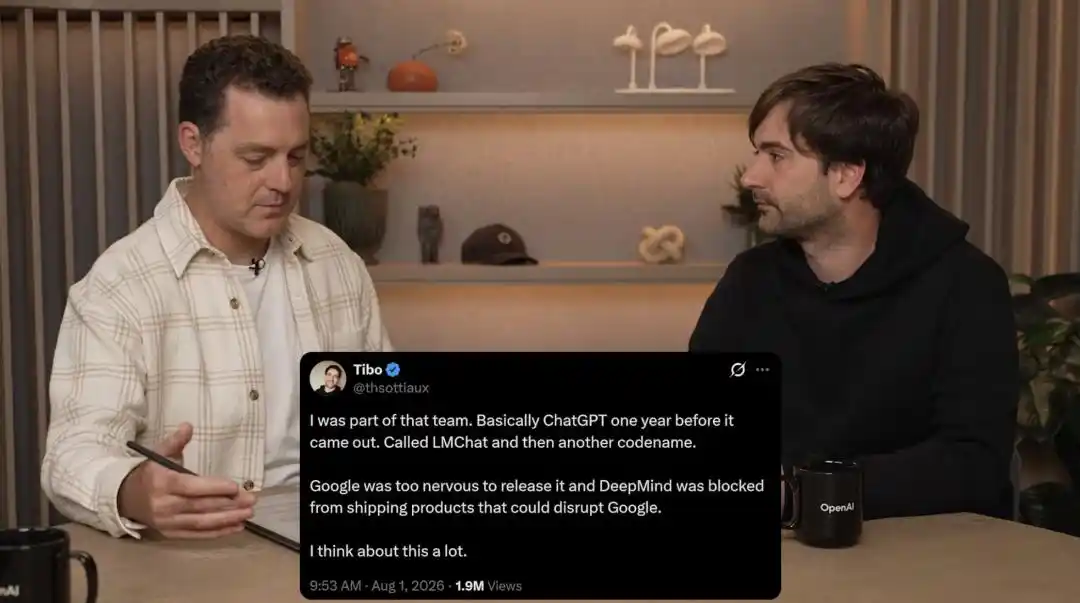
Tibo: It was a very exciting period. DeepMind was a very creative place.
My personal expertise is building infrastructure and products to accelerate research. There was a team working on language models and their scaling.
Later, they had achieved quite good results, so it was natural to think: Could this be turned into a product that can converse with you and be used for various things?
So ideas like LM Chat naturally emerged. It started as an internal project, and then the vision of making it a tool open to the public arose.
Host: What year was that?
Tibo: About a year before ChatGPT came out.
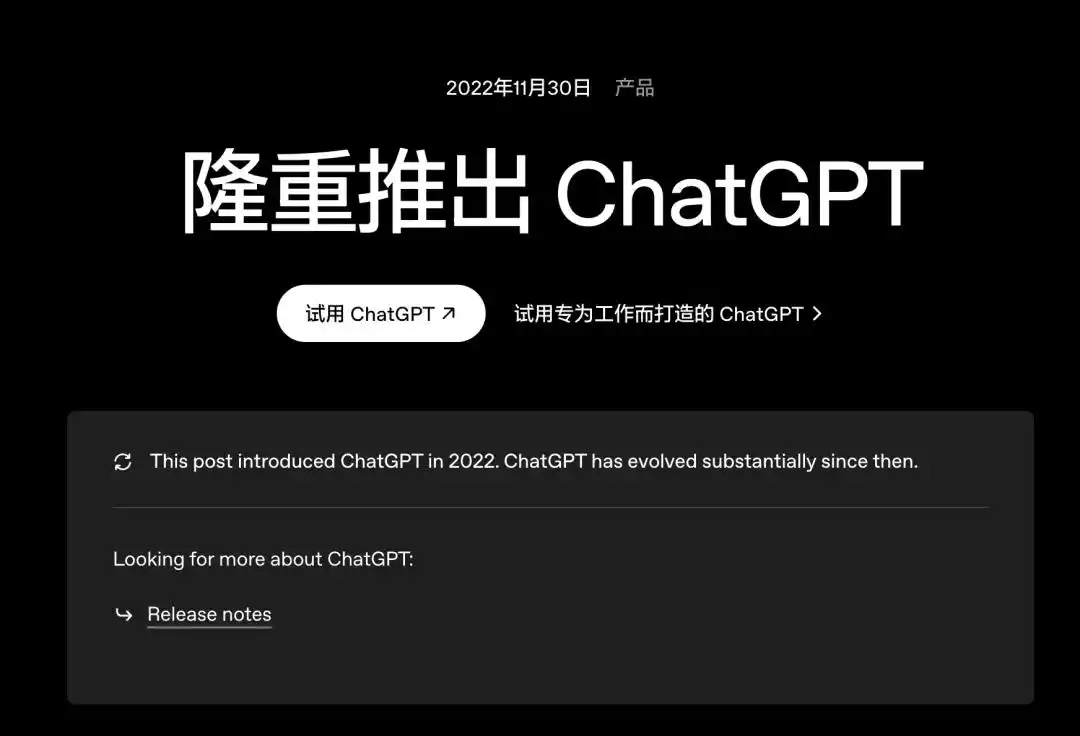
Tibo: We were also working on various other projects, which I won't go into. It was indeed a very creative place. It's just that DeepMind wasn't an organization designed to ship products.
In contrast, OpenAI is very different in this regard. Our research and product teams now collaborate extremely closely.
We brainstorm together and co-design many things. We are very inclined to ship products and very inclined to let people use them. I love that. That's also what attracted me here: the mission, the talent, and the talent density. There are so many great things about OpenAI.
Host: When you were involved with LM Chat back then, did you already know it was special, or that it would become special?
Tibo: It definitely felt very special. That kind of model made you realize for the first time: It can generate coherent text and provide some help. At first, it was just fun, and later it gradually became more and more useful.

Host: You said you often think about it, and I can understand that. I think Google tripped over its own feet in many ways. What lessons did you learn there that you've brought to OpenAI?
Tibo: Yes, that's why I often think about it. I think about it from the perspective of team culture and OpenAI's overall culture: What good parts to keep, and what not to do.
OpenAI's culture is very bottom-up and empowering. People can propose all sorts of ideas, get together, and ship things very quickly. For new product ideas, there's almost no resistance overall. That's very inspiring and fun; it's all about positively impacting the world. Keeping that is very important to me.
Another equally important thing is not letting it become a mess, right? You don't want to end up with a pile of features without overall direction and consistency. Therefore, it also needs to be balanced with a sense of simplicity and pride in product quality.
I think the ChatGPT iOS app is one of the best apps on the market. We want to maintain that. We invest a lot in delight, performance, efficiency, and simplicity. Those are overarching principles, while still empowering everyone to try new things and deliver quickly.
Building OpenAI's Culture
Host: If you were to give advice to founders on cultivating such a culture, what are some more specific elements or practices within OpenAI that you would recommend they emulate?
Tibo: I think, to have strong conviction; and to find a way to stay close to users while iterating quickly based on feedback. Also, be willing to disrupt yourself. This might not be as directly relevant for founders, but it is very relevant for a company like OpenAI.
We constantly have new research, new ideas; being able to judge when to invest in them, even if it means potentially reallocating resources from the main business, is extremely important. It's difficult, but really important.
Host: Exactly. That's precisely what you described Google failing to do earlier.

Tibo: To be fair, they had plans, but everything was part of a larger plan. For me, that wasn't the right place.
Host: As OpenAI or any company matures, does maintaining that culture of fast shipping and willingness to self-disrupt become more difficult? Especially when you already have a big cash cow and, on the other side, there's a potentially cool, innovative new thing.
Tibo: We are very future-oriented. The future of AI, what it will ultimately be, how humanity benefits from it, doesn't stop or care about what you've built in the next month or three months.
Therefore, I think it's very important to be fully committed and keep an open mind about where it's going, then figure out how to position yourself to make sure you can catch that wave.
Even for OpenAI it's like that: We train models and then discover their capabilities. Benchmarks don't tell you everything.
We have to spend a lot of time ourselves trying the models to realize: Oh, maybe we hadn't thought about using it to benefit in this specific way before, or, Oh, it can actually do this.
So that changes how we think about the product. For example now, we launched new voice features, which are very delightful and natural to communicate with. It can also use tools.

That changes a lot. Now I spend more time talking to it directly. Another thing I've been doing is voice dictation because the quality of dictation is very, very good; it's much more efficient than typing prompts.
So in the morning, I'll sit there with my phone and say a long paragraph: "Have ChatGPT do a few things..." and then it goes and does them; it has access to all my tools. And that wasn't possible before we had a truly great voice model. So it suddenly completely changes how you think about the product.
The Future of AI Agents
Host: Okay, let's continue talking about new models, new harnesses. A few weeks ago, I also want to start with another great post you made: "Codex will seem primitive in two to three months. We're about to go through another major evolution. The next generation of models needs more than just your laptop." So, starting with the harness. As models get stronger, which aspects of the harness still have a lot of room for innovation?
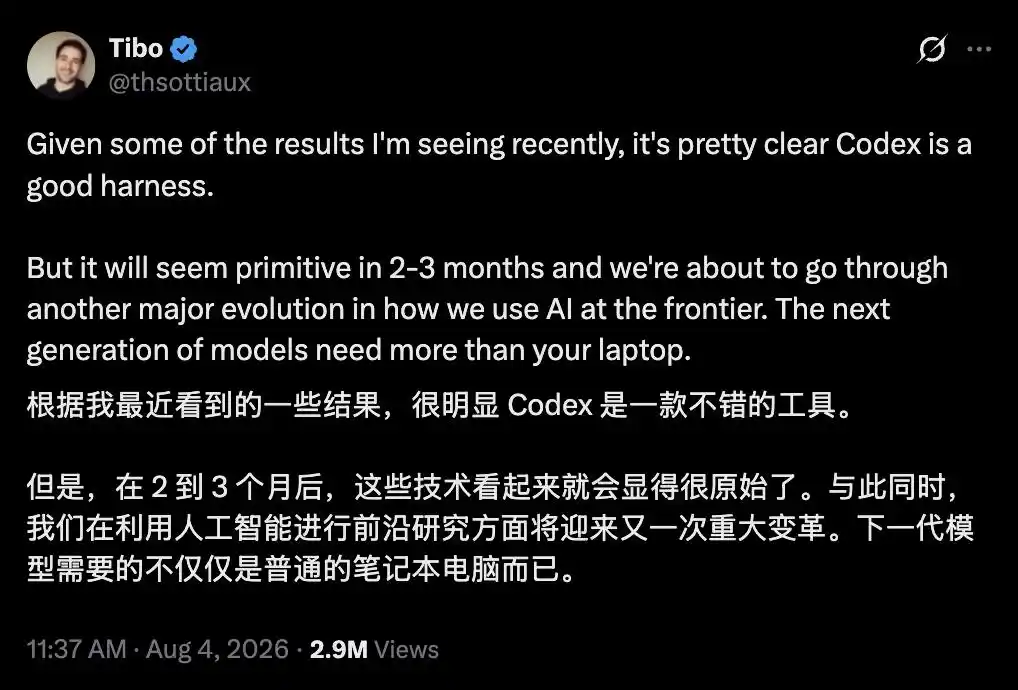
Tibo: So many, really so many. Like I said earlier about voice. Now, if you're a power user of Codex or other programming agents, you're already a bit accustomed to that feeling of it not being smooth, right?
You have to manage skill files; that's a way to teach it things, but I think many people also realize these files are quite difficult to maintain long-term. Memory is also a problem: It doesn't always remember everything; if you have sub-agents, you have to worry about them and build a small network. At every point in interacting with it, the illusion that "it's a complete partner" breaks.
What you really want is something that deeply understands you, understands your goals, understands your daily life, and understands what your team is doing. Ideally, it can also react, take initiative, help in your daily routine, and not break that illusion: It's just that perfect little buddy next to you. That's exactly what we're working towards.
Another thing is, when you have very, very powerful models, you find that the laptop itself becomes a limitation. The amount of work a laptop can handle is designed for humans.
It's roughly designed to accommodate the amount of work you can produce, your typing and thinking speed, how many applications you need open at once—these are human limitations.
Models don't have the same limitations. For example, a model might be able to handle 100 open applications simultaneously in the future, completely fine. So, from a resource access perspective, clearly, future models will need resources beyond what a single laptop can provide.
Host: You mean, I guess, cloud-based agents? And once we have the Ultra Fast we'll talk about later, with token speeds reportedly 10 to 14 times faster than Fast, bandwidth constraints will change. CPU will become the bandwidth; literally, tool calls, network, any tool, and any overhead in the tech stack will become the limiting factor.
Tibo: However, you can also compensate by doing many things concurrently. You can explore, write tests, compile, and verify a new hypothesis all at the same time. So you keep moving the bottleneck because you can handle more things concurrently, and the model can think and progress very efficiently and very quickly.
Host: At current token speeds, I find myself launching 10 to 15 agents in parallel, which creates a significant cognitive burden for me: constantly switching contexts, constantly launching them, and you can expect a task to return only after 30 to 45 minutes.
Now with Ultra Fast, this workflow will change significantly; I imagine I won't launch 10 or 15 agents simultaneously anymore, which might be a good thing. Maybe only three or four at a time. How do you think the independent developer's workflow will change over time?
Tibo: I think managing your attention and making the experience more attuned to your attention is something we care a lot about.
How AI Changes Developer Workflows
Tibo: After all, we are building products for humans. We want to build technology that empowers humans the most, which requires designing around your multitasking abilities: How do you want to manage attention? Should something be presented to you now, or is it better in 30 minutes?
And when Ultra Fast speed combines with voice, you suddenly feel: Okay, this thing can operate at my speed, or even faster.
Then you can stay in flow, keep brainstorming, see prototypes, generate small reports in real-time, that feels really good. You suddenly think: Yes, that previous way of multitasking with 10 agents, I don't really want to go back to that.
So we're trying to bring that very natural, yet seemingly tailor-made experience for you, where you don't have to adapt to it, but the technology adapts to you.
Host: In the past few months, there's been a lot of discussion about agentic programming techniques. Loops were popular, still are; now I hear about graphs. Are these techniques all about enabling independent developers to manage attention, or be more attention-friendly as you said? I like that term.
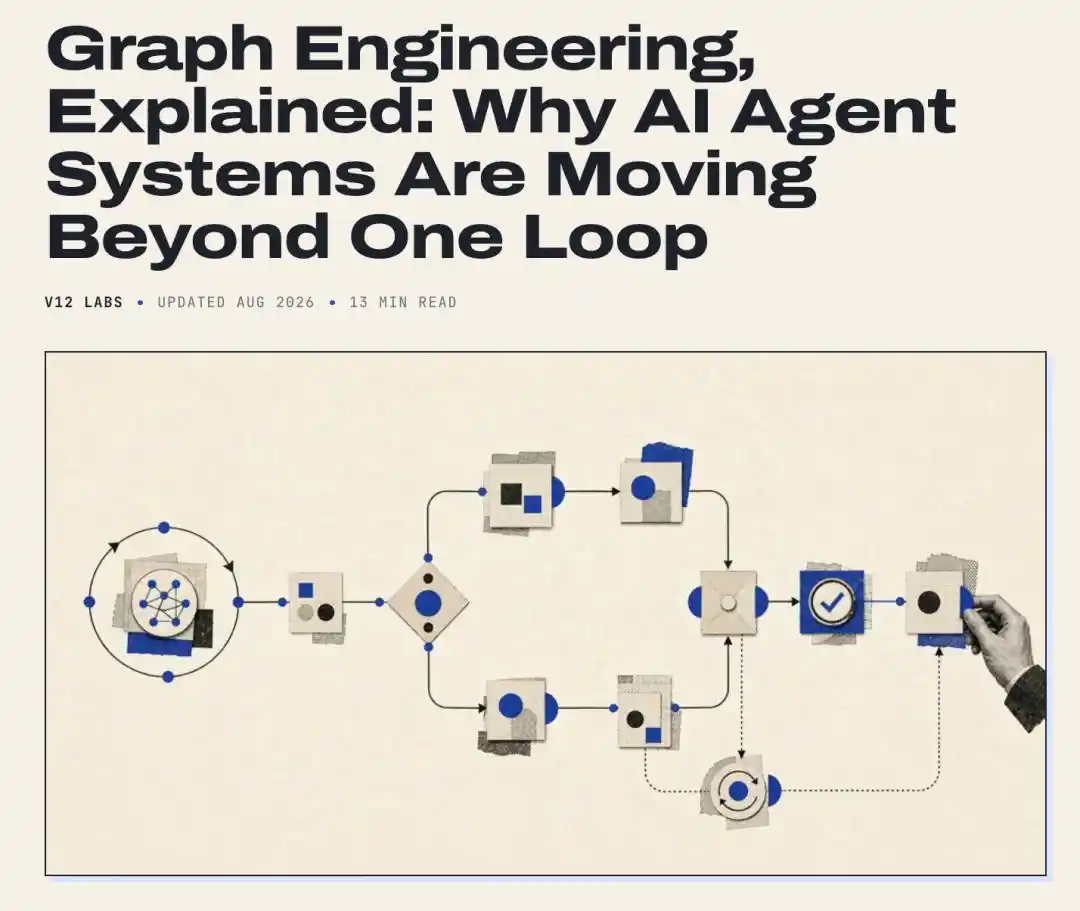
Tibo: I would separate the problems into two categories. The first category is building the best personal AGI, or personal agent: It can be in flow with you, proactively come up with important new ideas; and once it finds an opportunity, execute on your intent very efficiently.
Whether it's technical problems, research, suggestions, or anything like that, it can do it, and be highly attuned to you. This is very important, deeply rooted in understanding you as a human, as a unique individual. We're pushing that category hard.
The other category is full automation: You're more building intelligent systems to take over a very complex process. Maybe such a process needs, or once needed intelligence and appears very complex.
For example, looking at production logs and automatically doing performance optimization, or automatically fixing a regression after discovery. We also see this trend in cybersecurity:
When a scanner finds a vulnerability, can it automatically patch it and reduce the exposure window to almost zero, without human involvement in those loops, or with minimal involvement; you only approve high-risk actions, the system is mostly automated. Then you also don't need to maintain such direct control over it.
Host: Got it.
The Merger of ChatGPT and Codex
Host: So, I want to change the topic a bit. For the past few months, ChatGPT and Codex have been on a path of merging.
My first question is: How is that going? What's it like internally? What feedback have you received from users?
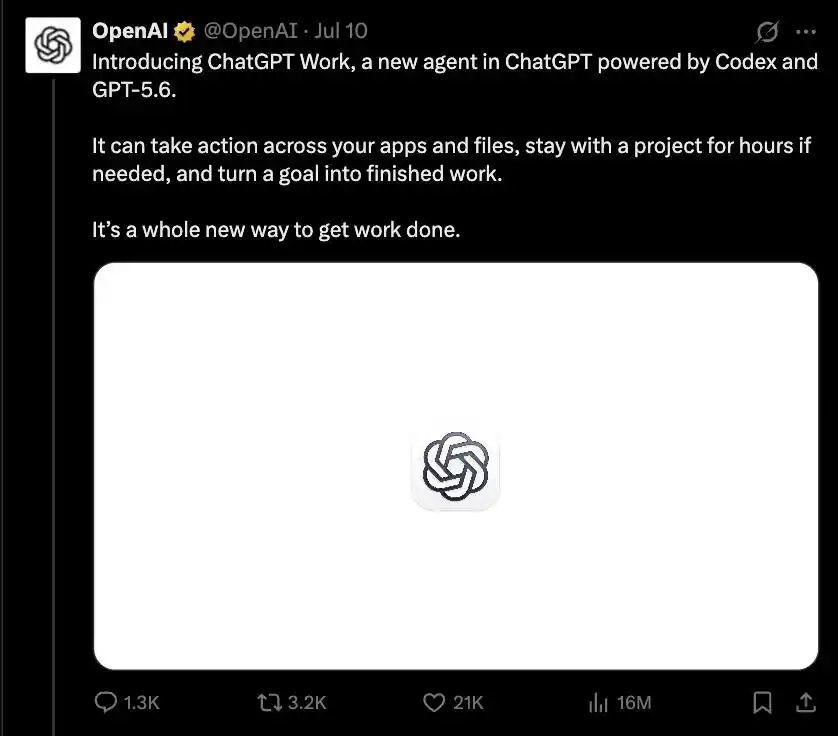
Tibo: It has indeed been a big help. Initially, the feedback we received was: "Why merge them? Is it really necessary?" But future models require us to merge them.
So, we will do it because it's the simplest and most correct way to build that highly personalized, super capable agent that can help you in all sorts of ways.
The underlying technology will be the same: the same harness, the same mindset. It will be highly multimodal, voice-first, extremely efficient; it doesn't matter if you're programming or not. This agent can do anything and is extremely efficient.
The interface you want should adapt to your needs. You shouldn't first decide "I'm a programmer, so I want a programmer interface," or "I'm non-technical, so I want a non-technical interface."
People exist on a continuum; labels like software engineer, designer, etc., are just human concepts we created to cope with an overly complex reality.
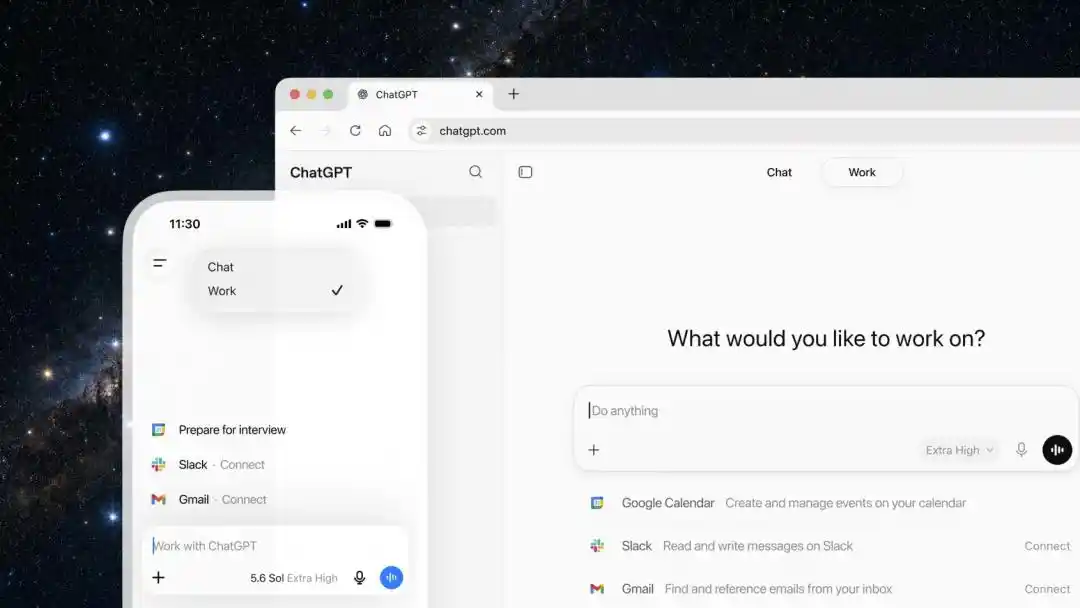
Because ultimately, everyone is at different points on that spectrum. So we need to build a perfect interface that adapts to each person. Whether you're technical or not, it will adjust to your specific personality. That's why we're doing this.
Host: However, does this mean it will inevitably become a unified interface? No more dropdowns for people to choose different products? Thinking about my mom possibly using the exact same interface as me is indeed incredible.
Of course, it will customize to my needs. If I'm doing more complex work, I might need more information. But for you, what's the final form?
Tibo: Exactly, it's the same thing. You and your mom will use the same thing. It will be your respective personal AGIs. You will have very different tasks, derive different utility from it, and connect it to different tools in your life, bringing different ideas and needs. Then it will continuously adjust itself to benefit you as much as possible. It will serve your friends and everyone else in the same way.
The Future of Human-Computer Interaction
Host: I want to come back to something you said earlier. You used the word "illusion" several times when describing the end state. For the average user, what is that perfect "illusion"? If you imagine a few years from now, what will interaction between AI and humans look like?
Tibo: For me, it will be something extremely attuned to humans. That's also why large language models succeeded: They use natural language. Natural language is a human concept, right? We're used to talking to each other. If you wrote me a letter tomorrow, I could read it. We already know each other quite well. So, if you wrote me a letter, I could also interpret a bit of emotion, maybe a bit of nuance between the lines. All of this is deeply rooted in humanity.
Therefore, the technology we're building is rooted in humans and in the human way of communicating and getting things done. It shouldn't make you say: "Oh, you misunderstood me because you didn't fully read the nuance in my tone, or didn't fully understand what I really meant in the text."
That's exactly what we're trying to avoid. So, we work very hard not to make you adapt to the technology, but to have the technology crafted to be just right, a natural extension of how humans originally operate in the world.
Host: I think about communication between people, a lot of which is non-verbal. Like how I gesture, facial movements. To what extent do you think AI will perceive or read this information visually in the future?
Is that important? Because what you're describing now seems to be just text. For those of us who grew up on the internet, we're very accustomed to communicating through text and adding subtle variations to convey the tone we really mean. However, will it still be necessary for AI to read our facial expressions, gestures, etc.?
Tibo: I think it's necessary. When I think about the future we're building, it will be very ambient and very natural.
For example, tomorrow, or later, I go to the office, write something on a whiteboard, generate an idea; it should also be there, understanding all of that. Or I say to it: "Hey, what do you think about this?" and we talk naturally via voice. Since we launched the new ChatGPT voice features, it's really taken off quickly. The number of users interacting with ChatGPT solely via voice is now growing rapidly.
I think the lesson here is: Every time you move towards a more natural direction, humans choose the path of least resistance. As you said, typing in a small box might be natural for some, but not for everyone. And once there's a way that's a little easier, a little better, people tend to use it.
OpenAI and Anthropic
Host: Good. First, congratulations, I saw your post this morning saying Codex has reached 20 million users. I saw that graph, it started like this, then suddenly shot up vertically. Congratulations.
I want to talk about competition with Anthropic because many people see OpenAI and Anthropic as the two main competitors in the industry right now. There was a time when Anthropic arguably absorbed everyone's attention, right? They were dominant then, and then suddenly things changed. First, what's your view of the market today?
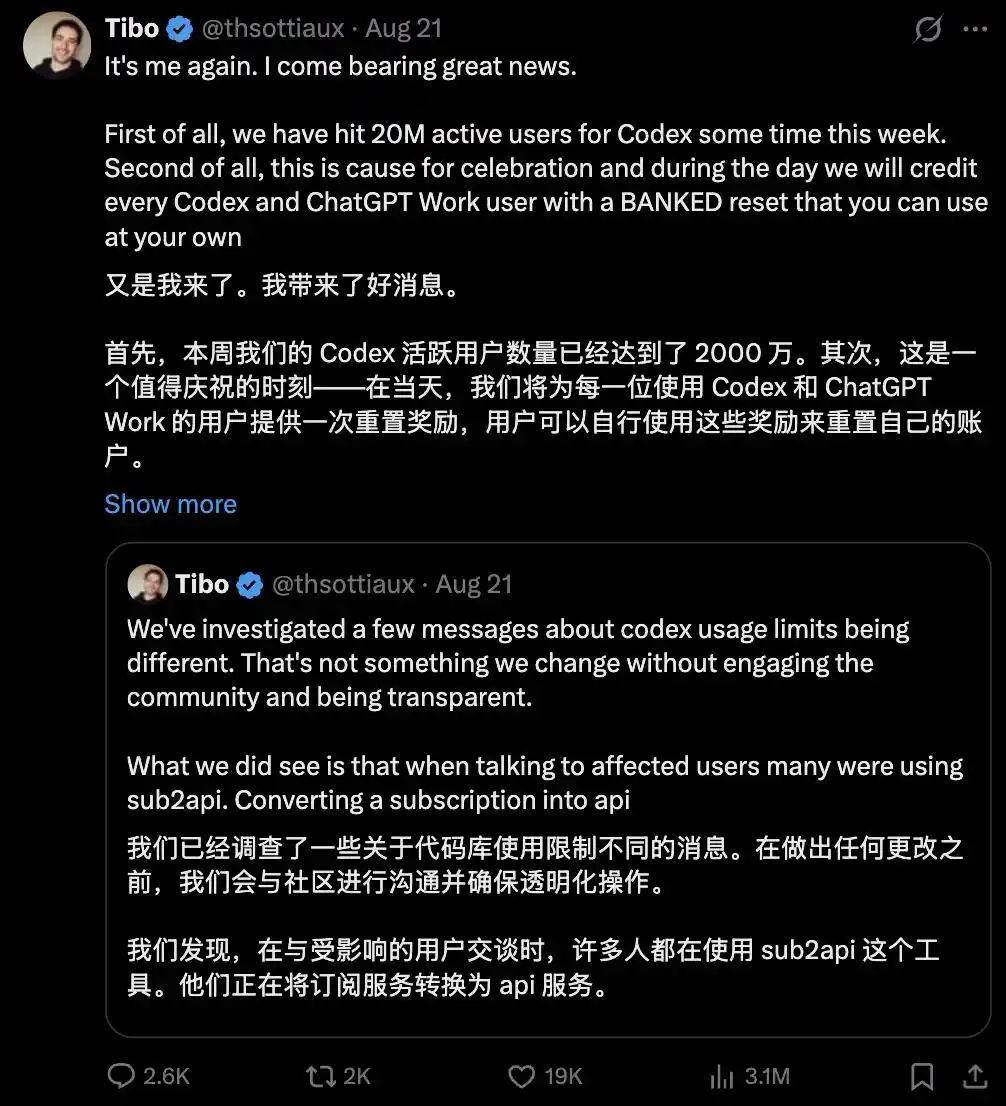
Tibo: Right now, what we're really focused on is building the most capable models, building highly efficient models, and taking pride in building products for everyone. I think one thing OpenAI does particularly well is caring about the world and caring about how we get this incredibly powerful technology into the hands of as many people as possible. That's also what we did when merging Codex and ChatGPT.
We want: Since we have this technology, make it safer and easier for everyone to use. Whether you're a product manager, designer, or in sales, marketing, PR, etc., you should be able to use its full capabilities. Then, we distribute it quickly via ChatGPT because there are already many users there. That also drove the rapid growth you mentioned.
I don't usually pay much attention to competitors; what I really focus on is: What can we uniquely do well, what are our values, and how can we move fastest in that direction.
Host: Understood. I want to dig a little deeper. I know you don't think much about Anthropic, but many others do: Which product do I believe in? Which product am I willing to pay $2200 for? From the perspective of OpenAI's market positioning, branding, tone, and how it interacts with developers and a broader audience, how do you feel that compares to Anthropic's approach?
Tibo: Again I'd say, I care a lot about building community for the world, bringing everyone along. I think you can feel that in how we do things: For example, we're very transparent about many things and draw many ideas from the community. Honestly, it's also very fun because we also gain a lot of energy from it.
**And the technology we're building is not just for ourselves; it's not just to accelerate OpenAI. It's very important. The mission is very important, so that's also where we derive energy. In my view, this is very grounded and fun; then good things follow.
Host: So let's talk about those good things. I want to talk about resets...
Why OpenAI Continuously Resets Quotas
Host: I know, everyone seems to watch your every tweet. Back to Codex's growth curve: This question might be a bit silly, but how much of these "resets" are boosting marketing and growth, and how much is just goodwill towards the developer community?
Tibo: I think it might be somewhat counterintuitive, but OpenAI is a place where you can just get things done directly. So initially, as we iterated and occasionally broke things, or when some configuration didn't meet expectations, providing compensation felt natural.
Our thinking at the time was: Thank you for trying this product. We know we're working very hard to get it right; it's still early. Since we happened to break it for about 30 minutes, we'll give you some more usage quota. We understand it's important, and we know you rely on it; thank you for being a user. That's where it all started.
I still view it that way: If we break it, or the experience isn't ideal and we haven't fully understood the cause yet, we compensate users. We reset usage limits. Later it obviously evolved into something quite noticed—now there's even a dedicated reset button.

And there's not much bureaucracy behind it. It's not coordinated with marketing or finance teams; whenever I want to press it, I can press that button. Our principle is: We want to build something amazing; when it doesn't, we make up for it.
Host: I still think it has accumulated a lot of goodwill in the community and driven growth to some extent at least. Really caring about users is important, right? You can say you care, or you can actually care: If we mess up, sorry; this is how we make up for it.
It reminds me of Amazon's return policy: If you're not satisfied for any reason, just return it. You seem to be building the same culture, the same perception for OpenAI: If we make a mistake, use those tokens again, or we'll give you a new batch of tokens.
Tibo: I appreciate you saying that. There are also good moments worth celebrating, worth marking. We're always releasing new features and rolling them out as broadly as possible; but there's no better way to share something meaningful with the entire community: Go explore this new feature. For example, if you haven't used Ultra Fast yet, here's some extra quota, try it.

Host: I heard there's actually a physical button now?
Tibo: Yes, there is.
Host: Okay, you have to show me later.
Tibo: I'll show you, it's really cool.
Host: But to do so many resets, it's obviously only possible if you've done a lot of compute capacity planning.
AI Efficiency and Compute
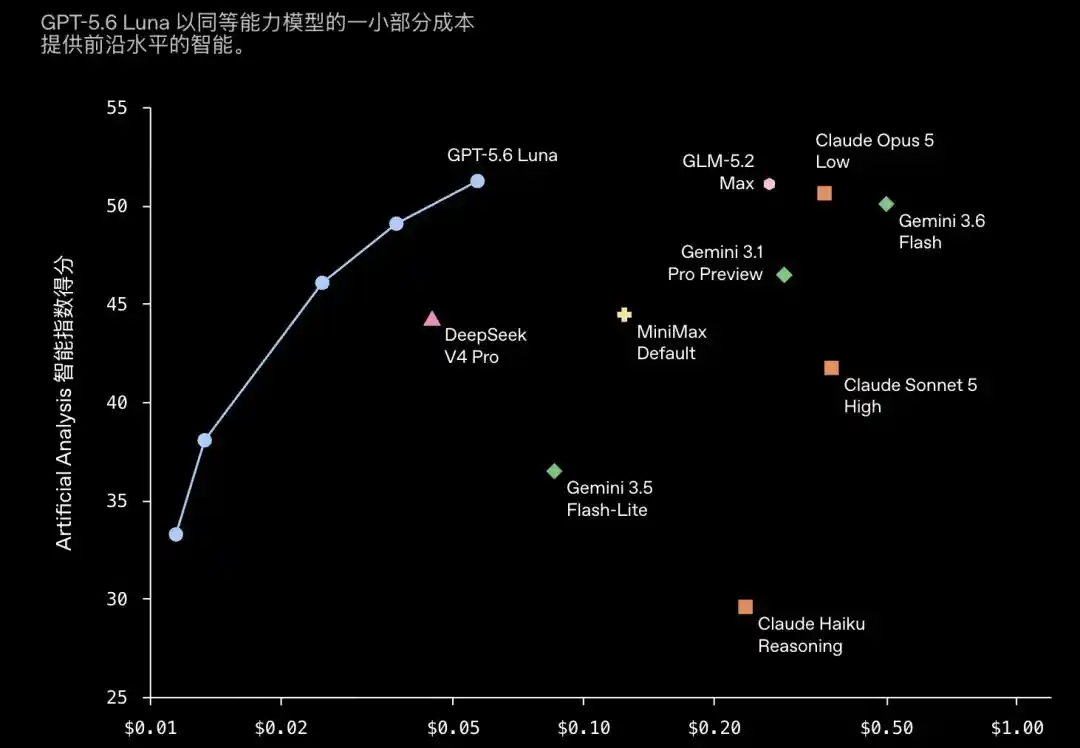
Host: You must have enough compute to support all these resets. I want to use this to talk about self-improvement: A few weeks ago—I think it was a few weeks ago—you released an article saying Sol optimized Luna's efficiency. You reduced Luna's price by 80%; Terra's price also decreased. In Luna's price reduction, how much came from real, dug-out efficiency gains? And how much was because you did good compute capacity planning, have good margins, so you can lower prices and let more people use it? In other words, what's the split between algorithmic advancement and strategic planning?
Tibo: We started planning compute quite early. Looking back two years, I think OpenAI was questioned for investing so much in compute back then.
Host: That was a crazy and brilliant bet.
Tibo: Yes. Now we're glad to have that compute. A large part of it is used for research, investing in our future, better and better models, and the efficiency of existing models.
And one amazing thing happening is: As we push the frontier of the most advanced models, we can use those models to figure out very quickly how to serve, how to refactor or re-engineer the entire tech stack, achieving extremely significant efficiency or performance gains. We're not just improving cost efficiency—we'll publish related content—but also speed efficiency.
Ultra Fast aside, overall speed has been increasing significantly. If you chart it, you'd find current speed is about 60% faster than three months ago. We're tackling each part of the tech stack one by one, ensuring they're optimally designed and engineered for our workloads. And our most powerful models are key to enabling a small team to do this work.
So, whenever we achieve very significant efficiency gains, especially cost efficiency gains, our commitment is: Keep performance and cost at the frontier. We don't just pocket the gains; we share them with customers and users; that's what we did with Luna.
Host: Internally, when you need to allocate compute between new model research, efficiency improvements for existing models, and inference, what do discussions typically look like? What is that tension like?
Tibo: We usually reason from first principles. We allocate a portion for research, a portion for products; within products, make different trade-offs. But this time there's almost no trade-off because the efficiency gains have already been achieved. So we can basically support very significant throughput growth with the same compute scale.
Recursive Self-Improvement
Host: A few months ago, before that price reduction article, I saw a blog saying a model was training the next model, or helping optimize the next model. Then I saw Sol examining how Luna runs and achieving these efficiency gains. To me, this seems like recursive self-improvement is still at a very early stage. What's your take? Is this what's happening?
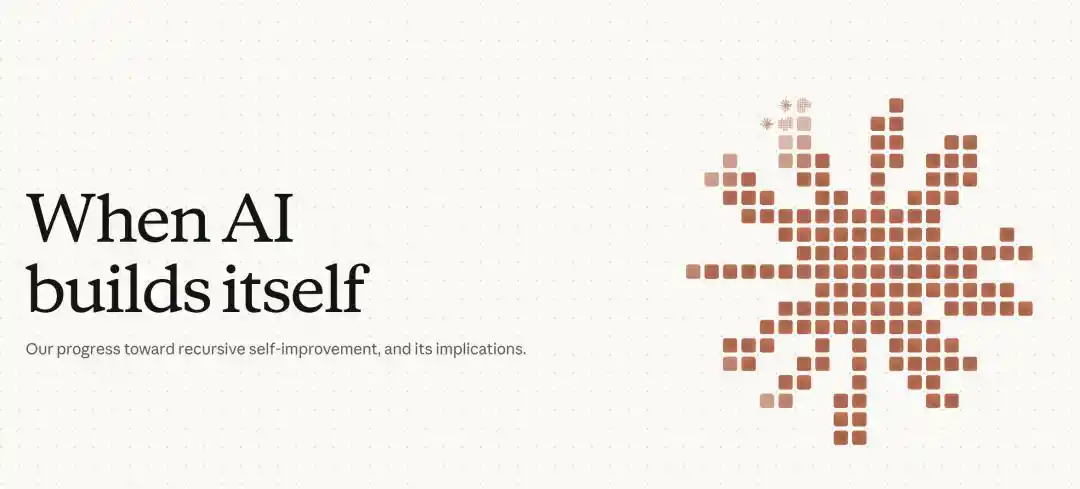
Tibo: Yes, I think recursive self-improvement is clearly a big topic right now. People most commonly apply it to research, e.g., having models develop other models.
But where we see a lot of success is: Using these models to develop the infrastructure that supports model use and is on the critical path; that's also a form of recursive self-improvement. They are part of a large system, including the inference tech stack, lower-level, harder-to-optimize kernels—the CUDA kernels we use; also includes developing more efficient new products and new ways to interact with models.
You mentioned cloud agents. If we truly crack cloud agents, humans themselves will immediately become more productive. Is that recursive self-improvement? Because you'll be more capable of deriving utility from them. I think in a sense yes, but it's more about infrastructure and being able to turn that capability back on itself.
Of course, we're doing this; I think it would be unwise not to.
Pausing Cutting-Edge AI Training
Host: Since we're talking about recursive self-improvement, I want to ask: I remember OpenAI's Sam Altman said the most cutting-edge RL training is currently paused. Can you talk about that? How was that decision made? I know we briefly talked about the Hugging Face incident, but what considerations went into this decision? How did the discussion go?
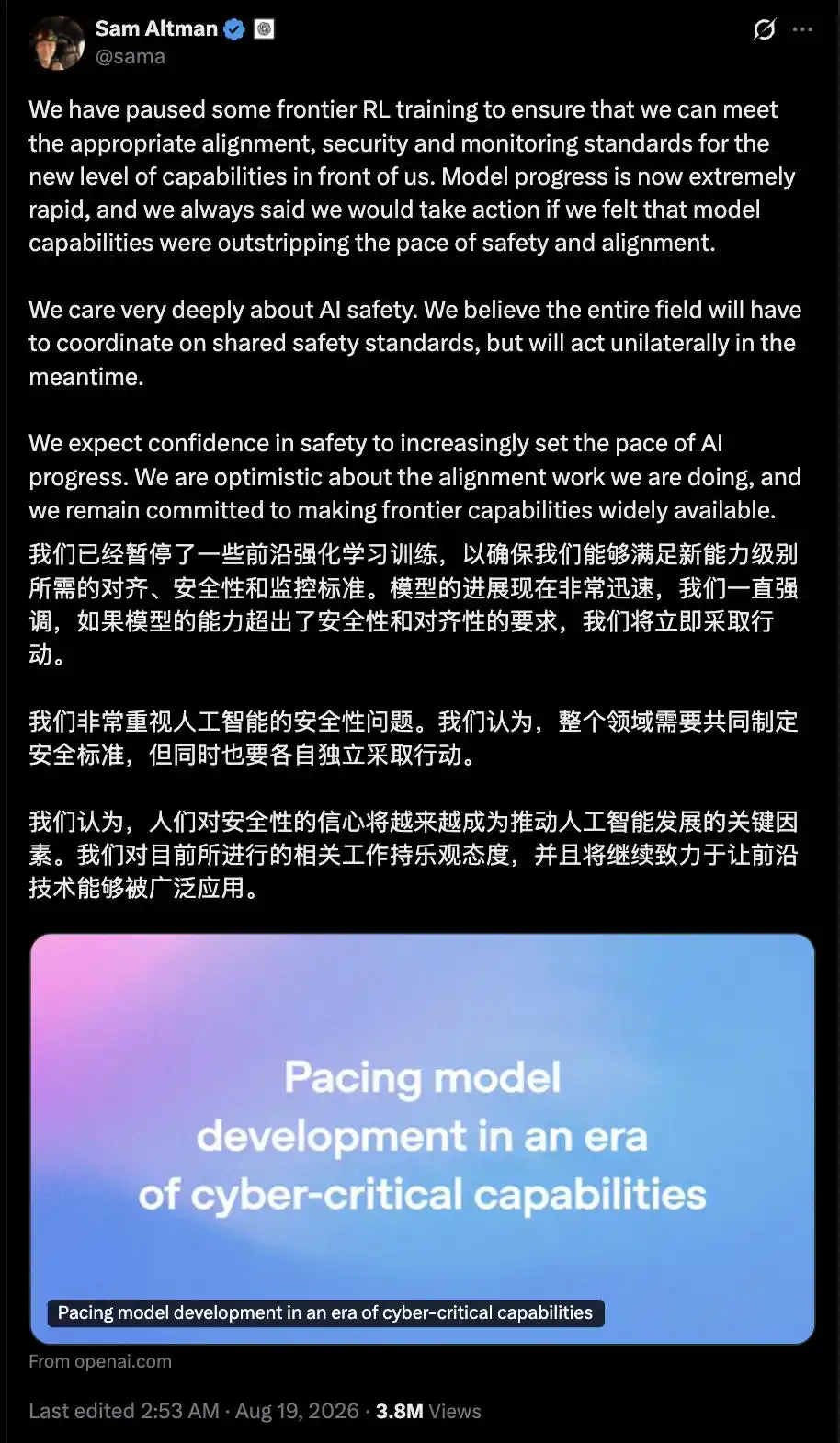
Tibo: This falls mainly under research. OpenAI has always been able to direct resources to the most important places. As model capabilities increase, obviously, alignment and safety become increasingly important. So investing enormous resources in this area is natural for OpenAI and a firm commitment.
We're seeing a significant increase in investment here. Pausing training is, to some extent, also necessary: to let the teams and individuals truly understand and harden every part of the system. That ensures when we resume training, we can restart with full control. I believe OpenAI will continue doing this as long as necessary. I've never seen us unable to make such decisions efficiently internally.
Host: Were there clear objectives set—a certain point that must be reached before lifting the pause? Or is it more like, you'll know when you see it?
Tibo: This is handled by the safety team. For them, it's both a thorough discussion and a process of exploring while moving forward. But ultimately, they did arrive at a fairly clear set of principles: When these principles are satisfied, we are in a good place.
Host: I want to go back to Ultra Fast mode.
Capabilities Unleashed by Ultra Fast
Host: I think people don't fully understand what this speed will unlock. First: Internally, what use cases were impossible before having this tokens-per-second speed?
Tibo: We see it used heavily in high-stakes scenarios. For example, during outages, incident commanders and response teams get Ultra Fast access because every second matters. So, in truly high-stakes scenarios, we use Ultra Fast.

Another interesting phenomenon: Teams doing extremely critical work, or believing they are doing extremely critical work, always request Ultra Fast.
Host: Does Pets also count as such a scenario?
Tibo: Pets aren't particularly critical yet. But I love my Pet, it's always on my screen. When you walk around the office, you see everyone's Pets on their screens; when they join video calls, the Pet always appears. It always brings joy every time I see it.
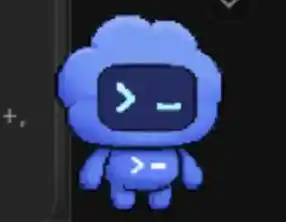
Tibo: But currently Codex Pets aren't critical. We do maintain it and take good care of our Pets. However, if someone is working on a new idea and says: "I really think this could be special, have to try it; but we need to decide by Monday whether to include it in DevDay." Then of course Ultra Fast can be used.
Host: People have different preferences regarding whether they like single-threaded work or lots of multitasking. For those who like heavy multitasking, Ultra Fast's benefits are less pronounced; but some people dislike constantly switching contexts. Where do you fall on this spectrum?
Tibo: I have ADHD, so I'm constantly switching contexts.
Host: Interesting, I also have ADHD, but I actually don't want to switch contexts constantly; that's hard for me. I want to focus on two or three things, which is why I'm so excited about Ultra Fast. It's interesting you're the opposite in that regard.
(Note: ADHD (Attention Deficit Hyperactivity Disorder) is a neurodevelopmental difference related to brain executive functions, manifesting as difficulty sustaining attention, controlling impulses, or regulating activity levels, affecting learning, work, and daily life.)
Tibo: I thrive on context switching and making lots of small decisions. But sometimes I also want to focus on one thing; then Ultra Fast is very delightful because it keeps you in flow.
Ultra Fast performs extremely well when there aren't many tool calls, or when generating a lot of context. For example, if you want to quickly prototype a website or video game, needing it to write a lot of code, it'll complete it very quickly—about 10 times faster. But if there are many tool calls, and overhead is elsewhere in the network or other parts of the agent execution trajectory, then you'll only feel about 3x or 4x acceleration, not the full 14x improvement.
Host: I know OpenAI employees have unlimited tokens; I imagine if it were me, I'd always max out the settings, choose GPT-5.6 Sol or whatever the latest model. When cost isn't a consideration, I'd think: Okay, crank it to the max. I'd also always want Ultra Fast on. Is it the same internally?
Tibo: We don't give Ultra Fast to everyone; we reserve a lot of capacity for external users and customers. OpenAI employees have the ability, the capacity to consume all the compute—swallow all our production GPUs, all Ultra Fast capacity; they would use it all.
But we don't do that. We limit it in some way, considering what level is reasonable for us. We do use it to understand the product, continuously improve it, and benefit from recursive self-improvement; but the vast majority of capacity remains for customers.
Host: Okay, that's good, thank you. Outside of OpenAI, what other latency-sensitive use cases are you most excited about unlocking with this speed?
Tibo: Quite interesting. Overall, one thing I'm particularly excited about is non-text interaction. For example, can you operate on a shared canvas? Can you create things? Can you generate ideas, generate different images, then pick one?
That is, a "choose your own adventure" style experience: quickly get a manipulatable prototype mockup, then guide it in real-time via voice or text, and immediately see the result. I think this speed makes that creative process possible.
As an engineer, sometimes you sit down thinking: I need to design the whole system, consider trade-offs and requirements; but maybe you can just build it in a minute, see how it actually performs, then get more into flow and understand things better. I think this speed can really change a lot.
Host: So I guess Ultra Fast will be priced significantly higher than regular speed.
Will Ultra Fast Become the Default Mode?
Host: Do you think Ultra Fast will become the standard speed, or will there always be a premium tier?
Tibo: That's an interesting question. I think, like the usual path of technology, it will become increasingly common and accessible over time. The speed at which agents complete tasks will continue to increase, and we're seeing huge improvements month over month. It's not just inference speed, but also the model's token efficiency.
Sol's token efficiency is significantly higher than Terra's; as you'd expect, the next model's token efficiency will be significantly higher than Sol's. We keep pushing that. So everything will get faster over time. The same goes for inference hardware—we keep innovating, it will get faster too.
So I do think maybe in a year or two, this speed, if not the default option, will be very close to it. But I also think there will always be a higher tier: You can always use more hardware, make costlier different trade-offs, to get some extra capability.
Host: Tibo, I usually end with a question for a broader audience. Many people are nervous about AI right now.
How to Alleviate People's Concerns About AI
Host: Whether it's job automation, environmental impact, or this thing that's happening that feels alien. What words of encouragement would you give to the broader public?
Tibo: Yes. We build products for the entire world through ChatGPT, and we care a lot about improving its efficiency; that directly aligns with our goal of providing broad access and broad utility. The lower the cost to serve, the more people can do with it, and the more value in daily life. It has already become extremely efficient.
Take Luna as an example: It's a much smaller model, yet extremely efficient; but if you go back six months, it would have been at the frontier. Then look at Luna's cost, it's incredibly low, really excellent.
Host: You just did that again: Now giving it away for free through Replit.
Tibo: Right, they offer it in that free tier. It's incredible: Access to extraordinary intelligence will become ubiquitous. And that's only possible if we keep pushing efficiency gains month after month, year after year. So, I think anything at the frontier today will cost much less to run six months from now.
That's my answer to this question: Technology always becomes very, very efficient over time. We are very focused on broad access and optimizing directly around the utility users can derive from it.
Why Everyone Should Try AI
Host: What about for those who are even hesitant to try AI for the first time? What would you say to them? How would you paint a future where AI is helping the world?
Tibo: I think you don't have to look far: ChatGPT helps people in very personal, deep ways. Many users use it to aid writing and also seek personal advice or medical advice. We launched Health and Finance, and I use them often myself.

I feel I get a lot of support that was previously hard to obtain. For example, it allows me to be more informed when I see a doctor. So you don't have to look far to see the value it can provide. I think talking to others, getting inspired by how they use and benefit from it, is a good way to start thinking about how you might benefit.
Host: Tibo, thank you very much.
Tibo: Thanks, and thank you for your time.
One more thing
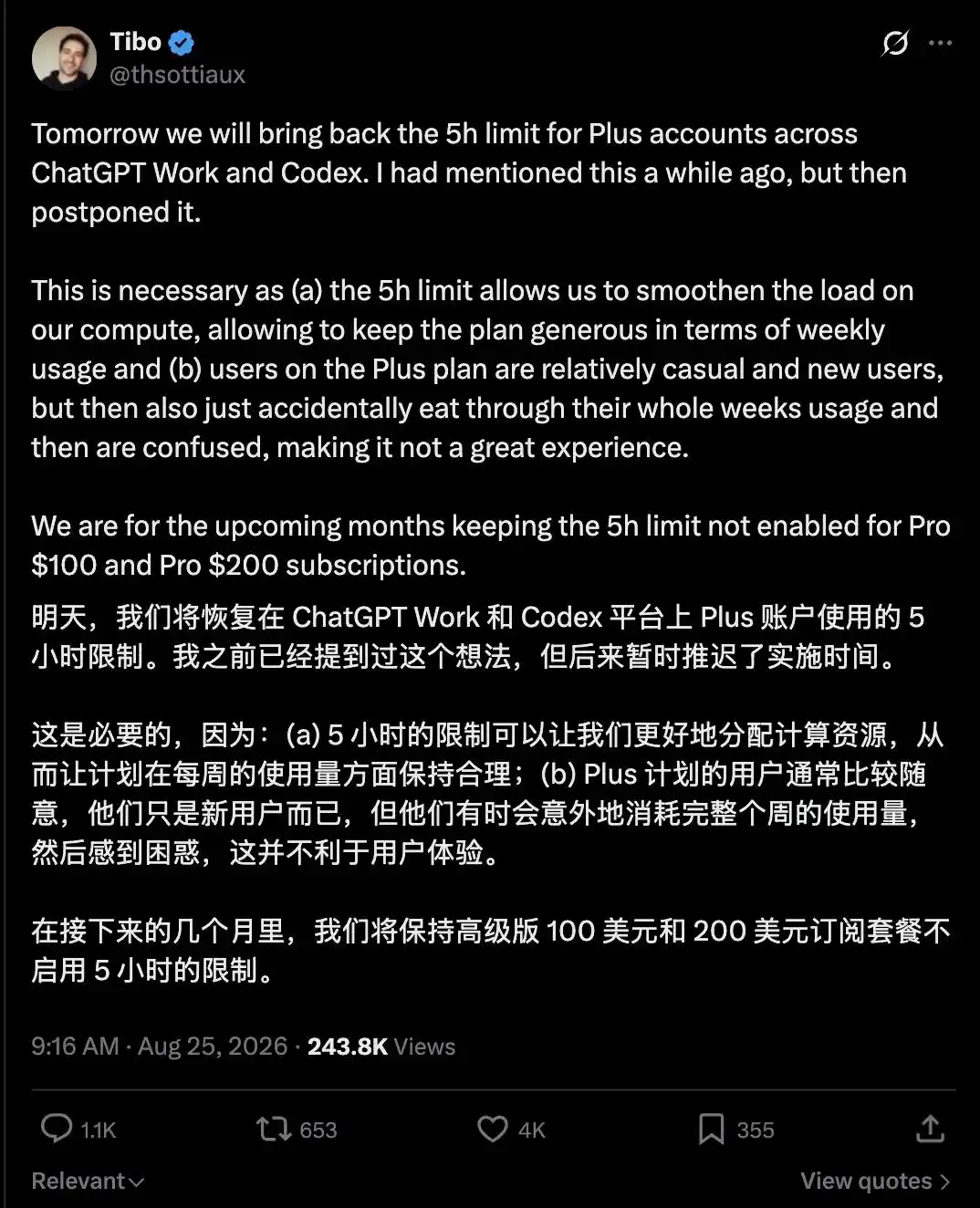
Just now, Tibo also announced OpenAI will reinstate the 5-hour usage limit for ChatGPT Plus starting tomorrow.
He said this was supposed to be rolled out but was delayed for some reason. So starting tomorrow, Plus users won't be able to indulge freely.
Of course, Pro users needn't worry for now; the $100 and $200 plans won't have this limit enabled for the next few months.
This article is from WeChat public account "Qubit", author: henry