BIS Warns Crypto Self-Custody Could Become New AML Loophole

bitcoinistPublicado a 2026-03-11Actualizado a 2026-03-11

Resumen

A new BIS paper warns that self-custodied crypto wallets could become a significant loophole in anti-money laundering (AML) enforcement if regulatory gaps are not addressed. The report highlights that as regulated payment channels face stricter rules, illicit financial flows may shift towards self-hosted wallets, which operate without intermediaries and thus avoid customer due diligence, transaction monitoring, and suspicious activity reporting. The paper argues that these wallets may be more attractive for illegal activities than cash due to their digital ease of transfer, cross-border efficiency, and lack of physical constraints. This creates a “waterbed effect,” where tightening one area of regulation simply displaces risk to another. Using the EU as a case study, the authors note that while hosted crypto services are now integrated into AML frameworks, self-custody wallets remain largely outside direct oversight. The absence of transaction limits, unlike the €10,000 cap on cash, could incentivize malicious actors to migrate to self-hosted crypto assets, thereby undermining overall AML efforts.

A new Bank of International Settlement (BIS) paper argues that self-custodied crypto could become the next weak point in anti-money laundering enforcement if regulators tighten rules around other payment rails without closing the gap around user-controlled wallets. The core concern is straightforward: when one channel becomes harder to use, illicit flows do not disappear. They move.

BIS Warns About Self-Hosted Crypto Wallets

Using the EU as its main case study, the paper says self-hosted wallets occupy a particularly sensitive position because they do not rely on an identifiable intermediary to perform customer due diligence, monitor transactions or file suspicious activity reports. That is the design distinction the authors keep returning to.

“Self-hosted wallets are a type of wallet that is entirely controlled by the user, without reliance on an intermediary. Validation of self-hosted cryptoasset transactions takes place on a permissionless public blockchain, with no individual intermediary being accountable for updating accounts.” On that basis, the paper says self-hosted crypto payments, absent additional measures, present one of the lowest probabilities of detection and enforcement.

The paper goes a step further. It says self-hosted wallets may, in practice, be even more attractive for illicit use than cash. Cash still offers the lowest level of oversight by design, the authors argue, but physical constraints matter: it is bulky, harder to move at scale and riskier to store or transport. Self-custodied crypto does not have those same frictions, which means the portability and cross-border speed of digital assets can amplify the compliance gap once intermediaries drop out of the picture.

That framing feeds into what the paper calls the “waterbed effect.” “Differences in the probability of detection ... can lead to arbitrage between payment instruments. This could be called a waterbed effect: if the water is pressed down in one area, it pops up in another. Over time, this dynamic weakens the overall effectiveness of AML/CFT frameworks and necessitates regulatory and supervisory intervention.” In the crypto context, the point is not simply that self-custody carries risk, but that uneven regulation can actively redirect bad actors toward it.

The EU example is central to that argument. Hosted crypto wallets are now much more tightly folded into the bloc’s AML architecture through the broader cryptoasset service provider, or CASP, framework, updated monitoring obligations and the Travel Rule regime. The paper notes that wallets and services enabling anonymisation are being pushed out of the regulated perimeter.

Self-hosted wallets, by contrast, are treated more indirectly: transactions involving them are not subject to due diligence and transaction monitoring unless a CASP is on one side of the transfer. In those cases, CASPs must assess money laundering and terrorist financing risk and apply mitigating measures.

What makes that asymmetry notable, the authors say, is that cash has a hard backstop the self-custody segment does not. Their comparison table states it plainly: cash in the EU is subject to a €10,000 transaction limit, while self-hosted crypto assets face “no transaction or holding limits.” The paper’s conclusion is that this difference “may provide an incentive for malicious actors to shift from cash to self-hosted crypto asset wallets.”

At press time, the total crypto market cap stood at $2.37 trillion.
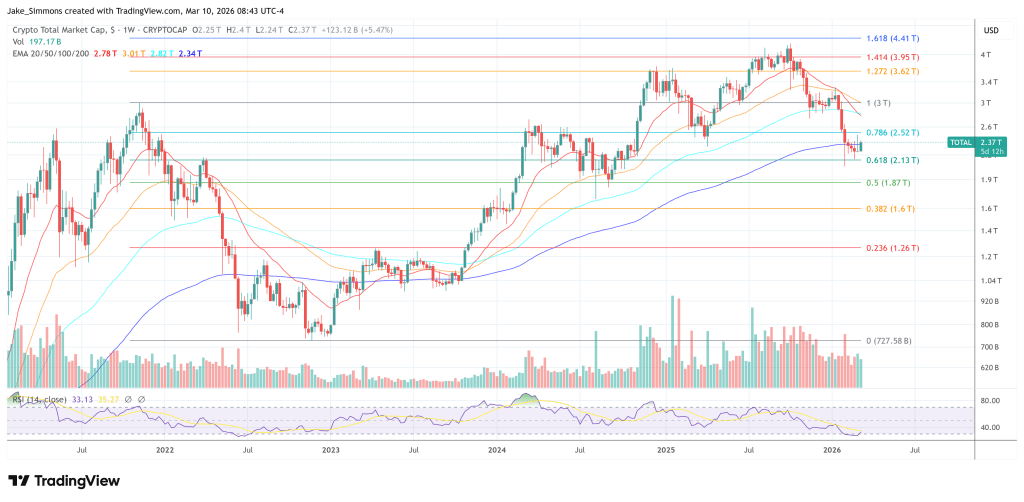
Total crypto market cap, 1-week chart | Source: TOTAL on TradingView.com

Preguntas relacionadas

QWhat is the main concern raised by the BIS paper regarding self-custodied crypto?

AThe main concern is that self-custodied crypto could become a new weak point in anti-money laundering enforcement if regulators tighten rules around other payment methods without addressing the regulatory gap around user-controlled wallets, potentially redirecting illicit financial flows to this channel.

QAccording to the paper, why are self-hosted wallets particularly attractive for illicit use compared to cash?

ASelf-hosted wallets are more attractive than cash for illicit use because, while cash has the lowest oversight by design, it has physical constraints like bulkiness and transportation risks. Self-custodied crypto lacks these frictions and offers greater portability and cross-border speed, amplifying the compliance gap.

QWhat is the 'waterbed effect' as described in the BIS paper?

AThe 'waterbed effect' refers to the phenomenon where differences in detection probabilities between payment instruments lead to arbitrage: when one channel becomes harder to use for illicit activities (pressed down), the activity moves to another, less regulated channel (pops up), weakening overall AML/CFT framework effectiveness.

QHow does the EU regulate self-hosted crypto wallets differently from hosted wallets?

AIn the EU, hosted wallets are tightly regulated under the CASP framework with updated monitoring obligations and Travel Rule requirements. Self-hosted wallets are treated indirectly: transactions involving them are only subject to due diligence and monitoring if a Cryptoasset Service Provider (CASP) is involved on one side of the transfer.

QWhat specific regulatory asymmetry between cash and self-hosted crypto does the paper highlight in the EU?

AThe paper highlights that cash transactions in the EU are subject to a €10,000 limit, while self-hosted crypto assets face no transaction or holding limits, creating an incentive for malicious actors to shift from cash to self-hosted crypto wallets to avoid detection.

Lecturas Relacionadas

How to View the Divergence Between Gold and Oil Prices?

The article analyzes the divergence between gold and oil prices following the outbreak of the U.S.-Iran war. While oil prices surged significantly, gold experienced a decline, contrary to expectations given its traditional role as a safe-haven asset during geopolitical crises. Gold serves three primary hedging functions: against geopolitical risk, inflation risk, and U.S. dollar risk. Since late 2023, gold had been in a strong bull market, rising from $1,800 to over $5,000, driven by simultaneous geopolitical tensions (e.g., Russia-Ukraine war, Middle East conflicts), inflationary pressures, and a weakening dollar due to the Fed's premature rate cuts. However, after the U.S. "decapitation" strike on Iran, gold prices fell sharply. This was attributed to two main factors: a shift of capital from gold to oil, as investors repositioned portfolios to capitalize on rising oil prices, and a liquidity crisis in U.S. financial markets that forced large-scale sell-offs of gold—a highly liquid asset—to meet redemption demands. More critically, growing pessimism about a prolonged U.S.-Iran conflict raised fears of sustained high oil prices, potential global economic disruption, and a possible reversal of Fed monetary policy (delayed cuts or even renewed hikes). This expectation of tighter policy caused gold’s dollar-related hedging function to reverse, overwhelming its geopolitical and inflation hedging roles and leading to a severe correction. Oil prices also experienced volatility. They initially spiked to nearly $120 per barrel post-strike, then fell by 30% on Trump’s hints of a quick resolution, but rebounded as market expectations corrected when the conflict persisted and the Strait of Hormuz remained threatened. The outlook for both commodities depends on the evolution of the U.S.-Iran conflict. If it becomes a prolonged war like Ukraine, gold may lack short-term value as monetary fears prevail, while oil and energy assets may benefit. A critical factor will be whether the Strait of Hormuz is reopened, which hinges on geopolitical decisions ahead.

marsbitHace 1 hora(s)

How to View the Divergence Between Gold and Oil Prices?

marsbitHace 1 hora(s)

The Stablecoin Yield Debate: How It's Stalling U.S. Crypto Regulatory Legislation?

The debate over stablecoin yields has become a central obstacle to U.S. cryptocurrency regulatory legislation, stalling the Senate’s proposed CLARITY Act. The conflict centers on whether dollar-pegged stablecoins should function solely as payment tools or also offer yield-bearing features that compete with traditional bank deposits and money market funds. Banks argue that yield offerings could drain deposits—potentially up to $500 billion by 2028—undermining their lending capacity and harming local economies. They are pushing Congress to explicitly prohibit such returns. In contrast, crypto firms contend that limited incentives could help digital dollars compete with traditional payment systems and drive mainstream adoption. A Congressional Research Service report highlighted legal ambiguities in the earlier GENIUS bill, which banned direct issuer-yield payments but left room for intermediaries to distribute benefits. This regulatory gap has intensified the legislative standoff. With political deadlines tightening ahead of elections, the window for passing the bill is narrow—likely closing by late April or early May. If Congress fails to act, regulators may impose rules independently, such as the OCC’s proposed restrictions on indirect yield mechanisms. The outcome will shape not only the future of stablecoin yields but also broader crypto market structure, including asset classification and regulatory clarity. Failure could delay legal certainty, forcing the industry to rely on organic adoption rather than legislative support.

marsbitHace 1 hora(s)

The Stablecoin Yield Debate: How It's Stalling U.S. Crypto Regulatory Legislation?

marsbitHace 1 hora(s)

Trading

Spot
Futuros

Artículos destacados

Qué es $BANK

Banco AI: Un Paso Revolucionario en el Futuro de la Banca Introducción En una era marcada por avances rápidos en tecnología, Banco AI se sitúa en la intersección de la inteligencia artificial (IA) y los servicios bancarios. Este proyecto innovador busca redefinir el panorama financiero, mejorando la eficiencia operativa, las medidas de seguridad y las experiencias del cliente a través del poder de la IA. Al embarcarnos en esta exploración de Banco AI, profundizaremos en lo que implica el proyecto, sus dinámicas operativas, su contexto histórico y hitos significativos. ¿Qué es Banco AI? En su esencia, Banco AI representa una iniciativa transformadora destinada a integrar la inteligencia artificial en varias operaciones bancarias. Este proyecto aprovecha las capacidades de la IA para automatizar procesos, mejorar los protocolos de gestión de riesgos y mejorar la interacción con los clientes a través de servicios personalizados. Los objetivos principales de Banco AI incluyen: Automatización de Funciones Bancarias: Al aprovechar las tecnologías de IA, Banco AI tiene como objetivo automatizar tareas rutinarias, reduciendo la carga sobre los recursos humanos y mejorando la eficiencia. Mejora en la Gestión de Riesgos: El proyecto utiliza algoritmos de IA para predecir e identificar riesgos, fortaleciendo así las medidas de seguridad contra fraudes y otras amenazas. Personalización de Servicios Bancarios: Banco AI se centra en ofrecer productos y servicios financieros a medida al analizar datos y comportamientos de los clientes. Mejoramiento de la Experiencia del Cliente: La implementación de soluciones impulsadas por IA, como chatbots y asistentes virtuales, tiene como objetivo proporcionar a los usuarios interacciones más humanas, revolucionando la forma en que los clientes se relacionan con los bancos. Con estos objetivos, Banco AI se posiciona como un jugador crucial para hacer que la banca sea más eficiente, segura y centrada en el usuario. ¿Quién es el Creador de Banco AI? Los detalles sobre el creador de Banco AI siguen siendo desconocidos. Como tal, no se ha identificado a ninguna persona u organización específica en la información disponible. El anonimato que rodea el inicio del proyecto plantea preguntas, pero no resta valor a su ambiciosa visión y objetivos. ¿Quiénes Son los Inversores de Banco AI? Al igual que con el creador del proyecto, no se ha divulgado información específica sobre los inversores u organizaciones que apoyan a Banco AI. Sin esta información, es un desafío delinear el respaldo financiero y el apoyo institucional que podrían estar impulsando el proyecto hacia adelante. No obstante, la importancia de contar con una sólida base de inversión es fundamental para sostener el desarrollo en un campo tan innovador. ¿Cómo Funciona Banco AI? Banco AI opera en múltiples frentes innovadores, centrándose en factores únicos que lo diferencian de los marcos bancarios tradicionales. A continuación, se presentan las características operativas clave: Automatización: Al aplicar algoritmos de aprendizaje automático, Banco AI automatiza varios procesos manuales dentro de los bancos. Esto resulta en la reducción de costos operativos y permite que los trabajadores humanos redirijan sus esfuerzos hacia actividades más estratégicas. Gestión Avanzada de Riesgos: La integración de la IA en las prácticas de gestión de riesgos equipa a los bancos con herramientas para predecir con precisión amenazas potenciales como el fraude, garantizando que la información y los activos de los clientes permanezcan seguros. Recomendaciones Financieras Personalizadas: A través del aprendizaje continuo a partir de las interacciones con los clientes, los sistemas de IA desarrollan una comprensión matizada de las necesidades del usuario, lo que les permite ofrecer consejos adaptados sobre decisiones financieras. Interacciones Mejoradas con los Clientes: Al utilizar chatbots y asistentes virtuales impulsados por IA, Banco AI permite una experiencia más atractiva para el cliente, permitiendo a los usuarios resolver sus consultas rápidamente, reduciendo así los tiempos de espera y mejorando los niveles de satisfacción. En conjunto, estas características operativas posicionan a Banco AI como un pionero en el sector bancario, estableciendo nuevos parámetros para la entrega de servicios y la excelencia operativa. Línea de Tiempo de Banco AI Entender la trayectoria de Banco AI requiere mirar su contexto histórico. A continuación, se presenta una línea de tiempo que destaca hitos y desarrollos importantes: Inicios de 2010: La conceptualización de la integración de la IA en los servicios bancarios comenzó a ganar atención a medida que las instituciones bancarias reconocieron los posibles beneficios. 2018: Se produjo un aumento notable en la implementación de tecnologías de IA cuando los bancos comenzaron a utilizar herramientas de IA como chatbots para el servicio al cliente básico y sistemas de gestión de riesgos para mejorar la seguridad. 2023: La sofisticación de la IA continuó avanzando, con la introducción de IA generativa para tareas más complejas como el procesamiento de documentos y análisis de inversiones en tiempo real. Este año marcó un salto significativo en las capacidades que la tecnología de IA otorgó a los bancos. 2024-Estatus Actual: A partir de este año, Banco AI se encuentra en una trayectoria ascendente, con investigaciones y desarrollos en curso que pronto mejorarán las capacidades en las operaciones bancarias. La continua exploración de las aplicaciones de IA sugiere emocionantes desarrollos aún por venir. Puntos Clave Sobre Banco AI Integración de la IA en la Banca: Banco AI se centra en adoptar inteligencia artificial para optimizar los procesos bancarios y mejorar la experiencia del usuario. Enfoque en Automatización y Gestión de Riesgos: El proyecto enfatiza fuertemente estas áreas, con el objetivo de desplazar la carga de tareas rutinarias mientras mejora los marcos de seguridad a través de análisis predictivos. Soluciones Bancarias Personalizadas: Al aprovechar los datos de los clientes, Banco AI permite servicios bancarios adaptados a las necesidades individuales de los usuarios. Compromiso con el Desarrollo: Banco AI se mantiene comprometido con esfuerzos de investigación y desarrollo continuos, asegurando su adaptabilidad y relevancia continua a medida que la tecnología sigue evolucionando. Conclusión En resumen, Banco AI ejemplifica un paso crucial hacia adelante en la industria bancaria, aprovechando la inteligencia artificial para redefinir los paradigmas operativos, mejorar la seguridad y promover la satisfacción del cliente. A pesar de las lagunas en la información sobre el creador y los inversores, los objetivos claros y los mecanismos funcionales de Banco AI proporcionan una sólida base para su evolución continua. A medida que la tecnología de IA sigue avanzando y fusionándose con el sector bancario, Banco AI está bien posicionado para impactar significativamente el futuro de los servicios financieros, mejorando la forma en que entendemos e interactuamos con la banca.

143 Vistas totalesPublicado en 2024.04.06Actualizado en 2024.12.03

Qué es $BANK

Cómo comprar BANK

¡Bienvenido a HTX.com! Hemos hecho que comprar Lorenzo Protocol (BANK) sea simple y conveniente. Sigue nuestra guía paso a paso para iniciar tu viaje de criptos.Paso 1: crea tu cuenta HTXUtiliza tu correo electrónico o número de teléfono para registrarte y obtener una cuenta gratuita en HTX. Experimenta un proceso de registro sin complicaciones y desbloquea todas las funciones.Obtener mi cuentaPaso 2: ve a Comprar cripto y elige tu método de pagoTarjeta de crédito/débito: usa tu Visa o Mastercard para comprar Lorenzo Protocol (BANK) al instante.Saldo: utiliza fondos del saldo de tu cuenta HTX para tradear sin problemas.Terceros: hemos agregado métodos de pago populares como Google Pay y Apple Pay para mejorar la comodidad.P2P: tradear directamente con otros usuarios en HTX.Over-the-Counter (OTC): ofrecemos servicios personalizados y tipos de cambio competitivos para los traders.Paso 3: guarda tu Lorenzo Protocol (BANK)Después de comprar tu Lorenzo Protocol (BANK), guárdalo en tu cuenta HTX. Alternativamente, puedes enviarlo a otro lugar mediante transferencia blockchain o utilizarlo para tradear otras criptomonedas.Paso 4: tradear Lorenzo Protocol (BANK)Tradear fácilmente con Lorenzo Protocol (BANK) en HTX's mercado spot. Simplemente accede a tu cuenta, selecciona tu par de trading, ejecuta tus trades y monitorea en tiempo real. Ofrecemos una experiencia fácil de usar tanto para principiantes como para traders experimentados.

395 Vistas totalesPublicado en 2025.05.09Actualizado en 2025.05.09

Cómo comprar BANK

Discusiones

Bienvenido a la comunidad de HTX. Aquí puedes mantenerte informado sobre los últimos desarrollos de la plataforma y acceder a análisis profesionales del mercado. A continuación se presentan las opiniones de los usuarios sobre el precio de BANK (BANK).

活动图片