The Stablecoin Yield Debate: How It's Stalling U.S. Crypto Regulatory Legislation?

marsbitPublicado a 2026-03-23Actualizado a 2026-03-23

Resumen

The debate over stablecoin yields has become a central obstacle to U.S. cryptocurrency regulatory legislation, stalling the Senate’s proposed CLARITY Act. The conflict centers on whether dollar-pegged stablecoins should function solely as payment tools or also offer yield-bearing features that compete with traditional bank deposits and money market funds. Banks argue that yield offerings could drain deposits—potentially up to $500 billion by 2028—undermining their lending capacity and harming local economies. They are pushing Congress to explicitly prohibit such returns. In contrast, crypto firms contend that limited incentives could help digital dollars compete with traditional payment systems and drive mainstream adoption. A Congressional Research Service report highlighted legal ambiguities in the earlier GENIUS bill, which banned direct issuer-yield payments but left room for intermediaries to distribute benefits. This regulatory gap has intensified the legislative standoff. With political deadlines tightening ahead of elections, the window for passing the bill is narrow—likely closing by late April or early May. If Congress fails to act, regulators may impose rules independently, such as the OCC’s proposed restrictions on indirect yield mechanisms. The outcome will shape not only the future of stablecoin yields but also broader crypto market structure, including asset classification and regulatory clarity. Failure could delay legal certainty, forcing the industry to ...

Written by: Oluwapelumi Adejumo

Compiled by: Saoirse, Foresight News

This legislative effort, backed by the President and aimed at establishing more comprehensive regulatory rules for the U.S. cryptocurrency market, is approaching a political deadline at the congressional level. Meanwhile, the banking industry is pressuring lawmakers and regulators to prohibit stablecoin companies from offering yields similar to bank deposit interest.

This contest has become one of the core unresolved issues on Washington's crypto agenda. The focus of the debate is: Should dollar-pegged stablecoins focus solely on payment and settlement functions, or can they add wealth management attributes that compete with bank accounts and money market funds?

The Senate's market structure bill, named the "CLARITY Act," has stalled due to a breakdown in negotiations surrounding so-called "stablecoin yields."

Industry insiders and lobbyists say that if the bill is to have a realistic chance of passage before the election year schedule tightens, the practical window for advancing the bill is from late April to early May.

Congressional Research Service Sharpens the Legal Dispute

The Congressional Research Service's (CRS) definition of this issue is narrower than the public debate suggests.

In a March 6th report, the CRS noted that the "GENIUS Act" prohibits stablecoin issuers from paying yields directly to users, but it does not fully clarify the legality of what it calls the "three-party model"—where intermediaries like exchanges stand between the issuer and the end-user.

The CRS stated that the bill does not explicitly define "holder," leaving room for debate on whether intermediaries could still pass on economic benefits to their customers. This ambiguity is precisely why the banking industry wants Congress to clarify this issue anew within the broader market structure bill.

Banks argue that even limited yield incentives could make stablecoins a strong competitor to bank deposits, impacting regional and community banks particularly hard.

However, crypto firms argue that incentives tied to payments, wallet usage, or network activity can help digital dollars compete with traditional payment channels and potentially elevate their status in mainstream finance.

This divergence also reflects differing perceptions of the future positioning of stablecoins.
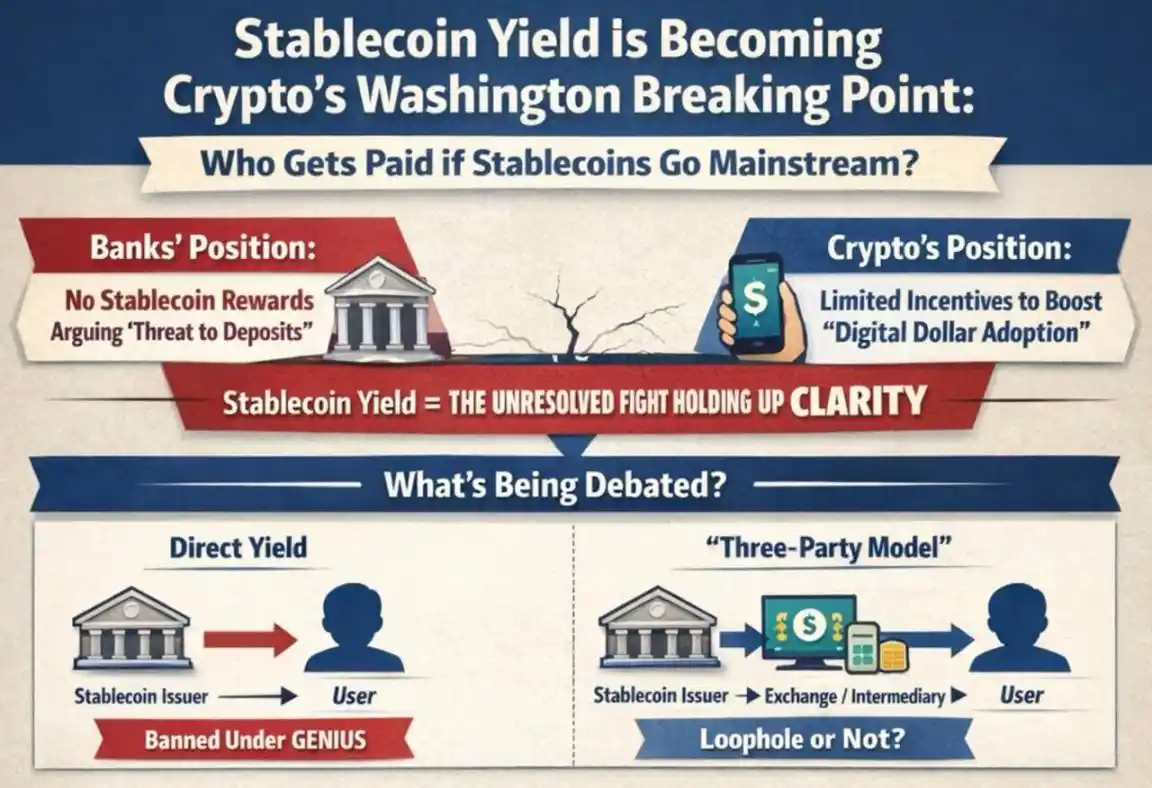
Infographic shows a serious divide between banks and crypto firms on the question of 'who should get stablecoin yields' as the use of digital dollars expands.

If lawmakers primarily view stablecoins as payment tools, the rationale for imposing stricter limits on related rewards becomes stronger. Conversely, if they see them as part of a major shift in how value flows on digital platforms, the argument for supporting limited incentives holds more ground.

Banking associations have urged lawmakers to close what they call a "regulatory loophole" before such reward mechanisms become more widespread. Banks claim that allowing rewards on idle balances would lead depositors to move funds out of banks, thereby weakening the core funding source for loans to families and businesses.

Standard Chartered estimated in January that stablecoins could drain about $500 billion in deposits from the U.S. banking system by the end of 2028, with small and medium-sized banks facing the most pressure.

Infographic compares why banks and crypto care about the stablecoin bill, showing deposit outflows, impact on lenders, cash-back rewards, and bank protectionism.

Banks are also trying to demonstrate to lawmakers that their position has public support. The American Bankers Association recently released a poll result:

  • When the question mentioned that 'allowing stablecoin yields could reduce lendable funds for banks, affecting communities and economic growth,' respondents supported a congressional ban on stablecoin yields by a 3:1 ratio;
  • By a 6:1 ratio, they believed stablecoin-related legislation should be cautious to avoid disrupting the existing financial system, especially community banks.

But the crypto industry counters that banks are simply trying to protect their own funding models by restricting competition from digital dollars.

Industry figures, including Coinbase CEO Brian Armstrong, argue that under the "GENIUS Act," reserve requirements for stablecoin issuers are stricter than for banks—issued stablecoins must be fully backed by cash or cash equivalents.

Transaction Volume Size Raises the Stakes in Washington's Game

Market size has made this yield debate impossible to dismiss as a niche issue.

Boston Consulting Group estimated that the total circulation volume of stablecoins last year was about $62 trillion. After excluding bot trading, internal exchange flows, and other activities, real economic activity was only about $4.2 trillion.

The huge gap between surface trading volume and actual economic use also explains why the "yield" debate has become so critical.

If stablecoins remain primarily a settlement tool for trading and market structure, lawmakers find it easier to define them as payment instruments; but if yield mechanisms turn stablecoins into a widely used cash storage tool in user apps, the pressure on banks would rise rapidly.

To this end, the White House earlier this year tried to broker a compromise: allowing limited yields for specific scenarios like peer-to-peer payments, but prohibiting returns on idle funds. Crypto firms accepted this framework, but banks rejected it, causing Senate negotiations to completely stall.

Even if Congress does not act, regulators may step in to tighten yield models.

The Office of the Comptroller of the Currency (OCC), in a proposed rule implementing the "GENIUS Act," suggested that if a stablecoin issuer provides funds to an affiliate or third party, which then pays yields to stablecoin holders, it would be deemed a disguised payment of prohibited yields.

This means that if Congress cannot legislate a clear stance, the executive branch may draw boundaries itself through regulatory rules.

Congress is Running Out of Time

The current contest is divided into two tracks:

  • Congress debates whether to solve the problem with statute law;
  • Regulators define the boundaries of corporate behavior within the existing legal framework.

For the Senate bill, time itself is the greatest pressure.

Galaxy Digital Head of Research Alex Thorn wrote on social media:

If the CLARITY Act does not pass committee review by the end of April, the probability of passage in 2026 will be extremely low. The bill must reach the full Senate floor for a vote by early May. Legislative time is running out, and the probability of passage decreases with each passing day.

He also cautioned that even if the yield dispute is resolved, a breakthrough for the bill is hardly assured:

It is currently believed externally that the stablecoin yield dispute is holding up the CLARITY Act. But even if a compromise is reached on the yield issue, the bill would likely still face other obstacles.

These obstacles could include decentralized finance (DeFi) regulation, regulatory agency authority, or even ethical issues.

Before the midterm elections in November, crypto regulation is likely to become a larger political battleground. This makes the current stalemate more urgent—once delayed, the bill will face a more crowded political schedule and a more difficult legislative environment.

Prediction markets also reflect a shift in sentiment. In early January, Polymarket gave the bill an ~80% chance of passage; after recent setbacks (including Armstrong calling the current version unworkable), the probability has dropped to near 50%.

Kalshi data shows the probability of the bill passing before May is only 7%, and the probability of passing by the end of the year is 65%.

Bill Failure Would Cede More Decision-Making to Regulators and the Market

The impact of failure extends far beyond the yield debate. The core purpose of the CLARITY Act is to define whether crypto tokens are securities, commodities, or another category, providing a clear legal framework for market regulation.

If the bill is shelved, the entire industry will rely more heavily on regulatory guidance, interim rules, and future political changes.

This is also one reason the market is highly focused on the bill's fate. Bitwise Chief Investment Officer Matt Hougan said earlier this year that the CLARITY Act would codify the current crypto-friendly regulatory environment into law; otherwise, future administrations could reverse existing policies.

He wrote that if the bill fails, the crypto industry will enter a period of "proving itself," needing three years to make itself indispensable to ordinary people and traditional finance.

Under this logic, future industry growth would rely less on the expectation of "legislative landing" and more on whether products like stablecoins and asset tokenization can truly achieve mass adoption.

This presents the market with two截然不同的 paths:

  • Bill Passes → Investors price in the growth of stablecoins and tokenization early;
  • Bill Fails → Future growth relies more on actual adoption, while facing uncertainty from potential policy shifts in Washington.

Flowchart shows the countdown to a stablecoin decision in the Senate, with deadlines on March 6th and late April or early May leading to two paths: if Congress acts, it brings regulatory clarity and faster growth; if Congress fails to act, uncertainty follows.

At this stage, the next move is up to Washington. If senators can restart this market structure bill this spring, lawmakers can still personally define: to what extent stablecoins can pass value to users, and how much of a crypto regulatory framework can be written into statute law. If not, regulators are clearly prepared to draw at least some of the rules themselves.

Regardless of the outcome, this debate has long surpassed "whether stablecoins belong in the financial system," delving into: how stablecoins will operate within the system, and who will benefit from their development.


Preguntas relacionadas

QWhat is the core issue that has stalled the progress of the CLARITY Act in the U.S. Senate?

AThe core issue stalling the CLARITY Act is the debate over 'stablecoin yields'—specifically, whether stablecoin companies should be allowed to offer interest-like rewards to users, which traditional banks argue creates unfair competition for deposits.

QAccording to the Congressional Research Service (CRS), what legal ambiguity exists in the GENIUS Act regarding stablecoin yields?

AThe CRS report pointed out that the GENIUS Act prohibits stablecoin issuers from paying yields directly to users but does not clearly define 'holder,' leaving a legal ambiguity that allows intermediaries (like exchanges) to potentially pass on economic benefits to end-users.

QWhy are U.S. banks lobbying against allowing stablecoin yields?

ABanks argue that allowing yields on stablecoins would lead to significant deposit outflows from the banking system, especially from community and regional banks, undermining their ability to lend to households and businesses and harming economic growth.

QWhat are the two potential paths for the U.S. crypto market if the CLARITY Act fails to pass?

AIf the CLARITY Act fails, the crypto market faces two paths: 1) Growth becomes more dependent on actual adoption and real-world utility (like payments and tokenization) rather than legislative certainty, and 2) Regulatory agencies may step in to set rules independently, creating a patchwork of guidance and increased policy uncertainty.

QWhat is the practical legislative deadline for the CLARITY Act to have a realistic chance of passage in an election year?

AThe practical window for the CLARITY Act to have a realistic chance of passage is from late April to early May. If it doesn't clear committee by the end of April, its chances in 2026 are considered extremely low due to the tightening election-year schedule.

Lecturas Relacionadas

Analyzing the Impact of AI on Economic Growth and Productivity

**Title: Analyzing AI's Impact on Economic Growth and Productivity** This article examines three contrasting views on AI's influence on economic growth and productivity. **The Optimistic View** posits that AI, especially through automating R&D ("recursive self-improvement"), could dramatically accelerate growth, even triggering a technological "singularity" with explosive, potentially infinite, economic expansion. **The Moderate/Mainstream View** acknowledges AI's productivity benefits but emphasizes significant real-world constraints that could limit its impact. These include: limited cost savings per task, structural ceilings on which jobs and industries are "exposed" to AI, adoption bottlenecks (e.g., compute, energy, regulatory hurdles), and the "weak link" effect where non-automatable tasks cap overall gains. Consequently, the realized AI dividend may be far lower than optimistic projections, with estimates typically ranging from 0.1% to 1.3% annual productivity growth. **The Pessimistic View** stems from two strands. The first aligns with the moderate view but applies extremely conservative assumptions about task exposure and efficiency gains, yielding minimal projected impact. The second introduces a demand-side critique: if AI primarily replaces rather than augments labor, it could depress labor's share of income, weaken consumer demand, and create a "demand trap" that ultimately stifles growth, unless offset by redistribution policies. **The authors' assessment** is nuanced: * **Short-term (1-2 years):** AI will support growth primarily through investment spending, not significant productivity gains. * **Medium-term (3-5 years):** Three potential paths emerge based on AI demand and bottleneck severity: 1. **"Optimistic Path":** High demand, few bottlenecks. Rapid productivity gains but risk of major job displacement and social conflict without redistribution. 2. **"Moderate Path" (most likely):** High demand but significant, surmountable bottlenecks. Leads to moderate productivity gains, financial market volatility (K-shaped returns), and sectoral job losses. 3. **"Pessimistic Path":** Low demand or severe bottlenecks. Minimal productivity and growth impact, triggering financial market corrections but allowing a smoother societal transition with less labor disruption. * **Long-term:** AI holds potential for a major productivity revolution and prosperity. The conclusion stresses that no path is smooth. Technologically "optimistic" outcomes could be socially detrimental, while "pessimistic" technological diffusion might be more socially stable. Policymakers must monitor developments and prepare balanced responses to manage economic, financial, and social sustainability.

marsbitHace 1 min(s)

Analyzing the Impact of AI on Economic Growth and Productivity

marsbitHace 1 min(s)

The New Cold War is a Tech Stock War

The New Cold War is a Tech Stock War The article argues that the contemporary geopolitical and economic rivalry between the US and China represents a "New Cold War," but one fundamentally fought through technology and financial markets, not physical barriers or conventional trade. Historically, US dominance was secured through financial systems. The Soviet Union, reliant on the rigid "Transferable Ruble," was ultimately undermined by its dependency on the US dollar for oil trade. Later, Japan's semiconductor challenge was countered not just by tariffs (e.g., Plaza Accord, 301 investigations) but by binding it to US Treasury bonds. China presents a more complex, "embedded" challenger. While it holds vast dollar reserves and US debt like Japan, its industrial base is stronger and more diversified than the Soviet Union's. Surviving the initial 2018 trade war phase, the conflict has evolved into a "tech-financial war." The core battlefield is now the stock market. US tech stocks (AI, semiconductors) are treated as sovereign assets, buoyed by bipartisan national will. China is pushing to strengthen its own financial markets to convert industrial strength into financial power and fund its tech ambitions. Companies like ChangXin (semiconductors), Moonshot AI, and DJI compete not just for market share but as financial proxies for their respective systems. The new paradigm is moving from globally efficient monopolies (Apple, Google) towards companies that achieve monopolistic profits within their respective geopolitical spheres. This competition over "pricing power" and financial valuation in segmented markets defines the current era, making the stock market the primary arena for this tech-centric struggle.

marsbitHace 11 min(s)

The New Cold War is a Tech Stock War

marsbitHace 11 min(s)

RWA Weekly: Ten European Financial Institutions Establish Tokenized Asset Cooperative; Ondo Launches New Execution Network Ondo Network

RWA Weekly: European Banks Form Tokenized Asset Cooperative; Ondo Launches New Execution Network Ondo Network Covering July 24-31, 2026, the RWA sector saw a steady on-chain total value locked (TVL) of $36.8 billion, with holder count hitting a record high. However, stablecoin transfer volumes fell sharply (~30%), indicating low on-chain settlement demand. Key regulatory moves include South Korea advancing stablecoin legislation and a push to scrap crypto taxes, Kenya lowering capital requirements for stablecoin issuers, and Zimbabwe approving seven projects for its crypto sandbox. In project developments, BIS-led Project Agorá successfully tested cross-border payments with tokenized funds across six currencies. Ten major European financial institutions formed the RL1 blockchain cooperative to build tokenized asset infrastructure. Other notable updates: Aviva launched a tokenized dollar liquidity fund on XRPL, POSCO International tokenized commercial invoices on Injective, and a Brazilian farmer used tokenized cattle as collateral for a loan. Additional progress includes BNY Mellon migrating its core transfer agent operations to blockchain, Securitize gaining SEC investment advisor registration, and Tether’s compliant stablecoin USA₮ launching on Celo. Ondo Finance introduced Ondo Network, a new execution layer focused on speed and privacy, moving away from its initial chain plans. An analysis highlights that despite the growing scale of on-chain RWAs (~$32B), approximately 90% remain underutilized in DeFi, pointing to a critical challenge in unlocking liquidity and fostering real-world application beyond mere issuance.

marsbitHace 11 min(s)

RWA Weekly: Ten European Financial Institutions Establish Tokenized Asset Cooperative; Ondo Launches New Execution Network Ondo Network

marsbitHace 11 min(s)

South Korean Stock Market Sees Sharp Rebound After Forceful De-leveraging, SK Hynix Rises 30%

On July 31, South Korean stocks staged a historic rebound. The benchmark KOSPI index surged 18.27%, with chipmaker SK Hynix hitting a 30% gain limit. This followed a brutal, near-40% decline in the KOSPI over the previous month, driven largely by a deleveraging spiral involving leveraged ETFs. Analysts attributed the sharp sell-off to structural liquidity issues rather than deteriorating corporate fundamentals. The rally was triggered by a confluence of positive catalysts. Firstly, strong earnings from U.S. cloud giants Microsoft and Amazon alleviated fears of an "AI bubble burst," boosting global tech sentiment. Secondly, SK Group Chairman Chey Tae-won made a rare personal purchase of SK Hynix shares, seen as a strong vote of confidence. Thirdly, the South Korean government announced a 20 trillion won ($139 billion) AI investment fund. In response to the market turmoil, South Korean regulators are tightening controls on leveraged ETFs, admitting oversight shortcomings. Measures include raising minimum cash保证金 requirements for散户 investors and suspending new product launches. While the rebound signals eased liquidity pressure, analysts note deep structural issues remain. The market's future stability is seen as dependent on global tech capital expenditure trends and memory chip price cycles, with some viewing the surge as a technical correction rather than a definitive trend reversal.

marsbitHace 31 min(s)

South Korean Stock Market Sees Sharp Rebound After Forceful De-leveraging, SK Hynix Rises 30%

marsbitHace 31 min(s)

Trading

Spot
活动图片