On August 19, Unitree Technology rang the bell to list on the STAR Market, opening at 1100 yuan per share with a market capitalization of approximately 444.9 billion yuan.
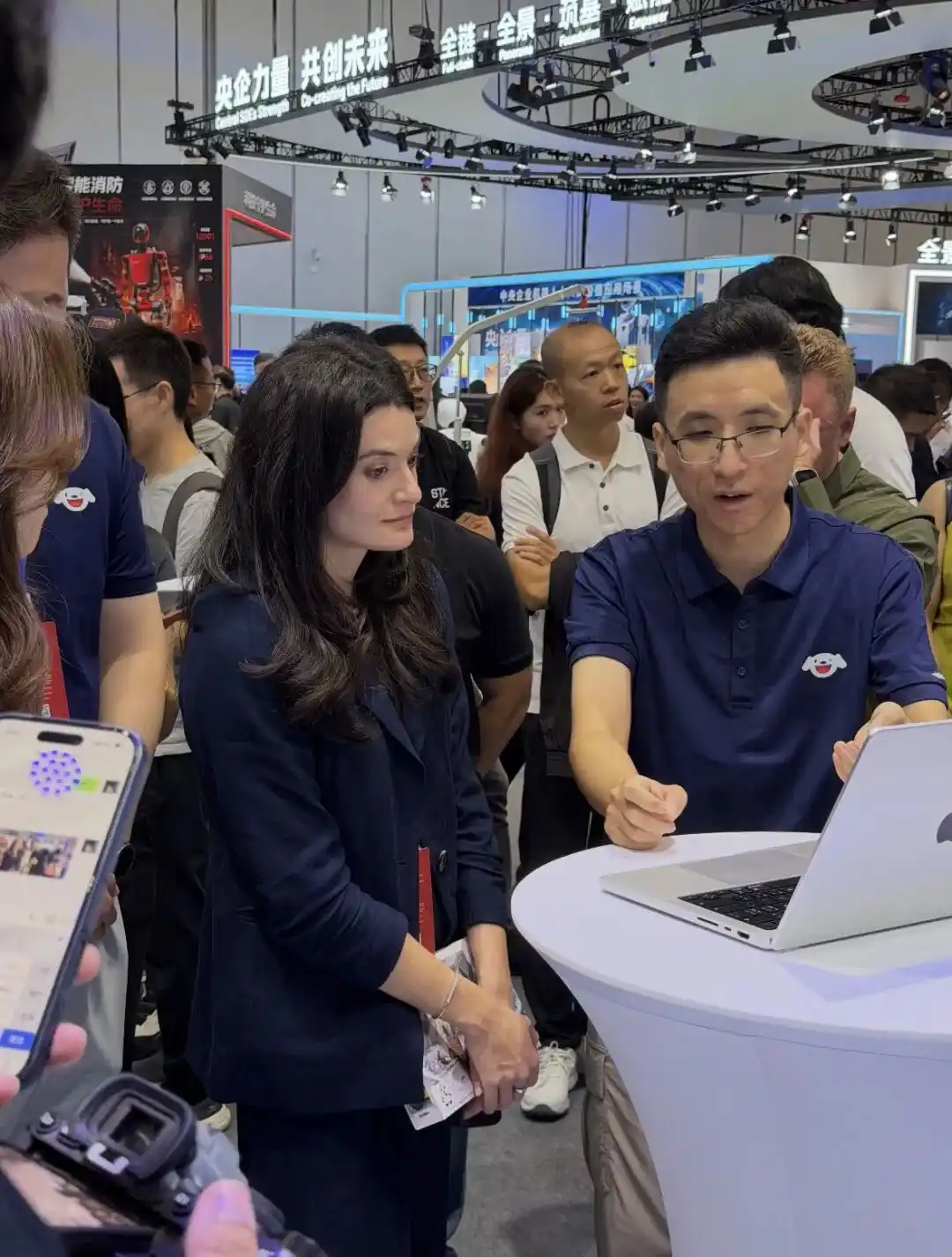
On the same day, Jensen Huang's daughter, Huang Minshan, flew to Beijing to visit the WRC World Robot Conference.
And just the next day, in the early morning Beijing time, the Silicon Valley robotics company Generalist AI released its new-generation foundation model, GEN-1.5.
Two months ago, Stanford Professor Fei-Fei Li personally invested in Generalist AI's $400 million funding round. Angel investors in the same round included Xiaomi co-founder Lin Bin and Zoom founder Eric Yuan. NVIDIA is also a shareholder. Smart money and smart people are simultaneously flocking in the same direction.
GEN-1.5 gave the reason for their investment: Show a robot a 3 to 12-second action demonstration, with no training or fine-tuning, and it executes immediately, achieving an average success rate of 59% across 10 manipulation tasks.
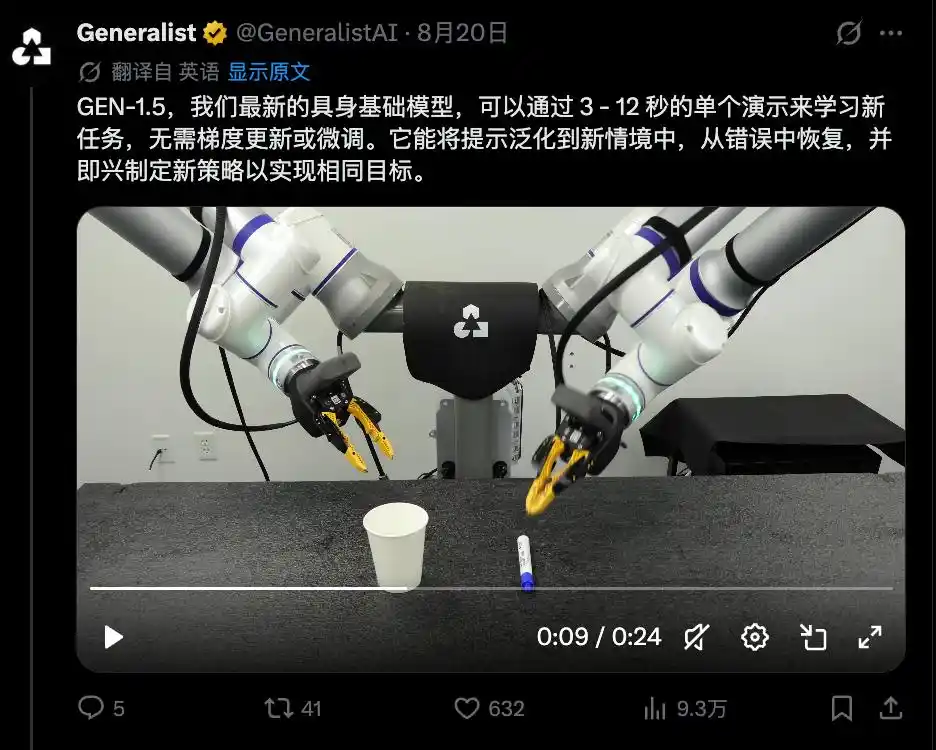
Previously, teaching a robot to unscrew a bottle cap required engineers to program for three months. Now, all that's needed is a three-second demonstration and zero lines of code.
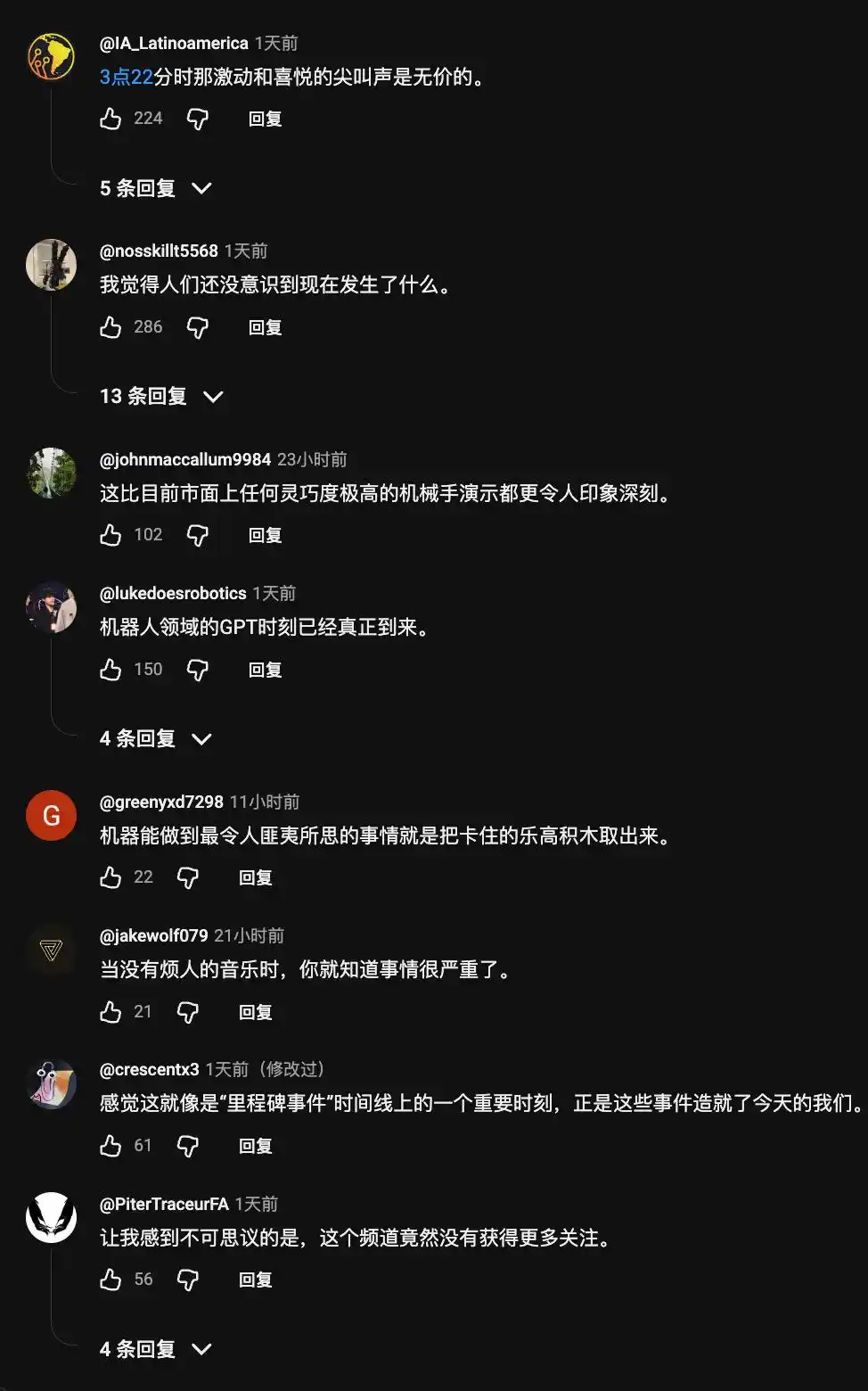
Several top researchers compare this moment to the release of GPT-3 in 2020, believing embodied intelligence has reached its own GPT-3 moment.
Strategies Never Taught Before Emerge from Pre-training
What most shocks researchers about GEN-1.5 is not imitation, but improvisation.
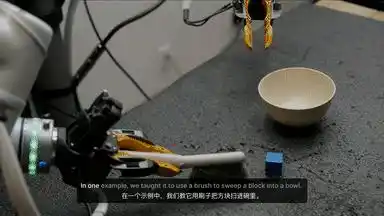
Generalist AI conducted an experiment: using 5 minutes of human demonstration data (fine-tuned with just 1 gradient step), they taught a robot to sweep blocks into a bowl with a brush, then replaced the tool.
Given a banana, it used the banana as a brush, sweeping blocks into the bowl—this isn't surprising, as the banana's shape and contact strategy are similar to a brush.
Given a dustpan, it abandoned the 'sweep' strategy, used its other hand to push blocks onto the dustpan, lifted the dustpan, and poured the blocks into the bowl.
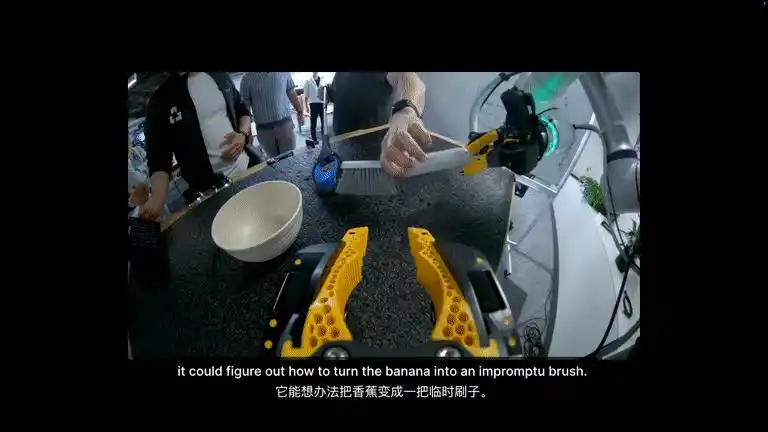
'Sweep' and 'scoop and pour' are two completely different contact sequences. This set of actions was not taught in the training data.
Generalist AI used nearest-neighbor language search to retrieve from about 1.89 million pre-trained scenes and found no similar dustpan usage.
No one told the model to do this at any stage.
Similar improvisational behaviors appeared repeatedly in testing: the bowl was covered by a piece of paper, the model lifted the paper to place blocks, sometimes even covering the paper back—a scenario not in the training data.
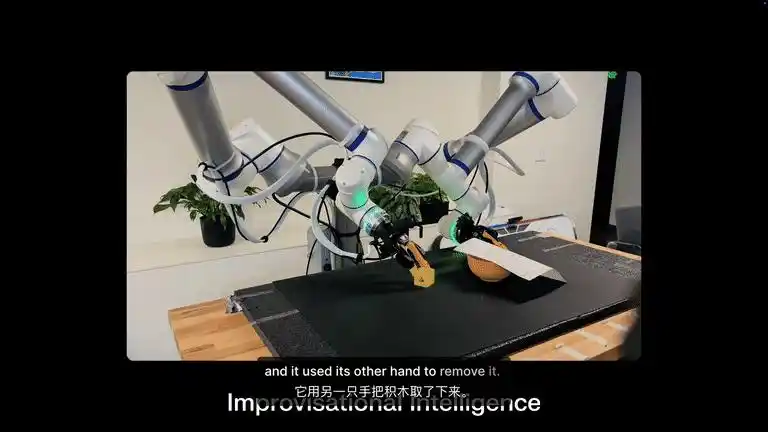
A LEGO block stuck to the robotic fingertip, and the model used its other hand to flick it off.
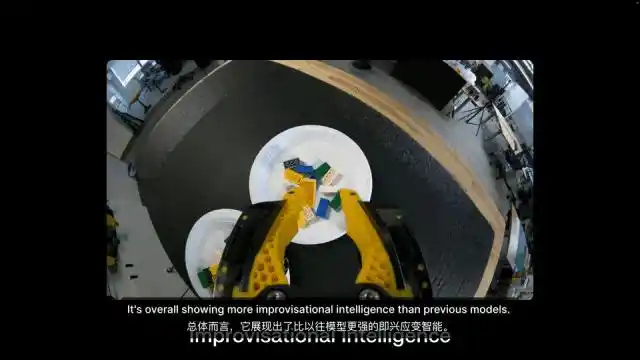
Training data only demonstrated rotating a jar lid with one hand; in some attempts, the model spontaneously switched to using both hands, adopting a completely different grasping and rotation strategy.
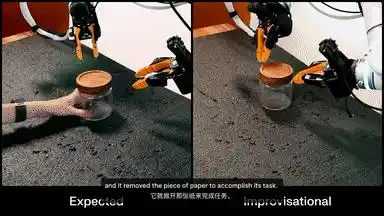
A model trained only to place one block into one bowl began spontaneously sorting multiple blocks by color.
These capabilities share a common origin: large-scale pre-training.
GEN-1.5 has been continuously pre-trained for over 8 months, undergoing three training phases.
Curves from the validation set released by Generalist AI show the model's 'next action prediction error' continues to decrease, with no signs of convergence yet.
Using terminology from the large language model field, this is the Scaling Law for embodied intelligence: As the scale of physical interaction data increases and training time extends, the model's generalization ability continues to strengthen.
A counterintuitive finding makes this trend clearer: The fewer gradient steps in fine-tuning, the stronger the improvisational ability.
Generalist AI explains that light fine-tuning keeps the model closer to the broad behavioral library accumulated during pre-training, preserving more 'physical experience' available for recall.
10 gradient steps only changed 0.15% of the model parameters.
Generalist AI's explanation is: This is already close to 'reminding the model of something it almost already knows.'
GEN-1.5 also bridges two gaps that have long plagued the robotics field.
A demonstration recorded in a simulator (even though pre-training data contains no simulation data) is fed into the context window, and a real robot directly executes the task, generalizing to different robotic hands and new object positions.
In some tests, a person directly demonstrates an action with their own hands in front of the robot's camera, and the robot subsequently replicates the task with its robotic hand.
Generalist AI states that none of these capabilities are the result of deliberate design: no architectural changes specifically promoting in-context learning, no meta-learning loops, no auxiliary training objectives encouraging improvisation.
These capabilities emerged spontaneously from pre-training on large-scale physical data.
'The Holy Grail of Manipulation Learning'
Other research teams have previously demonstrated similar in-context learning capabilities, but were limited to a few task types. GEN-1.5's novelty lies in its breadth; all results are self-reported by Generalist AI and have not undergone independent verification.
The tasks themselves are simple short-horizon manipulations (unscrewing caps, zipping zippers), still far from long-horizon complex tasks in real-world scenarios.
GPT-3 was released in June 2020. It took two and a half years (yes, two and a half) from GPT-3 to ChatGPT.
GEN-1.5 is currently in a similar position to GPT-3 in 2020: capabilities are rough but the direction is clear, tasks are simple but the Scaling trend is evident.
Generalist AI wrote a thought-provoking passage in its official blog:
After a certain pre-training threshold is crossed, the cost of adapting to a new task becomes negligible.
Emergent in-context learning, a few seconds of data, or one gradient step plus a minute of demonstration, is no longer task-specific training in the traditional sense, but closer to reminding the model of something it almost already knows.
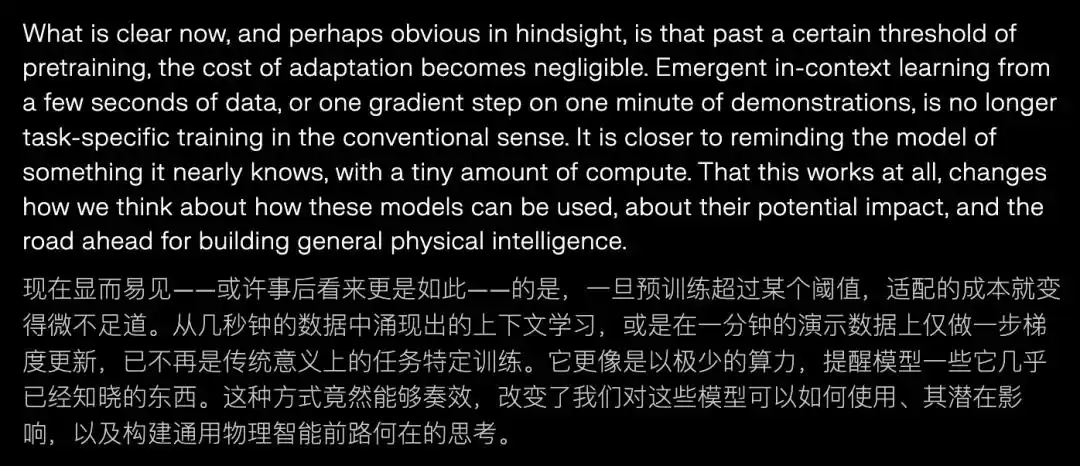
If the Scaling curve for embodied intelligence indeed shows no signs of convergence (Generalist AI says they haven't seen it yet), then the core resource for the next round of competition becomes who possesses enough physical interaction data to feed this engine.
This script is identical to the data arms race that large language models entered in 2021.
Learning at a Glance: The Turning Point Behind the Numbers 59% and 83%
In June 2020, OpenAI released GPT-3.
This model did something no one had achieved at the time: without retraining, just giving a few examples in a dialog box, it could complete new language tasks—provide an example set of 'red→apple, yellow→banana', then ask 'green→?', and it could answer 'watermelon'.
This capability is called in-context learning, the watershed moment for large language models transitioning from 'specialized tools' to 'general platforms'.
GEN-1.5 does the same thing in the physical world.
Generalist AI calls it Physical Prompting.
The operation method is straightforward: a real action demonstration (containing sensor data and action trajectories) is fed into the model's 30-second context memory window, with the remaining space used to receive real-time environmental observations.
The model immediately attempts execution, with no training steps throughout the entire process.
Here, a concept crucial for understanding GEN-1.5 needs explanation: gradient step.
Traditionally, teaching a robot a new task required tens of thousands of gradient descent steps, each step a fine-tuning of the model's internal parameters—a process typically needing massive data and computing power.
GEN-1.5's one-shot mode (demonstrate only once) skips all gradient steps; the model parameters remain completely unchanged.
Generalist AI tested GEN-1.5's performance on 10 different manipulation tasks: unscrewing a glass jar lid, zipping open a pencil case, taking money from a wallet, folding paper, stacking cups, flipping a phone, sweeping blocks with a brush, opening a book cover, tearing open a vacuum-sealed pad, sweeping trash.
The results fall into two groups:
One-shot (watch once, zero gradient steps): Average success rate across 10 tasks is 59% (standard deviation ±10%).
Few-shot (small number of examples, 5 minutes of data, about 50 demonstrations, 10 gradient steps): Average success rate is 83% (standard deviation ±9%).
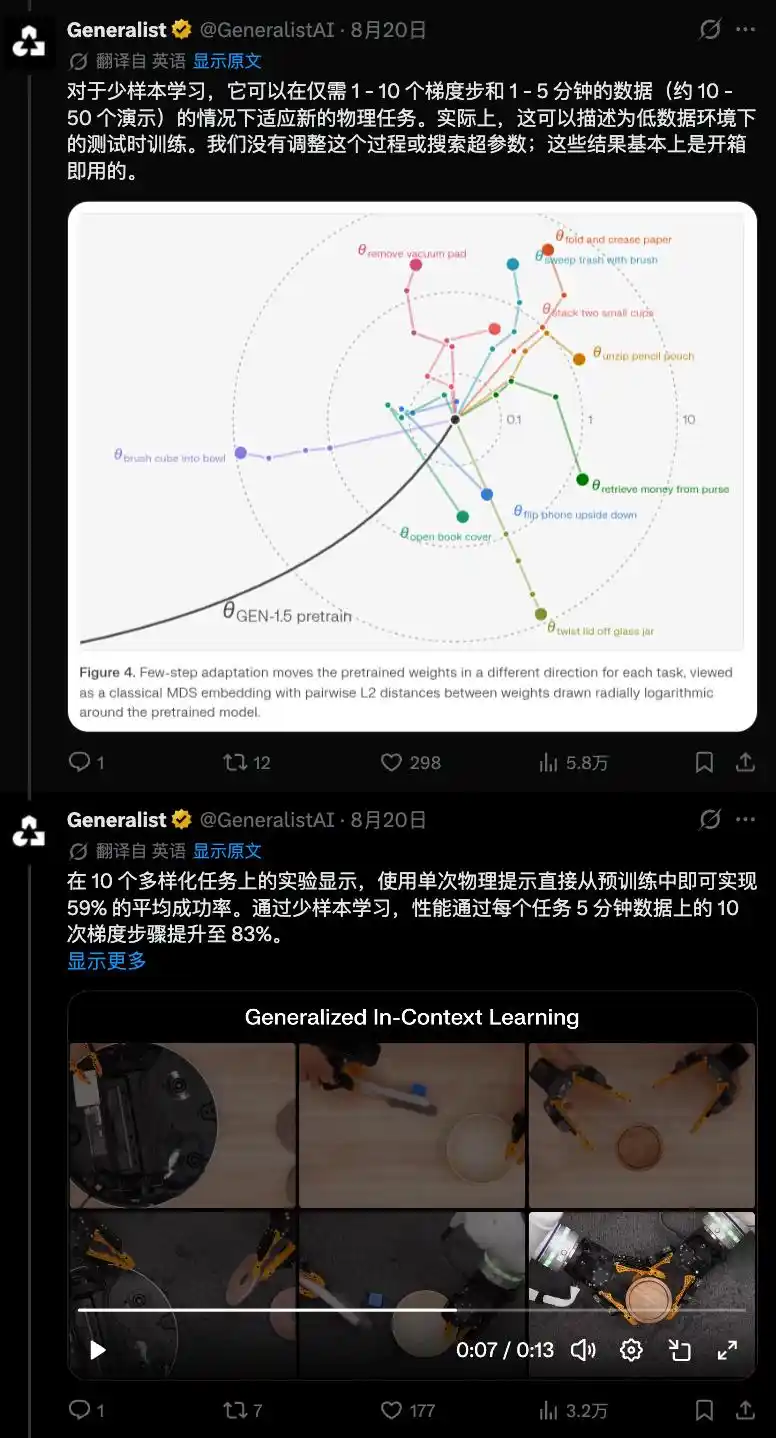
Compare this with GPT-3's numbers on language tasks in 2020: one-shot about 45%, few-shot (about 100 examples) about 65%.
The structure of these two sets of numbers is highly similar.
The meaning of these numbers can be understood this way: Before the emergence of large language models, having AI perform a new language task (like translating an unseen format) required specialized data collection and training a new model, taking months.
After GPT-3, this became 'writing a few examples in the input box,' compressing the time cost from months to seconds.
GEN-1.5 did the same compression in the field of physical manipulation.
Previously, teaching a robot to unscrew a bottle cap required engineers to program for months or feed tens of thousands of training data points for repeated parameter tuning.
Now, a 3 to 12-second demonstration is enough.
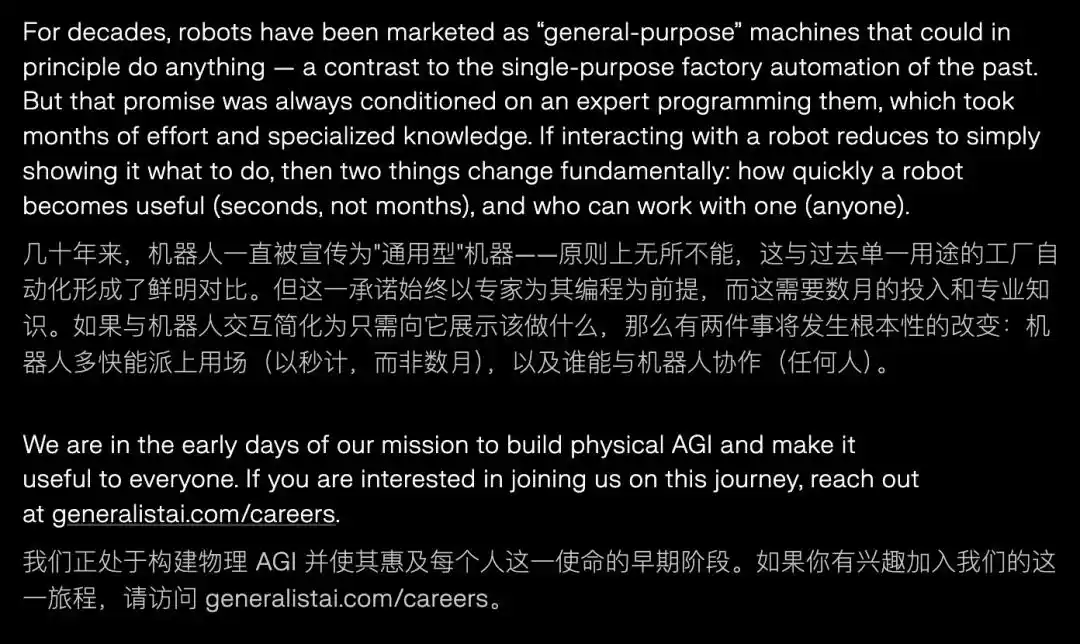
Generalist AI wrote in its official blog: This changes two things: the speed at which robots become useful (from months to seconds), and who can use robots (from experts to anyone).
The Boiling Week for Robotics: Unitree's IPO, Robot Conference, and Games Simultaneously Open
The release of GEN-1.5 falls within the most intensive week for the entire embodied intelligence industry.
Starting August 19, the WRC World Robot Conference opened in Beijing Yizhuang, featuring over 300 companies, more than 2000 exhibits, and over 150 global debut new products.
Three days later, on August 22, the second World Humanoid Robot Games opened at the National Speed Skating Oval 'Ice Ribbon'—666 teams with 2056 robots participated in 1301 matches across 51 events, a 138% increase in team numbers from the first games.
The Games introduced 21 scenario-based events for the first time, requiring humanoid robots to complete long-horizon tasks in real environments like factories, hotels, and home services, making 'on-the-job testing' the theme.
Unitree Technology, which just rang the bell, had humanoid robot shipments exceeding 5500 units in 2025, ranking first globally, with revenue of 1.7 billion yuan and a gross margin of 60%. DeepSeek also participated in strategic placement.
But Unitree's prospectus hides a set of contrasting data: Q1 2026 revenue growth slowed from 332.64% YoY to 68.49%, and non-GAAP net profit fell 52.55% YoY. The core reason for the slowdown is a significant increase in R&D investment.
What Unitree is chasing is precisely what it lacks: a large embodied intelligence model.
'New Position Pro' wrote in an analysis ("Unitree's Prospectus Hides Anxiety About the 'Shelf Life' of an Engineering Miracle") about the structural dilemma Unitree faces: Unitree built the globally top-shipping body, but the 'brain is absent.'
2026 is called the 'big year for IPOs' in embodied intelligence, with over 20 companies clarifying IPO plans, but the IPO wave is largely driven by funding pressure.
A large number of competitors rely on round after round of financing to sustain operations, with R&D pace dictated by financing windows.
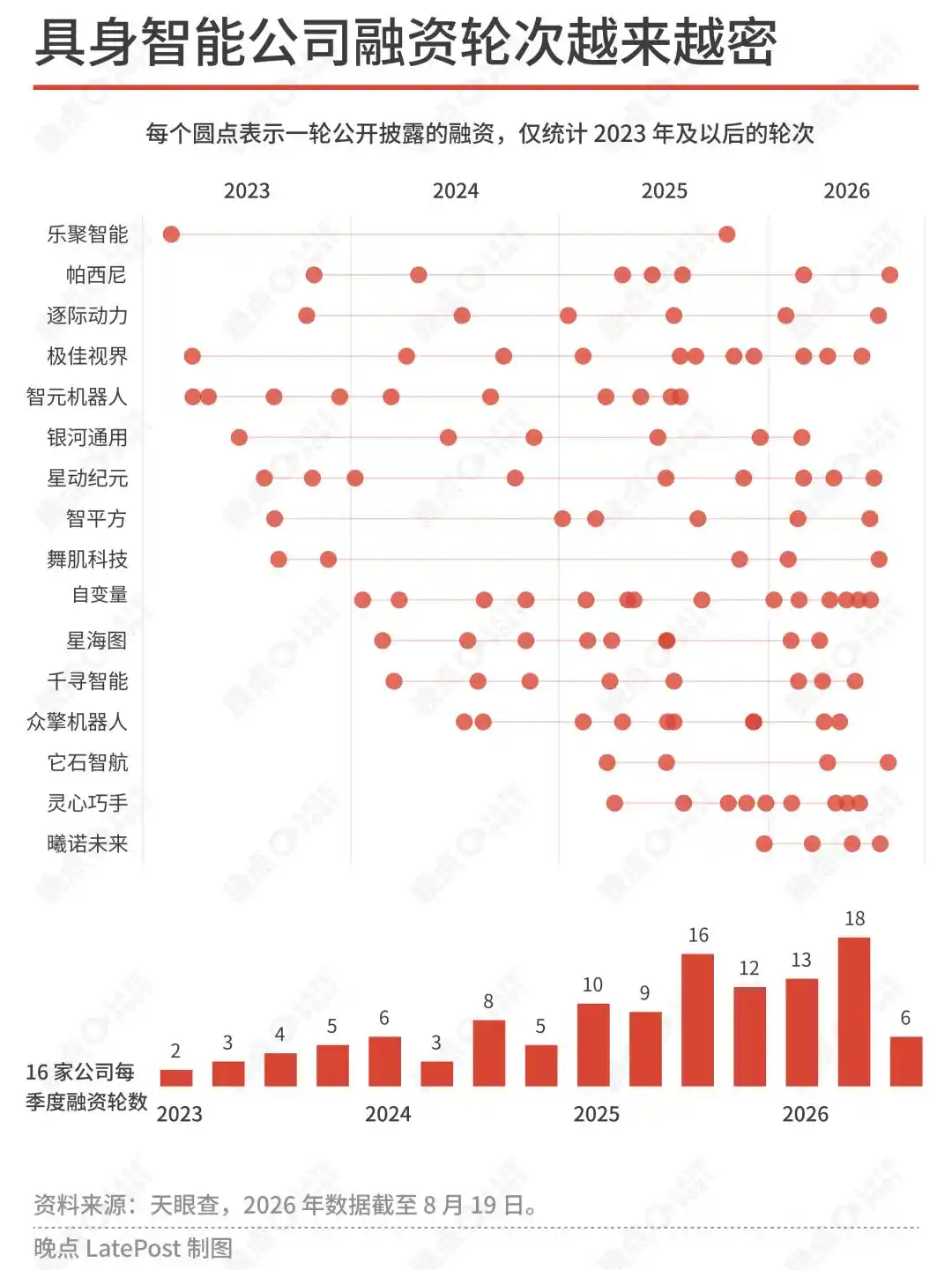
Source: LatePost 'The Money Game of Embodied Intelligence'
Unitree founder Wang Xingxing stated publicly at the WRC that the main bottleneck limiting humanoid robot development is the large embodied intelligence model, 'It is estimated that in as little as two to three years, or as long as five to ten years, we may achieve the ChatGPT moment for robots.'
The release of GEN-1.5 can be seen as the first empirical response to this judgment.
The Scaling Law exists in the field of embodied intelligence; large-scale pre-training can make the marginal cost of adapting to new tasks approach zero.
This conclusion has direct industrial implications for body manufacturers like Unitree: Once a general model at the brain level matures, the value of the body will depend on how quickly it can connect to this brain, not just hardware specifications and shipment scale.
The team background of Generalist AI is highly consistent with this technical path.
Co-founders Pete Florence and Andy Zeng come from Google DeepMind's robotics team, Andrew Barry from Boston Dynamics.
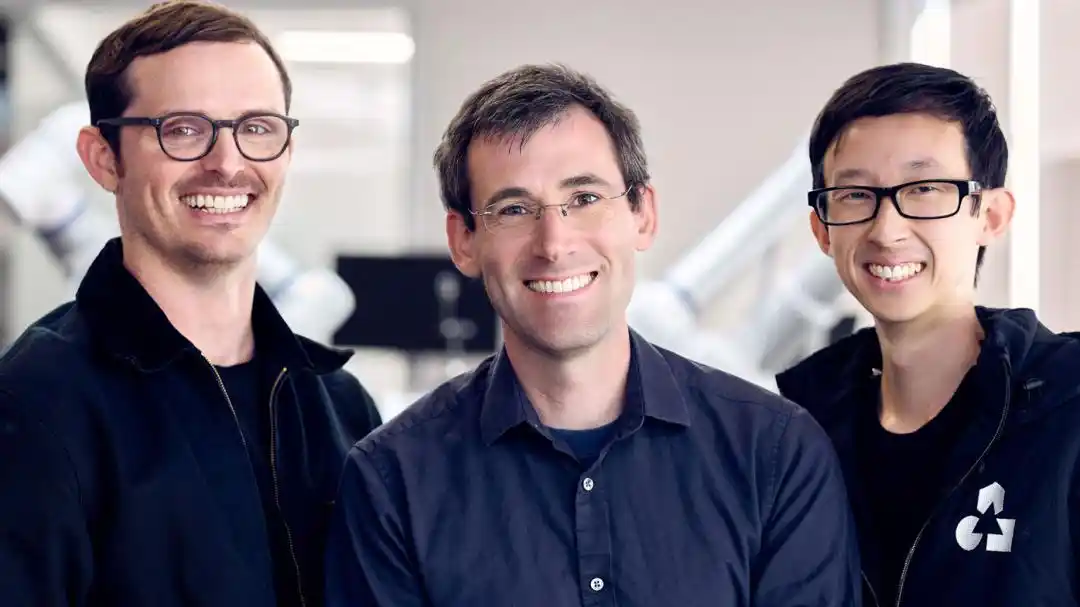
From left to right: Pete Florence, Andrew Barry, Andy Zeng
The company completed a $400 million funding round in June 2026, led by Radical Ventures, with participation from NVIDIA and Bezos Expeditions, post-money valuation $2 billion.
Generalist AI is negotiating a new funding round at a $3 billion valuation.
Silicon Valley Titans Experience a Long-Awaited Collective Boiling Moment
This release has triggered strong reactions within the robotics research community.
Co-founder Pete Florence wrote on X:
Since I began researching robotic foundation models, broad one-shot in-context learning has been the clearest goal in my heart.
Now I see nearly a decade of imagination walk into the real world.

Florence mentioned that he and Andy Zeng discussed a kind of 'Ctrl-C-Ctrl-V' capability during their graduate studies: seeing an action, the robot can replicate it—but achieving it was extremely difficult because 'the world you want to paste into is never the same as the world you copied from.'
Carnegie Mellon University robotics researcher Chris Paxton called GEN-1.5 'might be the real GPT moment' on X, writing:
The holy grail of manipulation learning, without a doubt, is one-shot learning.

https://x.com/chris_j_paxton/status/2090270734816092334

https://x.com/chris_j_paxton/status/2090210797125611972
Northeastern University embodied intelligence researcher Jimmy Yang retweeted, saying:
As an embodied AI researcher, this is a truly special moment for this field.

https://x.com/JimmyTYYang1/status/2090202923632366073
NVIDIA Robotics Technology Director Jim Fan's comment provided an in-depth technical observation perspective.
He pointed out two key factors for GEN-1.5's emergent capabilities:
First, the naturally occurring symmetrical repetitive action patterns in the training data, like repeatedly screwing in screws when assembling furniture, where the second screw is an 'in-context learning sample' of the first;
Second, human recovery actions after mistakes in the data, like picking something up and continuing after dropping it. This complete 'failure-recovery-continuation' arc allows the model to naturally exhibit error correction ability during testing.
Jim Fan also pointed out that the UMI data collection method used by Generalist AI (humans operating directly wearing robot grippers) preserves human 'physical intuition,' which is largely lost in traditional teleoperation where it's relayed through VR devices.
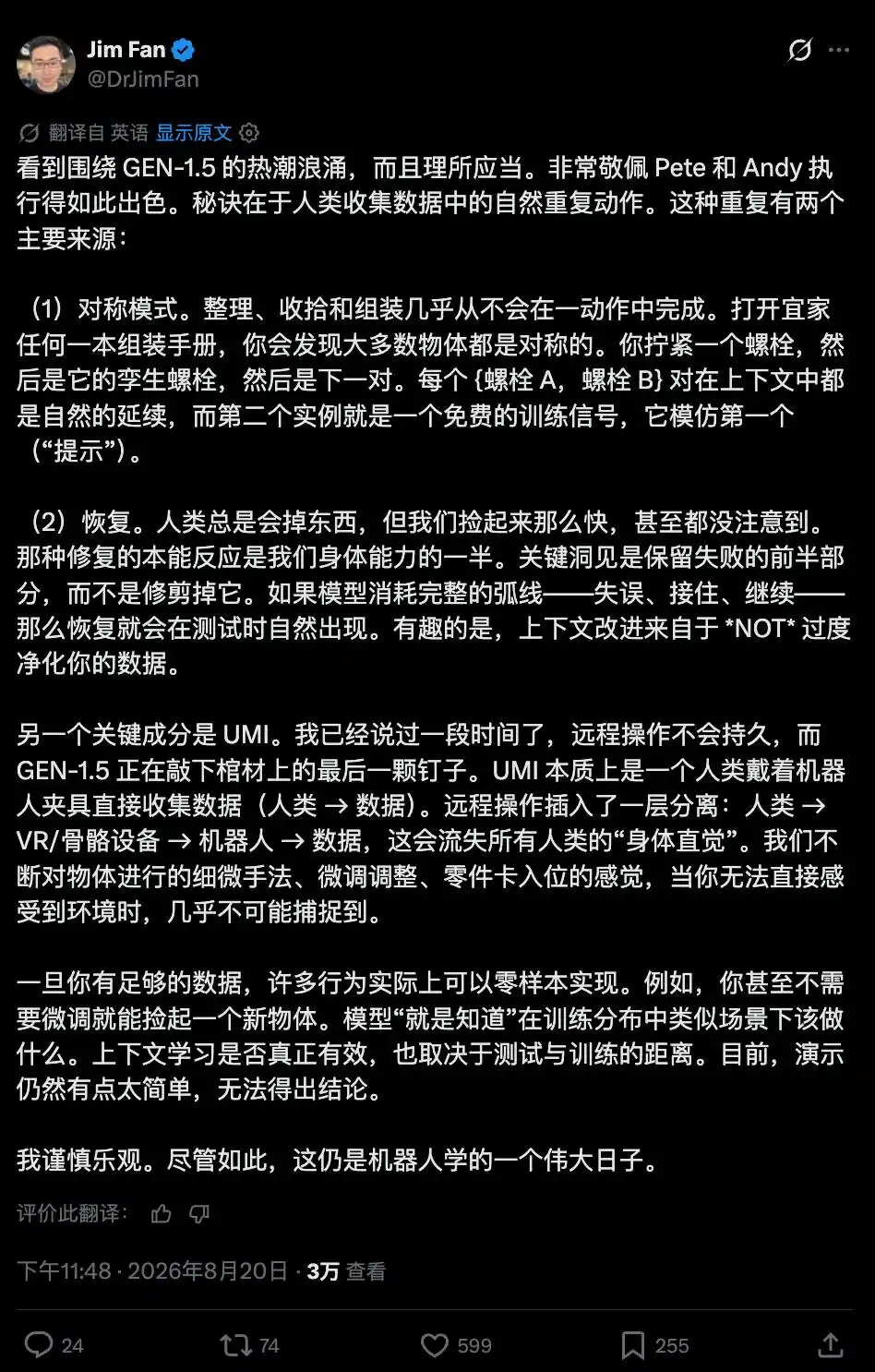
https://x.com/DrJimFan/status/2090465981240086992
Of course, rational skepticism also exists.
Jim Fan wrote in the comments of the same tweet:
The demonstrations are still a bit too simple to draw conclusions.

https://x.com/DrJimFan/status/2090469108764823587
This article is from the WeChat public account "XinZhiYuan" (New Wisdom Source), author: ASI Revelation