The semiconductor industry is once again facing a new round of price hikes driven by supply-demand dynamics and costs.
According to reports from 21st Century Business Herald and other media outlets, as of August, multiple semiconductor companies both in China and abroad have successively issued price adjustment notices to their customers, with the analog chip and RF chip sectors becoming the focal points of this round of price adjustments. Based on official customer notification documents that have surfaced, companies like STMicroelectronics, Analog Devices (ADI), and Maxscend have all confirmed the implementation of new supply prices in the second half of the year.
STMicroelectronics (STMicroelectronics), as a global leader in power semiconductors and MCUs, has products widely covering the industrial, automotive electronics, and consumer electronics fields. This semiconductor giant headquartered in Geneva, Switzerland, has already initiated its third product price adjustment within the year 2026. The notification sent to its customers indicates that a new round of price increases will take effect on August 23rd, covering multiple product lines.
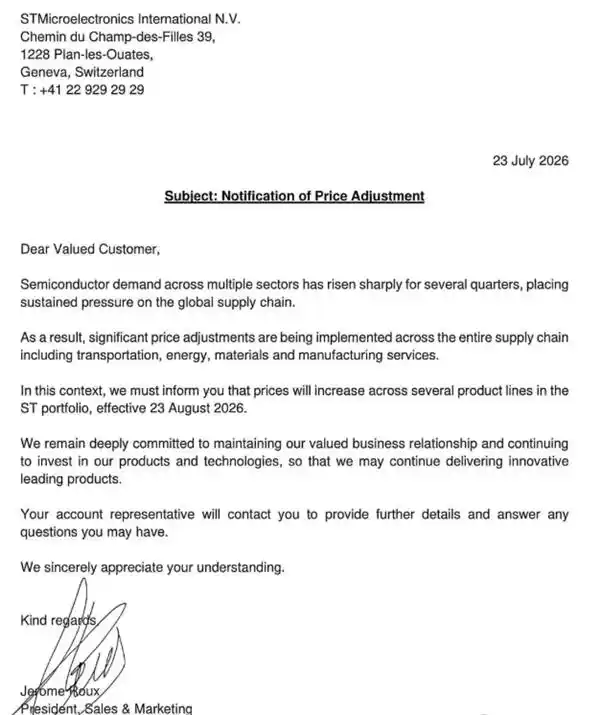
Discussing the reasons for the price hike, Jerome Roux, President of STMicroelectronics' Sales and Marketing, stated in the notification that semiconductor demand from multiple industries has significantly increased for several consecutive quarters, putting sustained pressure on the global supply chain. Consequently, there have been substantial price adjustments across the entire supply chain, including transportation, energy, raw materials, and manufacturing services.
At the end of May this year, Jiemian News reported that STMicroelectronics had sent a "Price Adjustment Notice" to its customers, announcing price increases for some products starting from June 28th. This was another price adjustment following the one announced on March 24th this year. Prior to this, international power semiconductor giants like Infineon and Texas Instruments had also successively issued price increase notices. Additionally, domestic MCU manufacturers such as SMIC and Nationz Technology have also raised prices.
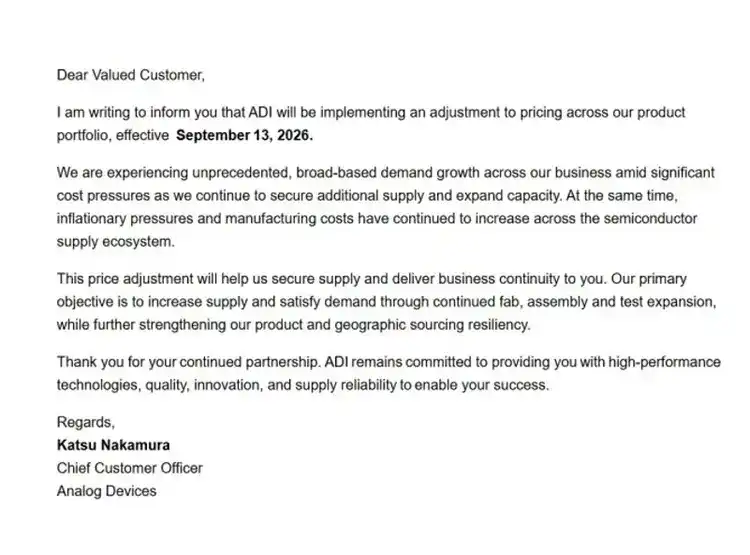
Apart from STMicroelectronics, the international analog chip giant Analog Devices (ADI) has also followed suit with a new round of price adjustments. ADI is a global leader in analog signal processing chips, with products extensively used in industrial control, communication, and high-reliability military equipment. According to its official letter to customers, this round of price adjustments across the entire product portfolio will officially take effect on September 13, 2026. This marks ADI's second price hike this year, with the first one taking effect on February 1st.
Katsu Nakamura, ADI's Chief Customer Officer, wrote in the notification letter, "As we continue to strive for additional supply and expand capacity, our business is experiencing unprecedented demand growth across the board while facing significant cost pressures. Concurrently, inflationary pressures and rising manufacturing costs within the entire semiconductor supply ecosystem persist."
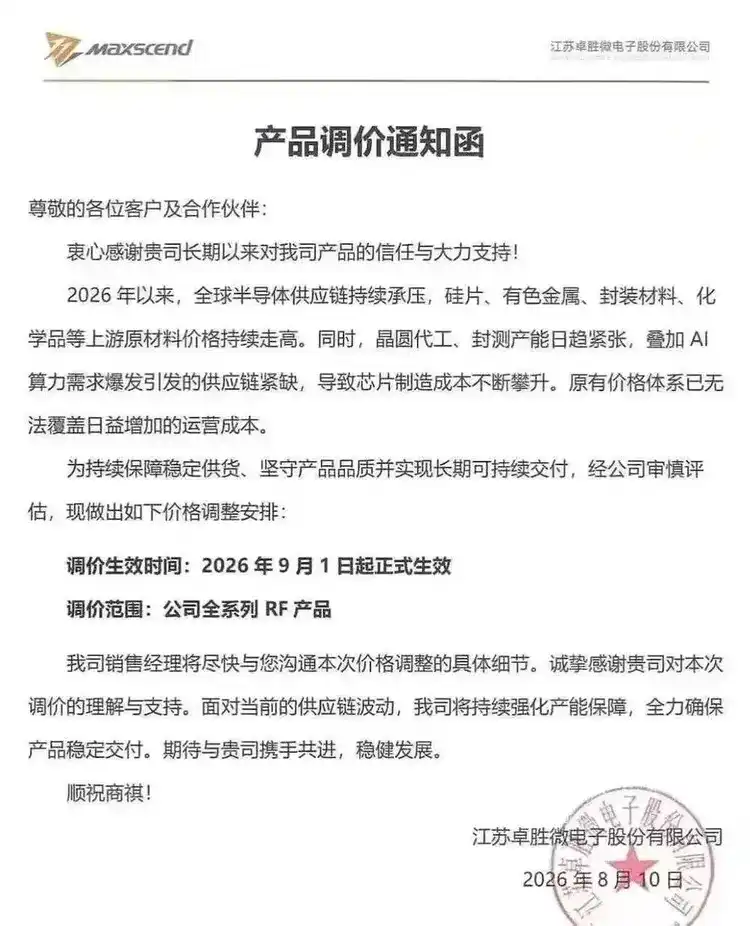
Domestic RF chip leader Maxscend has also joined this round of price adjustments. Jiangsu Maxscend Microelectronics Co., Ltd. is a core domestic manufacturer of RF front-end chips, with products used in smartphones and wireless communication devices.
On August 10th, Maxscend issued a "Product Price Adjustment Notice," announcing that starting from September 1st, the supply prices for the company's full range of RF products will be increased. The notice points out that since 2026, the global semiconductor supply chain has remained under continuous pressure, with upstream raw material prices such as silicon wafers, non-ferrous metals, packaging materials, and chemicals consistently rising. Meanwhile, capacity for wafer fabrication, packaging, and testing has become increasingly tight, coupled with supply shortages triggered by the explosive demand for AI computing power, leading to continuous increases in chip manufacturing costs. The original price structure can no longer cover the growing operational expenses. This is Maxscend's first price adjustment this year.
On August 11th, Jiemian News learned from Nationz Technology that the company will increase the prices of some products by 10% to 20% starting October 1st. This price adjustment primarily involves high-performance MCUs, with related products mainly used in industrial applications, AI power supplies, digital power supplies, and other fields.
Nationz Technology told the Jiemian News reporter that recently, the delivery lead times for related products from some international peers have generally lengthened, market shortages have emerged, and customer demand for domestic alternatives has increased. At the same time, with the growth in AI-related demand, some upstream capacity has been squeezed, leading to changes in the supply-demand dynamics.
Compared to the semiconductor price hikes in the first half of this year, the focus of the new round of increases has shifted to the mature process segment, while the extent of price increases for memory chips has moderated, transitioning into a period of high volatility. AI computing power not only consumes advanced node capacity but also significantly occupies 8-inch mature wafer capacity, squeezing available capacity for RF, industrial analog, and automotive-grade MCUs. Even without a recovery in consumer electronics terminal demand, tight capacity in mature wafer fabrication directly pushes up manufacturing costs across the entire chain.
The price increases in the first half of the year were initially driven by AI memory chips like HBM and server DRAM, with Samsung, SK Hynix, and Micron leading the way by significantly raising contract prices for memory, with some server memory seeing extremely high quarterly increases, acting as the core engine of the market trend. This subsequently spread to analog, power, and passive components, presenting a pattern of "memory leading the increases, other categories following." At that time, the full impact of AI's absorption of mature process capacity had not yet fully manifested, with price increases more directly resulting from order surges for corresponding products themselves.
Some analysis suggests that the expansion cycle for analog and power semiconductors generally takes 18-24 months, making it difficult for new capacity to be released in the short term to match the incremental demand derived from industrial and AI applications. Therefore, price resilience is expected to persist for some time. However, downstream manufacturers have a cost tolerance ceiling. If price hikes continue to intensify, downstream players may counter cost pressures by substituting components or adjusting inventory levels, which in turn could constrain chip manufacturers' ability to raise prices significantly further.
For downstream customers, continuous price adjustments mean rising procurement costs. However, in their notification documents, major original equipment manufacturers almost invariably link price adjustments with supply security, indicating that part of the revenue from price hikes will be used to absorb costs, and part will be invested in capacity expansion to alleviate supply chain tensions.
In the short term, the probability of prices softening for analog, RF, and power chips is low. However, the market is not on a one-way upward trajectory; factors such as downstream cost tolerance and fluctuations in global macroeconomic demand will become variables influencing the future direction of semiconductor prices.
This article is from WeChat public account "Jiemian News," author: Song Jianan