Payments giant Stripe acquires team from crypto wallet app Valora

cointelegraphPublicado a 2025-12-11Actualizado a 2025-12-11

Resumen

Payments giant Stripe has acquired the team behind crypto wallet app Valora, a day after launching the testnet for its stablecoin-focused blockchain project, Tempo. Valora CEO Jackie Bona stated the team will join Stripe to contribute expertise in web3 and user-first experiences. Valora, which spun out of Celo development group cLabs in 2021, offers a mobile wallet supporting stablecoins across multiple blockchains. The Valora app will continue operating under cLabs. This move accelerates Stripe's growing blockchain initiatives, particularly Tempo network, which has a $5 billion pre-launch valuation and emphasizes easy stablecoin creation.

Payments giant Stripe has acquired the team from crypto wallet firm Valora, just a day after launching its testnet for its stablecoin-focused blockchain project Tempo.

According to Valora CEO Jackie Bona, the acquisition will see the Valora team join Stripe and work on the firm’s blockchain initiatives.

Valora was founded in mid-2021 after spinning out of Celo development group cLabs and raising $20 million in Series A funding in the process.

The Valora app is a mobile wallet that supports stablecoins and other assets across Celo, Ethereum, Base, Optimism and Arbitrum. Apart from the wallet, the team also developed an open protocol launchpad for Web3 apps geared toward a mobile-native experience.

“Stripe shares our conviction that stablecoins and crypto can dramatically expand who gets to participate in the global economy,” said Bona, adding that “by bringing Valora’s team to Stripe, we’ll be able to contribute our expertise in web3 and user-first experiences to a platform with unparalleled reach.”

It is not explicitly stated what the Valora team will work on; however, Stripe will be tapping a team that has had a strong focus on global payments, digital wallets and user-friendly smartphone-based Web3 apps.

“Through this work, we’ve seen firsthand how access to stablecoins and crypto rails can expand economic opportunity. In the past few months, it became clear that we could accelerate this mission by joining Stripe, one of the world’s leading financial infrastructure platforms,” Bona said.
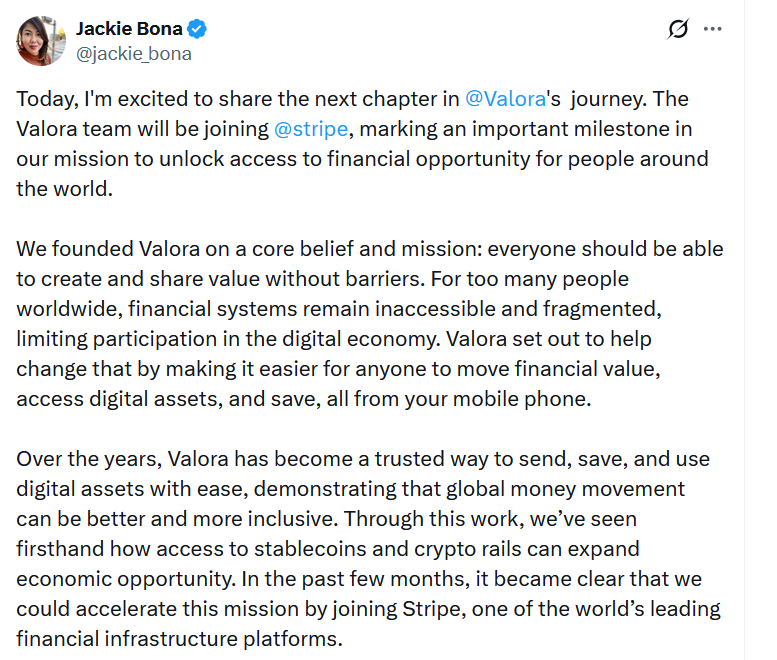
Source: Jackie Bona

Related: The easiest and safest methods for gifting crypto at Christmas in 2025

The Valora app will continue to function, but its operations and future development will be handed over to cLabs.

Momentum building for Stripe and Tempo

After an on-again-off-again relationship with crypto, Stripe has been making strides in the blockchain space over the past couple of years. Momentum has been building particularly since first unveiling Tempo four months ago in partnership with crypto VC firm Paradigm, with the network already having a $5 billion pre-launch.

The latest move from Stripe comes just a day after Stripe and Paradigm’s layer-1 blockchain project Tempo launched its open testnet.

One of the key features highlighted during the testnet launch was the ease and simplicity of creating stablecoins directly in the browser, among other benefits.

Magazine: 11 critical moments in Ethereum’s history that made it the No.2 blockchain

Lecturas Relacionadas

What Happens to Ethereum Developer Tools After the Grants Run Out?

On February 27th, the Ethereum Foundation (EF) announced Project Odin, a structured sustainability support program designed for a select group of strategic, previously grant-funded teams. Unlike a standard grant, Odin offers a long-term advisory mechanism focused on helping these teams establish credible, sustainable paths within a two-year framework, thereby reducing long-term dependence on single funding sources. The program addresses a critical post-grant challenge: how essential public goods, especially major developer tools, can achieve financial sustainability beyond initial funding. While grants from EF and programs like Gitcoin or RetroPGF remain vital for startups and research, they often fall short for mature, widely-used infrastructure. Tools like compilers, languages, and network stacks are deeply embedded but struggle with monetization, trapped between being too foundational to lose and too public to generate natural revenue. Project Odin provides teams with a dedicated Strategic Advisor to guide them through a three-phase process: 1) analyzing current funding and realistic options, 2) validating potential paths with stakeholders, and 3) executing plans, which may include crafting support contracts, service agreements, or other recurring revenue models. The first pilot participant is Vyper, a critical smart contract language for the EVM, highlighting the need for sustainable models for core infrastructure. The initiative reframes the public goods conversation from "who should be funded" to "how do already-proven teams avoid perpetual funding crises?" It encourages ecosystem participants—protocols and projects that depend on these tools—to view sustainable support not just as charity, but as essential risk management for their own operational supply chains.

marsbitHace 25 min(s)

What Happens to Ethereum Developer Tools After the Grants Run Out?

marsbitHace 25 min(s)

MARA Reports Q1 Revenue Below Expectations, Net Loss of $1.3 Billion, Stock Plunges After Hours

Bitcoin mining firm MARA Holdings reported disappointing Q1 2024 results, causing its stock to erase all daily gains and fall 3.44% in after-hours trading. Revenue dropped 18% year-over-year to $174.6 million, missing Wall Street estimates of $192.7 million. The company posted a net loss of $1.3 billion, a significant increase from a $533.4 million loss a year ago, primarily driven by unrealized losses on its holdings of 38,689 Bitcoin, which depreciated in value during the quarter. MARA also sold over 15,100 BTC in late March to repurchase debt at a discount. The broader mining environment remains challenging due to a 35% decline in Bitcoin's price from its all-time high and a nearly 30% increase in mining difficulty over the past year. MARA's market cap ranking among U.S. miners has slipped to seventh. Critically, the company announced a strategic pivot away from Bitcoin mining expansion. It stated it has no plans to purchase new mining equipment and is fully transitioning toward AI data centers. Its strategy involves retrofitting existing mining sites for AI and high-performance computing (HPC) and leveraging its recent $1.5 billion acquisition of Long Ridge Energy & Power, a gas-fired power plant and data center. This infrastructure could eventually support 600 MW of AI compute capacity, allowing MARA to redeploy up to 90% of its non-custodial mining power for AI and IT workloads.

marsbitHace 25 min(s)

MARA Reports Q1 Revenue Below Expectations, Net Loss of $1.3 Billion, Stock Plunges After Hours

marsbitHace 25 min(s)

The AI Investment Landscape Is Being Reshaped: Beyond the 'Magnificent Seven', What Opportunities Lie in the Semiconductor Supply Chain?

AI Investment Map is Reshaping: Opportunities Beyond the 'Magnificent Seven' Since ChatGPT ignited the AI wave, investment initially focused on the "Magnificent Seven" tech giants dominating cloud infrastructure. However, the rise of DeepSeek and debates on AI capital expenditure effectiveness are shifting this dynamic. Investors now recognize opportunities deeper in the supply chain—the companies providing the essential "picks and shovels." Early concerns about an AI investment "arms race" and potential low returns were partly alleviated by strong Q1 earnings from cloud providers, validating robust compute demand. This has highlighted a more certain investment thesis: regardless of which AI applications ultimately win, massive capital expenditure will first fuel demand for semiconductors and related components. This "pick-and-shovel" logic has driven semiconductor ETFs to record highs. Key beneficiaries include: * **Memory Chipmakers (e.g., SK Hynix, Samsung, Micron)**: High Bandwidth Memory (HBM) is a critical bottleneck for AI training. * **Photonics Companies**: Crucial for high-speed data transfer within AI data centers. * **The Broader "AI-11" Semiconductor Ecosystem**: This encompasses foundries & lithography (TSMC, ASML), logic & custom chips (AMD, Broadcom, Intel, Marvell), and enterprise storage (SanDisk, Western Digital). Every dollar of AI infrastructure spending flows through this chain. While the "Magnificent Seven" remain dominant in market size, their earnings growth premium over the rest of the S&P 500 ("S&P 493") is narrowing. Market attention and marginal investment are shifting towards the expanding semiconductor supply chain. The investment narrative is evolving from "betting on the ultimate AI winner" to "investing in the certainty of the infrastructure build-out." Understanding this shift from the demand side to the supply side is key to identifying future AI investment opportunities.

marsbitHace 54 min(s)

The AI Investment Landscape Is Being Reshaped: Beyond the 'Magnificent Seven', What Opportunities Lie in the Semiconductor Supply Chain?

marsbitHace 54 min(s)

Trading

Spot
Futuros
活动图片