Chip Stocks 'Hit a Wall,' But the Market Has Not

marsbitPublicado a 2026-08-10Actualizado a 2026-08-10

Resumen

Chip stocks face volatility, driven by the blowup of an AI hedge fund (Situational Awareness), which briefly dragged the Philadelphia Semiconductor Index down 29%. However, the market has defied concerns, treating the sell-off as a buying signal. Investors injected over $11 billion into semiconductor ETFs in two days, fueling strong rallies in leveraged and non-leveraged funds. This dynamic is part of a broader surge in risk appetite: the S&P 500 hit a record high, high-yield bond funds saw their largest weekly inflow in two years, and Bitcoin ETFs attracted significant capital. Bank of America's Bull & Bear Index has risen to its highest level since 2021. Market strategists note the momentum-driven "tsunami" in buying, though concentration remains in mega-cap tech stocks. Despite the optimism, a key risk persists: elevated Treasury yields, with the 30-year yield near two-decade highs, pose a headwind. A weak July jobs report, however, eased near-term Fed hike fears and supported markets. Analysts suggest the economic backdrop remains solid, with AI infrastructure demand underpinning growth, though potential bottlenecks like power supply could emerge. The prevailing investor psychology is that recent pullbacks have been brief, reinforcing confidence to buy dips, as evidenced by a sharp drop in semiconductor volatility. The overarching narrative is one of resilient money flows toward risk assets despite a lengthening list of worries.

Author: Bu Shuqing

Plunging chip stocks, surging bond yields, and ongoing geopolitical conflicts—Wall Street's worry list keeps growing, yet the flow of funds tells a completely different story.

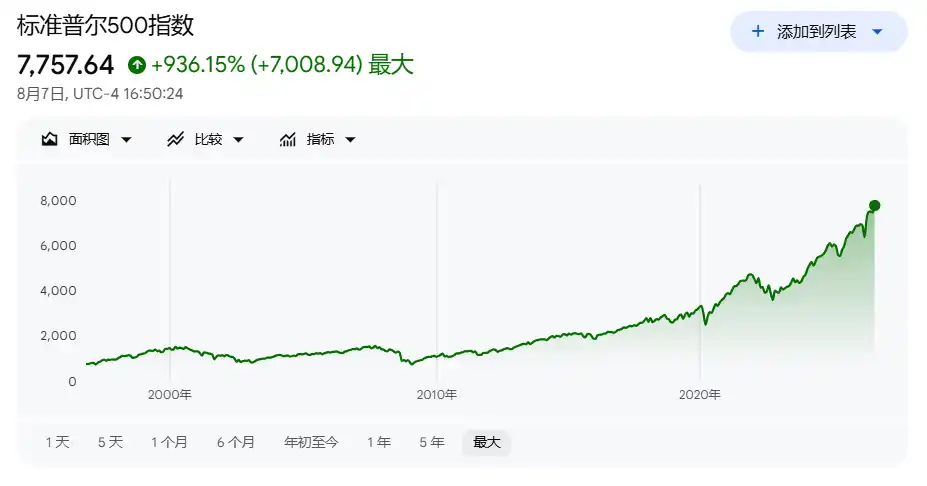
Last week, the S&P 500 hit a new all-time high, the Nasdaq 100 recorded its biggest weekly gain in two months, while high-yield bond funds attracted $4 billion in a single week, the highest inflow in two years, and Bitcoin ETFs saw a net inflow of $500 million over five trading days. Bank of America's Bull & Bear Index climbed to its highest level since 2021, indicating that market sentiment has turned decisively optimistic.
All this happened in the aftermath of the blow-up of AI hedge fund Situational Awareness—founded by the "Silicon Valley Stock God" Leopold Aschenbrenner. The event dragged the Philadelphia Semiconductor Index down 29% from its June high. However, instead of retreating, investors saw the turmoil as a buying signal, pouring more than $11 billion into semiconductor ETFs in just two trading days, subsequently sending those funds soaring.

Chip Plunge Becomes a Buy Signal

The blow-up of Situational Awareness was the most dramatic episode in recent markets. The struggles of this AI-themed hedge fund pulled the Philadelphia Semiconductor Index down 29% from its June peak, triggering sharp volatility in tech stocks.

But the market's reaction defied traditional risk-off logic. According to Bloomberg data, the triple-leveraged Direxion Daily Semiconductor Bull 3X ETF attracted over $2 billion in inflows in just two trading days, subsequently rallying more than 50% over seven sessions.

The two largest non-leveraged semiconductor funds together attracted over $7 billion during the same period, each rising about 16%.

Michael O'Rourke, Chief Market Strategist at JonesTrading, characterized this as a "tsunami" of momentum buying. "The Situational Awareness event created a tactical low for the AI trade, unleashing a massive wave of momentum-chasing behavior," he said. "However, it's worth noting that many investors still prefer concentration in mega-cap stocks, with the Magnificent Seven remaining the primary driver of index gains."

Risk Appetite Heats Up, From Retail to Institutions

What's driving the market isn't just the rebound in chip stocks, but a broad-based influx of funds across asset classes.

Citing Bank of America data, Bloomberg reported that high-yield bond funds saw a net inflow of $4 billion last week, the largest weekly amount in two years; Bitcoin ETFs recorded a net inflow of $500 million in the five trading days through last Thursday, despite Bitcoin's price having traded sideways in a narrow range for months. In the equity market, investors poured over $11 billion into leveraged and non-leveraged semiconductor ETFs combined last week.

Bank of America's Bull & Bear Index subsequently rose to its highest level since 2021. The team led by strategist Michael Hartnett noted that the equity rally has broadened beyond the core tech sector, with strong inflows into high-yield bonds and narrowing credit spreads supporting the optimistic sentiment.

Garrett Melson, a portfolio strategist at Natixis Investment Managers Solutions, believes current market fears are overblown and the fundamentals for risk assets remain solid. He maintains an overweight position in U.S. stocks, focused on large-cap tech, while keeping a low allocation to fixed income but holding some longer duration and selective credit exposure. "Ultimately, economic growth is performing well," Melson said. "Sentiment and positioning can become overextended at times, but this excess heat is localized. Rotation helps digest some of the excess froth while maintaining support for the indices."

The Shadow of High Yields: Bond Market Pressure Lingers

The party in risk assets is not unfolding in a worry-free environment. Although the yield on the 30-year U.S. Treasury fell on four of the past five trading days, it remains near its highest levels in nearly two decades, presenting a persistent background pressure the market cannot ignore.

Analysts are divided on the causes of the elevated yields. Some blame the late-July surge on Fed Chair Kevin Warsh deliberately avoiding clear rate guidance, casting doubt on the central bank's resolve to fight inflation; others argue the bond market movement reflects investor confidence in sustained economic expansion.

Last Friday, data from the U.S. Labor Department showed American employers unexpectedly cut jobs in July, with previous months' figures also revised down. This surprisingly weak jobs report instead boosted stocks, pulling bond yields lower as markets bet the Fed would not be forced to hike rates in the near term.

Lindsay Rosner of Goldman Sachs Asset Management said that as data clarifies, oil prices stabilize, and the full economic picture becomes clearer along with returns on capital expenditure. "Putting together what we're seeing, the economy is still strong, the market is adapting to the current AI supply, and price discovery is happening about what's ahead," she said.

Ayako Yoshioka, Senior Investment Strategist at Wealth Enhancement, cautioned that semiconductors remain the core of AI infrastructure buildout, but as the process advances, bottlenecks could shift towards electricity supply shortages. "Higher yields remain a risk—especially as AI infrastructure construction continues to knock on the bond market's door," she said.

Brief Pullbacks Repeatedly Reinforce Bullish Conviction

Supporting the current market sentiment is a repeatedly proven investor psychology—every pullback is short-lived, every panic is a buying opportunity.

Nathan Thooft, Senior Portfolio Manager at Manulife Investment Management, noted that price corrections have proven time and again to be fleeting, constantly reinforcing investors' psychological fortitude. Those who chose to exit at times of highest uncertainty have paid a price, as the biggest gains often occur precisely during the market's most turbulent moments.

"There still isn't a compelling alternative," Thooft said. "Cash may feel safe, but over the long term, it struggles to outpace inflation and earnings growth akin to stocks. As for bonds, we believe the term premium is still underestimated. Over the past decade, investors who kept waiting for a better entry point have largely been left behind by the market."

The Cboe Semiconductor ETF Volatility Index fell nearly 9 points this week, marking its biggest weekly decline this year, vividly illustrating the rapid repair in market sentiment. Although the worry list continues to lengthen, the direction of the money flow still clearly points toward risk assets.


Criptos en tendencia

Preguntas relacionadas

QWhat were the key contradictory market signals mentioned at the beginning of the article?

ADespite a list of concerns including a slump in chip stocks, surging bond yields, and ongoing geopolitical conflicts, capital flows told a different story. The S&P 500 hit a record high, the Nasdaq 100 posted its biggest weekly gain in two months, high-yield bond funds saw record inflows, and Bitcoin ETFs had significant net inflows, with the Bank of America's bull-bear index reaching its highest level since 2021.

QHow did the market react to the Situational Awareness hedge fund blow-up and the subsequent dip in chip stocks?

AInvestors treated the market turbulence triggered by the AI hedge fund's blow-up as a buying signal. In just two trading days, they poured more than $11 billion into semiconductor ETFs, leading to a sharp rebound. Notably, the triple-leveraged Direxion Daily Semiconductor Bull 3X ETF attracted over $2 billion in two days and surged more than 50% in the following seven sessions.

QAccording to the article, what is the current state of risk appetite among investors?

ARisk appetite has warmed significantly across the board, from retail to institutional investors. This is evidenced by massive inflows into high-yield bond funds, Bitcoin ETFs, and semiconductor ETFs. The Bank of America bull-bear index rose to its highest level since 2021, indicating widespread market optimism.

QWhat are the two main explanations given in the article for the persistently high 30-year US Treasury yield?

AAnalysts are divided. Some attribute the yield surge to Federal Reserve Chair Kevin Warsh's deliberate avoidance of clear interest rate guidance, which raised doubts about the Fed's resolve to fight inflation. Others believe the bond market movement reflects investor confidence in the economy's continued expansion.

QWhat potential risk does the article highlight for the ongoing AI infrastructure build-out, beyond semiconductors?

AThe article suggests that while semiconductors remain core to AI infrastructure, bottlenecks could shift to power supply shortages as the build-out progresses. Furthermore, higher bond yields pose a risk, especially as AI infrastructure construction continues to put pressure on the debt markets.

Lecturas Relacionadas

When 'Odysseus' Encounters the Algorithm

Christopher Nolan's "Odyssey," a $250 million IMAX epic, premiered in July 2026, quickly grossing over $1 billion and setting box office and critical records. The film's production was defined by its physical scale: shooting across six countries with practical effects, custom-built IMAX cameras, and extensive use of film. Concurrently, the AI-generated film "Odysseus: The Fall," created by the independent studio Fountain0 for just $50,000, demonstrated the technical feasibility of AI in long-form filmmaking. This stark 5,000x cost difference highlights a broader industry conflict between traditional, experience-driven production and algorithmic efficiency. While the AI film achieved technical success, it revealed current limitations, such as unstable long shots, inconsistent characters, and a lack of nuanced emotional performance. More importantly, its infinite, low-cost nature lacks the scarcity and immersive "event" status that fuels the theatrical premium for films like Nolan's. The market strongly favored the traditional model's brand security, physical assets, and premium theatrical experience. The analysis suggests AI will not replace auteurs like Nolan but will significantly disrupt mid-tier productions and technical, labor-intensive roles (e.g., pre-visualization, VFX). This could erode the career pathways for future directors. Paradoxically, as AI content proliferates, the perceived value of "handcrafted," physically-shot cinema may rise, akin to artisanal goods. The core tension is framed as the irreconcilable conflict between algorithmic "efficiency logic" and cinematic "experience logic." Ultimately, the enduring human preference may be for the unique, difficult journey of traditional storytelling over the predictable, algorithmically smooth path.

marsbitHace 10 min(s)

When 'Odysseus' Encounters the Algorithm

marsbitHace 10 min(s)

Wall Street 'Conspiracy Theory': Did Powell Deliberately Push Up Long-Term U.S. Treasury Yields?

Bank of America refutes market speculation that Federal Reserve Chair Warsh deliberately pushed up long-term U.S. Treasury yields via press conferences to tighten financial conditions. Their report argues such action contradicts the Fed's established policy framework and would lack FOMC support. According to the report, some market participants interpreted the post-July FOMC meeting rise in long-end yields and inflation breakevens as a deliberate strategy by Warsh to combat inflation by tightening financial conditions. Analysts Mark Cabana and Aditya Bhave directly reject this, stating the FOMC's core policy tool remains the federal funds rate, as outlined in its long-term strategy statements. They emphasize Warsh cannot unilaterally alter the Fed's operational approach, which would require full FOMC consensus—a high bar. The analysis highlights the Fed's precise control over overnight rates versus its limited, indirect influence on long-term yields, which operate through policy expectations and the hard-to-manage term premium channel. The recent sharp move in long-end rates serves as a reminder of the risks of operating outside the Fed's direct control. The report concludes the FOMC is unlikely to abandon its proven, controllable tools for unverified methods, dismissing the "four-dimensional chess" theory of long-rate manipulation as market overinterpretation.

marsbitHace 13 min(s)

Wall Street 'Conspiracy Theory': Did Powell Deliberately Push Up Long-Term U.S. Treasury Yields?

marsbitHace 13 min(s)

Third Quarter Beijing Office Market: Investment and Owner-occupier Acquisition Demand to Recover in Parallel

Third Quarter Beijing Office Market: Investment and Owner-Occupier Acquisition Demand to Recover in Parallel Structural shifts in the domestic economy are reshaping office leasing demand. While expansion in high-tech sectors like AI, semiconductors, and new energy will drive demand, traditional industries may downsize to cut costs. Rents are expected to continue declining due to new supply and landlords' concessions, but prime submarkets attracting high-tech tenants will see slower rental declines and faster absorption. Tenants increasingly favor submarkets with strong industry clusters and supportive policies. The adoption of AI may also lead some firms to reduce their office footprint as they optimize workforce efficiency. The investment sales market is showing signs of recovery. Investor-buyers are becoming more active, targeting properties with stable rental income in key tech hubs. Simultaneously, owner-occupier demand is emerging from high-tech firms seeking headquarters. They prefer buildings in relevant industry locations with good renovation potential. Market Strategy for Q3 2026: * For Tenants: Those for whom office image is critical should consider prime buildings in the CBD. Leverage strong brand positions to negotiate favorable terms, including landlord contributions to fit-out costs. * For Landlords: Transition to service providers by offering industry-specific support like financing connections. Proactively engage expiring tenants with renewal incentives and dedicated account management. * For Buyers: Investor-buyers should target stable, well-occupied assets in submarkets like Zhongguancun. Owner-occupiers from high-tech sectors can seek value in properties with good locational fit but financially pressured sellers, carefully assessing renovation costs. Q2 2026 Market Snapshot: The average effective rent for Beijing Grade A offices fell 2.7% QoQ to RMB 197/sqm/month, with vacancy at a high 16.3%. High-tech sectors drove major leases in submarkets like Zhongguancun and Wangjing-Jiuxianqiao. Total investment sales volume reached RMB 14.2 billion, boosted by investor interest in tech areas and owner-occupier acquisitions by high-tech firms. The average sales price rose 24% QoQ to RMB 38,312/sqm, partly due to premium prices paid for owner-occupier purchases in key financial submarkets.

marsbitHace 13 min(s)

Third Quarter Beijing Office Market: Investment and Owner-occupier Acquisition Demand to Recover in Parallel

marsbitHace 13 min(s)

BofA Research Report Insights: Bull & Bear Indicator Rises to 9.7, Liquidity Backstop and Midterm Elections Form Market's Core Contradiction

Bank of America's Bull & Bear indicator rose to 9.7 in early August, its highest since 2021 and nearing a "sell" signal. Weekly flows showed $52.9B into cash, $32.9B into equities, and $23.1B into bonds. The report highlights a core market contradiction: clear policy intent to backstop financial conditions (evidenced by recent coordinated FX intervention, termed a "poor man's LTCM event") versus extreme bullish sentiment, widening credit spreads for AI mega-cap firms, and rising political uncertainty ahead of the midterm elections. Fund flows were mixed: while equity inflows are on a record annualized pace, the tech sector saw its first outflow in six weeks. Bank of America's strategy advises a "summer retreat or rotation"—exiting risk assets or rotating into defensive sectors (consumer staples), duration assets (REITs, small caps, biotech), and the USD to hedge against potential financial tightening. The midterm election is identified as the key macro variable for H2 2026, acting as a referendum on populist fiscal policies. A Republican-held Senate is viewed as market-positive. The report also notes that AI capital expenditure momentum requires the Mag 7 index to recover above 50 to counter threats from cheap Chinese computing. Near-term market direction may hinge on July payroll data, influencing the Fed's Jackson Hole stance. Overall, while liquidity backstops provide downside protection, the extreme Bull & Bear reading suggests limited upside.

marsbitHace 17 min(s)

BofA Research Report Insights: Bull & Bear Indicator Rises to 9.7, Liquidity Backstop and Midterm Elections Form Market's Core Contradiction

marsbitHace 17 min(s)

Trading

Spot

Artículos destacados

Cómo comprar CHIP

¡Bienvenido a HTX.com! Hemos hecho que comprar USD.AI (CHIP) sea simple y conveniente. Sigue nuestra guía paso a paso para iniciar tu viaje de criptos.Paso 1: crea tu cuenta HTXUtiliza tu correo electrónico o número de teléfono para registrarte y obtener una cuenta gratuita en HTX. Experimenta un proceso de registro sin complicaciones y desbloquea todas las funciones.Obtener mi cuentaPaso 2: ve a Comprar cripto y elige tu método de pagoTarjeta de crédito/débito: usa tu Visa o Mastercard para comprar USD.AI (CHIP) al instante.Saldo: utiliza fondos del saldo de tu cuenta HTX para tradear sin problemas.Terceros: hemos agregado métodos de pago populares como Google Pay y Apple Pay para mejorar la comodidad.P2P: tradear directamente con otros usuarios en HTX.Over-the-Counter (OTC): ofrecemos servicios personalizados y tipos de cambio competitivos para los traders.Paso 3: guarda tu USD.AI (CHIP)Después de comprar tu USD.AI (CHIP), guárdalo en tu cuenta HTX. Alternativamente, puedes enviarlo a otro lugar mediante transferencia blockchain o utilizarlo para tradear otras criptomonedas.Paso 4: tradear USD.AI (CHIP)Tradear fácilmente con USD.AI (CHIP) en HTX's mercado spot. Simplemente accede a tu cuenta, selecciona tu par de trading, ejecuta tus trades y monitorea en tiempo real. Ofrecemos una experiencia fácil de usar tanto para principiantes como para traders experimentados.

566 Vistas totalesPublicado en 2026.04.21Actualizado en 2026.06.02

Cómo comprar CHIP

Discusiones

Bienvenido a la comunidad de HTX. Aquí puedes mantenerte informado sobre los últimos desarrollos de la plataforma y acceder a análisis profesionales del mercado. A continuación se presentan las opiniones de los usuarios sobre el precio de CHIP (CHIP).

活动图片