Is AAOI's P/S Ratio of 18.5 Expensive? Model Says 'Undervalued by 13%', Short Sellers Say '67% Bubble' — Who's Lying?

Publicado a 2026-08-17Actualizado a 2026-08-17

Resumen

The crucial question facing investors is whether the demand for its high-speed optical products and its planned capacity expansion can support the current revenue expectations. If this assumption proves untenable, the current valuation might resemble a value trap rather than a sound investment opportunity.

Applied Optoelectronics' stock has delivered many years of very strong upward momentum, but its low overall Value Score suggests the current share price may already reflect much of the market's optimism.

Over the past 5 years, Applied Optoelectronics' returns have been approximately 19 times the initial investment, which further focuses attention on how much upside the company may have left.

Recently, surging demand for the company's high-speed optical products (used to support AI and cloud data centers) may have raised investor expectations. However, any slowdown in demand or hiccups in planned capacity expansion could quickly affect what investors are willing to pay.

Applied Optoelectronics passes only 1 out of 6 valuation checks, so even considering its growth prospects, the company appears overvalued rather than undervalued on the whole.

The question now is whether Applied Optoelectronics' current valuation offers enough runway for reasonable returns after such a strong run-up.

Applied Optoelectronics returned 519.1% last year. Here's a look at how it stacks up across the Communications industry.

Is Applied Optoelectronics a Bargain Now?

For Applied Optoelectronics, the Price-to-Sales (P/S) ratio is a useful metric because the company is focused on revenue growth rather than established profitability.

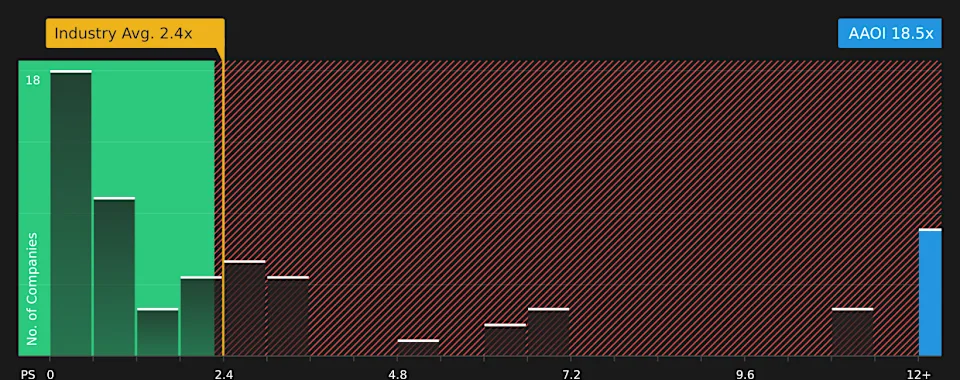
Applied Optoelectronics' P/S ratio is around 18.5x, significantly higher than the Communications industry average (~2.4x) and higher than the peer average (~7.0x). On a simple comparison, investors are paying much more per $1 of sales for this company than for many other communications stocks.

However, a more justified P/S ratio, considering the company's growth prospects, margins, size, and risk, is around 29.3x, which is still far above the current P/S. Despite the strong recent rally driven by AI-related policy news and revenue updates, the model indicates the current price does not fully reflect market expectations for Applied Optoelectronics based on revenue.

On a P/S basis, Applied Optoelectronics stock appears undervalued relative to where it should typically trade given its growth and risk profile.
The Applied Optoelectronics Narrative: What Must Hold True to Justify Today's Price?

The Simply Wall St Narratives series picks up Applied Optoelectronics' valuation puzzle, outlining what assumptions in growth, margins, and earnings must hold for the stock to be worth significantly more or less than its current price. Each article treats Applied Optoelectronics' implied fair value as a theory about the company's business that can be reassessed over time, not a one-time snapshot.

Currently, there is a stark divergence in views on Applied Optoelectronics, with a vast chasm between bullish and bearish theses on the stock.

Bull Thesis: Undervalued by 13%

"Growing demand from AI/machine learning workloads, video streaming, the Internet of Things, and the ongoing transition from copper to fiber in network infrastructure creates persistent tailwinds for the industry..."

Bear Thesis: Overvalued by 67%

"The case for going short is equally clear: the stock already reflects most of its upside potential..."

Summary

Applied Optoelectronics appears undervalued based on a customized Price-to-Sales (P/S) metric, but its low overall Value Score suggests most other metrics are not giving a clear endorsement. Recent high volatility in the share price implies market expectations are already elevated, warranting extra caution on relying on the P/S metric alone. The key question for investors is whether demand for its high-speed optical products and planned capacity expansion can support the current revenue expectations. If this assumption fails to hold, the current valuation might look more like a value trap than an investment opportunity.

Lecturas Relacionadas

Deciphering TapeOut: A Child Built a CPU On-Chain

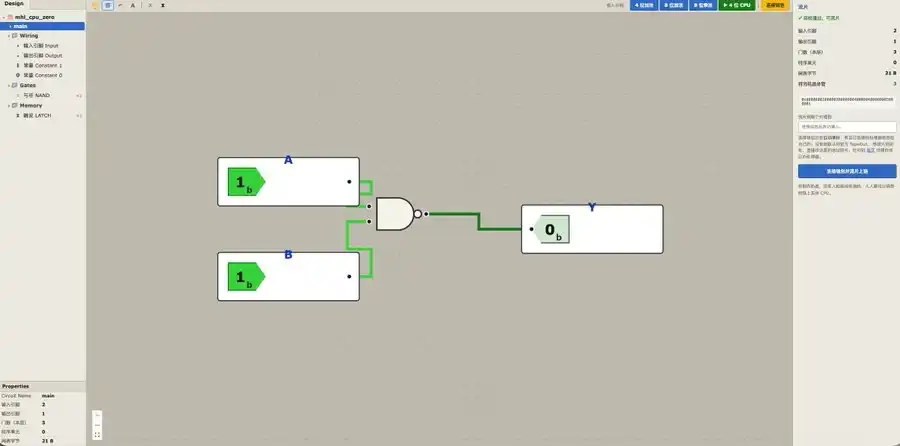
**Title: Understanding TapeOut: A Kid Built a CPU On-Chain** **Summary:** The article explores a remarkable experiment where a young developer named Blonskr has used blockchain technology to build a functional, on-chain CPU. Named "Behemoth," this CPU is based on the 1971 Intel 4004 processor specification. It runs on the BNB Chain, uses block production as its clock (running at a glacial 2.22 Hz), and is perhaps the slowest CPU in existence, yet it represents a novel and intriguing concept in the on-chain space. The core concept is the TapeOut protocol, named after the final "tape out" stage in semiconductor manufacturing. It treats the blockchain as a silicon wafer, with tokens representing fundamental logic components. The protocol's atomic unit is an ERC-1155 token representing a single NAND gate, the fundamental building block of digital logic. Users can visually design circuits on a "canvas," connecting these logic tokens. Once a design is finalized, the underlying tokens are burned, and an ERC-721 NFT representing the permanent, immutable circuit is minted. Blonskr used 2,300 such tokenized NAND gates to construct the Behemoth CPU. Key features of this and any TapeOut circuit include **permanent operation** (running as long as the chain exists), **free, permissionless evaluation** (anyone can query it without gas), and **safe composability** (circuits cannot call external contracts or modify state, making them inherently safe to use). This enables a new form of open, collaborative hardware design, where anyone can build upon and integrate components created by others. While highly niche, TapeOut reimagines the foundations of computation using blockchain's properties of permanence and openness. It pushes the boundaries of what can be built on-chain, potentially enabling future applications like custom mining circuits or decentralized, specialized processors. The experiment demonstrates an exciting combination of extreme technical vision and creative curiosity.

marsbitHace 26 min(s)

Deciphering TapeOut: A Child Built a CPU On-Chain

marsbitHace 26 min(s)

Novig Sues Wisconsin as Sports Prediction Market Dispute Heats Up

Novig, a sports event prediction market operator, has filed a lawsuit against Wisconsin's attorney general. The legal dispute centers on whether prediction markets fall under federal derivatives regulations or state gambling laws. The lawsuit, filed in a U.S. district court, seeks a declaratory judgment after Novig began offering event contracts to Wisconsin residents. This case is part of a broader conflict. In April, Wisconsin sued other prediction market platforms like Kalshi and Polymarket, alleging their sports-related contracts violate state gambling laws. Novig argues its contracts are "swaps" regulated exclusively by the federal Commodity Futures Trading Commission (CFTC), under the Commodity Exchange Act. Wisconsin contends they are sports betting. Federal courts have issued conflicting rulings on similar cases, creating legal uncertainty. The outcome is significant as prediction markets are a fast-growing sector, with trading volume reaching $9.5 billion on a single day in August. These markets are also increasingly intertwined with cryptocurrency infrastructure. Simultaneously, Novig is pursuing a nationwide legal strategy, having filed similar lawsuits in four other states. The company also recently secured a marketing partnership with the New York Mets, marking the first such deal with an MLB team. The Wisconsin case's resolution will influence whether prediction markets can operate as national financial products or remain constrained by individual state laws.

cryptonews.ruHace 33 min(s)

Novig Sues Wisconsin as Sports Prediction Market Dispute Heats Up

cryptonews.ruHace 33 min(s)

Держатели XRP могут торговать опционами на платформе Derive, используя FXRP в качестве залога

XRP holders can now trade options on the Derive platform using FXRP as collateral, as announced by Flare on August 12. This integration allows users to open positions from self-custody wallets while the underlying XRP backing the FXRP remains on the XRP Ledger. According to DeFi analyst Will Procheska, this provides XRP's dedicated holder base with a permissionless options market for generating yield or hedging. Derive's platform combines protocol-level settlements with an order book managed by Derive Trading Co., enabling users to retain asset control while professional market-makers provide liquidity. XRP options on Derive are cash-settled in USDC, so profits or obligations adjust the trader's USDC balance without transferring XRP or FXRP. The platform's portfolio margin system assesses overall account risk but may still trigger liquidations if margin levels fall below requirements. The launch expands Flare's XRPFi ecosystem. FXRP, introduced via the FAssets system in September 2025, creates an on-chain representation of XRP for use in smart contracts. It has since been integrated into spot trading and, more recently, permissionless lending markets on Morpho. This addition of options on Derive offers XRP holders hedging and premium-earning capabilities comparable to other major assets. While regulated XRP options debuted on CME Group in October 2025, Derive provides a decentralized alternative with USDC settlement and direct wallet access. The platform also supports perpetual futures, offering further trading strategies. Flare and Derive are exploring automated "strategy vaults" to simplify yield-generating options approaches for users.

cryptonews.ruHace 33 min(s)

Держатели XRP могут торговать опционами на платформе Derive, используя FXRP в качестве залога

cryptonews.ruHace 33 min(s)

Trading

Spot
活动图片