Weekly Token Unlocks: HYPE Unlocks Tokens Worth Approximately $320 Million

marsbitPublicado a 2026-01-04Actualizado a 2026-01-04

Resumen

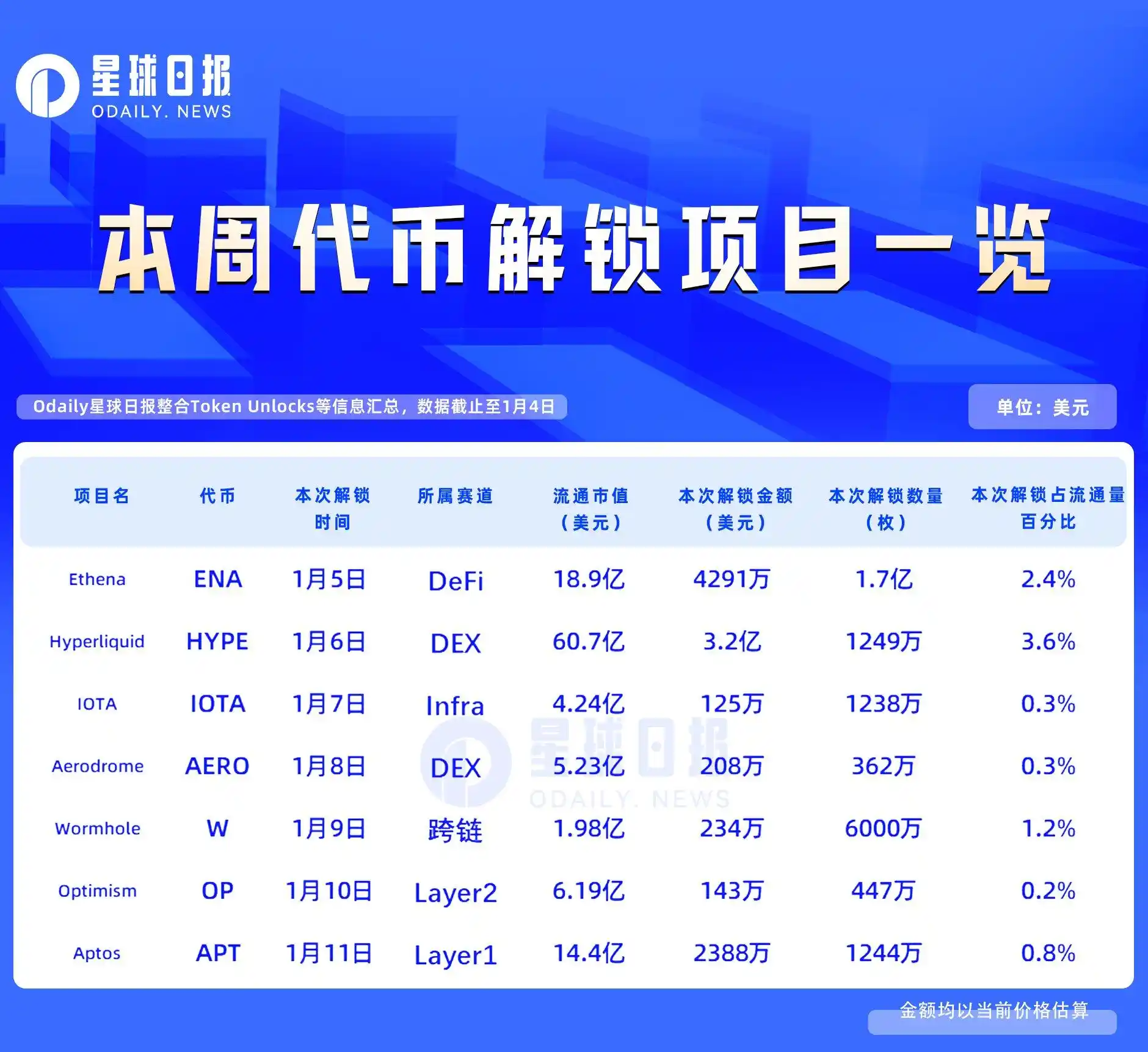
This week's major token unlocks feature significant releases from Hyperliquid and Ethena. Hyperliquid, a high-performance blockchain aiming to build a fully on-chain open financial system, will unlock 12.49 million tokens, valued at approximately $320 million. Ethena Labs, the creator of the algorithmic stablecoin USDe, will unlock 170 million tokens, worth roughly $42.91 million. USDe maintains its peg by utilizing collateral in BTC and stETH, generating yield from staking rewards and funding rates from short perpetual futures positions. Both projects have provided their specific token release schedules.

Hyperliquid

Project Twitter: https://x.com/HyperliquidX

Project Website: https://hyperfoundation.org/

This Unlock Amount: 12.49 million tokens

This Unlock Value: Approximately $320 million

Hyperliquid is a high-performance blockchain built with the vision of creating a fully on-chain open financial system. Liquidity, user applications, and trading activities synergize on a unified platform, aiming to accommodate all financial operations.

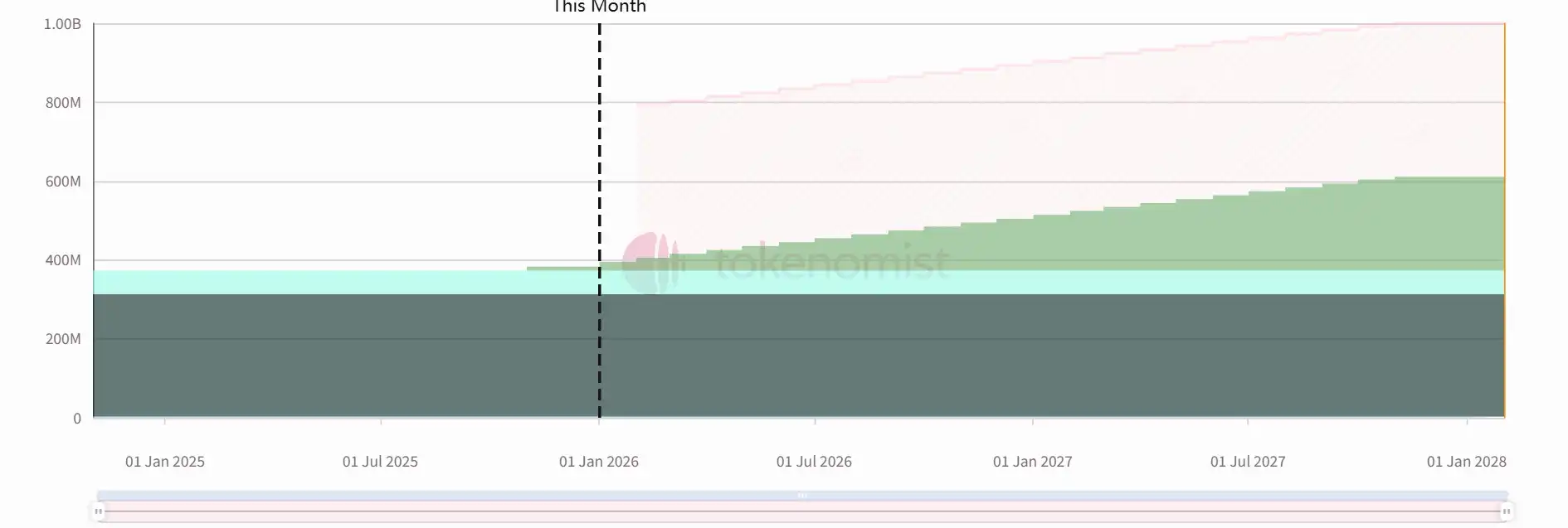
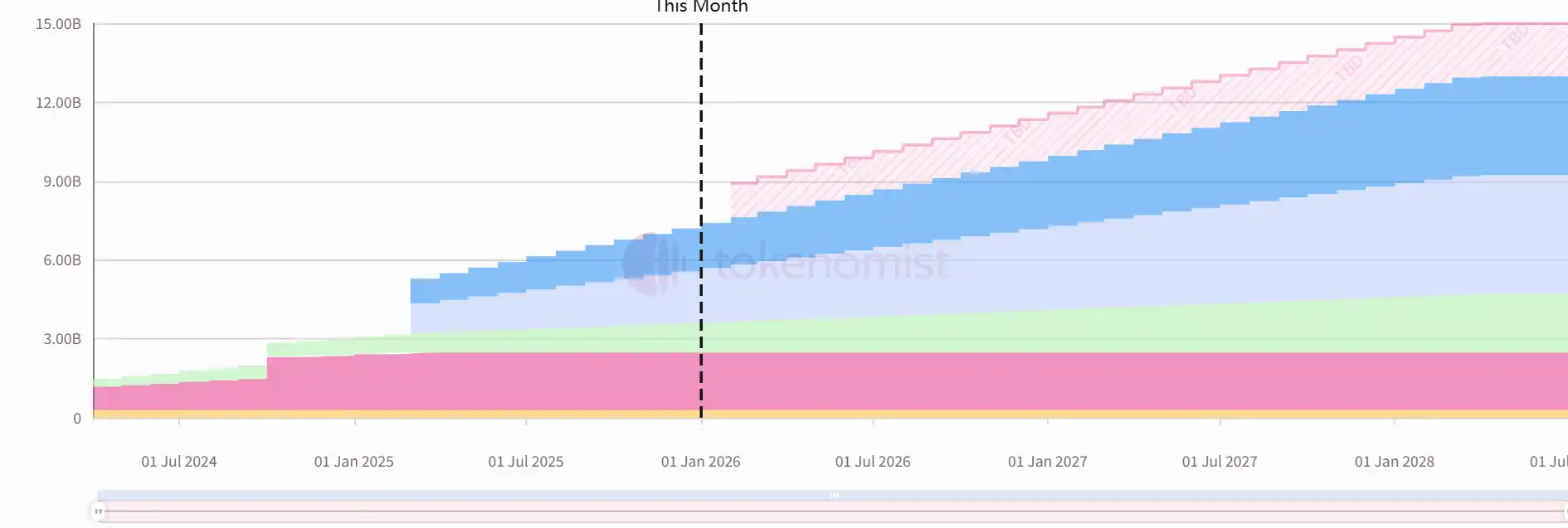
Specific release curve is as follows:
Ethena

Project Twitter: https://x.com/ethena_labs

Project Website: https://www.ethena.fi/

This Unlock Amount: 170 million tokens

This Unlock Value: Approximately $42.91 million

The algorithmic stablecoin USDe, launched by Ethena Labs, currently relies on collateral such as BTC and stETH, along with their inherent yields. It simultaneously creates Bitcoin and ETH short positions to balance Delta and utilizes perpetual/futures funding rates to maintain the peg and provide yields. Essentially, it uses the yield from spot positions to hedge the losses from the one-time short positions, achieving balance while capturing ETH staking yields and short position funding rates.

Specific release curve is as follows:
Preguntas relacionadas

QWhat is the total value of tokens unlocked by Hyperliquid this week?

AApproximately $320 million worth of tokens.

QHow many HYPE tokens were unlocked in this event?

A12.49 million tokens.

QWhat is the purpose of the Hyperliquid blockchain?

ATo build a fully on-chain open financial system that unifies liquidity, user applications, and trading activities on a single platform.

QHow many ENA tokens were unlocked by Ethena Labs this week?

A170 million tokens.

QWhat is the mechanism behind Ethena Labs' algorithmic stablecoin USDe?

AIt uses collateral like BTC and stETH, creates short positions in Bitcoin and ETH to balance Delta, and utilizes perpetual/futures funding rates to maintain the peg and provide yield.

Lecturas Relacionadas

Discourse Power, Internalization, Positive Externalities: Understanding Binance's Triple Dilemma and 'Original Sin'

An article titled "Discourse Power, Internalization, Positive Externalities: Understanding Binance's Triple Dilemma and 'Original Sin'" critiques Binance's dominant role in the crypto industry. It argues that Binance's near-monopoly on "discourse power" allows it to dictate which projects succeed, stifling genuine innovation as builders and VCs focus on pleasing its listing committee rather than users. This leads to a "blackout" effect, hindering organic growth. Furthermore, Binance's strategy is described as extreme "internalization." Its Launchpad model, featuring high Fully Diluted Valuations (FDV) and low circulation, functions like an internal capital vacuum. This, along with activities on BNB Chain, turns the market into a "slaughterhouse" where insiders profit while retail investors lose, preventing mass adoption and consuming user trust. Finally, the article highlights Binance's lack of "positive externalities." Unlike competitors like Coinbase (contributing to compliance and ETFs) or the Ethereum Foundation (advancing core technology), Binance's actions are seen as self-serving. Its focus on memes and a closed "walled garden" ecosystem, instead of fostering real innovation or open infrastructure, fails to benefit the broader industry. As the industry leader, this perceived lack of responsibility and担当 (dāndāng, bearing responsibility) creates a "virtue-position mismatch," making it a target of criticism. The solution isn't PR but ceding discourse power to the community and channeling liquidity to support genuine technological progress.

marsbitHace 9 min(s)

Discourse Power, Internalization, Positive Externalities: Understanding Binance's Triple Dilemma and 'Original Sin'

marsbitHace 9 min(s)

Why Do Bitcoin and Ethereum Fall But Not Rise?

This article analyzes why Bitcoin (BTC) and Ethereum (ETH) have underperformed other risk assets like stocks and commodities recently, despite a generally bullish macro environment. The core argument is that the underperformance is not primarily a macro issue, but a result of the crypto market's own structural dynamics and its ongoing deleveraging cycle. Key reasons identified include: - The crypto market is in the late stages of a deleveraging process, which began with a sharp sell-off in October, wiping out highly-leveraged speculative capital (especially from retail traders) and making the market fragile and risk-averse. - A significant amount of retail capital has been diverted to other booming assets like AI-related stocks and precious metals, which are experiencing their own FOMO-driven rallies. - Crypto markets remain structurally isolated from traditional finance (TradFi), with barriers to capital flow between them. - The market is still dominated by retail traders and passive funds (like ETFs), making it susceptible to emotional narratives, market micro-structure manipulation, and high volatility amplified by the use of high leverage (10x-20x) by散户. This creates an environment where concentrated selling in low-liquidity hours can trigger cascading liquidations. - The author draws historical parallels to the deleveraging of China's A-share market in 2015 and compares ETH's current price action to Tesla's in 2024, suggesting both are in a prolonged consolidation phase after a bubble. The article concludes that labeling BTC and ETH purely as "risk assets" is an oversimplification. While they are volatile, they also possess safe-haven qualities. The current sensitivity to negative news and sluggish response to positive developments is a temporary structural phenomenon of the deleveraging cycle, not a failure of their long-term value proposition. Once deleveraging concludes and new capital returns, this dynamic is expected to change.

marsbitHace 9 min(s)

Why Do Bitcoin and Ethereum Fall But Not Rise?

marsbitHace 9 min(s)

Regulatory Clarity for Tokenized Securities: Which Hot Projects Won't Pass the SEC's Scrutiny?

The U.S. SEC has issued new guidance clarifying the regulatory treatment of tokenized securities, emphasizing that the use of blockchain does not change the fundamental nature of securities obligations. The guidance distinguishes between two main types of tokenized securities: those led by the issuer (where blockchain is used as a technical upgrade to record ownership registry, without altering rights or regulatory requirements) and those created by third parties (which may not confer direct ownership rights and introduce additional risks such as custody or counterparty risk). The SEC stresses that regardless of the technology used, any asset that meets the definition of a security or derivative remains subject to existing federal securities laws. This move aims to address market confusion, particularly around unauthorized “tokenized stocks” that mimic equity without issuer involvement—such as certain products offered by platforms like Robinhood in Europe or third-party claims of tokenized equity in companies like OpenAI. In contrast, compliant initiatives—such as those by Kraken, NYSE, or DTCC—focus on integrating tokenization within existing regulatory frameworks, ensuring issuer participation and clear accountability. The guidance reinforces that tokenization is not a shortcut to bypass securities laws but must align with legal and economic substance.

Odaily星球日报Hace 1 hora(s)

Regulatory Clarity for Tokenized Securities: Which Hot Projects Won't Pass the SEC's Scrutiny?

Odaily星球日报Hace 1 hora(s)

Trading

Spot
Futuros
活动图片