Why Do Bitcoin and Ethereum Fall But Not Rise?

marsbitPublicado a 2026-01-30Actualizado a 2026-01-30

Resumen

This article analyzes why Bitcoin (BTC) and Ethereum (ETH) have underperformed other risk assets like stocks and commodities recently, despite a generally bullish macro environment. The core argument is that the underperformance is not primarily a macro issue, but a result of the crypto market's own structural dynamics and its ongoing deleveraging cycle. Key reasons identified include: - The crypto market is in the late stages of a deleveraging process, which began with a sharp sell-off in October, wiping out highly-leveraged speculative capital (especially from retail traders) and making the market fragile and risk-averse. - A significant amount of retail capital has been diverted to other booming assets like AI-related stocks and precious metals, which are experiencing their own FOMO-driven rallies. - Crypto markets remain structurally isolated from traditional finance (TradFi), with barriers to capital flow between them. - The market is still dominated by retail traders and passive funds (like ETFs), making it susceptible to emotional narratives, market micro-structure manipulation, and high volatility amplified by the use of high leverage (10x-20x) by散户. This creates an environment where concentrated selling in low-liquidity hours can trigger cascading liquidations. - The author draws historical parallels to the deleveraging of China's A-share market in 2015 and compares ETH's current price action to Tesla's in 2024, suggesting both are in a prolonged consolidation phase...

Editor's Note: Against the backdrop of rising multiple asset classes, the periodic stagnation of BTC and ETH is often simplistically attributed to their 'risk asset attributes'. This article argues that the core of the issue lies not in macro factors, but in the crypto market's own deleveraging phase and market structure.

As deleveraging nears its end and trading activity falls to low levels, existing capital struggles to counter short-term volatility amplified by highly leveraged retail investors, passive funds, and speculative trading. Before new capital inflows and FOMO sentiment return, the market is more sensitive to negative narratives, which is a structural outcome.

Historical analogies suggest this performance is more likely a phase of adjustment within a long-term cycle rather than a failure of fundamentals. This article attempts to move beyond short-term price movements, starting from cycles and structure, to re-understand the current position of BTC and ETH.

The following is the original text:

Bitcoin (BTC) and Ethereum (ETH) have recently significantly underperformed other risk assets.


We believe the main reasons for this phenomenon include: the stage of the trading cycle, market microstructure, and market manipulation by certain exchanges, market makers, or speculative funds.

Market Background

Firstly, the deleveraging-driven decline that began last October has dealt a heavy blow to highly leveraged participants, especially retail traders. A large amount of speculative capital has been washed out, leaving the overall market fragile and risk-averse.

At the same time, AI-related stocks in China, Japan, South Korea, and the US experienced extremely aggressive rallies; the precious metals market also saw a meme-like surge driven by FOMO (Fear Of Missing Out) sentiment. The rise of these assets absorbed a significant amount of retail capital—a point that is particularly crucial, as retail investors in Asia and the US remain the primary trading force in the crypto market.

Another structural issue is that crypto assets have not yet been truly integrated into the traditional financial system. In TradFi, commodities, stocks, and forex can be traded within a single account, with almost no friction for asset allocation shifts; however, in reality, moving funds from TradFi to crypto still faces multiple hurdles—regulatory, operational, and psychological.

Furthermore, the proportion of professional institutional investors in the crypto market remains limited. Most participants are not professional investors, lack independent analytical frameworks, and are easily influenced by speculative capital or exchanges that also act as market makers, thus being led by emotion and narrative. Narratives such as the 'four-year cycle' or 'Santa Claus rally' are repeatedly emphasized, despite lacking rigorous logic or solid data support.

Overly linear thinking is prevalent in the market, for instance, directly attributing BTC's price fluctuations to a single event like the JPY appreciation in July 2024, without deeper analysis. Such narratives are often quickly disseminated and have a direct impact on prices.

Next, we will move away from short-term narratives and analyze this issue from an independent thinking perspective.

Time Dimension is Crucial

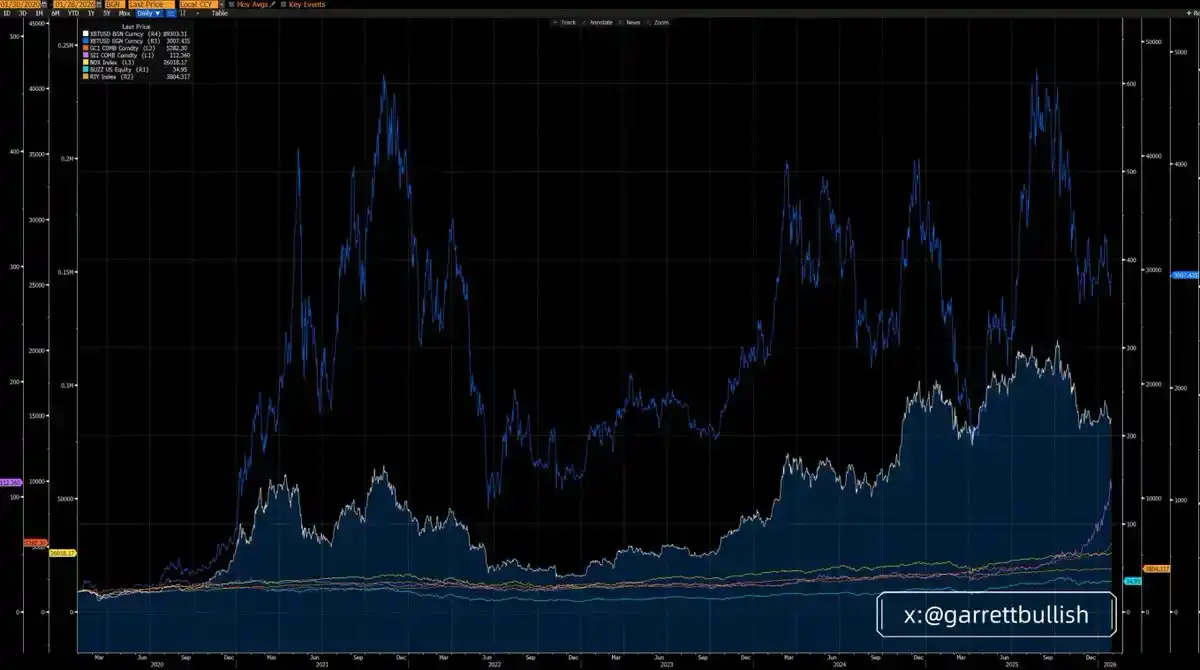
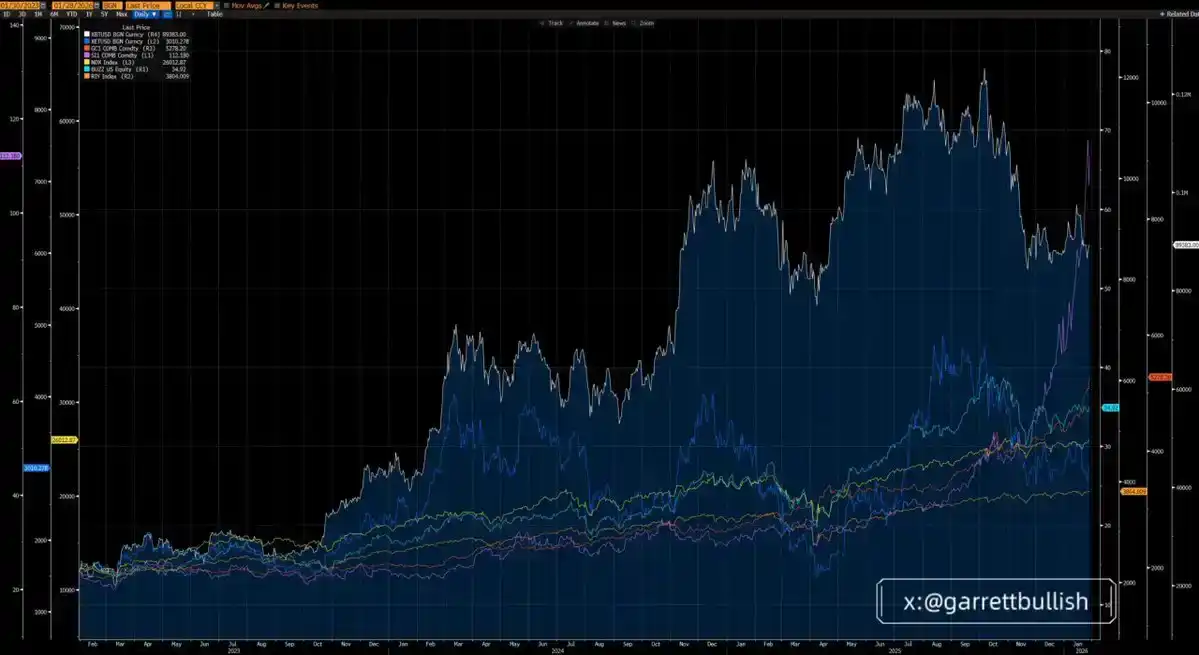
If viewed from a three-year cycle, BTC and ETH have indeed underperformed most major assets, with ETH being the weakest.

However, if extended to a six-year cycle (since March 12, 2020), the performance of BTC and ETH is significantly better than most assets, and ETH actually becomes the top performer.

From a longer time dimension and placed within a macro context, the current so-called 'short-term underperformance' is essentially a process of mean reversion within a longer historical cycle.

Ignoring the underlying logic and focusing only on short-term price fluctuations is one of the most common, and fatal, errors in investment analysis.

Rotation is a Normal Phenomenon

Before the short squeeze in silver prices last October, silver was also one of the worst-performing risk assets; yet now, on a three-year cycle dimension, silver has become the top-performing asset.

This change is highly similar to the current situation of BTC and ETH. Although they are underperforming in the short term, they remain among the most advantageous asset classes on a six-year cycle dimension.

As long as BTC's narrative as 'digital gold' and a store of value is not fundamentally disproven, as long as ETH continues to integrate with the AI wave and exists as core infrastructure in the RWA (Real World Assets) trend, there is no rational basis to believe they will consistently underperform other assets in the long run.

Emphasizing again: ignoring fundamentals and cherry-picking short-term price movements to draw conclusions is a serious analytical error.
Market Structure and Deleveraging

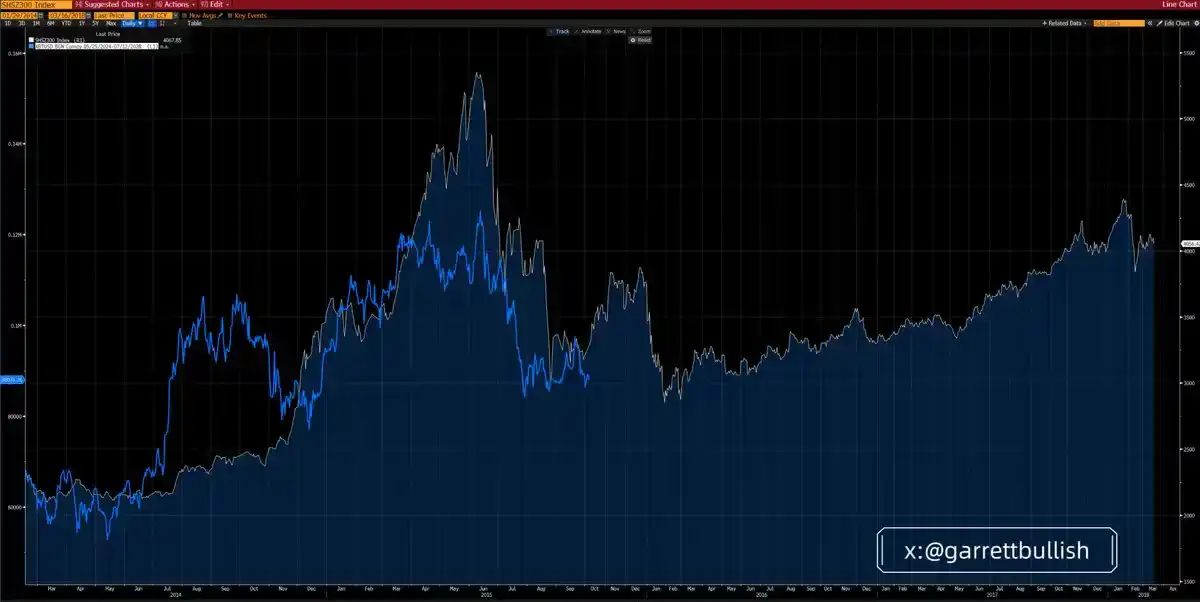
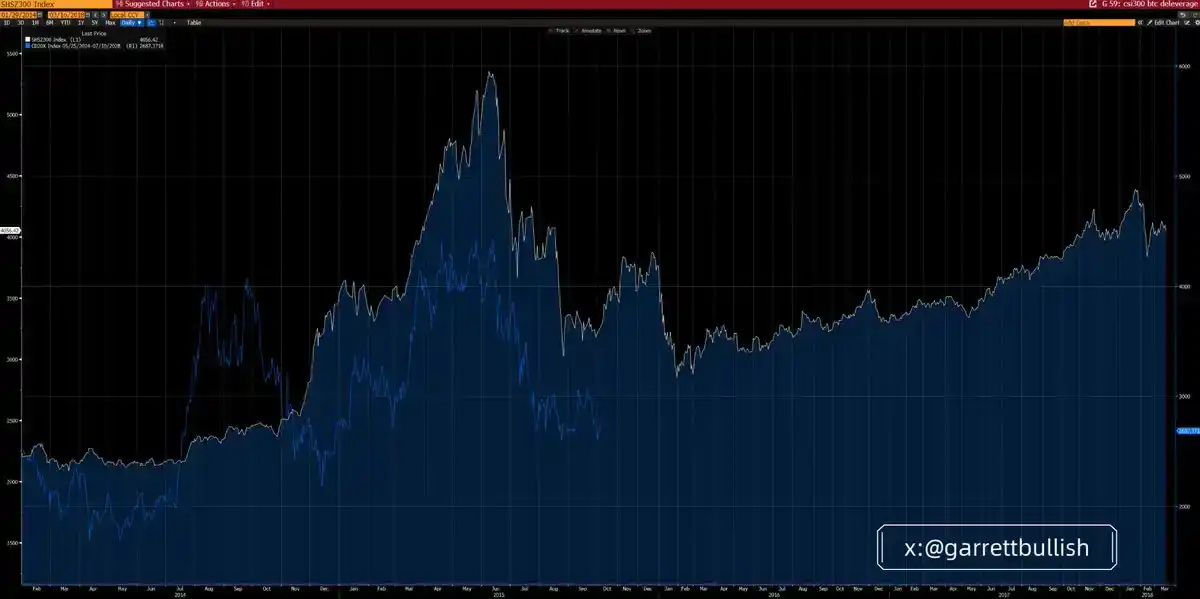
The current crypto market shows a striking similarity to the environment of China's A-share market in 2015 after a leverage-driven rally entered a deleveraging phase.

In June 2015, after a leverage-driven bull market stalled and the valuation bubble burst, the A-share market entered an A–B–C three-wave decline structure conforming to Elliott Wave Theory. After the C-wave bottomed, the market experienced months of sideways consolidation before gradually transitioning into a multi-year bull market.

The core drivers of that long-term bull market came from low valuations of blue-chip assets, improved macro policy environment, and significant monetary easing.

Bitcoin (BTC) and the CD20 index have almost completely replicated this 'leverage up - deleverage' evolution path in the current cycle, showing high consistency in both timing and structural form.

The underlying similarities are very clear: both market environments feature high leverage, extreme volatility, tops driven by valuation bubbles and herd behavior, repeated deleveraging shocks, a long and slow decline process, continuously falling volatility, and futures markets in a long-term contango structure.

In the current market, this contango structure is reflected in the discount of share prices of DAT (Digital Asset Treasury) related listed companies (like MSTR, BMNR) relative to their mNAV (adjusted Net Asset Value).

Meanwhile, the macro environment is gradually improving. Regulatory certainty is increasing, for example, through the ongoing promotion of legislation like the 'Clarity Act'; the US SEC and CFTC are also actively promoting the development of on-chain US equities trading.

Monetary conditions are also easing: rate cut expectations are heating up, quantitative tightening (QT) is nearing its end, repo market liquidity continues to be injected, and expectations of a more dovish stance from the next Fed chair are collectively improving the overall liquidity environment.
ETH and Tesla: An Informative Analogy

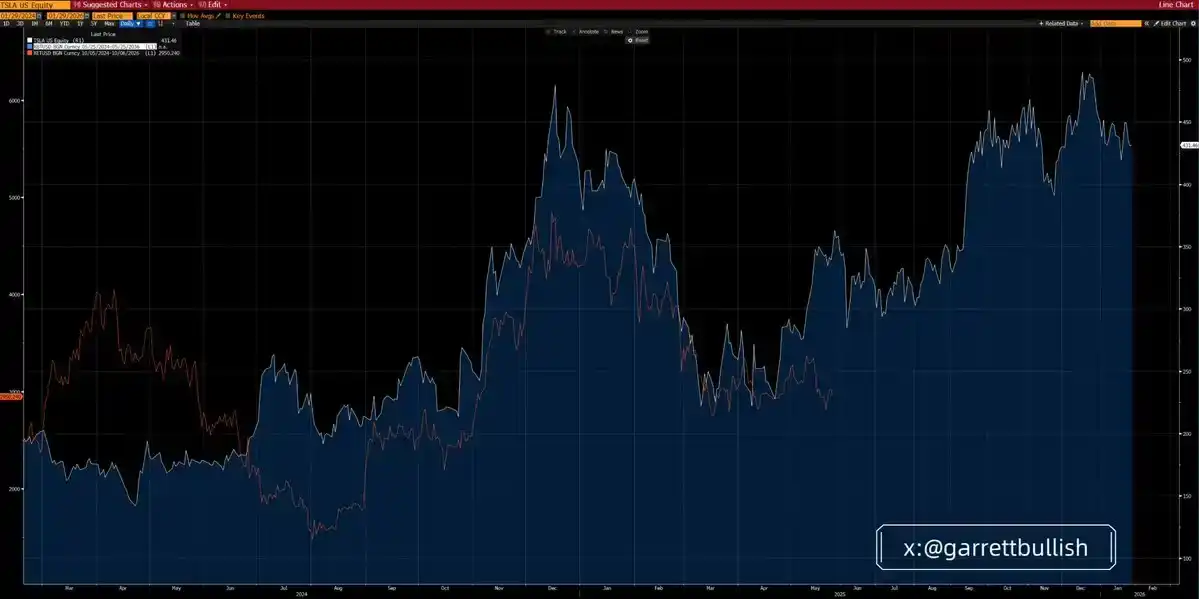
ETH's recent price action is highly similar to Tesla's (TSLA) performance in 2024.

At that time, Tesla's stock price first formed a head and shoulders bottom structure, then rebounded, consolidated sideways, surged again, entered a longer topping phase, fell rapidly, and then experienced a prolonged sideways consolidation at low levels.

It wasn't until May 2025 that Tesla finally broke out upwards, officially starting a new bull market. Its upward momentum came mainly from sales growth in the Chinese market, increased probability of Trump's election, and the commercialization of political networks.

From the current stage, ETH shows high similarity to Tesla at that time, both in technical patterns and fundamental background.

The underlying logic is also comparable: both carry technological narratives and meme attributes, attracted large amounts of highly leveraged capital, experienced violent fluctuations, peaked in valuation bubbles driven by herd behavior, and then entered an adjustment cycle of repeated deleveraging.

Over time, market volatility has gradually decreased, while fundamentals and the macro environment continue to improve.
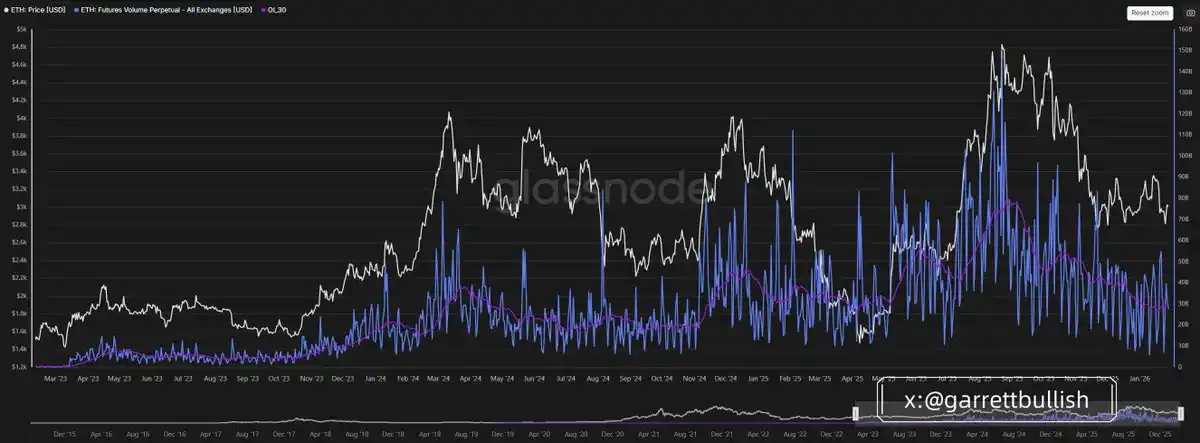
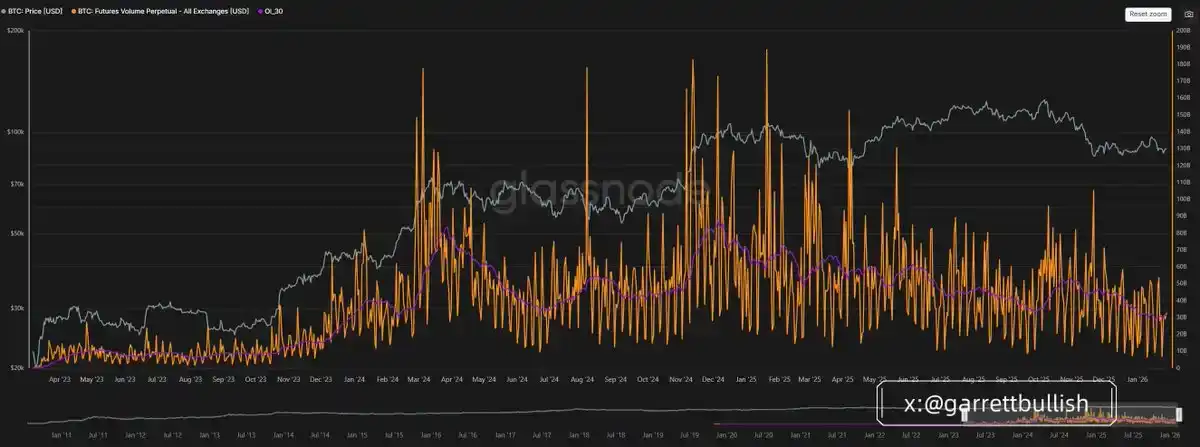
Looking at futures trading volume, market activity for BTC and ETH has neared historical lows, indicating the deleveraging process is approaching its end.

Are BTC and ETH 'Risk Assets'?

Recently, a rather strange narrative has emerged in the market: simply defining BTC and ETH as 'risk assets' and using this to explain why they haven't followed the rise of US stocks, A-shares, precious metals, or base metals.

By definition, risk assets typically feature high volatility and high beta. From both behavioral finance and quantitative statistical perspectives, US equities, A-shares, base metals, BTC, and ETH all meet this standard and often benefit in 'risk-on' environments.

But BTC and ETH possess additional attributes. Due to the DeFi ecosystem and on-chain settlement mechanisms, they also exhibit safe-haven characteristics similar to precious metals in specific situations, especially when geopolitical pressures rise.

Labeling BTC and ETH simply as 'pure risk assets' and asserting they cannot benefit from macro expansion based on this is essentially a narrative that selectively emphasizes negative factors.

Frequently cited examples include:

Potential EU-US tariff conflicts triggered by the Greenland issue

Canada-US tariff disputes

And potential military conflict between the US and Iran

This line of argument is essentially 'cherry-picking' and applying a double standard.

Theoretically, if these risks were truly systemic, then all risk assets should fall in sync, except perhaps base metals which might benefit from war demand. But the reality is that these risks lack the foundation to escalate into major systemic shocks.

AI and high-tech related demand remains extremely strong and is largely unaffected by geopolitical noise, especially in core economies like China and the US. Therefore, the stock market has not priced these risks substantively.

More importantly, most of these concerns have been downgraded or factually disproven. This leads to a key question: Why are BTC and ETH exceptionally sensitive to negative narratives, yet slow to react to positive developments or the subsidence of negative factors?

The Real Reasons

We believe the reasons lie primarily in the structural problems of the crypto market itself. The current market is at the tail end of a deleveraging cycle, with overall participant sentiment tight and highly sensitive to downside risks.

The crypto market is still dominated by retail investors, with limited participation from professional institutions. ETF flows reflect more passive sentiment following rather than active allocation based on fundamentals and judgment.

Similarly, the accumulation methods of most DATs (Digital Asset Treasuries) are also passive—whether through direct operation or third-party passive fund managers, often using non-aggressive algorithmic trading strategies like VWAP, TWAP, with the core goal of reducing intraday volatility.

This stands in stark contrast to speculative funds, whose main goal is precisely to create intraday volatility—and at this stage, this volatility manifests more on the downside, to manipulate price action.

At the same time, retail traders commonly use 10–20x leverage. This makes exchanges, market makers, or speculative funds more inclined to profit from market microstructure rather than endure medium-to-long-term price fluctuations.

We often observe concentrated selling during periods of thin liquidity, especially when Asian or US investors are asleep, for example, between 00:00–08:00 Asia time. Such fluctuations often trigger chain reactions, including liquidations, margin calls, and passive selling, further amplifying the decline.
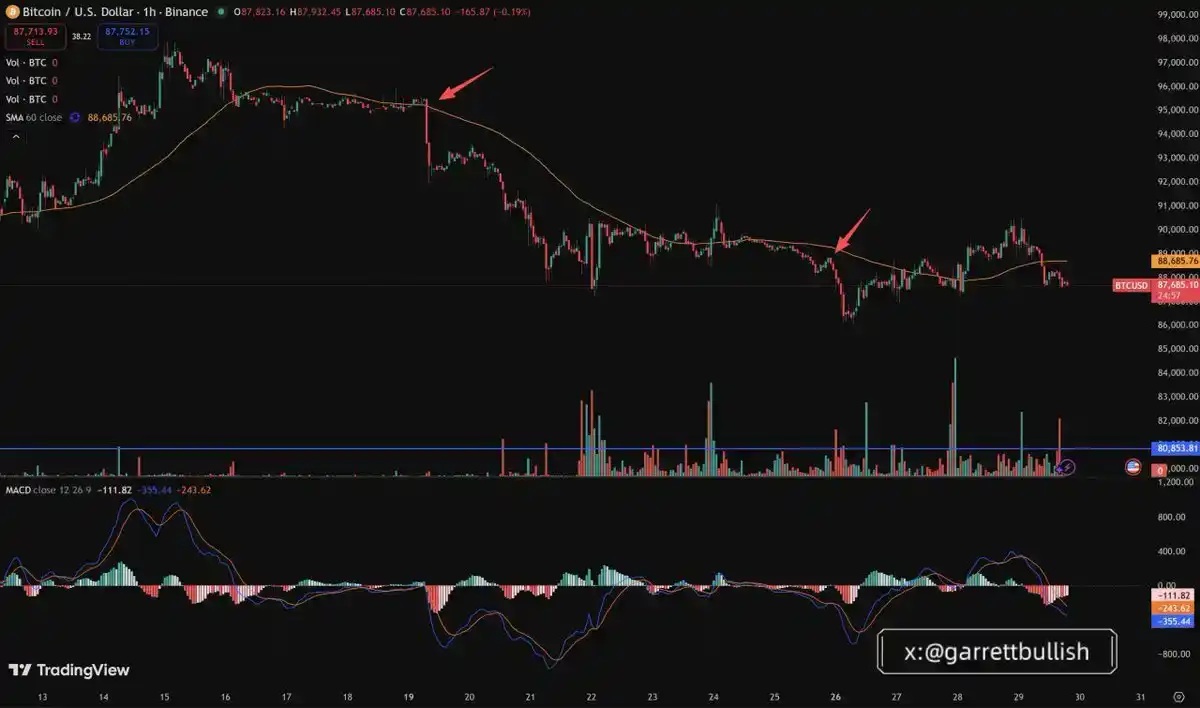
In the absence of substantial new capital inflows, or before FOMO sentiment returns, relying solely on existing capital is insufficient to counter the aforementioned types of market behavior.

Definition of Risk Assets

Risk Assets refer to financial instruments with certain risk characteristics, including stocks, commodities, high-yield bonds, real estate, and currencies.

Broadly speaking, risk assets refer to any financial security or investment vehicle not considered 'risk-free'. The common feature of such assets is that their prices are volatile and their value can change significantly over time.

Common types of risk assets include:

Equities / Stocks:
Shares of publicly traded companies, whose prices are affected by market conditions, company performance, and other factors, and can be highly volatile.

Commodities:
Physical assets like crude oil, gold, agricultural products, etc., whose prices are mainly influenced by changes in supply and demand.

High-Yield Bonds:
Bonds that offer higher interest rates due to lower credit ratings, but also come with higher default risk.

Real Estate:
Real property investments, whose value fluctuates with market cycles, economic conditions, and policy changes.

Currencies:
Various currencies in the foreign exchange market, whose prices can fluctuate rapidly due to geopolitical events, macroeconomic data, and policy changes.

Main Characteristics of Risk Assets

Volatility
Risk asset prices fluctuate frequently, which can lead to both gains and losses.

Coexistence of Return and Risk
Generally, the higher the risk of an asset, the higher the potential return, but also the greater the probability of loss.

High Sensitivity to Market Environment
The value of risk assets is influenced by various factors, including interest rate changes, macroeconomic conditions, and investor sentiment.

Preguntas relacionadas

QAccording to the article, what are the main reasons for Bitcoin and Ethereum's recent underperformance compared to other risk assets?

AThe main reasons are the stage of the trading cycle (deleveraging), the market microstructure, and market manipulation by some exchanges, market makers, or speculative funds.

QHow does the article explain the difference in performance of BTC and ETH when viewed on a 3-year versus a 6-year timeline?

AOn a 3-year timeline, BTC and ETH underperformed most major assets, with ETH being the weakest. However, on a 6-year timeline (since March 2020), they significantly outperformed most assets, with ETH being the strongest performer.

QWhat historical market does the article compare the current crypto market structure to, and what are the key characteristics they share?

AThe article compares it to the Chinese A-share market in 2015 after its leveraged-driven bull market. The key shared characteristics are high leverage, extreme volatility, a bubble top driven by valuation and herd behavior, repeated deleveraging shocks, a long and drawn-out decline, falling volatility, and a persistent contango structure in futures markets.

QWhy does the article argue that simply labeling BTC and ETH as 'risk assets' is an incomplete explanation for their recent price action?

ABecause while they are risk assets, they also possess additional safe-haven attributes similar to precious metals due to the DeFi ecosystem and on-chain settlement mechanisms, especially during rising geopolitical tensions. The label is a form of cherry-picking negative narratives.

QWhat structural issue within the crypto market itself does the article identify as a key amplifier of downside price moves?

AThe market is dominated by retail traders using high leverage (10-20x). This allows exchanges, market makers, or speculative funds to profit from market microstructure by engineering downward price moves, which trigger cascading liquidations and forced selling, especially during low-liquidity hours.

Lecturas Relacionadas

Trading

Spot
Futuros

Artículos destacados

Qué es BITCOIN

Entendiendo HarryPotterObamaSonic10Inu (ERC-20) y Su Posición en el Espacio Cripto En los últimos años, el mercado de criptomonedas ha sido testigo de un aumento en la popularidad de las monedas meme, capturando el interés no solo de los comerciantes, sino también de aquellos que buscan compromiso comunitario y valor de entretenimiento. Entre estos tokens únicos se encuentra HarryPotterObamaSonic10Inu (ERC-20), un proyecto intrigante que mezcla referencias culturales en el tejido de las criptomonedas. Este artículo profundiza en los aspectos clave de HarryPotterObamaSonic10Inu, explorando sus mecanismos, ethos impulsado por la comunidad y su relación con el paisaje cripto más amplio. ¿Qué es HarryPotterObamaSonic10Inu (ERC-20)? Como su nombre sugiere, HarryPotterObamaSonic10Inu es una moneda meme construida sobre la blockchain de Ethereum, clasificada bajo el estándar ERC-20. A diferencia de las criptomonedas tradicionales que pueden enfatizar la utilidad práctica o el potencial de inversión, este token prospera en el valor de entretenimiento y la fuerza de su comunidad. El proyecto tiene como objetivo fomentar un entorno donde los usuarios comprometidos puedan reunirse, compartir ideas y participar en actividades inspiradas por diversos fenómenos culturales. Una característica notable de HarryPotterObamaSonic10Inu es su cero impuestos en las transacciones. Este atractivo elemento tiene como objetivo incentivar el comercio y la participación comunitaria, sin cargos adicionales que puedan disuadir a los comerciantes de pequeña escala. El suministro total de la moneda está establecido en mil millones de tokens, una cifra que marca su intención de mantener una circulación sustancial dentro de la comunidad. Creador de HarryPotterObamaSonic10Inu (ERC-20) Los orígenes de HarryPotterObamaSonic10Inu están algo envueltos en misterio; los detalles sobre el creador siguen siendo desconocidos. El desarrollo de este token carece de un equipo identificable o de un plan explícito, lo cual no es inusual dentro del sector de monedas meme. En cambio, el proyecto ha surgido de manera orgánica, con su progreso muy dependiente del entusiasmo y la participación de su comunidad. Inversores de HarryPotterObamaSonic10Inu (ERC-20) En cuanto a inversiones externas y respaldo, HarryPotterObamaSonic10Inu también sigue siendo ambiguo. El token no lista ninguna fundación de inversión conocida o apoyo organizacional significativo. En cambio, la savia del proyecto es su comunidad de base, que informa su crecimiento y sostenibilidad a través de la acción colectiva y el compromiso en el espacio cripto. ¿Cómo Funciona HarryPotterObamaSonic10Inu (ERC-20)? Como una moneda meme, HarryPotterObamaSonic10Inu opera principalmente fuera de los marcos tradicionales que a menudo rigen el valor de los activos. Hay varios aspectos distintivos que definen cómo funciona el proyecto: Transacciones Sin Impuestos: Sin tarifas impositivas en las transacciones, los usuarios pueden comprar y vender el token libremente sin preocuparse por costos ocultos. Compromiso Comunitario: El proyecto prospera en la interacción comunitaria, aprovechando plataformas de redes sociales para crear entusiasmo y facilitar la participación. Las discusiones, el intercambio de contenido y el compromiso son elementos cruciales que ayudan a expandir su alcance y fomentar la lealtad entre los seguidores. Sin Utilidad Práctica: Cabe señalar que HarryPotterObamaSonic10Inu no ofrece utilidad concreta dentro del ecosistema financiero. Más bien, se clasifica como un token principalmente para actividades de entretenimiento y comunitarias. Referencia Cultural: El token incorpora astutamente elementos de la cultura popular para atraer interés, conectando con entusiastas de los memes y seguidores de las criptomonedas por igual. HarryPotterObamaSonic10Inu ejemplifica cómo las monedas meme operan de manera diferente a los proyectos de criptomonedas más tradicionales, ingresando al mercado como construcciones sociales innovadoras en lugar de activos utilitarios. Cronología de HarryPotterObamaSonic10Inu (ERC-20) La historia de HarryPotterObamaSonic10Inu está marcada por varios hitos notables: Creación: El token surgió de un meme viral, capturando la imaginación de muchos entusiastas de las criptomonedas. Las fechas específicas de creación no están disponibles, subrayando su ascenso orgánico. Listado en Exchanges: HarryPotterObamaSonic10Inu ha llegado a varios exchanges, permitiendo un acceso y comercio más fácil por parte de la comunidad. Iniciativas de Compromiso Comunitario: Actividades continuas destinadas a mejorar la interacción comunitaria, incluyendo concursos, campañas en redes sociales y generación de contenido por parte de fanáticos y defensores. Planes de Expansión Futuros: La hoja de ruta del proyecto incluye el lanzamiento de una colección de NFT, mercancía y un sitio de comercio electrónico relacionado con sus temas culturales, involucrando aún más a la comunidad e intentando añadir más dimensiones a su ecosistema. Puntos Clave Sobre HarryPotterObamaSonic10Inu (ERC-20) Naturaleza Impulsada por la Comunidad: El proyecto prioriza la participación colectiva y la creatividad, asegurando que la involucración de los usuarios esté a la vanguardia de su desarrollo. Clasificación como Moneda Meme: Representa la epítome de las criptomonedas basadas en el entretenimiento, diferenciándose de los vehículos de inversión tradicionales. Sin Afiliación Directa con Bitcoin: A pesar de la similitud en el nombre del ticker, HarryPotterObamaSonic10Inu es distinto y no tiene relación con Bitcoin u otras criptomonedas establecidas. Enfoque en la Colaboración: HarryPotterObamaSonic10Inu está diseñado para crear un espacio para la colaboración y el intercambio de historias entre sus poseedores, proporcionando una vía para la creatividad y el vínculo comunitario. Perspectivas Futuras: La ambición de expandirse más allá de su premisa inicial hacia NFTs y mercancías describe un camino para que el proyecto potencialmente ingrese a avenidas más tradicionales dentro de la cultura digital. A medida que las monedas meme continúan capturando la imaginación de la comunidad de criptomonedas, HarryPotterObamaSonic10Inu (ERC-20) se destaca debido a sus lazos culturales y su enfoque centrado en la comunidad. Si bien puede no encajar en el molde típico de un token impulsado por la utilidad, su esencia radica en la alegría y la camaradería fomentadas entre sus seguidores, destacando la naturaleza en evolución de las criptomonedas en una era cada vez más digital. A medida que el proyecto continúa desarrollándose, será importante observar cómo las dinámicas comunitarias influyen en su trayectoria en el cambiante paisaje de la tecnología blockchain.

1.3k Vistas totalesPublicado en 2024.04.01Actualizado en 2024.12.03

Qué es BITCOIN

Cómo comprar BTC

¡Bienvenido a HTX.com! Hemos hecho que comprar Bitcoin (BTC) sea simple y conveniente. Sigue nuestra guía paso a paso para iniciar tu viaje de criptos.Paso 1: crea tu cuenta HTXUtiliza tu correo electrónico o número de teléfono para registrarte y obtener una cuenta gratuita en HTX. Experimenta un proceso de registro sin complicaciones y desbloquea todas las funciones.Obtener mi cuentaPaso 2: ve a Comprar cripto y elige tu método de pagoTarjeta de crédito/débito: usa tu Visa o Mastercard para comprar Bitcoin (BTC) al instante.Saldo: utiliza fondos del saldo de tu cuenta HTX para tradear sin problemas.Terceros: hemos agregado métodos de pago populares como Google Pay y Apple Pay para mejorar la comodidad.P2P: tradear directamente con otros usuarios en HTX.Over-the-Counter (OTC): ofrecemos servicios personalizados y tipos de cambio competitivos para los traders.Paso 3: guarda tu Bitcoin (BTC)Después de comprar tu Bitcoin (BTC), guárdalo en tu cuenta HTX. Alternativamente, puedes enviarlo a otro lugar mediante transferencia blockchain o utilizarlo para tradear otras criptomonedas.Paso 4: tradear Bitcoin (BTC)Tradear fácilmente con Bitcoin (BTC) en HTX's mercado spot. Simplemente accede a tu cuenta, selecciona tu par de trading, ejecuta tus trades y monitorea en tiempo real. Ofrecemos una experiencia fácil de usar tanto para principiantes como para traders experimentados.

4.6k Vistas totalesPublicado en 2024.12.12Actualizado en 2025.03.21

Cómo comprar BTC

Qué es $BITCOIN

ORO DIGITAL ($BITCOIN): Un Análisis Integral Introducción al ORO DIGITAL ($BITCOIN) ORO DIGITAL ($BITCOIN) es un proyecto basado en blockchain que opera en la red Solana, cuyo objetivo es combinar las características de los metales preciosos tradicionales con la innovación de las tecnologías descentralizadas. Aunque comparte un nombre con Bitcoin, a menudo referido como “oro digital” debido a su percepción como un refugio de valor, ORO DIGITAL es un token separado diseñado para crear un ecosistema único dentro del paisaje Web3. Su meta es posicionarse como un activo digital alternativo viable, aunque los detalles sobre sus aplicaciones y funcionalidades aún están en desarrollo. ¿Qué es ORO DIGITAL ($BITCOIN)? ORO DIGITAL ($BITCOIN) es un token de criptomoneda diseñado explícitamente para su uso en la blockchain de Solana. A diferencia de Bitcoin, que proporciona un papel de almacenamiento de valor ampliamente reconocido, este token parece centrarse en aplicaciones y características más amplias. Aspectos notables incluyen: Infraestructura Blockchain: El token está construido sobre la blockchain de Solana, conocida por su capacidad para manejar transacciones de alta velocidad y bajo costo. Dinámicas de Suministro: ORO DIGITAL tiene un suministro máximo limitado a 100 cuatrillones de tokens (100P $BITCOIN), aunque los detalles sobre su suministro circulante no se han divulgado actualmente. Utilidad: Si bien las funcionalidades precisas no están delineadas explícitamente, hay indicios de que el token podría ser utilizado para diversas aplicaciones, potencialmente involucrando aplicaciones descentralizadas (dApps) o estrategias de tokenización de activos. ¿Quién es el Creador de ORO DIGITAL ($BITCOIN)? En la actualidad, la identidad de los creadores y el equipo de desarrollo detrás de ORO DIGITAL ($BITCOIN) sigue siendo desconocida. Esta situación es típica entre muchos proyectos innovadores dentro del espacio blockchain, particularmente aquellos alineados con las finanzas descentralizadas y fenómenos de monedas meme. Si bien tal anonimato puede fomentar una cultura impulsada por la comunidad, intensifica las preocupaciones sobre la gobernanza y la responsabilidad. ¿Quiénes son los Inversores de ORO DIGITAL ($BITCOIN)? La información disponible indica que ORO DIGITAL ($BITCOIN) no tiene patrocinadores institucionales conocidos ni inversiones destacadas de capital de riesgo. El proyecto parece operar en un modelo de peer-to-peer centrado en el apoyo y la adopción de la comunidad en lugar de rutas de financiamiento tradicionales. Su actividad y liquidez se sitúan principalmente en intercambios descentralizados (DEX), como PumpSwap, en lugar de plataformas de trading centralizadas establecidas, lo que resalta aún más su enfoque de base. Cómo Funciona ORO DIGITAL ($BITCOIN) Los mecanismos operativos de ORO DIGITAL ($BITCOIN) pueden elaborarse en función de su diseño blockchain y atributos de red: Mecanismo de Consenso: Al aprovechar el único proof-of-history (PoH) de Solana combinado con un modelo de proof-of-stake (PoS), el proyecto asegura una validación de transacciones eficiente que contribuye al alto rendimiento de la red. Tokenómica: Si bien los mecanismos deflacionarios específicos no se han detallado extensamente, el vasto suministro máximo de tokens implica que podría atender microtransacciones o casos de uso nicho que aún están por definirse. Interoperabilidad: Existe el potencial de integración con el ecosistema más amplio de Solana, incluyendo varias plataformas de finanzas descentralizadas (DeFi). Sin embargo, los detalles sobre integraciones específicas permanecen no especificados. Cronología de Eventos Clave Aquí hay una cronología que destaca hitos significativos relacionados con ORO DIGITAL ($BITCOIN): 2023: El despliegue inicial del token ocurre en la blockchain de Solana, marcado por su dirección de contrato. 2024: ORO DIGITAL gana visibilidad al estar disponible para trading en intercambios descentralizados como PumpSwap, permitiendo a los usuarios comerciar contra SOL. 2025: El proyecto presencia actividad de trading esporádica y potencial interés en compromisos liderados por la comunidad, aunque no se han documentado asociaciones notables o avances técnicos hasta el momento. Análisis Crítico Fortalezas Escalabilidad: La infraestructura subyacente de Solana soporta altos volúmenes de transacciones, lo que podría mejorar la utilidad de $BITCOIN en varios escenarios de transacción. Accesibilidad: El potencial bajo precio de trading por token podría atraer a inversores minoristas, facilitando una participación más amplia debido a oportunidades de propiedad fraccionada. Riesgos Falta de Transparencia: La ausencia de patrocinadores, desarrolladores o un proceso de auditoría conocidos públicamente puede generar escepticismo sobre la sostenibilidad y confiabilidad del proyecto. Volatilidad del Mercado: La actividad de trading depende en gran medida del comportamiento especulativo, lo que puede resultar en una volatilidad de precios significativa y en incertidumbre para los inversores. Conclusión ORO DIGITAL ($BITCOIN) surge como un proyecto intrigante pero ambiguo dentro del ecosistema de Solana en rápida evolución. Si bien intenta aprovechar la narrativa del “oro digital”, su alejamiento del papel establecido de Bitcoin como refugio de valor subraya la necesidad de una diferenciación más clara de su utilidad y estructura de gobernanza previstas. La aceptación y adopción futura dependerán probablemente de abordar la actual opacidad y de definir sus estrategias operativas y económicas de manera más explícita. Nota: Este informe abarca información sintetizada disponible hasta octubre de 2023, y pueden haber ocurrido desarrollos más allá del período de investigación.

83 Vistas totalesPublicado en 2025.05.13Actualizado en 2025.05.13

Qué es $BITCOIN

Discusiones

Bienvenido a la comunidad de HTX. Aquí puedes mantenerte informado sobre los últimos desarrollos de la plataforma y acceder a análisis profesionales del mercado. A continuación se presentan las opiniones de los usuarios sobre el precio de BTC (BTC).

活动图片