Tiger Research: Crypto Payment Cards Handling $1.5B Monthly Volume Stuck in the 1990s

marsbitPublicado a 2026-07-02Actualizado a 2026-07-02

Resumen

Titled "Crypto Payment Cards at a $1.5 Billion Monthly Volume, Stuck in the 1990s," this article analyzes the crypto payment card industry, arguing its development stage is analogous to debit cards before they became core banking accounts. Despite rapid growth to ~$15B monthly volume, usage is concentrated in emerging markets (e.g., Bangladesh, India) where access to USD is limited, not in developed economies. The industry lacks integration into daily financial life—most cards rely on user-topped-up stablecoins, not payroll deposits or recurring payments, resulting in low circulation velocity compared to fiat. The piece outlines four main business models: 1) Issuing Infrastructure (highly concentrated, with players like Rain offering T+0 stablecoin settlement), 2) Exchange-Issued Cards (for user retention, not core revenue), 3) Decentralized Wallet/DeFi Cards (complex, high-Gas, limited to crypto-natives), and 4) Stablecoin Digital Banks (the largest segment by volume, focusing on account functions for emerging markets). The conclusion warns that pure payment functionality is unsustainable. For long-term viability, companies must control the funds flow, secure niche markets, and build indispensable user account relationships—similar to how traditional banks captured primary accounts. Without this, crypto cards risk remaining niche prepaid tools.

In September 1958, Bank of America bulk-mailed credit cards to 65,000 residents of Fresno, California. This was the first payment card launched without supporting underlying infrastructure. One year after launch, the business was dismal, with a delinquency rate of 22% and losses as high as $20 million. The industry spent 15 years building an electronic settlement system; debit cards took another 17 years to officially appear, and Visa spent a full 20 years establishing a globally accepted payment standard.
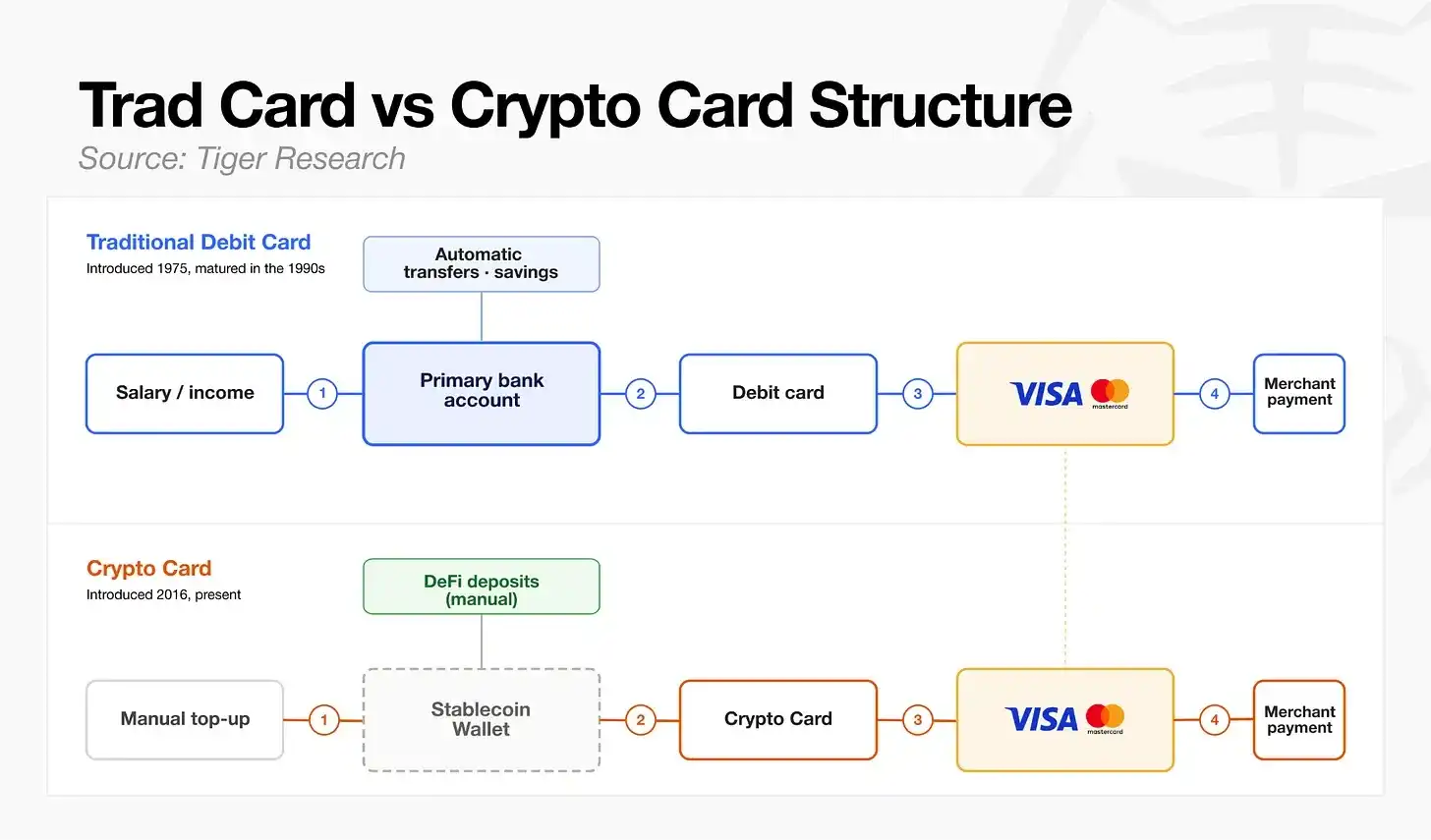
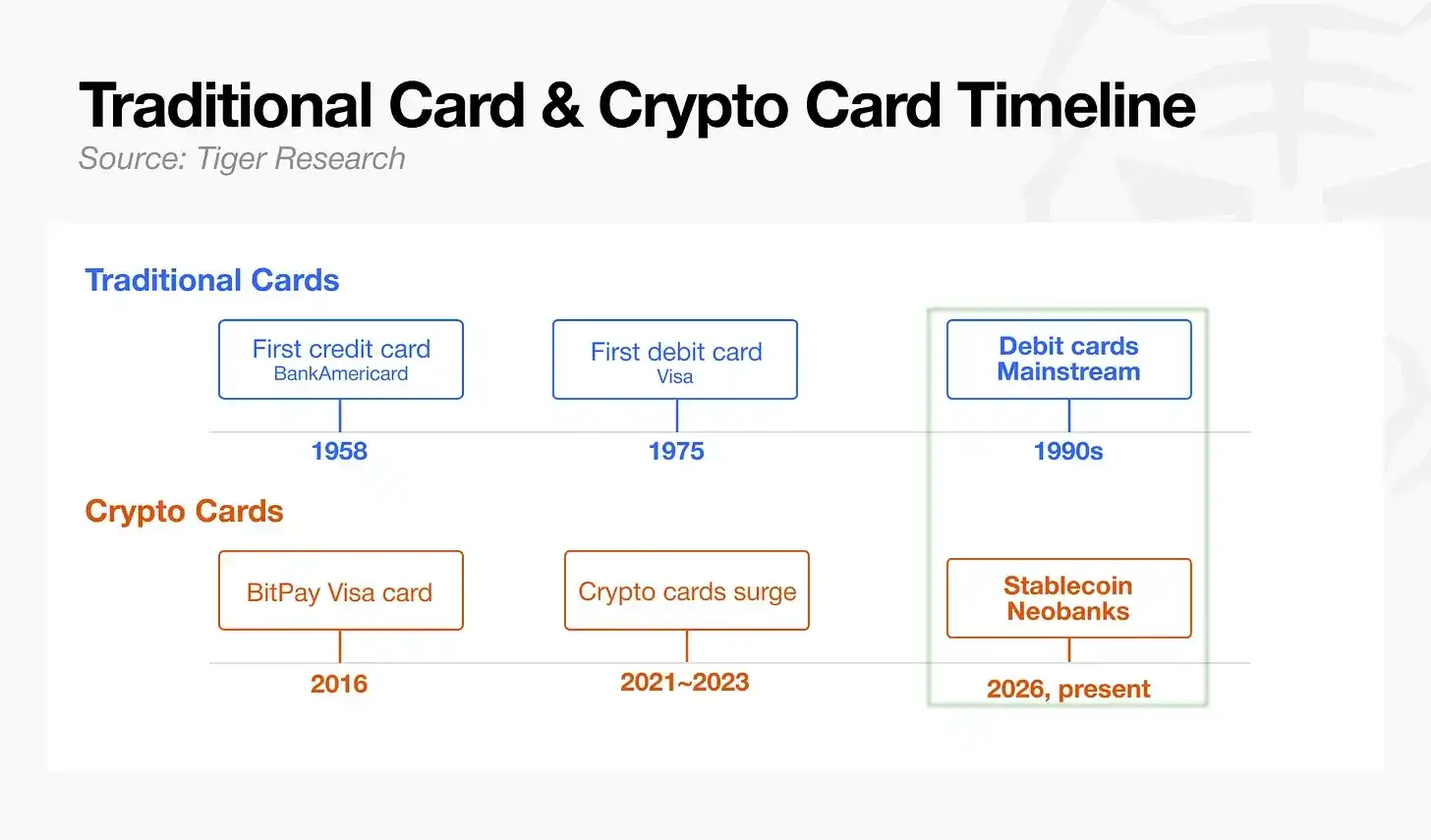
The biggest watershed between traditional payment and crypto payment lies in whether they foster users' routine financial account relationships. Debit cards were born in 1975, but only became a standard feature of individual core bank accounts after salary deposit services became widespread in the 1990s. In contrast, for today's crypto payment cards, the main funding source is basically users self-topping up stablecoins; the vast majority of crypto wallets cannot handle daily financial flows like salary deposits or scheduled bill payments. The industry's overall development stage is roughly equivalent to that of debit cards around the early 1990s.

The future leader in the crypto payment card race won't be determined by the number of cards issued, but by who first builds a core account that truly serves daily income and expenses, or finds a growth driver that fosters long-term user retention.

Monthly Transaction Volume of $1.5 Billion Does Not Equate to Industry Maturity

According to data from analytics firm Artemis, the monthly transaction volume of crypto payment cards grew from $100 million in early 2023 to $1.5 billion by the end of 2025, representing an annualized scale of approximately $18 billion. Affected by variations in on-chain data statistical methods, the actual annualized figure may fluctuate slightly, but the explosive growth in transaction volume is an indisputable fact.
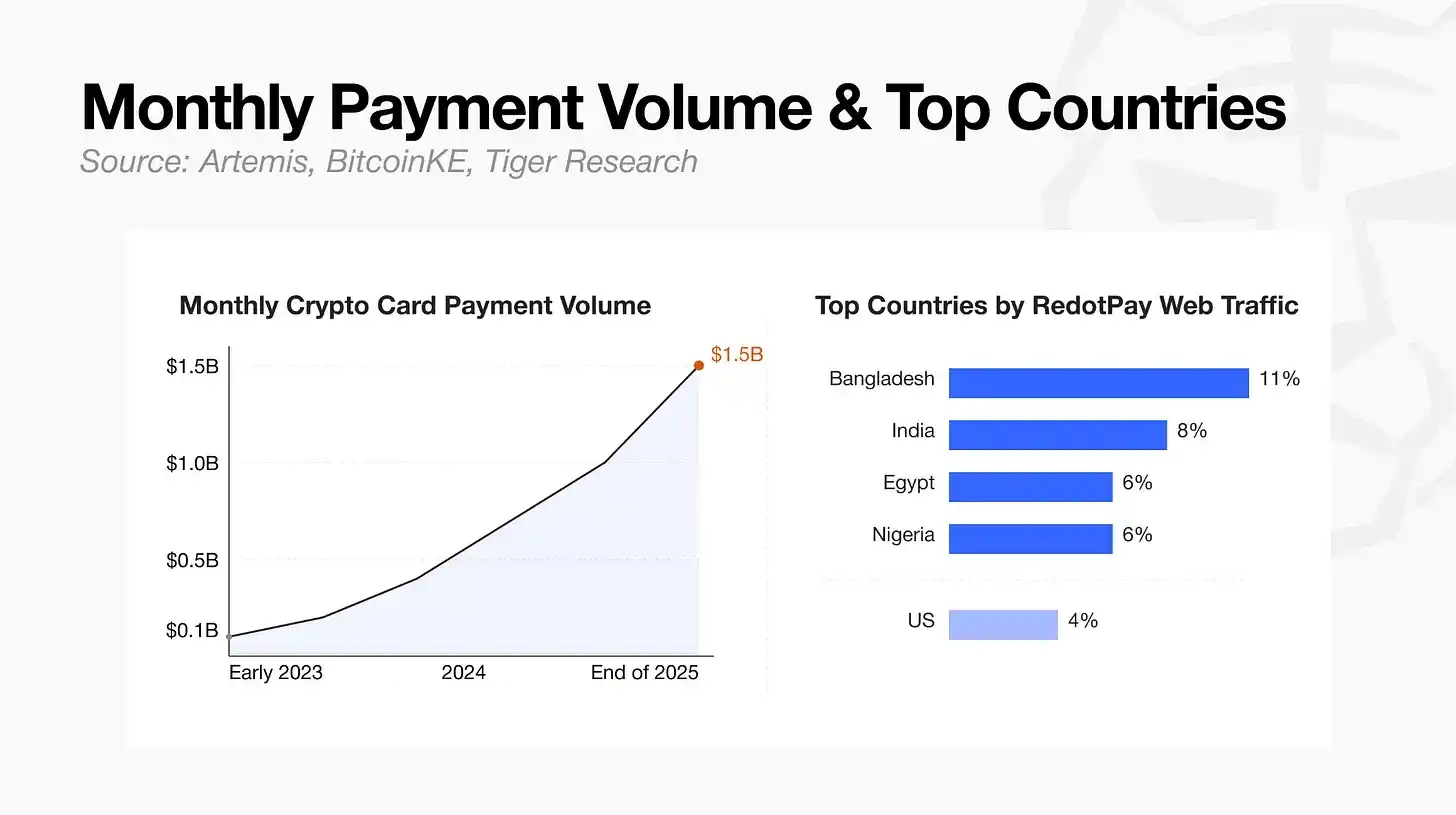
A closer analysis of these metrics reveals significant concentration among services and regions. Leading service provider RedotPay alone accounts for over half of the entire industry's transaction flow; platform users are highly concentrated in emerging markets: Bangladesh accounts for 11%, India 8%, Egypt 6%, Nigeria 6%, with the US representing only 4%.

This shows that the real demand for crypto payment cards does not come from developed mainstream markets, but from developing regions with insufficient financial services and restricted access to USD.
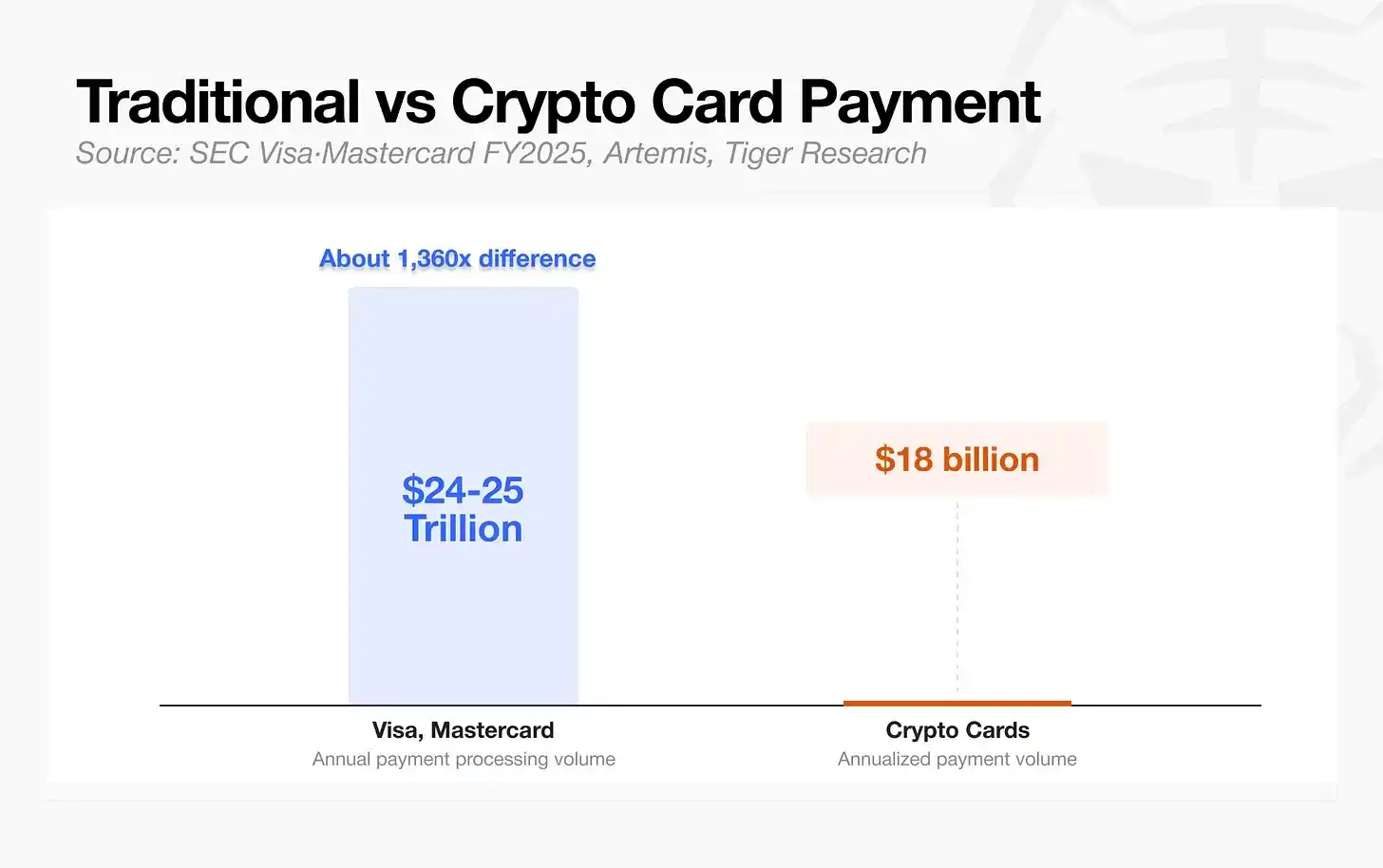
Compared to mature financial networks, the scale gap of cryptocurrency remains vast. Visa and Mastercard's annual total payment volume reaches $24-25 trillion, while crypto payment card annualized transactions are merely $18 billion. They are not on the same scale.
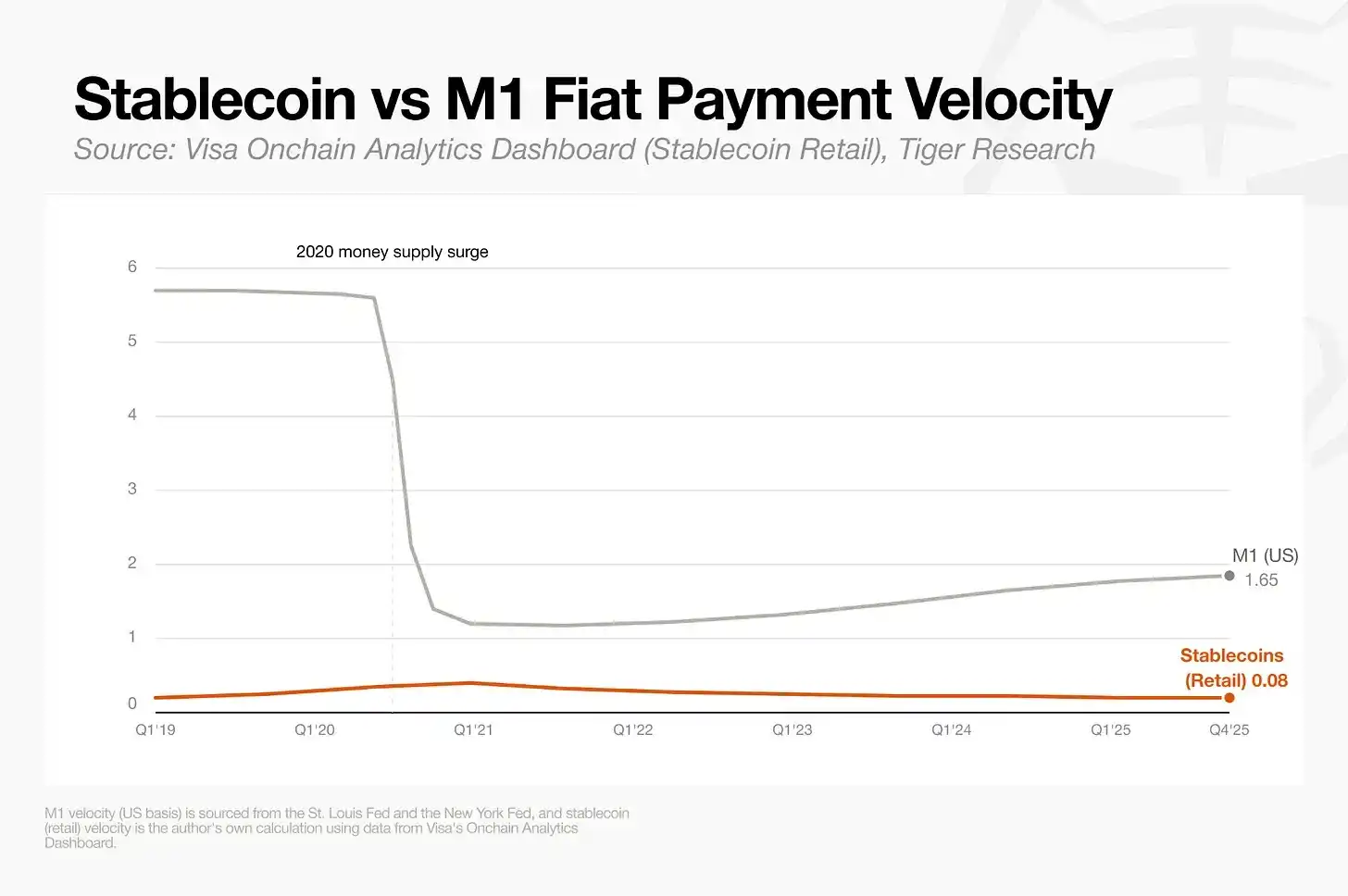
The velocity of circulation indicator, which measures the penetration of daily payments, is also relatively low. According to Visa statistics, the retail circulation velocity of on-chain stablecoins is only 0.08, merely one-twentieth of the velocity (1.65) of narrow fiat money M1. The pattern of stablecoin usage for most users is not the routine cycle of salary deposit, daily spending, and top-up recharge, but rather a one-time top-up followed by intermittent card spending.

Growth in transaction volume numbers does not equate to the market forming a mature, universally accepted clearing system. Currently, a large portion of crypto payment card transactions come from users in emerging markets who lack convenient access to USD-denominated bank accounts. For these users, crypto cards indeed possess practical financial value.

However, in developed markets, crypto payment cards have yet to find a stable product-market fit, nor have they established the deep account binding relationships brought about by features like salary deposits and automated bill payments.

Considering both funding channels and spending scenarios, current crypto payment cards are better suited for specific country-specific niche needs, acting as supplementary tools rather than universal financial infrastructure. Nonetheless, amidst the industry's rapid growth, leading players across four major business models are simultaneously refining various aspects of the industry chain.

Four Mainstream Business Models for Crypto Payment Cards
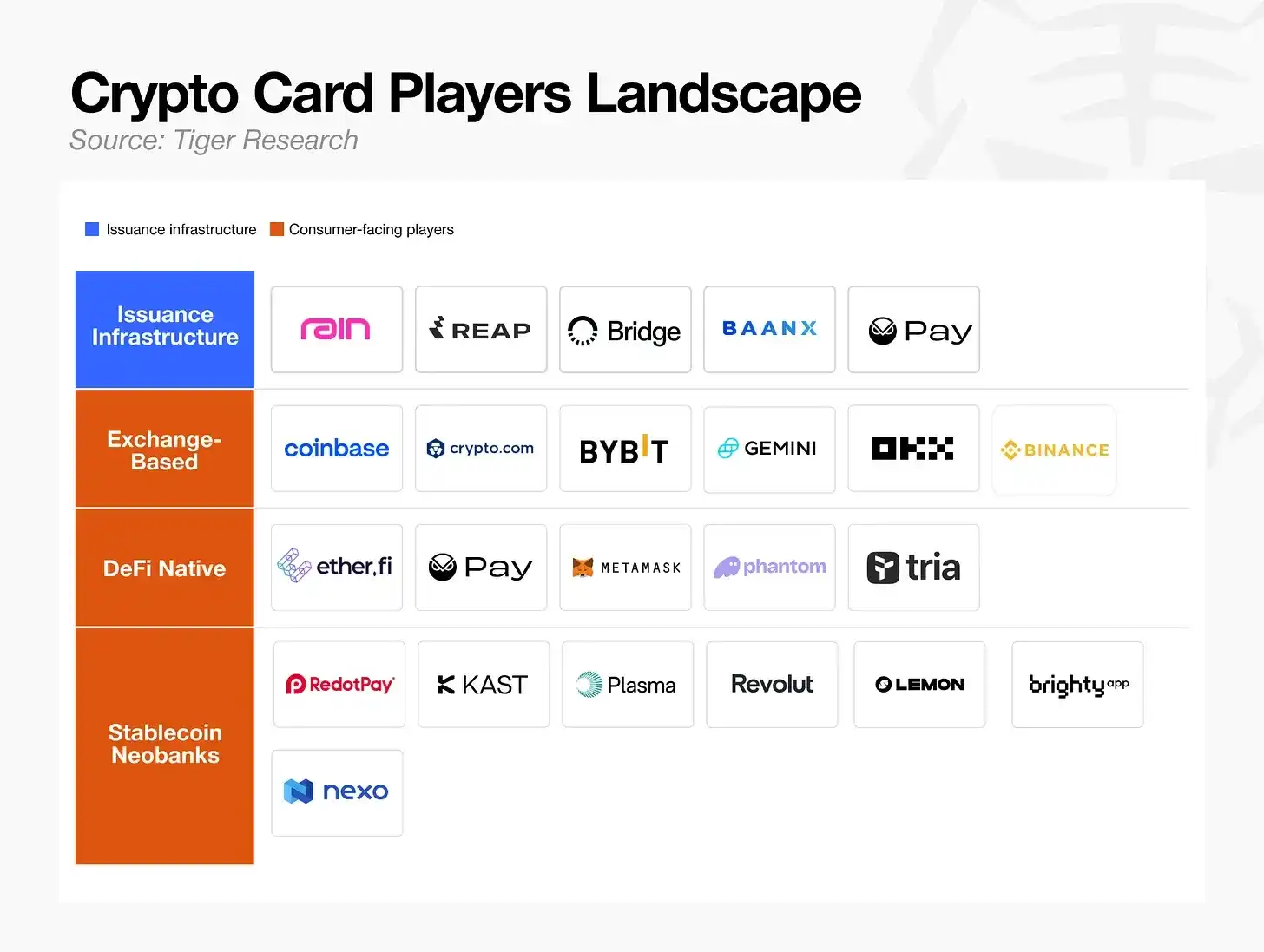
The crypto card industry can be broadly categorized into four business models, with various participants vying for first-mover advantage at different layers. These models vary widely, from companies focused on providing backend infrastructure to those merely adopting the card form factor but with entirely different underlying structures.

Card Issuing Infrastructure

The well-known payment networks Visa and Mastercard also apply to the crypto card ecosystem. Beneath them lies the card issuing infrastructure layer, which ultimately extends to the consumer card. As shown in the diagram above, there are two structures within the issuing infrastructure layer. The first is the traditional two-tier structure, where the program manager responsible for operations is separate from the issuing bank responsible for member management and settlement. The second is the full-stack issuer, such as Rain and Reap, which combines these two roles.
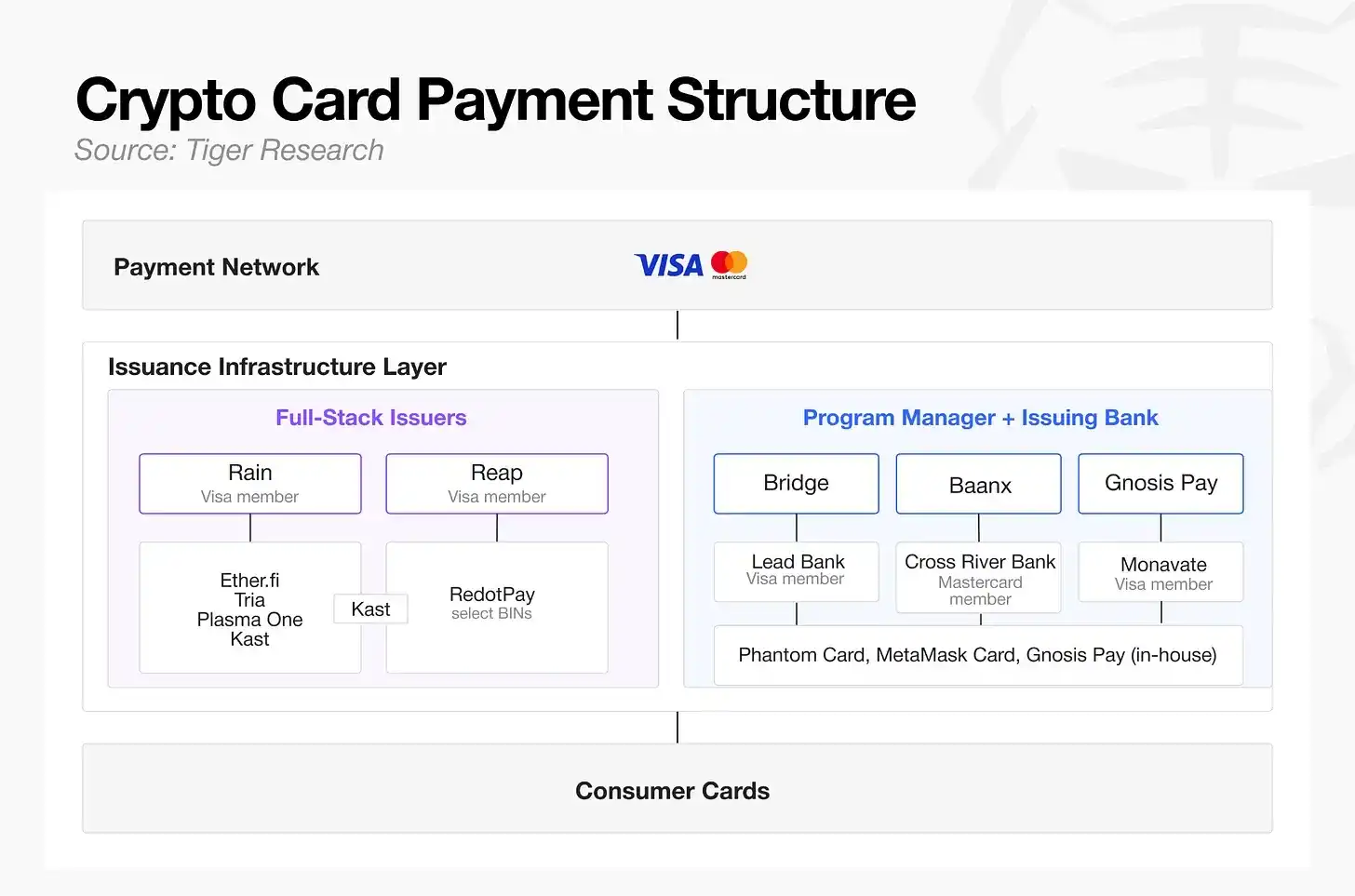
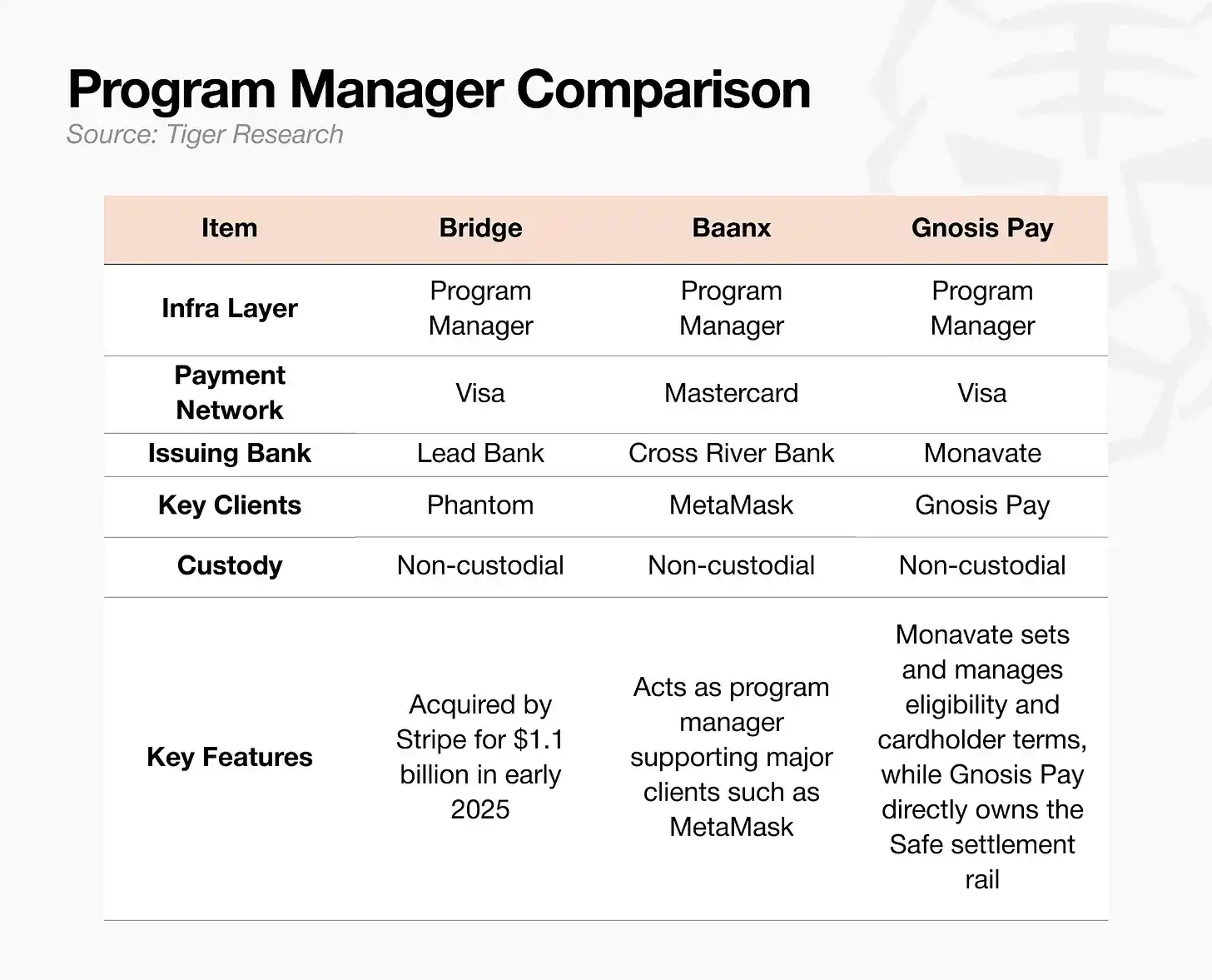
Multiple seemingly independent payment card brands actually reuse a handful of program service providers at their core. Phantom Card, MetaMask Card, and Gnosis Pay are typical examples.
Seemingly independent payment card products like Kast, Ether.fi, Tria, and Plasma One similarly share a small number of underlying infrastructure service providers, with Rain handling the majority of consumer-grade card business.

The high concentration of issuing infrastructure has also attracted established traditional digital banks to enter the fray. In March 2026, Nium launched a stablecoin card issuing platform, supporting both Visa and Mastercard networks. Other traditional financial infrastructure vendors include Bridge (acquired by Stripe for $1.1 billion in early 2025) and BVNK (acquired by Mastercard for up to $1.8 billion in March 2026).

Competition in the issuing sector is intensifying, with full-stack issuers, veteran program managers, and new fintech players competing on the same stage. Pure card issuing business alone can no longer build high barriers.

Rain has differentiated itself by leveraging daily stablecoin settlements. Traditional card settlement cycles take several days; Rain achieves T+0 settlement for stablecoins through Visa, significantly improving capital turnover efficiency for partner platforms like Ether.fi. Recently, the platform launched an AI Agent control layer, enabling programs to automatically generate disposable virtual cards, moving functionality beyond basic issuing infrastructure.

Issuing service providers seeking to break through cannot merely offer basic payment rails; they must also rapidly implement differentiated value-added features that traditional infrastructure cannot provide.

Exchange-Attached Payment Cards

For exchanges, payment cards are not a core revenue source; their primary role is to retain existing users. By overlaying card functionality onto the platform's existing user base, assets, and transaction data, they aim to prevent user churn. The platform's real profits come from trading fees, lending services, and asset custody, not from card spending itself.
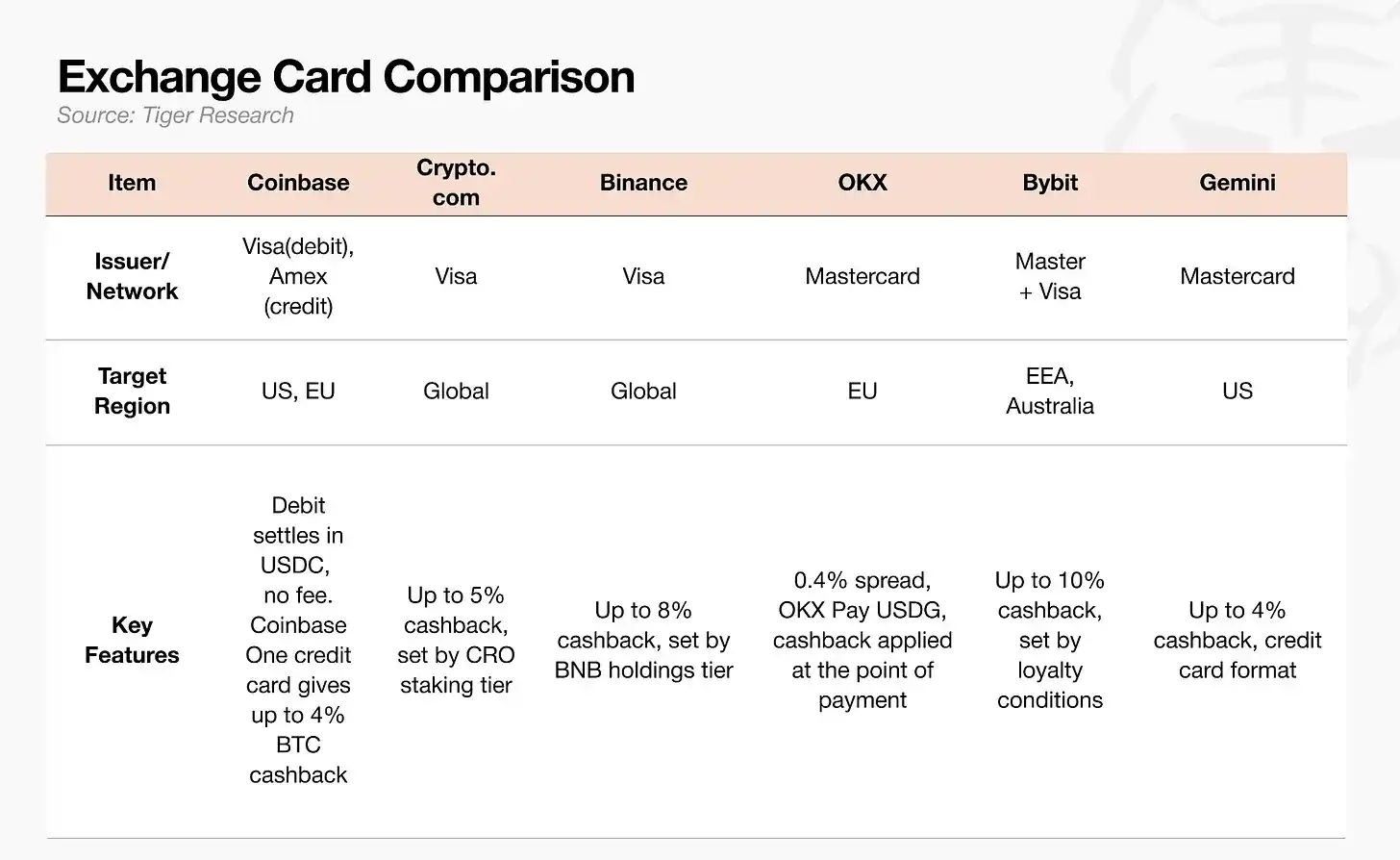
Exchanges view payment cards as a traffic entry point for building a financial super-app. However, the platform's native token cashback model carries risks: token price volatility directly leads to unstable actual cashback ratios.

Industry alternatives include stablecoin cashback and balance interest accrual, but the US "GENIUS Stablecoin Act" prohibits interest-bearing activities, creating a barrier to market expansion.

Decentralized Wallet DeFi Model

The core logic of this model is that the wallet itself is the user account, with assets self-custodied on-chain, eliminating the need to deposit them with a centralized exchange. Card spending is settled directly from on-chain assets. Simultaneously, it offers a line of credit, using the assets as collateral.

However, users need to set up vaults, manage collateral, and monitor liquidation risks themselves, resulting in high operational barriers. This consequently limits the scale of the user base for this model.
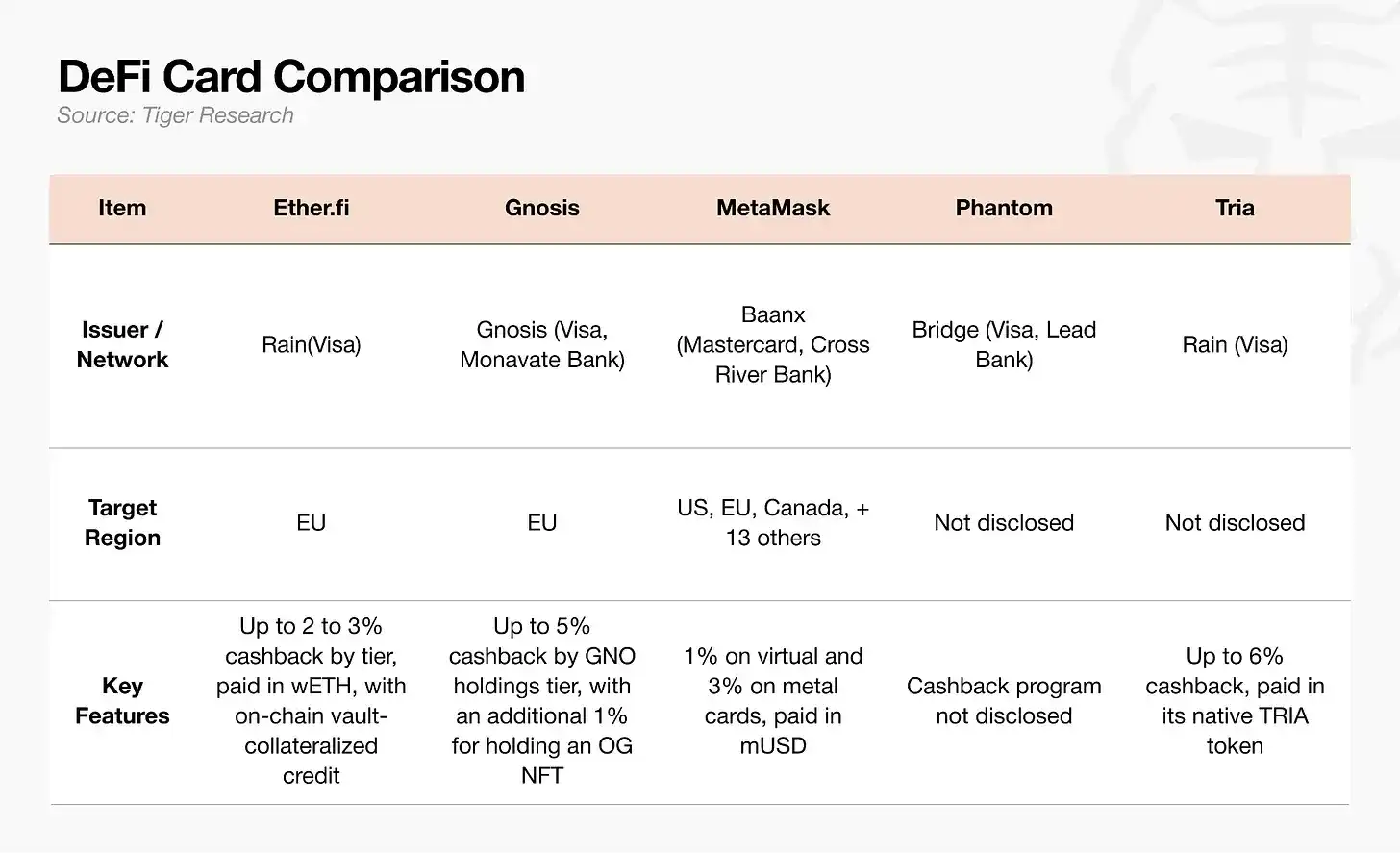
During payment, the system instantly converts on-chain assets to fiat for settlement, generating on-chain Gas fees for each transaction; when public chain throughput is insufficient or the network is congested, fees may exceed the spending amount, and transaction authorization delays are frequent.

For this reason, MetaMask Card opted for its self-developed Layer-2 network Linea, reducing per-transaction Gas fees to around $0.01, alleviating the pain points of high fees and delays for small payments. Tria employs a Gas-less top-up solution, with the platform covering fees generated during top-up, sparing users the operational cost of selecting blockchains and calculating fees.

However, until the user experience, balancing asset self-custody with spending convenience, is polished to the level of traditional debit cards, this model's users will remain confined to native crypto users.

Stablecoin Digital Bank

This is the segment with the highest share of current market transaction volume. Its focus is on account functionality rather than the card itself. Stablecoin balances integrate foreign exchange, cross-border remittance, and wealth management features, with the payment card merely serving as the top-level spending vehicle. In emerging markets with high local currency volatility, costly cross-border remittances, and difficult USD access, this model possesses strong competitiveness.
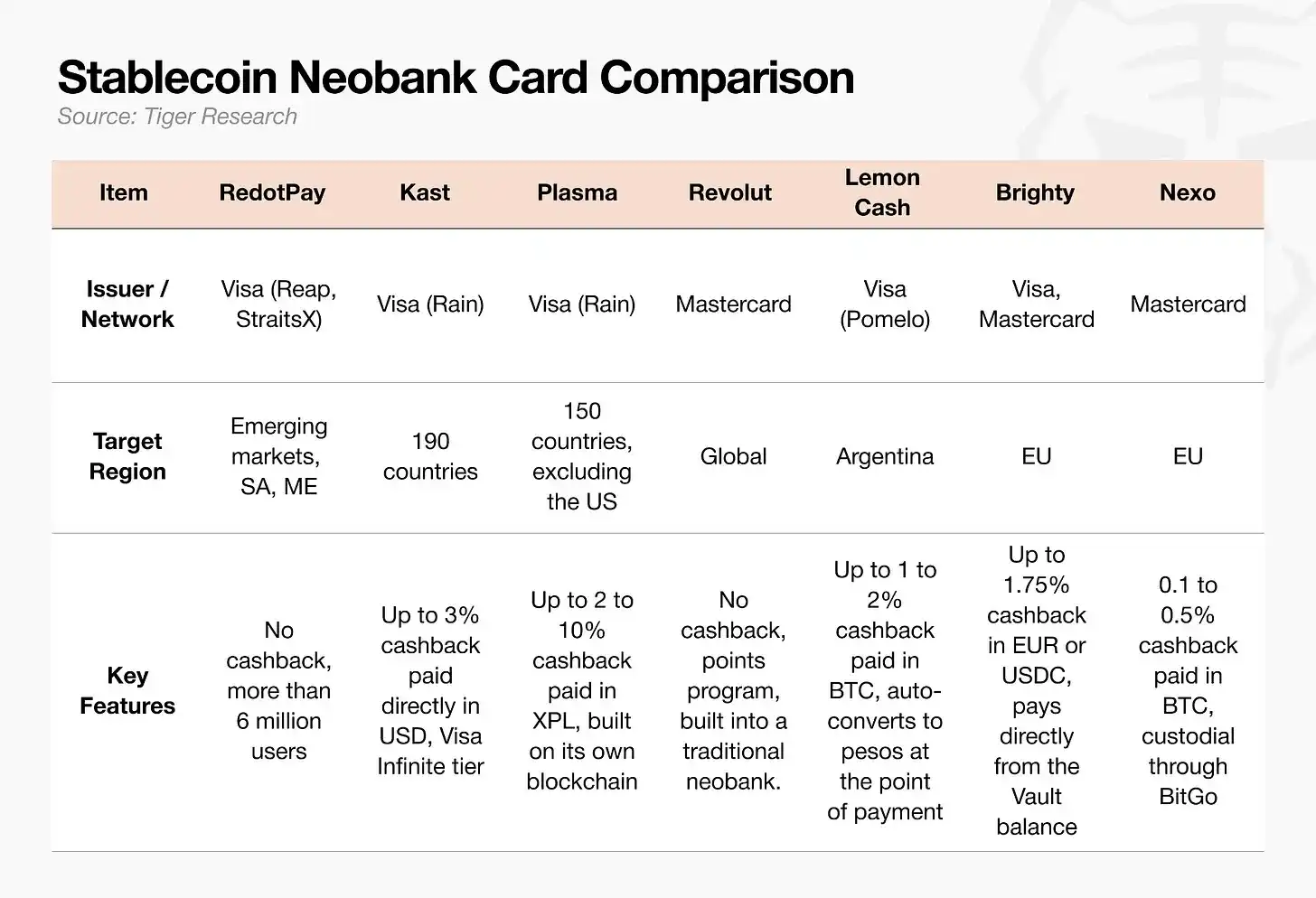
To sustain growth, this segment must move beyond the single form of a "prepaid card" model, where users autonomously purchase stablecoins and transfer them to their balance.

Cashback strategies across platforms have diverged based on market positioning. Industry leader RedotPay and established fintech player Revolut offer no cashback campaigns, while later entrants like Kast and Plasma One aggressively promote USD or platform token cashback to attract users.

However, relying solely on incentive subsidies cannot drive crypto payment cards to truly integrate into users' daily consumption habits.

Pure Payment Functionality Cannot Support Long-Term Development

The history of traditional bank cards and digital banks demonstrates that pure payment businesses have extremely low profitability ceilings. These enterprises only became profitable after incorporating concepts like the primary account and structural elements such as deposit-loan spreads into their business models. The crypto payment card industry has now reached the same critical development point. However, global regulatory frameworks like the US GENIUS Act and the EU's MiCA restrict the development of interest-bearing stablecoin and asset management services, making the path to breakthrough arduous.

Under these macro regulatory constraints, for industry players to survive long-term, they must grasp three core strategic imperatives:

  • Directly control the fund flow pathway.
  • Secure unique application scenarios in emerging markets.
  • Build proprietary user account systems that cannot be replaced by underlying infrastructure providers.

After industry standards solidify, companies unable to achieve the above will gradually fall behind.

Looking back at the history of debit cards, those who ultimately dominated the market were not the ones issuing the most cards, but those who first gained control of users' primary bank accounts. The crypto payment card industry now faces precisely the same proposition.

Crypto card operators need to directly control the fund flow upstream of the Visa payment process, seize first-mover advantage in niche markets, and, akin to the rise of bank accounts in traditional finance, take control of consumer infrastructure. This means establishing a global standard with no precedent to follow.

Without achieving the above, crypto payment cards will never become essential tools integrated into daily life, remaining merely prepaid cards used intermittently by niche groups for small cashback rewards.


Criptos en tendencia

Preguntas relacionadas

QAccording to the article, what is the key difference between traditional payment cards and current crypto payment cards?

AThe key difference lies in whether they establish a user's normalized financial account relationship. Traditional debit cards became core banking tools after the popularization of payroll deposits in the 1990s. In contrast, most crypto payment cards today rely primarily on user self-topped-up stablecoins, lacking integration with payroll, recurring payments, and other daily financial flows, placing the industry at a development stage equivalent to debit cards around 1990.

QBased on the data from Artemis, what does the concentration of crypto payment card traffic reveal about its real-world demand?

AThe data reveals that the real demand for crypto payment cards is not from developed mainstream markets but primarily from developing regions with insufficient financial services and limited access to US dollars. Over half of the industry's transaction volume comes from a single provider, RedotPay. User traffic is highly concentrated in emerging markets like Bangladesh (11%), India (8%), Egypt (6%), and Nigeria (6%), with the US accounting for only 4%.

QWhat are the four mainstream business models for crypto payment cards outlined in the article?

AThe four mainstream business models are: 1) Issuing Infrastructure (e.g., Rain, Nium), 2) Exchange-based Payment Cards (e.g., products from major crypto exchanges), 3) Decentralized Wallet/DeFi Cards (e.g., MetaMask Card, Tria), and 4) Stablecoin Digital Banks (e.g., RedotPay, Revolut's crypto offerings).

QWhat major challenge does the article identify for DeFi-based crypto payment cards regarding user experience?

AThe major challenge is the high user experience barrier. For DeFi cards, each transaction requires on-chain gas fees for currency conversion, which can sometimes exceed the transaction amount itself during network congestion, leading to authorization delays. While solutions like using Layer-2 networks or absorbing gas fees exist, the overall interaction experience has not yet reached the seamless level of traditional debit cards, limiting adoption to native crypto users.

QWhat three core strategic imperatives does the article suggest for crypto payment card players to achieve long-term survival and growth?

AThe three core strategic imperatives are: 1) Directly control the capital flow within the payment chain. 2) Secure and defend unique application scenarios in emerging markets. 3) Build a proprietary user account system that cannot be easily replaced by underlying infrastructure providers.

Lecturas Relacionadas

But Bin's Latest Speech: Do Not Miss Out on a Great Era

Dan Bin's Latest Speech: Don't Miss a Great Era On June 29th, Dan Bin, Chairman of Dongfang Harbor (东方港湾), delivered a keynote speech titled "Don't Miss a Great Era" at the "2026—All in the Silicon-based New Epoch" Mid-Year Strategy Summit. Addressing concerns about an AI bubble, Dan Bin argued from an industrial cycle perspective that "the risk of missing an era may be greater than worrying about short-term bubbles." He views humanity as standing at the dawn of the AI era, which could be more disruptive than the electronics, internet, and mobile internet eras. He posits that the AI wave is unlikely to end in just three or four years. Using the internet era's decade-long rhythm as a reference point—with ChatGPT's late 2022 launch as the starting line—a key risk assessment window may only arrive around 2033. Dan Bin emphasized that technological progress is the primary driver of long-term capital market growth, while factors like trade wars or interest rate hikes are secondary. Expanding to a civilizational scale, Dan Bin presented a thought experiment on silicon-based life potentially supplementing or succeeding carbon-based life as a direction for extending Earth's civilization, especially over cosmic timescales spanning billions of years. On geopolitics, he noted that AI is already rewriting warfare rules, as seen in conflicts like Ukraine, and that neither the U.S. nor China can afford to lose the AI race, with each leveraging different strengths. Reflecting on investment lessons, Dan Bin cited Warren Buffett's and Charlie Munger's admitted "regrets" about missing major tech opportunities like Microsoft, underscoring the need for continuous cognitive evolution. His firm, Dongfang Harbor, is deepening its research in foundational AI areas like computing power and storage. Dan Bin concluded by urging investors to maintain a long-term perspective, embrace the epochal shift, and rationally hold onto the opportunities presented by this transformative age. He closed with a poetic reminder: "The tide never turns back... Born in this time is a great fortune in itself. Don't let hesitation trap your steps, nor short-sightedness waste the years—do not miss this magnificent era that belongs to us."

marsbitHace 52 min(s)

But Bin's Latest Speech: Do Not Miss Out on a Great Era

marsbitHace 52 min(s)

Latest Speech by Dan Bin: Do Not Miss Out on a Great Era

Dan Bin, Chairman of Dongfang Harbor, delivered a keynote speech titled "Don't Miss a Great Era" at the Glonghui "2026—All in Silicon-Based New纪元" Mid-Year Strategy Summit on June 29th. Addressing concerns about an AI bubble, he argued from an industrial cycle perspective that the risk of missing an entire epoch far outweighs the risk of short-term泡沫. He positioned humanity at the dawn of the AI era, which he views as potentially more disruptive than the electronic, internet, and mobile internet eras. Dan Bin suggested the AI wave is unlikely to end in just three to four years. Drawing a parallel to the internet era's decade-long cycle starting from the 1994 Netscape IPO, he indicated that with ChatGPT's late-2022 launch as a marker, a key risk assessment point might not arrive until around 2033. He emphasized that technological progress is the primary driver of long-term capital market growth, with factors like trade wars and interest rates being secondary. Expanding his perspective to a civilizational scale, Dan Bin presented a thought experiment on silicon-based life potentially replacing carbon-based life as a direction for延续 Earth's civilization, especially given cosmic timescales and interstellar travel challenges. He noted AI's必然 weaponization, citing examples from the Russia-Ukraine war, and stated that neither the U.S. nor China can afford to lose the AI race, with each having distinct competitive advantages. Reflecting on investment lessons, he mentioned Warren Buffett's recent moves into tech like Google and查理·芒格's expressed regret about missing Microsoft's massive growth, underscoring the need for continuous认知迭代. Dan Bin concluded by urging investors to maintain a long-term perspective, focus on core technological trends, and rationally embrace the opportunities of this transformative era, so as not to辜负 this "great时代" defined by波澜壮阔 change.

链捕手Hace 57 min(s)

Latest Speech by Dan Bin: Do Not Miss Out on a Great Era

链捕手Hace 57 min(s)

Trading

Spot

Artículos destacados

Qué es $BANK

Banco AI: Un Paso Revolucionario en el Futuro de la Banca Introducción En una era marcada por avances rápidos en tecnología, Banco AI se sitúa en la intersección de la inteligencia artificial (IA) y los servicios bancarios. Este proyecto innovador busca redefinir el panorama financiero, mejorando la eficiencia operativa, las medidas de seguridad y las experiencias del cliente a través del poder de la IA. Al embarcarnos en esta exploración de Banco AI, profundizaremos en lo que implica el proyecto, sus dinámicas operativas, su contexto histórico y hitos significativos. ¿Qué es Banco AI? En su esencia, Banco AI representa una iniciativa transformadora destinada a integrar la inteligencia artificial en varias operaciones bancarias. Este proyecto aprovecha las capacidades de la IA para automatizar procesos, mejorar los protocolos de gestión de riesgos y mejorar la interacción con los clientes a través de servicios personalizados. Los objetivos principales de Banco AI incluyen: Automatización de Funciones Bancarias: Al aprovechar las tecnologías de IA, Banco AI tiene como objetivo automatizar tareas rutinarias, reduciendo la carga sobre los recursos humanos y mejorando la eficiencia. Mejora en la Gestión de Riesgos: El proyecto utiliza algoritmos de IA para predecir e identificar riesgos, fortaleciendo así las medidas de seguridad contra fraudes y otras amenazas. Personalización de Servicios Bancarios: Banco AI se centra en ofrecer productos y servicios financieros a medida al analizar datos y comportamientos de los clientes. Mejoramiento de la Experiencia del Cliente: La implementación de soluciones impulsadas por IA, como chatbots y asistentes virtuales, tiene como objetivo proporcionar a los usuarios interacciones más humanas, revolucionando la forma en que los clientes se relacionan con los bancos. Con estos objetivos, Banco AI se posiciona como un jugador crucial para hacer que la banca sea más eficiente, segura y centrada en el usuario. ¿Quién es el Creador de Banco AI? Los detalles sobre el creador de Banco AI siguen siendo desconocidos. Como tal, no se ha identificado a ninguna persona u organización específica en la información disponible. El anonimato que rodea el inicio del proyecto plantea preguntas, pero no resta valor a su ambiciosa visión y objetivos. ¿Quiénes Son los Inversores de Banco AI? Al igual que con el creador del proyecto, no se ha divulgado información específica sobre los inversores u organizaciones que apoyan a Banco AI. Sin esta información, es un desafío delinear el respaldo financiero y el apoyo institucional que podrían estar impulsando el proyecto hacia adelante. No obstante, la importancia de contar con una sólida base de inversión es fundamental para sostener el desarrollo en un campo tan innovador. ¿Cómo Funciona Banco AI? Banco AI opera en múltiples frentes innovadores, centrándose en factores únicos que lo diferencian de los marcos bancarios tradicionales. A continuación, se presentan las características operativas clave: Automatización: Al aplicar algoritmos de aprendizaje automático, Banco AI automatiza varios procesos manuales dentro de los bancos. Esto resulta en la reducción de costos operativos y permite que los trabajadores humanos redirijan sus esfuerzos hacia actividades más estratégicas. Gestión Avanzada de Riesgos: La integración de la IA en las prácticas de gestión de riesgos equipa a los bancos con herramientas para predecir con precisión amenazas potenciales como el fraude, garantizando que la información y los activos de los clientes permanezcan seguros. Recomendaciones Financieras Personalizadas: A través del aprendizaje continuo a partir de las interacciones con los clientes, los sistemas de IA desarrollan una comprensión matizada de las necesidades del usuario, lo que les permite ofrecer consejos adaptados sobre decisiones financieras. Interacciones Mejoradas con los Clientes: Al utilizar chatbots y asistentes virtuales impulsados por IA, Banco AI permite una experiencia más atractiva para el cliente, permitiendo a los usuarios resolver sus consultas rápidamente, reduciendo así los tiempos de espera y mejorando los niveles de satisfacción. En conjunto, estas características operativas posicionan a Banco AI como un pionero en el sector bancario, estableciendo nuevos parámetros para la entrega de servicios y la excelencia operativa. Línea de Tiempo de Banco AI Entender la trayectoria de Banco AI requiere mirar su contexto histórico. A continuación, se presenta una línea de tiempo que destaca hitos y desarrollos importantes: Inicios de 2010: La conceptualización de la integración de la IA en los servicios bancarios comenzó a ganar atención a medida que las instituciones bancarias reconocieron los posibles beneficios. 2018: Se produjo un aumento notable en la implementación de tecnologías de IA cuando los bancos comenzaron a utilizar herramientas de IA como chatbots para el servicio al cliente básico y sistemas de gestión de riesgos para mejorar la seguridad. 2023: La sofisticación de la IA continuó avanzando, con la introducción de IA generativa para tareas más complejas como el procesamiento de documentos y análisis de inversiones en tiempo real. Este año marcó un salto significativo en las capacidades que la tecnología de IA otorgó a los bancos. 2024-Estatus Actual: A partir de este año, Banco AI se encuentra en una trayectoria ascendente, con investigaciones y desarrollos en curso que pronto mejorarán las capacidades en las operaciones bancarias. La continua exploración de las aplicaciones de IA sugiere emocionantes desarrollos aún por venir. Puntos Clave Sobre Banco AI Integración de la IA en la Banca: Banco AI se centra en adoptar inteligencia artificial para optimizar los procesos bancarios y mejorar la experiencia del usuario. Enfoque en Automatización y Gestión de Riesgos: El proyecto enfatiza fuertemente estas áreas, con el objetivo de desplazar la carga de tareas rutinarias mientras mejora los marcos de seguridad a través de análisis predictivos. Soluciones Bancarias Personalizadas: Al aprovechar los datos de los clientes, Banco AI permite servicios bancarios adaptados a las necesidades individuales de los usuarios. Compromiso con el Desarrollo: Banco AI se mantiene comprometido con esfuerzos de investigación y desarrollo continuos, asegurando su adaptabilidad y relevancia continua a medida que la tecnología sigue evolucionando. Conclusión En resumen, Banco AI ejemplifica un paso crucial hacia adelante en la industria bancaria, aprovechando la inteligencia artificial para redefinir los paradigmas operativos, mejorar la seguridad y promover la satisfacción del cliente. A pesar de las lagunas en la información sobre el creador y los inversores, los objetivos claros y los mecanismos funcionales de Banco AI proporcionan una sólida base para su evolución continua. A medida que la tecnología de IA sigue avanzando y fusionándose con el sector bancario, Banco AI está bien posicionado para impactar significativamente el futuro de los servicios financieros, mejorando la forma en que entendemos e interactuamos con la banca.

165 Vistas totalesPublicado en 2024.04.06Actualizado en 2024.12.03

Qué es $BANK

Cómo comprar BANK

¡Bienvenido a HTX.com! Hemos hecho que comprar Lorenzo Protocol (BANK) sea simple y conveniente. Sigue nuestra guía paso a paso para iniciar tu viaje de criptos.Paso 1: crea tu cuenta HTXUtiliza tu correo electrónico o número de teléfono para registrarte y obtener una cuenta gratuita en HTX. Experimenta un proceso de registro sin complicaciones y desbloquea todas las funciones.Obtener mi cuentaPaso 2: ve a Comprar cripto y elige tu método de pagoTarjeta de crédito/débito: usa tu Visa o Mastercard para comprar Lorenzo Protocol (BANK) al instante.Saldo: utiliza fondos del saldo de tu cuenta HTX para tradear sin problemas.Terceros: hemos agregado métodos de pago populares como Google Pay y Apple Pay para mejorar la comodidad.P2P: tradear directamente con otros usuarios en HTX.Over-the-Counter (OTC): ofrecemos servicios personalizados y tipos de cambio competitivos para los traders.Paso 3: guarda tu Lorenzo Protocol (BANK)Después de comprar tu Lorenzo Protocol (BANK), guárdalo en tu cuenta HTX. Alternativamente, puedes enviarlo a otro lugar mediante transferencia blockchain o utilizarlo para tradear otras criptomonedas.Paso 4: tradear Lorenzo Protocol (BANK)Tradear fácilmente con Lorenzo Protocol (BANK) en HTX's mercado spot. Simplemente accede a tu cuenta, selecciona tu par de trading, ejecuta tus trades y monitorea en tiempo real. Ofrecemos una experiencia fácil de usar tanto para principiantes como para traders experimentados.

798 Vistas totalesPublicado en 2025.05.09Actualizado en 2026.06.02

Cómo comprar BANK

Discusiones

Bienvenido a la comunidad de HTX. Aquí puedes mantenerte informado sobre los últimos desarrollos de la plataforma y acceder a análisis profesionales del mercado. A continuación se presentan las opiniones de los usuarios sobre el precio de BANK (BANK).

活动图片