Large-scale Long-Term Bond Sell-off Forces a Severe Budgetary Reassessment

cryptonews.ruPublicado a 2026-08-15Actualizado a 2026-08-15

Resumen

Large-scale sell-offs in long-term government bonds have forced a major budget reassessment. Yields on key bonds surged to levels not seen in years or even decades: US 30-year Treasuries hit around 5.25% (highest since 2001), while German 30-year Bunds approached 3.73% (highest since 2011). French long-term yields returned to levels last seen during the global financial crisis, and Japan's 5-year government bond yields broke above 2.14%, signaling a departure from years of ultra-loose monetary policy. The era of ultra-cheap money, sustained by central bank stimulus post-2008 and during the pandemic, is ending. Investors now demand higher compensation for lending over decades, seeking protection against inflation, heavy bond issuance, and currency devaluation. Market patience with fiscal dysfunction is wearing thin, as seen in soaring yields for highly indebted European nations like France. The pressure stems from widening fiscal gaps in major economies (US, France, Japan), which face rising spending on defense, infrastructure, energy, and aging populations. In the US, annual federal interest payments now exceed $1 trillion. As central banks reduce bond holdings via quantitative tightening, they are withdrawing as major buyers. Governments are flooding the market with new debt, forcing private investors to demand higher yields—a rising term premium. The impact extends beyond government budgets: higher long-term yields push up mortgage rates, increase borrowing costs for cor...

A synchronous sell-off has pushed the yields of major long-term bonds to levels unseen in many years, and in some cases, decades. The yield on 30-year US Treasury bonds reached approximately 5.25%—the highest level since 2001—while the yield on 30-year German Bunds approached 3.73%—the highest level since 2011.

"Good morning from Germany, where the bond market is sending an unambiguous signal: the yield on 30-year German Bunds has risen to 3.73%—the highest level since 2011," wrote German journalist, author, and senior financial editor Holger Zschaepitz on X. "Germany now pays as much for borrowing as it did during the euro crisis era. The era of ultra-cheap money is over."
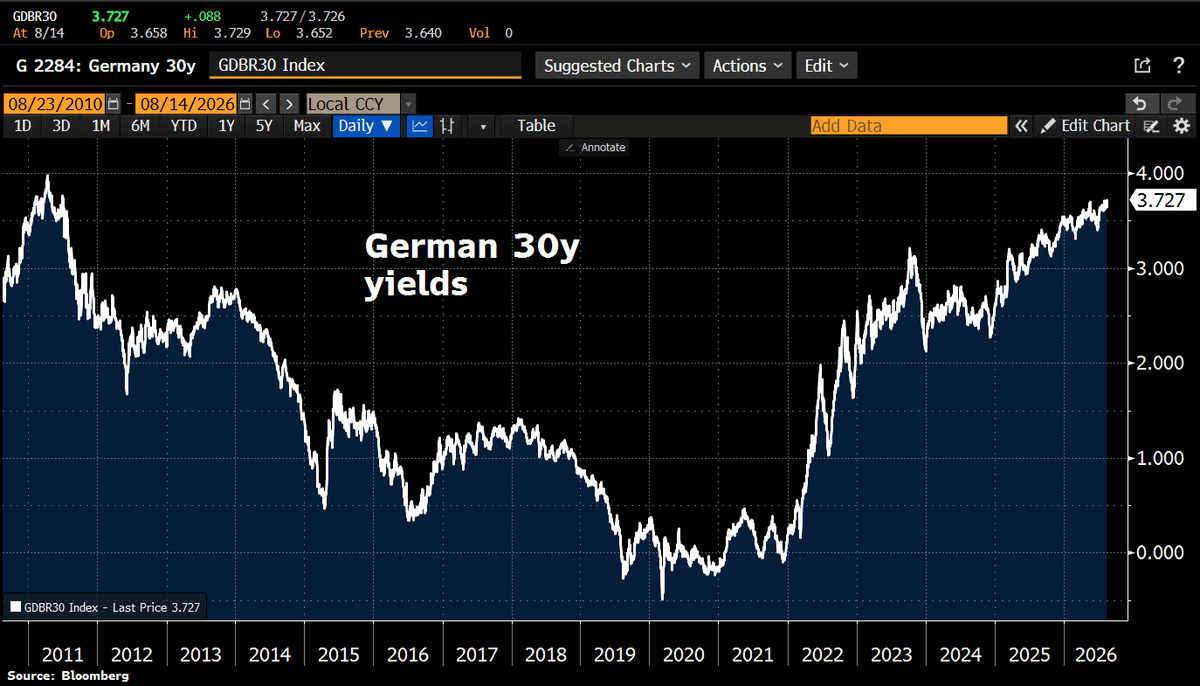
Bund yield chart provided by Holger Zschaepitz in his X post on August 15, 2026.

The yield on long-term French OAT bonds (short for Obligations Assimilables du Trésor) has returned to levels characteristic of the global financial crisis period. The yield on Japan's 5-year government bonds rose above 2.14%, marking a clear break after years of artificially soft monetary policy.

Investors Demand Compensation

Bond yield is the price governments pay investors for their money. When yields rise sharply, bond prices fall, and borrowing quickly becomes more expensive.

For over a decade after the 2008 financial crisis, central banks kept rates low and purchased vast amounts of government debt. This drove down yields, which in Europe and Japan even fell below zero. The pandemic doubled down on this trend: governments borrowed freely, and central banks prevented the market from asking inconvenient questions.

This scheme is collapsing. Investors providing credit for decades ahead now want protection from inflation, rampant bond issuance, and the erosion of the purchasing power of the cash they will get back.

"This week has seen a significant rise in the yields of long-term government bonds in heavily indebted European countries," explained Robin Brooks, a senior fellow in the Economic Studies Program at the Brookings Institution. "The situation is most notable in France, where the yield on 10y10y (orange line) and 10y20y (red line) has reached new historical highs."

Brooks added:

"The market's patience with fiscal dysfunction is running out."

Debt Markets Begin to Dictate Terms

The pressure point is fiscal policy—the growing gap between government spending and tax revenues. The United States, France, Japan, and other developed economies have accumulated massive debt while simultaneously increasing spending on defense, infrastructure, energy, and addressing aging populations.

In the US, according to recent estimates, the federal government's annual interest expense has exceeded $1 trillion. Each refinancing cycle locks in higher rates, turning yesterday's debt into tomorrow's budgetary problem.
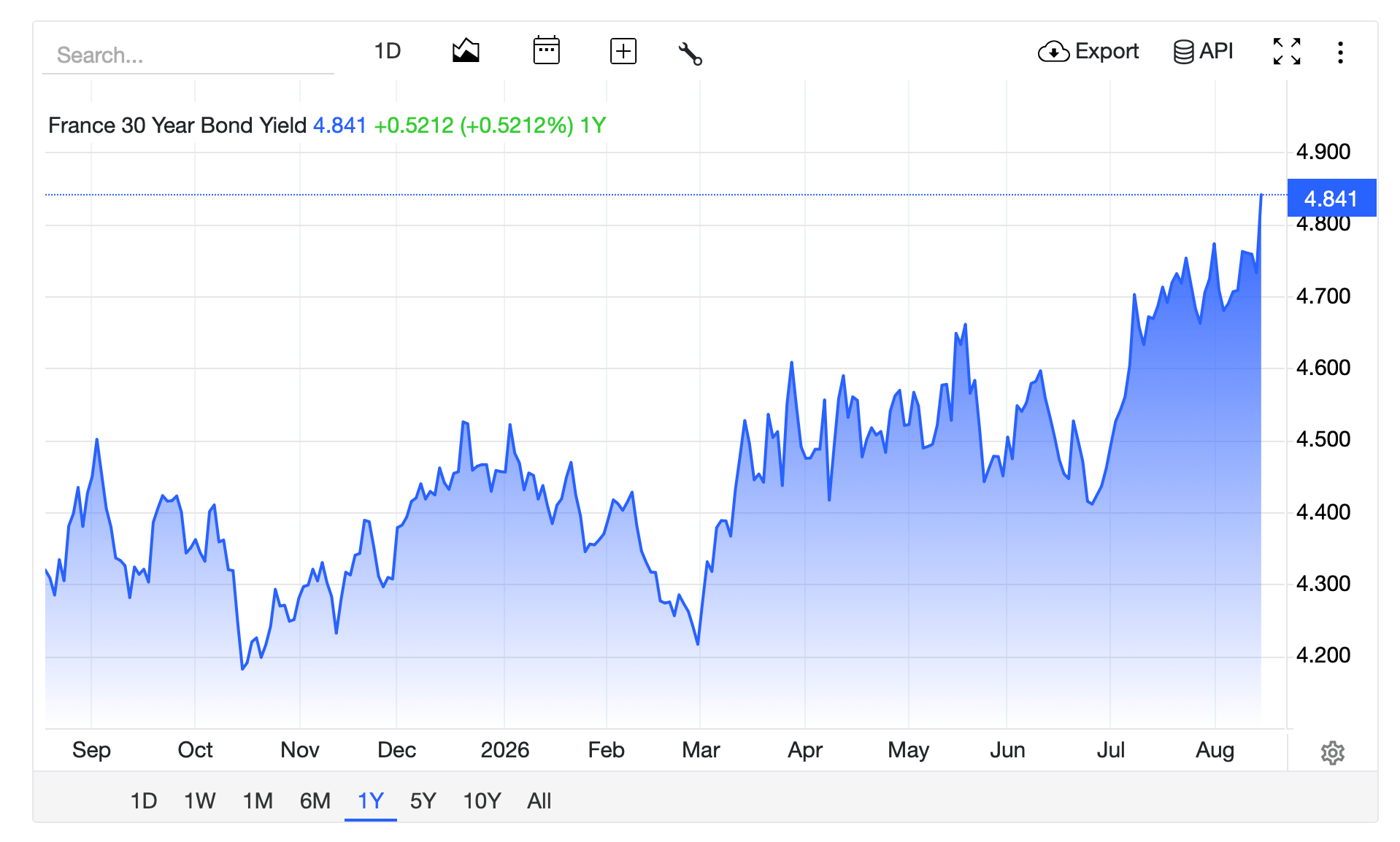
Yield on France's 30-year bonds according to tradingeconomics.com.

France has its own political and budgetary issues. Bond market participants are closely watching spending negotiations and debt forecasts, contributing to the rise in French bond yields compared to German benchmark bonds.

Germany, long considered the eurozone's most reliable borrower, plans to increase spending on infrastructure and defense. This means a larger supply of bonds, i.e., more government debt competing for investors' money.

Central Banks Exit the Market

Japan's actions are hard to ignore, as the Bank of Japan for years suppressed yields through yield curve control—a policy designed to keep borrowing costs low. As it gradually unwinds this regime, markets are re-pricing for higher rates and much less official support.

"Cheap money was a temporary phenomenon," wrote the Wealthmoose account on X. "Debt is forever. Now the bond market is presenting the bill."

The same trend is visible elsewhere. The Federal Reserve and other central banks have shrunk their bond portfolios through quantitative tightening, thereby removing a major buyer from the market.

Governments are flooding the market with bonds while central banks are buying fewer and fewer of them. Private investors can buy these securities, but only at higher yields. This extra compensation is the term premium—the fee for locking money away in long-term bonds.

The Bill Extends Beyond Government Budgets

The rise in long-term yields primarily hits households through mortgage rates. In the US, 30-year mortgage rates often follow Treasury yields, making home buying and refinancing more expensive.

Businesses face higher rates when issuing long-term bonds. Stocks also suffer as higher bond yields attract cash flows and reduce the present value investors assign to distant future profits. Savers, pension funds, and insurance companies can earn more on bonds. However, this resource reallocation comes at a high cost to governments and borrowers accustomed to the cheap money era.

end-content
Preguntas relacionadas

QWhat has caused long-term bond yields in major economies like the US and Germany to surge to multi-year highs?

AA large-scale, synchronized sell-off in the bond market has pushed yields to levels not seen in many years or even decades. This reflects a fundamental shift from the era of ultra-cheap money, as central banks withdraw support and investors demand higher compensation for inflation and fiscal risks.

QAccording to market analysts cited in the article, what message is the bond market sending to governments with high debt?

AThe bond market is sending a clear signal that its patience with fiscal dysfunction is running out. Analysts like Robin Brooks state that investors are now demanding a premium for lending to governments for decades, seeking protection against inflation, rampant bond issuance, and the erosion of purchasing power.

QWhat are the two main factors creating the current pressure on bond markets, according to the article?

AThe two main factors are expansive fiscal policy (governments increasing spending and accumulating huge debt) and the withdrawal of central bank support. Governments are flooding the market with new bonds while central banks are buying fewer of them through quantitative tightening, forcing private investors to step in only at higher yields.

QHow do rising long-term bond yields impact the broader economy beyond government budgets?

ARising long-term yields make mortgages and corporate borrowing more expensive, dampen stock prices by reducing the present value of future earnings, and increase costs for all borrowers. While savers and pension funds may earn more, the overall effect is a costly redistribution of resources away from entities accustomed to cheap money.

QWhat specific example illustrates the breaking of Japan's long-standing artificial monetary policy regime?

AThe yield on Japan's 5-year government bonds rose above 2.14%, which the article describes as a clean break after years of artificially soft monetary policy. This reflects the Bank of Japan's gradual retreat from its Yield Curve Control policy, forcing markets to reprice debt with much less official support.

Lecturas Relacionadas

Robert Kiyosaki Shares His Mentor's Predictions About the Emergence of Bitcoin and AI

American entrepreneur and author of "Rich Dad Poor Dad," Robert Kiyosaki, discussed the influence of futurist R. Buckminster Fuller on his worldview, linking Fuller's past technological predictions to the emergence of Bitcoin and the development of artificial intelligence. In an X post, Kiyosaki also reflected on personal purpose, sharing his journey from the music business—where he worked with bands like The Police and Iron Maiden—to creating the "Cashflow" board game and writing his famous book. He described feeling an inner emptiness despite his success, a turning point that came after meeting Fuller, whom he studied with for three summers. Kiyosaki described Fuller as a "friendly genius" who foresaw world-changing developments like Bitcoin and AI. However, the core of his post focused on Fuller's philosophical impact, particularly a quote about belonging to the universe and finding purpose by dedicating one's life to the maximum benefit of others. The entrepreneur remains a vocal advocate for cryptocurrencies. He regularly advises buying Bitcoin during market panics, viewing it and assets like Ethereum, gold, and silver as hedges against traditional financial system failures. Kiyosaki has predicted a major market crash by 2026, seeing it as an opportunity for prepared investors, with long-term price targets including $750,000 for Bitcoin and $95,000 for Ethereum.

cryptonews.ruHace 1 hora(s)

Robert Kiyosaki Shares His Mentor's Predictions About the Emergence of Bitcoin and AI

cryptonews.ruHace 1 hora(s)

Etherealize CEO Calls Wall Street's Private Blockchains a 'Race to the Bottom'

Etherealize co-founder and CEO Vivek Raman criticized Wall Street's growing interest in private, permissioned blockchains, calling them a "race to the bottom." In an interview with CoinDesk, Raman argued that consortium networks fragment liquidity and return the industry to the siloed systems that blockchain technology was meant to overcome. He stated that closed networks do not interoperate, undermining two key advantages of the technology: system compatibility and liquidity concentration. Etherealize promotes Ethereum as an open, foundational layer for institutional players. Raman insists that privacy and access restrictions should be built on top of public infrastructure—at the application or L2 level—rather than creating separate, closed networks. He compared Ethereum to HTTP as a base layer, with additional permissioned and private layers akin to HTTPS. Examples of this new wave of "closed" solutions mentioned include Canton Network from Digital Asset, Circle's Arc project, and Stripe's Tempo. Raman termed this trend "consortium chains 2.0," recalling earlier initiatives like the R3 interbank consortium and the Hyperledger corporate ecosystem from 2016 that failed to gain significant traction. He reiterated his firm belief that a global, open, permissionless infrastructure is necessary as a foundational base layer. Raman previously noted in June that traditional financial institutions had begun implementing Ethereum-based solutions into real business processes.

cryptonews.ruHace 1 hora(s)

Etherealize CEO Calls Wall Street's Private Blockchains a 'Race to the Bottom'

cryptonews.ruHace 1 hora(s)

Trading

Spot
活动图片