What Are the Odds: Only 6% of Solana Meme Traders Made a Profit Over 90 Days

cryptonews.ruPublicado a 2026-08-19Actualizado a 2026-08-19

Resumen

Memecoin Trading on Solana: Only 6% Turn a Profit in 90 Days A new dashboard tracking Solana memecoin traders reveals that only 6.25% were profitable over the last 90 days. Out of 304,161 active traders, just 19,003 made a profit, with the average trader losing $120. Realized losses across the sector totaled $1.26 billion, and among profitable traders, 88% earned less than $100. Only 25 wallets gained over $10,000, indicating a shift from high-yield opportunities to a peer-to-peer transfer of losses. Despite poor profitability compared to other crypto speculation, memecoin activity remains high, driven by incentives like copy-trading, influencer tokens, and point farming. Platforms like Pump.fun are seeing record fee revenue, exceeding $4.4 million daily. The model persists partly because launches are fully on-chain, bypassing centralized exchange listings and pre-launch hype. New applications like FOMO, which features social copy-trading, have attracted novice users who often incur immediate losses. Similarly, a platform launched by influencer Ansem uses airdrops to drive engagement, though trading there typically leads to losses as well. The trend suggests that while memecoins continue to draw in new participants, the vast majority end up losing money.

Meme token traders remain active, but only a few are profitable. Over the past 90 days, meme tokens have primarily attracted profit from the crypto space.

According to statistics, only 6.25% of traders holding meme tokens have been profitable over the last 90 days. A new dashboard monitoring Solana meme traders shows that most of them are losing money.

Over the past 90 days, on active Solana DEXs worked . Among them, only 19,003 made a profit, but the average trader lost $120. 304,161 traders

The biggest problem for meme token traders is the overall loss of value. According to on-chain research, meme token traders have collectively lost $1.26 billion in realized value. Of all profitable traders, 88% made less than $100.

The metrics track realized profit and loss, not paper token value. In most cases, meme tokens have low liquidity, even if their market capitalization is high.

Only 25 Solana Meme Traders Earned Over $10,000

Only 25 wallets earned more than $10,000, indicating that the meme space has lost its ability to generate high profits and has instead turned into a P2P-attracting market.
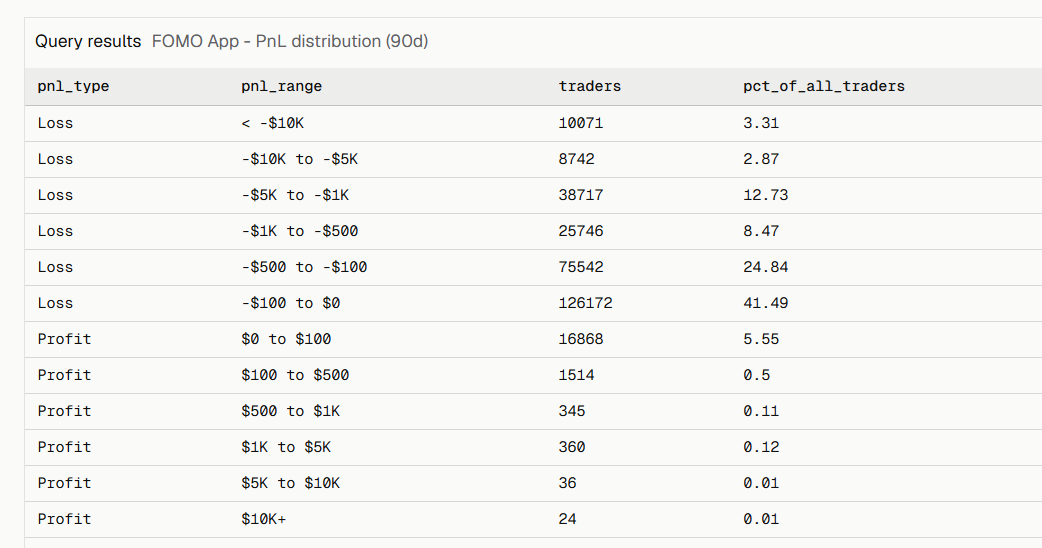
Traders using the FOMO app for meme tokens showed a similar pattern: only 25 wallets achieved a realized profit of over $10,000. | Source: Dune Analytics

The current profitability of meme tokens is even lower compared to betting or prediction platforms, or even regular speculative crypto trading. Despite this, the meme token model remains attractive due to incentives like copy trading, influencer tokens, and points farming.

The meme model has also changed: very few memes have longevity. New memes have an extremely short lifecycle and do not aim to build a community.

Meme-related activity has also pushed Pump.fun into the top three by fee volume. As of August 19th, the platform generates over $4.4 million in daily fees, the highest since January.

Meme Tokens Persist Despite Loss Risks

Despite the overall slowdown in the crypto market, meme tokens remain one of the viable models. The reason is that meme launches occur entirely on-chain, free from the constraints and expectations of centralized exchange listings.

On-chain token creation also partially solves the problem of inflated prices for selected tokens created by market makers. Meme tokens with new applications allow for instant connection to the system. New users also bypass BTC and blue-chip tokens, which are now closer to traditional financial instruments.

Robinhood increased its meme token usage by offering quick launches. Up to 51% of activity on Robinhood was related to meme tokens. As of August 19th, the trend is starting to shift, and Robinhood memes lost 10% of their value overnight, with losses over the past week exceeding 30%

Another factor contributing to meme activity growth was the launch of the FOMO app, which saw another wave of widespread adoption. The app attracted many newcomers just starting to explore meme trading, leading to almost immediate losses. The social trading feature in the FOMO app allowed users to copy influencer trades, leading to inflated valuations for a number of memes.

Meme tokens also attract new users through the latest platform launched by crypto influencer Ansem. In this case, platform usage is incentivized by airdrops, although the trading itself can lead to similar losses. As on other launchpads, users wait for new entrants while incurring losses in more than 99% of meme token launches.

end-content

Criptos en tendencia

Preguntas relacionadas

QWhat percentage of Solana meme token traders made a profit over the last 90 days?

AOnly 6.25% of Solana meme token traders made a profit over the last 90 days.

QWhat was the average loss in USD for traders dealing with meme tokens on Solana during that period?

AThe average trader lost $120 over the last 90 days.

QHow many wallets earned more than $10,000 trading Solana meme tokens, according to the article?

AOnly 25 wallets earned more than $10,000 trading Solana meme tokens.

QWhat platform's high fee volume is cited as evidence of continued meme token activity?

APump.fun is cited, which was earning over $4.4 million in daily fees as of August 19th.

QAccording to the article, what is a key reason meme tokens remain a viable model despite high losses?

AA key reason is that meme token launches happen entirely on-chain, without the constraints or expectations of being listed on centralized exchanges.

Lecturas Relacionadas

13F Reveals New Signal: AI Has Not Faded, Wall Street Is Just Getting 'Pickier'

Title: 13F New Signal: AI Is Not Receding, Wall Street Just Became "Selective" Analysis of 13F filings from the second quarter of 2026, which disclose institutional holdings, reveals a key trend: the AI investment theme persists, but Wall Street is now scrutinizing opportunities more selectively rather than chasing the sector broadly. While nearly 44% of the 6,371 institutions analyzed reduced holdings in the "Magnificent Seven" tech giants, semiconductors saw net buying from 48% of institutions. This indicates the core AI infrastructure thesis remains intact. However, significant internal shifts are occurring as major funds prioritize "risk-reward" or "betting odds" over simple sector exposure. Four prominent investors exemplify this new selectivity: 1. **Berkshire Hathaway** made a major new bet on Alphabet, valuing its strong cash flow and core businesses despite AI-related uncertainties. 2. **Tiger Global** reduced crowded mega-cap tech positions (e.g., Alphabet, NVIDIA) but increased exposure to other AI-related names like AMD and semiconductor manufacturing, rebalancing within the theme. 3. **Third Point** fully exited several first-wave AI winners (NVIDIA, Broadcom) to lock in gains, reallocating to names like Alphabet and Taiwan Semiconductor, and diversifying into media and industrials. 4. **Duquesne Family Office** (Stanley Druckenmiller) also sold some semiconductor holdings while buying others (e.g., Taiwan Semiconductor), focusing on individual companies' valuation and expectation gaps rather than the sector beta. Key conclusions from the filings: * **Alphabet is becoming a "divisive asset"** with significant institutional disagreement, representing a potential source of alpha. * The **"buy any chip stock" phase is over**. Semiconductor investing is now an alpha game, requiring stock-specific analysis over blanket sector bets. * **Non-AI assets are reappearing** in portfolios (e.g., airlines, homebuilders, media) as diversification and correlation-management tools. In summary, the AI investment cycle has not ended, but the phase of easy, broad-based gains is concluding. The next phase will be defined by selective stock-picking and precise calculation of risk versus reward within the AI ecosystem.

marsbitHace 17 min(s)

13F Reveals New Signal: AI Has Not Faded, Wall Street Is Just Getting 'Pickier'

marsbitHace 17 min(s)

Bitcoin 'Whale Investors' Increase Their Holdings by 43,000 BTC, Ending a Months-Long Selling Wave

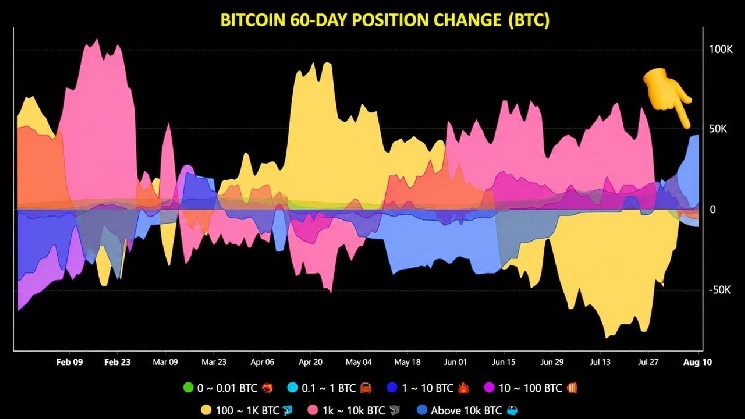
Large Bitcoin holders, defined as non-exchange and non-mining pool wallets, have accumulated approximately 43,000 BTC (worth around $2.9 billion) over the past 60 days. This marks a significant reversal from a several-month period where this same group were net sellers, contributing to downward pressure on Bitcoin's price following its October 2025 all-time high. The accumulation began when Bitcoin fell to around $60,000, a level that seemingly attracted large holders who had stayed on the sidelines during the sharper phase of the decline. Bitcoin has since recovered to trade in a narrower range between $62,000 and $65,000. This renewed demand is not limited to the largest "whale" wallets. Balances of so-called "dolphin" holders also increased in the same period, indicating a broader accumulation trend beyond just a handful of mega-wallets. This activity occurs against a backdrop of declining overall market activity, with August spot trading volumes hitting their lowest monthly level since August 2021, meaning the whale purchases represent a disproportionately large share of total market activity. This buying shift contrasts with the dominant selling trend seen for much of 2026 from other major entities. Looking ahead, a key factor to watch is whether this large-investor activity persists as Bitcoin approaches the upper bound of its recent $62k-$65k trading range.

cryptonews.ruHace 23 min(s)

Bitcoin 'Whale Investors' Increase Their Holdings by 43,000 BTC, Ending a Months-Long Selling Wave

cryptonews.ruHace 23 min(s)

Bitcoin (BTC) Enters a Bear Market, BlackRock Remains Optimistic! Here's Why and the Latest Statements

Bitcoin (BTC) has entered a bear market since October 2025, dropping over 50% from its all-time high of $126,000 to test support at $57,000. It is currently trading sideways around $63,000. In its latest analysis, asset management giant BlackRock stated that this severe correction does not invalidate the long-term investment case for the leading cryptocurrency. BlackRock attributes the decline primarily to market deleveraging, position shifts, capital rotation from Bitcoin into AI investments, weakening capital inflows, and a slowdown in digital asset purchases. It highlighted that open cryptocurrency futures positions exceeding $90 billion, with about 80% being perpetual futures outside the CME, were a significant contributor to the downturn. Additional selling pressure came from digital asset management firms and large Bitcoin holders, alongside net outflows from spot Bitcoin ETFs. Despite these challenges, BlackRock maintains its long-term bullish stance on Bitcoin. The firm reiterates that Bitcoin's limited supply and its potential to behave differently from traditional financial assets make it a viable tool for portfolio diversification and a potential hedge against fiat currency depreciation. BlackRock concludes that the sharp correction signals a market rebalancing of leverage and capital flows rather than a breakdown of Bitcoin's fundamental investment thesis.

cryptonews.ruHace 34 min(s)

Bitcoin (BTC) Enters a Bear Market, BlackRock Remains Optimistic! Here's Why and the Latest Statements

cryptonews.ruHace 34 min(s)

Trading

Spot

Artículos destacados

Qué es MEME 2.0

Memecoin 2.0: El Ascenso de $MEME 2.0 en el Mundo de las Criptomonedas Introducción En el panorama siempre cambiante de las criptomonedas, ha surgido un nuevo contendiente. Memecoin 2.0, simbolizada como $MEME 2.0, lleva el concepto de las monedas meme a un emocionante nuevo nivel. Como un subproducto del Memecoin original, este proyecto ha capturado la atención de la comunidad cripto al cambiar el enfoque de los incentivos financieros típicos a una experiencia comprometida y entretenida. Operando en la blockchain de Ethereum, Memecoin 2.0 redefine audazmente la participación de la comunidad en la esfera cripto. ¿Qué es Memecoin 2.0, $MEME 2.0? En su núcleo, Memecoin 2.0 es un proyecto de criptomoneda que prioriza el espíritu comunitario y la diversión asociada con la cultura meme. A diferencia de las criptomonedas convencionales, que se concentran en casos de uso prácticos y beneficios tangibles, Memecoin 2.0 se distingue al abrazar el lado más liviano de la moneda digital. El proyecto existe sin promesas de utilidad, un mapa estructurado o retornos financieros, enfocándose en cambio en fomentar una comunidad vibrante centrada en memes y en el disfrute compartido. Al hacerlo, aprovecha la creciente tendencia de la cultura meme en el espacio en línea, convirtiéndose en un jugador único en el mundo de los activos digitales. Creador de Memecoin 2.0, $MEME 2.0 A pesar de la extensa investigación sobre los orígenes de Memecoin 2.0, la identidad explícita de su creador sigue siendo desconocida. Esta anonimidad no es inusual en la comunidad cripto, donde muchos proyectos son liderados por individuos o grupos que prefieren permanecer en las sombras. La falta de información disponible públicamente sobre el creador podría verse como un movimiento estratégico, poniendo el foco en la participación comunitaria en lugar de la notoriedad individual dentro del espacio. Inversores de Memecoin 2.0, $MEME 2.0 La información sobre los inversores o el respaldo financiero de Memecoin 2.0 es escasa. Esta ausencia de detalles puede sugerir que el proyecto es autofinanciado o que su enfoque en la comunidad en lugar de las estructuras de inversión tradicionales ha atraído a un tipo diferente de apoyo. Dado que el mundo de las monedas meme generalmente involucra una participación más de base en lugar de inversión institucional, este enfoque está alineado con la ética de los proyectos impulsados por la comunidad. ¿Cómo Funciona Memecoin 2.0, $MEME 2.0? Memecoin 2.0 opera completamente en la blockchain de Ethereum, capitalizando sus robustas características de seguridad y escalabilidad. Al aprovechar las fortalezas de Ethereum, Memecoin 2.0 puede ofrecer un entorno seguro para las interacciones de los usuarios, asegurando que las transacciones sean tanto eficientes como rentables. Uno de los atributos únicos de Memecoin 2.0 radica en su estructura impulsada por la comunidad. El valor y la popularidad del token $MEME 2.0 derivan de la participación activa de sus usuarios, en vez de de una utilidad inherente. Este diseño refuerza el enfoque del proyecto en el aspecto de entretenimiento de las criptomonedas, lo que implica que la risa y la participación comunitaria son las verdaderas monedas que impulsan su éxito. Además, el proyecto encaja dentro del ecosistema más amplio de las monedas meme, donde el valor de cada moneda meme oscila basado en la cultura, tendencias y la participación de la comunidad, en lugar de principios económicos tradicionales. Cronología de Memecoin 2.0, $MEME 2.0 Para entender mejor la evolución y los hitos de Memecoin 2.0, aquí hay una cronología que destaca eventos significativos en su historia: 2024: Se reconoce la creación de Memecoin 2.0 como una ramificación del Memecoin original, estableciéndose dentro del contexto próspero de las monedas meme mientras opera en la blockchain de Ethereum. 13 de julio de 2024: Memecoin 2.0 se posiciona oficialmente como una moneda meme centrada en la comunidad en la red de Ethereum, enfatizando su enfoque centrado en el entretenimiento que invita a los usuarios a participar y crecer. Puntos Clave Sobre Memecoin 2.0, $MEME 2.0 Varios rasgos críticos definen a Memecoin 2.0: Enfoque Centrado en la Comunidad: La misión principal de Memecoin 2.0 es crear una experiencia comunitaria divertida y atractiva, capitalizando en el disfrute colectivo derivado de la cultura memética. Construido sobre Ethereum: Operar en la blockchain de Ethereum proporciona al proyecto una infraestructura esencial que garantiza seguridad y escalabilidad. Falta de Utilidad o Hoja de Ruta: En un notable desvío de las criptomonedas tradicionales, Memecoin 2.0 no promete características utilitarias ni retornos financieros, reafirmando su compromiso con la participación comunitaria y el compromiso social. Enfoque en la Cultura Memética: Al abrazar los aspectos humorísticos y culturales del fenómeno meme, Memecoin 2.0 proporciona una plataforma para que los usuarios interactúen con cripto tanto fuera de línea como en línea. Contexto Adicional: La Importancia de las Monedas Meme Las monedas meme han surgido como una clase distinta de criptomonedas, a menudo impulsadas por el humor y un enfoque desenfadado para el comercio. Estas monedas generalmente carecen de una utilidad significativa o hojas de ruta de desarrollo, atrayendo a los usuarios con la promesa de diversión, interacción comunitaria y relevancia cultural. En el panorama del ecosistema cripto más amplio, las monedas meme reviven la importancia de la participación comunitaria, revirtiendo enfoques únicamente motivados por el lucro. Proyectos como Memecoin 2.0 inauguran una era donde el entretenimiento puede armonizar con las aspiraciones financieras, convirtiendo la blockchain en un parque de diversiones para la creatividad y la interacción social. Conclusión Memecoin 2.0, o $MEME 2.0, encarna una nueva ola de criptomonedas que prioriza la participación comunitaria sobre estructuras financieras rígidas. Con un enfoque en el humor y la interacción social, capitaliza sobre la fascinación que rodea la cultura meme. Al operar en la blockchain de Ethereum, Memecoin 2.0 aprovecha las capacidades de la tecnología mientras se mantiene firme en su compromiso con el valor de entretenimiento de la moneda digital. A medida que el espacio alrededor de las criptomonedas continúa evolucionando, Memecoin 2.0 sirve como un testimonio de la noción de que el futuro de los activos digitales podría depender, en gran medida, de experiencias compartidas, risas y sólidas conexiones comunitarias. En el mundo impredecible de las criptomonedas, quizás la alegría pueda ser tan valiosa como la ganancia financiera tradicional.

215 Vistas totalesPublicado en 2024.04.04Actualizado en 2024.12.03

Qué es MEME 2.0

Cómo comprar MEME

¡Bienvenido a HTX.com! Hemos hecho que comprar Memeland (MEME) sea simple y conveniente. Sigue nuestra guía paso a paso para iniciar tu viaje de criptos.Paso 1: crea tu cuenta HTXUtiliza tu correo electrónico o número de teléfono para registrarte y obtener una cuenta gratuita en HTX. Experimenta un proceso de registro sin complicaciones y desbloquea todas las funciones.Obtener mi cuentaPaso 2: ve a Comprar cripto y elige tu método de pagoTarjeta de crédito/débito: usa tu Visa o Mastercard para comprar Memeland (MEME) al instante.Saldo: utiliza fondos del saldo de tu cuenta HTX para tradear sin problemas.Terceros: hemos agregado métodos de pago populares como Google Pay y Apple Pay para mejorar la comodidad.P2P: tradear directamente con otros usuarios en HTX.Over-the-Counter (OTC): ofrecemos servicios personalizados y tipos de cambio competitivos para los traders.Paso 3: guarda tu Memeland (MEME)Después de comprar tu Memeland (MEME), guárdalo en tu cuenta HTX. Alternativamente, puedes enviarlo a otro lugar mediante transferencia blockchain o utilizarlo para tradear otras criptomonedas.Paso 4: tradear Memeland (MEME)Tradear fácilmente con Memeland (MEME) en HTX's mercado spot. Simplemente accede a tu cuenta, selecciona tu par de trading, ejecuta tus trades y monitorea en tiempo real. Ofrecemos una experiencia fácil de usar tanto para principiantes como para traders experimentados.

351 Vistas totalesPublicado en 2024.12.12Actualizado en 2026.06.02

Cómo comprar MEME

Discusiones

Bienvenido a la comunidad de HTX. Aquí puedes mantenerte informado sobre los últimos desarrollos de la plataforma y acceder a análisis profesionales del mercado. A continuación se presentan las opiniones de los usuarios sobre el precio de MEME (MEME).

活动图片