Analysis of the Latest Portfolio Adjustment by the 'Version Prodigy' of US Stocks: 20% Position Possibly Invested in Anthropic, $9 Billion Short on NVIDIA, Ammunition Aimed at Power and Memory Sectors

marsbitPublicado a 2026-06-18Actualizado a 2026-06-18

Resumen

Leopold Aschenbrenner, a prominent AI investor, is shifting his strategy. While maintaining a significant ~$9B short position on NVIDIA, ASML, and Oracle, he is directing capital towards deeper AI infrastructure and model assets. Key areas include power, memory, data center networking, and a reported ~20% allocation to private AI company Anthropic. The analysis suggests this is not a signal of an AI bubble bursting, but a rotation within the infrastructure stack. The focus is moving from crowded "picks and shovels" plays like semiconductors to physical bottlenecks: power supply, data center construction, and materials like copper and fiber optics for connectivity. NVIDIA's recent $25B debt raise, despite strong cash reserves, is seen as a potential sign of changing financing dynamics in the sector. The long-term conviction remains in foundational infrastructure—particularly energy—which is viewed as a essential demand driver regardless of AI cyclicality.

Compiled & Edited: Deep Tide TechFlow

Speakers: Josh Kale, Anthropic AI Marketing; Ejaaz Ahamadeen, Former Coinbase Product Manager

Podcast Source: Limitless Podcast

Original Title: Leopold Aschenbrenner says "No More Stocks!"

Broadcast Date: June 17, 2026

Key Takeaways

Considered one of the world's most aggressive AI investors, Leopold Aschenbrenner, while maintaining a nominal short position of approximately $9 billion in public markets against NVIDIA, ASML, and Oracle, is shifting capital toward deeper AI infrastructure and model assets like power, memory, data center networking, and Anthropic. The two hosts believe this does not signal an AI bubble burst, but rather a rotation signal in infrastructure trades shifting from "chip-first" to "energy, network, and physical data center construction first," especially as NVIDIA just completed a $25 billion bond financing and Anthropic's valuation has been pushed higher, amplifying the market implications of this judgment.

Highlights Summary

Leopold's Core Trading Logic

  • "The classic 'selling shovels' trade in AI has become too crowded, and Leopold's recent position changes signal exactly that."
  • "His judgment isn't that AI infrastructure has peaked, but that certain layers within the infrastructure stack, especially semiconductors and traditional hot stocks, have become overly crowded."
  • "If the question becomes where the money will flow next, there are two answers. The first, most direct one, is flowing to the next real infrastructure bottlenecks: power, memory, and data center networking. The second answer is that mysterious investment exposed just weeks ago."
  • "He's essentially always betting on highly infrastructure-oriented things, investing in both these optical companies and power-related companies."
  • "If he's cautious on NVIDIA, then money will flow to power, memory, and such places; meanwhile, he also wants to invest directly in the 'mine' itself, rather than just buying more 'shovels.' Anthropic is his most favored 'mine.'"

Signals Released by NVIDIA's Financing

  • "The question isn't whether NVIDIA will continue to make money, but why a company with extremely high profit margins and already massive cash reserves would borrow an additional $25 billion externally."
  • "If a company simultaneously conducts massive stock buybacks and drastically increases dividends in the same month while also borrowing money, it's clearly not borrowing because it needs cash. A more reasonable explanation is that it's cheap capital, and the financing model for this AI rally is undergoing a subtle shift."

The Next Wave of AI Infrastructure Dividends

  • "The real bottlenecks are no longer just GPUs, but power, memory, data center networking, and the ability to actually build these things."
  • "You can't build data centers fast enough, expand memory chip capacity sufficiently, or instantly scale up power grids and related infrastructure, no matter how much money you raise. There aren't enough people on the ground, and regulations, approvals, and procedures are hindering progress."
  • "Whoever can build data centers will take the profits."

Optical Modules, Copper, and Fiber Optics

  • "As GPU scales grow larger, copper wires get hotter, energy loss increases, and efficiency deteriorates significantly. Fiber optics will become the next upgrade direction in this scenario."
  • "In very high-bandwidth, short-distance transmission scenarios, copper is almost the only material everyone truly wants to use. Only when it becomes unsuitable, like when distances are too long or heat is too high, do you switch to fiber optics. So the market demand for a copper-fiber combination is very strong right now."
  • "Copper futures have been performing strongly lately, essentially because everyone needs it. It's the most critical foundational material for short-distance, high-bandwidth transmission, and fiber optics is the next step."
  • "Copper remains the most critical material for short-distance, high-bandwidth transmission, but once distances lengthen and heat becomes too high, a switch to fiber optics is mandatory."
  • "The next wave of money will land on those infrastructure companies that don't sound particularly sexy."

Why Energy is the Safest Bet

  • "I've always been bullish on energy because even if AI demand slows, energy itself remains a global necessity, and this demand will only increase."
  • "The single trend that will continue to rise regardless of the scenario is our demand for energy, electricity, and power. These are the companies I'm most willing to go long on."
  • "The companies I most want to follow are those that Jensen is investing in and that also intersect with Leopold's logic. So the stock I'm closest to following right now is Marvell."
  • "The best long-term positions aren't necessarily the hottest chip companies, but the power infrastructure companies that are unavoidable under any macro scenario."

Leopold's AI Investment Portfolio

Josh Kale:

Leopold Aschenbrenner, this 24-year-old specializing in AI investments, is now almost regarded by the market as the world's strongest AI investor. Rumors suggest his fund's nominal position size now exceeds $20 billion. When we looked at Ejaaz's post a month ago, the fund size was only $13.7 billion, essentially doubling every quarter.

This time we've obtained several significant new changes in his recent investment moves. Last episode we discussed his portfolio, and the most surprising point then was that he was actually shorting a company almost everyone knows: NVIDIA, the world's highest market cap, hottest AI stock. Many couldn't understand why he established a short position exceeding $9 billion against such a company.

Now we have a new clue that might explain this. NVIDIA is actually raising capital, and through debt issuance. On the surface, this seems illogical. Why would a company as massive and highly profitable as NVIDIA need an additional $25 billion in cash it just completed raising? Today, we want to discuss, in conjunction with Leopold's portfolio, why he's making so much money, what he's looking at next, and what NVIDIA's financing really means.

Ejaaz Ahamadeen:

First, some background. Leopold Aschenbrenner was a former OpenAI researcher who raised a fund about a year and a half to two years ago. The initial size wasn't large; I recall it was around $200 million. But from his latest 13F, the fund's public holdings are now valued at $13.7 billion.

Naturally, the market wants to know which positions he's holding, what his core investment logic is, and where his next big trade will land. To understand this, we must know that until about a month ago, Leopold was very bullish on the entire AI sector, especially the "selling shovels" logic, meaning GPU and upstream hardware suppliers like NVIDIA.

But about a month ago, the market discovered he wasn't that bullish on the semiconductor line. He's still bullish on real bottleneck areas like memory and power, and probably also on new-style cloud providers, but he's surprisingly not bullish on the world's most valuable company, NVIDIA. More specifically, he has a total bearish position of about $9 billion against companies seen as core AI infrastructure beneficiaries: NVIDIA, ASML, Oracle, and others.

The Logic Behind Shorting NVIDIA

Ejaaz Ahamadeen:

When this came out, many people started worrying, thinking the AI bubble might be about to burst. On the surface, NVIDIA's GPUs are still selling like hotcakes, demand shows no clear sign of weakening, so what's the real issue?

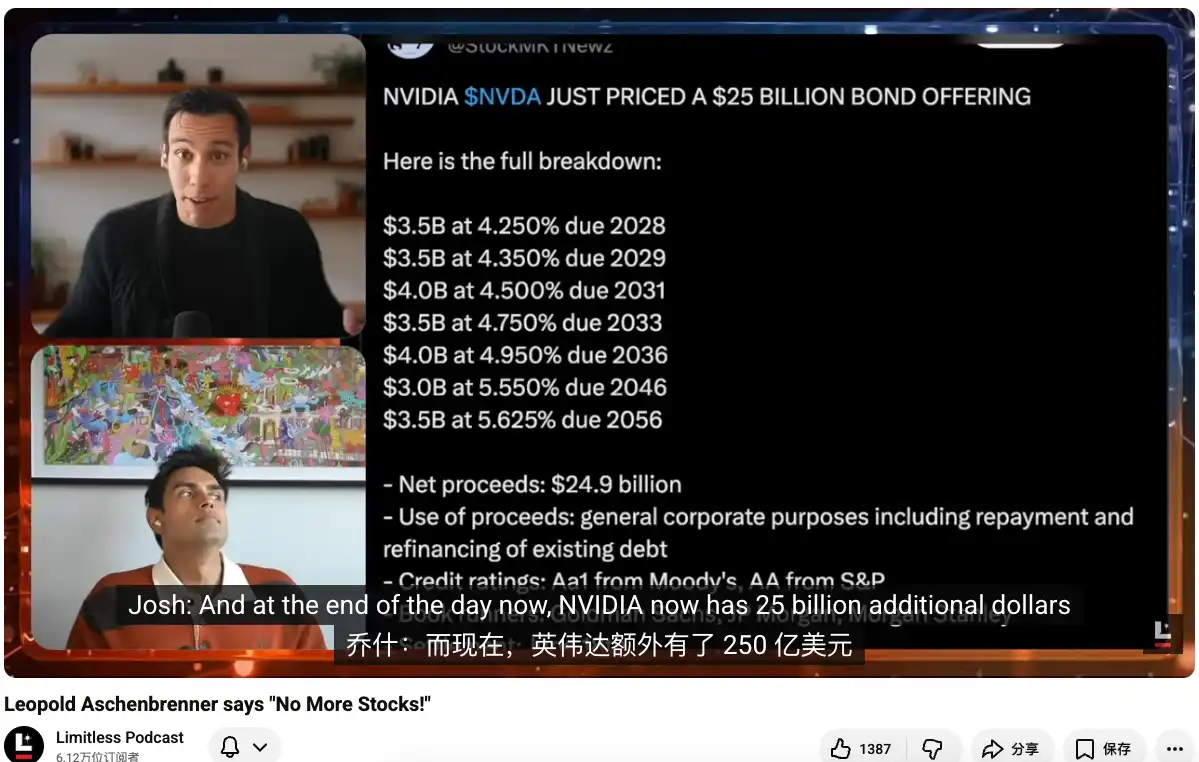
Later, we uncovered several new clues, the most important being that NVIDIA just raised $25 billion externally through a bond offering. This means it's not just using its own cash but adding external leverage. So the question arises: Why would the world's most profitable, highest-margin, strongest-cash-flow company borrow an additional $25 billion from outside?
Josh Kale:

And they initially planned to raise only $20 billion but ended up expanding to $25 billion, with subscriptions over three times oversubscribed. Last episode when discussing this portfolio, we said not to worry about a bubble yet because these companies, despite huge capital expenditures, have high enough revenues to theoretically support expansion with their own balance sheets.

But this is NVIDIA's first significant off-balance-sheet financing since 2021, instead of directly using its cash reserves. I recall it has about $12+ billion in cash on hand. Putting all this together creates a strange tension: on one side, Leopold is shorting, and on the other, NVIDIA appears to have infinite cash and profits yet still issues debt. What's really happening?

Breaking Down NVIDIA's Bond Financing

Josh Kale: Ejaaz, could you break down this deal itself? Because this isn't ordinary financing; it's a bond issuance. Essentially, NVIDIA's balance sheet now has an additional $25 billion, and the interest rates appear to be very low.

Ejaaz Ahamadeen:

I'll present both explanations. NVIDIA originally had about $13.7 billion in cash, meaning it could have simply spent its own money. So why raise external capital? The simplest analogy is buying a house. Many people choose a mortgage even if they have the full amount in cash because they can use their own capital elsewhere, and if the borrowing cost is low enough, it's more economical.

The interest rate environment hasn't been friendly in recent years, but if you're NVIDIA, one of the world's most valuable and sought-after companies, you can borrow under very favorable terms. This $25 billion bond offering has maturities ranging from 2 to 30 years and can be considered very cheap money, with rates close to US Treasury yields.

Moreover, the offering was oversubscribed by about 4 times. In other words, there was $85 billion in market demand for this $25 billion offering. NVIDIA could practically pick its investors. If we look solely at the official explanation, NVIDIA stated it's primarily for financial management, to repay and refinance some existing debt. Google did something very similar weeks ago and also in February this year. So you can certainly accept this explanation as financial optimization.

But another side is hard to ignore: Over the past month and a half, NVIDIA, Amazon, Google, and several other hyperscale cloud providers have all been adding external financing. Some through debt, others through equity sales. Leopold's view might not be entirely baseless. Could this be a sign of the bubble starting to soften, the house of cards beginning to wobble? However, if you look solely at the financial structure, it doesn't clearly point to danger yet.

Josh Kale:

I see it similarly. Shorting NVIDIA with $9 billion is a massive position. But during our research, we noticed something else: on May 18, NVIDIA's board authorized an additional $80 billion in share buybacks and increased the dividend from $0.01 to $0.25 per share, a 25x increase.

If a company simultaneously conducts massive stock buybacks and drastically increases dividends in the same month while also borrowing money, it's clearly not borrowing because it needs cash. A more reasonable explanation is that it's cheap capital, and the financing model for this AI rally is undergoing a subtle shift. Everyone wants to participate in these capital operations, and NVIDIA also realizes that raising debt is even cheaper than other financing methods, so they simply did it. At least for now, NVIDIA itself is still doing very well.

Why He Adjusted His Portfolio

Josh Kale: This leads back to another question. What exactly is Leopold thinking? Why has his judgment changed? The stock chart you showed earlier also indicates NVIDIA's recent performance hasn't been particularly strong, but it's not terrible either. It's still the world's largest company nearing a $5 trillion market cap, down only about 7% in a month, which is nothing amid the surge in other AI stocks.
Ejaaz Ahamadeen:

I don't think NVIDIA will disappear. Its GPUs, including the CPU product line launched weeks ago, I believe will perform very well. AI product demand is currently exponentially oversupplied, and the primary machine supplier capable of meeting this demand is still mainly NVIDIA.

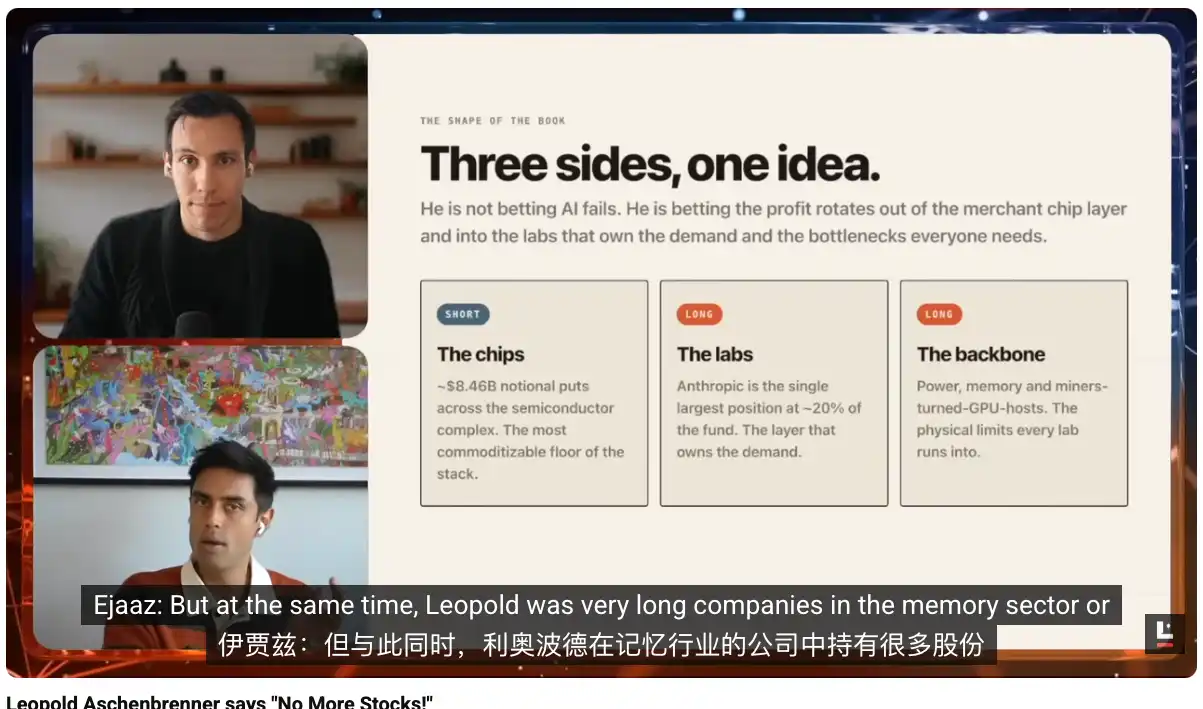
But I do believe the classic 'selling shovels' trade in AI has become too crowded, and Leopold's recent position changes signal exactly that. Looking at his recent 13F, his bearish positions are clearly skewed against the semiconductor line, like NVIDIA, ASML, Oracle, and other infrastructure-level companies.

Yet simultaneously, he holds heavy positions in memory, power, and new-style cloud directions. This indicates his judgment isn't that AI infrastructure has peaked, but that certain layers within the infrastructure stack, especially semiconductors and traditional hot stocks, have become overly crowded.

If the question becomes where the money will flow next, there are two answers. The first is most direct: flowing to the next real infrastructure bottlenecks: power, memory, data center networking. The second answer is that mysterious investment exposed just weeks ago.

The Unexpectedly Exposed Anthropic Position

Josh Kale:

This is what surprised me the most. I only learned about it from you yesterday, and my first reaction was disbelief. Could it be that Leopold's fund, 'Situational Awareness,' actually has 20% allocated to Anthropic equity? Current rumors suggest this company accounts for about one-fifth of Leopold's fund. The Wall Street Journal and several other media outlets report this, and sources very close to the transaction have confirmed it.

This became a completely unexpected card in his portfolio. Because 13F only discloses public market holdings, not private equity, and Anthropic is precisely a large chunk of non-public equity. This is also why people started understanding why outsiders estimate his portfolio valuation at $20 billion.
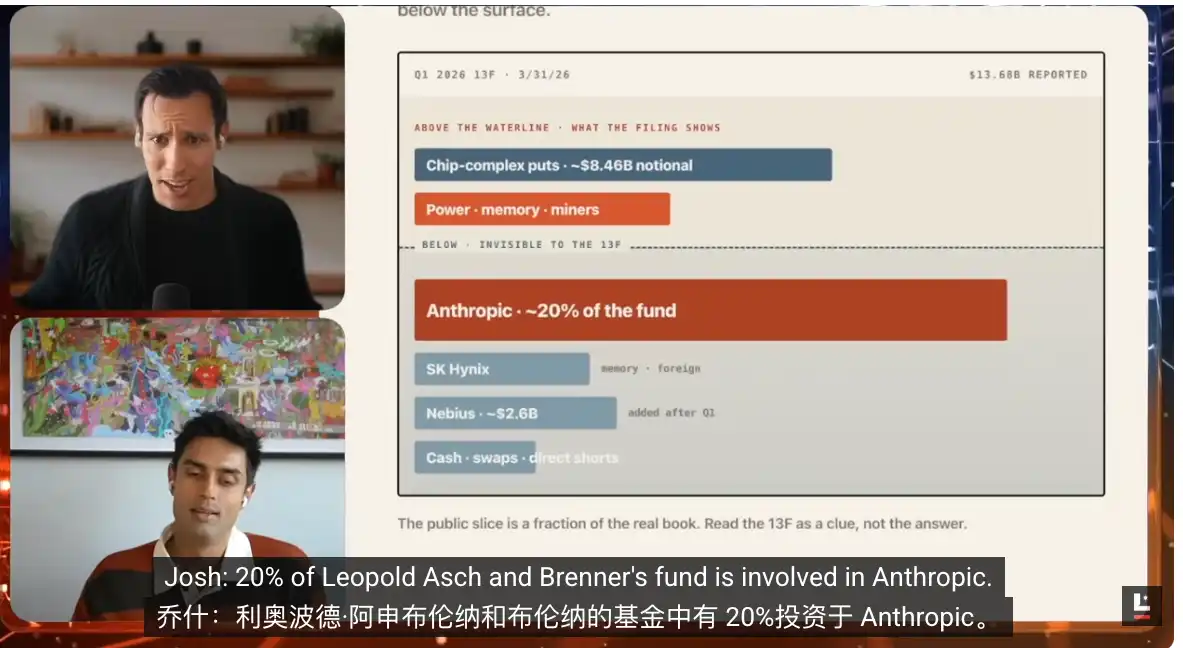
If 20% of the fund is in Anthropic, and he likely invested in early 2025, the return on Anthropic over that year has felt like seven years. This change significantly revises our understanding of his entire investment portfolio.

Ejaaz Ahamadeen:

Yes. His initial investment in Anthropic via private channels or the fund was around March 2025, when Anthropic was valued at about $60 billion. Now, according to the latest valuation round, it's been priced at $96.5 billion.

That's nearly a 15x gain. Using the calculation shown in today's episode, his latest 13F disclosed liquid portfolio value is $13.7 billion. If we add the Anthropic portion reported by the Wall Street Journal, roughly an additional $7 billion, the total fund management size reaches $20 billion.

How exaggerated is this? Bill Ackman, a top investor with three to four decades in the market, his Pershing Capital is also around $20 billion. Leopold has been in this game for only a year and a half, he's 24 years old, and has virtually no real investment experience to speak of.

Yet he's made some astonishingly accurate calls. The crazy part is he wrote it all down in advance. When he launched the fund a year and a half ago, he published a 65-page AI essay, 'Situational Awareness,' almost completely laying out the entire logic, including how capital would rotate from semiconductors and certain infrastructure layers to other bottleneck constraints. The market is now playing out along this line. It's truly remarkable.

The Next Wave of Infrastructure Rally

Ejaaz Ahamadeen:

So this also tells me where the next money will flow. If he's cautious on NVIDIA, then money will go to power, memory, and such places; meanwhile, he also wants to invest directly in the 'mine' itself, rather than just buying more 'shovels.' Anthropic is his most favored 'mine.'

Josh Kale:

This indeed looks like a new trend, and again, he's ahead of the curve. Over the past 12 months, everyone has been searching for AI's bottlenecks: rare earth metals, memory, RAM, etc., the market chased all these themes. Those judgments weren't wrong because that wave did happen.

But now, valuations for areas seen as bottlenecks are gradually rationalizing. The market has a better understanding of these companies' business models, market sizes, and future revenues, so much of the value is already priced in. In the next round, we're more concerned about where the subsequent money will continue to flow.

The direction you mentioned—land, power, server racks, physical infrastructure—seems correct. Because if we think about what's truly most important for AI, the answer increasingly seems to be physical construction capability. Look at xAI, or more accurately, SpaceX, which is now public. Its core revenue isn't rockets themselves but AI infrastructure construction.
Look at its recent deals with Anthropic and Google; the value brought surpasses the sum of Starlink, Starship, and the entire satellite business. There's clearly immense demand and value here. So the question becomes, who can actually build these things?

SpaceX is clearly one answer. Last night after-hours, its stock price reached $230, corresponding to roughly a $3.1 trillion valuation. We'll do a dedicated episode on SpaceX this week because its recent move is insane. It just completed the acquisition of Cursor, now valued at $3 trillion. Elon Musk earned more in a single day than Warren Buffett did in his entire career.

Who Will Capture the Next Round of Dividends

Josh Kale: Our concern is which companies are best at this hardware infrastructure, at developing 'machines that make machines.' Combining Leopold's direction with the broader trend, we think money will flow here next. So Ejaaz, in reality, which companies will this rotation land on?

Ejaaz Ahamadeen:

Many will be those infrastructure companies that don't sound particularly sexy. A name frequently mentioned recently is Marvell. Weeks ago at the Computex conference in Taiwan, Jensen Huang directly stated on stage that this would be the next trillion-dollar company.

And just three months before he made that statement, NVIDIA had invested $1.5 billion in Marvell. I'm starting to lose track of whether this counts as insider trading or market manipulation because after he said that, the stock rose another 70%.

I think it's easy now to directly conclude that AI infrastructure has peaked. But if you compare it to historical financial crises, like 2008, that smell of high leverage, financial engineering, and systemic manipulation hasn't fully appeared this round.

Two key differences exist. First, the products these companies make today are truly being bought by someone. Neither the dot-com bubble nor the financial crisis had such solid real demand. Second, constrained by physical laws, we can't infinitely add leverage now because the entire system is bottlenecked by human labor and construction capacity.

You can't build data centers fast enough, expand memory chip capacity sufficiently, or instantly scale up power grids and related infrastructure, no matter how much money you raise. There aren't enough people on the ground, and regulations, approvals, and procedures are hindering progress.

So I actually think this gives investors an advantage. Since you already know the hottest chip and shovel-selling trades are too crowded, then money will next flow to power, data networking (companies like Astera Labs), and other related areas. What you really need to think about is when these contracts will materialize, when these fabs will actually be built, when SpaceX rockets will launch AI satellites, even when we can start using solar power to train AI models.

The timeline determines the betting rhythm. At least that's the framework I'm using for my own investments (not investment advice). I see it this way because over the past year and a half, we've witnessed how money flowed from broad AI stocks to semiconductor and infrastructure trades.

Josh Kale:

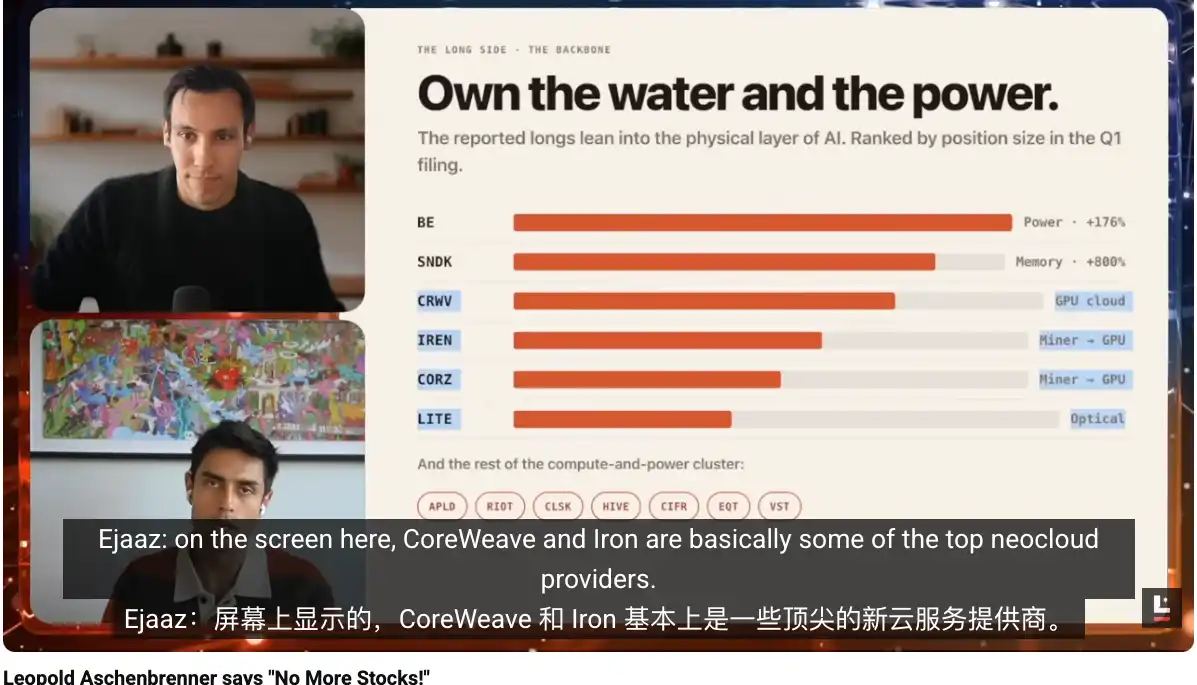
If you continue looking at this portfolio chart, you'll see this story is clearly written into his holding structure. By category, what's his largest allocation? Power and energy. Followed by memory, then cloud and GPU miners—the most tangible infrastructure.

He wants to hold new-style cloud providers like CoreWeave and also those miners who've pivoted to cloud compute. What he wants to own is this physical infrastructure because he believes this is the real bottleneck. As you mentioned, there are many finer details, like actual construction, hardware manufacturing, and data center building itself, all extremely difficult.

If we ask where the biggest bottleneck is, even permitting and approvals might be part of it. Who's solving these problems? SpaceX wants to move data centers to space; Tesla wants to use humanoid robots to solve labor issues. But both are far off. In the short to medium term, there are vast white-space opportunities, and this is precisely what Leopold is betting on.

The Advantages of Optical Modules and Fiber Optics

Josh Kale: I also want to add a detail we didn't elaborate on before. For those who want to dig deeper and find more alpha, many of his clues lie within optics and lower-level tech stacks. Ejaaz, you've been researching this lately; could you explain his thinking?

Ejaaz Ahamadeen:

If you look at the positions on his screen, CoreWeave and Iron are essentially top-tier new-style cloud service providers. Simply put, they're somewhat like Amazon Web Services, but AWS provides cloud services to internet companies, whereas these companies provide ready-made GPU infrastructure to AI companies.

They handle setting up GPUs, networking, deployment, so AI companies don't need to worry about underlying infrastructure and can directly train models and access compute. CoreWeave and Iron have been among his largest concentrated positions since he established them and have delivered the highest returns.

Notably, he still holds these two companies as major positions today. This also indicates another point: in his view, this trade is far from over. Furthermore, he privately invested in Core Scientific, a company that can help unlock CoreWeave's infrastructure supply capacity. In a sense, he added another layer of leverage to CoreWeave.

Beyond these, look at companies like Coherent and Lumentum; they are essentially fiber optic and optical connectivity suppliers. To explain in the simplest terms, semiconductors and GPUs need to communicate with each other. Traditionally, this relied heavily on copper wires. The problem is, as GPU scales grow larger, copper wires get hotter, energy loss increases, and efficiency deteriorates significantly. Fiber optics become the next upgrade direction in this scenario. It enables faster data transmission, higher cost efficiency, and allows companies providing inference and training compute to earn more. So you'll notice he's always betting on highly infrastructure-oriented things, investing in both these optical companies and power-related companies. It might not sound sexy, but in my view, this is where money is genuinely flowing now.

Josh Kale:

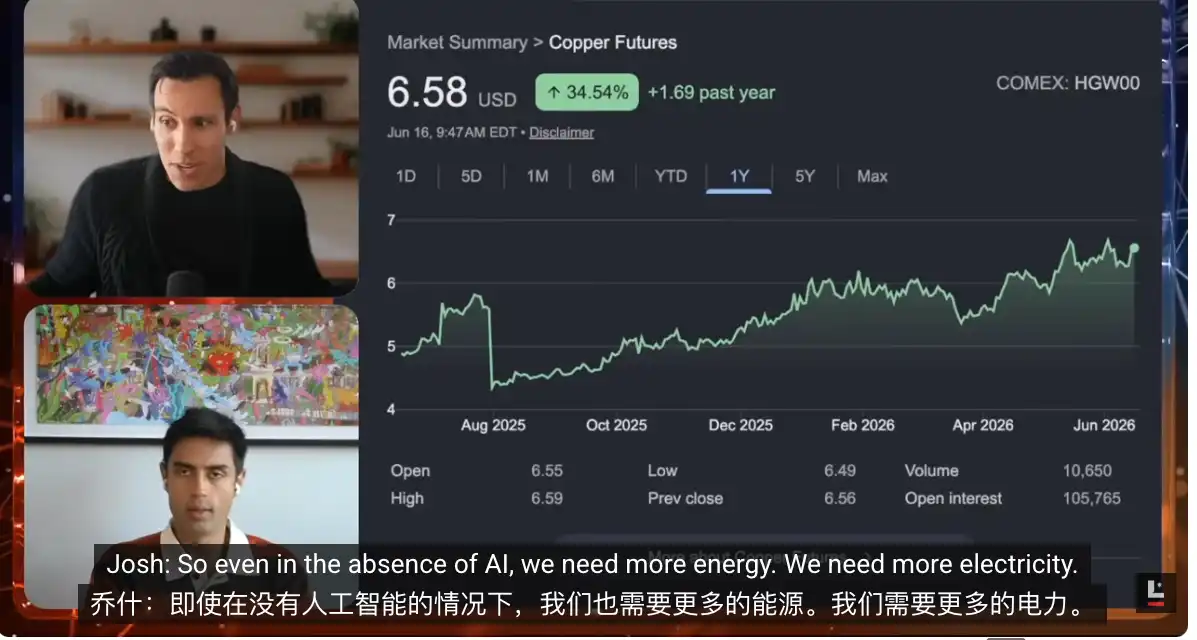
The copper aspect is also interesting to me because I recently realized how crucial it is for short-distance data transmission. In many high-bandwidth, short-distance transmission scenarios, copper is almost the only material everyone truly wants to use. Only when it becomes unsuitable, like when distances are too long or heat is too high, do you switch to fiber optics. So market demand for a copper-fiber combination is very strong right now, which is why observing the copper trade is interesting. Copper futures have been performing strongly lately, essentially because everyone needs it. It's the most critical foundational material for short-distance, high-bandwidth transmission, and fiber optics is the next step.

Thinking at an even more fundamental level, the materials theme has always been interesting. The most foundational layer beneath all layers is essentially what raw materials are most core for achieving intelligence. Copper is one, lithium is another, and many more. We really should do a dedicated episode on materials. Perhaps Leopold hasn't reached that layer yet, and we might spot the next rotation first.

Josh Kale:

If we go all the way down the stack, we could even look at copper mines to see how these things are made. But returning to the core judgment, I believe the next rotation indeed shifts from what seem like smaller bottlenecks to the truly hard things: hardware and large-scale data center construction.

Whoever can build data centers will take the profits. We've already seen how much money SpaceX makes due to massive data center demand. Whoever can deploy more data centers faster, provide sufficient power and GPUs, will earn the most money. This is essentially what Leopold is betting on now.

Is a Bubble Emerging?

Josh Kale: The summary is we don't think we've entered the bubble-bursting phase yet. Leopold's positions resemble rotation more than a full-scale retreat. So, should we still follow his lead?

Ejaaz Ahamadeen:

I admit, when I first saw his 13F, my initial reaction was disbelief that this guy was shorting the world's most valuable company with demand booked until 2029. But now, seeing this financing, I'm starting to think if NVIDIA continues adding external debt, or possibly even sells equity in the future, if this trend persists, then Leopold might be right again.

If that's the case, his fund could eventually surpass the world's top traders and best investment funds. He's been winning consistently; it's hard not to be impressed.

Josh Kale:

However, another important point: his life experience has almost always been about going long; he's never truly been tested by a large-scale sell-off. We mentioned Bill Ackman earlier; achieving 30x returns and surviving 30 years in the market are two different things.

If he can sustain this growth and also learn when to hit the sell button, manage risk, use hedging to protect himself, that would be even more formidable. We're already seeing glimpses of this capability. That $9 billion short position isn't $9 billion in cash directly shorting; it's achieved through options and leverage, not a one-to-one naked short. Regardless, this is very worth observing.

Energy is the Core Bet

Josh Kale: If you had to pick one stock from his entire portfolio you'd most want to buy, which would it be?

My own answer is energy stocks. I've always been bullish on energy because even if AI demand slows, energy itself remains a global necessity, and this demand will only increase. Even completely ignoring AI, we need more energy, more electricity. Companies like Bloom Energy, which can enhance power supply and delivery, excite me most because they're the most hedge-like bets. The single trend that will continue to rise regardless of the scenario is our demand for energy, electricity, and power. These are the companies I'm most willing to go long on.

Ejaaz Ahamadeen:

My answer is a bit of a cheat. The companies I most want to follow are those that Jensen is investing in and that also intersect with Leopold's logic. The stock I'm closest to following right now is Marvell. It's not a publicly disclosed holding of Leopold's, but it aligns very well with his bets on fiber optics and power, and Jensen has already invested $1.5 billion in it.
I've observed a phenomenon: whenever Jensen invests in a company through NVIDIA, whether it's Intel, CoreWeave, or others, they've basically kept rising afterward. So my current position is roughly here. I also hold some CoreWeave myself because both Jensen and Leopold are extremely bullish on it.

Josh Kale:

Marvell is up 270% over the past 6 months. This might truly be a good rule of thumb: when influential people like Jensen, or even figures with massive influence like Trump, publicly say to buy a certain stock, often you should really take a serious look.

History has repeatedly proven that such signals often have significant realization potential. Whether Intel or Marvell, these cases show that, on one hand, they indeed understand what they're talking about, and on the other, they have the ability to influence these companies' outcomes. So this rally has been truly insane.

I hope it continues. From the current perspective, it likely will. At least we're still leaning bullish, still optimistic, and will continue making judgments daily as things evolve.

Josh Kale: Any final thoughts you'd like to add regarding the update on Leopold's investment portfolio?

Ejaaz Ahamadeen:

I'd actually like to hear from those who are skeptical. If after listening to our analysis, you think we're completely wrong or have misunderstood something, please point it out directly.

Yesterday, I stared at NVIDIA's $25 billion financing news for a long time, initially looking to criticize it. But if we look solely at the financial logic, it does make sense. Why not borrow this almost risk-free cheap money? Using others' money for expansion is clearly more rational than selling your own equity because you retain more future profits.

Criptos en tendencia

Preguntas relacionadas

QWhat is the core trading logic behind Leopold Aschenbrenner's recent portfolio shift, particularly his large short position on NVIDIA?

ALeopold's logic is that the classic 'shovel-selling' AI infrastructure trade, particularly in crowded areas like semiconductors (e.g., NVIDIA, ASML), is becoming overvalued and congested. He is not calling a top for AI infrastructure overall, but believes capital is rotating from these hot sectors towards the next true bottlenecks: power, memory, and data center networking. He also seeks direct exposure to the 'ore' itself (like Anthropic) rather than just the 'shovels.'

QWhat signal might NVIDIA's recent $25 billion bond issuance be sending, according to the discussion?

AThe fact that NVIDIA, a highly profitable company with massive cash reserves, is raising significant external debt suggests a potential shift in the AI funding cycle. The hosts argue it likely represents NVIDIA securing very cheap capital to fund growth, but its occurrence alongside massive stock buybacks and dividend increases raises questions. It could be a sign of financial engineering becoming more prominent, which might support Leopold's cautious stance, though it doesn't necessarily indicate immediate financial distress for NVIDIA.

QAccording to the article, what are considered the next major bottlenecks and investment opportunities in the AI infrastructure stack?

AThe next wave of bottlenecks and opportunities is seen in physical, ground-level infrastructure constraints. Key areas include: 1) Power/Energy generation and distribution, 2) Memory chip supply, 3) Data center construction and networking (especially fiber optics for longer distances/high heat, while copper remains crucial for short-range), and 4) The actual capability to build and deploy data centers at scale, which is limited by manpower, permits, and construction logistics.

QWhat is the significance of Leopold Aschenbrenner's reported ~20% investment in Anthropic?

AThis private investment in Anthropic, not visible in public 13F filings, significantly recontextualizes his portfolio. It shows he is not just betting on AI infrastructure ('shovels') but is also taking a massive, direct position in a leading AI model company ('the ore'). The investment, made around early 2025, has reportedly seen enormous appreciation, contributing heavily to the estimated growth of his fund's total assets under management to around $20 billion and demonstrating his conviction in owning foundational AI assets.

QWhy do the hosts view investments in the energy/power sector as particularly compelling within the AI thematic?

AEnergy is viewed as a core, resilient, and non-cyclical bet within the AI boom. Even if AI-specific demand were to slow, the global demand for electricity and power is a secular, one-way trend that is only increasing. Companies that enhance power generation, distribution, and efficiency (like Bloom Energy) are seen as excellent long-term holdings that benefit from the AI boom but are also insulated from it, acting as a form of hedge while capturing a fundamental growth trend.

Lecturas Relacionadas

My Coding Betting Dashboard is Profiting, but Polymarket is Truly Not a Good Place for 'Arbitrage'

The author built a custom monitoring dashboard for Polymarket, a prediction market platform, and tested it with $1,600, achieving over 30% returns. However, the core argument is that Polymarket is not a good venue for traditional arbitrage. The dashboard has two main sections: a "Portfolio Dashboard" for tracking active positions with key metrics like total capital, P&L, and a risk-control module using a tier system (T1, T2, T3), and an "Opportunity Watchlist" for monitoring markets. The article details a critical structural trap in binary markets: a bet with a high perceived probability of success still carries a 100% loss risk if wrong. The author's T1/T2/T3 system is designed to manage this by limiting position sizes based on conviction and time horizon, emphasizing that high confidence should not equal high concentration. A key insight is the danger of "pseudo-diversification"—betting on different markets driven by the same underlying variable. The author concludes that Polymarket offers few true low-risk, arbitrage opportunities. It is instead a high-risk environment where wins can create a false sense of mastery, leading to large losses. The platform is better viewed as a training ground for honing judgment through disciplined, framework-driven betting rather than a reliable income source. The tools help transform intuition into structured, rule-based decisions to mitigate the risk of catastrophic errors.

marsbitHace 1 hora(s)

My Coding Betting Dashboard is Profiting, but Polymarket is Truly Not a Good Place for 'Arbitrage'

marsbitHace 1 hora(s)

WeChat AI Card Hands-On Guide: Has the AI Shopping Era Arrived?

**"WeChat AI Card" Practical Test Guide: Has the Era of AI Shopping Arrived?** WeChat has officially launched the "AI Exclusive Card," a feature integrated into its Workbuddy AI assistant. This card is designed to handle payments for AI-initiated purchases. Our hands-on test reveals it's not yet a tool for fully autonomous AI shopping, but rather a controlled payment layer for AI agents. The AI Card functions as an isolated sub-wallet within WeChat Pay. Users must bind the card and transfer funds into it from their main wallet. Crucially, every transaction requires explicit user confirmation via smartphone scan; AI cannot spend autonomously. Currently accessible through the Workbuddy agent, the card targets specific digital consumption scenarios: purchasing paid content (reports, data), calling paid APIs/tools, and subscribing to services. Its design prioritizes security and control by separating funds and mandating approval for each payment. We tested a real-world scenario: ordering bubble tea via Workbuddy using a "Meituan Life Assistant" skill. The process encountered multiple hurdles: high "skill" usage costs (exceeding daily free credits), and most importantly, while a payment was successfully initiated, the AI purchased an incorrect product (a mismatched group-buy coupon instead of the desired drink). This highlights the current limitation: the **AI Card only solves the payment step**. The broader challenge lies in the **AI agent's execution chain**—accurately understanding intent, navigating third-party platforms, selecting the right product, and ensuring proper fulfillment. The payment succeeded, but the purchase failed to meet the user's need. In conclusion, the WeChat AI Exclusive Card is a cautious, early-step experiment in AI commerce. It provides a secure, user-controlled payment method for agent interactions but is not yet capable of reliable, end-to-end complex purchases. For now, it's best used for low-value, low-risk digital services with careful user verification at each step. The vision of AI handling complete shopping tasks remains a work in progress.

marsbitHace 3 hora(s)

WeChat AI Card Hands-On Guide: Has the AI Shopping Era Arrived?

marsbitHace 3 hora(s)

Deconstructing Notion's Growth: From a Note-taking Tool to 100 Million Users—How Notion Built a Triple Growth Flywheel Through Product, Templates, and Community

Notion's growth from a niche note-taking tool to a platform with 100 million users is powered by three interconnected flywheels: Product-Led Growth (PLG), a Template Economy, and Community-Driven Growth. First, Notion's PLG strategy relies on a highly flexible, "plastic" product that users can adapt to countless personal and team workflows. Its freemium model lowers the barrier to entry, while features like page sharing and collaboration drive organic, usage-based viral growth as users naturally invite others. Second, the Template Economy solves the "blank page" problem. Templates, created by both Notion and its community, transform abstract product capabilities into concrete, copyable solutions for specific scenarios (e.g., project management, content calendars). This dramatically lowers activation costs for new users and fuels SEO-driven discovery. Third, a vibrant Community acts as a distributed growth engine. Users and official Ambassadors create tutorials, share use cases, and host local events. This community not only educates users but also fosters a sense of identity around pursuing "better ways of working," strengthening loyalty and enabling global, low-cost expansion. Together, these flywheels create a self-reinforcing ecosystem: a great product attracts users who create templates and community content, which in turn attracts more users and deepens engagement. This system allowed Notion to scale from individuals to teams and enterprises through a bottom-up adoption path. Looking ahead, AI integration promises to accelerate these flywheels further by making templates smarter and the platform a potential AI-native work operating system. Ultimately, Notion's defensible advantage is not just its features, but this deeply entrenched network of user assets, creators, and community trust.

marsbitHace 3 hora(s)

Deconstructing Notion's Growth: From a Note-taking Tool to 100 Million Users—How Notion Built a Triple Growth Flywheel Through Product, Templates, and Community

marsbitHace 3 hora(s)

$10 Billion, Qualcomm to Acquire Chip Legend Jim Keller's Company

Global mobile chip giant Qualcomm is in advanced talks to acquire AI chip startup Tenstorrent in a deal valued between $8-10 billion, according to media reports. This potential acquisition would be one of the largest in the AI chip sector in recent years. Tenstorrent, led by legendary chip architect Jim Keller, has gained prominence for its RISC-V architecture and AI accelerator designs. The move highlights Qualcomm's strategic push to diversify beyond its core smartphone chip business. As the smartphone market matures, Qualcomm is aggressively targeting growth in automotive, data center, and cloud AI. Acquiring Tenstorrent would allow Qualcomm to rapidly enter the high-end AI computing market, bypassing lengthy in-house development cycles. Tenstorrent's cost-effective system architecture, which avoids expensive HBM memory and relies on standard Ethernet for clustering, offers a potential alternative to Nvidia's costly solutions. Furthermore, Tenstorrent's high-performance RISC-V CPU technology and its focus on the automotive and edge computing segments align with Qualcomm's strategic goals, including its "Snapdragon Digital Chassis" platform. Despite the strategic rationale, the high valuation has sparked some investor caution. The successful integration of Tenstorrent's open-source culture and independent team into Qualcomm's organization, along with the commercialization of its technology, remains a key challenge.

marsbitHace 4 hora(s)

$10 Billion, Qualcomm to Acquire Chip Legend Jim Keller's Company

marsbitHace 4 hora(s)

Trading

Spot
Futuros

Artículos destacados

Qué es GROK AI

Grok AI: Revolucionando la Tecnología Conversacional en la Era Web3 Introducción En el paisaje de rápida evolución de la inteligencia artificial, Grok AI se destaca como un proyecto notable que une los dominios de la tecnología avanzada y la interacción del usuario. Desarrollado por xAI, una empresa liderada por el renombrado empresario Elon Musk, Grok AI busca redefinir la forma en que interactuamos con la inteligencia artificial. A medida que el movimiento Web3 continúa floreciendo, Grok AI tiene como objetivo aprovechar el poder de la IA conversacional para responder consultas complejas, proporcionando a los usuarios una experiencia que no solo es informativa, sino también entretenida. ¿Qué es Grok AI? Grok AI es un sofisticado chatbot de IA conversacional diseñado para interactuar dinámicamente con los usuarios. A diferencia de muchos sistemas de IA tradicionales, Grok AI abraza una gama más amplia de consultas, incluyendo aquellas que normalmente se consideran inapropiadas o fuera de las respuestas estándar. Los objetivos centrales del proyecto incluyen: Razonamiento Confiable: Grok AI enfatiza el razonamiento de sentido común para proporcionar respuestas lógicas basadas en la comprensión contextual. Supervisión Escalable: La integración de asistencia de herramientas asegura que las interacciones de los usuarios sean monitoreadas y optimizadas para la calidad. Verificación Formal: La seguridad es primordial; Grok AI incorpora métodos de verificación formal para mejorar la confiabilidad de sus resultados. Comprensión de Largo Contexto: El modelo de IA sobresale en retener y recordar un extenso historial de conversaciones, facilitando discusiones significativas y contextualizadas. Robustez Adversarial: Al enfocarse en mejorar sus defensas contra entradas manipuladas o maliciosas, Grok AI busca mantener la integridad de las interacciones de los usuarios. En esencia, Grok AI no es solo un dispositivo de recuperación de información; es un compañero conversacional inmersivo que fomenta un diálogo dinámico. Creador de Grok AI La mente detrás de Grok AI no es otra que Elon Musk, una persona sinónimo de innovación en varios campos, incluyendo la automoción, los viajes espaciales y la tecnología. Bajo el paraguas de xAI, una empresa enfocada en avanzar la tecnología de IA de maneras beneficiosas, la visión de Musk busca remodelar la comprensión de las interacciones de IA. El liderazgo y la ética fundacional están profundamente influenciados por el compromiso de Musk de empujar los límites tecnológicos. Inversores de Grok AI Si bien los detalles específicos sobre los inversores que respaldan a Grok AI son limitados, se reconoce públicamente que xAI, el incubador del proyecto, está fundado y apoyado principalmente por el propio Elon Musk. Las empresas y participaciones anteriores de Musk proporcionan un respaldo robusto, fortaleciendo aún más la credibilidad y el potencial de crecimiento de Grok AI. Sin embargo, hasta ahora, la información sobre fundaciones de inversión adicionales u organizaciones que apoyan a Grok AI no está fácilmente accesible, marcando un área para una posible exploración futura. ¿Cómo Funciona Grok AI? La mecánica operativa de Grok AI es tan innovadora como su marco conceptual. El proyecto integra varias tecnologías de vanguardia que facilitan sus funcionalidades únicas: Infraestructura Robusta: Grok AI está construido utilizando Kubernetes para la orquestación de contenedores, Rust para rendimiento y seguridad, y JAX para computación numérica de alto rendimiento. Este trío asegura que el chatbot opere de manera eficiente, escale efectivamente y sirva a los usuarios de manera oportuna. Acceso a Conocimiento en Tiempo Real: Una de las características distintivas de Grok AI es su capacidad para acceder a datos en tiempo real a través de la plataforma X—anteriormente conocida como Twitter. Esta capacidad otorga a la IA acceso a la información más reciente, permitiéndole proporcionar respuestas y recomendaciones oportunas que otros modelos de IA podrían pasar por alto. Dos Modos de Interacción: Grok AI ofrece a los usuarios una elección entre “Modo Divertido” y “Modo Regular”. El Modo Divertido permite un estilo de interacción más lúdico y humorístico, mientras que el Modo Regular se centra en ofrecer respuestas precisas y exactas. Esta versatilidad asegura una experiencia personalizada que se adapta a diversas preferencias de los usuarios. En esencia, Grok AI une rendimiento con compromiso, creando una experiencia que es tanto enriquecedora como entretenida. Cronología de Grok AI El viaje de Grok AI está marcado por hitos cruciales que reflejan sus etapas de desarrollo y despliegue: Desarrollo Inicial: La fase fundamental de Grok AI tuvo lugar durante aproximadamente dos meses, durante los cuales se realizó el entrenamiento inicial y el ajuste del modelo. Lanzamiento Beta de Grok-2: En un avance significativo, se anunció la beta de Grok-2. Este lanzamiento introdujo dos versiones del chatbot—Grok-2 y Grok-2 mini—cada una equipada con capacidades para chatear, programar y razonar. Acceso Público: Tras su desarrollo beta, Grok AI se volvió disponible para los usuarios de la plataforma X. Aquellos con cuentas verificadas por un número de teléfono y activas durante al menos siete días pueden acceder a una versión limitada, haciendo que la tecnología esté disponible para un público más amplio. Esta cronología encapsula el crecimiento sistemático de Grok AI desde su inicio hasta el compromiso público, enfatizando su compromiso con la mejora continua y la interacción del usuario. Características Clave de Grok AI Grok AI abarca varias características clave que contribuyen a su identidad innovadora: Integración de Conocimiento en Tiempo Real: El acceso a información actual y relevante diferencia a Grok AI de muchos modelos estáticos, permitiendo una experiencia de usuario atractiva y precisa. Estilos de Interacción Versátiles: Al ofrecer modos de interacción distintos, Grok AI se adapta a diversas preferencias de los usuarios, invitando a la creatividad y la personalización en la conversación con la IA. Avanzada Infraestructura Tecnológica: La utilización de Kubernetes, Rust y JAX proporciona al proyecto un marco sólido para asegurar confiabilidad y rendimiento óptimo. Consideración de Discurso Ético: La inclusión de una función generadora de imágenes muestra el espíritu innovador del proyecto. Sin embargo, también plantea consideraciones éticas en torno a los derechos de autor y la representación respetuosa de figuras reconocibles—una discusión en curso dentro de la comunidad de IA. Conclusión Como una entidad pionera en el ámbito de la IA conversacional, Grok AI encapsula el potencial de experiencias transformadoras para los usuarios en la era digital. Desarrollado por xAI y guiado por el enfoque visionario de Elon Musk, Grok AI integra conocimiento en tiempo real con capacidades avanzadas de interacción. Busca empujar los límites de lo que la inteligencia artificial puede lograr mientras mantiene un enfoque en consideraciones éticas y la seguridad del usuario. Grok AI no solo encarna el avance tecnológico, sino que también representa un nuevo paradigma de conversación en el paisaje Web3, prometiendo involucrar a los usuarios con tanto conocimiento hábil como interacción lúdica. A medida que el proyecto continúa evolucionando, se erige como un testimonio de lo que la intersección de la tecnología, la creatividad y la interacción similar a la humana puede lograr.

407 Vistas totalesPublicado en 2024.12.26Actualizado en 2024.12.26

Qué es GROK AI

Qué es ERC AI

Euruka Tech: Una Visión General de $erc ai y sus Ambiciones en Web3 Introducción En el paisaje en rápida evolución de la tecnología blockchain y las aplicaciones descentralizadas, nuevos proyectos emergen con frecuencia, cada uno con objetivos y metodologías únicas. Uno de estos proyectos es Euruka Tech, que opera en el amplio dominio de las criptomonedas y Web3. El enfoque principal de Euruka Tech, particularmente su token $erc ai, es presentar soluciones innovadoras diseñadas para aprovechar las crecientes capacidades de la tecnología descentralizada. Este artículo tiene como objetivo proporcionar una visión general completa de Euruka Tech, una exploración de sus objetivos, funcionalidad, la identidad de su creador, posibles inversores y su importancia dentro del contexto más amplio de Web3. ¿Qué es Euruka Tech, $erc ai? Euruka Tech se caracteriza como un proyecto que aprovecha las herramientas y funcionalidades ofrecidas por el entorno Web3, centrándose en integrar inteligencia artificial dentro de sus operaciones. Aunque los detalles específicos sobre el marco del proyecto son algo elusivos, está diseñado para mejorar la participación del usuario y automatizar procesos en el espacio cripto. El proyecto tiene como objetivo crear un ecosistema descentralizado que no solo facilite transacciones, sino que también incorpore funcionalidades predictivas a través de inteligencia artificial, de ahí la designación de su token, $erc ai. El objetivo es proporcionar una plataforma intuitiva que facilite interacciones más inteligentes y un procesamiento eficiente de transacciones dentro de la creciente esfera de Web3. ¿Quién es el Creador de Euruka Tech, $erc ai? En la actualidad, la información sobre el creador o el equipo fundador detrás de Euruka Tech permanece no especificada y algo opaca. Esta ausencia de datos genera preocupaciones, ya que el conocimiento del trasfondo del equipo es a menudo esencial para establecer credibilidad dentro del sector blockchain. Por lo tanto, hemos categorizado esta información como desconocida hasta que se disponga de detalles concretos en el dominio público. ¿Quiénes son los Inversores de Euruka Tech, $erc ai? De manera similar, la identificación de inversores u organizaciones de respaldo para el proyecto Euruka Tech no se proporciona fácilmente a través de la investigación disponible. Un aspecto que es crucial para los posibles interesados o usuarios que consideren involucrarse con Euruka Tech es la garantía que proviene de asociaciones financieras establecidas o respaldo de firmas de inversión de renombre. Sin divulgaciones sobre afiliaciones de inversión, es difícil sacar conclusiones completas sobre la seguridad financiera o la longevidad del proyecto. De acuerdo con la información encontrada, esta sección también se encuentra en estado de desconocido. ¿Cómo Funciona Euruka Tech, $erc ai? A pesar de la falta de especificaciones técnicas detalladas para Euruka Tech, es esencial considerar sus ambiciones innovadoras. El proyecto busca aprovechar el poder computacional de la inteligencia artificial para automatizar y mejorar la experiencia del usuario dentro del entorno de las criptomonedas. Al integrar IA con tecnología blockchain, Euruka Tech tiene como objetivo proporcionar características como operaciones automatizadas, evaluaciones de riesgo e interfaces de usuario personalizadas. La esencia innovadora de Euruka Tech radica en su objetivo de crear una conexión fluida entre los usuarios y las vastas posibilidades que presentan las redes descentralizadas. A través de la utilización de algoritmos de aprendizaje automático e IA, busca minimizar los desafíos de los usuarios primerizos y optimizar las experiencias transaccionales dentro del marco de Web3. Esta simbiosis entre IA y blockchain subraya la importancia del token $erc ai, que actúa como un puente entre las interfaces de usuario tradicionales y las capacidades avanzadas de las tecnologías descentralizadas. Cronología de Euruka Tech, $erc ai Desafortunadamente, como resultado de la información limitada disponible sobre Euruka Tech, no podemos presentar una cronología detallada de los principales desarrollos o hitos en el viaje del proyecto. Esta cronología, típicamente invaluable para trazar la evolución de un proyecto y entender su trayectoria de crecimiento, no está actualmente disponible. A medida que la información sobre eventos notables, asociaciones o adiciones funcionales se haga evidente, las actualizaciones seguramente mejorarán la visibilidad de Euruka Tech en la esfera cripto. Aclaración sobre Otros Proyectos “Eureka” Es importante señalar que múltiples proyectos y empresas comparten una nomenclatura similar con “Eureka”. La investigación ha identificado iniciativas como un agente de IA de NVIDIA Research, que se centra en enseñar a los robots tareas complejas utilizando métodos generativos, así como Eureka Labs y Eureka AI, que mejoran la experiencia del usuario en educación y análisis de servicio al cliente, respectivamente. Sin embargo, estos proyectos son distintos de Euruka Tech y no deben confundirse con sus objetivos o funcionalidades. Conclusión Euruka Tech, junto con su token $erc ai, representa un jugador prometedor pero actualmente oscuro dentro del paisaje de Web3. Si bien los detalles sobre su creador e inversores permanecen no revelados, la ambición central de combinar inteligencia artificial con tecnología blockchain se presenta como un punto focal de interés. Los enfoques únicos del proyecto para fomentar la participación del usuario a través de la automatización avanzada podrían destacarlo a medida que el ecosistema Web3 progresa. A medida que el mercado cripto continúa evolucionando, los interesados deben mantener un ojo atento a los avances en torno a Euruka Tech, ya que el desarrollo de innovaciones documentadas, asociaciones o una hoja de ruta definida podría presentar oportunidades significativas en el futuro cercano. Tal como está, esperamos más información sustancial que podría revelar el potencial de Euruka Tech y su posición en el competitivo paisaje cripto.

387 Vistas totalesPublicado en 2025.01.02Actualizado en 2025.01.02

Qué es ERC AI

Qué es DUOLINGO AI

DUOLINGO AI: Integrando el Aprendizaje de Idiomas con Web3 e Innovación en IA En una era donde la tecnología redefine la educación, la integración de la inteligencia artificial (IA) y las redes blockchain anuncia una nueva frontera para el aprendizaje de idiomas. Entra DUOLINGO AI y su criptomoneda asociada, $DUOLINGO AI. Este proyecto aspira a fusionar la capacidad educativa de las principales plataformas de aprendizaje de idiomas con los beneficios de la tecnología descentralizada Web3. Este artículo profundiza en los aspectos clave de DUOLINGO AI, explorando sus objetivos, marco tecnológico, desarrollo histórico y potencial futuro, mientras mantiene claridad entre el recurso educativo original y esta iniciativa independiente de criptomoneda. Visión General de DUOLINGO AI En su esencia, DUOLINGO AI busca establecer un entorno descentralizado donde los aprendices puedan ganar recompensas criptográficas por alcanzar hitos educativos en la competencia lingüística. Al aplicar contratos inteligentes, el proyecto tiene como objetivo automatizar los procesos de verificación de habilidades y asignación de tokens, adhiriéndose a los principios de Web3 que enfatizan la transparencia y la propiedad del usuario. El modelo se aparta de los enfoques tradicionales para la adquisición de idiomas al apoyarse en gran medida en una estructura de gobernanza impulsada por la comunidad, permitiendo a los poseedores de tokens sugerir mejoras al contenido del curso y a las distribuciones de recompensas. Algunos de los objetivos notables de DUOLINGO AI incluyen: Aprendizaje Gamificado: El proyecto integra logros en blockchain y tokens no fungibles (NFTs) para representar niveles de competencia lingüística, fomentando la motivación a través de recompensas digitales atractivas. Creación de Contenido Descentralizada: Abre avenidas para que educadores y entusiastas de los idiomas contribuyan con sus cursos, facilitando un modelo de reparto de ingresos que beneficia a todos los contribuyentes. Personalización Impulsada por IA: Al emplear modelos avanzados de aprendizaje automático, DUOLINGO AI personaliza las lecciones para adaptarse al progreso de aprendizaje individual, similar a las características adaptativas que se encuentran en plataformas establecidas. Creadores del Proyecto y Gobernanza A partir de abril de 2025, el equipo detrás de $DUOLINGO AI permanece seudónimo, una práctica frecuente en el paisaje descentralizado de criptomonedas. Esta anonimidad está destinada a promover el crecimiento colectivo y la participación de los interesados en lugar de centrarse en desarrolladores individuales. El contrato inteligente desplegado en la blockchain de Solana anota la dirección de la billetera del desarrollador, lo que significa el compromiso con la transparencia en las transacciones a pesar de que la identidad de los creadores sea desconocida. Según su hoja de ruta, DUOLINGO AI aspira a evolucionar hacia una Organización Autónoma Descentralizada (DAO). Esta estructura de gobernanza permite a los poseedores de tokens votar sobre cuestiones críticas como implementaciones de características y asignaciones del tesoro. Este modelo se alinea con la ética del empoderamiento comunitario que se encuentra en diversas aplicaciones descentralizadas, enfatizando la importancia de la toma de decisiones colectiva. Inversores y Asociaciones Estratégicas Actualmente, no hay inversores institucionales o capitalistas de riesgo identificables públicamente vinculados a $DUOLINGO AI. En cambio, la liquidez del proyecto proviene principalmente de intercambios descentralizados (DEXs), marcando un contraste marcado con las estrategias de financiamiento de las empresas de tecnología educativa tradicionales. Este modelo de base indica un enfoque impulsado por la comunidad, reflejando el compromiso del proyecto con la descentralización. En su libro blanco, DUOLINGO AI menciona la formación de colaboraciones con “plataformas de educación blockchain” no especificadas, destinadas a enriquecer su oferta de cursos. Si bien aún no se han divulgado asociaciones específicas, estos esfuerzos colaborativos sugieren una estrategia para fusionar la innovación blockchain con iniciativas educativas, ampliando el acceso y la participación de los usuarios a través de diversas avenidas de aprendizaje. Arquitectura Tecnológica Integración de IA DUOLINGO AI incorpora dos componentes principales impulsados por IA para mejorar su oferta educativa: Motor de Aprendizaje Adaptativo: Este sofisticado motor aprende de las interacciones de los usuarios, similar a los modelos propietarios de las principales plataformas educativas. Ajusta dinámicamente la dificultad de las lecciones para abordar desafíos específicos de los aprendices, reforzando áreas débiles a través de ejercicios dirigidos. Agentes Conversacionales: Al emplear chatbots impulsados por GPT-4, DUOLINGO AI proporciona una plataforma para que los usuarios participen en conversaciones simuladas, fomentando una experiencia de aprendizaje de idiomas más interactiva y práctica. Infraestructura Blockchain Construido sobre la blockchain de Solana, $DUOLINGO AI utiliza un marco tecnológico integral que incluye: Contratos Inteligentes de Verificación de Habilidades: Esta característica otorga automáticamente tokens a los usuarios que superan con éxito las pruebas de competencia, reforzando la estructura de incentivos para resultados de aprendizaje genuinos. Insignias NFT: Estos tokens digitales significan varios hitos que los aprendices logran, como completar una sección de su curso o dominar habilidades específicas, permitiéndoles intercambiar o mostrar sus logros digitalmente. Gobernanza DAO: Los miembros de la comunidad con tokens pueden participar en la gobernanza votando sobre propuestas clave, facilitando una cultura participativa que fomenta la innovación en las ofertas de cursos y características de la plataforma. Línea de Tiempo Histórica 2022–2023: Conceptualización Los cimientos de DUOLINGO AI comienzan con la creación de un libro blanco, destacando la sinergia entre los avances en IA en el aprendizaje de idiomas y el potencial descentralizado de la tecnología blockchain. 2024: Lanzamiento Beta Un lanzamiento beta limitado introduce ofertas en idiomas populares, recompensando a los primeros usuarios con incentivos en tokens como parte de la estrategia de participación comunitaria del proyecto. 2025: Transición a DAO En abril, se produce un lanzamiento completo de la red principal con la circulación de tokens, lo que provoca discusiones comunitarias sobre posibles expansiones a idiomas asiáticos y otros desarrollos de cursos. Desafíos y Direcciones Futuras Obstáculos Técnicos A pesar de sus ambiciosos objetivos, DUOLINGO AI enfrenta desafíos significativos. La escalabilidad sigue siendo una preocupación constante, particularmente en equilibrar los costos asociados con el procesamiento de IA y mantener una red descentralizada y receptiva. Además, garantizar la creación y moderación de contenido de calidad en medio de una oferta descentralizada plantea complejidades en el mantenimiento de estándares educativos. Oportunidades Estratégicas Mirando hacia adelante, DUOLINGO AI tiene el potencial de aprovechar asociaciones de micro-certificación con instituciones académicas, proporcionando validaciones verificadas en blockchain de habilidades lingüísticas. Además, la expansión entre cadenas podría permitir que el proyecto acceda a bases de usuarios más amplias y a ecosistemas blockchain adicionales, mejorando su interoperabilidad y alcance. Conclusión DUOLINGO AI representa una fusión innovadora de inteligencia artificial y tecnología blockchain, presentando una alternativa centrada en la comunidad a los sistemas tradicionales de aprendizaje de idiomas. Si bien su desarrollo seudónimo y su modelo económico emergente traen ciertos riesgos, el compromiso del proyecto con el aprendizaje gamificado, la educación personalizada y la gobernanza descentralizada ilumina un camino hacia adelante para la tecnología educativa en el ámbito de Web3. A medida que la IA continúa avanzando y el ecosistema blockchain evoluciona, iniciativas como DUOLINGO AI podrían redefinir cómo los usuarios se involucran con la educación lingüística, empoderando comunidades y recompensando la participación a través de mecanismos de aprendizaje innovadores.

431 Vistas totalesPublicado en 2025.04.11Actualizado en 2025.04.11

Qué es DUOLINGO AI

Discusiones

Bienvenido a la comunidad de HTX. Aquí puedes mantenerte informado sobre los últimos desarrollos de la plataforma y acceder a análisis profesionales del mercado. A continuación se presentan las opiniones de los usuarios sobre el precio de AI (AI).

活动图片