On August 19, 2026, Unitree Technology went public on the STAR Market. Its IPO price was 150.8 yuan, and its market capitalization on the first day reached 341.8 billion yuan, with a P/E ratio exceeding 219 times.
This company, hailed by the capital market as the "first humanoid robot stock in the A-share market," declared with a staggering number a fact: embodied intelligence is no longer just a concept in laboratories, but a sector validated by real money.
However, this is just the tip of the iceberg.
The day after Unitree's IPO—August 20—Unitree's founder, Wang Xingxing, shared a thought-provoking judgment at the main forum of the World Robot Conference: the "ChatGPT moment" for embodied intelligence could arrive in as little as 2 to 3 years, or as long as 5 to 10 years.
On one side is the frenzy of the capital market; on the other, the calm prudence of entrepreneurs.
So, where exactly is this sector headed? Where is the money going? Where are people starting companies? Who is achieving winner-takes-all?
IT Juzi uses complete data up to August 20, 2026, to attempt to answer these questions.
This article's content is selected from a speech by IT Juzi Analysis Director Liu Xiaoqing at an offline salon on August 22.
I. First, Clarify: What is Embodied Intelligence, and Why Now?
Embodied Intelligence, in essence, is about giving AI "a body."
In recent years, large language models have surged ahead in the digital world—inputting text, outputting text, everything happening in virtual space. But embodied intelligence tackles a more fundamental problem: enabling AI not only to "think" but also to "see," "move," and "operate" in the real physical world. If large models are compared to the "brain of the digital world," embodied intelligence is the "body plus brain for the physical world."
This is fundamentally different from traditional industrial robots. Robotic arms in factories execute fixed programs; they can't handle a different product. Embodied intelligence systems possess capabilities for autonomous perception, generalized reasoning, and adaptive execution—in simpler terms, they can "act according to circumstances."
So why did this sector suddenly explode after 2023? It's the result of four converging forces.
First, the spillover of large model capabilities. Multimodal large models, world models, and simulation data technologies are maturing, providing a sufficiently intelligent "brain" for embodied intelligence. In the past, robots were "dumb" because they lacked an intelligent core to drive them; now, that core is gradually taking shape.
Second, continuously decreasing hardware costs. Joint modules, sensors, and computing chips are all getting cheaper. Building a humanoid robot is no longer an astronomical investment, significantly lowering the barrier to entry for startups.
Third, dense policy catalysts. Local governments have introduced dedicated policies for the robotics industry, providing funding, land, and talent support.
Fourth, benchmark events igniting confidence. The successful IPO of Unitree Technology, with a market cap of 341.8 billion yuan, tells the entire market—this track is not only viable but can deliver excess returns.
However, before the capital frenzy, it's necessary to listen to the cool-headed judgments of frontline entrepreneurs.
At the WRC main forum on August 20, Wang Xingxing frankly admitted: the biggest bottleneck for embodied intelligence currently is insufficient generalization capability. "Success rates in fixed scenarios might approach 100%, but change the environment or even the object, and the success rate plummets."
He gave an analogy—language models operate losslessly in digital space, but every physical interaction by a robot generates deviations and losses. AI currently cannot autonomously correct those final few centimeters, or even millimeters, of micro-operation errors.
His criterion for the "ChatGPT moment" is: take a robot and place it in an arbitrary, unfamiliar environment; it should be able to autonomously complete about 80% of tasks via voice commands.
As for the timeline? "Quickly, maybe 2 to 3 years; slowly, maybe 5 to 10 years."
The gap between 2-3 years and 5-10 years precisely indicates that even the top entrepreneurs themselves don't have a definitive answer.
But Wang Xingxing also revealed a direction worth watching: Unitree is exploring "physical AI robot self-evolution"—letting AI itself search papers, write code, simulate and verify, test on real machines, and score and evaluate, forming a closed loop. If this path succeeds, the industry's explosion might be faster than most expect.
Embodied intelligence is on the eve of a technological explosion; capital has already surged in, but the true industry inflection point has yet to arrive.
II. 425 Companies: A Startup Wave in Accelerated Sprint
Panorama of the Startup Wave
As of August 2026, there are 425 startup companies in China's embodied intelligence field. This number itself is striking, but the structure is even more noteworthy—321 of them, or 75%, were founded in the little over three years from 2023 to 2026.
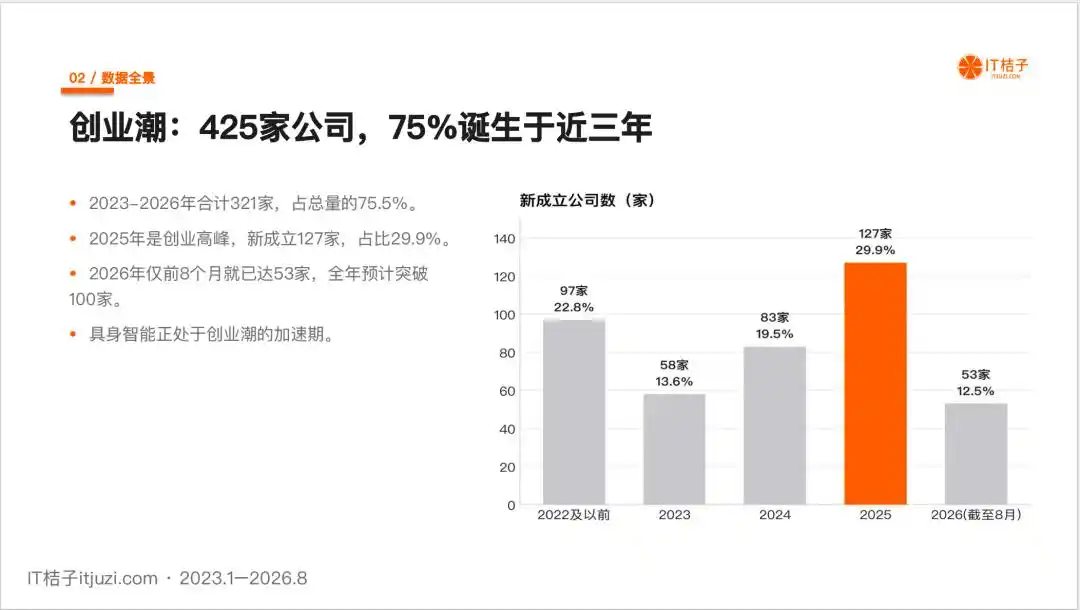
2025 was the peak year for startups, with 127 companies born. In just the first 8 months of 2026, another 53 new companies emerged, suggesting the annual number is expected to exceed 100 at this rate.
This isn't a story of linear growth; it's a story of accelerated sprint. Embodied intelligence is in the acceleration phase of its startup wave.
That 75% of companies were founded in just over three years indicates this sector has completed the shift from "proof of concept" to "startup consensus."
However, it's worth noting that the pace of 53 companies in the first eight months of 2026, while fast, actually shows a slowdown compared to the annualized growth from 2025's 127 companies—this might suggest the first wave of "novelty-seeking" startup peaks is nearing its top, and later entrants will need stronger differentiated capabilities.
Regional Pattern: Tripartite Dominance of Beijing, Guangdong, and Shanghai
Where are these companies located? The answer is highly concentrated.
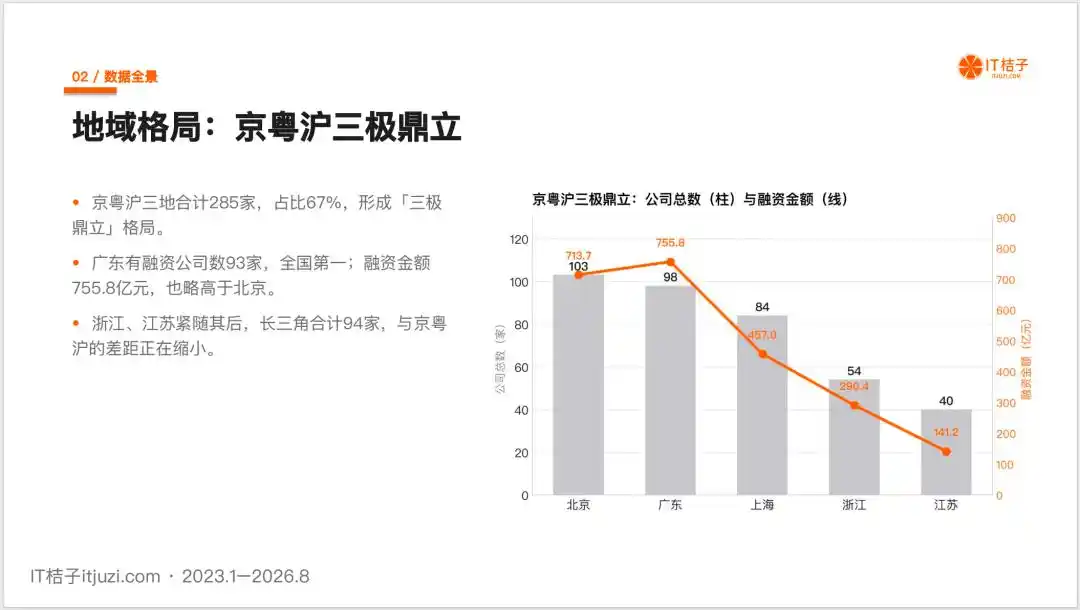
Beijing, Guangdong, and Shanghai together host 285 companies, accounting for 67% of the total—clearly establishing a "tripartite dominance" pattern.
But there's a signal in the data that's easy to overlook: Guangdong's number of funded companies (93) has surpassed Beijing's (91), and its total funding amount (75.58 billion yuan) also slightly exceeds Beijing's (71.37 billion yuan).
This indicates that Guangdong's startup ecosystem is not only active in quantity but also holds an advantage in capital recognition. The logic behind this is easy to understand—the Pearl River Delta has the nation's densest hardware supply chain. From molds to sensors to motors, entrepreneurs can find suppliers for almost all core components within an hour's drive.
Zhejiang (54 companies) and Jiangsu (40 companies) follow closely, with the Yangtze River Delta totaling 94 companies, narrowing the gap with the Beijing-Guangdong-Shanghai trio.
Overall, however, regional barriers for embodied intelligence startups remain high—entrepreneurs outside core regions need to incur significantly higher costs to compensate for geographical disadvantages in supply chain and talent.
Financing Stages: Early-Stage Dominant, but Divergence Has Emerged
Among the 385 companies that have received funding, the distribution of financing rounds shows a clear "inverted pyramid" structure.
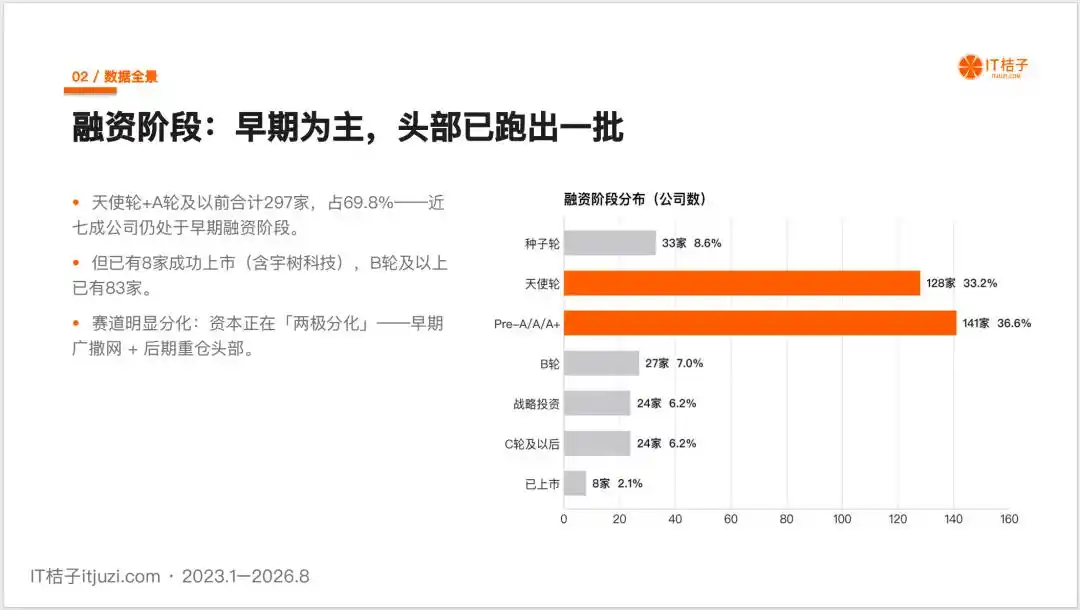
Companies at the Angel round and Series A or earlier stages total 297, accounting for 69.8%—nearly 70% are still in early stages. But 8 companies have already gone public (including Unitree), and there are 83 at Series B and beyond.
This data reveals a key signal—clear differentiation has already emerged in the sector. The capital strategy is "large at both ends, small in the middle": casting a wide net early on to see who can break out; then heavily doubling down on those who do.
Companies stuck between Series A and B face the greatest financing pressure.
This "dumbbell-shaped" capital structure has repeatedly appeared in capital-intensive, high-tech sectors like AI and semiconductors. It essentially reflects the risk control logic of capital for high-risk sectors—dispersing risk with small, early-stage bets, and placing large bets later to capture certainty.
III. 124.5 Billion Yuan: Four Key Data Points on Capital Heat
Financing Events and Amounts Soaring Year by Year
This set of data provides the most intuitive window into understanding the sector's overall heat.
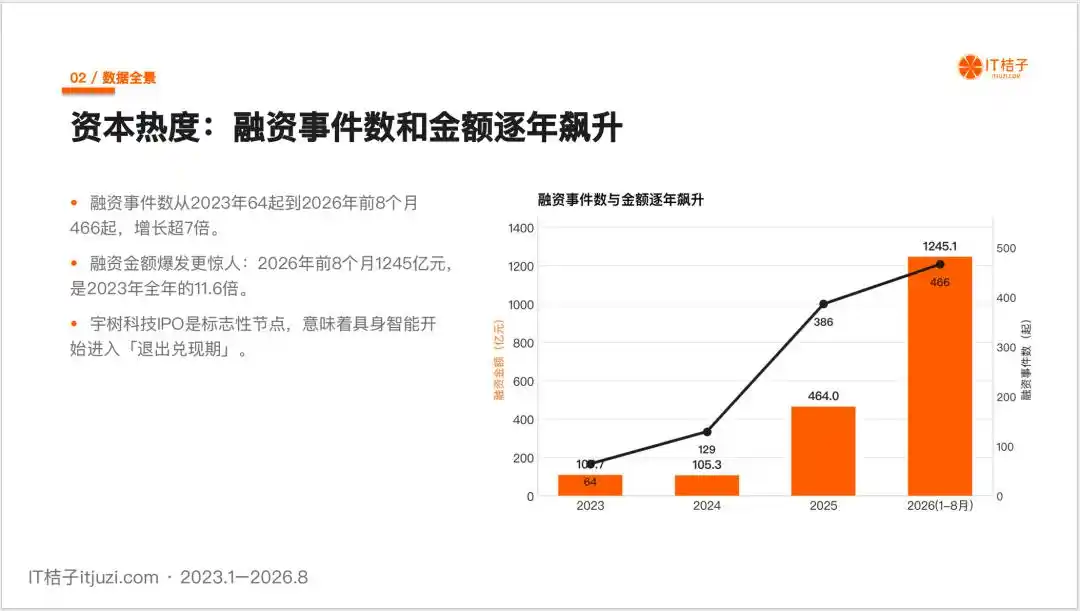
There were 64 financing events totaling 10.77 billion yuan in all of 2023. In 2024, the number of events doubled to 129, but the amount remained roughly flat—indicating that new financings were mainly smaller, early-stage rounds, with average deal sizes shrinking. 2025 saw takeoff, with 386 events raising 46.4 billion yuan.
In just the first 8 months of 2026, there were 466 events raising 124.51 billion yuan—11.6 times the total amount for all of 2023.
If you connect these four numbers into a curve, the core message isn't just "fast growth," but "accelerated growth."
The increment expands each year; capital isn't entering at a constant pace but is accelerating its inflow.
The driving force behind this is twofold: on one hand, IPOs like Unitree's and major financing rounds for leading companies have validated exit paths, attracting more capital. On the other hand, the narrative of embodied intelligence as the "second half of AI" is gradually being accepted by mainstream funds, turning it from a niche for early-stage tech funds into a must-have allocation for all types of funds.
853 Institutions Involved: From "Selective Bets" to "Full Market Consensus"
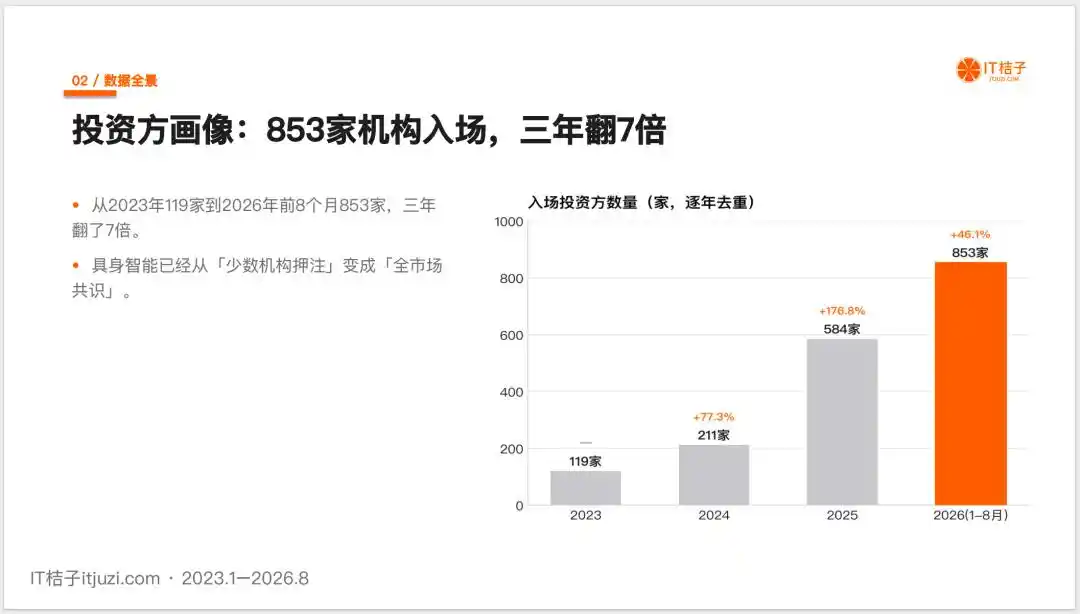
In three years, the number of investors has multiplied by seven times.
The meaning of having 853 institutions participating in the first eight months of 2026 is this: embodied intelligence is no longer the "private preserve" of a few early-stage tech funds; it has become a consensus direction for the entire market. For a VC today, it's hard to justify to LPs without having looked at embodied intelligence projects.
Looking at growth rates, 2025 saw the most explosive growth in the number of investors (+176.8%), while 2026's growth rate moderated somewhat (+46.1%).
This doesn't necessarily indicate a drop in heat but more likely suggests that "most institutions that should enter have basically entered," and the room for incremental growth is narrowing.
For entrepreneurs, this means financing competition will shift from "who can get funding" to "who can get better funding"—the judgment and resource empowerment from the investor side will become increasingly important.
TOP20 Investors: Who is "Heavily Investing" in Embodied Intelligence?
The top 20 investors by total number of investments across the cycle present a picture of diverse forces intertwining.
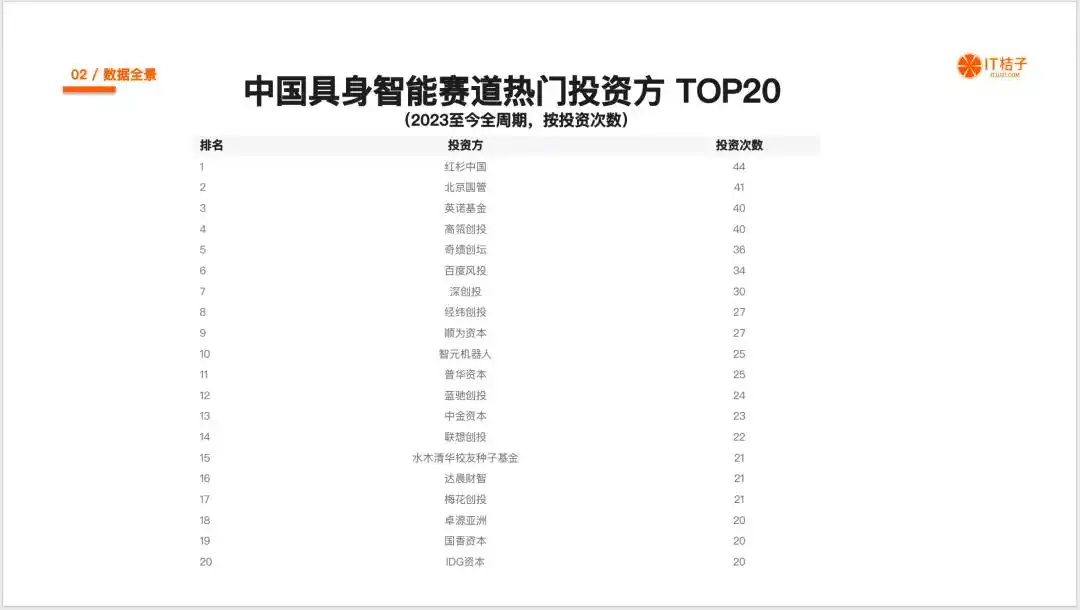
There are several noteworthy observations.
Sequoia Capital China ranks first with 44 investments and 23.06 billion yuan, demonstrating its "sweeping" layout capability covering all stages. Hillhouse Capital follows closely with 40 investments and 20.57 billion yuan. These two leading market-oriented VCs far outpace others in investment intensity.
State-owned capital is a force to be reckoned with. Beijing State-owned Capital Operation and Management Center ranks second with 41 investments, followed by Shenzhen Capital Group (30), and CICC Capital (23)—the state-owned system in embodied intelligence isn't merely making financial investments but carries clear industrial guidance intentions.
MiraclePlus ranks fifth with 36 investments. This early-stage fund founded by Qi Lu is known for "betting on sectors and people," and embodied intelligence is clearly one of its key focus areas. Considering MiraclePlus concentrates on seed and angel rounds, its frequency of 36 deals indicates an extremely high density of investment in this field.
Zhiyuan Robotics ranks tenth with 25 investments. This itself is not a VC but a leading enterprise in the embodied intelligence field. A portfolio company turning around to heavily invest in upstream and downstream players—this signals that leading companies are already building their own industrial ecosystems.
Tsinghua Alumni Seed Fund ranks fifteenth with 21 investments. This is the only university-affiliated fund in the TOP20, reaffirming the industrial incubation capability of the Tsinghua ecosystem in embodied intelligence.
Looking at the annual evolution: In 2023, early-stage capital was dominant, with Lanchi Ventures and MiraclePlus very active; in 2025, state-owned and industrial capital entered on a large scale; by 2026, top-tier institutions entered comprehensively—Sequoia (29), Hillhouse (24), Baidu Ventures (16). The entry rhythm of capital clearly shows a three-stage progression: "early exploration—mid-term acceleration—late-stage decisive battle."
Investor Classification: Market-Oriented Capital Leads, Industry Giants Layout Comprehensively
Classifying the TOP100 investors of 2026 by nature reveals a clearer capital structure.
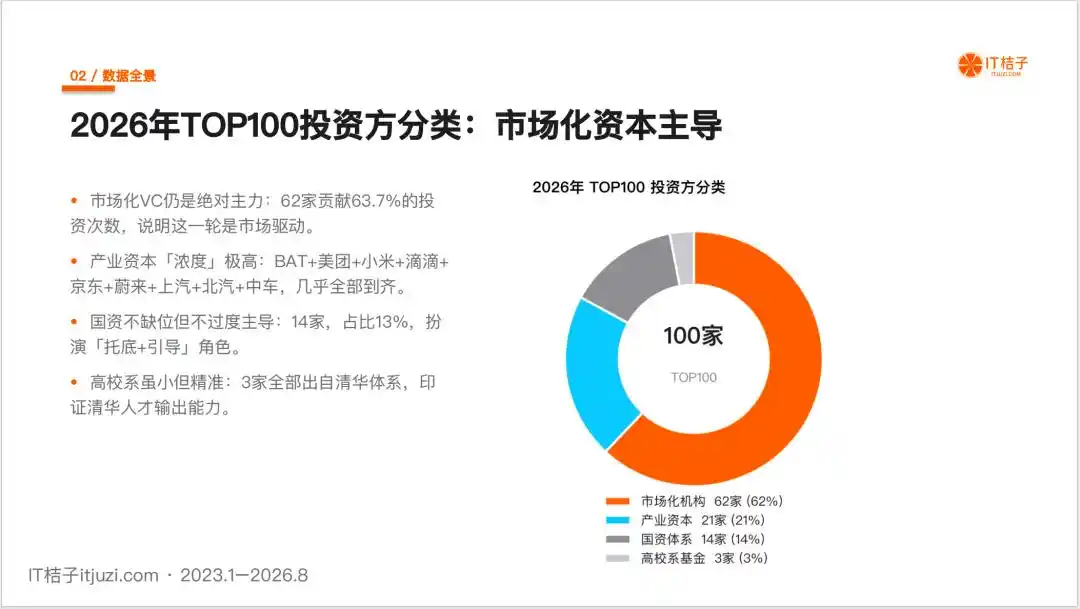
Market-oriented VCs are the absolute main force. 62 institutions contributed 63.7% of the investment counts, indicating that this wave of embodied intelligence enthusiasm is essentially market-driven, not purely policy-catalyzed. This is a healthy signal—market-driven capital allocation is typically more efficient.
The "concentration" of industrial capital is extremely high. Among the 21 industrial capital players, Baidu, Alibaba, Tencent, Meituan, Xiaomi, Didi, JD.com, NIO, SAIC, BAIC, CRRC—almost all are present. They are not just making financial investments but more strategic layouts. Baidu Ventures (34 investments), Xiaomi via Shunwei Capital (27), Lenovo Capital (22)—every major internet and automotive giant is building its own embodied intelligence blueprint.
State-owned capital is present but not overly dominant. 14 state-owned institutions, accounting for 13%, play a role of "providing a safety net and offering guidance." This proportion is within a reasonable range for hard-tech sectors.
University-affiliated funds are few but precise. Only 3—Tsinghua Alumni Seed Fund, Mubai Technology Innovation, and Leaguer Innovation—all from the Tsinghua ecosystem, made a total of 25 investments. The number of institutions is limited, but their moves are precise, with a high density of successful portfolio companies.
IV. The Tsinghua Group of 96 People: Where Do Entrepreneurs Come From?
Embodied intelligence is not a sector for "grassroots entrepreneurship"—its entrepreneur profile shows distinct academic-driven characteristics.
IT Juzi analyzed the educational backgrounds of core founding teams in the embodied intelligence sector, with results showing:
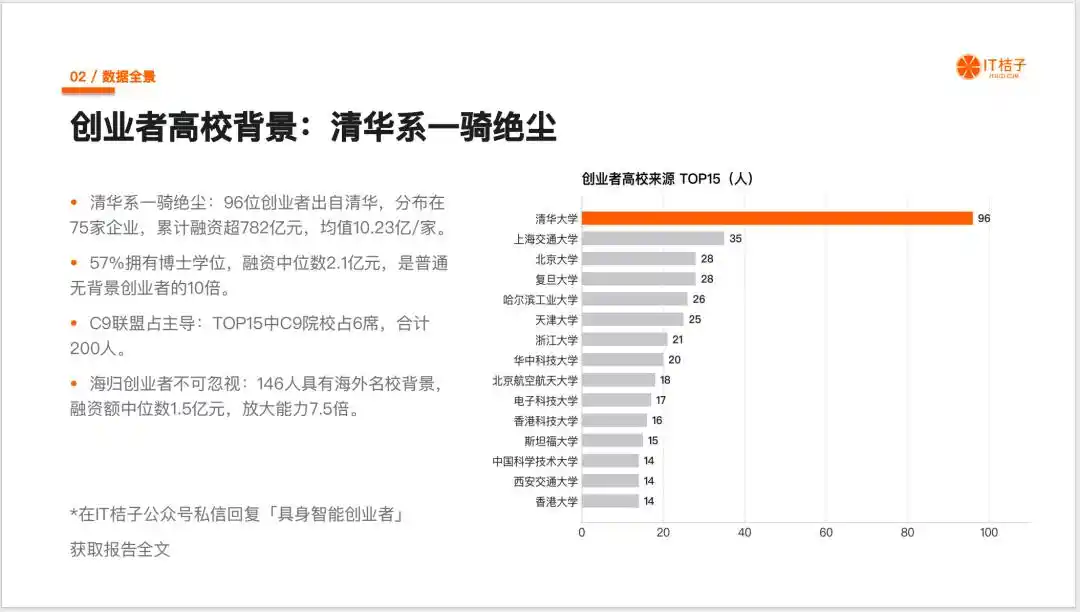
Tsinghua University leads by a wide margin. 96 entrepreneurs graduated from Tsinghua, accounting for nearly a quarter of the statistically available total. These 96 individuals are distributed across 75 companies, with cumulative funding exceeding 78.2 billion yuan, averaging 1.023 billion yuan per company. Among them, 57% hold doctoral degrees, with a median funding amount of 210 million yuan—10 times that of entrepreneurs without prestigious academic backgrounds.
A 10-fold funding gap is significant. While academic credentials don't equal capability, and more funding doesn't guarantee success, this data at least indicates one thing: embodied intelligence is a highly "academic-driven" sector, where the research-to-industry conversion capability of top universities is being manifested intensely.
C9 League institutions dominate. Six of the TOP15 are C9 universities—Tsinghua, SJTU, Peking University, HIT, Zhejiang University, USTC—together accounting for 200 individuals, nearly half of the total. The long-term academic accumulation of these universities in robotics, AI, automation, etc., is intensively transforming into entrepreneurial outcomes.
Overseas returnee entrepreneurs are a force not to be ignored. 146 entrepreneurs have educational backgrounds from prestigious overseas universities, with 15 from Stanford—the only overseas university in the TOP15. The median funding for overseas returnee entrepreneurs is 150 million yuan, 7.5 times that of the average entrepreneur. Stanford's academic influence in embodied intelligence is being transmitted back to China's industrial side through returning entrepreneurs.
The entrepreneur profile for embodied intelligence highly resembles other hard-tech sectors like biopharma and semiconductors—academic background and research experience are almost "standard equipment."
This means the talent barrier for this sector is high, "technical founders" are the mainstream, and purely business-model-driven entrepreneurs find it hard to gain a foothold here. Meanwhile, Tsinghua's absolute dominance also indicates that talent supply for embodied intelligence heavily relies on a handful of top-tier universities, raising a question worth pondering regarding the diversity of talent supply for the entire sector.
V. From "Building the Body" to "Building the Brain": Deep Structural Shift in the Sector
From the Perspective of Deal Counts: Embodied Brain Systems Overtake Humanoid Robots
The distribution and evolution of financing deal counts across sub-sectors from 2023 to August 2026 reveal the most important structural shift in the sector.
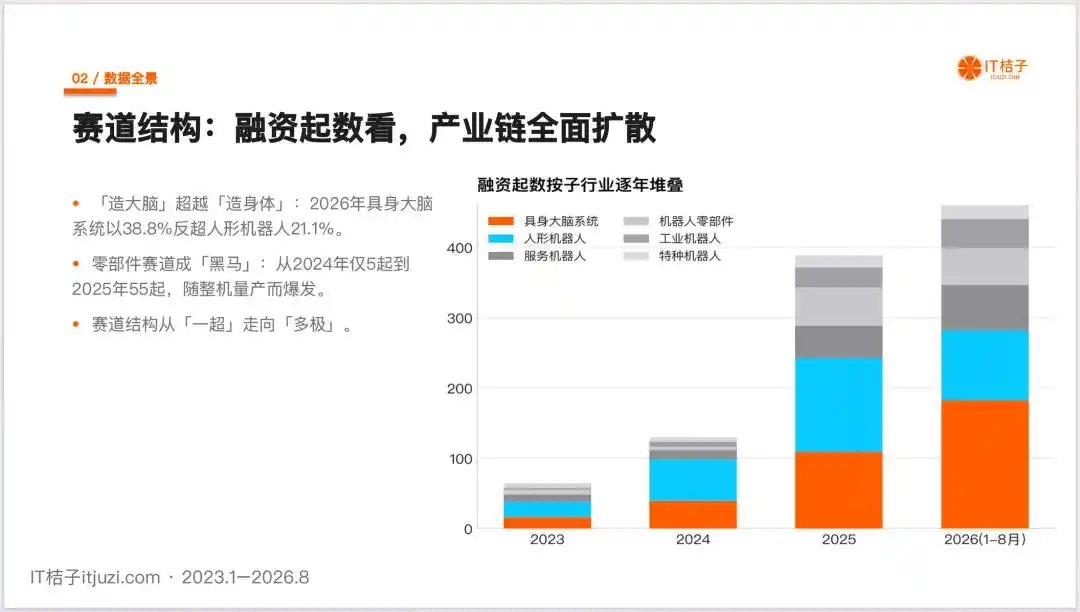
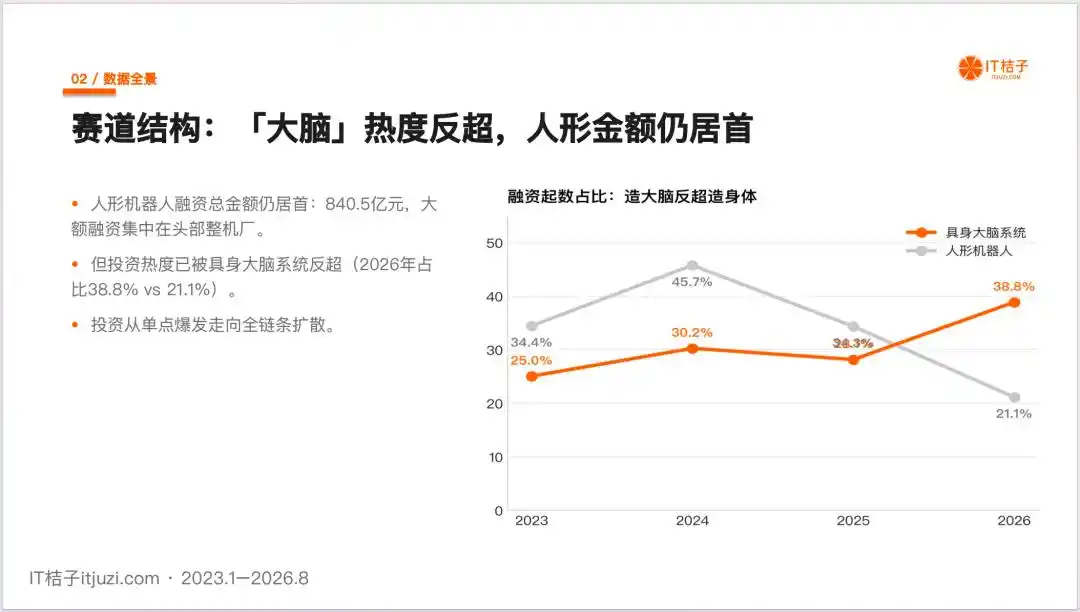
In 2023, humanoid robot financing deals accounted for 34.4%, the absolute dominant position. Embodied brain systems accounted for only 25%, ranking second. By 2026, the situation reversed—embodied brain systems, at 38.8%, overtook humanoid robots' 21.1%, becoming the sub-sector with the most financing deals.
In other words, capital's attention is shifting from "building the body" to "building the brain."
Another noteworthy change is the sudden rise of the robot components sector. There were only 5 financing deals in all of 2024; this jumped directly to 55 in 2025, and reached 53 in just the first 8 months of 2026. Upstream segments like dexterous hands and joint modules are exploding as mass production of complete machines advances.
From the Perspective of Funding Amounts: Complete Machines Still Attract Most Capital, but "Brain" and "Components" Are Catching Up Fast
Switching to the dimension of funding amounts, the story is slightly different.
Humanoid robots rank first with a total amount of 84.05 billion yuan—although overtaken in deal count, large funding rounds are concentrated in leading complete machine manufacturers, resulting in higher single-deal amounts. Embodied brain systems rank second with 63.45 billion yuan, but their growth is fierce—reaching 45.25 billion yuan in just the first 8 months of 2026, rapidly closing in on the cumulative amount for humanoid robots.
Of the 17.27 billion yuan for service robots, 14.22 billion was concentrated in the first 8 months of 2026—indicating that commercialization in service scenarios is accelerating. Robot components jumped from 100 million yuan in 2024 to 9.66 billion yuan in the first 8 months of 2026, showing the most astonishing growth.
Deal counts represent "breadth," while amounts represent "depth." The shift in counts indicates capital's focus is broadening, spreading from complete machines to brains and components. The amount structure shows that large funds are still concentrated in leading complete machine companies—capital is chasing breadth in brains and components but still betting depth on complete machines. This strategy of "casting a wide but shallow net, while fishing for big fish deeply" suggests the financing environment for most small and medium-sized complete machine companies may become increasingly competitive.
VI. Five Core Judgments
Based on the data, we attempt to extract five trend judgments.
Capital Has Flooded In, But the Industry Inflection Point Has Not Yet Arrived
Wang Xingxing's statement at WRC was blunt: the "ChatGPT moment" for embodied intelligence could be 2-3 years away, or 5-10 years. But primary market financing has already "jumped the gun"—124.5 billion yuan in the first 8 months of 2026 is 11.6 times the total for all of 2023.
This means capital is betting on an industry explosion 2-3 years from now. The current phase remains one of "layout," not "harvest."
Unitree Technology opened an exit pathway, but the industry as a whole is still some distance from large-scale commercialization. For investors, this is a gamble about timing—those who accurately judge the pace of the industry explosion will gain excess returns.
Humanoid Robots Are the Greatest Common Divisor, But the "Brain" is the Decisive Point
Humanoid robots are the sub-sector with the most financing deals (313) and the highest total funding (84.05 billion yuan). But their financing heat has been overtaken by embodied brain systems—38.8% vs. 21.1% in deal share for 2026.
A relevant analogy is the smartphone industry. Smartphone OEMs built the entire industry, but what truly determined user experience and ecosystem structure were the operating system and chips.
Embodied intelligence is on the same path. Leading companies in the brain layer may eventually exceed the valuation of most OEMs.
The Startup Wave is Accelerating, But the Window is Narrowing
75% of the 425 companies were founded in the last three years, with 2025 being the peak; nearly 70% are still in early stages. On the surface, entrepreneurial opportunities still appear abundant.
But the components sector's explosive growth from 5 deals in 2024 to 55 in 2025 indicates the industry chain is rapidly extending downwards, and first-movers are already establishing barriers.
The cases of Lingxin Qiaoshou (15 billion yuan) and Tipping Point (10 billion yuan) in the dexterous hand field tell us: once a bottleneck component is broken through, capital is willing to assign extremely high premiums—but this precisely means later entrants will have to pay a much higher price to catch up.
For new entrants, "what to do" is more important than "whether to do it." Against the backdrop of a crowded landscape in complete machines and humanoid robots, finding "niches" not yet fully covered in the industry chain—such as sensors for specific scenarios, joint components for specific materials, or data services for specific industries—might be a more pragmatic choice.
Regional Concentration Determines Startup Success or Failure
The Beijing-Guangdong-Shanghai trio accounts for 67% of companies and over 60% of funding. This concentration level is on the high side among tech sectors.
Embodied intelligence startups are highly correlated with local hardware supply chains, AI talent density, and state-owned capital guidance intensity. The hardware supply chain advantage of the Pearl River Delta, the AI talent density of Beijing, and the international resources and industrial foundation of Shanghai constitute the core barriers for the entrepreneurial ecosystems in these three regions.
Entrepreneurs outside these core regions need to incur significantly higher costs in talent recruitment, supply chain access, and investor outreach.
But this raises a question worth considering: as the industry spreads to more cities, can "second-tier" cities rise? Suzhou, Hefei, Wuhan, Chengdu—cities with strong manufacturing bases or AI research resources—could potentially become the next hubs for the embodied intelligence startup wave.
Talent Outflow from Big Tech Combined with Comprehensive Entry of Industrial Capital
Among the TOP100 investors in 2026, 21 are industrial capital players—Baidu, Alibaba, Tencent, Meituan, Xiaomi, Didi, JD.com, NIO, SAIC, BAIC, CRRC—covering almost all of China's most important tech and manufacturing groups. They are not just making financial investments but more strategic layouts, building their respective embodied intelligence ecosystems.
Simultaneously, talent continues to flow out from big tech into entrepreneurship.
Founding teams of several leading embodied intelligence companies come from Huawei, DJI, Baidu, Tencent, etc. When talent with large-scale engineering experience enters the startup arena, combined with the resource infusion from industrial capital, the competitive landscape of embodied intelligence will accelerate its shift from "lab competition" to "industrialization race."
The fact that the three Tsinghua-affiliated funds made a total of 25 investments illustrates from another angle: universities in the embodied intelligence field are not just talent exporters but also key nodes for industrial incubation. The closed loop integrating academic research, talent cultivation, and startup incubation is becoming a unique competitive barrier for the embodied intelligence sector.
This article is from the WeChat public account "IT Juzi" (ID: itjuzi521), author: Judy