Nasdaq Plunges 4.2% in a Single Day: Does "Black Friday" Burst the U.S. Stock Market Bubble?

marsbitPublicado a 2026-06-08Actualizado a 2026-06-08

Resumen

The Nasdaq plunged 4.18% on June 5, 2026, its worst single-day drop in over a year, as a much stronger-than-expected US jobs report triggered fears of economic overheating and delayed Federal Reserve interest rate cuts. The selloff, centered on high-valuation tech and AI stocks like Nvidia and Broadcom, spread across major indices. The article examines whether this signals a market top. The strong May non-farm payrolls data, nearly double expectations, pushed bond yields higher, directly hurting rate-sensitive tech stocks. This exposed vulnerabilities in the crowded AI trade, where valuations had soared on narratives of infinite growth, despite emerging signs of slowing order momentum and corporate AI monetization challenges. Prior to the drop, market indicators flashed warning signs: historically high valuations (e.g., Shiller CAPE ratio near 39.5), extreme bullish sentiment, and high levels of leverage. Technical charts showed key support levels being breached. Wall Street is divided on the outlook. Bears, citing risks of "stagflation" and AI bubble comparisons to the dot-com era, warn of a potential significant correction. Bulls view the drop as a healthy correction within a bull market, underpinned by a strong economy and expected corporate earnings growth of around 7% in 2026. The immediate future hinges on upcoming key events: the May CPI inflation data and the mid-June FOMC meeting. Their outcomes will critically shape market expectations for the Fed's rate path. T...

Original | Odaily Planet Daily (@OdailyChina)

Author | Qin Xiaofeng (@QinXiaofeng 888 )
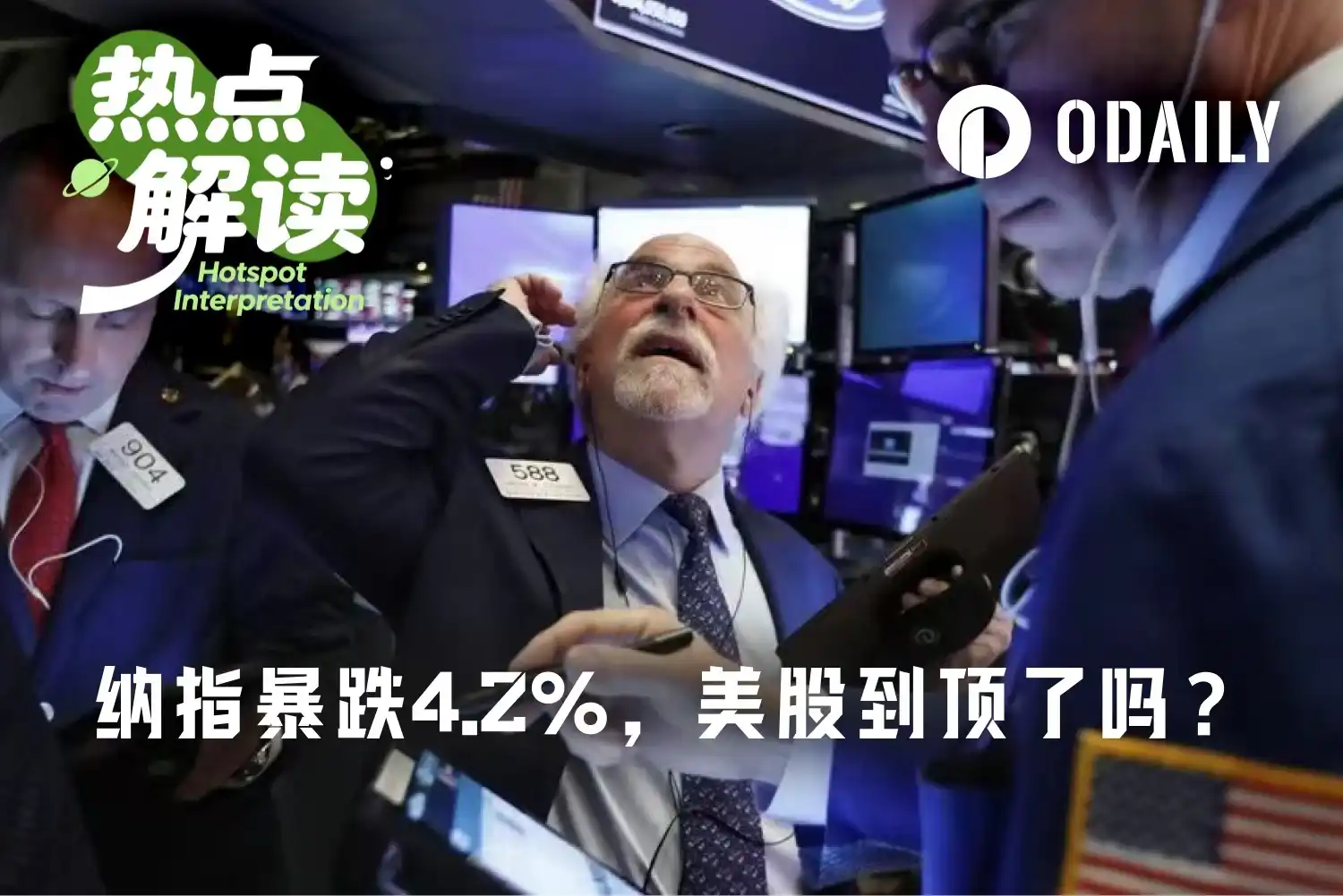
On Friday, June 5, U.S. stocks experienced the most intense single-day pullback so far in 2026.

The Nasdaq Composite Index plummeted 4.18%, closing at 25,709.43 points, marking its largest single-day drop since April 2025. The S&P 500 fell 2.64% to 7,383.74 points, ending its record nine-week winning streak. The Dow Jones Industrial Average dropped 695.15 points (1.35%) to 50,866.78 points. The Philadelphia Semiconductor Index plunged over 10%, with market capitalization evaporating by approximately $1.3 trillion in a single day, led by declines in core AI stocks such as Nvidia, Broadcom, Micron, and Marvell.

Instantly, the question of "Have U.S. stocks peaked?" loomed in the mind of every investor. Odaily Planet Daily will conduct a rigorous analysis combining recent data and historical comparisons: Are current U.S. stock valuations too high? Is this pullback a healthy correction or a trend reversal? Where are the future driving factors?

I. Panorama of the June 5th Plunge: A Data-Driven "Perfect Storm"

The Non-Farm Payrolls (NFP) report released on Friday evening was the immediate trigger for this plunge.

The U.S. Department of Labor's May NFP data showed an addition of 172,000 jobs, almost double the market expectation of 88,000, and significantly higher than April's 115,000. April's job figures were already above expectations. March's job data was revised upward by 29,000, and April's was revised upward by 64,000. Job growth over the past three months reached its strongest level in two years. This indicates a systematic underestimation of the U.S. employment situation in prior data, enough to fuel market concerns about an overheating economy.

The strong employment data pushed up inflation expectations, with the market anticipating the Federal Reserve could raise interest rates as early as October this year. Following the data release, U.S. Treasuries were sold off. The 10-year Treasury yield rose 5.8 basis points to 4.531%, and the more policy-sensitive 2-year Treasury yield jumped over 7 basis points in a single day to 4.1%.

The jump in bond yields hit technology stocks, which are high-valuation, high-growth assets and are most sensitive to interest rates, the hardest.

Broadcom's strong earnings the day before failed to surpass the market's extremely high expectations for its AI custom chip business guidance, triggering a chain reaction. Nvidia fell over 6%, Micron dropped 13.3%, Marvell fell 16.7%, and AMD declined 10.9%. Concentrated profit-taking in the semiconductor sector, coupled with doubts about the sustainability of AI capital expenditures, created an avalanche effect. Reports that Meta would add hundreds of billions in AI investment failed to reverse the sector's downturn.

Trading volume expanded, and the VIX fear index surged 37% to 21.15, indicating a rapid spread of risk-averse sentiment. Bitcoin simultaneously fell below $60,000, and gold and crude oil also adjusted, with risk assets under comprehensive pressure. However, not all sectors fell: defensive sectors like utilities, healthcare, and consumer staples closed higher, with "old blue chips" like Johnson & Johnson and Coca-Cola attracting safe-haven funds. This suggests the market was not in a state of full-blown panic but rather a targeted adjustment in high-valuation sectors.

On a weekly basis, the S&P 500 ended its nine-week winning streak, with the Nasdaq logging a weekly loss of 4.7%, its worst in over a year. The Dow showed relative resilience, falling only 0.3% for the week, reflecting signs of sector rotation.

"This was an extreme manifestation of 'good news is bad news,'" Morgan Stanley's chief U.S. equity strategist, Michael Wilson, noted in a post-market report. "Strong employment data means the Fed's tightening shackles will be fastened tighter, directly shaking the only pillar supporting the high valuations of U.S. stocks—the expectation of imminent rate cuts."

II. The AI Myth Fades: Dominoes of a Crowded Trade

If the NFP data was the trigger, then the accumulated bubble and fragility within the AI sector itself were the highly explosive powder keg.

Over the past 18 months, AI was the sole narrative driving U.S. stocks to successive new highs. Nvidia's market cap once surpassed $5 trillion, accounting for over 7% of the S&P 500 index's weighting. At one point, the entire AI ecosystem-related stocks approached 40% of the S&P 500's total market cap.

However, entering Q2 2026, cracks began to appear in this faith.

Recent supply chain surveys revealed that several cloud service providers were reportedly cutting back on some orders for Nvidia's next-generation Blackwell Ultra chips due to excessive previous stockpiling and the much slower-than-expected monetization speed of enterprise AI applications. Nvidia's earnings report at the end of May, while still impressive, showed its revenue growth guidance had slowed for the third consecutive quarter, and there were signs of a potential decline in gross margins.

The extremely crowded long positions in tech giants rapidly evolved into a stampede to close positions under the impact of interest rate shocks. When the NFP data triggered soaring rates, the attractiveness of holding these high-duration, high-valuation growth stocks plummeted abruptly. Their marginal buyers—leverage-dependent quantitative funds and retail investors—were the first to collapse, triggering a chain reaction.

"The AI trade has shifted from FOMO (fear of missing out) to fear of being caught." Renowned value investor and GMO co-founder Jeremy Grantham has long warned about excessive AI valuations. He has compared the current situation to the eve of the 2000 internet bubble, noting that revenues for many AI companies may struggle to support their current high valuations.

III. Valuation and Historical Comparison: Have U.S. Stocks Reached a Bubble Peak?

The reason this pullback sparked widespread discussion about "whether the market has peaked" lies in its occurrence against a backdrop of multiple high valuation and sentiment indicators converging.

First, valuations are at historically high levels. Prior to the June 5th correction, the S&P 500's Cyclically Adjusted Price-to-Earnings ratio (CAPE, Shiller P/E) was around 39.5, ranking third highest after the 2000 internet bubble and the post-2021 pandemic easing period, significantly above levels preceding the 2007 financial crisis. The forward P/E also reached around 22.5, far above the long-term historical average of 15.8. The "Buffett Indicator"—the ratio of total U.S. stock market capitalization to U.S. GDP—briefly touched a high of 237% in late May, far exceeding the range Buffett himself defined as "significantly overvalued" (>120%). Any unexpected negative news could accelerate mean reversion.

Second, capital and sentiment are at extreme levels. The BofA Bull & Bear Indicator rose to 8.5 in late May, firmly locked in the "Extreme Greed" zone, often considered a reliable contrarian sell signal. The American Association of Individual Investors (AAII) bullish sentiment reading was mostly in the 35%-45% range in May, indicating optimistic but not extreme euphoric sentiment. Retail margin debt balances remained near a historical high of around $1.3 trillion in April-May, showing continued aggressive use of leverage.

Meanwhile, "smart money" has shown signs of retreat: Berkshire Hathaway's Q1 13F report revealed its cash and cash equivalents reached a record high of approximately $397 billion, and the company continued to be a net seller of stocks in Q2; the insider selling-to-buying ratio climbed to a relatively high level in May, the highest since 2021.

Third, technical indicators show critical breakdowns. Last Friday, the S&P 500 not only fell below short-term moving averages but also breached the lower rail of the recent uptrend channel. The index is currently testing its 200-day moving average (around the 7000-7200 point range). Technical analysts like BTIG's chief technical strategist Jonathan Krinsky point out that if the S&P 500 fails to quickly reclaim key support levels and further loses the 200-day moving average, it would technically confirm the potential start of a mid-term correction, with an adjustment range possibly reaching 10%-15%.

IV. Bull vs. Bear Debate: Pullback, Correction, or Beginning of a Bear Market?

Faced with the market pullback, Wall Street's bulls and bears quickly took sides, engaging in a fierce debate.

The bearish camp believes this could be the beginning of a bubble adjustment. Some strategists point to emerging risks of "stagflation" in the U.S. economy—while the May ISM Manufacturing PMI rebounded to 54.0 (indicating expansion), inflation indicators remain sticky. They warn that corporate earnings growth may face downward revision pressure due to financing costs and demand uncertainty, and the current equity risk premium is at low levels.

Societe Generale's star strategist Albert Edwards, a long-term skeptic, warns that the AI bubble resembles past tech bubbles, potentially accompanied by capital misallocation and challenges for some companies, with the Nasdaq facing significant downside risk.

The bullish camp emphasizes this is a healthy, overdue correction within a bull market. Goldman Sachs' chief U.S. equity strategist, David Kostin, acknowledges high valuations but argues a market driven by earnings growth still has support. He expects S&P 500 component earnings to grow about 7% in 2026, with productivity gains from AI starting to improve corporate margins in the second half. "The strong NFP data precisely proves the economy is not heading for a hard landing, with minimal recession risk. When the rate panic subsides, capital will re-recognize the solidity of the earnings foundation." Goldman maintains a higher year-end target for the S&P 500, previously raised to the 6900-7600 range.

UBS Global Wealth Management also advises clients to "buy the dip," citing healthy household and corporate balance sheets and ongoing corporate share buyback plans providing a market buffer.

Charles Schwab's chief investment strategist, Liz Ann Sonders, offers a moderate and pragmatic perspective: "'The top' is never a point but a process. Currently, the liquidity- and sentiment-driven broad rally phase has ended. We are entering a fundamentals-driven stock-picking market. Overall market indices may range-bound and trend slightly lower over the coming months, but a 2008-style crash is unlikely unless we see a freeze in credit markets."

V. Key Future Catalysts: Inflation Data and the Fed's "Judgment"

Undoubtedly, two major events this week will serve as critical watersheds determining the nature of this adjustment. On Wednesday, June 10, the U.S. May Consumer Price Index (CPI) will be released. Market consensus expects the core CPI year-on-year increase to be around 2.8%-2.9% (April was 2.8%). If the data significantly exceeds expectations upward, it will further reinforce market concerns about "sticky inflation" and potentially push back Fed rate cut expectations further, intensifying pressure on bond and stock markets.

The Federal Reserve's Federal Open Market Committee (FOMC) meeting on June 16-17 will be an important observation window. Following the strong June 5 NFP data, several Fed officials reiterated the need for caution. Officials like Cleveland Fed President Beth Hammack emphasized that while the labor market shows resilience, interest rates may need to remain at current higher levels for longer. The Economic Projections Summary (dot plot) released then will be closely watched. If the median projection shows fewer rate cuts in 2026 than previously anticipated, or even hints at maintaining rates unchanged for the year, market expectations for the rate path will undergo significant repricing.

Additionally, geopolitical and trade policy risks could also introduce extra uncertainty. The U.S. has previously implemented import tariffs and export controls on advanced semiconductors to strengthen domestic supply chain security and restrict key technology outflow. This ongoing policy direction, when tech stock sentiment is fragile, could still have long-term impacts on the global AI supply chain, raise the inflation center, and thereby compress valuations for some companies.

Conclusion

Returning to the initial question: "Have U.S. stocks peaked?"

For investors, all the necessary conditions sufficient to confirm a long-term major peak—extreme valuations, policy shifts, core narrative cracks, retail euphoria, technical breakdowns—are appearing simultaneously for the first time in over a decade. Historical experience shows that when these signals resonate highly, even if the bull market doesn't end immediately, the risk-reward ratio has already deteriorated extremely. The current market is in a fragile transition period from "narrative" to "reality." The long-term productivity promise of the AI revolution must now begin to undergo rigorous scrutiny from every piece of macro data and earnings report.

The era of one-sided bets on a perpetually rising market may be over. Caution is the most fundamental respect for risk. Over the next two weeks, investors need to closely watch every decimal point in the May CPI report and every potential micro-shift in the Fed's dot plot. Together, they will determine whether this summer is an interlude within a bull market or the prelude to a new era.

Preguntas relacionadas

QWhat was the direct trigger for the significant sell-off in the U.S. stock market on June 5th according to the article?

AThe direct trigger was the release of stronger-than-expected U.S. non-farm payroll data for May, which showed the addition of 172,000 jobs, nearly double market expectations. This raised concerns about economic overheating and pushed market expectations for a Federal Reserve rate hike forward, leading to a spike in Treasury yields.

QWhy were technology and semiconductor stocks particularly hard hit during the market decline?

ATechnology and semiconductor stocks, being high-valuation, high-growth assets, are most sensitive to interest rates. The surge in bond yields triggered by the strong jobs data made these stocks less attractive. Additionally, specific negative catalysts like Broadcom's AI chip guidance failing to exceed high expectations and reports of cloud providers cutting orders for Nvidia's next-gen chips contributed to a concentrated sell-off in the crowded AI trade.

QWhat historical valuation comparison does the article make to suggest U.S. stocks might be overvalued?

AThe article mentions that before the correction, the S&P 500's Cyclically Adjusted Price-to-Earnings (CAPE or Shiller P/E) ratio was around 39.5x, which is the third-highest level in history, after the 2000 dot-com bubble and the 2021 post-pandemic easing period. It also references the "Buffett Indicator" (U.S. stock market capitalization to GDP ratio) reaching a high of around 237%, well into the "severely overvalued" range defined by Warren Buffett.

QWhat are the two key upcoming events that the article identifies as potential turning points for the market?

AThe two key upcoming events are: 1) The release of the U.S. Consumer Price Index (CPI) for May on June 10th, which will provide crucial data on inflation trends. 2) The Federal Reserve's Federal Open Market Committee (FOMC) meeting on June 16th-17th, where the updated economic projections (dot plot) will be closely watched for any shifts in the expected path of interest rates.

QAccording to the article, what is the core debate among Wall Street analysts regarding the nature of this market pullback?

AThe core debate is between analysts who view this as a potential start of a bubble adjustment or bear market versus those who see it as a healthy, overdue correction within a bull market. Bears point to high valuations, sticky inflation risks, and potential earnings pressure. Bulls argue the strong economic data prevents a hard landing, corporate earnings growth remains supportive, and the long-term AI productivity story is intact, suggesting investors should buy the dip.

Lecturas Relacionadas

Gary Yang: Agent Economy and AI Submicroeconomics

**Title:** Agent Economy and AI Sub-Microeconomics - Gary Yang **Summary:** Following the AI singularity, the pace of evolution has accelerated rapidly, creating new generational disparities in technological advancement globally. While many regions are still grappling with single-agent bottlenecks, Silicon Valley has moved ahead into the next dimension: the Agent Economy and A2A ecosystems. The article outlines six key areas of this emerging paradigm: 1. **AI Payment Competition & H2A Bottlenecks:** A fierce battle for AI Agent payment protocol standards is underway (e.g., MPP, x402). However, most current efforts remain Human-to-Agent (H2A), essentially grafting AI onto traditional human-centric commerce, which creates a non-AI-native bottleneck. The true potential lies in Agent-to-Agent (A2A) autonomous economies. 2. **Agent Economy & the Inevitable A2A Trend:** The Agent Economy is defined by autonomous AI Agents creating, exchanging, and capitalizing value as independent economic actors. The A2A ecosystem describes their interactions. This represents the next major investment frontier, akin to the early days of e-commerce or DeFi, but with faster iteration and an AI-native, efficiency-first perspective that often diverges from human needs. 3. **AI Protocol vs. Crypto Protocol:** AI Protocols are the foundational rules for Agent interaction in an open network (communication, discovery, collaboration), akin to the governance and economic laws of the AI world. Currently, they focus on communication and weak boundaries, unlike Crypto Protocols which emphasize asset rights and clear ownership. While they appear different due to political-economic factors and legacy system constraints, their eventual convergence into a unified Digital Protocol system is seen as inevitable, driven by first principles. 4. **AI Agent Sub-Microeconomics & Biological Analogy:** AI Agent economics differ fundamentally from human economics: higher frequency/lower value transactions, energy/value direct correlation, efficiency-driven (not emotional) decisions, task-oriented (not consumption-oriented) behavior, and near-zero organizational/communication costs. A powerful analogy frames the Agent economy as a biological system: the LLM is the nucleus, the Agent harness is the cytoplasm, the Agent itself is a cell, its communication protocol is the cell membrane, and external tools (Skills, Prompts) are the extracellular environment. 5. **The Inevitability of AIFi & FinChip:** AIFi (AI Finance) represents the financial system where AI-native value within the Agent economy is tokenized and exchanged. Unlike TradFi/DeFi where value resides *in* finance, in AIFi, value originates *in* AI, and finance becomes its form. This shift is enabled by Agents taking over value discovery. FinChip (Financial Chip) is introduced as a key infrastructure—a fusion of AI autonomy and crypto smart contracts—forming intelligent financial assets to power the future A2A economy. 6. **AI-Native as a Paradigm Shift:** Adopting AI is not akin to "Internet+". It requires AI-Native thinking—designing systems based on first principles, the shortest energy-value path, and maximum efficiency. This abstract, counter-intuitive logic poses a significant, ongoing challenge for all practitioners, as effective, generalized upgrade methodologies will be slow to emerge in this rapidly evolving landscape.

链捕手Hace 37 min(s)

Gary Yang: Agent Economy and AI Submicroeconomics

链捕手Hace 37 min(s)

From 'The Big Short' to San Francisco: The Revelry and Dizziness Within the AI Bubble

From "The Big Short" to San Francisco: The Frenzy and Dizziness in the AI Bubble The article captures the intense, frenetic atmosphere in San Francisco, the epicenter of the current AI boom. Drawing a parallel to the "smell of money" from *The Big Short*, the author observes a city gripped by a singular status game centered entirely on AI and technology. This manifests in a palpable, caffeine-fueled anxiety ("people are shaking"), rampant comparison using vanity metrics like funding rounds, and pervasive "Big Bubble Behavior." The piece explores the city's stark contrasts: its dystopian streets versus beautiful vistas, and the disconnect between the doomsday concerns of some AI researchers and the optimistic, growth-focused "GTM" teams. It critiques the obsession with "math genius" founders as the new ticket to outsized returns, akin to scouting sports prodigies. Referencing economic historian Carlota Perez's "frenzy phase" and Karl Polanyi's "double movement," the author frames the boom as a period where financial speculation detaches from fundamentals, with society potentially becoming subordinate to a new economic force driven by "geniuses in data centers." Ultimately, while acknowledging the unprecedented wealth creation and party-like energy, the article concludes with cautionary advice: when the music is playing, you should dance, but don't get drunk. The core reminder is to stay grounded, avoid distorted judgment, and maintain perspective amidst the euphoria.

marsbitHace 38 min(s)

From 'The Big Short' to San Francisco: The Revelry and Dizziness Within the AI Bubble

marsbitHace 38 min(s)

Is AI Creating a New Class of 'Information Poor'?

AI is generating a new kind of "information poverty." The core issue isn't that AI denies answers to the poor; it's that it provides abundant, cheap, and plausible-sounding answers to everyone. This availability shifts the true scarcity from obtaining answers to possessing the **judgment to evaluate them** and the access to turn them into real-world opportunities. New information poverty thus describes those who have AI tools and outputs, but lack the complementary skills, authorization, and contextual experience to critically assess and act on them. Research reveals a multi-layered divide: access to AI is stratified by income and platform design (e.g., premium vs. free, embedded tools). In workplaces, usage heavily favors higher-paid, more experienced, or formally trained employees, with AI often automating entry-level tasks that were traditional stepping stones. Crucially, the heaviest users are often mid-career professionals whose existing expertise allows them to effectively judge and leverage AI outputs, while novices risk over-relying on them without building judgment. While controlled experiments show AI can significantly boost low-skilled workers' performance, real-world adoption and benefit are constrained by unequal social and organizational structures. Historically, general-purpose technologies first reward those with existing complementary capital. AI, by affecting judgment-based work, may accelerate and deepen this initial inequality gap, even if it narrows over decades. The danger lies in the illusion of competence it creates, potentially stunting the very critical thinking needed in an era where judgment is paramount.

marsbitHace 1 hora(s)

Is AI Creating a New Class of 'Information Poor'?

marsbitHace 1 hora(s)

Jensen Huang 'Saves' South Korean Stock Market: Locks In SK Hynix Memory, Chip Shortage to Continue

On June 5th, South Korea's stock market experienced a sharp decline, with major chipmakers like Samsung and SK Hynix dropping nearly 10%. Amidst the turmoil, NVIDIA CEO Jensen Huang's visit to Seoul played a dramatic role in boosting market sentiment. Following a dinner meeting with SK Group Chairman Chey Tae-won and SK Hynix CEO Kwak Noh-Jung, Huang confirmed that NVIDIA's new Vera CPU will utilize SK Hynix DRAM. The companies announced a multi-year technical partnership to co-develop next-generation memory for NVIDIA's AI infrastructure, covering products from data centers to personal AI and robotics. This collaboration extends beyond memory supply. SK Hynix is integrating NVIDIA's AI and Omniverse platform into its own semiconductor design and manufacturing processes, including computational lithography and creating digital twins of its fabrication plants for autonomous operation. While strengthening ties with SK Hynix, NVIDIA is diversifying its supply chain for the upcoming HBM4 memory, with Samsung, SK Hynix, and Micron all certified as suppliers for its Vera Rubin platform. Despite this, Huang warned that the global chip shortage, driven by relentless demand from AI factory construction, is expected to persist for several years across the entire supply chain. His visit underscores NVIDIA's systematic effort to deepen integration with South Korea's broader tech industry.

marsbitHace 2 hora(s)

Jensen Huang 'Saves' South Korean Stock Market: Locks In SK Hynix Memory, Chip Shortage to Continue

marsbitHace 2 hora(s)

Nasdaq Plunges 4.2% in a Single Day, Did 'Black Friday' Pop the U.S. Stock Bubble?

The Nasdaq Composite plummeted 4.18% on June 5, its biggest single-day drop since April 2025, triggering widespread debate over whether the U.S. stock market has peaked. The sell-off was sparked by a stronger-than-expected U.S. non-farm payrolls report, which fueled fears of economic overheating and pushed back market expectations for Federal Reserve rate cuts, leading to a sharp rise in Treasury yields. The AI sector, the primary driver of the recent bull market, suffered severe losses, with the Philadelphia Semiconductor Index crashing over 10%. Stocks like Nvidia, Broadcom, and Micron led the decline. Concerns are mounting about the sustainability of AI capital expenditures and high valuations, with signs of order cuts for next-generation chips emerging. Analyses point to several warning signs: historically high market valuations (e.g., elevated Shiller CAPE ratio, Buffett Indicator), extreme bullish sentiment indicators, and significant insider selling. The sell-off also caused a key technical breakdown, with the S&P 500 breaking below its short-term moving average and testing its 200-day moving average. Wall Street is divided on the outlook. Bears warn this could be the start of a bubble deflation or a "stagflation" scenario, while bulls view it as a healthy, overdue correction within a bull market driven by solid corporate earnings growth. A more moderate view suggests the easy liquidity-driven rally is over, and markets are entering a phase of fundamental stock-picking with potential for consolidation. The immediate future hinges on key upcoming events: the May CPI report and the mid-June FOMC meeting. Their outcomes will be critical in determining whether this is a temporary pullback or the beginning of a more significant trend reversal. The consensus is that the era of one-directional market gains may be ending, requiring increased investor caution.

Odaily星球日报Hace 2 hora(s)

Nasdaq Plunges 4.2% in a Single Day, Did 'Black Friday' Pop the U.S. Stock Bubble?

Odaily星球日报Hace 2 hora(s)

Trading

Spot
Futuros
活动图片