Jito Seizes User Traffic with JTX, Why Is It Still Undervalued by the Market?

marsbitPublicado a 2026-07-28Actualizado a 2026-07-28

Resumen

Jito, a Solana infrastructure provider, has launched a new product called JTX, which is shifting its business model from being a price-taker on Solana block space to becoming a price-setter for user transaction flow. Despite this strategic shift aimed at capturing and monetizing user traffic, the market continues to undervalue its native token, JTO. Analysts present a valuation case for JTO, arguing the market still prices it as backend infrastructure. Their base case scenario assumes JTX captures 15% of Solana DEX volume by Q2 2027, generating significant annualized revenue. Applying a conservative 30x P/S multiple to this revenue implies a JTO price of $1.18, representing ~57% upside from current levels (~$0.75). A probability-weighted target, including bullish (40% probability, 25% market share) and bearish (10% probability, 5% share) scenarios, points to a target of $2.75, suggesting ~267% potential upside. The thesis hinges on JTX's early positive performance data and its potential to benefit from the expected growth of on-chain trading, particularly from tokenized stocks and real-world assets. Furthermore, an estimated 80% of JTX's net revenue is slated for JTO buybacks, creating a potential value-accrual flywheel. The report concludes that Jito's transformation via JTX is not yet reflected in its valuation.

Authors: Jake Koch-Gallup & Sam Schubert

Compiled by: AididiaoJP, Foresight News

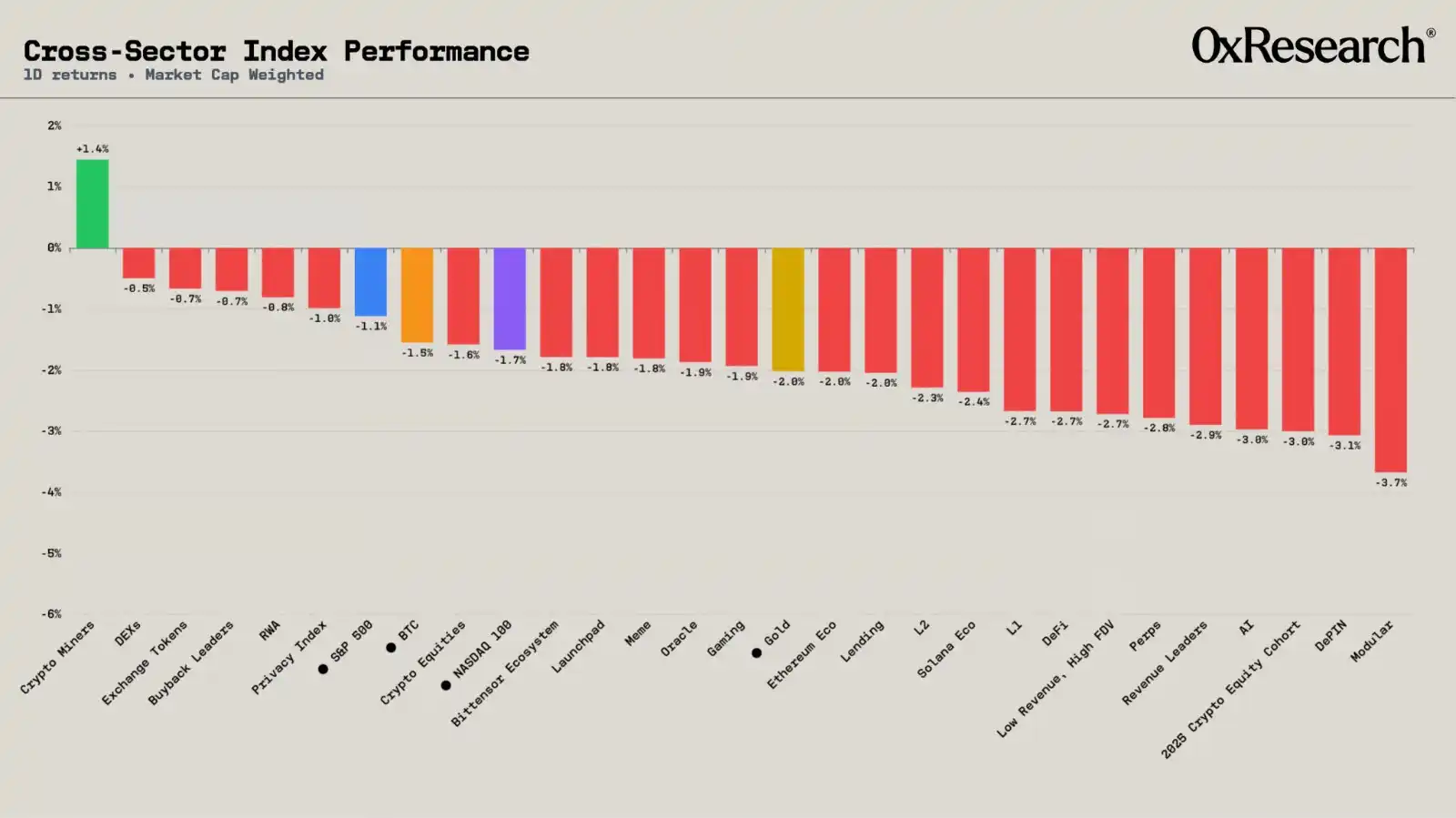
Following JTX's launch on July 14, how should we value JTO? This product is reshaping Jito's business model: it's no longer just a price-taker on Solana block space, but has begun pricing user traffic. Our base case implies 57% upside, while our probability-weighted target points to a potential gain of 267%. Meanwhile, the broader crypto market has pulled back, with only the crypto miner sector closing in the green, driven by a wave of AI data center trades.

Zooming out, one trend remains prominent: over the past week, the crypto miner sector surged 27.0%, significantly outperforming all other crypto sectors. It was followed by DEX (+4.6%), Bittensor Ecosystem (+4.3%), and Ethereum Ecosystem (+3.9%). The broader equity market was almost flat over the same period.
This rally has been fueled by a series of AI infrastructure announcements, indicating a shift in how investors value Bitcoin mining companies. On July 20, Hut 8 announced another 15-year, $9.8 billion lease for its Beacon Point campus, covering 352 megawatts. This deal doubles its contracted capacity to 704 MW, bringing the total base contract value to $19.6 billion. On the same day, IREN secured another $2.8 billion in AI cloud contracts, raising its year-end run-rate target from $3.7 billion to over $4.0 billion, with about 85% of its capacity already contracted to clients like Microsoft, NVIDIA, and Perplexity.
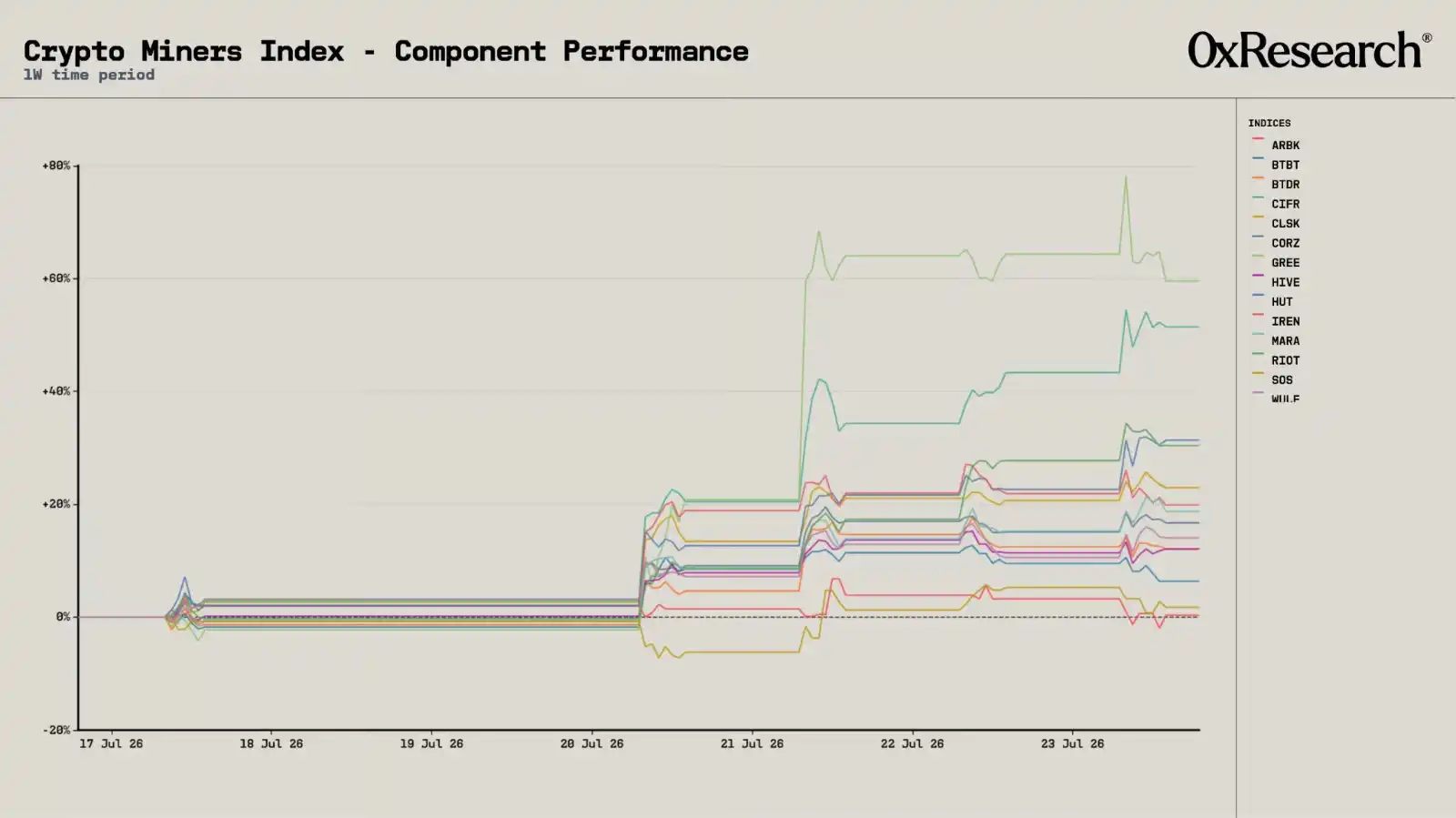
The market reacted swiftly. Over the past week, Greenidge gained 59.6%, followed by Cipher (+51.4%), Hut 8 (+31.4%), Riot (+30.4%), and CleanSpark (+22.9%). The common thread is that investors are increasingly viewing these companies as owners of scarce power and data center infrastructure, not just Bitcoin miners. As long as demand for AI compute continues to outpace supply, this narrative is likely to remain a primary catalyst for the sector, even as Bitcoin itself trades sideways.

Valuing Jito's JTX

Today, we dig deeper into valuing JTO. JTX's progress is redefining what the company is. The market still prices it as Solana backend infrastructure—a price-taker dependent on block space activity—whereas JTX (launched July 14) has effectively turned it into a price-setter for user traffic. Our buy thesis hinges on Jito's ability to truly capture this traffic, not a rebound in its traditional business.

While still early, JTX's execution data shows positive signs. Among the over 77,000 trades since launch, the median execution price deviated from the oracle mid-price by just 5.5 basis points, with 77.6% of trades within 25 bps and 29.1% even beating the oracle quote. Execution quality correlates strongly with liquidity: SOL had a median deviation of 3.9 bps, JitoSOL only 0.5 bps, while illiquid long-tail assets showed wider spreads. BAM's advantage is not yet pronounced: 4.6 bps in BAM-dominated blocks vs. 4.8 bps in others.

This structure exists because Jito deliberately sacrificed short-term revenue for long-term optimization of Solana's market structure—it shut down predatory MEV traffic and prioritized BAM, directly cutting into the high-margin Jito tip revenue that once contributed significantly.

Our model remains conservative on the legacy business: no assumption of tip revenue returning to peak levels, no assumption of JitoSOL LST recovery, and no assumption of BAM being fully monetized. The base case instead assumes JTX captures 15% of Solana DEX volume by Q2 2027, generating quarterly net revenue of $5.8 million and total revenue of $8.2 million, annualizing to about $32.7 million, with JTX accounting for roughly 72%. This implies a treasury-adjusted price-to-sales ratio of less than 15x based on Q2 2027 annualized revenue.
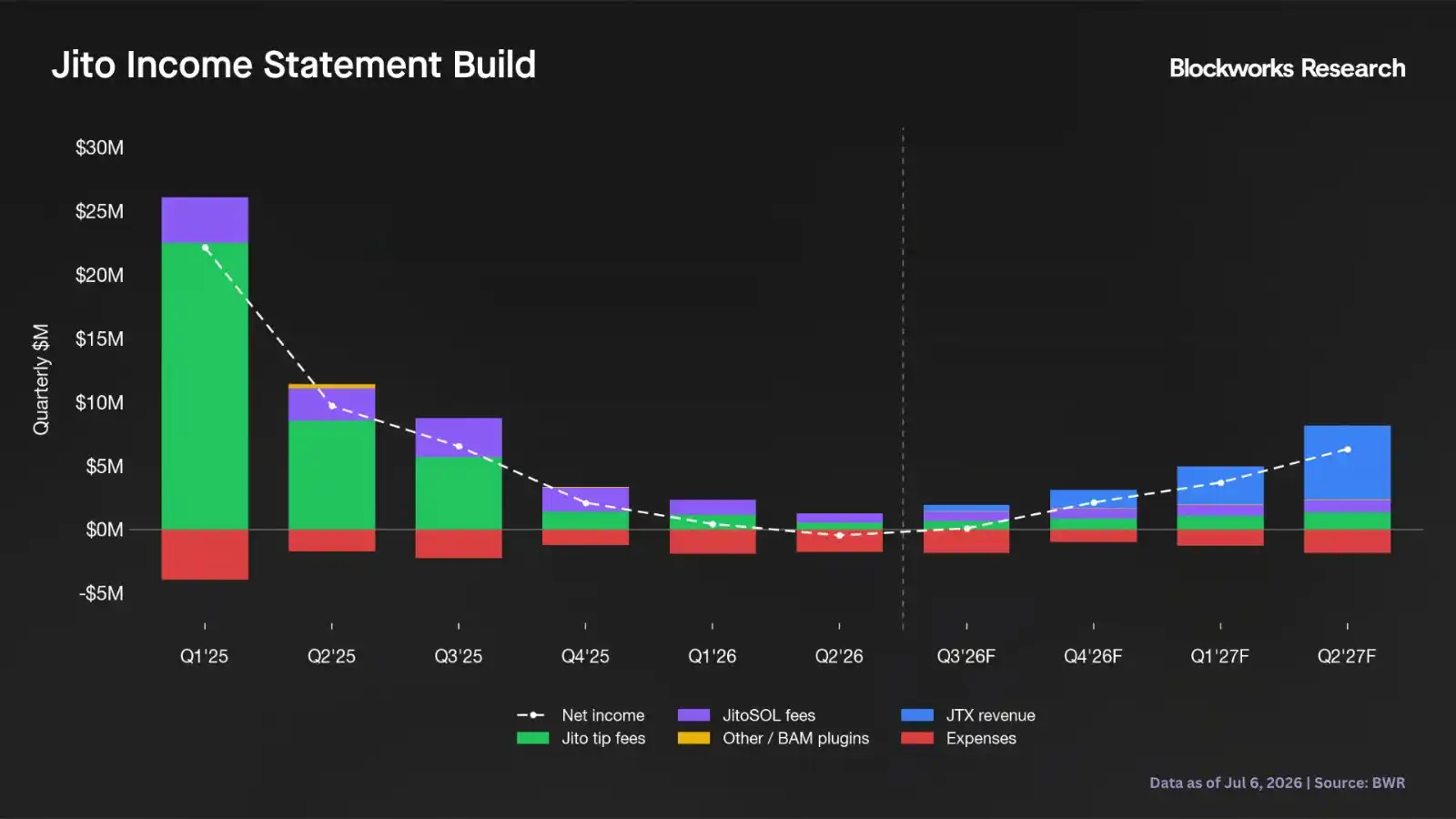
Historical context suggests this is cheap: even with declining revenue, the backend infrastructure business has traded at an average P/S of about 38x since early 2025. Applying a conservative 30x multiple to the base case annualized revenue yields a JTO price of $1.18, implying about 57% upside. A 30x multiple is not unreasonable for a growing business with a superior front-end economic model, especially compared to a shrinking business trading at 38x.
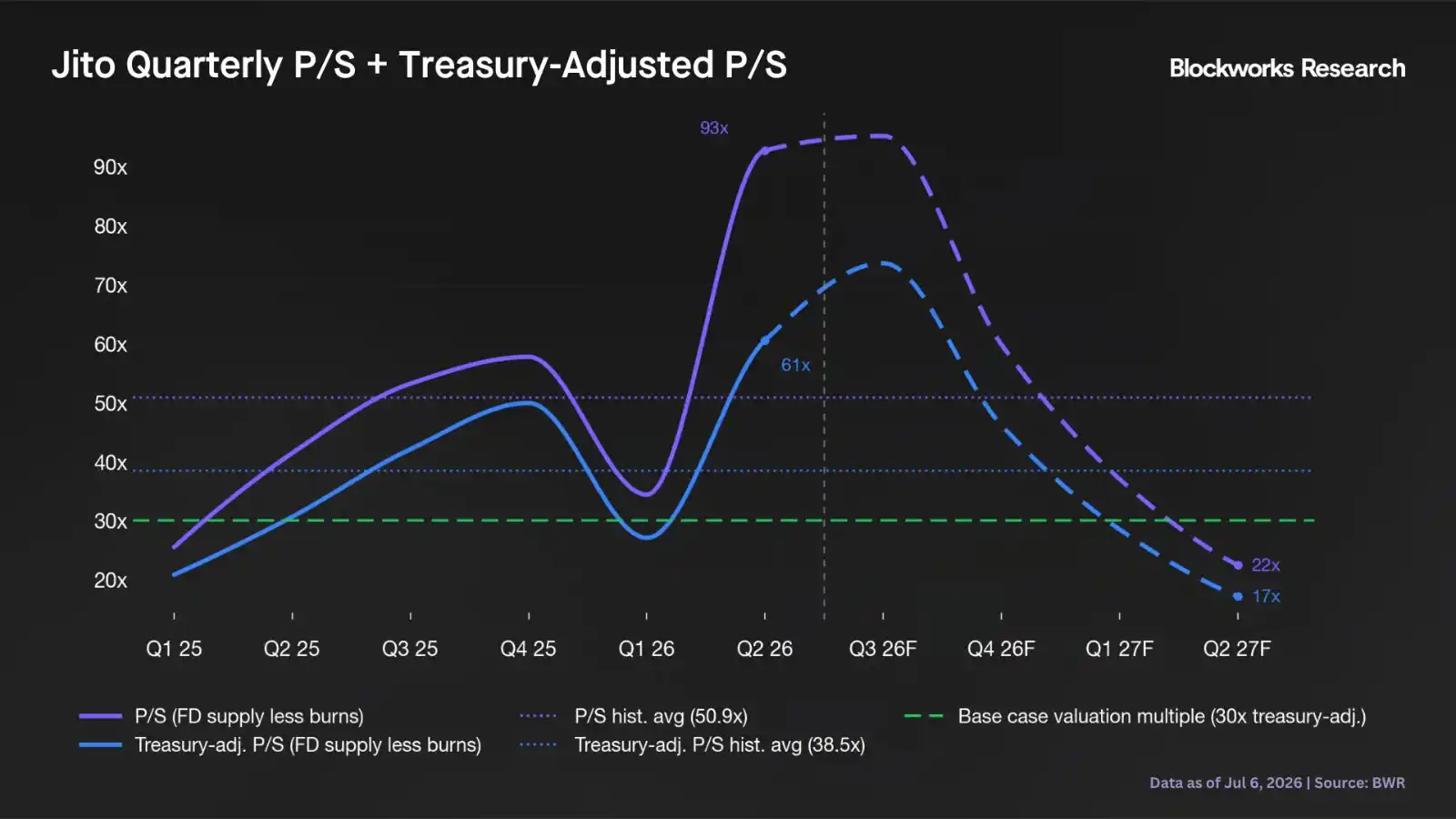
The scenario range is wide. The bull case (40% probability) assumes a 25% JTX market share and a 45x multiple, leading to a price of $5.31, a 600% gain. The bear case (10% probability) assumes market share stagnates at 5% and the P/S compresses to a commoditized 15x, leading to a price of $0.36, a 52% decline. The probability-weighted price target across the three scenarios is $2.75, implying about 267% upside from the current ~$0.75. The valuation is highly sensitive to Solana DEX volume, and our weighting leans optimistic because we believe tokenized stocks and real-world assets will scale on-chain, simultaneously boosting trading volume and JTX's market share.

JTX also makes JTO's value capture clearer: an estimated 80% of its revenue is earmarked for buybacks. The base case implies ~$8.6 million in buybacks over the next 12 months, retiring ~1.5% of the treasury-adjusted supply (bull case: ~5.7%). While the flywheel remains small today, it will scale directly with JTX's success.


Preguntas relacionadas

QWhat is JTX, and how is it changing Jito's business model?

AJTX is a new product launched by Jito on July 14. It is shifting Jito's business model from being a price taker dependent on Solana block space activity to becoming a price setter for user traffic. It allows Jito to capture and monetize this traffic directly.

QWhat is the market's recent trend regarding the crypto miner sector?

AOver the past week, the crypto miner sector has surged 27.0%, significantly outperforming all other crypto sectors. This rally is largely driven by announcements related to AI infrastructure, leading investors to value these companies more as owners of scarce electricity and data center infrastructure rather than just Bitcoin miners.

QAccording to the analysis, what is the potential upside for JTO based on the base case scenario?

AAccording to the base case scenario analysis, applying a conservative 30x P/S multiple to Jito's projected annualized revenue gives a target price of $1.18 for JTO, implying an approximate 57% upside from the current price.

QWhat is the probability-weighted target price for JTO and the implied potential upside?

AThe probability-weighted target price for JTO is $2.75, which implies a potential upside of approximately 267% from the current price of around $0.75. This target is derived from a weighted average of optimistic, base, and pessimistic scenarios.

QHow does JTX plan to create value for JTO token holders?

AJTX is expected to direct approximately 80% of its revenue towards buybacks of the JTO token. In the base case scenario, this would amount to about $8.6 million in buybacks over the next 12 months, potentially retiring around 1.5% of the treasury-adjusted token supply.

Lecturas Relacionadas

AI is Killing 'Poor People's Entertainment'

AI Is Eliminating 'Entertainment for the Poor' This article discusses the rising cost of video gaming, arguing that AI is making digital entertainment increasingly expensive. It follows the example of a frugal gamer who, accustomed to waiting for discounts and buying second-hand games, now faces a new reality. Video game consoles like the PS5 Pro and Switch 2 are increasing in price post-launch, breaking the traditional pattern of降价 over time. Game prices are also rising, with major titles like GTA 6 launching at $80. Furthermore, the industry is moving towards eliminating physical media, exemplified by Sony's plan to stop PS disc production by 2028. This shift blocks the二手 market, a key cost-saving avenue for players. Even Valve's anticipated affordable Steam Machine launched with a high price and disappointing specs. Manufacturers cite inflation, supply chain issues, and rising development costs, but a core driver is the AI boom. AI data centers now consume semiconductor and memory resources once prioritized for consumer electronics like game consoles. This competition from a more profitable sector drives up hardware costs. Additionally, developing modern AAA games with massive teams over many years is astronomically expensive, pushing publishers towards digital-only distribution and subscription models to secure recurring revenue. The article suggests this trend extends beyond gaming. Video streaming, music platforms, cloud storage, and AI tools are increasingly locked behind complex subscription tiers. While AI promises future benefits, it is currently making digital entertainment and services more costly. The era of progressively cheaper, accessible online entertainment is ending, forcing consumers to pay more upfront for future technological promises.

marsbitHace 45 min(s)

AI is Killing 'Poor People's Entertainment'

marsbitHace 45 min(s)

The Demise of the Trillion-HKD ETF Myth: SK Hynix Plummets, Hong Kong Switches from 'Double Leverage' to 'Flexible Leverage', South Korea Restricts Leveraged ETF Investments

South Korea's AI-driven bull market has taken a sharp downturn, severely impacting SK Hynix's stock and prompting regulatory tightening in both Hong Kong and South Korea on single-stock leveraged products. The CSOP SK Hynix Daily Leveraged (2x) ETF, once the world's largest single-stock leveraged ETF with over HKD 130 billion in assets, saw its value plummet by over 80% as SK Hynix shares fell nearly 46% from their June peak, erasing more than HKD 100 billion. In response, Hong Kong's Securities and Futures Commission (SFC) revised its regulatory framework. Starting August 3rd, fixed 2x leverage for single-stock leveraged and inverse products will shift to a dynamic "flexible leverage" mechanism, where daily leverage can vary up to a maximum of 2x. This aims to balance market development with investor protection but has sparked debate about changes to the products' core features and potential reduced appeal for risk-seeking investors. Simultaneously, South Korean authorities announced plans to further restrict single-stock leveraged ETFs following two consecutive days of market circuit breakers. Proposed measures include capping individual investors' allocations to such products at 20% of their total financial investment assets, increasing trading costs, and enhancing suitability requirements. The Finance Minister publicly apologized, acknowledging insufficient initial risk assessment. Analysts note that while the long-term fundamentals for South Korean semiconductor firms like SK Hynix remain solid, short-term market volatility is heightened due to concentrated leveraged bets and shifting global risk sentiment. The regulatory moves in both markets signal a clear shift from encouraging innovation towards prioritizing risk control, reminding investors of the amplified risks inherent in leveraged products.

marsbitHace 51 min(s)

The Demise of the Trillion-HKD ETF Myth: SK Hynix Plummets, Hong Kong Switches from 'Double Leverage' to 'Flexible Leverage', South Korea Restricts Leveraged ETF Investments

marsbitHace 51 min(s)

After the Privatization of the Internet, Silicon Valley Begins Privatizing Human Civilization

"The Privatization of Human Civilization" The article critiques how AI companies like Anthropic are systematically acquiring and digitizing millions of books—sometimes by destroying physical copies—to build proprietary training datasets for models like Claude. While a lawsuit resulted in a settlement, the author argues the deeper issue transcends copyright: it is about the privatization and centralized control of human knowledge and civilization. This process coincides with a powerful Silicon Valley ideology, exemplified by Marc Andreessen's "Techno-Optimist Manifesto" and movements like e/acc (Effective Accelerationism). This worldview frames technological growth and speed as inherently moral, portraying caution, regulation, and public dissent as obstacles to progress. It often envisions intelligence itself, rather than human well-being, as the ultimate goal, potentially sidelining present human concerns. Figures like Peter Thiel and Curtis Yarvin express skepticism towards democratic processes as too slow, suggesting more centralized, founder-led governance is efficient. This logic extends to AI, where a small team within a company defines the model's "constitution"—its rules, values, and definitions of truth and safety—effectively governing how millions understand the world. Thus, the scanned books symbolize a new form of control. Knowledge isn't erased but is ingested into private, opaque systems. The original, decentralized, and contestable nature of books and public knowledge is replaced by a curated, company-controlled output. The public's access to their own cultural heritage becomes mediated by corporate AI, which remembers civilization only in the form its creators dictate. This is not book-burning but a subtler, potentially more complete privatization of human memory and understanding.

marsbitHace 1 hora(s)

After the Privatization of the Internet, Silicon Valley Begins Privatizing Human Civilization

marsbitHace 1 hora(s)

Trading

Spot
活动图片