UBS: The Crowdedness of A-Share Tech Stocks Is Far From Reaching Historical Peaks

marsbitPublicado a 2026-06-05Actualizado a 2026-06-05

Resumen

UBS: A-share tech stocks still far from peak crowding levels A-shares' technology sector has seen a strong rebound, with trading activity hitting record highs, raising concerns about market crowding. However, UBS Securities argues that a key indicator of institutional positioning suggests the current crowding level remains well below historical peaks. While the large-cap tech sector's share of total A-share trading volume and market capitalization have reached historical highs, the overweight ratio of domestic mutual funds in this sector stood at 9.9% in Q1 2026. This is down from 11.6% in Q3 2025 and significantly lower than the historical peak of 14.1% in Q4 2015. It also pales in comparison to the historical peak overweight of 18.7% for the consumer sector. UBS notes that typical cycles from a low to a peak in fund overweighting last about three years, and the current outperformance of the tech/growth style has lasted less than two years since the policy pivot in September 2024. UBS expects A-share earnings recovery to accelerate, providing fundamental support. It forecasts 2026 A-share profit growth to rise to 11% from 3.9% in 2025. Non-financial A-share profits grew 11.8% YoY in Q1 2026, with gross and net profit margins at their highest since 2023. Persistent fund inflows, the expansion of thematic ETFs, and a recovery in private fund issuance are supporting market liquidity. In tactical allocation, UBS favors growth and cyclical styles under its "slow bull" base ca...

Author: Xu Chao

Source: Wall Street News

A-share tech stocks have staged a strong rebound, with trading activity repeatedly hitting new highs, raising market concerns about crowding. However, the latest research report from UBS Securities offers a more reassuring judgment: although the trading volume and market cap proportion of the large tech sector have both surpassed historical highs, key indicators measuring the concentration of institutional holdings show that the current crowdedness is still significantly below historical peaks, and the duration of this tech growth style has not yet reached two years.

According to the latest UBS Securities report, as of the first quarter of 2026, the overweight ratio of public funds in the large tech sector (including electronics, communications, computers, and defense) was 9.9%, lower than the 11.6% in the third quarter of 2025 and significantly lower than the historical peak of 14.1% in the fourth quarter of 2015; it also lags far behind the historical maximum overweight ratio of 18.7% for the consumer sector.
UBS points out that it typically takes about three years for the public fund overweight ratio to cycle from a trough to a peak. Since the policy pivot in September 2024, the outperformance of this tech growth style has lasted less than two years so far.

Meanwhile, the A-share earnings recovery is accelerating, providing more solid fundamental support for the market rally.

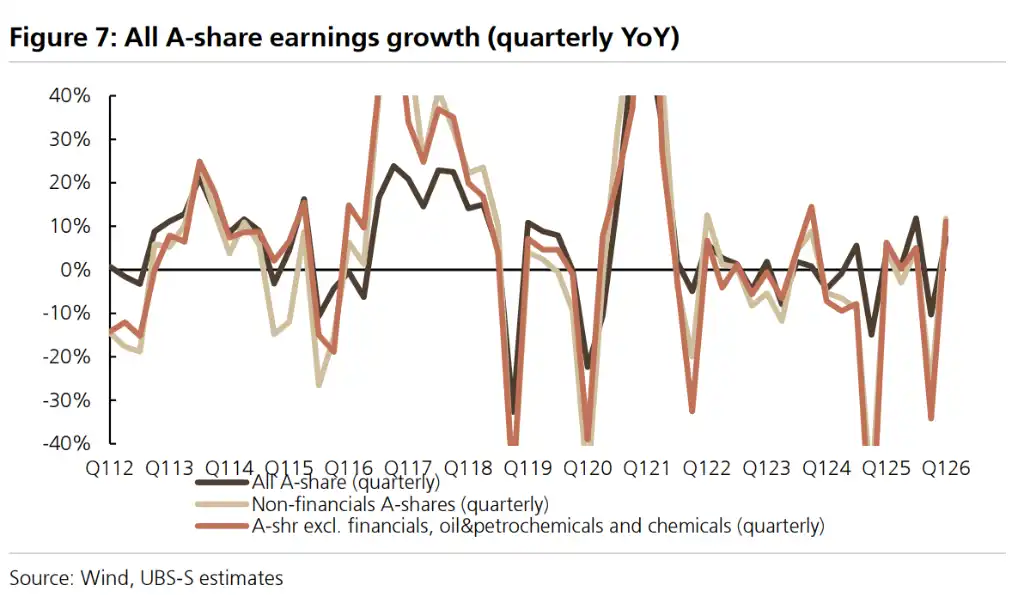
UBS expects the profit growth rate for all A-shares to rise from 3.9% in 2025 to 11% in 2026. In the first quarter of 2026, non-financial sector profits increased by 11.8% year-on-year, with both gross margin and net profit margin hitting their highest levels since 2023. Continued inflows from multiple funding channels, sustained expansion of industry-theme ETF sizes, and the recovery of private fund issuance collectively form important support for the current market micro-liquidity.

In tactical allocation, UBS leans towards growth and cyclical styles under its baseline "slow bull" scenario. At the sector level, it strongly favors electronics, communications, electrical equipment, machinery, non-ferrous metals, and chemicals, and maintains buy ratings on multiple related stocks.

Tech Overweight Ratio Still Has Room, Current Style Duration Still Short

The trading heat and capital concentration in the tech sector have warmed up significantly recently.

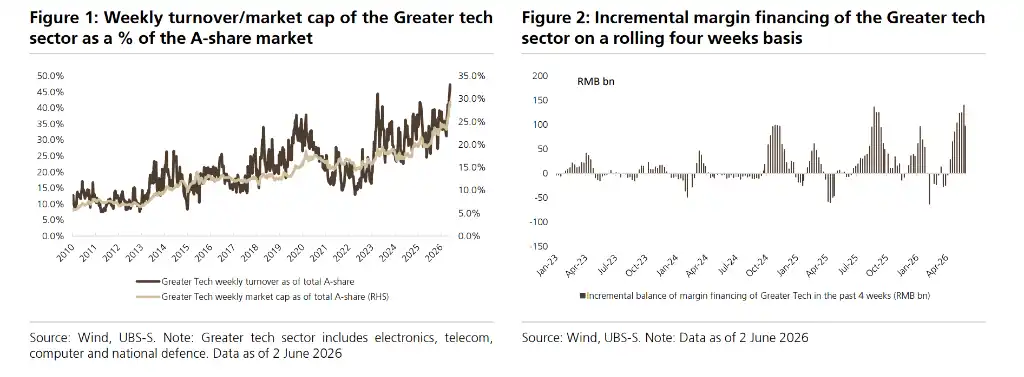
According to UBS data, as of June 2, 2026, the weekly trading volume of the large tech sector accounted for 45.5% of total A-share trading volume, and its market cap accounted for 28.6% of the total market. Both metrics are at historical highs. Since the Iran-US ceasefire on April 8, which repaired risk appetite, the STAR 50 and ChiNext indices have surged 35.5% and 30.4% cumulatively, significantly outperforming the 11.0% gain of the Wind All-A Index and the 9.8% gain of the CSI 300 Index over the same period.

However, UBS believes that using trading heat and short-term gains to judge crowdedness has limitations, and the public fund overweight ratio is a more core indicator for measuring institutional positioning concentration. From this perspective, the current overweight ratio of the large tech sector is not only lower than its own historical peak but also far behind levels seen at historical peaks for the consumer sector, such as 22.8% in the third quarter of 2010 and 21.0% in the third quarter of 2012.

UBS reviewed the historical patterns of five major style rotations in A-shares since 2014:

  • From 2014 to 2015, leveraged funds drove sharp market fluctuations.
  • From 2017 to 2019, foreign inflows fueled the "blue-chip stock" rally.
  • From 2019 to 2021, public funds chased profit-compounding companies, forming a positive feedback loop.
  • From 2022 to before the policy pivot in 2024, insurance capital and the "national team" drove defensive sectors to outperform.
  • After the policy pivot in 2024, margin financing, ETFs, and private funds have propelled the outperformance of small-cap and growth styles.

The study found that each style typically lasts about three years from formation to rotation — the high fundamental growth of a single sector rarely lasts more than three years, and there is a natural ceiling to fund concentration. Pressure from redemptions after narrowing outperformance transmits to stock prices and triggers a trend reversal.

However, signals from some sub-sectors are already worth noting. The overweight ratio for the electronics sector has reached 6.6%, exceeding the previous high of 5.4% in the third quarter of 2020. The overweight ratio for the communications sector has refreshed its record high since 2010 for three consecutive quarters, reaching 4.0%. UBS stated it will continue to monitor changes in related indicators.

Earnings Recovery Accelerates, Solidifying Market Rally Foundation

UBS expects the profit growth rate for all A-shares to rise to 11% in 2026 and points out that multiple top-down and bottom-up indicators confirm the acceleration of the earnings improvement trend.

Based on Q1 2026 earnings data, the year-on-year profit growth rate for non-financial A-shares surged from 0.8% in 2025 to 11.8%; excluding oil, petrochemicals, and basic chemicals, the growth rate reached 12.3%. The profit growth rate for the STAR Market in Q1 was as high as 204.7%, and the ChiNext Market reached 22.7%, both significantly outperforming the main board's 5.5%. Gross margin and net profit margin increased by 0.6 and 0.3 percentage points year-on-year, respectively, both hitting their highest levels since 2023, indicating that margin pressure for downstream companies remains manageable despite high oil prices.
On the macro level, April PPI rose 2.8% year-on-year, and CPI rose 1.2%. UBS expects inflation to rise further in the coming months. Since non-financial A-share revenue growth is highly correlated with nominal GDP and PPI trends, rising inflation will directly drive faster expansion on the revenue side.

Bottom-up data also confirms the upward profit trend.

In the first four months of this year, profits for industrial enterprises above designated size grew 18.2% year-on-year, with profits in computer, communication, and electronic equipment manufacturing soaring 107.7% year-on-year; profits in non-ferrous metal mining, mining, and coal washing sectors grew 94.9%, 26.0%, and 21.0% year-on-year, respectively. Regarding profit expectations, earnings growth expectations for the IT, raw materials, real estate, and energy sectors over the past six months have all been revised upward by more than 20 percentage points. The trajectory of these upward revisions is highly similar to past earnings upcycle years like 2017, 2019, and 2021.

From a medium-term perspective, an increasing share of overseas business is another important support for margin expansion. The proportion of overseas revenue for non-financial A-shares has steadily increased from 9.5% in 2010 to 18.7% in 2025. Furthermore, the gross margin of overseas business has consistently been higher than that of domestic business, with the gap widening further in 2025. UBS believes that the continued advancement of "anti-involution" policies and the implementation of supportive policies will also drive further sector margin recovery over the medium term.

Tactical Allocation: Emphasis on Growth and Cyclicals, Six Sectors Overweighted

At the style allocation level, under its baseline "slow bull" scenario, UBS favors growth styles. The backdrop of rising PPI and industrial profits supports cyclical styles. Sustained ample liquidity and high market turnover favor small-cap styles.

However, the continued expansion of industry-theme ETF sizes is providing additional capital support to leading companies. UBS expects the relative performance of large-cap versus small-cap styles to be more balanced in the second half of the year compared to 2025.

At the sector level, UBS is overweight six areas: Electronics (benefiting from semiconductor inventory cycle recovery and AI innovation), Communications (driven by AI computing demand and widespread adoption of industrial internet, fueling profit growth for sub-sector leaders), Machinery (automation equipment and industrial robotics benefiting from domestic capital expenditure recovery and import substitution), Non-ferrous Metals (rising copper and aluminum prices, lithium sector demand recovery), Chemicals (advancement of anti-involution and accelerated exit of overseas capacity accelerating bottom formation), and Electrical Equipment (policy support and AI data center power demand driving energy storage development).


Preguntas relacionadas

QAccording to UBS, is the crowding in A-share technology stocks at a historically high level currently?

ANo. While trading volume and market cap share of the large tech sector are at historical highs, the core indicator measuring institutional position concentration, the public fund overweight ratio, is still far below historical peaks. The current overweight ratio for the large tech sector is 9.9%, significantly lower than its historical peak of 14.1% in Q4 2015 and much lower than the consumer sector's historical peak overweight of 18.7%.

QWhat is the expected profit growth rate for all A-shares in 2026 according to UBS's report?

AUBS expects the profit growth rate for all A-shares to increase to 11% in 2026, up from 3.9% in 2025.

QWhat are the two tech sub-sectors where the overweight ratios have already reached concerning levels as per UBS's analysis?

AThe two sub-sectors are Electronics and Communications. The Electronics sector's overweight ratio has reached 6.6%, surpassing its previous high of 5.4% in Q3 2020. The Communications sector's overweight ratio has hit 4.0%, a new high for three consecutive quarters since 2010.

QWhat are the six sectors that UBS recommends overweighting in its tactical asset allocation under the 'slow bull' baseline scenario?

AThe six sectors are: Electronics, Communications, Electrical Equipment, Machinery, Non-ferrous Metals, and Chemicals.

QBased on historical patterns studied by UBS, how long does a typical market style cycle from formation to rotation usually last in the A-share market?

AUBS's research on style shifts since 2014 indicates that a typical market style cycle, from formation to rotation, usually lasts about three years.

Lecturas Relacionadas

Anthropic Cries Wolf: Is the AGI Threat Real, or Just an IPO Story?

Anthropic has published an article titled "When AI builds itself," discussing the emerging concept of "recursive self-improvement," where AI begins to actively participate in designing, training, testing, and optimizing its own subsequent versions. The company presents internal data showing that by May 2026, over 80% of code merged into its codebase was written by Claude, its AI model. Claude's capabilities have expanded to handling complex, open-ended engineering tasks, achieving a 76% success rate in such areas, and even contributing to research processes, such as optimizing code performance and conducting AI safety experiments. Anthropic outlines an evolution from human-driven development to AI-assisted workflows, culminating in the current stage where AI agents can autonomously write, run, and delegate code. The company cautions that the path toward a "closed loop," where AI continuously improves itself, is becoming visible. It calls for coordinated global mechanisms to potentially slow or pause frontier AI development to allow safety research and societal structures to catch up. However, the timing of this warning coincides with Anthropic's preparations for an IPO, framing the narrative not just as a safety concern but also as a demonstration of Claude's advanced capabilities and its integral role in accelerating Anthropic's own R&D—creating a potential "flywheel" effect for competitive advantage. This contrasts with OpenAI's recent, more policy-oriented discussion of the same risks, highlighting the competitive dynamics in the AI industry as companies position themselves in both the technological and regulatory landscape.

marsbitHace 10 min(s)

Anthropic Cries Wolf: Is the AGI Threat Real, or Just an IPO Story?

marsbitHace 10 min(s)

BIT Research: ETF Purchases Have Slowed, Strategy (MicroStrategy) Has Slowed, What Else Can Drive Bitcoin's Rise?

Market Refocus on Inflation and Rate Expectations Weighs on Bitcoin Currently, the market is in a phase of macro-repricing dominated by inflation and interest rate expectations. Bitcoin, which previously benefited from easy liquidity and low inflation, is seeing its core bullish drivers weaken. These drivers were market expectations for interest rate cuts and strong inflows from Bitcoin ETFs and institutions like MicroStrategy (referred to as "Strategy" in the text). The logic has shifted. Recent high inflation data (e.g., CPI hitting 3.8% in a May 2026 report) has caused the market to sharply reduce its rate cut expectations for 2025 and even price in potential hikes. This is a key constraint for Bitcoin, as it lacks cash flows and is highly sensitive to rate expectations. Concurrently, institutional capital flows have slowed significantly. Following the hot CPI data, Bitcoin ETFs saw accelerated outflows, with around $4.3 billion leaving over a period. MicroStrategy's ability to keep adding substantial Bitcoin to its balance sheet is also diminishing. Together, ETF and MicroStrategy holdings total roughly $110 billion, but their momentum as growth engines is cooling. In summary, Bitcoin's current pressure stems not from its own fundamentals but from a changing macro environment. As long as inflation stays elevated, Bitcoin is likely to remain in a consolidating phase. However, historically, inflation eventually peaks. Once it recedes and rate cut expectations rebuild, institutional capital could return, potentially fueling a new and more robust recovery phase for Bitcoin.

marsbitHace 17 min(s)

BIT Research: ETF Purchases Have Slowed, Strategy (MicroStrategy) Has Slowed, What Else Can Drive Bitcoin's Rise?

marsbitHace 17 min(s)

Earning 1000 Trillion in Half a Year, 'Pocketing' 20 Million per Capita: This Round of Wealth Creation in the Korean Stock Market is Unprecedented in Scale

The South Korean stock market is experiencing an unprecedented wealth surge in 2026, with household equity and fund asset values soaring by over 1,000 trillion KRW (~$730bn) year-to-date. This translates to an average per capita wealth increase of roughly 20 million KRW, fueled by a historic 109% rally in the KOSPI index. The boom is driven by three converging forces: an AI-driven semiconductor supercycle boosting giants like Samsung and SK Hynix; the government's "Value-Up" market reforms addressing long-standing corporate governance issues; and aggressive real estate regulations that have locked capital within financial markets, preventing profits from flowing back into property. This has triggered a wealth effect, boosting high-end consumption significantly. However, the gains are highly concentrated. The two semiconductor behemoths account for over half the index's value, but retail investors own relatively low stakes in them, systematically missing the biggest rallies. Wealth and consumption benefits are skewed towards luxury goods and imported cars, bypassing mainstream retail. Further risks stem from excessive leverage, with high trading volume in leveraged ETFs, and a market sentiment heavily reliant on the AI sector's fortunes and speculative rumors. While this cycle marks a potential shift from real estate to equities as a primary wealth generator for Koreans, its sustainability, amid structural imbalances and leverage, remains a critical test.

marsbitHace 23 min(s)

Earning 1000 Trillion in Half a Year, 'Pocketing' 20 Million per Capita: This Round of Wealth Creation in the Korean Stock Market is Unprecedented in Scale

marsbitHace 23 min(s)

Behind ZEC's Over 30% Plunge: An 'Unlimited Minting' Vulnerability with No Way to Prove if It Was Ever Exploited

A critical vulnerability was discovered in Zcash's Orchard privacy pool, allowing for the theoretical creation of undetectable counterfeit ZEC. Researcher Taylor Hornby found the flaw on May 29th, 2024, within the Orchard circuit's cryptographic constraints, which could let an attacker bypass asset conservation rules. Although a rapid emergency fix was deployed within days via a coordinated soft and hard fork, a core uncertainty remains: due to Orchard's privacy features, it is impossible to cryptographically prove whether this "unlimited mint" flaw was exploited in the nearly four years since the pool's 2022 launch. This uncertainty, rather than the patched flaw itself, triggered a market panic, causing ZEC's price to drop over 30%. While the Zcash Foundation stated no evidence of exploitation was found, independent entity Shielded Labs emphasized the impossibility of definitively proving no counterfeit ZEC was ever created. The incident highlights the unique trust challenge in privacy systems. To address this, developers are proposing a new network upgrade with enhanced auditing to allow verifiable proof of supply integrity. Notably, the researcher utilized the newly released AI model Claude Opus 4.8 as a tool during the security review, signaling the growing role of advanced AI in uncovering complex cryptographic vulnerabilities.

marsbitHace 25 min(s)

Behind ZEC's Over 30% Plunge: An 'Unlimited Minting' Vulnerability with No Way to Prove if It Was Ever Exploited

marsbitHace 25 min(s)

Trading

Spot
Futuros
活动图片