Coinbase Targets Crypto Crime, Freezing $3M Linked To Scam Operations

bitcoinistPublicado a 2026-06-05Actualizado a 2026-06-05

Resumen

Coinbase froze over $3 million in cryptocurrency linked to Southeast Asian scam networks as part of a multi-agency "Disruption Week" campaign. The operation, coordinated by the DOJ's Scam Center Strike Force, involved companies like Meta, Microsoft, and Starlink, and disrupted over 1.4 million scam accounts. The DOJ noted that investment fraud, including "pig butchering" scams, is among the fastest-growing threats, with crypto-related scams causing billions in losses. This action follows other recent crackdowns targeting scam infrastructure globally. Coinbase highlighted that blockchain provides a permanent transaction record, aiding investigations and countering the narrative that crypto is solely a tool for crime.

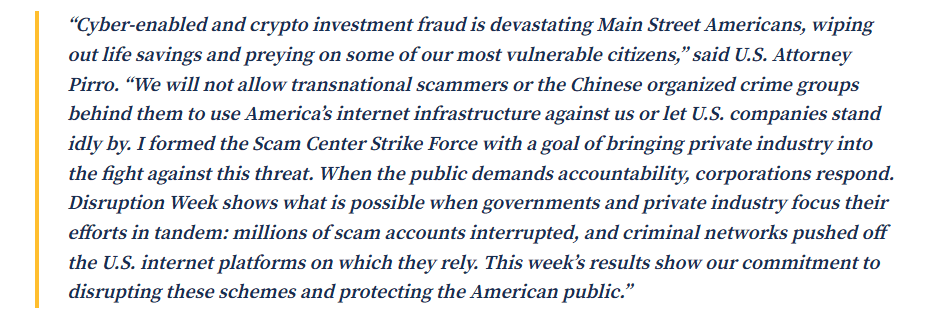
Coinbase moved to freeze more than $3 million in crypto linked to scam networks operating across Southeast Asia, a move that came as US authorities and private firms widened a joint campaign against fraud rings that have drained billions from Americans. The freeze was announced during Disruption Week, a coordinated push led by the DOJ’s Scam Center Strike Force.

Multi-Agency Push

According to Coinbase, the effort pulled in government agencies and private companies to hit the fraud chain at several points at once, from online accounts to money flows and physical sites. The exchange said no single company or agency could stop the crews on its own.

The company said the work involved social platforms, financial institutions, connectivity providers, and law enforcement working together, while the Justice Department framed the action as part of a broader strike against Southeast Asian criminal organizations. Officials said those groups have defrauded Americans of billions of dollars.
Source: US DOJ

Accounts, Servers, And Arrests

Meta, Microsoft, and Starlink were among the private firms named in the operation, helping take down servers and other hosting tools linked to the scam networks. Authorities also said more than 1.4 million social media and email accounts were disrupted, and the Royal Thai Police Anti-Cyber Scam Center made arrests tied to the effort.

The scam pattern is familiar, but the scale keeps climbing. The DOJ said investment fraud and pig butchering remain among the fastest-growing and most damaging scams aimed at Americans, and the FBI reported earlier this month that losses from crypto- and AI-related scams in 2025 topped $11 billion, with investment scams causing the most damage.

Total crypto market cap currently at $2.15 trillion. Chart: TradingView

Another part of the same push came in April, when the Scam Center Strike Force and its partners restrained more than $701 million in crypto tied to investment scams. Authorities have also carried out other crackdowns this year, including actions in Dubai and Albania, as pressure on scam infrastructure spread beyond Southeast Asia.

Crypto’s Place In The Crackdown

Coinbase also argued that blockchain gives investigators a permanent record of transactions, a point it used to push back on the idea that crypto is only a tool for crime. The coalition behind the operation included the FBI, the US Secret Service, and law enforcement partners in the UK, Australia, Canada, New Zealand, and Thailand.

The latest freeze fits a pattern of steady pressure on scam centers rather than one-off arrests. Officials have kept aiming at websites, messaging channels, servers, and the money trail itself, hoping to cut off the machinery that lets these fraud rings keep running.

Featured image from Unsplash, chart from TradingView

Preguntas relacionadas

QAccording to the article, how much cryptocurrency did Coinbase freeze that was linked to Southeast Asian scam networks?

ACoinbase moved to freeze more than $3 million in crypto linked to scam networks operating across Southeast Asia.

QWhat was the name of the coordinated law enforcement push during which this crypto freeze was announced?

AThe freeze was announced during Disruption Week, a coordinated push led by the DOJ's Scam Center Strike Force.

QWhich private companies were named as helping to take down servers linked to the scam networks?

AMeta, Microsoft, and Starlink were among the private firms named in the operation, helping take down servers and other hosting tools linked to the scam networks.

QWhat does the FBI report say about total losses from crypto- and AI-related scams in 2025?

AThe FBI reported earlier this month that losses from crypto- and AI-related scams in 2025 topped $11 billion, with investment scams causing the most damage.

QHow does Coinbase argue that blockchain technology can assist in fighting crime, according to the article?

ACoinbase argued that blockchain gives investigators a permanent record of transactions, pushing back on the idea that crypto is only a tool for crime.

Lecturas Relacionadas

Dalio Warns: AI Boom Shows Signs of a Bubble, Day of Reckoning Will Be the Time of Burst

Ray Dalio, founder of Bridgewater Associates, warns that the current artificial intelligence investment boom shows classic signs of a bubble, which he expects will eventually burst. In a Bloomberg Television interview, he noted that great technological revolutions often lead to capital inflows that create bubbles, making it difficult for investors and companies to calibrate their spending accurately—either overspending to capture market share or underspending and losing their competitive position. This caution comes amid significant rallies in AI-related assets, particularly chipmakers, driven by soaring demand for data centers and high-bandwidth chips, raising debates about overheating valuations. In contrast, Nvidia CEO Jensen Huang recently asserted that investors embracing the AI wave would see "crazy" returns and dismissed concerns over return on investment for data center spending as outdated. Dalio, however, focuses on the risks in the profit realization phase. He argues that bubbles tend to show signs of破裂 when markets transition from investment to the need for tangible returns, describing the burst as a process of converting paper wealth into cash. While acknowledging AI's intrinsic value, he expressed concern over the future profitability of some AI companies, suggesting the market is repeating a familiar pattern. The 76-year-old billionaire, who fully exited Bridgewater in 2025, has a net worth estimated at $21.5 billion according to the Bloomberg Billionaires Index.

marsbitHace 37 min(s)

Dalio Warns: AI Boom Shows Signs of a Bubble, Day of Reckoning Will Be the Time of Burst

marsbitHace 37 min(s)

Privacy Coin Crisis of Confidence! ZEC Plunges Over 56% in a Single Day

Zcash (ZEC), a leading privacy-focused cryptocurrency, experienced a severe crash on June 5th, plummeting over 56% in a single day and erasing nearly two months of gains. The flash crash was triggered by the disclosure of a critical zero-knowledge proof vulnerability within Zcash's Orchard privacy pool, which had existed since the pool's launch in May 2022. The flaw theoretically allowed an attacker to forge unlimited ZEC undetectably due to the pool's privacy features. The vulnerability was discovered on May 29th by independent security researcher Taylor Hornby during a proactive audit commissioned by Shielded Labs, utilizing AI-assisted analysis. The Zcash development team responded swiftly, implementing an emergency soft fork to disable Orchard transactions on June 2nd and executing a permanent hard fork fix (NU6.2) on June 3rd. Despite the technical fix, a major crisis of confidence emerged. The core issue is that Orchard's privacy design makes it cryptographically impossible to prove whether the vulnerability was exploited over the past four years, casting permanent doubt on the historical supply integrity of ZEC. While Shielded Labs argues exploitation was unlikely, the inability to provide definitive proof has severely damaged market trust. This sentiment was exacerbated when BitMEX co-founder Arthur Hayes, a prominent ZEC supporter, announced he was selling his entire position. He stated that privacy assets require "perfect security" rather than "probable safety." The combined effect of the disclosure and Hayes's exit ignited widespread panic selling, leading to massive liquidations and significant price decline. Analysts note the event highlights a fundamental tension within privacy coins: the conflict between verifiable supply and cryptographic privacy.

链捕手Hace 39 min(s)

Privacy Coin Crisis of Confidence! ZEC Plunges Over 56% in a Single Day

链捕手Hace 39 min(s)

Trading

Spot
Futuros
活动图片





