Over 13% APY, Apyx Is Bringing the 'Killer App for Bitcoin' On-Chain

Odaily星球日报Publicado a 2026-05-26Actualizado a 2026-05-26

Resumen

The article discusses the rise of high-yield stablecoins in DeFi, focusing on the Apyx protocol and its integration of STRC (Strategy's Bitcoin credit instrument) to generate sustainable on-chain yields. Apyx addresses a market need for stablecoins with yields exceeding typical DeFi offerings (often below 5-10%). Its core innovation is bridging STRC—a tradable, dividend-yielding equity instrument backed by Strategy's Bitcoin holdings—from traditional finance to the decentralized ecosystem. STRC offers a floating yield (over 12.3%) by converting Bitcoin's long-term appreciation potential into a "digital credit" product. Apyx employs a dual-token model: `apxUSD`, a stablecoin pegged to $1 for liquidity, and `apyUSD`, an interest-bearing token where yields accumulate (currently ~11% APY, targeting over 13%). The yield is derived from STRC dividends, providing a more sustainable income source compared to token-incentivized models. Since its February launch, Apyx has grown rapidly, with `apxUSD` becoming a top-20 DeFi stablecoin by issuance. The protocol enhances its utility and capital efficiency through deep integrations with major DeFi platforms: Morpho (for collateralized borrowing/lending), Curve (for low-slip liquidity pools), and Pendle (for trading and leveraging future yield via PT/YT tokens). Apyx is also running a multi-season points program leading to a Token Generation Event (TGE) and airdrop on October 13, 2026, incentivizing user engagement through activities li...

Original | Odaily Planet Daily(@OdailyChina)

Author | Liaoliao

The cryptocurrency market, particularly the decentralized finance (DeFi) sector, is perpetually in search of underlying assets that combine stability, high liquidity, and high yield. As the yields from traditional real-world assets (RWA, such as U.S. Treasuries) gradually stabilize, the DeFi market's craving for high-yielding, interest-bearing assets is fostering a new paradigm shift. Against this backdrop, stablecoin projects based on STRC are rising at a remarkable pace.

As the cornerstone of the crypto world, the evolution of stablecoins has progressed from early fiat-backed versions (like USDT, USDC), to crypto asset overcollateralized versions (like DAI), to algorithmic versions (like the imploded UST), and to the basis trade arbitrage versions (like USDe) that have emerged in recent years.

However, the current market pain point is that stablecoin yields below 10%, or even 5%, can no longer meet the risk premium demand of on-chain capital, while excessively high algorithmic yields often come with systemic risks like "death spirals."

STRC-driven stablecoin projects are filling this gap at an opportune time. Judging from TVL growth rates, on-chain capital flow directions, to community discussion heat, building stablecoins based on STRC has become one of the most watched niche sectors in the current DeFi market.

Especially with the support of yield protocols like Pendle and Morpho, these products have evolved beyond being mere "stablecoins" into a new asset form that combines stability, yield, and financial composability.

What is STRC?

STRC refers to a "Bitcoin Credit Facility" launched by the treasury company Strategy.

Odaily Note: For a detailed analysis of STRC, please refer to “In-depth Analysis of STRC: Strategy's New Magic Trick for Raising Money to Buy Bitcoin.”

Simply put, Strategy raises capital from the market by issuing STRC, then continuously uses the proceeds to buy Bitcoin. STRC holders receive a floating interest income exceeding 12.3%, paid monthly. Unlike traditional bonds, STRC is a preferred stock instrument, not debt, thus having no fixed maturity date. Simultaneously, its dividend rights are superior to common stock (MSTR), possessing strong "fixed-income-like" properties.

The most unique aspect of STRC is that it essentially transforms the long-term appreciation expectation of Bitcoin into a "Digital Credit" product acceptable to traditional capital markets.

To maintain STRC's value near its $100 face value, Strategy dynamically adjusts its dividend rate – increasing the yield to attract capital when STRC trades below par, and suppressing the premium by issuing more shares when it trades above.
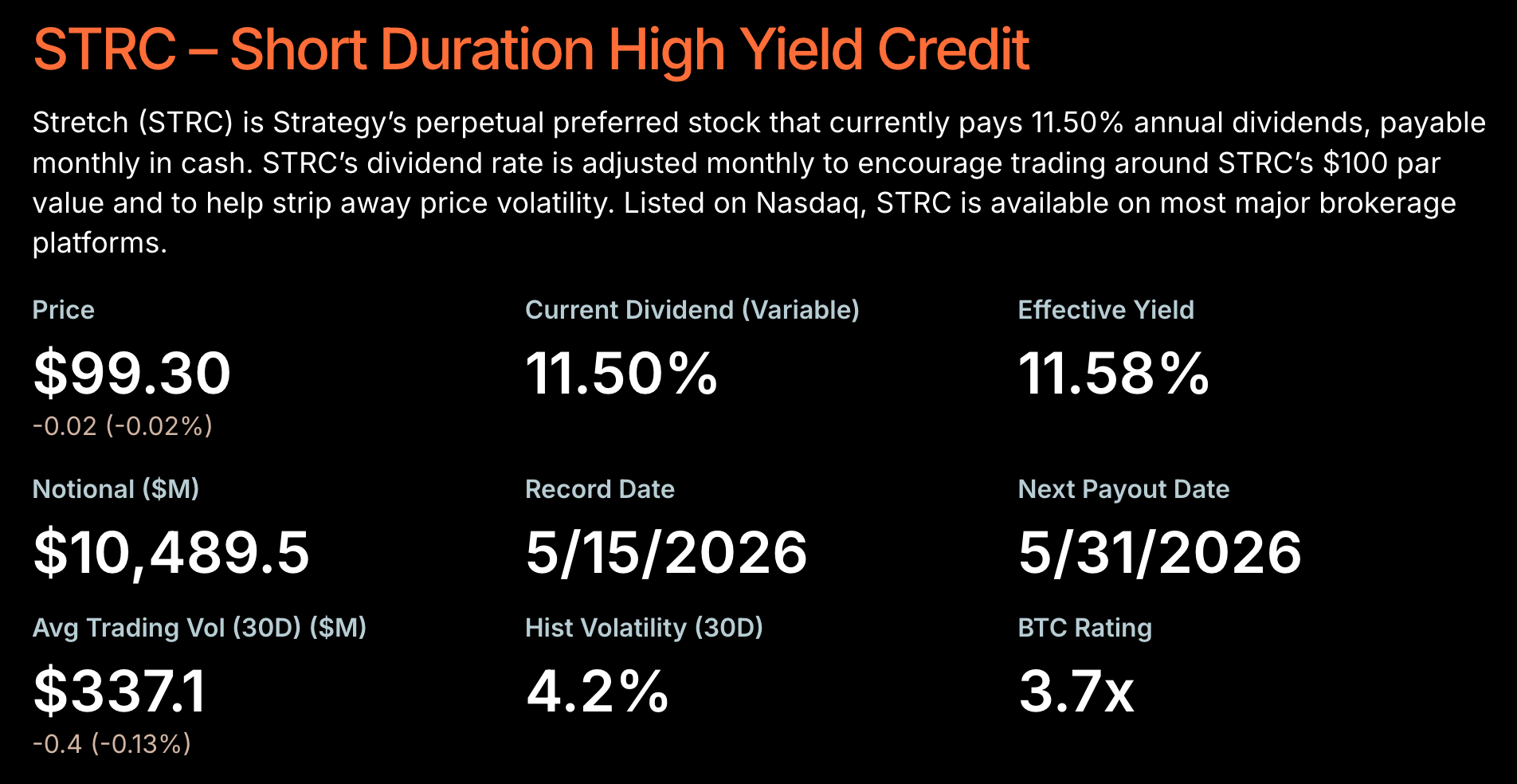
Since Strategy launched STRC, market reception has been quite positive, thanks to its relatively stable "peg" performance (successfully restored after a few brief deviations) and its considerable yield.

At the time of writing, the total issuance size of STRC has surpassed $10.4 billion, accounting for over 60% of the total preferred stock issuance in the global market for 2026.

Earlier this month, Strategy founder Michael Saylor stated in an interview with David Lin – Digital credit products like STRC are the killer application for Bitcoin (refer to Interview with Michael Saylor: I Did Say I'd Sell, But Never Net Sell).

However, traditional STRC shares typically circulate only among Wall Street hedge funds, compliant institutions, and high-net-worth accredited investors. On-chain DeFi users, due to barriers like access, compliance, and capital channels, find it difficult to directly access this high-yield product sweeping through traditional finance.

This is precisely where Apyx, the protagonist of this article, steps in.

What Apyx does is serve as a bridge between Wall Street's digital credit instruments and on-chain DeFi legos. Through innovative on-chain financial architecture, it brings STRC's excess yield opportunities on-chain, constructing the next generation of interest-bearing stablecoins with high liquidity, composability, and higher yields.

Deconstructing Apyx, Perhaps the Highest-Yielding Stablecoin in the Market

Unlike many stablecoin projects reliant on airdrop narratives and lacking real yield sources, Apyx's core competitiveness lies not just in "higher APY," but in its backing which combines traditional finance capital capabilities with on-chain protocol composability.

Regarding background, the core supporter behind Apyx is the NASDAQ-listed treasury company DeFi Development Corp. The latter not only participated in Apyx's incubation and strategic investment but also provided the critical bridge connecting traditional capital markets with the on-chain world.

In terms of product design, Apyx employs a dual-token model of apxUSD + apyUSD.

Among them, apxUSD is closer to a traditional stablecoin, pegged to $1, primarily serving as a medium of exchange and on-chain liquidity. apxUSD itself does not automatically accrue yield; it functions more like a highly liquid "base dollar asset," suitable for trading, payments, lending, etc.

The true embodiment of Apyx's core value is apyUSD – users can lock apxUSD to obtain apyUSD (a 20-day unlock period applies), the latter being similar to Lido's wstETH, with its price increasing continuously as underlying yield accumulates. In other words, apyUSD itself is the carrier of yield.
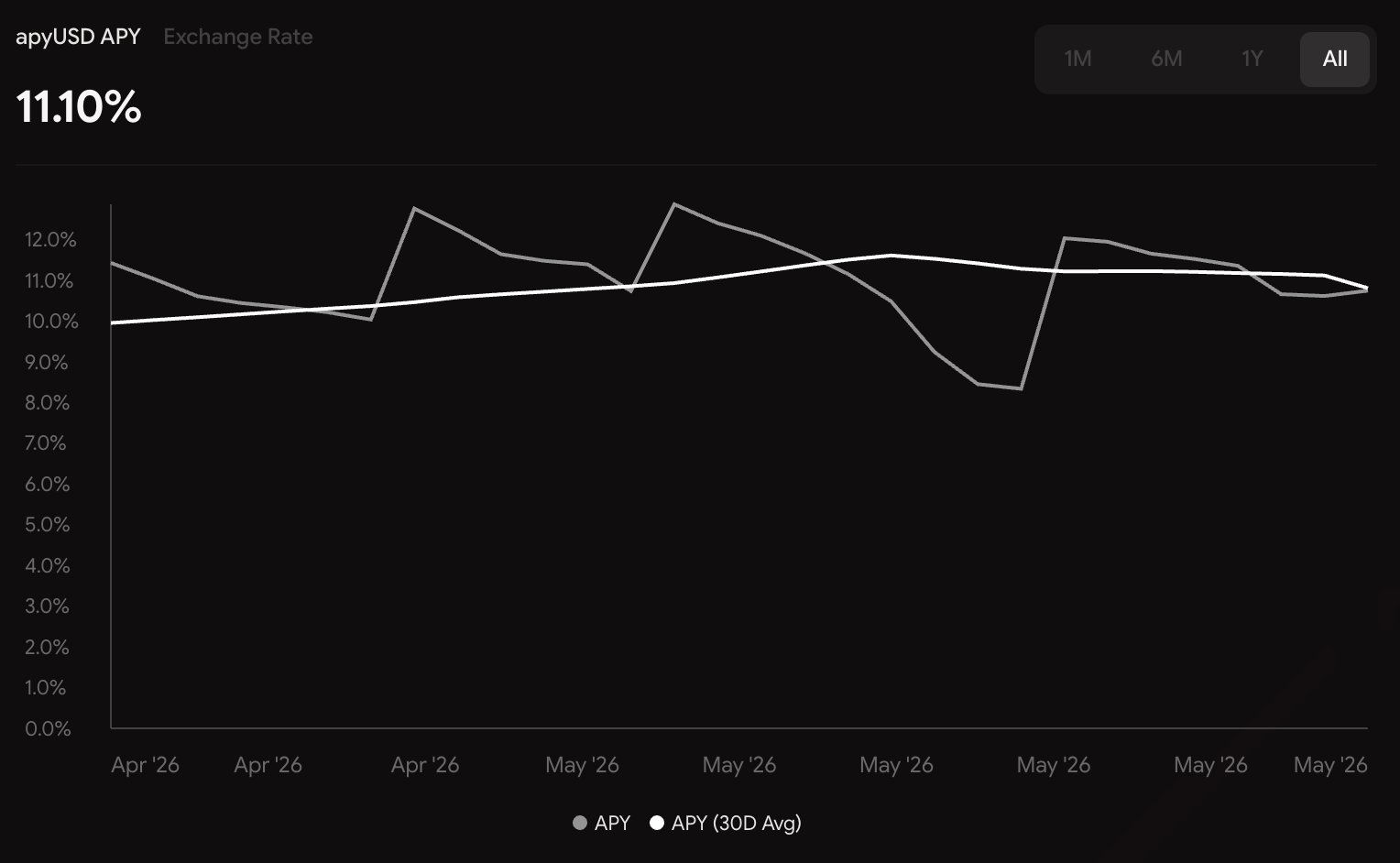
Currently, the real-time annualized yield for apyUSD is approximately 11%, with an expected annualized yield exceeding 13%. Against the backdrop of continuously declining yields for USD stablecoins overall, a stablecoin asset with a genuine yield source and double-digit yield is naturally exceptionally attractive.

Furthermore, it's crucial to emphasize that unlike many stablecoin projects relying on token subsidies to achieve short-term high yields, Apyx's core yield originates from STRC dividends, making the yield source more stable and sustainable.

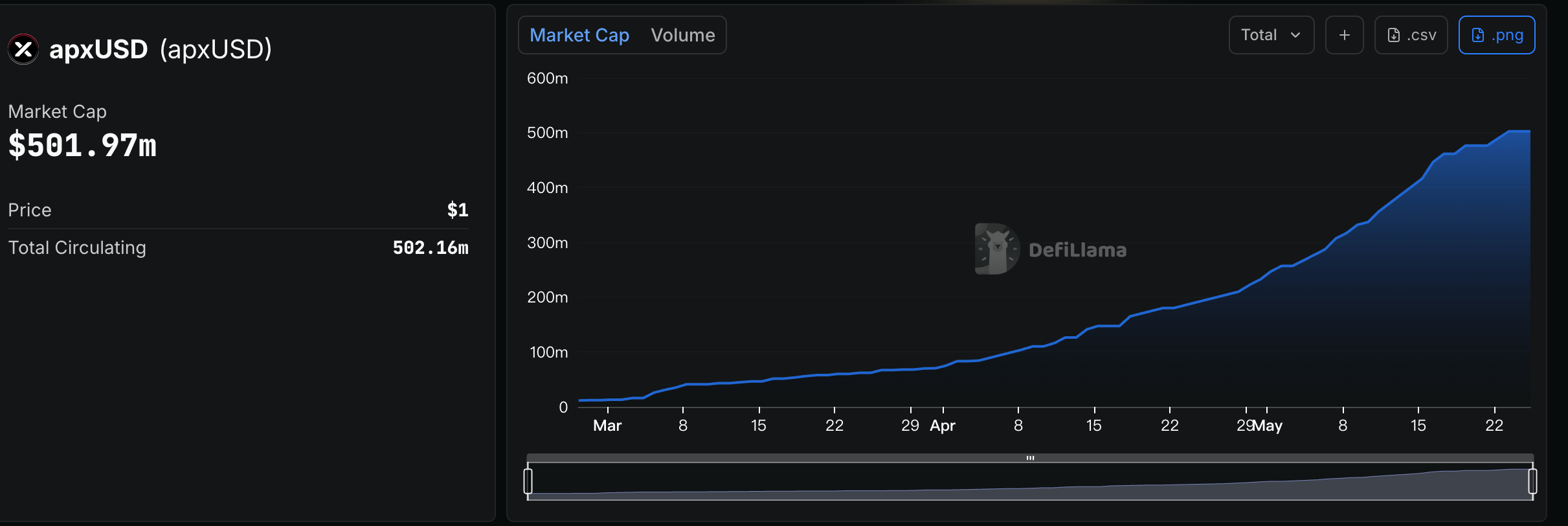
DefiLlama data shows that since its launch at the end of February this year, the issuance scale of apxUSD has rapidly reached 502 million tokens in less than three months, making it the 21st largest stablecoin protocol by issuance size in the DeFi world.
However, yield alone is insufficient to sustain a stablecoin ecosystem. What truly determines a protocol's ceiling is the asset's composability and liquidity efficiency. On this front, Apyx has clearly done extensive work – currently, Apyx is deeply integrated with several mainstream protocols including Morpho, Curve, and Pendle.

On Morpho, users can use apyUSD as collateral to borrow other assets, enabling operations like "earning yield while unlocking liquidity." For more aggressive players, even recursive lending can be employed to amplify yield exposure. Curve addresses liquidity issues. By constructing trading pools with apxUSD and mainstream stablecoins like USDC and USDT, Apyx ensures low slippage even during large-volume swaps, which is crucial for a stablecoin system.

As for Pendle, it might be the most explosive component within the entire Apyx ecosystem. Since Pendle can split yield-bearing assets into PT (Principal Token) and YT (Yield Token), apyUSD evolves beyond being just a "hold-to-earn-yield" asset into a tradable, leveragable, speculatable yield product – conservative users can lock in fixed yields via PT; more aggressive users can amplify bets on future yields by buying YT.

Precisely because of this high degree of composability, Apyx's ecosystem expansion speed is noticeably faster than many traditional stablecoin protocols.

In a sense, what Apyx is doing is not merely "issuing a high-yield stablecoin." It's more akin to attempting to establish an on-chain credit market centered around STRC.

Points Program and Point-Earning Strategies

In today's DeFi market, "points" are no longer just simple user incentive tools; they resemble a way to pre-price future token rights. Especially as the market re-enters a phase of liquidity competition, whether a project can continuously attract capital often depends on two things – whether the yield is sufficiently high, and whether the token expectation is sufficiently clear.

A significant reason for Apyx's rapid TVL accumulation in a short time is closely related to its current points system. According to the official plan, Apyx's points program follows a phased rollout model:

  • Season 1 concluded on May 22, 2026. The official has confirmed that 5% of the total token supply will be allocated to early participants in this stage;
  • Season 2 commenced immediately after Season 1 ended and will continue until October 11, releasing another 6% in token incentives;
  • After Season 2 concludes, Apyx will conduct its TGE and airdrop on October 13.

This rhythm is quite clever. On one hand, the Season deadlines naturally create "sprint windows," incentivizing capital inflows to accelerate before the end. On the other hand, the seamless transition from Season 1 to Season 2 avoids the common problem of "TVL collapse right after Season 1 ends" seen in many projects. Most importantly, Apyx has set a clear future TGE and airdrop date, providing users with more definite interaction expectations.

For the market, this means Apyx's airdrop expectation is not a short-term event but more like a liquidity war lasting several months. From the user's perspective, the more critical question is "how to earn points more efficiently."
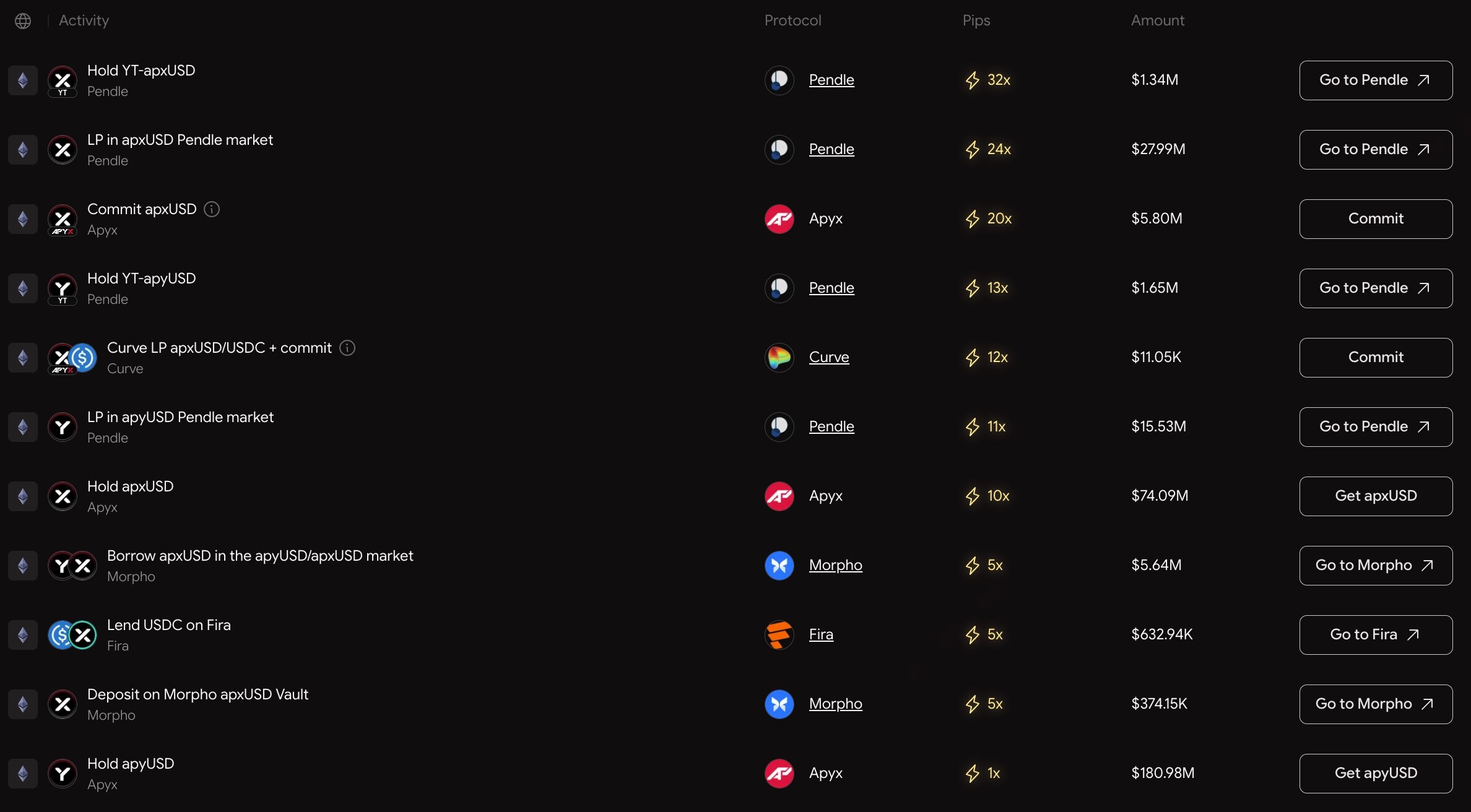
Apyx outlines point-earning efficiency for different operations on its official website, broadly categorized into "Basic Mode" and "Advanced Mode."

"Basic Mode" involves simply holding apxUSD (10x points) or apyUSD (1x point). "Advanced Mode" entails flexibly using the integrated protocols mentioned above, such as borrowing/lending apxUSD on Morpho (5x points), providing LP for apxUSD on Curve (12x points). The most efficient strategies revolve around Pendle: directly holding YT for apxUSD yields 32x points, and providing LP for apxUSD on Pendle also offers a 24x points multiplier.

Competitive Landscape of the Sector, and Apyx's Advantages

As an emerging sector still in its very early stages, the STRC-driven stablecoin market currently doesn't have many core players in the true sense. Judging by capital scale, market attention, and ecosystem expansion speed, the projects that have truly formed influence are essentially just Apyx and Saturn. In a sense, the entire "Digital Credit Stablecoin" sector is gradually evolving into a dual-leader competitive landscape.

Although Saturn launched earlier, Apyx has now surpassed it in terms of data metrics. Overall, Apyx's competitive advantages manifest in the following key dimensions.

First, absolute TVL size and underlying asset holdings advantage. Apyx established a clear strategic goal in its project positioning – to become the world's largest institutional holder of STRC. As of the end of April, holdings had reached $125 million (Saturn only $50 million). If Apyx achieves its strategic objective, it would essentially monopolize the on-chain yield distribution rights based on Strategy's digital credit at the source. Furthermore, for a stablecoin, Apyx's TVL size advantage translates to deeper trading pools, lower slippage for large swaps, and more robust liquidity efficiency, safely accommodating large capital inflows and outflows.

Second, higher yield, with no risk of yield pause. For the target clientele of Apyx and Saturn, the core demand is continuous and predictable yield. Compared to Saturn's sUSDat, Apyx's apyUSD static holding yield maintains an approximate 2% annualized yield advantage. Additionally, and very importantly, sUSDat's design is deeply tied to STRC's exchange rate. When STRC falls below the "Watermark" due to ex-dividend events or other reasons, YT-sUSDat's yield accumulation completely pauses, a problem Apyx does not have.

Third, clearer TGE expectations, and no VC sell-side pressure. Users in the crypto industry detest "indefinite points PUA." Compared to Saturn, Apyx has clearly disclosed the TGE date, the timing of each Season's points activities, and the allocated token amounts, making users psychologically more likely to stay. Moreover, Apyx's development did not involve VC funding, only minimal early investment, partly from the founding contributors themselves. This means there are no private round institutions dumping for profit before retail investors enter, making the token rewards corresponding to points more ideal.

Potential Risks and Outlook Expectations

It is crucial to clearly emphasize that Apyx's high yield does not equate to "risk-free." Essentially, Apyx remains a yield product built upon a Bitcoin credit structure, not a traditional risk-free dollar asset. Therefore, before discussing its growth potential, one must also acknowledge the risk sources behind it.

First, is the credit risk of the underlying asset itself. The core logic of STRC is built upon Strategy and its Bitcoin balance sheet. In other words, the market's acceptance of STRC's yield is fundamentally based on belief that Strategy can continuously utilize its Bitcoin assets to maintain its credit structure and perpetually execute financing, balance sheet expansion, and interest payments.

Should the Bitcoin market experience extreme volatility, such as a sharp crash in a short period, or a significant decline in market risk appetite towards Strategy's leveraged model, then STRC's market pricing, liquidity, and yield structure could all be impacted. While this "systemic risk" doesn't imply immediate protocol collapse, it does signify that Apyx's yield source is somewhat tied to the Bitcoin cycle itself.

Second, are the typical DeFi composability risks. Since Apyx is deeply integrated with protocols like Morpho, Curve, and Pendle, its ecosystem is built upon highly complex on-chain composability. The advantage of this structure is the极大提升资金效率; but the trade-off is that the system's risks become more coupled.

For instance, if a foundational protocol encounters a smart contract vulnerability, liquidity crisis, or abnormal liquidation mechanism, risks could propagate throughout the ecosystem via LP, collateral, and yield-splitting structures. Especially as recursive lending and high-leverage玩法 become more普及, market fluctuations can be further amplified.

Therefore, Apyx is better understood as a "medium-to-high risk, high yield" on-chain credit asset, not a replacement for traditional overcollateralized stablecoins. But it is precisely this risk stratification that gives Apyx its unique appeal in the current market environment.

The stablecoin market today faces an increasingly evident problem – yields are rapidly becoming homogenized. As U.S. Treasury yields recede and traditional arbitrage spaces narrow, the real yield most stablecoin protocols can provide is increasingly limited. The market needs new yield sources, and users are willing to bear a certain degree of risk for higher yields.

Over the past few years, from LSD, Restaking to Pendle yield trading, the entire DeFi market has essentially been validating one thing – users never reject risk; what they truly reject are assets with no "risk-reward ratio." The emergence of STRC恰好为市场提供了一种新的"风险 vs 收益"选项.

And over the past few months, the sustained growth in TVL for Apyx and the entire STRC sector demonstrates that the market is voting for this narrative with real capital.


Preguntas relacionadas

QWhat is STRC, and how does it generate high yields?

ASTRC is a 'Bitcoin credit instrument' issued by the company MicroStrategy. It is a form of preferred equity (not debt) that allows MicroStrategy to raise funds from the market to continuously buy Bitcoin. STRC holders receive a high, floating interest rate (over 12.3%, paid monthly). This effectively transforms the long-term appreciation expectation of Bitcoin into a 'Digital Credit' product with stable yield characteristics acceptable to traditional capital markets. Its yield is dynamically adjusted to maintain its price near a $100 par value.

QWhat are the two tokens in Apyx's model, and what are their respective functions?

AApyx uses a dual-token model. 1) apxUSD is a stablecoin pegged to $1, functioning primarily as a transaction medium and a source of on-chain liquidity for trading, payments, and lending. It does not automatically accrue yield. 2) apyUSD is the yield-bearing token. Users lock apxUSD to receive apyUSD (with a 20-day unlocking period). Its price increases over time as underlying yield accrues, making it the direct carrier of the protocol's returns.

QHow does Apyx achieve its high expected APY of over 13% for apyUSD?

AApyx's core yield is derived from the dividends paid by the underlying STRC assets. The protocol acts as a bridge, bringing the high-yield STRC product from traditional finance onto the blockchain. This provides a real, sustainable yield source rather than relying on temporary token subsidies, which differentiates it from many other high-APY stablecoin projects.

QWhat key DeFi protocols has Apyx integrated with to enhance its utility and capital efficiency?

AApyx has been deeply integrated with several major DeFi protocols: Morpho (for using apyUSD as collateral to borrow other assets, enabling leveraged yield strategies), Curve (for providing deep liquidity pools between apxUSD and other stablecoins like USDC/USDT, ensuring low slippage), and Pendle (for splitting apyUSD's yield into Principal Tokens (PT) and Yield Tokens (YT), allowing for fixed yield locking or speculative trading on future yields).

QWhat are the main potential risks associated with investing in or using Apyx?

AThe primary risks are twofold: 1) Underlying Asset Risk: Apyx's yield depends on STRC, which is tied to MicroStrategy's Bitcoin strategy. Extreme Bitcoin price volatility or a loss of market confidence in MicroStrategy's leveraged model could impact STRC's pricing, liquidity, and yield payments. 2) DeFi Composability Risk: Deep integration with protocols like Morpho and Pendle creates a complex, interconnected system. Smart contract vulnerabilities, liquidity crises, or liquidation issues in any integrated protocol could propagate risk throughout the Apyx ecosystem, especially when leverage is involved.

Lecturas Relacionadas

Kelp DAO's $400 Million Bad Debt Was Covered, But at a $12 Billion Cost to Aave

On May 26th, Kelp DAO successfully transferred its final batch of rsETH, completing the 37-day process of fully backing rsETH 1:1 after a security incident. However, the resolution came at a significant cost to Aave. The protocol's TVL plummeted by over $12 billion in the following month. Furthermore, a separate legal battle over 30,766 frozen ETH continues in court, posing ongoing reputational risk. The recovery was enabled by an unprecedented, one-time coalition dubbed "DeFi United," involving major contributions from Aave's founder, treasury, Consensys, Mantle, and others. Despite this, the event triggered a major outflow of funds, with whales like Justin Sun moving capital to competitors like Spark. Aave's path to regaining its position relies heavily on the successful execution of its multi-pronged strategy. Its new V4 protocol, designed for open, heterogeneous asset markets, faces delays due to internal governance disputes. Meanwhile, the V3 version remains the core revenue generator, and the permissioned Horizon fork is targeting institutional RWA (Real-World Assets) growth—a segment less impacted by the rsETH incident but dependent on traditional finance adoption timelines. The key takeaway is that while the immediate bad debt was covered, Aave paid a steep price in lost trust and capital. Recovering market share depends on accelerating V4's rollout and advancing its institutional RWA offerings, both of which face external and internal hurdles. The "DeFi United" safety net is unlikely to be replicable for future crises.

marsbitHace 35 min(s)

Kelp DAO's $400 Million Bad Debt Was Covered, But at a $12 Billion Cost to Aave

marsbitHace 35 min(s)

TechFlow Intelligence Report: Xiaomi Announces 200 Billion HKD Stock Buyback Plan, Spot Gold Falls Nearly 1%

TechFlow Report: Xiaomi announced a HK$200 billion stock buyback plan, while spot gold fell nearly 1%. A wider range of tech headlines includes Google unveiling its powerful video editing model Gemini Omni and the original "Attention is All You Need" authors advocating for a move beyond Transformer architecture. In other AI news, IBM reported its first successful use of a quantum computer to train an AI model, and Qwen3.5 released uncensored local model versions. The crypto/Web3 sector saw discussions on opaque stablecoin products and DEX fee changes. Major tech companies are under scrutiny: Uber's COO publicly questioned the ROI of AI investments, Motorola was accused of hijacking Amazon app links for affiliate codes, and Google faced criticism for using web data to fuel its AI. U.S. markets are focused on high S&P 500 valuations (31.8x P/E) and an intense concentration of capital in semiconductor stocks, with warnings about the sustainability of the AI data center boom. Geopolitical tensions, featuring simultaneous U.S. airstrikes on Iran and peace talks, caused significant oil price volatility. Other notable developments include Ferrari's first pure EV priced at 4.35 million yuan and Boston Dynamics' Atlas robot learning soccer from videos. The underlying theme suggests the AI narrative is shifting from boundless potential to requiring tangible results, while traditional geopolitical risks remain a powerful force in markets.

marsbitHace 38 min(s)

TechFlow Intelligence Report: Xiaomi Announces 200 Billion HKD Stock Buyback Plan, Spot Gold Falls Nearly 1%

marsbitHace 38 min(s)

Coin & Stock Barometer: Bitcoin Miner MARA Holdings Spends Over $860,000 on Bulletproof Vehicle Services for Executives; Bitmine Included in Preliminary List for FTSE Russell 1000 Index (May 19)

Crypto Market Wrap & Key Corporate Updates (May 19) The crypto market saw a decline followed by a minor rebound, while U.S. crypto-related stocks fell broadly. In corporate news: **MARA Holdings**, a Bitcoin miner, disclosed spending over $869,000 on vehicle ballistic armor services for its CEO and CFO under its security program. The board cited higher risks associated with the company's public disclosure of holding substantial Bitcoin assets. According to BitcoinTreasuries.NET, Elon Musk's **SpaceX and Tesla** collectively hold 30,221 BTC ($2.3B), which would rank them as the fifth-largest public company holder if combined. **DDC Enterprise Limited** increased its Bitcoin holdings by 200 BTC, bringing its total to 2,583 BTC. The firm stated it plans to continue accumulating BTC based on liquidity, not short-term price movements. Bitcoin treasury company **Nakamoto** announced a 1-for-40 reverse stock split to regain compliance with Nasdaq's minimum bid price requirement. The company reported a Q1 2026 net loss of $238.8M, partly due to a $102.5M unrealized loss on its Bitcoin holdings. **Tether** acquired SoftBank's stake in **Twenty One Capital (XXI)**, increasing its control. Tether's CEO expressed strengthened confidence in XXI's long-term Bitcoin strategy. Fundstrat's **Tom Lee** stated that **Bitmine (BMNR)** has been included in the preliminary list for the FTSE Russell 1000 Index. Concurrently, two new wallets suspected to be linked to Bitmine withdrew 60,000 ETH ($126M) from Bitgo and Kraken. Solana treasury company **Solmate Infrastructure** announced a registered direct offering of shares to raise approximately $11.4 million. **AI Financial**, a WLFI treasury company, reported a Q1 2026 net loss of $271.5M and raised substantial doubt about its ability to continue as a going concern, partly due to unrealized losses on its WLFI token holdings. **SUI Group** disclosed it holds over 108.7 million SUI tokens (~$115M), with its market cap to net asset value ratio at 0.91x. *Disclaimer: This summary is for informational purposes only and does not constitute investment advice.*

marsbitHace 54 min(s)

Coin & Stock Barometer: Bitcoin Miner MARA Holdings Spends Over $860,000 on Bulletproof Vehicle Services for Executives; Bitmine Included in Preliminary List for FTSE Russell 1000 Index (May 19)

marsbitHace 54 min(s)

China's AI Fronts: From Yan'an to Midway

This article analyzes the competitive landscape of China's AI industry through a dual-front war analogy: the "Eastern Front" of business model competition and the "Western Front" of global strategic positioning. **The Eastern Front: The Scramble for Supply Lines and Monetization** The "Eastern Front" examines the contrasting strategies of three Chinese tech giants—Tencent, Alibaba, and ByteDance—in the face of AI's high marginal costs. Tencent integrates AI as a catalyst within its existing ecosystems (advertising, gaming, cloud) for monetization, prioritizing high-value scenarios over user growth. Alibaba bets on a full-stack, self-developed approach from chips to applications, aiming to control costs and ecosystem, though this requires immense patience and resources. ByteDance, with Doubao as its flagship, pursues a traditional traffic-driven, "super app" strategy but faces severe monetization challenges as its massive user base incurs unsustainable operational costs. The central challenge for all is building a reliable "supply line" (sustainable funding/profit) and achieving efficient monetization, moving beyond being mere "token factories." **The Western Front: "Preserving Land" vs. "Preserving People"** The "Western Front" frames a global strategic divergence. The U.S. model ("preserving land") focuses on closed-source, high-premium models (e.g., Anthropic) targeting lucrative enterprise markets. China's strategy ("preserving people") leverages open-source models (e.g., Alibaba's Qwen, DeepSeek) and extremely low pricing to attract global developers and capture long-tail markets, akin to a "surround the cities from the countryside" approach. The goal is to make Chinese models the default infrastructure, locking in future ecosystem value. However, the critical test is whether this open-source ecosystem can achieve a commercial闭环, converting developer adoption into tangible revenue (e.g., via cloud services), and bridging the monetization gap with Western models that charge for value, not just tokens. **Conclusion: The Long March from Factory to Brand** The article concludes that China's AI industry possesses technology, users, and scenarios but must integrate them to create and capture value. Its ultimate success depends on navigating both fronts: companies must establish sustainable monetization on the Eastern Front, while the industry's Western strategy must evolve from simply "preserving people" (developer adoption) to truly "preserving both people and land" — transforming open-source ecosystem dominance into commercial success and premium brand value. This journey from being a "token factory" to a "value highland" will require strategic patience and the ability to outlast competitors in a prolonged contest.

marsbitHace 1 hora(s)

China's AI Fronts: From Yan'an to Midway

marsbitHace 1 hora(s)

Trading

Spot
Futuros

Artículos destacados

Qué es BITCOIN

Entendiendo HarryPotterObamaSonic10Inu (ERC-20) y Su Posición en el Espacio Cripto En los últimos años, el mercado de criptomonedas ha sido testigo de un aumento en la popularidad de las monedas meme, capturando el interés no solo de los comerciantes, sino también de aquellos que buscan compromiso comunitario y valor de entretenimiento. Entre estos tokens únicos se encuentra HarryPotterObamaSonic10Inu (ERC-20), un proyecto intrigante que mezcla referencias culturales en el tejido de las criptomonedas. Este artículo profundiza en los aspectos clave de HarryPotterObamaSonic10Inu, explorando sus mecanismos, ethos impulsado por la comunidad y su relación con el paisaje cripto más amplio. ¿Qué es HarryPotterObamaSonic10Inu (ERC-20)? Como su nombre sugiere, HarryPotterObamaSonic10Inu es una moneda meme construida sobre la blockchain de Ethereum, clasificada bajo el estándar ERC-20. A diferencia de las criptomonedas tradicionales que pueden enfatizar la utilidad práctica o el potencial de inversión, este token prospera en el valor de entretenimiento y la fuerza de su comunidad. El proyecto tiene como objetivo fomentar un entorno donde los usuarios comprometidos puedan reunirse, compartir ideas y participar en actividades inspiradas por diversos fenómenos culturales. Una característica notable de HarryPotterObamaSonic10Inu es su cero impuestos en las transacciones. Este atractivo elemento tiene como objetivo incentivar el comercio y la participación comunitaria, sin cargos adicionales que puedan disuadir a los comerciantes de pequeña escala. El suministro total de la moneda está establecido en mil millones de tokens, una cifra que marca su intención de mantener una circulación sustancial dentro de la comunidad. Creador de HarryPotterObamaSonic10Inu (ERC-20) Los orígenes de HarryPotterObamaSonic10Inu están algo envueltos en misterio; los detalles sobre el creador siguen siendo desconocidos. El desarrollo de este token carece de un equipo identificable o de un plan explícito, lo cual no es inusual dentro del sector de monedas meme. En cambio, el proyecto ha surgido de manera orgánica, con su progreso muy dependiente del entusiasmo y la participación de su comunidad. Inversores de HarryPotterObamaSonic10Inu (ERC-20) En cuanto a inversiones externas y respaldo, HarryPotterObamaSonic10Inu también sigue siendo ambiguo. El token no lista ninguna fundación de inversión conocida o apoyo organizacional significativo. En cambio, la savia del proyecto es su comunidad de base, que informa su crecimiento y sostenibilidad a través de la acción colectiva y el compromiso en el espacio cripto. ¿Cómo Funciona HarryPotterObamaSonic10Inu (ERC-20)? Como una moneda meme, HarryPotterObamaSonic10Inu opera principalmente fuera de los marcos tradicionales que a menudo rigen el valor de los activos. Hay varios aspectos distintivos que definen cómo funciona el proyecto: Transacciones Sin Impuestos: Sin tarifas impositivas en las transacciones, los usuarios pueden comprar y vender el token libremente sin preocuparse por costos ocultos. Compromiso Comunitario: El proyecto prospera en la interacción comunitaria, aprovechando plataformas de redes sociales para crear entusiasmo y facilitar la participación. Las discusiones, el intercambio de contenido y el compromiso son elementos cruciales que ayudan a expandir su alcance y fomentar la lealtad entre los seguidores. Sin Utilidad Práctica: Cabe señalar que HarryPotterObamaSonic10Inu no ofrece utilidad concreta dentro del ecosistema financiero. Más bien, se clasifica como un token principalmente para actividades de entretenimiento y comunitarias. Referencia Cultural: El token incorpora astutamente elementos de la cultura popular para atraer interés, conectando con entusiastas de los memes y seguidores de las criptomonedas por igual. HarryPotterObamaSonic10Inu ejemplifica cómo las monedas meme operan de manera diferente a los proyectos de criptomonedas más tradicionales, ingresando al mercado como construcciones sociales innovadoras en lugar de activos utilitarios. Cronología de HarryPotterObamaSonic10Inu (ERC-20) La historia de HarryPotterObamaSonic10Inu está marcada por varios hitos notables: Creación: El token surgió de un meme viral, capturando la imaginación de muchos entusiastas de las criptomonedas. Las fechas específicas de creación no están disponibles, subrayando su ascenso orgánico. Listado en Exchanges: HarryPotterObamaSonic10Inu ha llegado a varios exchanges, permitiendo un acceso y comercio más fácil por parte de la comunidad. Iniciativas de Compromiso Comunitario: Actividades continuas destinadas a mejorar la interacción comunitaria, incluyendo concursos, campañas en redes sociales y generación de contenido por parte de fanáticos y defensores. Planes de Expansión Futuros: La hoja de ruta del proyecto incluye el lanzamiento de una colección de NFT, mercancía y un sitio de comercio electrónico relacionado con sus temas culturales, involucrando aún más a la comunidad e intentando añadir más dimensiones a su ecosistema. Puntos Clave Sobre HarryPotterObamaSonic10Inu (ERC-20) Naturaleza Impulsada por la Comunidad: El proyecto prioriza la participación colectiva y la creatividad, asegurando que la involucración de los usuarios esté a la vanguardia de su desarrollo. Clasificación como Moneda Meme: Representa la epítome de las criptomonedas basadas en el entretenimiento, diferenciándose de los vehículos de inversión tradicionales. Sin Afiliación Directa con Bitcoin: A pesar de la similitud en el nombre del ticker, HarryPotterObamaSonic10Inu es distinto y no tiene relación con Bitcoin u otras criptomonedas establecidas. Enfoque en la Colaboración: HarryPotterObamaSonic10Inu está diseñado para crear un espacio para la colaboración y el intercambio de historias entre sus poseedores, proporcionando una vía para la creatividad y el vínculo comunitario. Perspectivas Futuras: La ambición de expandirse más allá de su premisa inicial hacia NFTs y mercancías describe un camino para que el proyecto potencialmente ingrese a avenidas más tradicionales dentro de la cultura digital. A medida que las monedas meme continúan capturando la imaginación de la comunidad de criptomonedas, HarryPotterObamaSonic10Inu (ERC-20) se destaca debido a sus lazos culturales y su enfoque centrado en la comunidad. Si bien puede no encajar en el molde típico de un token impulsado por la utilidad, su esencia radica en la alegría y la camaradería fomentadas entre sus seguidores, destacando la naturaleza en evolución de las criptomonedas en una era cada vez más digital. A medida que el proyecto continúa desarrollándose, será importante observar cómo las dinámicas comunitarias influyen en su trayectoria en el cambiante paisaje de la tecnología blockchain.

1.5k Vistas totalesPublicado en 2024.04.01Actualizado en 2024.12.03

Qué es BITCOIN

Cómo comprar BTC

¡Bienvenido a HTX.com! Hemos hecho que comprar Bitcoin (BTC) sea simple y conveniente. Sigue nuestra guía paso a paso para iniciar tu viaje de criptos.Paso 1: crea tu cuenta HTXUtiliza tu correo electrónico o número de teléfono para registrarte y obtener una cuenta gratuita en HTX. Experimenta un proceso de registro sin complicaciones y desbloquea todas las funciones.Obtener mi cuentaPaso 2: ve a Comprar cripto y elige tu método de pagoTarjeta de crédito/débito: usa tu Visa o Mastercard para comprar Bitcoin (BTC) al instante.Saldo: utiliza fondos del saldo de tu cuenta HTX para tradear sin problemas.Terceros: hemos agregado métodos de pago populares como Google Pay y Apple Pay para mejorar la comodidad.P2P: tradear directamente con otros usuarios en HTX.Over-the-Counter (OTC): ofrecemos servicios personalizados y tipos de cambio competitivos para los traders.Paso 3: guarda tu Bitcoin (BTC)Después de comprar tu Bitcoin (BTC), guárdalo en tu cuenta HTX. Alternativamente, puedes enviarlo a otro lugar mediante transferencia blockchain o utilizarlo para tradear otras criptomonedas.Paso 4: tradear Bitcoin (BTC)Tradear fácilmente con Bitcoin (BTC) en HTX's mercado spot. Simplemente accede a tu cuenta, selecciona tu par de trading, ejecuta tus trades y monitorea en tiempo real. Ofrecemos una experiencia fácil de usar tanto para principiantes como para traders experimentados.

4.9k Vistas totalesPublicado en 2024.12.12Actualizado en 2025.03.21

Cómo comprar BTC

Qué es $BITCOIN

ORO DIGITAL ($BITCOIN): Un Análisis Integral Introducción al ORO DIGITAL ($BITCOIN) ORO DIGITAL ($BITCOIN) es un proyecto basado en blockchain que opera en la red Solana, cuyo objetivo es combinar las características de los metales preciosos tradicionales con la innovación de las tecnologías descentralizadas. Aunque comparte un nombre con Bitcoin, a menudo referido como “oro digital” debido a su percepción como un refugio de valor, ORO DIGITAL es un token separado diseñado para crear un ecosistema único dentro del paisaje Web3. Su meta es posicionarse como un activo digital alternativo viable, aunque los detalles sobre sus aplicaciones y funcionalidades aún están en desarrollo. ¿Qué es ORO DIGITAL ($BITCOIN)? ORO DIGITAL ($BITCOIN) es un token de criptomoneda diseñado explícitamente para su uso en la blockchain de Solana. A diferencia de Bitcoin, que proporciona un papel de almacenamiento de valor ampliamente reconocido, este token parece centrarse en aplicaciones y características más amplias. Aspectos notables incluyen: Infraestructura Blockchain: El token está construido sobre la blockchain de Solana, conocida por su capacidad para manejar transacciones de alta velocidad y bajo costo. Dinámicas de Suministro: ORO DIGITAL tiene un suministro máximo limitado a 100 cuatrillones de tokens (100P $BITCOIN), aunque los detalles sobre su suministro circulante no se han divulgado actualmente. Utilidad: Si bien las funcionalidades precisas no están delineadas explícitamente, hay indicios de que el token podría ser utilizado para diversas aplicaciones, potencialmente involucrando aplicaciones descentralizadas (dApps) o estrategias de tokenización de activos. ¿Quién es el Creador de ORO DIGITAL ($BITCOIN)? En la actualidad, la identidad de los creadores y el equipo de desarrollo detrás de ORO DIGITAL ($BITCOIN) sigue siendo desconocida. Esta situación es típica entre muchos proyectos innovadores dentro del espacio blockchain, particularmente aquellos alineados con las finanzas descentralizadas y fenómenos de monedas meme. Si bien tal anonimato puede fomentar una cultura impulsada por la comunidad, intensifica las preocupaciones sobre la gobernanza y la responsabilidad. ¿Quiénes son los Inversores de ORO DIGITAL ($BITCOIN)? La información disponible indica que ORO DIGITAL ($BITCOIN) no tiene patrocinadores institucionales conocidos ni inversiones destacadas de capital de riesgo. El proyecto parece operar en un modelo de peer-to-peer centrado en el apoyo y la adopción de la comunidad en lugar de rutas de financiamiento tradicionales. Su actividad y liquidez se sitúan principalmente en intercambios descentralizados (DEX), como PumpSwap, en lugar de plataformas de trading centralizadas establecidas, lo que resalta aún más su enfoque de base. Cómo Funciona ORO DIGITAL ($BITCOIN) Los mecanismos operativos de ORO DIGITAL ($BITCOIN) pueden elaborarse en función de su diseño blockchain y atributos de red: Mecanismo de Consenso: Al aprovechar el único proof-of-history (PoH) de Solana combinado con un modelo de proof-of-stake (PoS), el proyecto asegura una validación de transacciones eficiente que contribuye al alto rendimiento de la red. Tokenómica: Si bien los mecanismos deflacionarios específicos no se han detallado extensamente, el vasto suministro máximo de tokens implica que podría atender microtransacciones o casos de uso nicho que aún están por definirse. Interoperabilidad: Existe el potencial de integración con el ecosistema más amplio de Solana, incluyendo varias plataformas de finanzas descentralizadas (DeFi). Sin embargo, los detalles sobre integraciones específicas permanecen no especificados. Cronología de Eventos Clave Aquí hay una cronología que destaca hitos significativos relacionados con ORO DIGITAL ($BITCOIN): 2023: El despliegue inicial del token ocurre en la blockchain de Solana, marcado por su dirección de contrato. 2024: ORO DIGITAL gana visibilidad al estar disponible para trading en intercambios descentralizados como PumpSwap, permitiendo a los usuarios comerciar contra SOL. 2025: El proyecto presencia actividad de trading esporádica y potencial interés en compromisos liderados por la comunidad, aunque no se han documentado asociaciones notables o avances técnicos hasta el momento. Análisis Crítico Fortalezas Escalabilidad: La infraestructura subyacente de Solana soporta altos volúmenes de transacciones, lo que podría mejorar la utilidad de $BITCOIN en varios escenarios de transacción. Accesibilidad: El potencial bajo precio de trading por token podría atraer a inversores minoristas, facilitando una participación más amplia debido a oportunidades de propiedad fraccionada. Riesgos Falta de Transparencia: La ausencia de patrocinadores, desarrolladores o un proceso de auditoría conocidos públicamente puede generar escepticismo sobre la sostenibilidad y confiabilidad del proyecto. Volatilidad del Mercado: La actividad de trading depende en gran medida del comportamiento especulativo, lo que puede resultar en una volatilidad de precios significativa y en incertidumbre para los inversores. Conclusión ORO DIGITAL ($BITCOIN) surge como un proyecto intrigante pero ambiguo dentro del ecosistema de Solana en rápida evolución. Si bien intenta aprovechar la narrativa del “oro digital”, su alejamiento del papel establecido de Bitcoin como refugio de valor subraya la necesidad de una diferenciación más clara de su utilidad y estructura de gobernanza previstas. La aceptación y adopción futura dependerán probablemente de abordar la actual opacidad y de definir sus estrategias operativas y económicas de manera más explícita. Nota: Este informe abarca información sintetizada disponible hasta octubre de 2023, y pueden haber ocurrido desarrollos más allá del período de investigación.

83 Vistas totalesPublicado en 2025.05.13Actualizado en 2025.05.13

Qué es $BITCOIN

Discusiones

Bienvenido a la comunidad de HTX. Aquí puedes mantenerte informado sobre los últimos desarrollos de la plataforma y acceder a análisis profesionales del mercado. A continuación se presentan las opiniones de los usuarios sobre el precio de BTC (BTC).

活动图片