Kelp DAO's $400 Million Bad Debt Was Covered, But at a $12 Billion Cost to Aave

marsbitPublicado a 2026-05-26Actualizado a 2026-05-26

Resumen

On May 26th, Kelp DAO successfully transferred its final batch of rsETH, completing the 37-day process of fully backing rsETH 1:1 after a security incident. However, the resolution came at a significant cost to Aave. The protocol's TVL plummeted by over $12 billion in the following month. Furthermore, a separate legal battle over 30,766 frozen ETH continues in court, posing ongoing reputational risk. The recovery was enabled by an unprecedented, one-time coalition dubbed "DeFi United," involving major contributions from Aave's founder, treasury, Consensys, Mantle, and others. Despite this, the event triggered a major outflow of funds, with whales like Justin Sun moving capital to competitors like Spark. Aave's path to regaining its position relies heavily on the successful execution of its multi-pronged strategy. Its new V4 protocol, designed for open, heterogeneous asset markets, faces delays due to internal governance disputes. Meanwhile, the V3 version remains the core revenue generator, and the permissioned Horizon fork is targeting institutional RWA (Real-World Assets) growth—a segment less impacted by the rsETH incident but dependent on traditional finance adoption timelines. The key takeaway is that while the immediate bad debt was covered, Aave paid a steep price in lost trust and capital. Recovering market share depends on accelerating V4's rollout and advancing its institutional RWA offerings, both of which face external and internal hurdles. The "DeFi United" sa...

Original Author: Sanqing, Foresight News

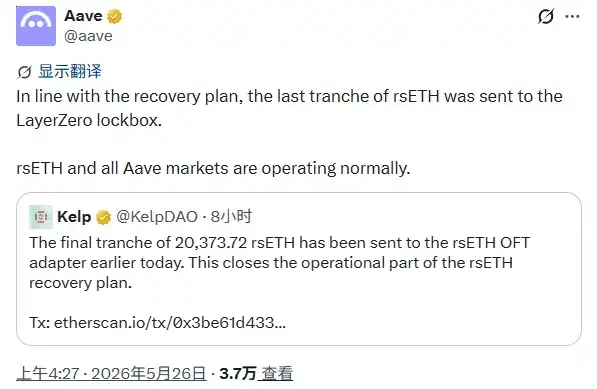
On May 26, Kelp DAO transferred the final batch of 20,373.72 rsETH to the LayerZero OFT Adapter, while Aave simultaneously announced that rsETH and all affected markets had returned to normal. In 37 days, the full replenishment of 116,500 rsETH was completed.
However, this only means rsETH is once again backed 1:1; it does not mean Aave's books are cleared. The 30,766 ETH frozen by the Arbitrum Security Council is still stuck in the U.S. District Court for the Southern District of New York, with ownership undecided. The TVL lost by Aave hasn't returned along with rsETH.

The Bill Extends Beyond the TVL Column

According to DefiLlama data, Aave's TVL was $26.396 billion on April 18, the day of the incident; on May 25, it was $14.181 billion. The amount that hasn't returned after a month exceeds $12 billion.

The more difficult part lies ahead. The U.S. District Court for the Southern District of New York will hold a hearing on June 5 regarding the ownership of the 30,766 ETH frozen by the Arbitrum Security Council. Both Aave LLC and Gerstein Harrow had submitted supplemental briefs by May 22. The judge previously modified the restraining notice on May 8 to allow fund transfers, but the substantive ruling is still pending confirmation on June 5.

Gerstein Harrow represents families of North Korean terrorism victims, holding an unexecuted judgment of $877 million. Regardless of the outcome, this lawsuit consumes Aave's brand.

This time, DeFi United was able to form because multiple parties were willing to provide backing: Stani Kulechov contributed 5,000 ETH from his own pocket, Consensys and Joseph Lubin committed up to 30,000 ETH, the Aave treasury allocated up to 25,000 ETH, plus a credit line of up to 30,000 ETH provided by Mantle and support from multiple parties like Lido and Ether.fi.

The scale of community mobilization was unprecedented, but Aave exhausted this one-time-only card. If another upstream contamination event occurs, assembling a similar list may not be possible again.

For example, after the incident, Sun Yuchen moved approximately $174 million (including 65,854 ETH and some stablecoins) from Aave to Spark, with cumulative deposits in Spark exceeding $1.3 billion. Whales voted with their feet, and funds have already migrated.

The Openness of V4 is Being Slowed Down by Governance

Aave has more than just V4 as a countermeasure card, but V4 is the most crucial one.

V4 was already launched on the Ethereum mainnet on March 30, with a Hub-and-Spoke architecture and three initial Liquidity Hubs. Aave Labs promised "security-first growth," with deposit limits gradually increasing. Deposits surpassed $10 million on April 8, crossed $50 million on May 9, and total deposits reached $86.13 million on May 26, with active borrowing positions at $27.77 million.
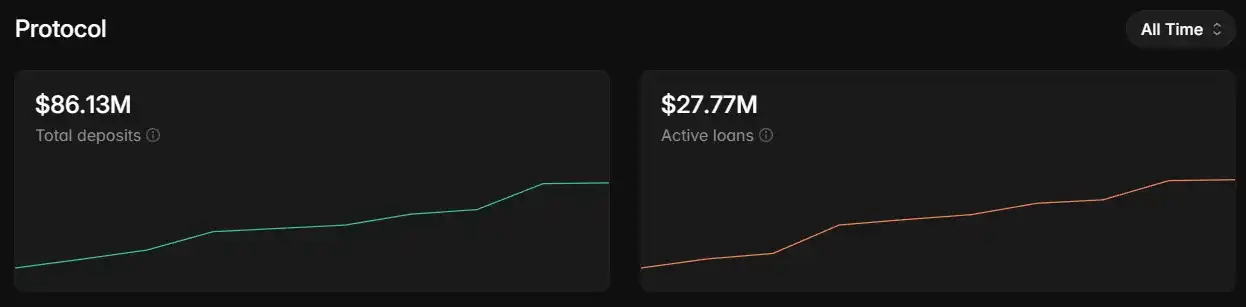
This pacing was a responsible design choice before rsETH; after rsETH, it became a stress test. Aave was handling a $200 million bad debt on V3 while slowly expanding limits on V4.

More challenging is that V4 also faces internal friction from its own governance layer. In February 2026, Aave Labs submitted a strategic proposal bundling product revenue, service provider incentives, the V4 growth engine, and brand/legal custody, requesting representatives to vote on four different risk dimensions at once.

Marc Zeller, founder of the Aave Chan Initiative, publicly questioned whether it was appropriate to bundle such a massive funding request with strategic approval. This governance dispute continued to ferment around the V4 launch, with each delay allowing competitors to eat away a bit more market share.

V4's advantage is the openness of the Spoke design—anyone can build a Spoke, and those meeting conditions can connect to a Liquidity Hub as a credit line. This is also why Babylon Labs chose to connect its Trustless Bitcoin Vaults to V4 rather than others. But the speed at which this openness materializes depends on whether the governance layer can keep up with the pace.

More Than Just V4: Aave is Fighting Three Battles

Aave V3 remains the cash cow. With annualized revenue exceeding $100 million, and $14.1 billion TVL primarily on V3. The "Aave will win" proposal positions V3 as in a "stable maintenance" phase, with Stani publicly committing to no forced migration and no deadline.

V4 and V3 will run in parallel for at least 24 to 36 months, with V4 being an additive complement layer, taking on heterogeneous scenarios that V3 cannot accommodate. Horizon is an independent, permissioned V3 fork specifically designed for institutional RWA.

Each of the three layers is capturing different increments. V4 captures new scenarios that V3's risk architecture cannot accommodate, with an added task after rsETH: giving funds that have migrated to Morpho and Spark a reason to return to Aave. Horizon captures traditional finance RWA flows, completely separate from V3 and V4 pools.

Horizon Market officially launched in August 2025, a permissioned V3 instance deployed by Aave, allowing institutions to use tokenized government bonds, corporate bonds, and money market funds as collateral to borrow stablecoins like USDC, GHO, and RLUSD.
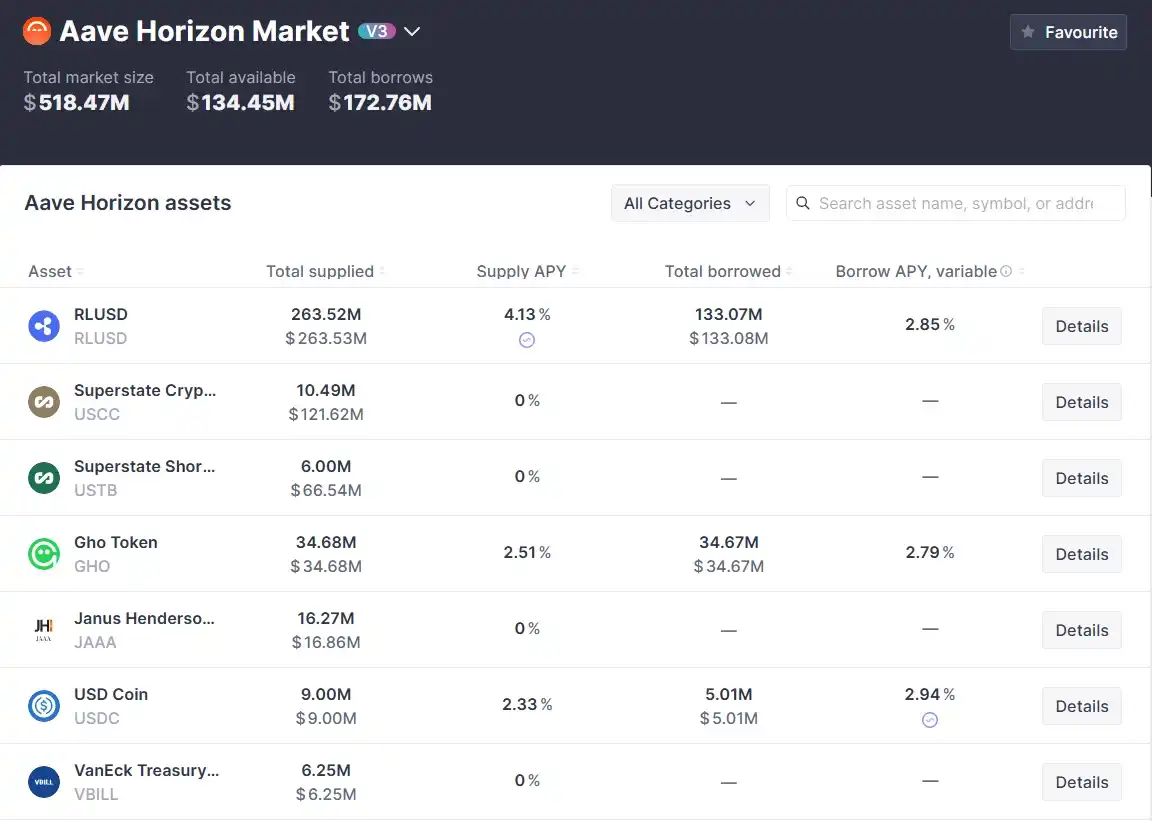
As of May 26, it has accumulated over $500 million in net deposits, aiming to surpass $1 billion by the end of 2026, with partners including BlackRock, Franklin Templeton, Circle, Ripple, and VanEck.

This route diverges from Morpho's vault management model. Morpho uses third-party institutions like Steakhouse and Gauntlet to curate vaults, capturing lending flows from retail institutions like Coinbase. Aave uses Horizon to directly connect with traditional finance asset managers for RWA.

The two paths target different institutional customer profiles. Morpho serves fintech companies that use on-chain lending as a tool, while Aave serves asset managers that treat the chain as an issuance venue.

The fund migration after the rsETH event primarily affected the first type of client. The migration cost is higher and the reaction slower for the second type. The compliance framework, KYC processes, and asset access audits Aave has accumulated on Horizon are not easily replicable by Morpho in the short term after the event.

This is the only incremental line for Aave not directly impacted by the rsETH event, but its growth depends on the pace at which traditional finance integrates with DeFi.

No Second DeFi United

Aave remains the largest protocol in the lending market, with $14.1 billion TVL still nearly double that of Morpho. The deployment depth accumulated over years is unmatched in the short term.

But the bill left by rsETH isn't on the balance sheet; it's in the column for institutions' default preference for lending protocols. Spark's TVL grew from $3.727 billion to $5.3 billion in a month; Morpho slowly climbed back to pre-incident levels after hitting bottom on April 21. These numbers won't automatically reverse and flow back just because Aave's markets have recovered.

The speed at which V4 delivers on heterogeneous scenarios, plus the progress of Horizon on institutional RWA, will determine whether Aave can recapture the lost market share. But the former is stuck in governance friction, and the latter depends on traditional finance's own integration pace. And for both these things, Aave can only wait.

DeFi United is not a permanent institution; it was a one-time mobilization.

Preguntas relacionadas

QWhat was the final action taken by Kelp DAO regarding the rsETH tokens, and how did Aave respond?

AOn May 26th, Kelp DAO transferred the final batch of 20,373.72 rsETH tokens to the LayerZero OFT Adapter. Simultaneously, Aave announced that the rsETH market and all affected markets had returned to normal.

QAccording to DeFiLlama data, what was the financial impact on Aave's TVL in the month following the rsETH incident on April 18th?

AAccording to DeFiLlama data, Aave's TVL on April 18th was $26.396 billion. By May 25th, it had fallen to $14.181 billion. This represents a loss exceeding $12 billion in TVL over approximately one month.

QWhat major upcoming legal event is mentioned regarding the frozen 30,766 ETH, and who is the opposing party in this case?

AThe U.S. District Court for the Southern District of New York will hold a hearing on June 5th to determine the ownership of the 30,766 ETH frozen by the Arbitrum Security Council. The opposing party is the law firm Gerstein Harrow, representing families of victims of North Korean terrorism who are seeking to collect on an $877 million judgment.

QWhat are the three core product layers or 'battles' that Aave is currently engaged in, as outlined in the article?

AAave is currently operating on three fronts: 1) Aave V3, the primary cash cow and stable maintenance layer with the majority of TVL. 2) Aave V4, the new hub-and-spoke architecture designed for new, heterogeneous lending scenarios. 3) Horizon, a separate, permissioned fork of V3 designed specifically for institutional Real-World Assets (RWA).

QWhat does the article suggest is a key challenge for the success of Aave V4, despite its technical advantages?

AThe article suggests that a key challenge for Aave V4's success is governance infighting and delays within Aave's own governance layer. The speed at which V4's promised openness can be realized depends on the governance process keeping pace, which has been slowed by internal disputes over strategic proposals.

Lecturas Relacionadas

TechFlow Intelligence Report: Xiaomi Announces 200 Billion HKD Stock Buyback Plan, Spot Gold Falls Nearly 1%

TechFlow Report: Xiaomi announced a HK$200 billion stock buyback plan, while spot gold fell nearly 1%. A wider range of tech headlines includes Google unveiling its powerful video editing model Gemini Omni and the original "Attention is All You Need" authors advocating for a move beyond Transformer architecture. In other AI news, IBM reported its first successful use of a quantum computer to train an AI model, and Qwen3.5 released uncensored local model versions. The crypto/Web3 sector saw discussions on opaque stablecoin products and DEX fee changes. Major tech companies are under scrutiny: Uber's COO publicly questioned the ROI of AI investments, Motorola was accused of hijacking Amazon app links for affiliate codes, and Google faced criticism for using web data to fuel its AI. U.S. markets are focused on high S&P 500 valuations (31.8x P/E) and an intense concentration of capital in semiconductor stocks, with warnings about the sustainability of the AI data center boom. Geopolitical tensions, featuring simultaneous U.S. airstrikes on Iran and peace talks, caused significant oil price volatility. Other notable developments include Ferrari's first pure EV priced at 4.35 million yuan and Boston Dynamics' Atlas robot learning soccer from videos. The underlying theme suggests the AI narrative is shifting from boundless potential to requiring tangible results, while traditional geopolitical risks remain a powerful force in markets.

marsbitHace 1 hora(s)

TechFlow Intelligence Report: Xiaomi Announces 200 Billion HKD Stock Buyback Plan, Spot Gold Falls Nearly 1%

marsbitHace 1 hora(s)

Coin & Stock Barometer: Bitcoin Miner MARA Holdings Spends Over $860,000 on Bulletproof Vehicle Services for Executives; Bitmine Included in Preliminary List for FTSE Russell 1000 Index (May 19)

Crypto Market Wrap & Key Corporate Updates (May 19) The crypto market saw a decline followed by a minor rebound, while U.S. crypto-related stocks fell broadly. In corporate news: **MARA Holdings**, a Bitcoin miner, disclosed spending over $869,000 on vehicle ballistic armor services for its CEO and CFO under its security program. The board cited higher risks associated with the company's public disclosure of holding substantial Bitcoin assets. According to BitcoinTreasuries.NET, Elon Musk's **SpaceX and Tesla** collectively hold 30,221 BTC ($2.3B), which would rank them as the fifth-largest public company holder if combined. **DDC Enterprise Limited** increased its Bitcoin holdings by 200 BTC, bringing its total to 2,583 BTC. The firm stated it plans to continue accumulating BTC based on liquidity, not short-term price movements. Bitcoin treasury company **Nakamoto** announced a 1-for-40 reverse stock split to regain compliance with Nasdaq's minimum bid price requirement. The company reported a Q1 2026 net loss of $238.8M, partly due to a $102.5M unrealized loss on its Bitcoin holdings. **Tether** acquired SoftBank's stake in **Twenty One Capital (XXI)**, increasing its control. Tether's CEO expressed strengthened confidence in XXI's long-term Bitcoin strategy. Fundstrat's **Tom Lee** stated that **Bitmine (BMNR)** has been included in the preliminary list for the FTSE Russell 1000 Index. Concurrently, two new wallets suspected to be linked to Bitmine withdrew 60,000 ETH ($126M) from Bitgo and Kraken. Solana treasury company **Solmate Infrastructure** announced a registered direct offering of shares to raise approximately $11.4 million. **AI Financial**, a WLFI treasury company, reported a Q1 2026 net loss of $271.5M and raised substantial doubt about its ability to continue as a going concern, partly due to unrealized losses on its WLFI token holdings. **SUI Group** disclosed it holds over 108.7 million SUI tokens (~$115M), with its market cap to net asset value ratio at 0.91x. *Disclaimer: This summary is for informational purposes only and does not constitute investment advice.*

marsbitHace 1 hora(s)

Coin & Stock Barometer: Bitcoin Miner MARA Holdings Spends Over $860,000 on Bulletproof Vehicle Services for Executives; Bitmine Included in Preliminary List for FTSE Russell 1000 Index (May 19)

marsbitHace 1 hora(s)

China's AI Fronts: From Yan'an to Midway

This article analyzes the competitive landscape of China's AI industry through a dual-front war analogy: the "Eastern Front" of business model competition and the "Western Front" of global strategic positioning. **The Eastern Front: The Scramble for Supply Lines and Monetization** The "Eastern Front" examines the contrasting strategies of three Chinese tech giants—Tencent, Alibaba, and ByteDance—in the face of AI's high marginal costs. Tencent integrates AI as a catalyst within its existing ecosystems (advertising, gaming, cloud) for monetization, prioritizing high-value scenarios over user growth. Alibaba bets on a full-stack, self-developed approach from chips to applications, aiming to control costs and ecosystem, though this requires immense patience and resources. ByteDance, with Doubao as its flagship, pursues a traditional traffic-driven, "super app" strategy but faces severe monetization challenges as its massive user base incurs unsustainable operational costs. The central challenge for all is building a reliable "supply line" (sustainable funding/profit) and achieving efficient monetization, moving beyond being mere "token factories." **The Western Front: "Preserving Land" vs. "Preserving People"** The "Western Front" frames a global strategic divergence. The U.S. model ("preserving land") focuses on closed-source, high-premium models (e.g., Anthropic) targeting lucrative enterprise markets. China's strategy ("preserving people") leverages open-source models (e.g., Alibaba's Qwen, DeepSeek) and extremely low pricing to attract global developers and capture long-tail markets, akin to a "surround the cities from the countryside" approach. The goal is to make Chinese models the default infrastructure, locking in future ecosystem value. However, the critical test is whether this open-source ecosystem can achieve a commercial闭环, converting developer adoption into tangible revenue (e.g., via cloud services), and bridging the monetization gap with Western models that charge for value, not just tokens. **Conclusion: The Long March from Factory to Brand** The article concludes that China's AI industry possesses technology, users, and scenarios but must integrate them to create and capture value. Its ultimate success depends on navigating both fronts: companies must establish sustainable monetization on the Eastern Front, while the industry's Western strategy must evolve from simply "preserving people" (developer adoption) to truly "preserving both people and land" — transforming open-source ecosystem dominance into commercial success and premium brand value. This journey from being a "token factory" to a "value highland" will require strategic patience and the ability to outlast competitors in a prolonged contest.

marsbitHace 1 hora(s)

China's AI Fronts: From Yan'an to Midway

marsbitHace 1 hora(s)

Trading

Spot
Futuros

Artículos destacados

Cómo comprar DAO

¡Bienvenido a HTX.com! Hemos hecho que comprar DAO Maker (DAO) sea simple y conveniente. Sigue nuestra guía paso a paso para iniciar tu viaje de criptos.Paso 1: crea tu cuenta HTXUtiliza tu correo electrónico o número de teléfono para registrarte y obtener una cuenta gratuita en HTX. Experimenta un proceso de registro sin complicaciones y desbloquea todas las funciones.Obtener mi cuentaPaso 2: ve a Comprar cripto y elige tu método de pagoTarjeta de crédito/débito: usa tu Visa o Mastercard para comprar DAO Maker (DAO) al instante.Saldo: utiliza fondos del saldo de tu cuenta HTX para tradear sin problemas.Terceros: hemos agregado métodos de pago populares como Google Pay y Apple Pay para mejorar la comodidad.P2P: tradear directamente con otros usuarios en HTX.Over-the-Counter (OTC): ofrecemos servicios personalizados y tipos de cambio competitivos para los traders.Paso 3: guarda tu DAO Maker (DAO)Después de comprar tu DAO Maker (DAO), guárdalo en tu cuenta HTX. Alternativamente, puedes enviarlo a otro lugar mediante transferencia blockchain o utilizarlo para tradear otras criptomonedas.Paso 4: tradear DAO Maker (DAO)Tradear fácilmente con DAO Maker (DAO) en HTX's mercado spot. Simplemente accede a tu cuenta, selecciona tu par de trading, ejecuta tus trades y monitorea en tiempo real. Ofrecemos una experiencia fácil de usar tanto para principiantes como para traders experimentados.

145 Vistas totalesPublicado en 2024.12.11Actualizado en 2025.03.21

Cómo comprar DAO

Discusiones

Bienvenido a la comunidad de HTX. Aquí puedes mantenerte informado sobre los últimos desarrollos de la plataforma y acceder a análisis profesionales del mercado. A continuación se presentan las opiniones de los usuarios sobre el precio de DAO (DAO).

活动图片