Written by: Rita
SpaceX has announced a $100 billion Starbase project in the Louisiana swamplands, planning for 10 launch pads, with construction starting in 2027 and the first flight in 2029. Morgan Stanley believes the market has not fully grasped the scale of Starship. Even excluding this new base, Morgan Stanley's 2040 launch forecast would only require 8 launch pads to support it, yet SpaceX is planning for 15.
On August 25th, Morgan Stanley released a research report on SpaceX, pointing out that the 10 launch pads at Starbase LA could indicate a launch cadence far exceeding current expectations. SpaceX's current stock price is $137, while Morgan Stanley has a price target of $300 with an Overweight rating. They believe investors are getting an opportunity to re-evaluate the company at a price near its IPO level, with stronger fundamental momentum than at the time of listing.
Louisiana Base Scale Far Exceeds Existing Facilities
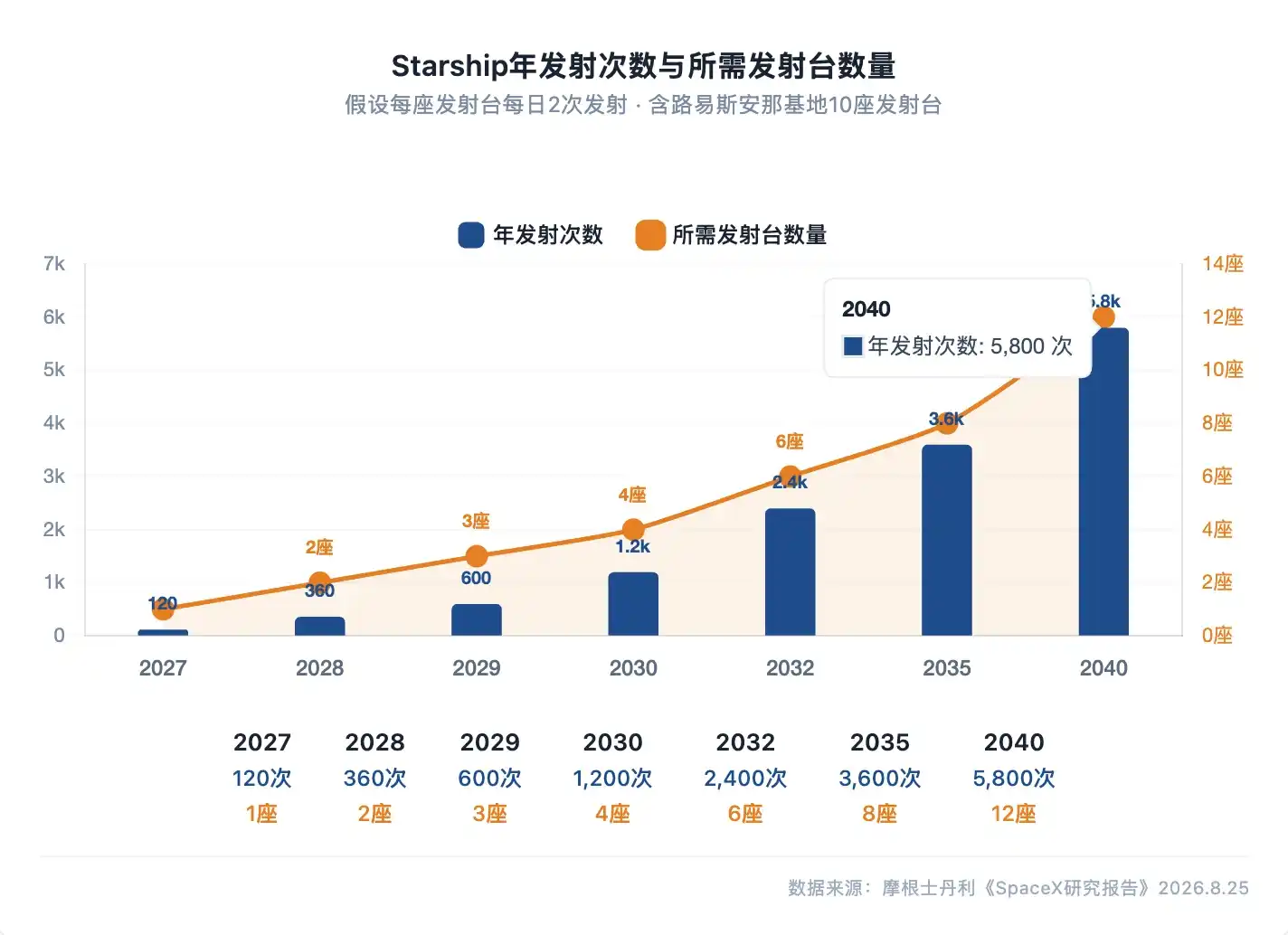
Starbase LA is located on former ExxonMobil property in Vermilion Parish, planning for 5 launch complexes (2 pads each, totaling 10 pads), along with supporting propellant production facilities, a power plant, vehicle processing facilities, and employee housing. The project is expected to create 3,000 direct jobs. Louisiana Governor Jeff Landry personally participated in the announcement ceremony.
This will become SpaceX's fourth and largest launch facility, expected to support thousands of launches annually, playing a central role in scaling Starship missions. Including Pad 1 and Pad 2 at Starbase Texas, LC-39A at Kennedy Space Center, and SLC-37A and SLC-37B at Cape Canaveral, SpaceX currently has a total of 15 launch pads planned.
Why Build in Louisiana
Morgan Stanley summarizes four reasons.
Unique Launch Trajectory. Louisiana expands polar orbit access capability, which is crucial for orbital computing.
Natural Gas. Louisiana is the third-largest natural gas producing state in the U.S. Each Starship launch requires over 1,000 tons of liquid methane.
Political Hedging. Texas and Florida are facing bipartisan backlash against data centers and AI. A cross-jurisdictional layout helps SpaceX maintain negotiation flexibility.
Government Incentives. Over the past year, Louisiana has tailored a large incentive package for SpaceX, including sales tax rebates for aerospace facilities, an extension of industrial tax exemptions, liability protection for aerospace entities, and state-assisted land transfers.
Starship is the Ultimate Enabler for SpaceX's Scaling
Starship's payload capacity is over 5 times that of Falcon 9, and it is fully reusable (Falcon 9 is partially reusable). Morgan Stanley believes reusable rockets are the elevator to space. Just as elevators changed the shape of buildings in Manhattan, the space elevator is also fostering new architectures in orbit, on the moon, and beyond.
SpaceX's goal is to reduce launch costs from a historical average of $18,500 per kilogram to under $200. Morgan Stanley expects Starship to reduce launch costs to about $500/kg by 2030 and reach under $200/kg by 2035.
The critical path is Ship's recovery and reuse. SpaceX has already captured and reused the Super Heavy booster three times, with physical recovery of a Ship expected by the end of 2026. The real focus is not recovery itself, but turnaround time.
Morgan Stanley assumes in its model that Ship will have a useful life of approximately 2 flights (i.e., reusable once) from 2027 to 2029, reaching 17 flights by 2035 and 43 flights by 2040. Achieving over 30 reuses for the Booster is expected to take 8 years, roughly matching Falcon 9's historical reuse cadence. Even if Ship cannot be reused initially, Starship's sheer scale advantage can significantly lower internal launch costs. Morgan Stanley expects SpaceX to begin launching Starlink with Starship in late 2026 or 2027.
Valuation and Upside Potential
Morgan Stanley uses a sum-of-the-parts valuation to derive the $300 price target. Space business valued at $8, Connectivity business at $118, X and Grok valued at $8, Enterprise AI business at $165 (already including a 50% execution risk discount). At the current stock price of $137, the implied multiple for the Enterprise AI business is in the very low single digits, with the orbital AI call option priced at almost zero.
Morgan Stanley performed a sensitivity test: Each additional 1 GW of nominal computing power (assuming $50/W, 70% incremental margin) capitalized at 10x EBITDA, could add $27 to the stock price, equivalent to about 20% of the current price. Morgan Stanley's estimate for AI computing power by fiscal year-end 2027 is 4.9 GW, with the company's target close to 10 GW.
SpaceX also announced the completion of its final Falcon 9 Starlink launch from Florida. All future Florida Starlink missions will be transitioned to Starship. Each Starship launch has 25 times the downlink capacity of a Falcon 9, meaning only a few launches are needed to compensate for the reduced frequency of Falcon 9 launches. Morgan Stanley believes this demonstrates the company's commitment to transitioning to Starship and is a key signal for understanding SpaceX's long-term value.

Disclaimer
This article is a compilation and interpretation of a third-party brokerage research report (Morgan Stanley, August 25, 2026) by Chaoxiang Research, combined with the organization of publicly available market information. The ratings, price targets, earnings forecasts, and related judgments cited in the article are the views of the report's analysts, representing only the position of their affiliated institution, and do not represent the views of Chaoxiang Research, nor do they constitute any investment advice.
The market involves risks, decisions require independence. This article should not be used as the basis for trading any securities.