On August 27, U.S. Solana ETFs saw the year's best single-day inflow, reaching $60.91 million. Even with two more trading days left in the month, August has already become the best month of the year, with inflows exceeding $134 million. The total net assets of all nine funds grew to $1.49 billion from $1.26 billion the previous day, and the cumulative net inflow now stands at $1.32 billion. Trading volume yesterday reached $196.82 million, more than double the figure from August 26.
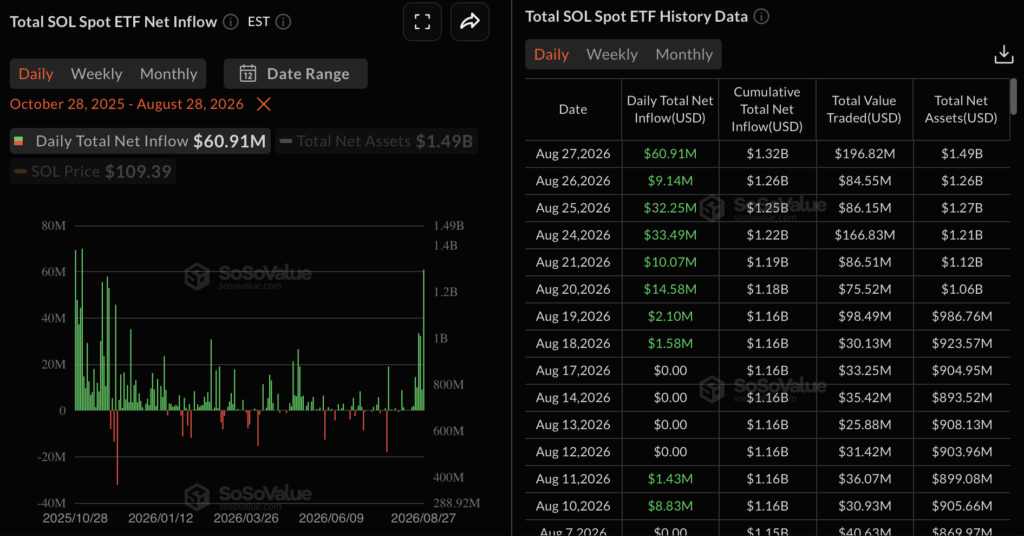
Source: SoSoValue
Two other factors added momentum to the increasing $SOL trading, both coinciding within the same 24-hour period.
Bitwise Accounted for Two-Thirds of the Day's Flow
Of the total $60.91 million daily inflow, Bitwise's BSOL fund attracted $40.20 million, accounting for approximately 66% of the total. BSOL's net assets currently stand at $1.02 billion with a cumulative inflow of $1.01 billion since launch, making it the only $SOL product to surpass the billion-dollar mark. Grayscale's GSOL attracted $6.22 million, Fidelity's FSOL attracted $5.82 million, and Morgan Stanley's MSOL attracted $4.74 million. 21Shares' TSOL saw a daily inflow of $3.93 million, although its cumulative net inflow remains at -$98.26 million.
Schwab Unlocked Access for 39.9 Million Accounts
A couple of hours before the daily crypto flow data was released, Charles Schwab announced it would add $SOL, AVAX, and LINK to its proprietary spot crypto trading product, Schwab Crypto, in the coming months.
BREAKING: Charles Schwab will add Solana via $SOL through Schwab Crypto
— Solana (solana) August 27, 2026
Direct to 39.9 million brokerage accounts managing client assets worth $13.04 trillion. pic.twitter.com/GpK72p0M2M
ETFs already provided advisors with a wrapper they could include in model portfolios. Schwab's direct move into ETFs removes one layer for retail investors who never intended to open a Phantom wallet. Neither channel is necessary for the other's operation, but expanding both channels in the same week changes the portion of the available investor pool that can actually buy.
The Network Just Voted to Print Less and Burn More
On the same day, the first on-chain governance vote for the Solana network concluded, considering two proposals that would limit $SOL supply from opposite sides.
The first option halves the rate of new $SOL entering circulation, bringing the network's minimum inflation level from 2032 forward to approximately 2029 and reducing the projected $SOL issuance by roughly 18.9 million over six years. The second option rewrites fee mechanics so that a much larger portion of fees is burned rather than paid out, potentially increasing daily burns from about 648 $SOL to 7,500-9,000.
The conclusion of the vote is not the same as shipping the goods. Solana proposal implementation timelines have slipped before, and the burn range is a forecast tied to network activity, not a fixed schedule.
$SOL Price Breaks $105 for the First Time Since January
On August 27, $SOL traded at $109, up approximately 44% in August and on track to be the strongest month since 2024. The last time the price exceeded $105 was in January.
What's unusual about this situation is the sequence of events. Access expanded via two separate channels while the network moved to curtail issuance, all within a single session. The flow figure drew attention, but $60.91 million against $1.49 billion in total assets is a good day, not a regime change. How high the rate holds in the next few sessions says more than the August 27 data alone.