Can SK Hynix's Stock Double Again in This Rally?

marsbitPublicado a 2026-06-16Actualizado a 2026-06-16

Resumen

The article discusses the highly optimistic price target of approximately $3,500 for SK Hynix stock, set by Aletheia Capital. This target is significantly above the consensus range of $2,000-$2,520 from major brokerages. The core debate is whether SK Hynix deserves a fundamental re-rating beyond its traditional cyclical discount, based on the long-term impact of AI-driven demand. The $3,500 target hinges on three key assumptions holding simultaneously until at least 2027: 1) Continued shortage and high pricing for HBM (High Bandwidth Memory), a critical component for AI chips; 2) Sustained high prices for standard DRAM, as HBM production consumes capacity and constrains general supply; and 3) Strong AI server demand generating substantial, above-expectation free cash flow. SK Hynix's leading ~58% market share in HBM and its early certification with key clients like Nvidia provide a competitive advantage, allowing it to capture significant supply chain premiums. The HBM shortage is seen not just as a niche growth driver but as a catalyst that amplifies profitability across the entire memory business by tightening overall DRAM supply. However, the article cautions that this target represents an optimistic "tail scenario." Key risks include potential supply increases from competitors (Samsung, Micron) by 2027, a possible slowdown in HBM price growth, and high capital expenditures that could erode the projected free cash flow. The divergence in analyst targets reflects the mar...

TL;DR

Aletheia Capital raised its target price for SK Hynix to approximately $3,500 in a report released today, pushing it far above the target range of mainstream institutions.

Aletheia Capital is an independent research and investment advisory firm headquartered in Hong Kong, serving institutional investors and covering sectors such as Asian tech hardware. In contrast, publicly reported target prices from SK Securities are around $2,000, while Mirae Asset and KB Securities target around $2,520.

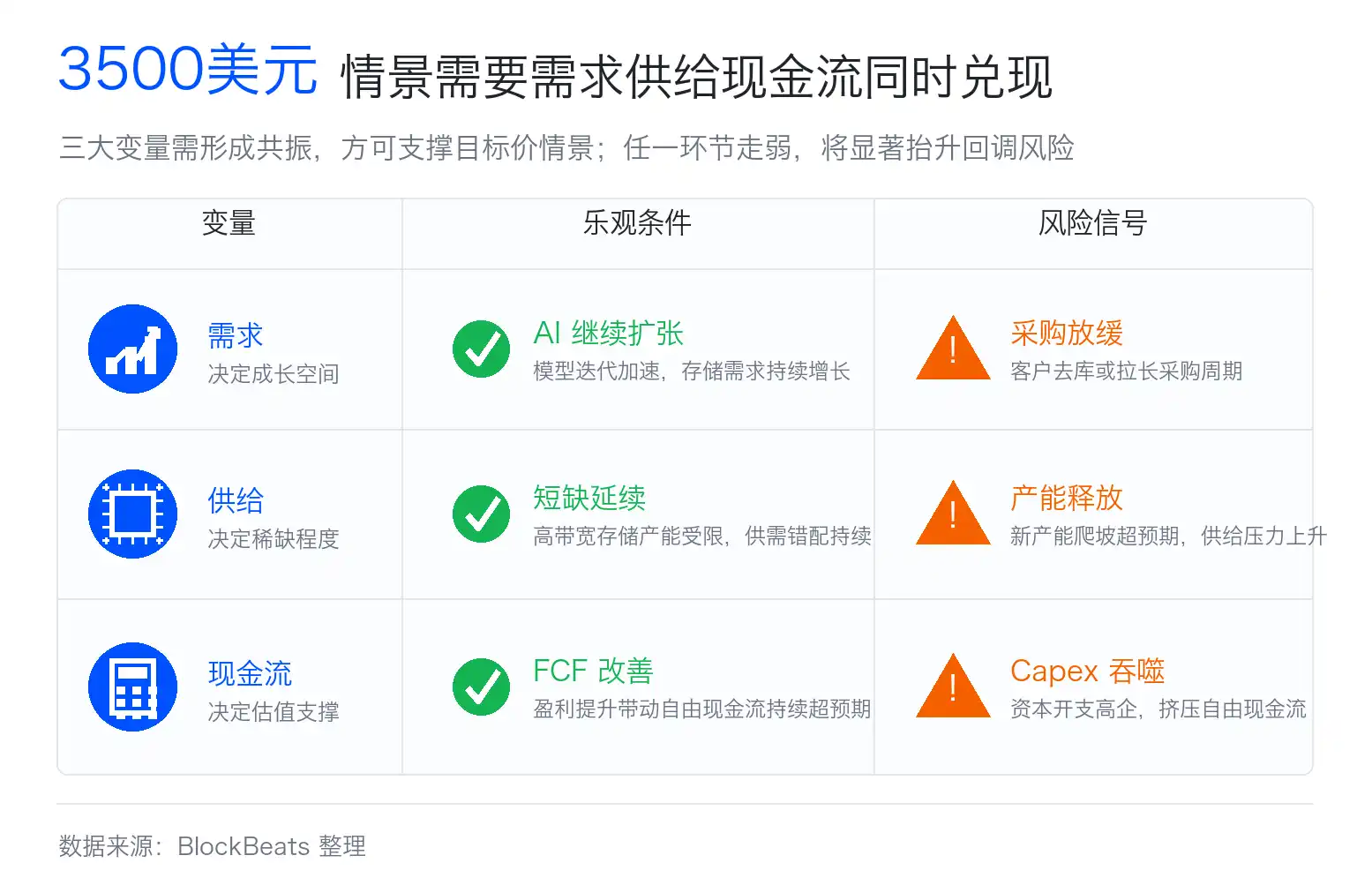
The truly aggressive aspect of the $3,500 target price is not just being more optimistic than mainstream institutions. It requires the market to believe three things will happen simultaneously: continued shortages of HBM (high-bandwidth memory for AI chips), continued price increases for standard DRAM, and AI server demand sustaining both the memory upcycle and free cash flow until 2027.

The market has already acknowledged that SK Hynix deserves a re-rating; the divergence lies in how far this re-rating can go. Most mainstream institutions still apply a cyclical industry discount, while the $3,500 price implies pulling out an optimistic tail scenario even after the re-rating.
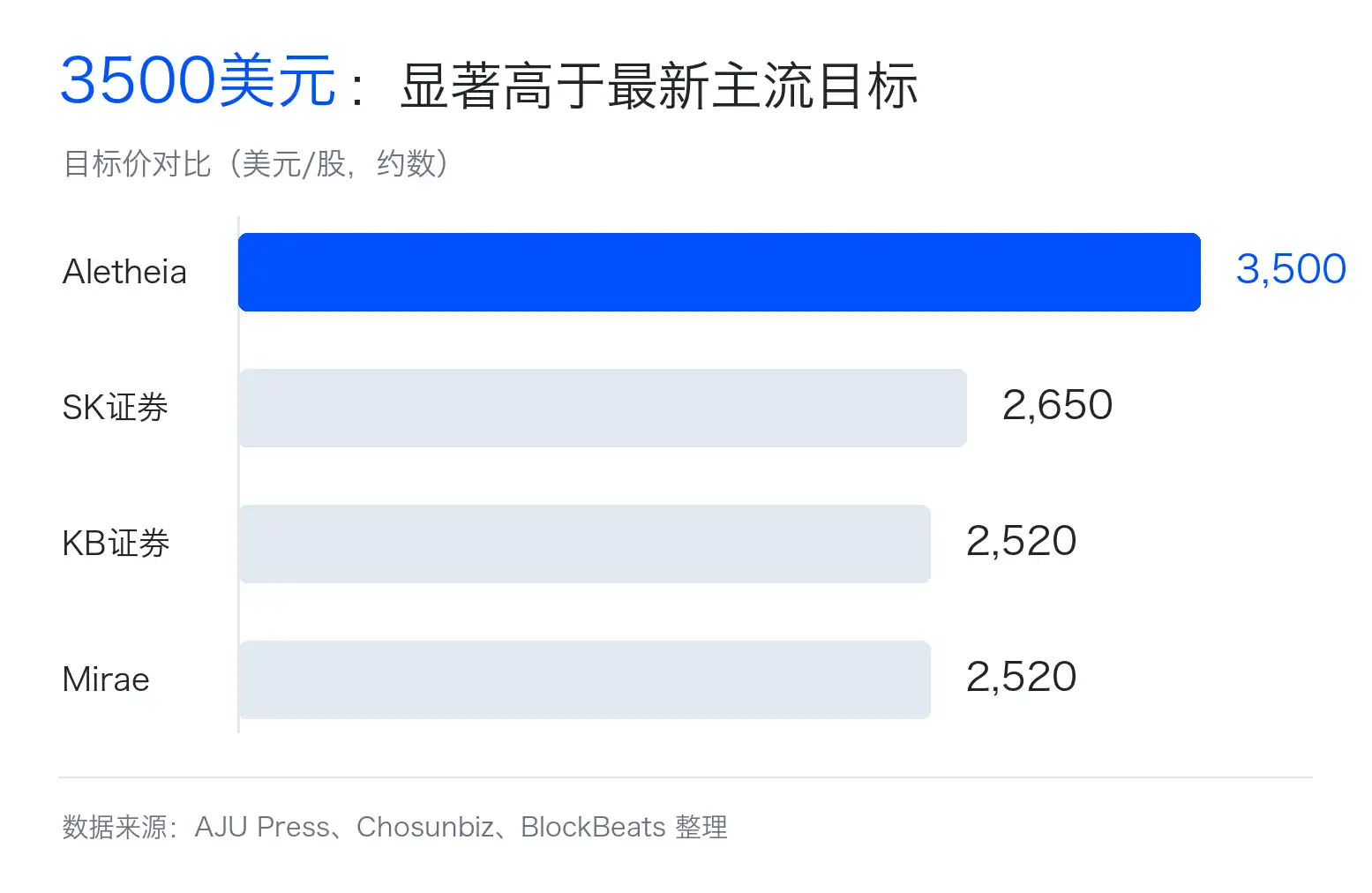
The Divergence Lies in the 2027 Profit Base

The $3,500 figure is most easily misread as a simple valuation question: if you just apply a 10x multiple to SK Hynix's 2027 profits or free cash flow, the stock price can continue rising. The difficulty lies not in the multiple itself, but in how much money the company will actually earn and how much cash it will retain in 2027.

Memory company profits are highly volatile. During an upturn, prices rise, inventory clears, and margins expand rapidly. During a downturn, new capacity comes online, customers cancel orders, prices fall, and profits can quickly reverse. This is why the market has long assigned lower valuation multiples to memory companies.

Even with SK Hynix's current strong profitability, its 12-month forward P/E ratio, as mentioned in public reports, remains in the single digits. The market isn't blind to AI; it's concerned that this rally will ultimately still be priced as a cyclical peak.

The aggressive target price circulating from Aletheia challenges this cyclical discount. Based on public descriptions, it bets that sustained AI hardware demand will keep pushing HBM and DRAM prices higher, and SK Hynix's 2027 free cash flow will significantly exceed most current expectations, thus allowing for repricing based on this higher base.

The issue is that $3,500 requires multiple variables to align favorably simultaneously: HBM prices remaining strong, standard DRAM prices not being undercut by new capacity, SK Hynix maintaining its leading market share, capital expenditures not consuming too much cash, and the market still willing to assign a non-low multiple to a cyclical stock. If any link underperforms expectations, the target price would shift from a structural re-rating to a high-cycle extrapolation.

HBM Shortages Spill Over to Standard Memory

HBM can change SK Hynix's pricing logic because it's not a minor upgrade to standard memory; it's a core component next to AI accelerator cards. No matter how fast an AI chip computes, its overall performance can be bottlenecked if data can't be fed in fast enough. HBM's role is to provide a higher-bandwidth data channel for GPUs or AI accelerators.

General investors can think of it this way: the GPU is the engine, and HBM is the high-speed fuel delivery system. The stronger the engine, the higher the demand on the fuel system. In the past, when trading AI hardware, the market looked first at NVIDIA GPUs. Now, the market is increasingly realizing that GPU shipments and the ability to build up AI servers also depend on HBM supply.

Increasing HBM supply isn't as simple as slightly tweaking a standard DRAM production line for immediate volume. It requires more complex stacking, packaging, customer qualification, and consumes more wafer area and advanced packaging resources. Producing an equivalent capacity of HBM typically occupies more production capacity resources than standard DRAM.

This spreads the impact to standard memory. As manufacturers shift more resources to HBM, supply of DRAM for standard servers, PCs, and mobile devices tightens, potentially pushing up the average selling price of DRAM.

This is precisely the core mechanism that makes the ~$3,500 target price plausible. If HBM were just a fast-growing niche product, it could only boost part of SK Hynix's revenue. If HBM simultaneously constrains standard DRAM supply and lifts the entire memory price curve, it becomes an amplifier for the entire company's margins and cash flow.
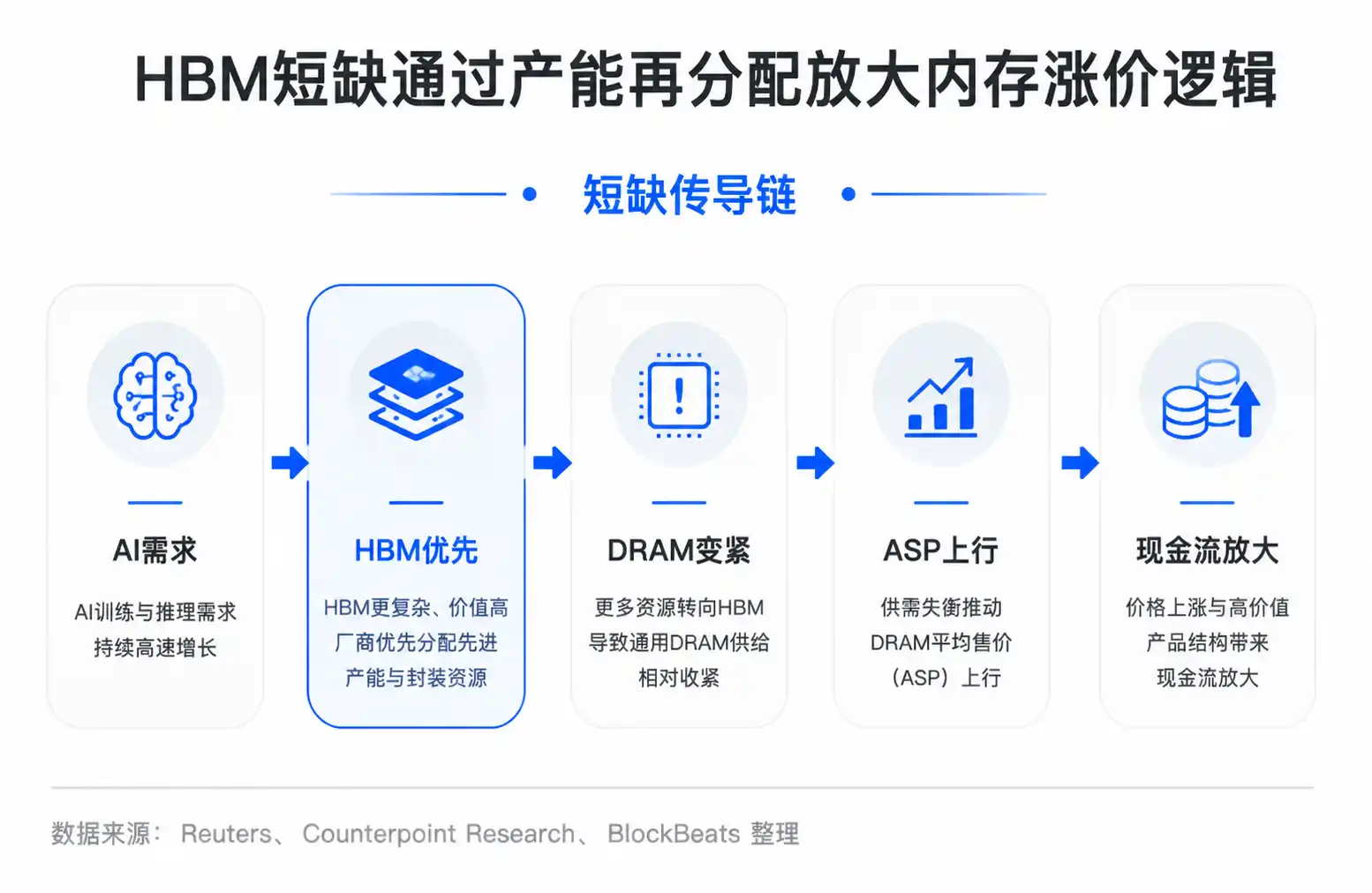
However, HBM shortages can only extend the cycle, not eliminate it. Samsung and Micron are catching up, SK Hynix itself will also expand production, and new wafer fabs and packaging capabilities will eventually be reflected in the supply side. The core of the debate is not whether shortages exist, but how long they will last and how long prices can remain strong.

SK Hynix Reaps the Most Direct Supply Chain Premium

SK Hynix is at the center of this re-rating not just because it's a memory company, but because it's the fastest runner in HBM. According to Reuters citing Counterpoint data, SK Hynix held about 58% of the global HBM market share in Q1 2026, with Samsung and Micron each around 21%. Reuters has also referred to it as a key supplier in NVIDIA's HBM supply chain.
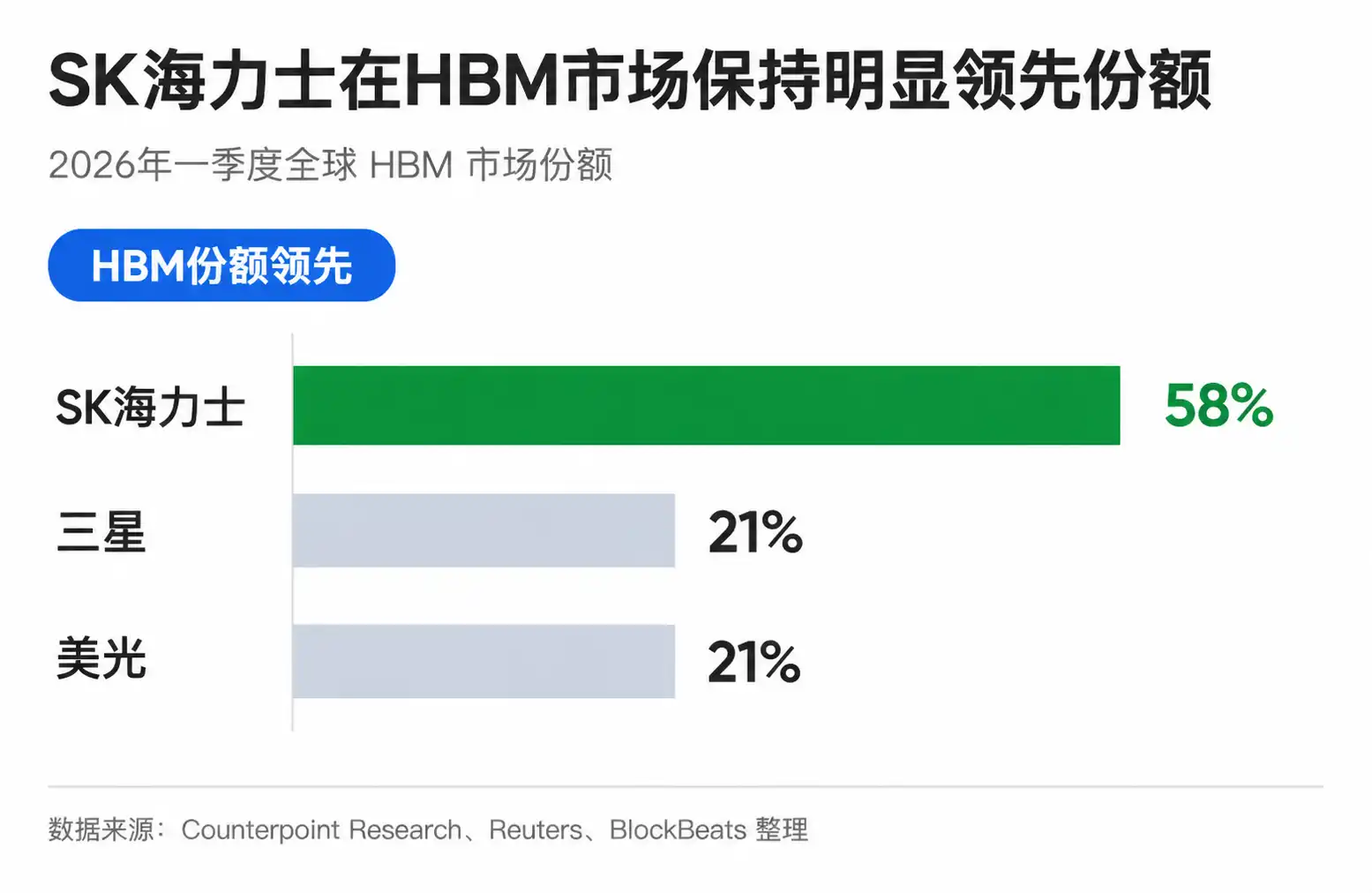
Such a lead is valuable in the semiconductor supply chain. AI chipmakers selecting HBM suppliers consider not just price, but also performance, yield, stability, and qualification progress. Being first to pass customer qualification makes it easier to enter the collaboration window for the next-generation products. Locking in orders earlier provides more initiative in capacity planning and price negotiations.

This is also why 2026 supply-demand visibility is drawing attention. According to a 2025 Reuters report, SK Hynix had completed 2026 HBM supply discussions with key customers. Multiple industry reports also suggest HBM shortages may extend into 2027. For investors, 2026 performance is at least not entirely story-driven.

SK Hynix's benefits aren't limited to HBM revenue itself. Because HBM occupies more capacity, squeezing standard DRAM supply, the traditional memory business may also benefit from price increases. AI demand first enters the financials through HBM, then influences the entire DRAM price through capacity reallocation.

This explains why institutional target prices keep being revised upward. Even without accepting an extreme scenario like $3,500, target prices in the ~$2,000 to $2,520 range indicate that mainstream institutions are already recalculating SK Hynix's profit elasticity for 2026-2027. The difference is that most still retain the discount appropriate for a cyclical industry, not extrapolating post-2027 tightness directly into a new normal.

Doubling the Stock Price Awaits Three Conditions

The $3,500 target price circulating from Aletheia essentially bets on continued strong demand, continued tight supply, and continued cash flow exceeding expectations. Over the past two years, massive GPU purchases by cloud providers and AI companies drove the HBM demand explosion. Next, the market needs to see if inference, enterprise AI, and custom ASICs can continue expanding memory consumption, ensuring demand isn't confined to training clusters.

The supply side also can't loosen too quickly. 2026 tightness is relatively easier to understand due to lags in capacity, packaging, and qualification; by 2027, new capacity and products from Samsung, SK Hynix, and Micron will gradually enter the market. If new supply arrives faster than expected, HBM price increases may narrow, and standard DRAM will face renewed pressure.

Ultimately, it comes down to cash flow. During an upturn, memory companies often increase capital expenditures for expansion, process upgrades, and advanced packaging. Profit growth doesn't necessarily all stay on the balance sheet. If SK Hynix needs significant investment to maintain its lead, the free cash flow base underpinning the $3,500 target price would be eroded.

Therefore, this target price is better viewed as an optimistic scenario, not a validated market consensus. 2027 is the real observation window: if HBM prices, DRAM ASPs, supply timing, and free cash flow continue to align favorably, the market will believe AI is raising the memory industry's profit center. If prices soften first, supply arrives first, or cash flow is consumed by capex, then ~$3,500 would shift from a re-rating anchor to an emotional peak.
Preguntas relacionadas

QWhat are the three key conditions that Aletheia Capital's highly optimistic $3,500 price target for SK Hynix relies on?

AAletheia Capital's $3,500 price target for SK Hynix relies on three key conditions simultaneously occurring: 1) Sustained shortage and high prices for HBM (High Bandwidth Memory). 2) Continued price increases for regular DRAM. 3) AI server demand supporting strong market conditions and high free cash flow for the company through 2027.

QAccording to the article, what is the primary challenge in achieving the $3,500 target price, aside from the valuation multiple?

AThe primary challenge is not the valuation multiple itself, but accurately forecasting how much profit (or free cash flow) SK Hynix will actually generate in 2027. This requires multiple favorable variables to align, including HBM and DRAM pricing, market share, manageable capital expenditures, and market willingness to apply a higher multiple to a traditionally cyclical stock.

QHow does HBM shortage theoretically benefit SK Hynix's overall memory business beyond just HBM sales?

AHBM production is more complex and consumes more manufacturing resources (like wafer area and advanced packaging capacity) than regular DRAM. As manufacturers allocate more resources to produce HBM, the supply of regular DRAM for servers, PCs, and phones becomes tighter. This supply constraint can drive up the average selling price (ASP) of all DRAM, thereby boosting the profitability and cash flow of SK Hynix's entire memory division, not just the HBM segment.

QWhy is SK Hynix considered a core beneficiary in the current AI-driven memory revaluation?

ASK Hynix is a core beneficiary not just because it is a memory company, but because it holds a significant technological and supply chain lead in HBM. With reported market share around 58% in Q1 2026 and status as a key HBM supplier to NVIDIA, its early mover advantage in performance, yield, and customer certification allows it to secure orders, plan capacity proactively, and command pricing power more effectively than its competitors.

QWhat does the article suggest the $3,500 price target should be viewed as, rather than a market consensus?

AThe article suggests that the $3,500 price target should be viewed as an optimistic scenario or tail-end outcome, not an established market consensus. It represents a bet on a highly favorable alignment of demand, supply, and cash flow conditions extending through 2027. If any of these factors underperform, the target price would revert from being a structural revaluation anchor to merely reflecting peak-cycle optimism.

Lecturas Relacionadas

Sharplink CEO: One Million Ethereum Developers, Who Can Compete?

Etherean Ecosystem: One Million Developers and a Formidable Moat The Ethereum network has surpassed a significant milestone: over one million unique lifetime developers, with approximately 232,000 active in the past year. This vast and growing talent pool is Ethereum's core advantage, far more critical than transient metrics like speed or transaction fees. The central question is not which blockchain is fastest, but where the best builders choose to build long-term. Ethereum's answer lies in a decade-long accumulation of infrastructure, standards, tools, liquidity, and collaborative culture that is exceptionally difficult to replicate. It has become the default operating system for programmable finance. This massive developer base is actively working on complex, high-risk challenges that deepen Ethereum's strategic moat: * **Glamsterdam Upgrade (2026):** Focused on core protocol scalability (ePBS, parallel execution) while preserving core values like credible neutrality. * **Synchronous Composability:** Aims to make numerous Rollups interoperate like a single chain, directly addressing fragmentation concerns. * **Quantum Resistance:** Ethereum leads mainstream ecosystems in coordinated preparation for post-quantum cryptography, with a targeted migration plan around 2029. This developer advantage is self-reinforcing, fueled by: * **Deep Composability:** Applications interact like interoperable financial Lego bricks via shared standards (e.g., EVM, Solidity). * **Credible Neutrality:** Secured by over 900,000 validators, making it trusted by major institutions. * **Modularity:** Rollups (Base, Arbitrium, etc.) expand, rather than fracture, the ecosystem into a tightly connected modular internet economy. * **Culture:** Attracts top-tier researchers and standard-setters who guide the entire industry. In essence, while other chains generate activity, Ethereum is consolidating as the trusted, long-term coordination layer for internet-native finance. Its future is being built now by the architects of the next-generation financial infrastructure.

Odaily星球日报Hace 34 min(s)

Sharplink CEO: One Million Ethereum Developers, Who Can Compete?

Odaily星球日报Hace 34 min(s)

Ethereum Reaches the Milestone of One Million Developers, Sharplink CEO Delves Deep into Ethereum's Future Possibilities

Ethereum Surpasses One Million Developers Milestone: A Look at Its Unshakeable Dominance and Future Joseph Chalom, CEO of Sharplink, reflects on his recent Asia trip where he engaged deeply with Ethereum developers and ecosystem leaders. The most striking takeaway was not just the industry's vibrancy, but the rigorous, long-term vision of local builders. This context brings to life a pivotal statistic: Ethereum has now surpassed one million cumulative developers (1,012,824), with approximately 232,000 remaining active in the past year—a talent pool unmatched by any other crypto ecosystem. The critical question isn't which blockchain is fastest, but where top developers choose to build long-term. Ethereum's answer is unequivocal. Its decade-long lead stems from a unique convergence of technology, institutional culture, economic systems, and composability, cementing its role as the foundational operating system for programmable finance. This massive developer base is tackling the industry's hardest problems, continuously strengthening Ethereum's moat. Key initiatives include: * **The Glamsterdam Upgrade (planned 2026):** Introducing ePBS and Block-level Access Lists for parallel execution and higher throughput while preserving core values like credible neutrality and fair MEV distribution. * **Synchronous Composability:** Projects are working to enable atomic transactions across dozens of Rollups, making them function as one unified chain and eliminating ecosystem fragmentation. * **Post-Quantum Security:** Ethereum is far ahead in preparing for quantum computing threats, with a dedicated foundation working group and testnets targeting a full migration by ~2029—a crucial factor for institutional adoption. Beyond developers, Ethereum's core network effects are its unparalleled composability and unified standards (like EVM and Solidity), which create a powerful flywheel: more developers → better tools → greater liquidity → more institutional participation. Its other decisive advantages include credible neutrality (over 900k validators), a secure modular architecture with interconnected Rollups, and a deeply entrenched culture shaped by top-tier researchers. Ultimately, there's a vast difference between generating short-term activity and becoming the trusted, long-term coordination layer for global native finance. Major institutions prioritize security, trust, and liquidity—areas where Ethereum holds dominant mindshare. The industry's trajectory shows resources consolidating around unified standards, deep liquidity, and developer consensus. After meeting the builders in Seoul and Hong Kong, Chalom is more convinced than ever: Ethereum's unshakeable future is being built right now.

Foresight NewsHace 45 min(s)

Ethereum Reaches the Milestone of One Million Developers, Sharplink CEO Delves Deep into Ethereum's Future Possibilities

Foresight NewsHace 45 min(s)

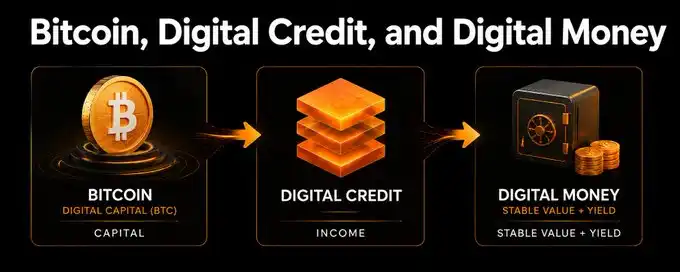
Saylor's Latest Long Read: Bitcoin is Not Money, It's Digital Capital, and Money is Built Upon It

Michael Saylor presents his "Digital Asset Stack" theory, positioning Bitcoin as the foundational layer of digital capital. He argues Bitcoin itself should remain unchanged—no staking, inflation, or protocol alterations. Instead, a five-layer financial architecture should be built atop it: Digital Capital (BTC), Digital Credit (e.g., yield instruments like STRC), Digital Currency (stable, yield-bearing instruments pegged to fiat), Digital Yield (leveraged/structured products), and Digital Equity (e.g., MSTR stock, absorbing residual volatility). Saylor asserts this stack transforms Bitcoin's high-volatility, high-energy capital into tailored products: stable currencies for payments/savings, yield instruments for income seekers, and equity for growth investors. This approach meets diverse needs—corporate treasuries, banks, retirees, emerging market users—without compromising Bitcoin's core properties (scarcity, decentralization). The "killer use case" is rebuilding global money, credit, and capital markets on Bitcoin, bridging the fiat world with a superior digital asset foundation. The system leverages traditional finance principles (risk layering, structured products) while using Bitcoin as the ultimate collateral. This expands Bitcoin's utility, drives adoption, and offers a better monetary experience: digital, yield-bearing, stable-value tools for everyday use.

marsbitHace 58 min(s)

Saylor's Latest Long Read: Bitcoin is Not Money, It's Digital Capital, and Money is Built Upon It

marsbitHace 58 min(s)

Has the Cryptocurrency Market Hit Bottom? Here's What Institutions Think

"Has the crypto market bottomed out? Major institutions are divided on the outlook, according to a recent analysis by Matt Hougan, Chief Investment Officer of Bitwise. Three prominent research firms published in-depth reports on the topic with differing conclusions. Galaxy Digital argues Bitcoin has not yet found its bottom, pointing to only 4 out of 13 historical bottoming indicators being met. Their analysis suggests a potential bottom range of $30,000 to $54,000. NYDIG adopts a more cautious stance, noting that while metrics are close to historical bear market lows, a classic panic-selling capitulation event is missing. They acknowledge the possibility of a bottom but consider it unlikely, citing structural changes from institutional adoption. In contrast, Standard Chartered Bank asserts the bottom is already in at around $59,000. Their revised bullish view, predicting a year-end target of $100,000, hinges on anticipated reductions in ETF selling pressure linked to events like a potential SpaceX IPO. Despite the surface-level disagreement on the exact price floor, the reports share significant common ground crucial for long-term investors. All three institutions agree that a market bottom will likely form within the current year, that current prices are closer to the bottom than to previous cycle highs, and that Bitcoin is poised for another major bull cycle in the future. The core takeaway is that while the precise bottom level remains debated, the long-term value proposition for Bitcoin remains strong and may even be strengthening. Key supportive trends include rising global debt, persistent inflation, declining trust in traditional institutions, accelerating digitization, and improving market infrastructure. Therefore, for investors with a long-term horizon, the focus should shift from pinpointing the exact bottom to recognizing that the cycle's peak is likely still ahead, making current levels an attractive entry point for substantial potential upside."

Foresight NewsHace 1 hora(s)

Has the Cryptocurrency Market Hit Bottom? Here's What Institutions Think

Foresight NewsHace 1 hora(s)

Trading

Spot
Futuros
活动图片