Saylor's Latest Long Read: Bitcoin is Not Money, It's Digital Capital, and Money is Built Upon It

marsbitPublicado a 2026-06-16Actualizado a 2026-06-16

Resumen

Michael Saylor presents his "Digital Asset Stack" theory, positioning Bitcoin as the foundational layer of digital capital. He argues Bitcoin itself should remain unchanged—no staking, inflation, or protocol alterations. Instead, a five-layer financial architecture should be built atop it: Digital Capital (BTC), Digital Credit (e.g., yield instruments like STRC), Digital Currency (stable, yield-bearing instruments pegged to fiat), Digital Yield (leveraged/structured products), and Digital Equity (e.g., MSTR stock, absorbing residual volatility). Saylor asserts this stack transforms Bitcoin's high-volatility, high-energy capital into tailored products: stable currencies for payments/savings, yield instruments for income seekers, and equity for growth investors. This approach meets diverse needs—corporate treasuries, banks, retirees, emerging market users—without compromising Bitcoin's core properties (scarcity, decentralization). The "killer use case" is rebuilding global money, credit, and capital markets on Bitcoin, bridging the fiat world with a superior digital asset foundation. The system leverages traditional finance principles (risk layering, structured products) while using Bitcoin as the ultimate collateral. This expands Bitcoin's utility, drives adoption, and offers a better monetary experience: digital, yield-bearing, stable-value tools for everyday use.

Author: Michael Saylor

Compiled by: Deep Tide TechFlow

Deep Tide Insight: MicroStrategy founder Saylor presents a "Digital Asset Stack" theory, positioning Bitcoin as the foundational digital capital layer, upon which are built digital credit, digital currency, digital yield, and digital equity. The core argument is that Bitcoin itself does not require staking, inflation, or protocol changes; its benefits are generated through the capital structures built on top of it. This framework supports the strategy behind STRC and MSTR and serves as a direct response to debates like "should stablecoins pay interest?" and "should Bitcoin emulate Ethereum?"
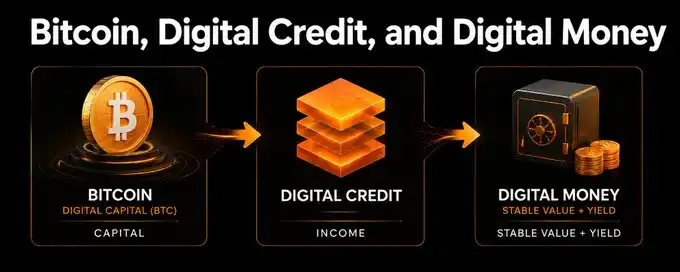
The Modern Digital Asset Stack

Bitcoin is digital capital.

This is the foundation of the entire modern digital economy.

Bitcoin is scarce, globally liquid, highly tradeable, programmable, divisible, and auditable, accessible to anyone with an internet connection. It is not issued by a government, not controlled by a corporation, has no tenants, no maintenance costs, no borders, no physical address, no board of directors, and no central bank can dilute it.

It is the foundational layer of digital value.

But capital itself is just the starting point.

The next stage for Bitcoin is not merely holding BTC, but building an entire digital capital stack on top of it: Digital Capital, Digital Credit, Digital Currency, Digital Yield, and Digital Equity.

This is how Bitcoin evolves from a single asset into a global financial architecture.

Bitcoin remains Bitcoin. The world builds on top of it.

The Stack Has Five Layers

The modern digital asset stack consists of five layers.

Layer One: Digital Capital, which is BTC—the pure, scarce, high-energy capital asset.

Layer Two: Digital Credit, instruments like STRC, yield-generating instruments backed by Bitcoin, designed to dampen volatility and provide yield.

Layer Three: Digital Currency, a stable-value, interest-bearing instrument. It is pegged to a currency like the US dollar and can take the form of tokens, funds, preferred securities, accounts, or other wrappers, fundamentally a combination of digital credit and fiat cash equivalents.

Layer Four: Digital Yield, leveraged or structured yield products. For investors willing to accept more risk, leverage, volatility, or illiquidity.

Layer Five: Digital Equity, like the residual equity of MSTR. It is the junior tranche that absorbs volatility, supports the entire credit structure, and captures the residual upside.

This is not a protocol change, not staking, not monetary inflation, and not another new token pretending to be Bitcoin. This is capital markets built on Bitcoin.

Layer One: Digital Capital - BTC

At the bottom of the stack is BTC.

BTC is the digital equivalent of gold, landmark real estate, and sovereign reserve assets, but with superior liquidity, divisibility, scarcity, and global settlement capabilities. It is the highest-energy asset in this system.

High energy leads to volatility. Bitcoin can swing dramatically precisely because it is pure digital capital: scarce, liquid, global, and traded 24/7. This volatility is not a bug; it is the raw material for building digital capital markets.

But not every investor can hold raw BTC directly. Family offices want capital appreciation, corporations want treasury reserves, banks want collateral, insurers want yield, retirees want interest, payment companies want stable settlement, crypto exchanges want a dollar-like asset that truly pays interest to users, and savers in emerging markets want dollars, liquidity, and yield.

A 40% volatility asset is perfect for some investors and completely unsuitable for others.

The answer is not to change Bitcoin, but to build products on top of it that match the needs of each type of capital.

Layer Two: Digital Credit - Bitcoin-Backed Yield

Digital Credit transforms high-volatility digital capital into lower-volatility yield.

STRC is an example: a senior, high-yield, short-duration yield instrument issued by a Bitcoin-backed company. BTC provides the long-term capital foundation, Digital Equity absorbs residual volatility, and Digital Credit sits above equity, paying a yield to investors who want income without directly bearing BTC's volatility.

The key is not that Digital Credit always has a fixed, single-digit volatility. It doesn't.

Credit instruments have low volatility in normal markets and higher volatility in stressed markets. Spreads widen, liquidity changes, rates move, issuer perception shifts, and market structures evolve.

A more accurate description is: Digital Credit is designed to dampen the volatility of Digital Capital.

It achieves this through capital structure, seniority, yield, par mechanisms, liquidity support, and a layer of junior equity cushion. The goal is to convert the raw, high-volatility capital energy of BTC into a more stable stream of yield suitable for credit investors.

Finance professionals have long understood this logic. A mortgage is not a house, a municipal bond is not a city, a corporate bond is not common stock, and a preferred security is not the equity beneath it. An asset can be volatile, while the credit layer can be far less so.

The purpose of Digital Credit is not to eliminate risk, but to allocate it intelligently. Equity holders accept residual volatility and upside, credit holders take yield and a more senior claim, and digital currency holders achieve another layer of stability and liquidity. Each investor picks the risk tranche matching their mandate.

Bitcoin itself does not need to generate yield. No staking, no inflation, no protocol changes, no need to become Ethereum. Yield is created by the capital structure on top of Bitcoin, not by degrading Bitcoin.

This distinction is crucial.

Layer Three: Digital Currency - Stable-Value Money Built on Digital Credit

Digital Currency is the next layer.

It is a stable-value, daily redeemable instrument that functions like money while paying a meaningful yield. Depending on jurisdiction, distribution channel, and investor type, it can be structured as a token, fund, preferred security, account, or other regulated wrapper.

The concept is simple: combine Digital Credit with fiat cash equivalents. Digital Credit serves as the yield engine, fiat cash equivalents provide liquidity and stability, the structure itself manages duration, redemptions, credit exposure, reserves, and market risk, and the holder gets a stable-value asset that yields interest.

For example, a product might hold Bitcoin-backed Digital Credit yielding around 10%-12%, combined with Treasury bills, money market funds, repos, or bank reserves. After deducting for liquidity reserves, fees, and risk buffers, the target yield for this Digital Currency instrument might land in the 6%-8% range.

This is the breakthrough. Digital Capital becomes Digital Credit, Digital Credit combined with fiat liquidity becomes Digital Currency.

This is how a Bitcoin-backed, stable-value instrument can pay interest. It's not magic; it's structured finance.

BTC is the capital asset, Digital Equity is the first-loss and upside layer, Digital Credit is the yield layer, and Digital Currency is the stable-value liquidity layer. The entire stack transforms Bitcoin's raw volatility into useful financial products without touching Bitcoin itself.

Stable-Value Does Not Equal Risk-Free

This distinction is important.

Digital Currency should not be described as risk-free or sold as an unconditional guarantee. It should be described as: designed to maintain stable value through reserves, liquidity, credit structure, transparency, and risk management.

A well-designed Digital Currency product should be scrutinized with the same questions finance professionals use to evaluate any money market, stablecoin, or short-duration credit product: What are the underlying assets? What is the credit exposure? How much liquidity reserve is there? What is the duration? How does redemption work? What is the seniority? What is the collateral? What is the transparency? Who bears the first loss? How does it perform under stress?

This scrutiny is healthy.

Digital Currency does not eliminate risk; it packages, discloses, manages, and prices risk into a form useful for savers, businesses, payment networks, exchanges, and institutions.

Why Digital Currency Pegs to Fiat

Many Bitcoin believers will ask: Why should Digital Currency peg to the dollar or another fiat currency?

Because the world's debts are still denominated in fiat.

Salaries are calculated in dollars, euros, yen, pesos, and local currencies. Invoices are in fiat. Taxes are in fiat. Mortgages are in fiat. Credit card bills are in fiat. Corporate accounting is in fiat. The banking system, insurance contracts, payroll systems, and financial statements are all fiat-denominated.

Most people do not want their checking account to swing 5% in a day. They want a stable unit of account.

This is why stablecoins found product-market fit. The world wants digital dollars because the dollar remains the dominant unit of account in global commerce.

But the current stablecoin model is incomplete. Stablecoins provide digital liquidity, but holders often do not receive the full economic benefit of the reserve yield. Bank deposits are convenient but typically offer little yield. Money market funds yield but lack native, 24/7 digital transferability. Staked assets yield but require users to accept crypto price volatility and protocol risk.

Digital Currency can combine the best attributes: stable value, digital transferability, daily liquidity, transparent reserves, meaningful yield, and a Bitcoin-backed capital structure.

The fiat peg solves the unit of account problem; Bitcoin solves the capital preservation problem. The dollar is the measuring stick; Bitcoin is the power source.

The Ideal Monetary Experience

Good money should fulfill three functions: medium of exchange, store of value, and unit of account.

BTC is the strongest long-term store of value, but for most of the world, it is not yet a unit of account. Digital Currency solves this bridge problem.

A dollar-pegged, Bitcoin-backed, interest-bearing Digital Currency instrument can act as a medium of exchange because it is stable and transferable; act as a store of value for those measuring in fiat because it yields rather than sitting idle; and function as a unit of account because it is denominated in the currency people already use to price salaries, bills, taxes, and debt.

This is not a rejection of Bitcoin; it is a bridge from the fiat world to the Bitcoin world.

This is Bitcoin's Killer Use Case

Bitcoin's killer use case is not just payments.

The true killer use case is rebuilding the world's currency, credit, and capital markets on a foundation of digital capital.

Bitcoin is the superior asset, but the world does not consist of only one type of investor. Some want raw BTC, some want yield, some want stable value, some want collateral, some want leverage, some want payments, some want growth equity, some want treasury reserves, and some want a dollar balance they can transfer instantly that also pays interest.

The Digital Asset Stack allows Bitcoin to serve all of them. BTC serves capital allocators, Digital Credit serves yield investors, Digital Currency serves savers and payment users, Digital Yield serves return-seeking investors, and Digital Equity serves growth investors. The same Bitcoin foundation supports every layer.

This is how Bitcoin expands from a trillion-dollar asset into a global financial system.

Bitcoin does not need to replace all fiat currencies directly tomorrow. It can back the tools the world already uses today: dollars, credit, accounts, funds, securities, payment assets, treasury products. This is the bridge.

Why This Makes Sense to Finance Professionals

For finance professionals, this framework should look familiar.

The innovation is not that risk disappears, but that Bitcoin becomes the foundational collateral and capital asset for a modern, layered financial system.

Traditional finance has long layered risk: common equity, preferred equity, senior debt, secured credit, money market instruments, levered funds, structured products, bank deposits, payment balances. The Digital Asset Stack applies the same logic to Bitcoin.

The key variables are all standard: seniority, collateralization ratio, liquidity, duration, yield, credit spreads, redemption rights, market depth, disclosure, regulatory treatment, accounting treatment, tax treatment, counterparty exposure.

Bitcoin introduces a superior foundational asset, and capital markets transform that asset into products tailored to different mandates.

This is not anti-finance; it's better finance.

Why This Makes Sense to Bitcoin Investors

For Bitcoin investors, the most important principle is simple: Bitcoin remains Bitcoin.

No protocol changes, no base-layer yield, no staking, no inflation, no touching the 21 million supply cap, no one is forced to abandon self-custody.

Those who want pure BTC can hold pure BTC. Those who want to run nodes can run nodes. Those who want self-custody can self-custody.

The Digital Asset Stack does not compromise Bitcoin's core principles; it merely extends its reach. This is disciplined expansion. The base layer should remain sacred; most innovation should happen on top of it: custody, applications, securities, credit instruments, payment systems, wallets, exchanges, funds, capital markets.

This is how Bitcoin serves billions without forcing everyone into a single, narrow adoption model. It can be a personal self-custodied money, a corporate digital capital, a bank's collateral, a nation's reserve, a family's property, a market's infrastructure, and hope for anyone in economic hardship.

The world builds on Bitcoin because Bitcoin deserves to be built upon.

Why This Makes Sense to MSTR Investors

For MSTR investors, the Digital Asset Stack explains the role of Digital Equity.

Digital Equity is the junior tranche. It absorbs volatility, supports the credit structure, benefits from BTC appreciation, captures residual upside after senior debt is satisfied, and provides the capital structure that makes Digital Credit and Digital Currency possible.

An equity like MSTR is not BTC, is not STRC, is not Digital Currency. Each has a different role.

BTC is Digital Capital, an STRC-like security is Digital Credit, Digital Currency is stable-value yield, Digital Yield is amplified yield, and MSTR-like common stock is Digital Equity.

Equity is more volatile because it is a residual claim; credit is less volatile because it is senior; currency is designed to be more stable because it combines credit with liquidity reserves. This is the logic of a capital stack.

Digital Equity makes the upper layers possible because someone must always bear the residual risk and earn the residual return.

Why This Makes Sense to Crypto Innovators

For crypto innovators, Digital Currency is a major opportunity.

Stablecoins proved the world wants digital fiat. DeFi proved users want yield. Exchanges proved global markets want 24/7 liquidity. Wallets proved value can move at internet speed. Bitcoin proved digital scarcity can be secure, decentralized, and global.

The next step is to combine these breakthroughs into a better product.

A Bitcoin-backed, interest-bearing, stable-value dollar instrument could become the native asset for wallets, exchanges, payment networks, fintech apps, DeFi protocols, treasury platforms, and global commerce.

It can compete with stablecoins that pay users almost no interest, with bank deposits that pocket the spread, with money market funds that yield but lack native digital transferability, and with staked assets that require users to accept token volatility to earn yield.

This is constructive competition. Crypto does not need more speculation for speculation's sake. It needs useful, durable, transparent, yield-bearing financial products that solve real problems for real users. Digital Currency is one of those.

Digital Yield: Not Money, But Useful

Above Digital Currency is Digital Yield.

Digital Yield is not money; it is an investment product.

It can be structured using leveraged digital credit, leveraged digital currency, structured funds, private vehicles, or other instruments, targeting investors seeking higher returns who are willing to accept higher risk, leverage, volatility, or illiquidity.

A leveraged digital currency strategy might target returns significantly higher than its unleveraged counterpart. But that is not a checking account, not a stablecoin, not a savings product for everyone. That is Digital Yield.

This distinction is important. Digital Currency is for stability, liquidity, payments, savings, and working capital. Digital Yield is for sophisticated investors seeking amplified returns. Digital Equity is for investors seeking residual upside. The power of the stack lies in the clarity of each product's role.

The Three-Layer Breakthrough

The key innovation is this three-layer transformation.

Digital Capital: High-volatility, high-energy BTC.

Digital Credit: Bitcoin-backed yield, designed through seniority, structure, yield, and equity support to dampen a significant portion of BTC's volatility.

Digital Currency: Combining Digital Credit with fiat cash equivalents and liquidity reserves to create a stable-value, interest-bearing instrument.

This is the breakthrough. Bitcoin gives us the world's strongest digital capital asset, capital markets transform that asset into credit, and credit plus liquidity reserves transforms that yield into currency.

The world doesn't need everyone to price coffee in satoshis tomorrow. The world today needs better money: money that moves at internet speed, remains stable in the user's unit of account, pays meaningful yield, and is ultimately powered by the strongest digital capital asset ever created.

That is Digital Currency.

Why This is Good for BTC

Digital Currency increases the utility of BTC.

Every dollar of Digital Currency built on Bitcoin-backed credit creates incremental demand for Bitcoin-backed capital structures, creating new reasons to hold BTC, finance BTC, custody BTC, audit BTC, insure BTC, and build services around BTC.

It also brings Bitcoin exposure to investors who cannot handle the volatility of raw Bitcoin. Retirees may not want raw BTC volatility, corporations may not, banks may not, payment companies may not. But they may want a stable-value dollar asset yielding 6%-8% and backed by Bitcoin-backed digital credit.

This brings new capital into the Bitcoin ecosystem. More capital means more adoption, more adoption means more liquidity, more liquidity means greater resilience, and greater resilience means a stronger Bitcoin.

Why This is Good for the Crypto Industry

The crypto industry needs a better monetary foundation.

Many crypto users want dollars, many crypto investors want yield, many crypto builders want programmable assets, many crypto platforms want liquid collateral, and many crypto applications need a stable unit of account.

Digital Currency built on Bitcoin-backed credit gives the industry a better foundational product: a stable-value, interest-bearing digital dollar powered by Bitcoin.

It can live on exchanges, in wallets, in funds, in accounts, on payment networks, and eventually wherever digital value flows. It doesn't force users to choose between zero-yield stablecoins and volatile staked tokens; it gives them another option: stable-value, yield-bearing digital currency built on Bitcoin-backed capital. This is good for crypto.

Why This is Good for Investors

Investors should not be forced into a single risk tranche.

The Digital Asset Stack gives every investor a choice. Want digital capital? Hold BTC. Want digital credit? Hold STRC-like instruments. Want digital currency? Hold stable-value, yield-bearing instruments. Want digital yield? Hold leveraged or structured products. Want digital equity? Hold MSTR-like common stock.

It's a full menu. Savers can hold digital currency, yield investors can hold digital credit, growth investors can hold digital equity, long-term believers can hold BTC, and sophisticated investors can hold digital yield. The same Bitcoin foundation supports everyone. This is how Bitcoin becomes accessible to every mandate.

Why This is Good for the World

The world needs better money.

Billions want dollars because they are liquid, familiar, and widely accepted. But they also want yield, transparency, liquidity, and protection from debasement erosion.

Today, many are forced to choose between unstable local currencies, low-yield bank deposits, zero-yield stablecoins, volatile crypto assets, or financial products they cannot access.

Digital Currency can improve this. It can offer stable value, digital liquidity, daily redemptions, and meaningful yield. It can help savers, businesses, payment companies, emerging markets, exchanges, institutions, and anyone who wants better money but doesn't want the volatility of raw BTC.

The analog world built its economy on gold, real estate, banks, deposits, credit, equity, funds, and payment networks. The digital world will be built on BTC, digital credit, digital currency, digital yield, and digital equity.

Bitcoin is digital capital. Digital credit transforms it into yield. Digital currency transforms it into daily utility. Digital yield amplifies it. Digital equity finances it.

The foundation layer remains sacred; the capital stack remains open.

This is the modern Digital Asset Stack. This is how Bitcoin becomes the foundation for a better financial system.


Preguntas relacionadas

QAccording to Michael Saylor, what is Bitcoin in his 'Modern Digital Asset Stack' theory?

AIn Michael Saylor's 'Modern Digital Asset Stack' theory, Bitcoin is the foundational layer called 'Digital Capital.' It is characterized as a purely scarce, high-energy capital asset that serves as the bedrock for the entire modern digital economy, akin to digital gold or sovereign reserve assets.

QWhat are the five layers of the Modern Digital Asset Stack described by Saylor?

AThe five layers are: 1. Digital Capital (BTC), 2. Digital Credit (e.g., tools like STRC for yield), 3. Digital Currency (stable-value, yield-bearing instruments), 4. Digital Yield (leveraged or structured yield products), and 5. Digital Equity (e.g., MSTR's residual equity).

QWhy does Saylor's model propose that Digital Currency should be pegged to a fiat currency like the US dollar?

ASaylor argues that Digital Currency should be pegged to a fiat currency like the US dollar because the world's existing financial obligations (wages, taxes, debts, contracts) are denominated in fiat. A stable unit of account is essential for daily commerce, and a dollar-pegged, yield-bearing digital currency bridges the gap between the traditional financial world and the Bitcoin ecosystem.

QWhat role does Digital Equity (like MSTR stock) play in the Digital Asset Stack according to the article?

ADigital Equity, such as MSTR stock, acts as the subordinated or 'first-loss' layer in the stack. It absorbs volatility, supports the credit structure above it, and captures the residual upside after senior debt obligations are met. It provides the capital structure that makes the creation of Digital Credit and Digital Currency possible.

QHow does Saylor argue that the Digital Asset Stack model benefits the broader cryptocurrency industry?

ASaylor argues that the industry needs a better monetary foundation. This model provides a superior foundational product: a stable-value, yield-bearing digital dollar (Digital Currency) backed by Bitcoin capital. It offers users an alternative to zero-yield stablecoins or volatile staking tokens, integrates with wallets and exchanges, and brings new capital into the Bitcoin ecosystem through structured financial products.

Lecturas Relacionadas

Standard Chartered Bank Places a 40x 'Bet', Calls for UNI to Rise to $100

Standard Chartered Bank’s digital asset research head, Geoff Kendrick, initiated coverage on Uniswap with a highly bullish long-term price target of $100 for its UNI token by 2030—a roughly 40-fold increase from its ~$2.60 trading price at the time of the report. The bank’s thesis hinges on the exponential growth of tokenized real-world assets (RWA), projected to surge from ~$340 billion to $4 trillion by 2028. It expects the share of these assets deployed in DeFi to rise from 3.5% to 30%, driving total DeFi TVL to around $2.7 trillion. As the leading decentralized exchange (DEX), Uniswap is positioned to capture a significant portion of this liquidity influx. A key catalyst is Uniswap’s “fee switch,” activated in late 2024, which directs a portion of protocol fees to UNI token buybacks and burns. This transforms UNI from a pure governance token into a yield-generating, deflationary asset, narrowing its valuation gap with centralized exchanges like Coinbase. The report draws an analogy: Coinbase operates like Netflix (centralized, high-cost), while Uniswap functions like YouTube (open, user-generated, network-effect driven). Despite its dominant market share and recent institutional adoption—such as BlackRock’s BUIDL fund and Fidelity’s stablecoin using Uniswap for liquidity—the path faces challenges. Competition from Solana-based DEXs and aggregators threatens user mindshare, while regulatory delays or setbacks in RWA adoption could slow the projected growth. Furthermore, UNI remains down over 92% from its 2021 peak, reflecting persistent market skepticism. Ultimately, Standard Chartered’s report signals a shift in traditional finance’s perception of DeFi, valuing network effects and cash flow potential. However, realizing the $100 target depends on Uniswap successfully navigating intense competition, regulatory hurdles, and the multi-year timeline for massive tokenized asset adoption.

marsbitHace 9 min(s)

Standard Chartered Bank Places a 40x 'Bet', Calls for UNI to Rise to $100

marsbitHace 9 min(s)

For Those Still Obsessed with Altcoins, Just Go All-in on HOOD

Title: "For Those Still Fixated on Altcoins, Just Bet on HOOD" The article argues that Robinhood (HOOD) stock is a compelling alternative for investors still holding onto hopes for altcoin rallies. It highlights HOOD's recent strong performance, briefly touching $100, and expresses continued optimism. The bullish thesis is multi-faceted: HOOD's operational data for May showed record highs in key metrics like total assets and funded customers, though crypto volume was weaker. Positive catalysts include Robinhood launching its own prediction market (Rothera) to capture more revenue, gaining approval to act as an IPO underwriter for major upcoming listings, and being selected to manage the new "Trump Account" government savings program for millions of future US newborns. Insider and institutional buying, along with raised price targets, provide further confidence. The core argument is that HOOD is successfully decoupling from the crypto market's fortunes. While crypto-related revenue was once a major contributor, its share of total revenue has been declining, hitting 13% in Q1 2026. Although HOOD's price historically moved with Bitcoin, a recent divergence is noted. The author posits that Robinhood's growing equity trading, prediction markets, and IPO-related businesses can drive growth independently of a crypto bull market. Thus, HOOD offers asymmetric exposure: it stands to benefit if the crypto market recovers but is no longer wholly dependent on it. For those disillusioned with altcoins' risks, HOOD presents a potentially safer way to maintain exposure to the fintech and speculative trading space.

marsbitHace 17 min(s)

For Those Still Obsessed with Altcoins, Just Go All-in on HOOD

marsbitHace 17 min(s)

For Those Still Obsessed with Altcoins, Just Buy HOOD

The author expresses bullish sentiment on Robinhood (HOOD) stock, citing multiple positive catalysts. Recent monthly operational data shows record highs in key metrics like total assets, funded customers, and margin balances. On the news front, Robinhood launched its own prediction market (Rothera), received approval to act as an IPO underwriter, and was selected to manage the new "Trump Accounts" for U.S. newborns, ensuring a long-term user base. Insiders and institutions are also buying or raising price targets. The core investment thesis, however, focuses on HOOD's evolving valuation narrative. Historically viewed as a "crypto proxy," its stock price was highly correlated with Bitcoin and its revenue heavily dependent on cryptocurrency trading fees. Recent data indicates this dependence is waning: crypto-related revenue hit a multi-quarter low of 13% of total revenue in Q1 2026, and the stock price has recently decoupled from BTC's trend. The author argues HOOD is transforming into a more diversified platform. Its growth is now driven by equities, options, prediction markets, and IPO-related services. This reduces its cyclical vulnerability to crypto bear markets. Crucially, if the crypto market recovers, HOOD would still benefit from increased trading activity. Therefore, for investors still hoping for gains from altcoins but concerned about their risks and liquidity, the author suggests HOOD offers a compelling alternative with higher safety margins—it can rise with a crypto bull run but isn't reliant on one.

Odaily星球日报Hace 22 min(s)

For Those Still Obsessed with Altcoins, Just Buy HOOD

Odaily星球日报Hace 22 min(s)

Cryptocurrency & Stock Market Indicator丨SpaceX Discloses Holding 18,712 Bitcoins Worth $1.18 Billion; Strategy Spends $100 Million Two Weeks in a Row to Scoop Up BTC at Low Levels (June 16)

"Coin-Stock Barometer: SpaceX discloses holding 18,712 Bitcoin worth $1.18B; Strategy spends another $100M accumulating BTC (June 16) SpaceX has officially disclosed holding 18,712 Bitcoin in its S-1 filing, valued at ~$1.18B, becoming the 8th largest public company Bitcoin holder. Its average cost is ~$35,000 per BTC. In weekly BTC treasury news, Strategy (formerly MicroStrategy) purchased another 1,587 BTC (~$100M) last week, increasing its total to 846,842 BTC. Mara Holdings added 1,000 BTC. However, Metaplanet and others made no purchases. Nakamoto sold ~600 BTC to repay ~$45M in debt. Global public companies (excluding miners) now hold 1,121,341 BTC. In other crypto treasury developments: - Metaplanet acquired Siiibo Securities to build a Bitcoin-focused financial ecosystem in Japan. - Bitmine increased its ETH holdings by 76,881 last week. - SharpLink's cumulative ETH staking rewards surpassed 21,119 ETH. - Forward Industries' acquisition offers for two SOL treasury companies, including Brera Holdings (holding 2.1M SOL), were rejected. - Tron Inc.'s TRX holdings surpassed 700 million. - Avalanche Treasury Co. (AVAT) begins trading on Nasdaq. - AIFC detailed plans to use WLFI tokens for collateral/loans. Market perspectives on U.S. stocks vary. 'White-Haired Stock God' Serenity sees the current cycle as retail-to-institution transfers, where negative reports may signal institutional accumulation. Morgan Stanley suggests a rotation from tech to cyclical stocks could occur. Citrini believes the U.S. stock market hasn't peaked but expects frequent 10-15% pullbacks in the coming months."

marsbitHace 27 min(s)

Cryptocurrency & Stock Market Indicator丨SpaceX Discloses Holding 18,712 Bitcoins Worth $1.18 Billion; Strategy Spends $100 Million Two Weeks in a Row to Scoop Up BTC at Low Levels (June 16)

marsbitHace 27 min(s)

Trading

Spot
Futuros

Artículos destacados

Qué es $S$

Entendiendo SPERO: Una Visión General Completa Introducción a SPERO A medida que el panorama de la innovación continúa evolucionando, la aparición de tecnologías web3 y proyectos de criptomonedas juega un papel fundamental en la configuración del futuro digital. Un proyecto que ha atraído la atención en este campo dinámico es SPERO, denotado como SPERO,$$s$. Este artículo tiene como objetivo reunir y presentar información detallada sobre SPERO, para ayudar a entusiastas e inversores a comprender sus fundamentos, objetivos e innovaciones dentro de los dominios web3 y cripto. ¿Qué es SPERO,$$s$? SPERO,$$s$ es un proyecto único dentro del espacio cripto que busca aprovechar los principios de descentralización y tecnología blockchain para crear un ecosistema que promueva la participación, la utilidad y la inclusión financiera. El proyecto está diseñado para facilitar interacciones de igual a igual de nuevas maneras, proporcionando a los usuarios soluciones y servicios financieros innovadores. En su esencia, SPERO,$$s$ tiene como objetivo empoderar a los individuos al proporcionar herramientas y plataformas que mejoren la experiencia del usuario en el espacio de las criptomonedas. Esto incluye habilitar métodos de transacción más flexibles, fomentar iniciativas impulsadas por la comunidad y crear caminos para oportunidades financieras a través de aplicaciones descentralizadas (dApps). La visión subyacente de SPERO,$$s$ gira en torno a la inclusividad, buscando cerrar brechas dentro de las finanzas tradicionales mientras aprovecha los beneficios de la tecnología blockchain. ¿Quién es el Creador de SPERO,$$s$? La identidad del creador de SPERO,$$s$ sigue siendo algo oscura, ya que hay recursos públicos limitados que proporcionan información de fondo detallada sobre su(s) fundador(es). Esta falta de transparencia puede derivarse del compromiso del proyecto con la descentralización, una ética que muchos proyectos web3 comparten, priorizando las contribuciones colectivas sobre el reconocimiento individual. Al centrar las discusiones en torno a la comunidad y sus objetivos colectivos, SPERO,$$s$ encarna la esencia del empoderamiento sin señalar a individuos específicos. Como tal, comprender la ética y la misión de SPERO sigue siendo más importante que identificar a un creador singular. ¿Quiénes son los Inversores de SPERO,$$s$? SPERO,$$s$ cuenta con el apoyo de una diversa gama de inversores que van desde capitalistas de riesgo hasta inversores ángeles dedicados a fomentar la innovación en el sector cripto. El enfoque de estos inversores generalmente se alinea con la misión de SPERO, priorizando proyectos que prometen avances tecnológicos sociales, inclusión financiera y gobernanza descentralizada. Estas fundaciones de inversores suelen estar interesadas en proyectos que no solo ofrecen productos innovadores, sino que también contribuyen positivamente a la comunidad blockchain y sus ecosistemas. El respaldo de estos inversores refuerza a SPERO,$$s$ como un contendiente notable en el dominio de proyectos cripto que evoluciona rápidamente. ¿Cómo Funciona SPERO,$$s$? SPERO,$$s$ emplea un marco multifacético que lo distingue de los proyectos de criptomonedas convencionales. Aquí hay algunas de las características clave que subrayan su singularidad e innovación: Gobernanza Descentralizada: SPERO,$$s$ integra modelos de gobernanza descentralizada, empoderando a los usuarios para participar activamente en los procesos de toma de decisiones sobre el futuro del proyecto. Este enfoque fomenta un sentido de propiedad y responsabilidad entre los miembros de la comunidad. Utilidad del Token: SPERO,$$s$ utiliza su propio token de criptomoneda, diseñado para servir diversas funciones dentro del ecosistema. Estos tokens permiten transacciones, recompensas y la facilitación de servicios ofrecidos en la plataforma, mejorando la participación y la utilidad general. Arquitectura en Capas: La arquitectura técnica de SPERO,$$s$ apoya la modularidad y escalabilidad, permitiendo la integración fluida de características y aplicaciones adicionales a medida que el proyecto evoluciona. Esta adaptabilidad es fundamental para mantener la relevancia en el cambiante paisaje cripto. Participación de la Comunidad: El proyecto enfatiza iniciativas impulsadas por la comunidad, empleando mecanismos que incentivan la colaboración y la retroalimentación. Al nutrir una comunidad sólida, SPERO,$$s$ puede abordar mejor las necesidades de los usuarios y adaptarse a las tendencias del mercado. Enfoque en la Inclusión: Al ofrecer tarifas de transacción bajas e interfaces amigables para el usuario, SPERO,$$s$ busca atraer a una base de usuarios diversa, incluyendo a individuos que anteriormente pueden no haber participado en el espacio cripto. Este compromiso con la inclusión se alinea con su misión general de empoderamiento a través de la accesibilidad. Cronología de SPERO,$$s$ Entender la historia de un proyecto proporciona información crucial sobre su trayectoria de desarrollo y hitos. A continuación se presenta una cronología sugerida que mapea eventos significativos en la evolución de SPERO,$$s$: Fase de Conceptualización e Ideación: Las ideas iniciales que forman la base de SPERO,$$s$ fueron concebidas, alineándose estrechamente con los principios de descentralización y enfoque comunitario dentro de la industria blockchain. Lanzamiento del Whitepaper del Proyecto: Tras la fase conceptual, se lanzó un whitepaper completo que detalla la visión, los objetivos y la infraestructura tecnológica de SPERO,$$s$ para generar interés y retroalimentación de la comunidad. Construcción de Comunidad y Primeras Interacciones: Se realizaron esfuerzos de divulgación activa para construir una comunidad de primeros adoptantes y posibles inversores, facilitando discusiones en torno a los objetivos del proyecto y obteniendo apoyo. Evento de Generación de Tokens: SPERO,$$s$ llevó a cabo un evento de generación de tokens (TGE) para distribuir sus tokens nativos a los primeros seguidores y establecer liquidez inicial dentro del ecosistema. Lanzamiento de la dApp Inicial: La primera aplicación descentralizada (dApp) asociada con SPERO,$$s$ se puso en marcha, permitiendo a los usuarios interactuar con las funcionalidades centrales de la plataforma. Desarrollo Continuo y Alianzas: Actualizaciones y mejoras continuas a las ofertas del proyecto, incluyendo alianzas estratégicas con otros actores en el espacio blockchain, han moldeado a SPERO,$$s$ en un jugador competitivo y en evolución en el mercado cripto. Conclusión SPERO,$$s$ se erige como un testimonio del potencial de web3 y las criptomonedas para revolucionar los sistemas financieros y empoderar a los individuos. Con un compromiso con la gobernanza descentralizada, la participación comunitaria y funcionalidades diseñadas de manera innovadora, allana el camino hacia un paisaje financiero más inclusivo. Como con cualquier inversión en el espacio cripto que evoluciona rápidamente, se anima a los posibles inversores y usuarios a investigar a fondo y participar de manera reflexiva con los desarrollos en curso dentro de SPERO,$$s$. El proyecto muestra el espíritu innovador de la industria cripto, invitando a una mayor exploración de sus innumerables posibilidades. Mientras el viaje de SPERO,$$s$ aún se desarrolla, sus principios fundamentales pueden, de hecho, influir en el futuro de cómo interactuamos con la tecnología, las finanzas y entre nosotros en ecosistemas digitales interconectados.

73 Vistas totalesPublicado en 2024.12.17Actualizado en 2024.12.17

Qué es $S$

Qué es AGENT S

Agent S: El Futuro de la Interacción Autónoma en Web3 Introducción En el paisaje en constante evolución de Web3 y las criptomonedas, las innovaciones están redefiniendo constantemente cómo los individuos interactúan con las plataformas digitales. Uno de estos proyectos pioneros, Agent S, promete revolucionar la interacción humano-computadora a través de su marco agente abierto. Al allanar el camino para interacciones autónomas, Agent S busca simplificar tareas complejas, ofreciendo aplicaciones transformadoras en inteligencia artificial (IA). Esta exploración detallada profundizará en las complejidades del proyecto, sus características únicas y las implicaciones para el dominio de las criptomonedas. ¿Qué es Agent S? Agent S se presenta como un marco agente abierto innovador, diseñado específicamente para abordar tres desafíos fundamentales en la automatización de tareas informáticas: Adquisición de Conocimiento Específico del Dominio: El marco aprende inteligentemente de diversas fuentes de conocimiento externas y experiencias internas. Este enfoque dual le permite construir un rico repositorio de conocimiento específico del dominio, mejorando su rendimiento en la ejecución de tareas. Planificación a Largo Plazo de Tareas: Agent S emplea planificación jerárquica aumentada por la experiencia, un enfoque estratégico que facilita la descomposición y ejecución eficiente de tareas complejas. Esta característica mejora significativamente su capacidad para gestionar múltiples subtareas de manera eficiente y efectiva. Manejo de Interfaces Dinámicas y No Uniformes: El proyecto introduce la Interfaz Agente-Computadora (ACI), una solución innovadora que mejora la interacción entre agentes y usuarios. Utilizando Modelos de Lenguaje Multimodal de Gran Escala (MLLMs), Agent S puede navegar y manipular diversas interfaces gráficas de usuario sin problemas. A través de estas características pioneras, Agent S proporciona un marco robusto que aborda las complejidades involucradas en la automatización de la interacción humana con las máquinas, preparando el terreno para una multitud de aplicaciones en IA y más allá. ¿Quién es el Creador de Agent S? Si bien el concepto de Agent S es fundamentalmente innovador, la información específica sobre su creador sigue siendo elusiva. El creador es actualmente desconocido, lo que resalta ya sea la etapa incipiente del proyecto o la elección estratégica de mantener a los miembros fundadores en el anonimato. Independientemente de la anonimidad, el enfoque sigue siendo en las capacidades y el potencial del marco. ¿Quiénes son los Inversores de Agent S? Dado que Agent S es relativamente nuevo en el ecosistema criptográfico, la información detallada sobre sus inversores y patrocinadores financieros no está documentada explícitamente. La falta de información disponible públicamente sobre las bases de inversión u organizaciones que apoyan el proyecto plantea preguntas sobre su estructura de financiamiento y hoja de ruta de desarrollo. Comprender el respaldo es crucial para evaluar la sostenibilidad del proyecto y su posible impacto en el mercado. ¿Cómo Funciona Agent S? En el núcleo de Agent S se encuentra una tecnología de vanguardia que le permite funcionar de manera efectiva en diversos entornos. Su modelo operativo se basa en varias características clave: Interacción Humano-Computadora Similar a la Humana: El marco ofrece planificación avanzada de IA, esforzándose por hacer que las interacciones con las computadoras sean más intuitivas. Al imitar el comportamiento humano en la ejecución de tareas, promete elevar las experiencias de los usuarios. Memoria Narrativa: Empleada para aprovechar experiencias de alto nivel, Agent S utiliza memoria narrativa para hacer un seguimiento de las historias de tareas, mejorando así sus procesos de toma de decisiones. Memoria Episódica: Esta característica proporciona a los usuarios una guía paso a paso, permitiendo que el marco ofrezca apoyo contextual a medida que se desarrollan las tareas. Soporte para OpenACI: Con la capacidad de ejecutarse localmente, Agent S permite a los usuarios mantener el control sobre sus interacciones y flujos de trabajo, alineándose con la ética descentralizada de Web3. Fácil Integración con APIs Externas: Su versatilidad y compatibilidad con varias plataformas de IA aseguran que Agent S pueda encajar sin problemas en ecosistemas tecnológicos existentes, convirtiéndolo en una opción atractiva para desarrolladores y organizaciones. Estas funcionalidades contribuyen colectivamente a la posición única de Agent S dentro del espacio cripto, ya que automatiza tareas complejas y de múltiples pasos con una intervención humana mínima. A medida que el proyecto evoluciona, sus posibles aplicaciones en Web3 podrían redefinir cómo se desarrollan las interacciones digitales. Cronología de Agent S El desarrollo y los hitos de Agent S pueden encapsularse en una cronología que resalta sus eventos significativos: 27 de septiembre de 2024: El concepto de Agent S fue lanzado en un documento de investigación integral titulado “Un Marco Agente Abierto que Usa Computadoras Como un Humano”, mostrando las bases del proyecto. 10 de octubre de 2024: El documento de investigación fue puesto a disposición del público en arXiv, ofreciendo una exploración profunda del marco y su evaluación de rendimiento basada en el benchmark OSWorld. 12 de octubre de 2024: Se lanzó una presentación en video, proporcionando una visión visual de las capacidades y características de Agent S, involucrando aún más a posibles usuarios e inversores. Estos marcadores en la cronología no solo ilustran el progreso de Agent S, sino que también indican su compromiso con la transparencia y la participación comunitaria. Puntos Clave Sobre Agent S A medida que el marco Agent S continúa evolucionando, varios atributos clave destacan, subrayando su naturaleza innovadora y potencial: Marco Innovador: Diseñado para proporcionar un uso intuitivo de las computadoras similar a la interacción humana, Agent S aporta un enfoque novedoso a la automatización de tareas. Interacción Autónoma: La capacidad de interactuar de manera autónoma con las computadoras a través de GUI significa un salto hacia soluciones informáticas más inteligentes y eficientes. Automatización de Tareas Complejas: Con su metodología robusta, puede automatizar tareas complejas y de múltiples pasos, haciendo que los procesos sean más rápidos y menos propensos a errores. Mejora Continua: Los mecanismos de aprendizaje permiten a Agent S mejorar a partir de experiencias pasadas, mejorando continuamente su rendimiento y eficacia. Versatilidad: Su adaptabilidad en diferentes entornos operativos como OSWorld y WindowsAgentArena asegura que pueda servir a una amplia gama de aplicaciones. A medida que Agent S se posiciona en el paisaje de Web3 y criptomonedas, su potencial para mejorar las capacidades de interacción y automatizar procesos significa un avance significativo en las tecnologías de IA. A través de su marco innovador, Agent S ejemplifica el futuro de las interacciones digitales, prometiendo una experiencia más fluida y eficiente para los usuarios en diversas industrias. Conclusión Agent S representa un audaz avance en la unión de la IA y Web3, con la capacidad de redefinir cómo interactuamos con la tecnología. Aunque aún se encuentra en sus primeras etapas, las posibilidades para su aplicación son vastas y atractivas. A través de su marco integral que aborda desafíos críticos, Agent S busca llevar las interacciones autónomas al primer plano de la experiencia digital. A medida que nos adentramos más en los reinos de las criptomonedas y la descentralización, proyectos como Agent S sin duda desempeñarán un papel crucial en la configuración del futuro de la tecnología y la colaboración humano-computadora.

486 Vistas totalesPublicado en 2025.01.14Actualizado en 2025.01.14

Qué es AGENT S

Cómo comprar S

¡Bienvenido a HTX.com! Hemos hecho que comprar Sonic (S) sea simple y conveniente. Sigue nuestra guía paso a paso para iniciar tu viaje de criptos.Paso 1: crea tu cuenta HTXUtiliza tu correo electrónico o número de teléfono para registrarte y obtener una cuenta gratuita en HTX. Experimenta un proceso de registro sin complicaciones y desbloquea todas las funciones.Obtener mi cuentaPaso 2: ve a Comprar cripto y elige tu método de pagoTarjeta de crédito/débito: usa tu Visa o Mastercard para comprar Sonic (S) al instante.Saldo: utiliza fondos del saldo de tu cuenta HTX para tradear sin problemas.Terceros: hemos agregado métodos de pago populares como Google Pay y Apple Pay para mejorar la comodidad.P2P: tradear directamente con otros usuarios en HTX.Over-the-Counter (OTC): ofrecemos servicios personalizados y tipos de cambio competitivos para los traders.Paso 3: guarda tu Sonic (S)Después de comprar tu Sonic (S), guárdalo en tu cuenta HTX. Alternativamente, puedes enviarlo a otro lugar mediante transferencia blockchain o utilizarlo para tradear otras criptomonedas.Paso 4: tradear Sonic (S)Tradear fácilmente con Sonic (S) en HTX's mercado spot. Simplemente accede a tu cuenta, selecciona tu par de trading, ejecuta tus trades y monitorea en tiempo real. Ofrecemos una experiencia fácil de usar tanto para principiantes como para traders experimentados.

1.0k Vistas totalesPublicado en 2025.01.15Actualizado en 2026.06.02

Cómo comprar S

Discusiones

Bienvenido a la comunidad de HTX. Aquí puedes mantenerte informado sobre los últimos desarrollos de la plataforma y acceder a análisis profesionales del mercado. A continuación se presentan las opiniones de los usuarios sobre el precio de S (S).

活动图片