Bitcoin Liquidation Shakeout Leaves Traders Watching $66K Resistance And $61K Support

bitcoinistPublicado a 2026-06-13Actualizado a 2026-06-13

Resumen

Bitcoin's recent volatility triggered a major liquidation event, wiping out roughly $980 million in leveraged positions within 24 hours as price swung from ~$64,100 down to $60,700 and back above $63,000. Traders are now watching key technical levels. Major pivot resistance is identified at $66,247, with reclaimed highs near $64,234 and next resistance at $65,890. Critical support zones lie between $63,127-$63,354, then $62,459, with broader downside targets around $59,150-$60,171. Liquidation heatmaps show significant liquidity clusters above ($63.5K-$66K) and below ($58.5K-$61K) spot price, creating a volatile corridor. The market is in a corrective phase; a clean break above resistance is needed for a bullish shift, while failure to hold low-$63K support risks a move toward lower liquidity zones.

TL;DR

  • Bitcoin’s sharp move from the mid-$64,000 area to near $60,700, followed by a rebound above $63,000, triggered a large leverage reset across crypto markets.
  • CryptoReviewing/status/2065076555949216117′′>CryptoReviewing said total crypto liquidations reached about $980 million in less than 24 hours, with liquidity zones now sitting both above and below spot.
  • Trade Nation’s TradingView analysis places Bitcoin’s key pivot resistance at 66,247, with downside supports at 59,150, 56,900, and 54,920.
  • A separate TradingView idea from virDeStatera points to 64,234 as the swept high to reclaim, with 65,890 as the next key resistance.

Bitcoin traders are watching a tight cluster of liquidation zones and technical levels after a sharp two-way move flushed leverage from both sides of the market.

CryptoReviewing, citing a Coinglass liquidation heatmap, said Bitcoin first dropped from $64,100 to $60,700, liquidating roughly $456 million, before rebounding back above $63,000 and triggering another $524 million in liquidations. The analyst described the combined move as roughly $980 million in crypto liquidations in less than 24 hours.
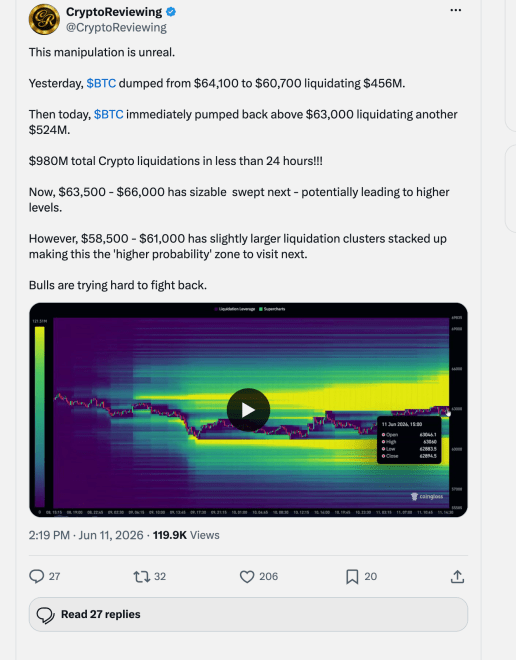
CryptoReviewing highlighted Bitcoin liquidation clusters using Coinglass heatmap data.

The word “manipulation” appeared in the original post, but the cleaner read is that this was a high-leverage market reacting violently around crowded positioning. In that kind of environment, both long and short traders can be forced out quickly as price sweeps liquidity above and below nearby ranges.

Bitcoin Liquidity Zones Sit On Both Sides

The key issue now is where the next liquidity pocket sits. CryptoReviewing pointed to the $63,500 to $66,000 region as a sizable upside zone, while also noting a slightly larger downside cluster around $58,500 to $61,000.

That creates an awkward setup for short-term traders. A push higher could force more short covering if Bitcoin breaks into the upper liquidity zone. But a failure to hold current levels could pull price back toward the lower cluster, where late longs may again be vulnerable.

Liquidation maps are not precise price forecasts. They show where leveraged positions may be concentrated, not where price must go. Still, when volatility is elevated and liquidity is thin, these levels can become magnets because forced liquidations often add fuel to already-moving markets.

Trade Nation Flags 66,247 As Pivot Resistance

A TradingView idea from Trade Nation offered a more traditional support-and-resistance framework for Bitcoin’s current pullback. The analysis described BTC as being in a corrective phase on the four-hour chart and identified 66,247 as the main pivot resistance level.

As long as Bitcoin remains below that level, Trade Nation’s downside scenario highlights 59,150 as near-term support, followed by 56,900 and 54,920. On the upside, a move above 66,247 would shift attention toward 67,950 and then 69,940.

Those levels line up reasonably well with the broader liquidation-map picture. The $59,150 support sits inside the wider $58,500 to $61,000 downside liquidity region, while the 66,247 pivot is close to the upper $63,500 to $66,000 zone identified in the heatmap post.
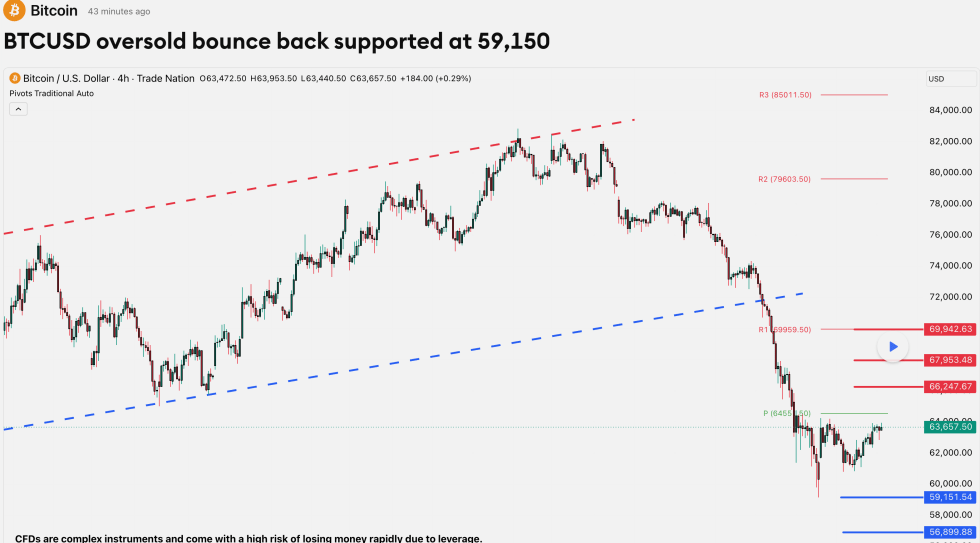
Trade Nation’s TradingView setup marked 66,247 as the main pivot resistance.

Short-Term Traders Watch The Swept High

A separate TradingView idea from virDeStatera focused on Bitcoin’s one-hour structure and argued that a new overnight high had been swept. The analysis placed that swept high at 64,234, with price pulling back toward 63,713 at the time of the post.

The same setup identified 65,890 as key resistance, with intraday support between 63,127 and 63,354. Below that, virDeStatera highlighted 62,459 as key support and 60,171 as a broader thesis line.

The technical language in the original TradingView post included several proprietary indicators, but the practical takeaway is simpler: Bitcoin needs to reclaim the swept 64,234 area with convincing volume before traders can reasonably look toward 65,890 and the broader 66,000 region.

If that reclaim fails, attention likely shifts back toward the lower support stack. The first area to watch would be the 63,127 to 63,354 band, followed by 62,459 and then the wider 60,000 to 61,000 zone flagged by liquidation data.
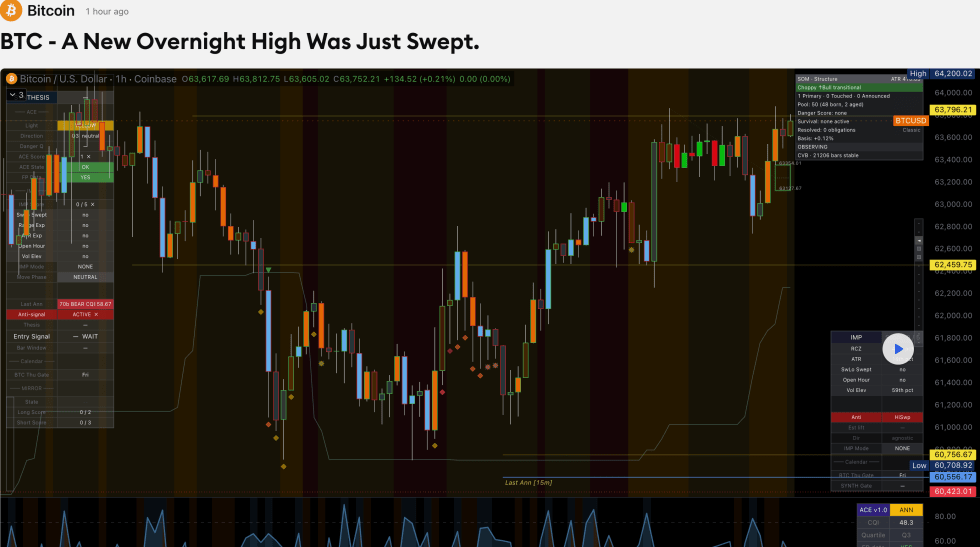
virDeStatera’s TradingView idea focused on the 64,234 swept high and nearby intraday support.

What This Means For Bitcoin Traders

The current setup does not offer a clean one-way signal. Instead, it shows a market sitting between two obvious liquidity pockets after a major leverage reset.

For bulls, reclaiming 64,234 and then pressing toward 65,890 would be the first step toward testing the 66,247 pivot and the upper liquidation zone. For bears, failure to hold above the low-$63,000 area would keep the lower support cluster in play.

That makes risk management more important than prediction. Bitcoin can move quickly when liquidation levels sit close to spot, and the recent $980 million flush shows how fast crowded positioning can unwind.

For now, the clearest map is this: resistance is stacked between roughly 64,234, 65,890, and 66,247, while downside risk builds around 63,127 to 63,354, then 62,459, and finally the broader 59,150 to 60,171 region. Until one side breaks cleanly, Bitcoin remains trapped in a short-term volatility corridor.

Originally shared by CryptoReviewing on X

Preguntas relacionadas

QWhat was the total estimated value of crypto liquidations triggered by Bitcoin's recent volatile price move, and over what time period did this occur?

AThe total estimated value of crypto liquidations was about $980 million, and this occurred in less than 24 hours.

QAccording to the article, what is the main pivot resistance level for Bitcoin identified in Trade Nation's TradingView analysis?

AThe main pivot resistance level identified by Trade Nation is $66,247.

QWhat are the two broad Bitcoin price ranges identified as liquidity clusters or zones by the analyst CryptoReviewing?

ACryptoReviewing identified an upside liquidity zone from $63,500 to $66,000, and a slightly larger downside liquidity cluster around $58,500 to $61,000.

QIn the shorter-term analysis by virDeStatera, what price level is identified as the 'swept high' that Bitcoin needs to reclaim?

AThe 'swept high' that Bitcoin needs to reclaim is at $64,234.

QBased on the article's conclusion, what is the primary focus for traders in the current Bitcoin market setup, rather than trying to predict direction?

AThe primary focus for traders should be on risk management, as the market is trapped in a short-term volatility corridor between key resistance and support levels.

Lecturas Relacionadas

Blockchain Has Finally Started to Sail into the Mainstream After 18 Years

Blockchain Finds Its True Path After 18 Years: Becoming the Financial Backbone for AI Agents and Autonomy This analysis explores a pivotal shift in the blockchain and crypto investment landscape, driven by the dominance of AI. Major venture capital firms, including Variant, Paradigm, Haun Ventures, and YZi Labs, are moving beyond pure "crypto" investment theses. They are expanding their focus to AI, robotics, and frontier tech, signaling that blockchain is no longer seen as a standalone sector but as an underlying infrastructure layer. The core argument is that blockchain's killer application may not be user-facing apps, but rather providing the economic rails for the coming wave of AI agents, autonomous robots, and automated systems. Key capabilities like self-custody wallets, programmable stablecoins for micropayments, on-chain identity, and verifiable smart contracts are positioned as essential for a future where machines conduct economic activity. The recent $1.4 billion investment by Tether (via its venture arm) in German robotics company NEURA Robotics exemplifies this, aiming to embed Tether's wallet tools directly into robots for autonomous transactions. While many "AI + Crypto" projects remain superficial, the article concludes that true value lies where crypto is a necessary component—enabling machine-to-machine payments, agent autonomy, verifiable data provenance, and open financial settlement for the AI era. For crypto venture capital, this convergence with AI represents both an adaptation to shifting capital flows and a potential path to unlocking the large-scale, non-speculative utility the industry has long sought.

marsbitHace 6 min(s)

Blockchain Has Finally Started to Sail into the Mainstream After 18 Years

marsbitHace 6 min(s)

Blockchain has finally begun sailing toward the main channel after 18 years

After 18 years of development, blockchain technology is beginning to move from a specialized niche into mainstream adoption, according to a recent industry analysis. The shift is reflected in the changing strategies of major crypto venture capital firms, which are expanding their focus beyond pure "digital ownership" towards broader themes like "autonomy." The report highlights that leading VC firms like Variant, Paradigm, Haun Ventures, and YZi Labs are broadening their investment mandates to include not only crypto but also artificial intelligence (AI), robotics, biotech, and other frontier technologies. This reflects a recognition that the isolated "crypto investment" narrative is losing appeal to limited partners (LPs) as capital and attention increasingly flow toward AI and other high-growth tech sectors. A key emerging thesis is that blockchain's most significant future application may not be as a consumer-facing product, but as the underlying economic and settlement infrastructure for the AI era. As AI agents and autonomous systems become more prevalent, they will require programmable, global, and low-cost payment networks (like stablecoins), verifiable digital identities, and secure wallets to manage transactions and assets on behalf of users. The investment by stablecoin issuer Tether into robotics company NEURA, with plans to integrate its wallet technology, is cited as a prime example of this convergence. However, the article cautions that simply labeling projects as "AI + Crypto" is insufficient. True value lies in integrations where blockchain technology is essential—such as enabling machine-to-machine micropayments, verifiable data provenance for AI, or transparent governance for autonomous organizations—rather than being a superficial marketing add-on. In conclusion, while AI currently dominates the tech narrative and capital flows, it may ultimately create the real-world, high-frequency demand that the crypto industry has long sought. For crypto VCs and projects, the path forward is to position blockchain not as a competing sector, but as a critical foundational layer powering autonomy and economic activity in an AI-driven future.

链捕手Hace 12 min(s)

Blockchain has finally begun sailing toward the main channel after 18 years

链捕手Hace 12 min(s)

Y Combinator Co-founder: How to Make a Billion Dollars?

The Y Combinator co-founder argues that becoming a billionaire by founding a successful startup is not only possible but demonstrably achievable without unfair or unethical practices. He disputes a politician's claim to the contrary, using the example of a founder whose company grew at 93% monthly solely through creating a product users loved and recommended. The core mechanism is exponential growth. A conservative 15% monthly growth rate compounds to a 4384x increase over five years, which can easily lead to billion-dollar valuations and founder wealth. The process depends on two key variables: the growth rate and the duration it can be sustained. A high growth rate stems from a great product that users naturally promote, while a long duration requires a large enough market. For aspiring founders, especially young ones, the simplest path is to build something they and their friends genuinely need. Young people's current needs often predict future mass-market trends. He advises against actively "searching" for ideas, as this tends to filter out unconventional but promising ones. Instead, inspiration should come from working on interesting projects with friends, as many iconic companies (e.g., Apple, Facebook) started this way. Ultimately, building a massively valuable startup is not about exploitation but empathy: deeply understanding a user group and building a product that significantly improves their lives. This, powered by exponential growth in a large market, is the legitimate path to immense wealth creation.

Foresight NewsHace 15 min(s)

Y Combinator Co-founder: How to Make a Billion Dollars?

Foresight NewsHace 15 min(s)

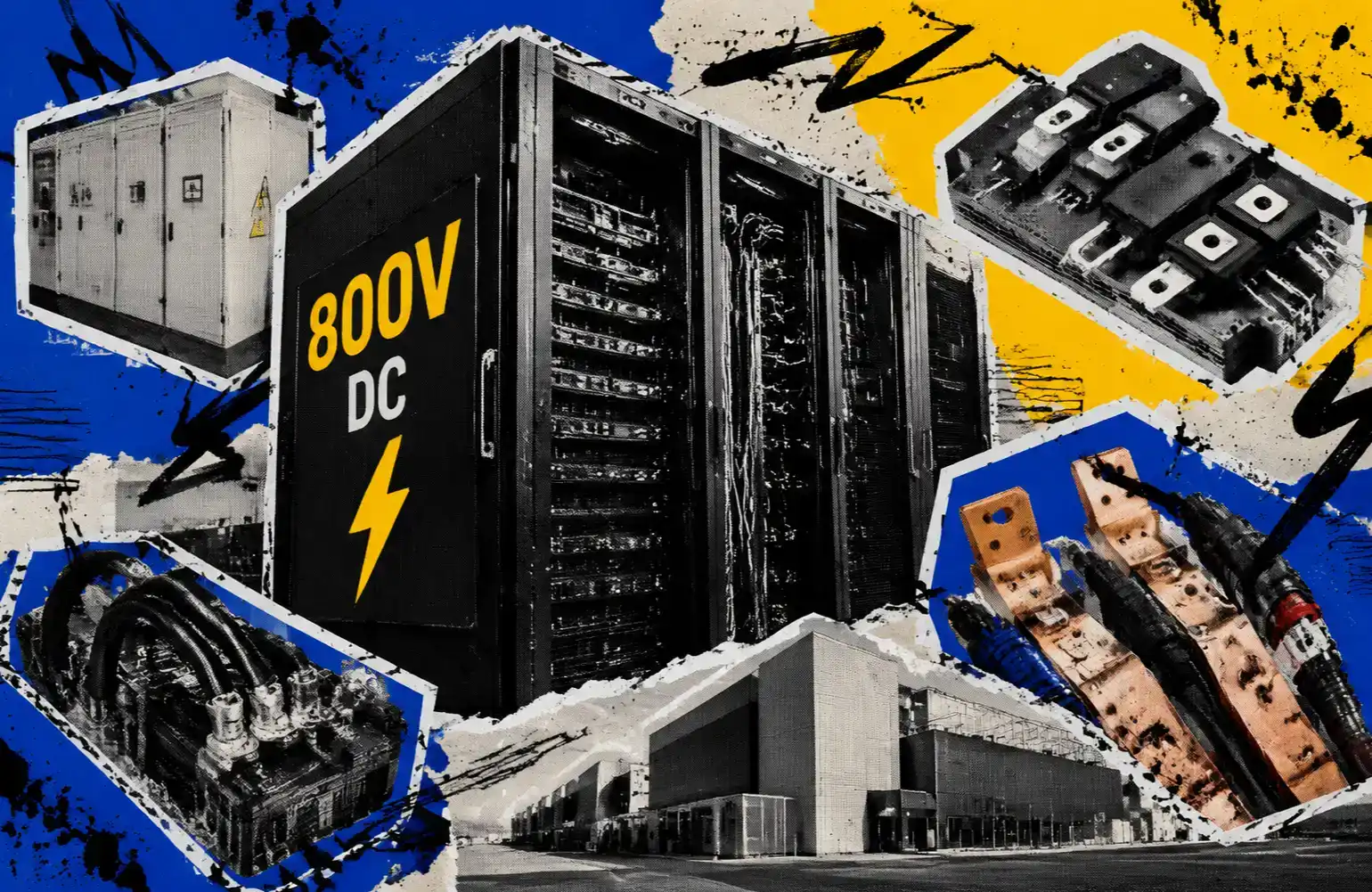
The 800V Voltage Standard Championed by Nvidia: Which Infrastructure Providers Stand to Benefit?

NVIDIA is actively promoting the 800VDC architecture as a key direction for its next-generation AI factories and high-power racks, particularly for the upcoming Rubin and Kyber platforms. The primary driver is the rapidly increasing power density of AI racks, with designs like GB200/GB300 NVL72 reaching 120-140kW and future systems potentially hitting 180-220kW. At such high power levels, traditional low-voltage power delivery becomes inefficient due to massive current, leading to significant copper use, cable bulk, heat, and power loss. The 800VDC standard aims to increase efficiency by transmitting power at higher voltage and lower current to the rack before stepping it down locally for GPUs. NVIDIA claims this can improve efficiency by up to 5%, reduce total cost of ownership (TCO) by up to 30%, and cut copper usage by approximately 45%. This shift redefines infrastructure roles, pushing power engineering to the forefront alongside GPU performance. Key beneficiaries and ecosystem partners highlighted include: 1. **Power Infrastructure Providers:** Companies like Vertiv, Schneider Electric, Delta Electronics (台达电), and Korean firms LS Electric and HD Hyundai Electric are involved in designing next-gen AI factory power distribution, rack power supplies, and backup systems. 2. **Power Semiconductors:** Suppliers of SiC/GaN devices, such as Infineon and STMicroelectronics, are better suited for high-voltage, high-efficiency conversion in this new architecture. 3. **Connectivity & Structure:** The focus shifts to high-reliability components like busbars, high-voltage connectors, and advanced PCBs that meet stricter insulation and safety requirements. 4. **Liquid Cooling & Rack ODM:** As power and heat density rise, liquid cooling becomes critical. Full-rack system integrators (e.g., Dell, Wiwynn, Wistron) must now demonstrate robust pre-delivery testing capabilities, including burn-in testing under full load, requiring significant power and cooling infrastructure in their factories. The transition is not immediate for all data centers but is targeted at high-density AI factories. NVIDIA’s 800VDC ecosystem is in a preparatory phase, with full-scale production expected to align with the 2027 launch of Kyber rack-scale systems. The investment thesis revolves around which companies can demonstrate proven product integration, customer validation, and reliable delivery of complete, high-power AI rack systems, making power, cooling, and testing capabilities new critical variables in the AI infrastructure value chain alongside GPUs.

marsbitHace 35 min(s)

The 800V Voltage Standard Championed by Nvidia: Which Infrastructure Providers Stand to Benefit?

marsbitHace 35 min(s)

Did 'Unlimited Minting' Actually Happen? Zcash Founder Responds to Four Major Market Concerns

The Orchard shielding pool in the privacy cryptocurrency Zcash was recently found to have contained a critical counterfeiting vulnerability that existed for four years. This discovery caused significant market panic and a sharp drop in the price of ZEC, though it has since recovered partially. Zcash founder Zooko Wilcox addressed four key questions raised by the vulnerability. First, while it's unknown if the bug was exploited, he believes it likely was not, citing advanced, targeted discovery methods, a rapid response to freeze the pool, and the typical "smash-and-grab" nature of past crypto exploits. Second, he states that if no exploitation occurred, all legitimate user funds in Orchard are recoverable. However, cautious users moving funds should be aware of privacy trade-offs and other risks involved in transferring to transparent or Sapling pools. Third, users currently cannot independently verify that the total ZEC supply hasn't been inflated due to this bug. However, the proposed "Ironwood" network upgrade will restore this ability by permanently sealing the Orchard pool. This will prevent any counterfeit funds from circulating and allow anyone running a node to cryptographically verify that the supply cap has not been breached. Finally, regarding other undiscovered vulnerabilities, Wilcox notes that intensive ongoing audits by multiple teams, including using advanced AI-assisted tools, have so far found no other counterfeiting bugs. This provides increased, though not absolute, confidence. In conclusion, while assessments suggest the bug was likely unused and funds are safe, the core issue was the loss of user-verifiable supply integrity. The Ironwood upgrade is presented as the solution, aiming to restore trust by allowing users to independently verify Zcash's supply security without relying on third-party assurances.

marsbitHace 36 min(s)

Did 'Unlimited Minting' Actually Happen? Zcash Founder Responds to Four Major Market Concerns

marsbitHace 36 min(s)

Trading

Spot
Futuros

Artículos destacados

Qué es BITCOIN

Entendiendo HarryPotterObamaSonic10Inu (ERC-20) y Su Posición en el Espacio Cripto En los últimos años, el mercado de criptomonedas ha sido testigo de un aumento en la popularidad de las monedas meme, capturando el interés no solo de los comerciantes, sino también de aquellos que buscan compromiso comunitario y valor de entretenimiento. Entre estos tokens únicos se encuentra HarryPotterObamaSonic10Inu (ERC-20), un proyecto intrigante que mezcla referencias culturales en el tejido de las criptomonedas. Este artículo profundiza en los aspectos clave de HarryPotterObamaSonic10Inu, explorando sus mecanismos, ethos impulsado por la comunidad y su relación con el paisaje cripto más amplio. ¿Qué es HarryPotterObamaSonic10Inu (ERC-20)? Como su nombre sugiere, HarryPotterObamaSonic10Inu es una moneda meme construida sobre la blockchain de Ethereum, clasificada bajo el estándar ERC-20. A diferencia de las criptomonedas tradicionales que pueden enfatizar la utilidad práctica o el potencial de inversión, este token prospera en el valor de entretenimiento y la fuerza de su comunidad. El proyecto tiene como objetivo fomentar un entorno donde los usuarios comprometidos puedan reunirse, compartir ideas y participar en actividades inspiradas por diversos fenómenos culturales. Una característica notable de HarryPotterObamaSonic10Inu es su cero impuestos en las transacciones. Este atractivo elemento tiene como objetivo incentivar el comercio y la participación comunitaria, sin cargos adicionales que puedan disuadir a los comerciantes de pequeña escala. El suministro total de la moneda está establecido en mil millones de tokens, una cifra que marca su intención de mantener una circulación sustancial dentro de la comunidad. Creador de HarryPotterObamaSonic10Inu (ERC-20) Los orígenes de HarryPotterObamaSonic10Inu están algo envueltos en misterio; los detalles sobre el creador siguen siendo desconocidos. El desarrollo de este token carece de un equipo identificable o de un plan explícito, lo cual no es inusual dentro del sector de monedas meme. En cambio, el proyecto ha surgido de manera orgánica, con su progreso muy dependiente del entusiasmo y la participación de su comunidad. Inversores de HarryPotterObamaSonic10Inu (ERC-20) En cuanto a inversiones externas y respaldo, HarryPotterObamaSonic10Inu también sigue siendo ambiguo. El token no lista ninguna fundación de inversión conocida o apoyo organizacional significativo. En cambio, la savia del proyecto es su comunidad de base, que informa su crecimiento y sostenibilidad a través de la acción colectiva y el compromiso en el espacio cripto. ¿Cómo Funciona HarryPotterObamaSonic10Inu (ERC-20)? Como una moneda meme, HarryPotterObamaSonic10Inu opera principalmente fuera de los marcos tradicionales que a menudo rigen el valor de los activos. Hay varios aspectos distintivos que definen cómo funciona el proyecto: Transacciones Sin Impuestos: Sin tarifas impositivas en las transacciones, los usuarios pueden comprar y vender el token libremente sin preocuparse por costos ocultos. Compromiso Comunitario: El proyecto prospera en la interacción comunitaria, aprovechando plataformas de redes sociales para crear entusiasmo y facilitar la participación. Las discusiones, el intercambio de contenido y el compromiso son elementos cruciales que ayudan a expandir su alcance y fomentar la lealtad entre los seguidores. Sin Utilidad Práctica: Cabe señalar que HarryPotterObamaSonic10Inu no ofrece utilidad concreta dentro del ecosistema financiero. Más bien, se clasifica como un token principalmente para actividades de entretenimiento y comunitarias. Referencia Cultural: El token incorpora astutamente elementos de la cultura popular para atraer interés, conectando con entusiastas de los memes y seguidores de las criptomonedas por igual. HarryPotterObamaSonic10Inu ejemplifica cómo las monedas meme operan de manera diferente a los proyectos de criptomonedas más tradicionales, ingresando al mercado como construcciones sociales innovadoras en lugar de activos utilitarios. Cronología de HarryPotterObamaSonic10Inu (ERC-20) La historia de HarryPotterObamaSonic10Inu está marcada por varios hitos notables: Creación: El token surgió de un meme viral, capturando la imaginación de muchos entusiastas de las criptomonedas. Las fechas específicas de creación no están disponibles, subrayando su ascenso orgánico. Listado en Exchanges: HarryPotterObamaSonic10Inu ha llegado a varios exchanges, permitiendo un acceso y comercio más fácil por parte de la comunidad. Iniciativas de Compromiso Comunitario: Actividades continuas destinadas a mejorar la interacción comunitaria, incluyendo concursos, campañas en redes sociales y generación de contenido por parte de fanáticos y defensores. Planes de Expansión Futuros: La hoja de ruta del proyecto incluye el lanzamiento de una colección de NFT, mercancía y un sitio de comercio electrónico relacionado con sus temas culturales, involucrando aún más a la comunidad e intentando añadir más dimensiones a su ecosistema. Puntos Clave Sobre HarryPotterObamaSonic10Inu (ERC-20) Naturaleza Impulsada por la Comunidad: El proyecto prioriza la participación colectiva y la creatividad, asegurando que la involucración de los usuarios esté a la vanguardia de su desarrollo. Clasificación como Moneda Meme: Representa la epítome de las criptomonedas basadas en el entretenimiento, diferenciándose de los vehículos de inversión tradicionales. Sin Afiliación Directa con Bitcoin: A pesar de la similitud en el nombre del ticker, HarryPotterObamaSonic10Inu es distinto y no tiene relación con Bitcoin u otras criptomonedas establecidas. Enfoque en la Colaboración: HarryPotterObamaSonic10Inu está diseñado para crear un espacio para la colaboración y el intercambio de historias entre sus poseedores, proporcionando una vía para la creatividad y el vínculo comunitario. Perspectivas Futuras: La ambición de expandirse más allá de su premisa inicial hacia NFTs y mercancías describe un camino para que el proyecto potencialmente ingrese a avenidas más tradicionales dentro de la cultura digital. A medida que las monedas meme continúan capturando la imaginación de la comunidad de criptomonedas, HarryPotterObamaSonic10Inu (ERC-20) se destaca debido a sus lazos culturales y su enfoque centrado en la comunidad. Si bien puede no encajar en el molde típico de un token impulsado por la utilidad, su esencia radica en la alegría y la camaradería fomentadas entre sus seguidores, destacando la naturaleza en evolución de las criptomonedas en una era cada vez más digital. A medida que el proyecto continúa desarrollándose, será importante observar cómo las dinámicas comunitarias influyen en su trayectoria en el cambiante paisaje de la tecnología blockchain.

1.8k Vistas totalesPublicado en 2024.04.01Actualizado en 2024.12.03

Qué es BITCOIN

Cómo comprar BTC

¡Bienvenido a HTX.com! Hemos hecho que comprar Bitcoin (BTC) sea simple y conveniente. Sigue nuestra guía paso a paso para iniciar tu viaje de criptos.Paso 1: crea tu cuenta HTXUtiliza tu correo electrónico o número de teléfono para registrarte y obtener una cuenta gratuita en HTX. Experimenta un proceso de registro sin complicaciones y desbloquea todas las funciones.Obtener mi cuentaPaso 2: ve a Comprar cripto y elige tu método de pagoTarjeta de crédito/débito: usa tu Visa o Mastercard para comprar Bitcoin (BTC) al instante.Saldo: utiliza fondos del saldo de tu cuenta HTX para tradear sin problemas.Terceros: hemos agregado métodos de pago populares como Google Pay y Apple Pay para mejorar la comodidad.P2P: tradear directamente con otros usuarios en HTX.Over-the-Counter (OTC): ofrecemos servicios personalizados y tipos de cambio competitivos para los traders.Paso 3: guarda tu Bitcoin (BTC)Después de comprar tu Bitcoin (BTC), guárdalo en tu cuenta HTX. Alternativamente, puedes enviarlo a otro lugar mediante transferencia blockchain o utilizarlo para tradear otras criptomonedas.Paso 4: tradear Bitcoin (BTC)Tradear fácilmente con Bitcoin (BTC) en HTX's mercado spot. Simplemente accede a tu cuenta, selecciona tu par de trading, ejecuta tus trades y monitorea en tiempo real. Ofrecemos una experiencia fácil de usar tanto para principiantes como para traders experimentados.

5.2k Vistas totalesPublicado en 2024.12.12Actualizado en 2026.06.02

Cómo comprar BTC

Qué es $BITCOIN

ORO DIGITAL ($BITCOIN): Un Análisis Integral Introducción al ORO DIGITAL ($BITCOIN) ORO DIGITAL ($BITCOIN) es un proyecto basado en blockchain que opera en la red Solana, cuyo objetivo es combinar las características de los metales preciosos tradicionales con la innovación de las tecnologías descentralizadas. Aunque comparte un nombre con Bitcoin, a menudo referido como “oro digital” debido a su percepción como un refugio de valor, ORO DIGITAL es un token separado diseñado para crear un ecosistema único dentro del paisaje Web3. Su meta es posicionarse como un activo digital alternativo viable, aunque los detalles sobre sus aplicaciones y funcionalidades aún están en desarrollo. ¿Qué es ORO DIGITAL ($BITCOIN)? ORO DIGITAL ($BITCOIN) es un token de criptomoneda diseñado explícitamente para su uso en la blockchain de Solana. A diferencia de Bitcoin, que proporciona un papel de almacenamiento de valor ampliamente reconocido, este token parece centrarse en aplicaciones y características más amplias. Aspectos notables incluyen: Infraestructura Blockchain: El token está construido sobre la blockchain de Solana, conocida por su capacidad para manejar transacciones de alta velocidad y bajo costo. Dinámicas de Suministro: ORO DIGITAL tiene un suministro máximo limitado a 100 cuatrillones de tokens (100P $BITCOIN), aunque los detalles sobre su suministro circulante no se han divulgado actualmente. Utilidad: Si bien las funcionalidades precisas no están delineadas explícitamente, hay indicios de que el token podría ser utilizado para diversas aplicaciones, potencialmente involucrando aplicaciones descentralizadas (dApps) o estrategias de tokenización de activos. ¿Quién es el Creador de ORO DIGITAL ($BITCOIN)? En la actualidad, la identidad de los creadores y el equipo de desarrollo detrás de ORO DIGITAL ($BITCOIN) sigue siendo desconocida. Esta situación es típica entre muchos proyectos innovadores dentro del espacio blockchain, particularmente aquellos alineados con las finanzas descentralizadas y fenómenos de monedas meme. Si bien tal anonimato puede fomentar una cultura impulsada por la comunidad, intensifica las preocupaciones sobre la gobernanza y la responsabilidad. ¿Quiénes son los Inversores de ORO DIGITAL ($BITCOIN)? La información disponible indica que ORO DIGITAL ($BITCOIN) no tiene patrocinadores institucionales conocidos ni inversiones destacadas de capital de riesgo. El proyecto parece operar en un modelo de peer-to-peer centrado en el apoyo y la adopción de la comunidad en lugar de rutas de financiamiento tradicionales. Su actividad y liquidez se sitúan principalmente en intercambios descentralizados (DEX), como PumpSwap, en lugar de plataformas de trading centralizadas establecidas, lo que resalta aún más su enfoque de base. Cómo Funciona ORO DIGITAL ($BITCOIN) Los mecanismos operativos de ORO DIGITAL ($BITCOIN) pueden elaborarse en función de su diseño blockchain y atributos de red: Mecanismo de Consenso: Al aprovechar el único proof-of-history (PoH) de Solana combinado con un modelo de proof-of-stake (PoS), el proyecto asegura una validación de transacciones eficiente que contribuye al alto rendimiento de la red. Tokenómica: Si bien los mecanismos deflacionarios específicos no se han detallado extensamente, el vasto suministro máximo de tokens implica que podría atender microtransacciones o casos de uso nicho que aún están por definirse. Interoperabilidad: Existe el potencial de integración con el ecosistema más amplio de Solana, incluyendo varias plataformas de finanzas descentralizadas (DeFi). Sin embargo, los detalles sobre integraciones específicas permanecen no especificados. Cronología de Eventos Clave Aquí hay una cronología que destaca hitos significativos relacionados con ORO DIGITAL ($BITCOIN): 2023: El despliegue inicial del token ocurre en la blockchain de Solana, marcado por su dirección de contrato. 2024: ORO DIGITAL gana visibilidad al estar disponible para trading en intercambios descentralizados como PumpSwap, permitiendo a los usuarios comerciar contra SOL. 2025: El proyecto presencia actividad de trading esporádica y potencial interés en compromisos liderados por la comunidad, aunque no se han documentado asociaciones notables o avances técnicos hasta el momento. Análisis Crítico Fortalezas Escalabilidad: La infraestructura subyacente de Solana soporta altos volúmenes de transacciones, lo que podría mejorar la utilidad de $BITCOIN en varios escenarios de transacción. Accesibilidad: El potencial bajo precio de trading por token podría atraer a inversores minoristas, facilitando una participación más amplia debido a oportunidades de propiedad fraccionada. Riesgos Falta de Transparencia: La ausencia de patrocinadores, desarrolladores o un proceso de auditoría conocidos públicamente puede generar escepticismo sobre la sostenibilidad y confiabilidad del proyecto. Volatilidad del Mercado: La actividad de trading depende en gran medida del comportamiento especulativo, lo que puede resultar en una volatilidad de precios significativa y en incertidumbre para los inversores. Conclusión ORO DIGITAL ($BITCOIN) surge como un proyecto intrigante pero ambiguo dentro del ecosistema de Solana en rápida evolución. Si bien intenta aprovechar la narrativa del “oro digital”, su alejamiento del papel establecido de Bitcoin como refugio de valor subraya la necesidad de una diferenciación más clara de su utilidad y estructura de gobernanza previstas. La aceptación y adopción futura dependerán probablemente de abordar la actual opacidad y de definir sus estrategias operativas y económicas de manera más explícita. Nota: Este informe abarca información sintetizada disponible hasta octubre de 2023, y pueden haber ocurrido desarrollos más allá del período de investigación.

83 Vistas totalesPublicado en 2025.05.13Actualizado en 2025.05.13

Qué es $BITCOIN

Discusiones

Bienvenido a la comunidad de HTX. Aquí puedes mantenerte informado sobre los últimos desarrollos de la plataforma y acceder a análisis profesionales del mercado. A continuación se presentan las opiniones de los usuarios sobre el precio de BTC (BTC).

活动图片