Crypto Allies Gain Ground In Congress After Indiana Primary Win

bitcoinistPublicado a 2026-05-08Actualizado a 2026-05-08

Resumen

The crypto industry's main political action committee, Fairshake, spent heavily to support the successful primary re-election of Indiana Republican Representative James Baird, a reliable ally on crypto legislation. Fairshake, backed by major firms like Coinbase and Ripple, has a massive war chest and is already directing millions toward other 2026 races. Baird's win coincides with advancing crypto bills in Congress, including the CLARITY Act, which recently overcame a key hurdle on stablecoin yield provisions. However, the legislation faces scrutiny, with some senators demanding added ethics rules before offering their support.

A war chest of $193 million. That’s what Fairshake, the crypto industry’s most powerful political action committee, reported holding as of January — and it’s spending that money fast.

Money Behind The Win

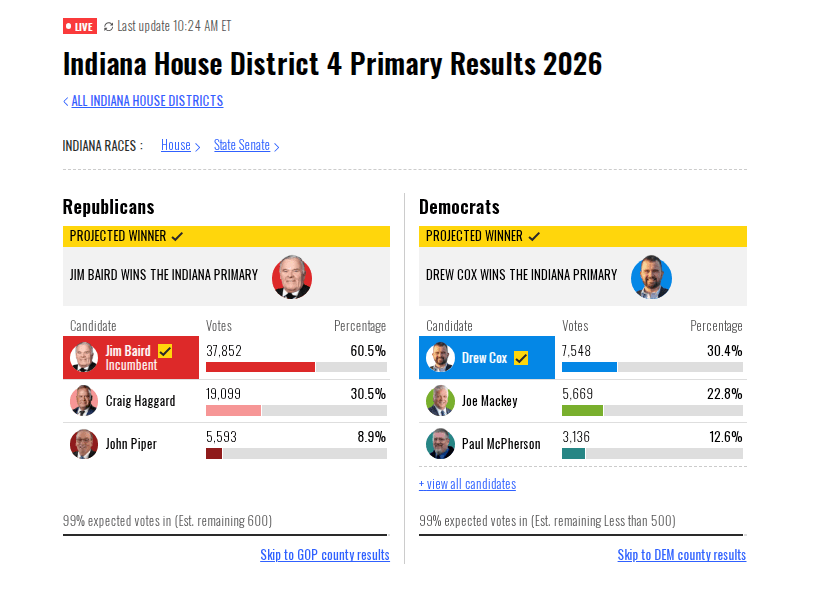
Indiana Republican James Baird cruised to victory Tuesday in his party’s primary for the state’s 4th congressional district, pulling in over 60% of the vote against challenger Craig Haggard and a handful of others.

Baird also had the backing of US President Donald Trump. But another force was working in his favor: Defend American Jobs, a Super PAC tied to Fairshake, poured roughly $514,000 into media buys supporting him ahead of the vote, according to filings with the Federal Election Commission.

Fairshake itself is bankrolled by some of the biggest names in crypto, including Coinbase and Ripple Labs. The committee spent over $130 million trying to shape the outcome of the 2024 elections. In 2026, it’s already at it again — about $10 million has been directed toward races in Illinois and Texas so far.
Source: NBC News

A Reliable Vote For The Industry

Baird has been in Congress since January 2019 and has built a record that crypto advocates consider dependable. He backed the GENIUS Act, which deals with stablecoin regulation, and the CLARITY Act, a bill focused on crypto market structure. For Fairshake, he was worth protecting.

“Representative Baird has been a proven leader for pro-job, pro-consumer, and pro-innovation policies in Congress,” a Fairshake spokesperson said.

“We’re proud to support leaders committed to responsible regulation that ensures the US remains the global leader in innovation.”

Baird reportedly thanked Trump publicly following his win.

BTCUSD trading at $80,137 on the 24-hour chart: TradingView

Legislation Moves Forward

The Indiana result comes as crypto-related legislation picks up momentum in Washington. Last week, Senators Thom Tillis and Angela Alsobrooks said they had finalized language in the CLARITY Act to include a compromise on stablecoin yield — a sticking point that had held up the bill for months.

The Senate Banking Committee had not yet scheduled a markup as of Wednesday, but many observers expect the stablecoin agreement to push the broader market structure legislation forward.

Trump’s relationship with the crypto industry has drawn scrutiny alongside these developments. Several senators have said they won’t support the CLARITY Act without ethics provisions attached to it.

Senator Tillis was among those who stated publicly he would not back the bill without such guardrails in place.

Featured image from MetaAI, chart from TradingView

Preguntas relacionadas

QWhat is Fairshake and how much money did it report holding as of January?

AFairshake is the crypto industry's most powerful political action committee (Super PAC). It reported holding a war chest of $193 million as of January.

QHow did the crypto-linked Super PAC support James Baird in the Indiana primary?

ADefend American Jobs, a Super PAC tied to Fairshake, poured roughly $514,000 into media buys supporting James Baird ahead of the Indiana Republican primary vote.

QWhat two crypto-related bills has Representative James Baird backed in Congress?

ARepresentative James Baird has backed the GENIUS Act, which deals with stablecoin regulation, and the CLARITY Act, a bill focused on crypto market structure.

QAccording to the article, what recent development has helped move the CLARITY Act forward?

ASenators Thom Tillis and Angela Alsobrooks finalized language in the CLARITY Act to include a compromise on stablecoin yield, a sticking point that had held up the bill for months.

QWhat condition have several senators, including Thom Tillis, placed on their support for the CLARITY Act?

ASeveral senators, including Thom Tillis, have stated they will not support the CLARITY Act without ethics provisions attached to it.

Lecturas Relacionadas

Smart Money Hoards $40 Billion in Cash, Retail Bets $2.6 Trillion on Calls: The Critical Moment of the US Stock Market's AI Narrative

Title: Smart Money Hoards $40 Billion in Cash, Retail Traders Bet $2.6 Trillion on Call Options: The Tipping Point for the AI Narrative in U.S. Stocks The U.S. stock market is experiencing a striking divergence. While the S&P 500 hits new highs, the financial sector is down 6% year-to-date, underperforming more than during the 2008 and COVID crises. In contrast, a record $2.6 trillion in S&P 500 call options traded in a single day, and the Philadelphia Semiconductor Index RSI is at its highest since 1999. This reflects a clear split: "smart money" is retreating while retail traders chase gains. Key data points highlight this critical juncture in the AI-driven rally: 1. SoftBank had to cut its $10 billion loan target against its OpenAI stake to $6 billion, as lenders questioned the valuation of the private AI giant, signaling primary market skepticism. 2. The explosive $2.6 trillion daily options volume, with 60% being calls, is described by a Goldman Sachs partner as a "semi-irrational chase," drawing parallels to the 1999 tech bubble. 3. The financial sector's severe underperformance relative to the S&P 500 is a classic technical warning signal, indicating potential underlying economic stress. 4. Apollo Global Management, despite strong earnings, is building a $40 billion cash buffer in its insurance business, preparing for what its CEO calls a 30-35% probability of an exogenous shock from geopolitics, inflation, and AI's economic disruption. 5. Consumer behavior mirrors this split: while Whirlpool plunged on a worsening macro outlook for big-ticket items, DoorDash rose on strong demand for small, immediate services. Together, these conflicting signals from primary markets, secondary markets, leading sectors, and top institutions suggest market risk premia have compressed to a precarious level. The current price action may be increasingly reliant on speculative sentiment rather than fundamental support, marking a potential tipping point for the AI investment narrative.

marsbitHace 19 min(s)

Smart Money Hoards $40 Billion in Cash, Retail Bets $2.6 Trillion on Calls: The Critical Moment of the US Stock Market's AI Narrative

marsbitHace 19 min(s)

Tiger Research: AI Agents Will Now Need Identity Verification

Tiger Research: AI Agents Now Need "ID Verification" AI agents are increasingly capable of autonomously executing contracts, making payments, and conducting trades. However, a critical issue remains unresolved: how to verify the identity of the agent on the other side of a transaction. This article examines the emerging competition to establish a KYA (Know Your Agent) standard and the current state of regulatory progress. **Core Points:** 1. As AI agents operate independently in A2A (agent-to-agent) scenarios, the focus shifts from KYC (Know Your Customer) to KYA for identity verification. 2. KYA is not universally required; it's essential primarily when independently deployed agents interact with open ecosystems like DEXs, engage in A2A payments, or pay merchants, not within centralized platforms. 3. A standards battle is underway, with four key players approaching KYA from different angles: * **ERC-8004:** A blockchain-native approach, creating agent IDs as NFTs with on-chain registries for identity, reputation, and validation. * **Visa TAP:** Leverages Visa's payment network to issue verified "Agent Intent" credentials, bundling agent identity into its payment rails. * **Trulioo:** Adapts the SSL certificate model to issue dynamic "Digital Agent Passports," verifying both developer (KYB) and user (KYC) credentials. * **Sumsub:** Focuses on real-time risk detection and re-verification of the human behind an agent during suspicious transactions, rather than pre-issuing certificates. 4. Regulatory momentum is building. The EU AI Act, the U.S. NIST, and Singapore's national AI governance framework are prioritizing agent identity management. The rollout of KYA standards is likely to follow a pattern similar to the FATF Travel Rule, becoming a watershed moment for the industry. The market is unlikely to have a single winner. Different approaches will dominate specific niches: ERC-8004 for on-chain autonomous transactions, Visa TAP for payment-bound commerce, Trulioo for regulated finance, and Sumsub for fraud-prone scenarios. The key differentiator will be which players successfully integrate their identity infrastructure earliest as adoption scales.

marsbitHace 1 hora(s)

Tiger Research: AI Agents Will Now Need Identity Verification

marsbitHace 1 hora(s)

Perspective: The current AI supercycle will last 15 years, but most are still buying stocks in the first FOMO stage

This article outlines a 15-year AI supercycle, segmented into four investment stages. It argues that while most investors are still focused on the first stage, smart money is already moving to the third. **Stage 1: The Foundation (2023-2025) - Priced In** The semiconductor layer (e.g., NVIDIA, AMD) is complete. While growth continues, the historic entry opportunity is over as risk/reward has compressed. **Stage 2: The Build-Out (2025-2027) - In Progress** This phase involves building the necessary physical infrastructure: power/utilities (CEG), cooling (VRT), networking (ANET), and nuclear SMRs (OKLO, SMR). Significant upside remains, but obvious names have already moved. **Stage 3: The Asymmetric Bet (2026-2028) - Positioning Window** AI moves into the physical world. Key areas include robotics/autonomy (Tesla Optimus), space/defense/drones (Rocket Lab, LUNR), and critical materials. This stage presents the best asymmetric risk/reward and is where positioning should occur now. **Stage 4: The Endgame (2028+) - Software Dominance** The mega-cap cloud platforms (Microsoft, Alphabet, Amazon, Meta), with their massive capital expenditure, will build the AI software layer and AGI infrastructure, aiming to win the entire cycle. **Core Conclusion:** The cycle is confirmed in Stage 2. Stage 3 (robotics, space, defense, nuclear SMRs) is where capital is currently rotating for maximum opportunity, while the majority of investors are expected to be 12 months behind this shift.

marsbitHace 1 hora(s)

Perspective: The current AI supercycle will last 15 years, but most are still buying stocks in the first FOMO stage

marsbitHace 1 hora(s)

Trading

Spot
Futuros

Artículos destacados

Cómo comprar WIN

¡Bienvenido a HTX.com! Hemos hecho que comprar WINkLink (WIN) sea simple y conveniente. Sigue nuestra guía paso a paso para iniciar tu viaje de criptos.Paso 1: crea tu cuenta HTXUtiliza tu correo electrónico o número de teléfono para registrarte y obtener una cuenta gratuita en HTX. Experimenta un proceso de registro sin complicaciones y desbloquea todas las funciones.Obtener mi cuentaPaso 2: ve a Comprar cripto y elige tu método de pagoTarjeta de crédito/débito: usa tu Visa o Mastercard para comprar WINkLink (WIN) al instante.Saldo: utiliza fondos del saldo de tu cuenta HTX para tradear sin problemas.Terceros: hemos agregado métodos de pago populares como Google Pay y Apple Pay para mejorar la comodidad.P2P: tradear directamente con otros usuarios en HTX.Over-the-Counter (OTC): ofrecemos servicios personalizados y tipos de cambio competitivos para los traders.Paso 3: guarda tu WINkLink (WIN)Después de comprar tu WINkLink (WIN), guárdalo en tu cuenta HTX. Alternativamente, puedes enviarlo a otro lugar mediante transferencia blockchain o utilizarlo para tradear otras criptomonedas.Paso 4: tradear WINkLink (WIN)Tradear fácilmente con WINkLink (WIN) en HTX's mercado spot. Simplemente accede a tu cuenta, selecciona tu par de trading, ejecuta tus trades y monitorea en tiempo real. Ofrecemos una experiencia fácil de usar tanto para principiantes como para traders experimentados.

339 Vistas totalesPublicado en 2024.12.11Actualizado en 2025.03.21

Cómo comprar WIN

Discusiones

Bienvenido a la comunidad de HTX. Aquí puedes mantenerte informado sobre los últimos desarrollos de la plataforma y acceder a análisis profesionales del mercado. A continuación se presentan las opiniones de los usuarios sobre el precio de WIN (WIN).

活动图片