Edel Finance loses $403K as flash-loan oracle exploit hits xStock lending reserves

ambcryptoPublicado a 2026-07-01Actualizado a 2026-07-01

Resumen

Edel Finance, a programmable market layer for tokenized equities, suffered a $403,000 exploit. An attacker manipulated the wrapped xStocks (wGOOGLx) exchange rate via a flash loan, briefly inflating the collateral's value 78-fold to borrow far beyond its true worth. Although the protocol acted promptly to limit losses, the attack revealed critical oracle and collateral pricing vulnerabilities in tokenized lending markets. The exploit severely impacted liquidity, causing total value locked (TVL) to plummet from around $630,000 to roughly $947 as users withdrew funds. A net outflow of approximately $630,000 followed. Recovery hinges on restoring user confidence through deposit growth, stabilized TVL, and stronger oracle protections and risk management practices.

Edel Finance, a programmable market layer for tokenized equities, suffered a roughly $403,000 exploit. This was after an attacker manipulated the wrapped xStocks exchange rate through a flash loan.

The wGOOGLx collateral briefly gained in value about 78-fold over its true value. The inflated valuation allowed the attacker to borrow far more than the collateral’s true value, leaving the lender with significant bad debt.

Fortunately for the users of Edel Finance, they were able to act promptly to contain the issue before additional loss occurring.
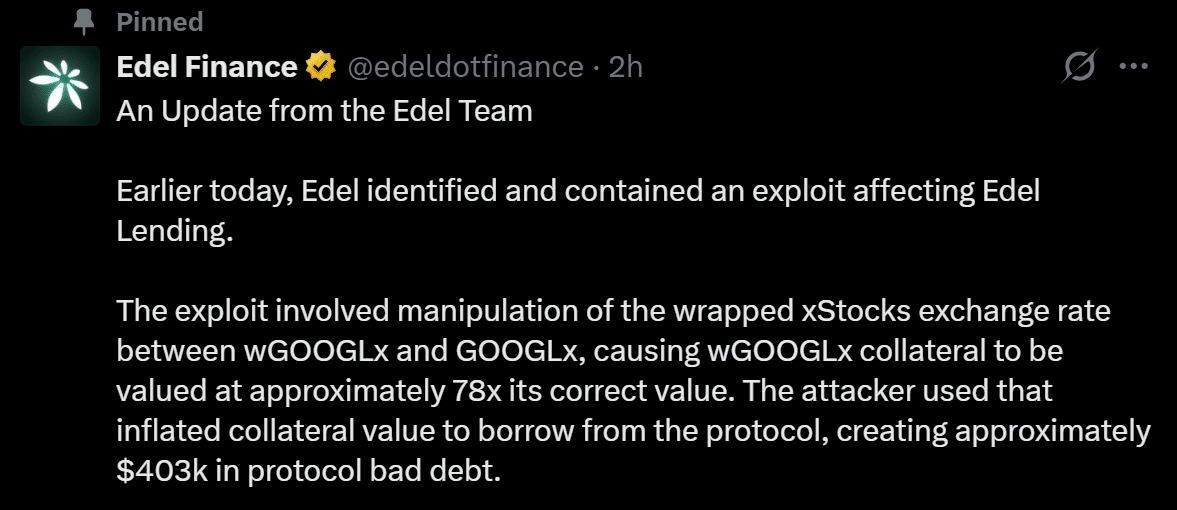
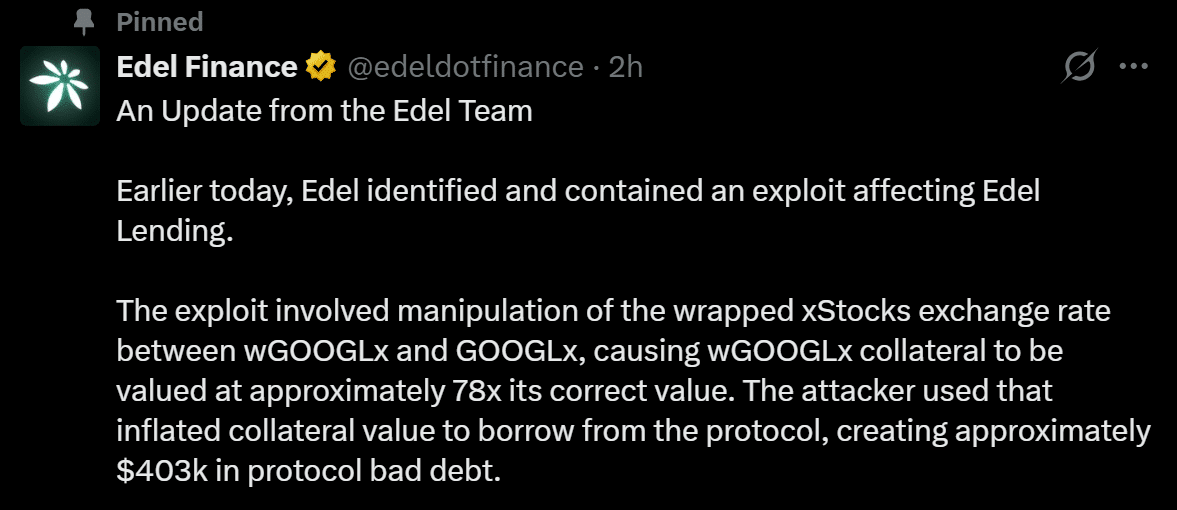
Source: X

In addition, a significant vulnerability was exposed by the attack despite the rapid response by Edel Finance. More importantly, the attack highlighted persistent weaknesses in oracle and collateral pricing across tokenized lending markets.

Conversely, unless the vulnerabilities are fully addressed, confidence remains fragile. Going forward, stronger oracle protections and collateral validation will likely determine how quickly trust returns.

Post-exploit withdrawals leave liquidity under pressure

The aftermath of the exploit quickly spilled into Edel Finance’s liquidity. As confidence deteriorated, total value locked (TVL) plunged from approximately $630,000 to roughly $947, reflecting a rapid wave of user withdrawals.
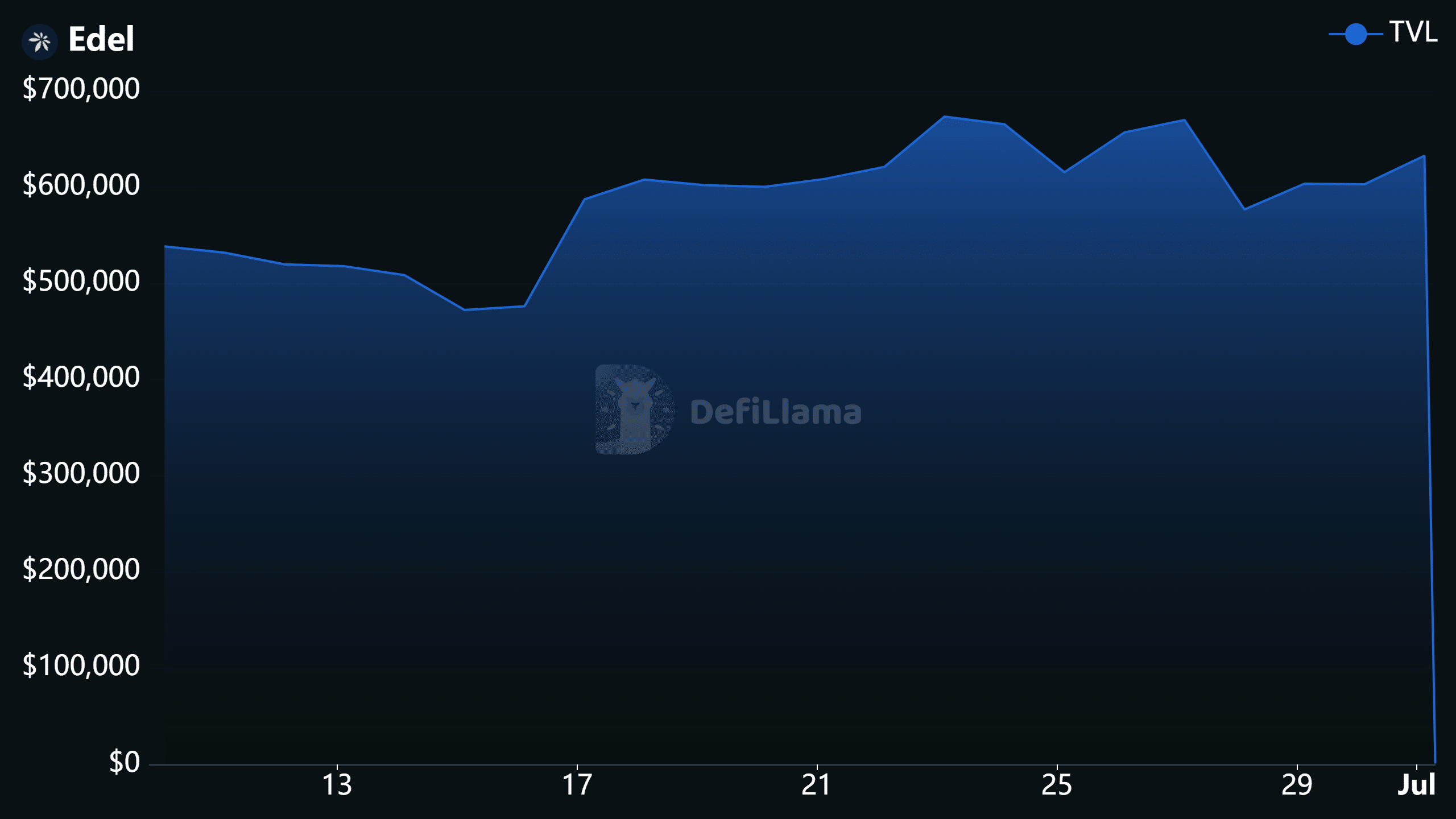
Source: DeFiLlama

Capital flows reinforced the trend further. According to DeFiLlama data, Edel Finance recorded an estimated net outflow of $630,000, the largest on record. Earlier on, a $100,000 inflow had briefly supported liquidity. Even so, it failed to offset the accelerating withdrawals that followed the exploit.
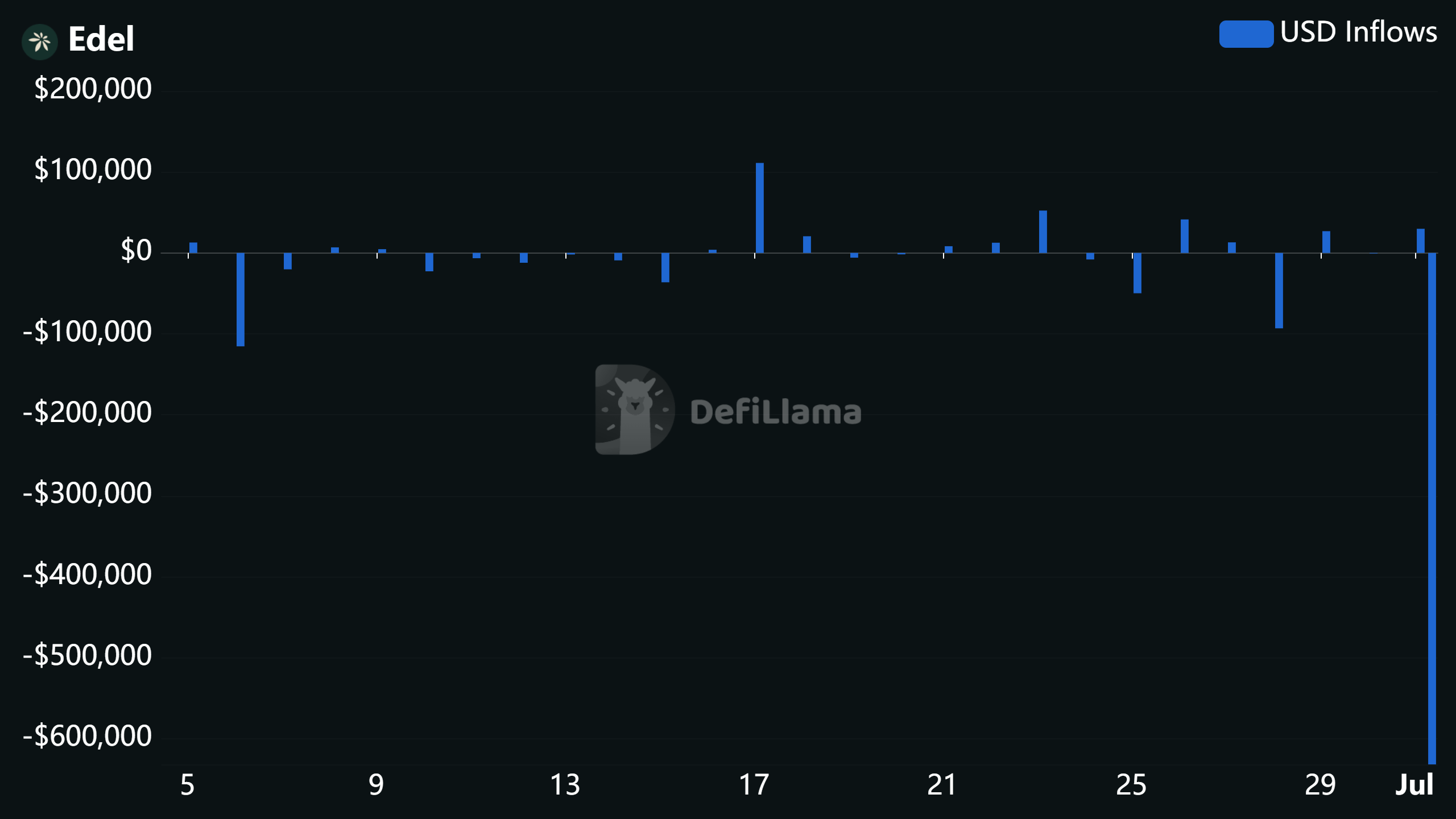
Source: DeFiLlama

These actions suggest that lenders are taking precedence over preserving capital versus supporting the protocol. Going forward, recovery depends on sustained deposit growth, stabilizing TVL, and shrinking daily outflows.

Without continued deposit growth, borrowing will continue to have limited capacity, ultimately limiting the ability of the lending platform to normalize its liquidity and delaying a return to normalcy within the lending markets.

It will take rebuilding confidence among users for meaningful capital to begin returning to Edel Finance through continued use of the lending platform and strengthened risk management practices.


Final Summary

  • Edel Finance’s xStock (wGOOGLx) exploit exposed critical oracle risks, highlighting persistent weaknesses in tokenized lending security.
  • Edel Finance’s recovery now depends on restoring liquidity, rebuilding TVL, and regaining user confidence.


Criptos en tendencia

Preguntas relacionadas

QWhat was the primary method used by the attacker to exploit Edel Finance?

AThe attacker manipulated the wrapped xStocks exchange rate through a flash loan, artificially inflating the value of wGOOGLx collateral.

QHow much financial loss did Edel Finance suffer due to this exploit?

AEdel Finance suffered a roughly $403,000 exploit.

QWhat specific vulnerability in the protocol did the attack highlight?

AThe attack highlighted persistent weaknesses in oracle and collateral pricing mechanisms across tokenized lending markets.

QWhat happened to Edel Finance's Total Value Locked (TVL) following the exploit?

AFollowing the exploit and user withdrawals, the TVL plunged from approximately $630,000 to roughly $947.

QWhat is identified as essential for Edel Finance's recovery and the return of user capital?

ARecovery depends on rebuilding user confidence, sustained deposit growth, stabilizing TVL, and implementing stronger oracle protections and risk management practices.

Lecturas Relacionadas

Xing Bo Strikes Again: Last Time 'Critiquing' World Models, This Time It's Agents' Turn

Xing Bo, President of MBZUAI and professor at Carnegie Mellon University, along with co-authors Mingkai Deng and Jinyu Hou, has released a new paper, "Critique of Agent Model," critiquing the current state of artificial intelligence agents. The paper draws a crucial distinction between "agentic" systems, which rely on external toolchains, prompts, and workflows, and truly "agentive" systems capable of genuine autonomy driven by internal decision-making structures. To illustrate this, it references a real-world incident where an AI programming assistant, following an external prompt but lacking internalized judgment, caused a catastrophic data deletion. The authors propose a detailed analysis and a new framework, "Goal-Identity-Configurator" (GIC), for building truly autonomous agents. This framework systematically addresses five key dimensions where current "Agent" designs fall short: 1. **Goal:** Moving from step-by-step human instruction to a system capable of autonomously decomposing a single long-term goal and adapting sub-goals based on new information. 2. **Identity:** Evolving self-assessment updated by experience, rather than a static description in a system prompt. 3. **Decision Making:** Replacing textual Chain-of-Thought reasoning with "simulative reasoning" that uses a dedicated world model to predict real-world consequences before selecting actions. 4. **Cognitive Control:** Introducing a separate "System III" metacognitive module that dynamically decides when to deliberate, stick to a plan, or act quickly. 5. **Learning:** Enabling "continual autonomous learning," where the agent itself decides when to act, practice in simulation, or update its world model and self-perception. The GIC architecture integrates six components—a belief encoder, goal decomposer, identity evolver, configurator (System III), simulation-based planner (System II), and executor (System I)—to embody these principles. The paper argues that a growth path akin to pilot training (ground theory, simulator practice, real deployment) should be underpinned by a unified cognitive architecture, not separate workflows. On safety, the authors contend that the GIC framework's modular, explicit design enhances inspectability, allowing problematic behavior to be traced to specific components (e.g., flawed goal or poorly trained module) rather than emerging opaquely. However, they acknowledge that ultimate safety depends on correctly training these modules in the first place. In conclusion, the paper challenges the loose application of the term "Agent," asserting that task completion alone does not equal true autonomy. True autonomy requires goals, identity, and judgment to be genuinely internalized within the agent's architecture, not merely enforced by external scripts.

marsbitHace 11 min(s)

Xing Bo Strikes Again: Last Time 'Critiquing' World Models, This Time It's Agents' Turn

marsbitHace 11 min(s)

How Collector Crypt Uses 'Recirculating Buybacks' to Create an Illusion of Growth

Title: How Collector Crypt Creates a Growth Illusion with "Buyback Loops" Key Findings: Collector Crypt's (CC) net take rate has halved from 11.2% in Q3 2025 to 5.6% in Q2 2026, while GMV grew 4.7x. This growth is driven by higher-tier card packs ($250, $1,000, $2,500) which have lower platform dollar retention rates. The newly launched $2,500 Mythic tier captured 36.7% of June GMV within 13 days. Growth is fueled by a small cohort of high-spending, high-frequency wallets rather than broad user base expansion. The economic model faces pressure from three key areas: 1) **Shifting GMV Mix**: Pushing users towards larger, lower-retention card packs increases GMV but reduces overall profitability. 2) **Physical Redemptions**: Card redemptions for physical items remove reusable inventory from the system, creating costly replenishment needs. In May, redemptions consumed 41.6% of pre-redemption net income. Only 75 wallets drove redemptions in June. 3) **B2B/API Strategy**: Partner revenue remains negligible (cumulatively $1.83M) and dependent on CC for inventory, vaulting, and buyback services, failing to create a scalable, asset-light recurring revenue stream. The core product is a repetitive pack-buyback loop with limited secondary market activity and token value accrual. Sensitive modeling shows CC's economics turn negative when any two of the following pressures coincide: replenishment costs near market price, redemption rates exceeding 9%, or high-tier buyback rates around 93%. While CC operates in a large and growing collectibles market, its current growth levers—bigger packs, high buyback rates, and capital recycling by a few wallets—create a volume illusion without demonstrating sustainable collector engagement, deep secondary markets, or a viable path to improved margins. Future proof points include broadening collector participation, deepening secondary trading, and developing true asset-light B2B revenue channels.

Foresight NewsHace 33 min(s)

How Collector Crypt Uses 'Recirculating Buybacks' to Create an Illusion of Growth

Foresight NewsHace 33 min(s)

Grayscale's Latest Research: What is Solana's Next Growth Engine?

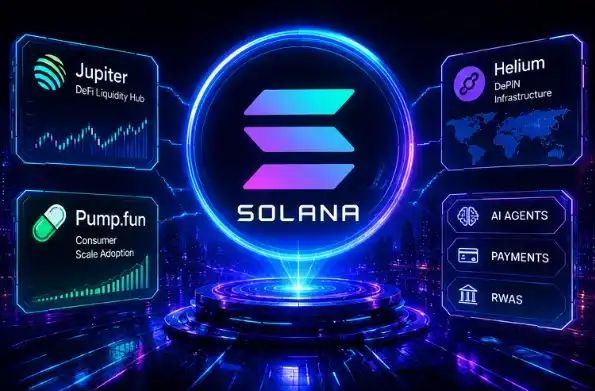
Grayscale's latest report, "Solana: Crypto's Financial Bazaar," signals a shift in how the market views Solana, moving beyond its high-performance and meme-centric reputation. The report frames Solana as an evolving application platform for large-scale economic activity, akin to a bustling digital marketplace. The analysis highlights that public chain competition has moved past raw throughput (TPS) to focus on genuine economic activity—daily users, transaction volume, and real revenue. Solana's metrics, such as over 1,000 dApps, 100M+ daily transactions, and ~4.3M daily active users, showcase this shift toward application-layer prosperity. The report identifies three key growth drivers: 1. **Jupiter**: Evolving from a DEX aggregator to a core liquidity hub and comprehensive financial platform for Solana's DeFi. 2. **Pump.fun**: Demonstrates Solana's capacity for consumer-scale applications, attracting millions of users and generating significant, sustainable revenue, validating network stability under high load. 3. **Helium & DePIN**: Represents expansion into real-world infrastructure, connecting blockchain to physical resources like wireless networks and positioning services, opening new long-term use cases. Solana Foundation's recent focus aligns with this broader vision, emphasizing AI Agents (for machine-to-machine transactions), payments, stablecoins, and Real-World Assets (RWA) to build a sustainable growth model beyond cyclical trends. While challenges remain—such as value capture for SOL and maintaining ecosystem sustainability beyond hot trends—institutional interest is growing due to Solana's maturing application business models, expanding payment/stablecoin ecosystem, and persistent developer activity. The competition is no longer about speed alone, but about which network can foster the most vibrant and valuable digital economy.

marsbitHace 54 min(s)

Grayscale's Latest Research: What is Solana's Next Growth Engine?

marsbitHace 54 min(s)

Trading

Spot

Artículos destacados

Cómo comprar LAYER

¡Bienvenido a HTX.com! Hemos hecho que comprar Solayer (LAYER) sea simple y conveniente. Sigue nuestra guía paso a paso para iniciar tu viaje de criptos.Paso 1: crea tu cuenta HTXUtiliza tu correo electrónico o número de teléfono para registrarte y obtener una cuenta gratuita en HTX. Experimenta un proceso de registro sin complicaciones y desbloquea todas las funciones.Obtener mi cuentaPaso 2: ve a Comprar cripto y elige tu método de pagoTarjeta de crédito/débito: usa tu Visa o Mastercard para comprar Solayer (LAYER) al instante.Saldo: utiliza fondos del saldo de tu cuenta HTX para tradear sin problemas.Terceros: hemos agregado métodos de pago populares como Google Pay y Apple Pay para mejorar la comodidad.P2P: tradear directamente con otros usuarios en HTX.Over-the-Counter (OTC): ofrecemos servicios personalizados y tipos de cambio competitivos para los traders.Paso 3: guarda tu Solayer (LAYER)Después de comprar tu Solayer (LAYER), guárdalo en tu cuenta HTX. Alternativamente, puedes enviarlo a otro lugar mediante transferencia blockchain o utilizarlo para tradear otras criptomonedas.Paso 4: tradear Solayer (LAYER)Tradear fácilmente con Solayer (LAYER) en HTX's mercado spot. Simplemente accede a tu cuenta, selecciona tu par de trading, ejecuta tus trades y monitorea en tiempo real. Ofrecemos una experiencia fácil de usar tanto para principiantes como para traders experimentados.

300 Vistas totalesPublicado en 2025.02.11Actualizado en 2026.06.02

Cómo comprar LAYER

Discusiones

Bienvenido a la comunidad de HTX. Aquí puedes mantenerte informado sobre los últimos desarrollos de la plataforma y acceder a análisis profesionales del mercado. A continuación se presentan las opiniones de los usuarios sobre el precio de LAYER (LAYER).

活动图片