8.5 Million USDT Flees Overnight: Can High-Yield Stablecoin Vaults Still Be Safely Deposited?

Foresight NewsPublicado a 2026-06-23Actualizado a 2026-06-23

Resumen

$8.5M USDT Exodus Triggers High-Yield Stablecoin Vault Shutdown Fears of a liquidity crunch following a third-party auditor's withdrawal from competitor MainStreet triggered over $8.5 million in user withdrawals from Altura's stablecoin vault in 24 hours, forcing it to begin an orderly wind-down. Altura clarified it holds no MainStreet assets, indicating the crisis stemmed from a sector-wide loss of confidence rather than direct asset contagion. The incident highlights a critical vulnerability in high-yield stablecoin products: a mismatch between user expectations for instant redemptions and the illiquid, long-duration nature of underlying investments like private credit and real-world assets (RWA). Even without actual losses, the mere prospect of being last in line for repayment can spark a debilitating bank run. The key lesson is that operational liquidity risk and market confidence are decisive factors. Tools like reserve audits, intended to reduce uncertainty, can backfire if their withdrawal accelerates panic faster than assurances can spread. The industry must now observe how Altura manages its asset liquidation and user reimbursements, a process that will test the feasibility of offering DeFi-native speeds on traditionally illiquid yield strategies.


Author: Liam Akiba Wright

Compiled by: Chopper, Foresight News


TL;DR:


  • Altura stated that users withdrew over 8.5 million USDT within 24 hours before the platform began an orderly closure of the vault.
  • This bank run indicates that even high-yield stablecoin products with no direct asset connection to other protocol disputes can still face liquidity pressure from a run.
  • The lingering question is: Can the platform's remaining positions be paid out on time? There are significant time differences in the liquidation cycles of different investment strategies.


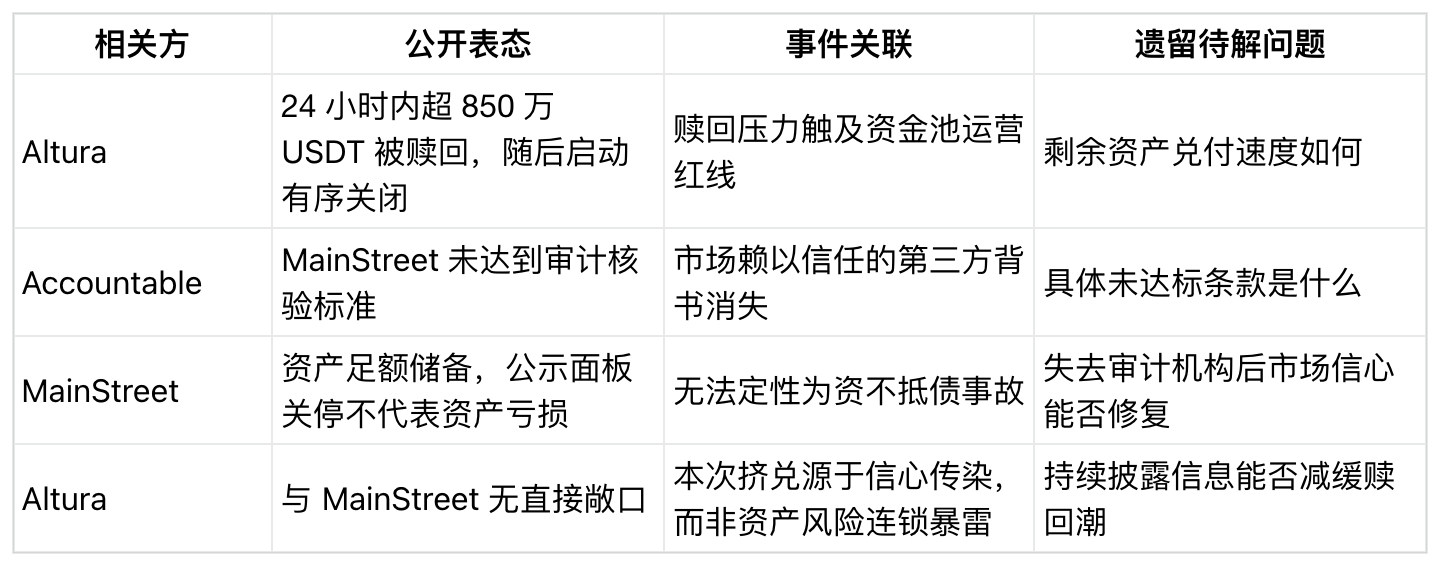
The reserve audit controversy at MainStreet triggered a collapse of market confidence across the entire stablecoin yield sector, with Altura experiencing outflows exceeding 8.5 million USDT in a single day, leading the project to decide on an orderly vault closure.


Altura CEO Ranveer Arora stated that user redemptions exceeded $8.5 million before the vault closure. Altura also asserted that it has no connection whatsoever with MainStreet or its underlying investment strategies. The core of this bank run incident is not the transmission of asset risk, but rather a chain reaction triggered by a collective loss of confidence in similar yield products.


The catalyst for the event was the termination of cooperation between MainStreet and the third-party audit firm Accountable, citing MainStreet's failure to meet audit verification standards. MainStreet publicly claimed to have sufficient asset reserves, but the lack of third-party audit endorsement led to widespread skepticism among users holding similar yield products: If everyone redeems at once, can the fund pool achieve rapid payout?


This is precisely the operational risk exposed by the Altura incident. From a user's perspective, redemption operations seem simple, but the platform's assets are dispersed across different segments such as exchange holdings, private credit lending, and real-world asset (RWA) settlements, each with completely unsynchronized repayment cycles.


MainStreet later stated that the shutdown of the third-party reserve display panel does not indicate asset losses or impairment in the investment portfolio.


Altura's own risk disclaimer is equally crucial: The project explicitly stated that it holds no MainStreet-related assets, and its HyperEVM lending pool, USDT/AVLT trading market, and Ethereum lending targets were unaffected by this event.


However, when users see an audit firm terminate cooperation with a certain stablecoin yield product, their focus shifts from whether a neighboring protocol has risk exposure to whether all similar products can withstand a concentrated redemption wave.


Liquidity Becomes the Core Contradiction in a Concentrated Redemption Wave


Stablecoin users often focus only on the token itself, and the USDT in this incident is also a core settlement vehicle in the crypto market. USDT's peg to the US dollar remains solid, with a total market cap of approximately $186 billion and a 24-hour trading volume exceeding $51 billion.


This market scale has a dual impact: on one hand, USDT's underlying liquidity is extremely abundant, making it difficult for a single USDT-denominated fund pool to shake the overall stablecoin market; but on the other hand, the liquidity of the fund pool itself depends entirely on capital allocation, asset storage channels, settlement rules, and whether counterparties can match users' expected redemption speeds.


Altura's announcement also highlighted this reality: funds stored on exchanges are easier to liquidate quickly compared to private credit or real-world asset (RWA) investments; however, exchange withdrawals are also subject to platform procedures, transfer channels, and market conditions. Private credit and RWA assets have fixed repayment cycles, and processes like loan recovery, share redemption, and settlement windows cannot match DeFi users' demand for instant withdrawals.


The misalignment of repayment cycles for different assets means that even in the absence of actual asset losses, market sentiment can dictate a product's survival. Users who redeem first can withdraw instantly, while those who redeem later can only wait for assets to mature and be liquidated. This expectation drives everyone to redeem early. The mere possibility of batch payouts is enough to accelerate a bank run stampede.


The scale of redemptions in this case is significant. Altura's overall fund pool size reaches tens of millions of dollars, making the 8.5 million USDT single-day redemption a very high proportion. Large-scale concentrated withdrawals force investment portfolios originally focused on yield enhancement to shift towards asset allocation prioritizing liquidity.


Redemption Cycle: The Next Key Indicator to Watch


Looking at the entire stablecoin sector, this lesson cannot be ignored. The total stablecoin market cap is hundreds of billions, with daily trading volumes in the tens of billions. Various yield-bearing stablecoin products promise principal stability plus yield, but their underlying investment strategies often cannot be liquidated instantly.


Such products are operationally feasible, but risks are concentrated at the operational level. Reserve proof displays, third-party audits, exchange holdings, private credit, RWA investments—the liquidity shortcomings of these links are only fully exposed when users abandon the pursuit of yield and simply want to retrieve their cash.


For Altura, the core observation point moving forward is the liquidation process: whether assets can be redeemed orderly, the frequency of platform updates and disclosures, the scale of funds returned at each stage, and whether the platform can prevent users from panic-selling long-term assets at low prices to exit hastily. Current information can only confirm liquidity risks, not prove underlying asset losses at Altura.


For the entire industry's stablecoin yield products, the test from this incident lies in whether third-party audit endorsements can stabilize confidence during market volatility, rather than becoming a trigger for panic. Reserve display panels and third-party verification are tools meant to reduce market uncertainty, but negative news about terminated audit partnerships spreads much faster than project clarifications.


This is the revelation the Altura bank run brings to the industry. In the DeFi fund pool sector, market confidence is by no means an insignificant soft metric; it directly determines whether users are willing to deposit funds long-term, allowing sufficient liquidation cycles for underlying investment strategies.


Preguntas relacionadas

QWhat event triggered the user panic and the subsequent mass withdrawal of over 8.5 million USDT from Altura?

AThe panic was triggered by the news that the third-party audit firm Accountable terminated its cooperation with another stablecoin yield platform, MainStreet, citing MainStreet's failure to meet audit verification standards. This eroded confidence in the entire stablecoin yield sector, leading users to question the liquidity and safety of similar platforms, including Altura.

QAccording to the article, what is the fundamental reason for the liquidity crisis at Altura, despite having no direct exposure to MainStreet's assets?

AThe fundamental reason is a collective loss of confidence in the stablecoin yield sector, leading to a bank run. The crisis is not due to direct asset risk transmission from MainStreet, but rather the mismatch between user expectations for instant withdrawals and the platform's underlying investment assets, which have different and often longer settlement cycles (e.g., exchange holdings vs. private credit or RWA investments).

QWhat key operational risk did the Altura incident expose for stablecoin yield platforms?

AThe incident exposed the liquidity mismatch risk. While platforms invest user funds into various assets (exchange holdings, private credit, RWAs) to generate yield, these assets have different redemption and settlement timelines. These timelines cannot match the DeFi user's expectation for instant withdrawals, creating a vulnerability during periods of mass redemption requests.

QWhat will be a critical indicator to watch regarding Altura's future, as mentioned in the article?

AA critical indicator will be the platform's redemption and wind-down process. This includes observing whether assets can be redeemed in an orderly manner, the frequency of platform updates, the scale of funds returned at each stage, and whether the process can avoid forcing users to sell long-term assets at a discount to exit quickly.

QWhat broader lesson for the stablecoin yield industry does the article draw from the Altura event?

AThe lesson is that market confidence is a critical, hard metric, not a soft one. Tools like third-party audit reports and reserve proof dashboards, intended to reduce uncertainty, can themselves become triggers for panic if their status changes negatively. Confidence directly determines whether users are willing to leave funds deposited long enough for the underlying investment strategies to reach their settlement cycles.

Lecturas Relacionadas

Second Half of U.S. Crypto Policy: The Clarity Act Aims for 60 Votes, CFTC's "One-Person Commission" Becomes Biggest Variable

In a pivotal year for US crypto policy, the "CLARITY Act" is advancing in the Senate but faces a high hurdle, needing 60 votes to pass. Key challenges include bridging partisan divides on ethics and swaying undecided Republican senators within a tight legislative calendar of only about 40 working days. The policy "second half" involves intense negotiations on a broader framework for Web3 and DeFi, including crypto tax reforms and the Blockchain Regulatory Certainty Act. A significant uncertainty is the understaffed CFTC, operating with four commissioner vacancies, which complicates regulatory clarity. Meanwhile, the departure of key "crypto champions"—SEC Commissioner Hester Peirce and Senator Cynthia Lummis—will impact ongoing policy efforts. Industry experts are cautiously optimistic but realistic. Sara K. Weed notes that while progress is being made, CLARITY is unlikely to pass this Congress, pushing agencies like the SEC and CFTC to provide more guidance. Sulolit Mukherjee suggests meaningful crypto tax legislation is more likely to be attached to larger must-pass bills. Rashan Colbert discusses the jurisdictional debate over prediction markets, emphasizing the need for a regulatory framework that fosters their development as financial tools rather than treating them broadly as gambling. The clock is ticking, but opportunities remain for substantive progress through continued bipartisan dialogue and pragmatic efforts.

marsbitHace 1 hora(s)

Second Half of U.S. Crypto Policy: The Clarity Act Aims for 60 Votes, CFTC's "One-Person Commission" Becomes Biggest Variable

marsbitHace 1 hora(s)

Dan Koe's New Essay: Escaping the Fate of the Wage Slave, How to Survive the AI Replacement Wave?

Dan Koe argues that the true threat in the AI era isn't technology itself, but a reliance on others for one's livelihood and happiness. The core problem is "wage slavery"—spending life on unfulfilling work. To survive and thrive, one must escape this by building their own enterprise. The key is developing five elements: Agency (initiative), Taste (discernment), Persuasion, Persistence, and Iteration. These boil down to problem-solving skills and experiential knowledge, which cannot be learned passively but only through doing your own projects. The solution is to become "unemployable" by shifting your identity. This requires: 1) Radically changing your environment to force growth, 2) Choosing a medium (like content creation) that provides real feedback through trial and error, and 3) Mastering either code or, preferably, media (content). Content creation is more valuable because its subjective nature and need for human perspective create a durable advantage over generic AI output. To start, define your life's work by answering foundational questions about your innate knowledge, unique abilities, and contrarian beliefs. Then, immediately act by publishing your first piece of content. The cycle of creating, receiving feedback, and iterating is the essential path to developing the skills needed for an independent, meaningful career and financial resilience.

marsbitHace 2 hora(s)

Dan Koe's New Essay: Escaping the Fate of the Wage Slave, How to Survive the AI Replacement Wave?

marsbitHace 2 hora(s)

Research Report Analysis: Morgan Stanley Details SanDisk SNDK, The Truth About Cloud Data Center Pricing Power and AI Inference Benefits

Morgan Stanley raised its price target for SanDisk (SNDK) from $1100 to $1750 on June 22, maintaining an Overweight rating. The upgrade is driven by AI inference demand reshaping the NAND market, particularly for KV Cache and context window storage in cloud data centers. These cloud clients exhibit price inelasticity and sign long-term contracts, granting SanDisk significant pricing power. SanDisk's New Business Model (NBM) agreements, covering over one-third of FY27 bit shipments with 3-5 year terms and fixed price/price collar structures, are crucial. They are projected to sustain gross margins around 80% even at floor prices, providing a buffer against cyclical downturns. Morgan Stanley forecasts gross margins to surge from 30.3% in FY25 to 86.7% in FY27e. With NAND supply expected to remain tight into 2026/2027 and cloud/data centers becoming the largest end-market, SanDisk holds supply-side pricing power. The company targets 15-19% bit growth via technology transitions, not capacity expansion. Revenue is projected to grow ~6.6x from FY25 to FY27, with EPS rising from $2.74 to $14.73, driven by high-margin cloud business. Key upside catalysts include faster enterprise SSD adoption and edge AI growth. Downside risks involve slower industry growth, competitor capex increases, market share loss, and competition from Chinese players like YMTC. The investment thesis rests on AI-driven structural demand, NBM's margin protection, and sustained supply tightness. The $1750 target implies ~28x FY27e P/E.

marsbitHace 2 hora(s)

Research Report Analysis: Morgan Stanley Details SanDisk SNDK, The Truth About Cloud Data Center Pricing Power and AI Inference Benefits

marsbitHace 2 hora(s)

A Threefold Performance Leap! NEAR Achieves 200ms Physical Block Time Limit with SPICE

NEAR's core development team, Near One, has announced its next major protocol evolution: SPICE (Separation of Consensus and Execution). Currently in development, SPICE represents the most significant upgrade before the full implementation of Nightshade 3.0. Its core innovation is decoupling the consensus layer, responsible for ordering transactions, from the execution layer, which processes them. This allows the consensus layer to run at full speed without waiting for transaction execution to complete. Once deployed, SPICE is projected to triple NEAR's block production speed, achieving a 200ms block time, which is considered the physical limit due to the speed of light and network latency. This leap will dramatically reduce transaction latency and finality, with transactions confirming in roughly 0.4 seconds—faster than a typical card payment. The upgrade also enables more complex, long-running transactions and significantly improves user experience for applications like NEAR Intents and near.com. Beyond raw speed, SPICE enhances network scalability and security. It enables deeper parallelism, efficiently distributing workload across shards and improving resource utilization. The simpler block structure and lighter contracts also facilitate formal verification and security auditing. Furthermore, SPICE lays the critical groundwork for future Nightshade 3.0 features, most notably atomic cross-shard transactions, which would simplify complex contract logic and eliminate development hurdles caused by asynchronous execution. The Near One team is actively developing SPICE, targeting deployment in the coming months.

Foresight NewsHace 3 hora(s)

A Threefold Performance Leap! NEAR Achieves 200ms Physical Block Time Limit with SPICE

Foresight NewsHace 3 hora(s)

Trading

Spot
Futuros
活动图片