A Threefold Performance Leap! NEAR Achieves 200ms Physical Block Time Limit with SPICE

Foresight NewsPublicado a 2026-06-23Actualizado a 2026-06-23

Resumen

NEAR's core development team, Near One, has announced its next major protocol evolution: SPICE (Separation of Consensus and Execution). Currently in development, SPICE represents the most significant upgrade before the full implementation of Nightshade 3.0. Its core innovation is decoupling the consensus layer, responsible for ordering transactions, from the execution layer, which processes them. This allows the consensus layer to run at full speed without waiting for transaction execution to complete. Once deployed, SPICE is projected to triple NEAR's block production speed, achieving a 200ms block time, which is considered the physical limit due to the speed of light and network latency. This leap will dramatically reduce transaction latency and finality, with transactions confirming in roughly 0.4 seconds—faster than a typical card payment. The upgrade also enables more complex, long-running transactions and significantly improves user experience for applications like NEAR Intents and near.com. Beyond raw speed, SPICE enhances network scalability and security. It enables deeper parallelism, efficiently distributing workload across shards and improving resource utilization. The simpler block structure and lighter contracts also facilitate formal verification and security auditing. Furthermore, SPICE lays the critical groundwork for future Nightshade 3.0 features, most notably atomic cross-shard transactions, which would simplify complex contract logic and eliminate develo...


Authors: Anton Astafiev, Chief Technology Officer, Near One;

Mally Anderson, NEAR Columnist

Compiled by: Saoirse, Foresight News


The NEAR core development team Near One recently announced two major upgrades to the NEAR protocol, both set to go live later this month: one is dynamic resharding, used to enhance network scalability; the other is the launch of the first quantum signature scheme, providing post-quantum security for all NEAR accounts. This article details the next core plan in NEAR's technical roadmap—SPICE, which stands for "Separation of Protocol Into Consensus and Execution." SPICE is currently still in the research and development phase and is the most important upgrade before the implementation of Nightshade 3.0, the next iteration of NEAR's sharding technology.

(To understand the sharding technology evolution from 2019 to the present, you can read the previously published dynamic resharding feature article; for a complete understanding of NEAR protocol's overall evolution, please refer to Bowen Wang's keynote speech on Nightshade 3.0 at the 2026 NEARCON conference.)


After SPICE officially launches, NEAR's block production speed will increase to three times its original rate, achieving a 200-millisecond block time. As of May 2025, NEAR's current performance is 600ms block time and 1.2-second transaction finality. The core logic behind this performance leap is decoupling the consensus process from transaction execution: the consensus layer can run at full speed without waiting for transaction execution to complete before producing a block. It's worth mentioning that constrained by the speed of light and the basic time required for consensus nodes to send and receive messages, 200 milliseconds is the theoretical fastest block time achievable at the physical layer.


The layered operation of consensus and execution will bring three core improvements: faster block times, lower transaction latency, and support for longer-running, more complex logic transactions.


How SPICE Achieves Protocol Speedup


The separation of consensus and execution is a fundamental and far-reaching upgrade to the NEAR protocol. It is also the most extensive technical transformation since the introduction of the stateless validation mechanism in 2024, representing a massive engineering effort for the Near One team. The concept of SPICE was first proposed at the NEAR industry summit in late 2024; now that prerequisite upgrades like Gas Keys (already live in version 2.12), sharded smart contracts, and dynamic resharding have all been implemented, SPICE's development process has also accelerated.


Although implementing this layered architecture is extremely difficult, its underlying logic is clear and easy to understand: the core value of a blockchain is to provide an immutable, irrevocable guarantee of transaction ordering. Traditional schemes rely on Byzantine Fault Tolerant (BFT) consensus mechanisms, where each block synchronously packs ordered transactions and updates account balances, which directly slows down block production efficiency. SPICE, however, splits transaction ordering and state execution into two independent processes: all validator nodes only need to reach consensus on the transaction list and block hash, ensuring the transaction order cannot be tampered with. This process requires no complex computation while preserving blockchain determinism. Nodes can produce blocks by only verifying transaction signatures. Account state calculations can proceed asynchronously while block consensus is confirmed. The execution flow is no longer tied to block ordering and does not need to synchronously update the state root in every consensus block round.
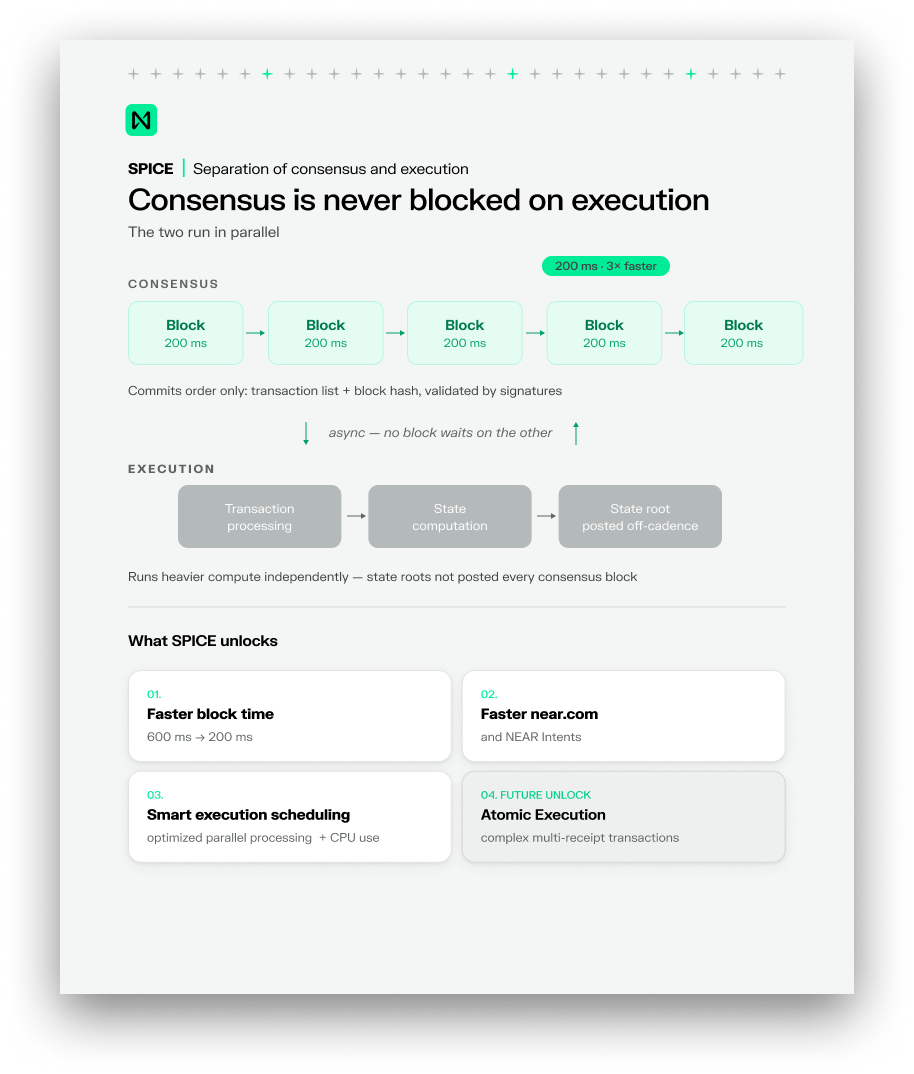

Diagram of the SPICE layered architecture


SPICE does not just compress block time from 600ms to 200ms, tripling the speed; it can also handle more interaction operations within the same timeframe, significantly accelerating complex transaction processing, and even support long-process transactions executed in steps across multiple blocks. NEAR itself already uses an optimistic block mechanism, and SPICE will greatly reduce the maximum wait time for users. Under the current mechanism, if a transaction requires supplementary external data, users must wait for a full block to be produced before initiating the next operation; with SPICE, users can complete three consecutive interaction operations within the waiting period of what was previously one block.


SPICE will also significantly optimize the user experience for near.com and NEAR Intents. Alex Shevchenko, CEO of Defuse Labs, commented on this: "The increased block speed on NEAR means faster transaction finality, making the user experience incredibly smooth, truly achieving 'instantaneous completion.' Whether it's ultra-fast sub-second transactions, transfers, or private payments, all can be realized. The transaction confirmation standard for traditional payment giant Visa is 3 seconds, while NEAR only needs 0.4 seconds, faster than you can input a payment password or tap your phone against a payment terminal."


This extreme speed is also a necessity for the agent economy: the interaction rate of automated agents far exceeds that of human users and traditional financial systems. Relying on this block production mechanism approaching the physical limit, NEAR can unleash the full operational potential of agents, enabling seamless flow between fiat and crypto assets; while also supporting multiple agents initiating complex, longer-duration transactions in parallel.


The Technical Path to Nightshade 3.0


The separation of consensus and execution is the first crucial step towards implementing Nightshade 3.0. Among all sharded public blockchains, NEAR is the first project to implement this architecture; while Monad has also achieved consensus-execution separation, it is based on a non-sharded EVM public chain. Besides speed improvement, SPICE further enhances network scalability through deep parallelization. Currently, NEAR executes transactions by shard according to account ID. Once a shard experiences a surge in load, all user transactions within that shard will experience delays. SPICE lays the groundwork for subsequent cross-shard synchronous transactions. Simultaneously, it utilizes "bubble filling" mechanisms to make full use of bandwidth resources: the execution queue doesn't need to wait for network communication, and block generation doesn't need to wait for transaction execution to complete. The two processes run in parallel without gaps, greatly improving network resource utilization.


Faster blocks paired with the already-launched sharded smart contracts can also simultaneously enhance network security. NEAR's sharded smart contracts are essentially lightweight independent accounts, partitioned individually by user and business scenario; combined with shorter, more concise blocks, the entire network's business load can be evenly distributed across various shards, enabling dynamic adaptive scaling for the network. This not only optimizes scaling performance but also yields significant security benefits. With AI tools significantly lowering the barrier for hacker attacks and vulnerability exploitation, structurally simple blocks and lightweight contracts are easier to secure; as NEAR gradually implements formal verification of contracts and zero-knowledge proofs, short blocks can significantly reduce verification computational power consumption and cost.
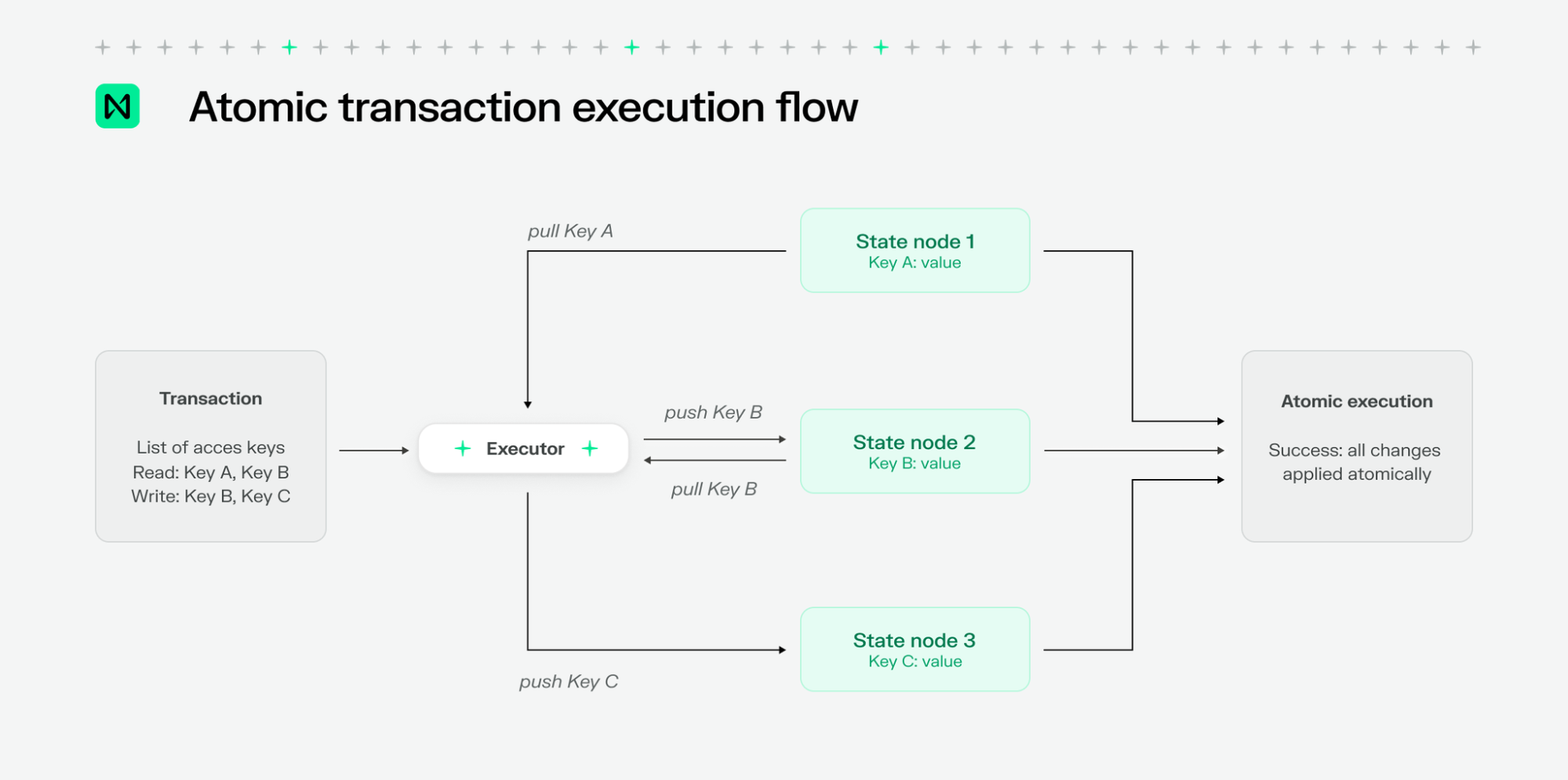

Cross-shard atomic transaction execution flow


SPICE also paves the way for subsequent major upgrades in Nightshade 3.0. In the future, building on SPICE with another iteration of updates will enable cross-shard atomic transactions—indivisible, irreversible complete execution across shards. This has long been a core goal in the field of sharding technology and a key demand for developers (especially NEAR Intents ecosystem developers). Atomic execution can simplify complex transaction logic, avoiding development difficulties brought by existing asynchronous cross-shard mechanisms. This type of asynchronous logic has long been a primary cause of smart contract vulnerabilities and functional delays, and the SPICE architecture can mitigate this issue from the ground up. The core implementation idea is: by leveraging the decoupling of consensus and execution, migrate transaction calculations to dedicated execution nodes that can read the state of all shards involved in the transaction. Combined with NEAR's mature stateless validation system, only a single execution node needs to generate an execution proof for all other nodes in the network to complete verification. This design does not raise the hardware requirements for ordinary validator nodes while continuously unleashing the performance ceiling of the execution layer.


The Near One team is fully advancing SPICE development, planning to implement and launch it within the coming months. (Everyone can continue to follow nearone.org for detailed technical updates, or check the latest protocol developments on the NEAR X official account.)


Criptos en tendencia

Preguntas relacionadas

QWhat is the SPICE upgrade in the NEAR Protocol and what does it aim to achieve?

ASPICE, short for 'Separating Consensus from Execution,' is a major underlying upgrade to the NEAR Protocol. Its primary goal is to decouple the consensus process from transaction execution, allowing the consensus layer to run at full speed without waiting for transaction execution to complete before producing a block. This separation aims to achieve a threefold performance improvement, reducing block production time from 600ms to a near-physical limit of 200ms, lowering transaction latency, and supporting more complex, longer-running transactions.

QAccording to the article, what is the theoretical physical limit for block production time that NEAR aims to achieve with SPICE, and why is this the limit?

AThe theoretical physical limit for block production time that NEAR aims to achieve with SPICE is 200 milliseconds. This limit is considered the fastest possible at a physical level due to constraints imposed by the speed of light and the fundamental time required for consensus nodes to send and receive messages.

QWhat are the three core improvements expected from implementing the consensus and execution separation architecture of SPICE?

AThe three core improvements expected from the SPICE architecture are: 1) Faster block production speed, 2) Lower transaction latency, and 3) The ability to support transactions with longer execution cycles and more complex logic.

QHow does the SPICE architecture lay the groundwork for future upgrades like Nightshade 3.0 and cross-shard atomic transactions?

ASPICE lays the groundwork for Nightshade 3.0 and cross-shard atomic transactions by establishing the foundational separation of consensus and execution. This decoupling allows for the future implementation of a dedicated execution node that can read the state of all shards involved in a transaction. Combined with NEAR's stateless validation system, this enables a single execution node to generate an execution proof that the rest of the network can verify, paving the way for atomic execution across shards without increasing hardware requirements for ordinary validators.

QWhat problem does the current NEAR sharding design have that SPICE helps to mitigate, according to the article?

AIn the current NEAR sharding design, transactions are executed in shards divided by account ID. If one shard experiences a sudden surge in load, transactions for all users within that shard can face delays. SPICE helps mitigate this by enabling deeper parallelization and preparing the network for synchronized transaction processing across shards in the future.

Lecturas Relacionadas

Research Report Analysis: Morgan Stanley Details SanDisk SNDK, The Truth About Cloud Data Center Pricing Power and AI Inference Benefits

Morgan Stanley raised its price target for SanDisk (SNDK) from $1100 to $1750 on June 22, maintaining an Overweight rating. The upgrade is driven by AI inference demand reshaping the NAND market, particularly for KV Cache and context window storage in cloud data centers. These cloud clients exhibit price inelasticity and sign long-term contracts, granting SanDisk significant pricing power. SanDisk's New Business Model (NBM) agreements, covering over one-third of FY27 bit shipments with 3-5 year terms and fixed price/price collar structures, are crucial. They are projected to sustain gross margins around 80% even at floor prices, providing a buffer against cyclical downturns. Morgan Stanley forecasts gross margins to surge from 30.3% in FY25 to 86.7% in FY27e. With NAND supply expected to remain tight into 2026/2027 and cloud/data centers becoming the largest end-market, SanDisk holds supply-side pricing power. The company targets 15-19% bit growth via technology transitions, not capacity expansion. Revenue is projected to grow ~6.6x from FY25 to FY27, with EPS rising from $2.74 to $14.73, driven by high-margin cloud business. Key upside catalysts include faster enterprise SSD adoption and edge AI growth. Downside risks involve slower industry growth, competitor capex increases, market share loss, and competition from Chinese players like YMTC. The investment thesis rests on AI-driven structural demand, NBM's margin protection, and sustained supply tightness. The $1750 target implies ~28x FY27e P/E.

marsbitHace 10 min(s)

Research Report Analysis: Morgan Stanley Details SanDisk SNDK, The Truth About Cloud Data Center Pricing Power and AI Inference Benefits

marsbitHace 10 min(s)

Deep Insight: Decentralized Inference is Not Hype, but a Key Track for AI to Break Through Centralized Monopoly

Decentralized Reasoning: Beyond the Hype, a Key to Breaking AI's Centralized Monopoly A future scenario where a powerful AI model is banned by a major government illustrates the core value proposition of decentralized AI: resistance to censorship. The core bet of decentralized inference networks is mitigating this risk, with other benefits like cost being secondary. The path is extremely difficult, involving four key challenges: 1. **Running Massive Models:** Distributing a single model across a decentralized GPU swarm requires sophisticated techniques like pipeline and speculative decoding to overcome crippling network latency, aiming for usable speeds (e.g., 30-40 tokens/second). 2. **Proving Model Integrity:** Verifying that a node runs the correct model is critical. Solutions range from cryptographically secure but slow ZKML to faster, economically-secure methods like statistical fingerprints, deterministic re-execution, or live-weight proofs, each involving trade-offs between integrity, latency, and cost. 3. **Ensuring Prompt Privacy:** Simply sharding a model does not protect user inputs from nodes. Robust solutions currently require trusted hardware (TEEs) or advanced cryptography (FHE), which are not yet widely deployed in consumer swarms. 4. **Building a Real Market:** Identifying the ideal customer is tough. Beyond speculative AI agents, the viable market currently consists of startups embedding AI and projects needing batch processing (e.g., synthetic data generation), where decentralized aggregation can be an advantage over low-latency needs. The article analyzes several projects tackling these problems, such as Dolphin Network (live-weight proofs), Inference.net (statistical verification), Morpheus (TEE-based), and Darkbloom (Apple Secure Enclave). It provides a framework: decentralization is a "tax" for latency-sensitive applications (e.g., chat) but a potential supply-side advantage for throughput-oriented tasks (e.g., batch processing). The long-term vision is a closed data loop where decentralized inference generates valuable data (traces, preferences) to feed decentralized training networks, which in turn produce better open-weight models for the inference networks. A due diligence checklist advises focusing on projects that: are truly decentralized at specific layers; have a credible integrity method; offer real cost benefits; ensure genuine privacy; handle node reliability; have paying users; and are built by teams with deep AI expertise. The ultimate goal should be products that appeal beyond the crypto-native audience, using crypto mechanisms invisibly to deliver better cost, performance, or privacy.

Foresight NewsHace 1 hora(s)

Deep Insight: Decentralized Inference is Not Hype, but a Key Track for AI to Break Through Centralized Monopoly

Foresight NewsHace 1 hora(s)

Trading

Spot
Futuros

Artículos destacados

Cómo comprar ONE

¡Bienvenido a HTX.com! Hemos hecho que comprar Harmony (ONE) sea simple y conveniente. Sigue nuestra guía paso a paso para iniciar tu viaje de criptos.Paso 1: crea tu cuenta HTXUtiliza tu correo electrónico o número de teléfono para registrarte y obtener una cuenta gratuita en HTX. Experimenta un proceso de registro sin complicaciones y desbloquea todas las funciones.Obtener mi cuentaPaso 2: ve a Comprar cripto y elige tu método de pagoTarjeta de crédito/débito: usa tu Visa o Mastercard para comprar Harmony (ONE) al instante.Saldo: utiliza fondos del saldo de tu cuenta HTX para tradear sin problemas.Terceros: hemos agregado métodos de pago populares como Google Pay y Apple Pay para mejorar la comodidad.P2P: tradear directamente con otros usuarios en HTX.Over-the-Counter (OTC): ofrecemos servicios personalizados y tipos de cambio competitivos para los traders.Paso 3: guarda tu Harmony (ONE)Después de comprar tu Harmony (ONE), guárdalo en tu cuenta HTX. Alternativamente, puedes enviarlo a otro lugar mediante transferencia blockchain o utilizarlo para tradear otras criptomonedas.Paso 4: tradear Harmony (ONE)Tradear fácilmente con Harmony (ONE) en HTX's mercado spot. Simplemente accede a tu cuenta, selecciona tu par de trading, ejecuta tus trades y monitorea en tiempo real. Ofrecemos una experiencia fácil de usar tanto para principiantes como para traders experimentados.

303 Vistas totalesPublicado en 2024.12.12Actualizado en 2026.06.02

Cómo comprar ONE

Discusiones

Bienvenido a la comunidad de HTX. Aquí puedes mantenerte informado sobre los últimos desarrollos de la plataforma y acceder a análisis profesionales del mercado. A continuación se presentan las opiniones de los usuarios sobre el precio de ONE (ONE).

活动图片