Analog Chip Giants TI and ADI Are Stepping Up

marsbitPublicado a 2026-08-25Actualizado a 2026-08-25

Resumen

Analog chip giants Texas Instruments (TI) and Analog Devices (ADI) have both reported strong quarterly results, signaling an industry recovery. TI's Q2 2026 revenue reached $5.463 billion, a 23% year-over-year (YoY) increase. ADI's Q3 FY2026 revenue hit $4.022 billion, up 40% YoY, marking a new quarterly record. Both companies benefited from rising demand in industrial and data center markets, though their growth paths differed. TI experienced broad-based strength across its segments. Industrial revenue (33% of total) grew approximately 30% YoY, while data center revenue (9%) doubled. The automotive segment (33%) also showed a strong rebound, attributed to demand from China's EV/hybrid market and low inventory levels at automakers. ADI's growth was led by its industrial (49% of revenue, +53% YoY) and communications (16%, +84% YoY) segments, with data center products constituting 80% of the latter. Management highlighted a significant "AI exposure," with data center and ATE-related businesses now accounting for 20% of total revenue. Key differences emerged in their strategies and supply chain dynamics. ADI attributed a larger portion of its growth to AI infrastructure demand and has built "strategic inventory" to a record high of ~$1.93 billion to support future growth, despite channel inventory being below target levels. Its product lead times have extended to up to six months, and price increases are contributing to margin expansion. TI's inventory remained high at $4.6...

The two giants of analog chips, TI (Texas Instruments) and ADI (Analog Devices), both recently delivered strong quarterly results.

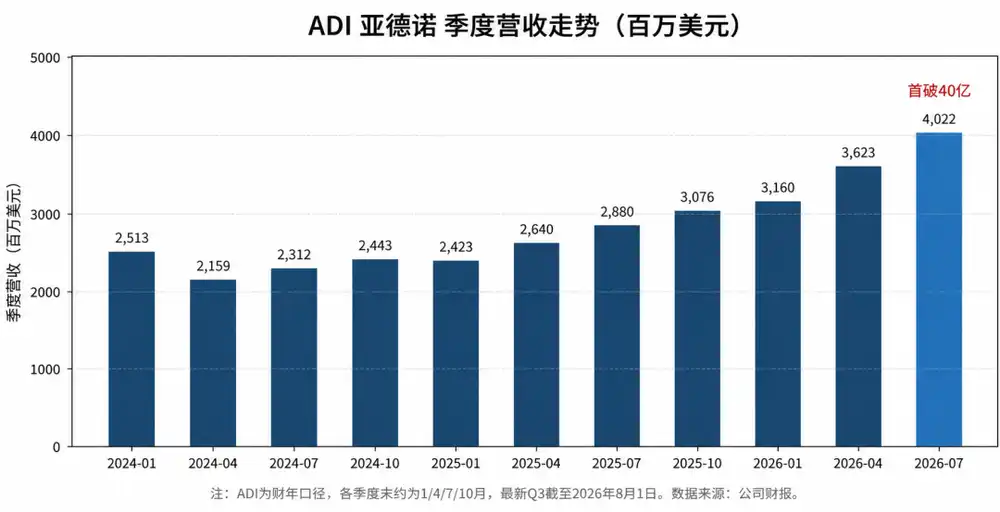
TI announced its Q2 2026 financial results, with revenue reaching $5.463 billion, a year-on-year increase of 23%. ADI announced its Q3 fiscal 2026 results for the period ending August 1, with revenue reaching $4.022 billion, a year-on-year increase of 40%, setting a new single-quarter historical high. Both companies benefited from rising demand in areas such as industrial and data centers, but their growth paths differ.

This article will compare TI and ADI side by side to see what different signals lie behind the strong growth of these two giants.

01

What Can We See in the Earnings Reports?

Both Accelerating, But with Different Details

First, let's look at the latest fundamentals of both companies.

ADI achieved revenue of $4.022 billion in Q3 fiscal 2026 ending August 1, up 40% year-on-year and 11% quarter-on-quarter. This marks the company's first single quarter surpassing $4 billion in history. TI achieved revenue of $5.463 billion in Q2 ending June 30, up 23% year-on-year and 13% quarter-on-quarter.

Year-on-year, ADI's growth rate was faster. Quarter-on-quarter, the growth rates of the two were similar. Overall, TI's scale is still larger, about 1.36 times that of ADI.

Taking a longer-term view, the shape of their recovery from the trough is also different.
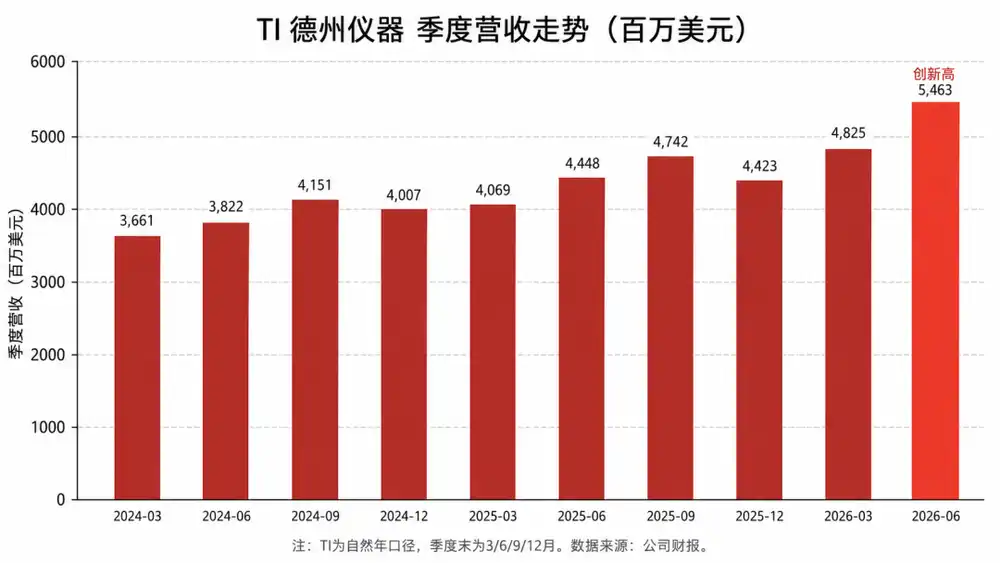
Both companies' quarterly revenues fell to recent lows in early 2024: TI 'bottomed out' in Q1 2024 (ending March 31, $3.661 billion), and ADI 'bottomed out' in fiscal Q2 (ending April 30, $2.159 billion). They have since recovered, but at different paces: TI saw ups and downs over the past two years and only showed significant consecutive quarter-on-quarter growth starting this year; ADI hovered at low levels for about a year before beginning significant growth, maintaining a relatively stable upward trend after entering 2025, gradually reaching over $4 billion.

Looking at business segments, TI described this quarter as "across-the-board strength": Industrial (33% of total revenue in 2025) grew approximately 30% year-on-year; Data Center (9% share) revenue doubled year-on-year; Automotive (33% share) grew by double-digit percentage points year-on-year, showing clear recovery within the quarter; Personal Electronics (21% share) was flat; Communications Equipment (3% share) grew both year-on-year and quarter-on-quarter. Multiple segments were running simultaneously.

ADI also achieved year-on-year growth across all four of its end markets, with Industrial and Communications performing strongly: Industrial accounted for 49% of this quarter's revenue, surging 53% year-on-year. Communications accounted for 16%, skyrocketing 84% year-on-year, with Data Center business currently making up 80% of that segment's revenue. Automotive accounted for 25%, growing 16% year-on-year. Consumer accounted for 10%, growing 6% year-on-year.

The common growth highlights for both are Industrial and Data Centers. However, TI emphasizes the simultaneous improvement across multiple end markets, with Automotive showing a new turn from weakness to strength this quarter. ADI, on the other hand, saw the most outstanding performance from its Industrial and Communications businesses.

Regarding gross margin, ADI more commonly uses adjusted (Non-GAAP) figures, with the latest quarter's gross margin at 72.5%. TI consistently uses GAAP-based figures. Comparing using the same GAAP basis, ADI's latest gross margin was 67.3%, while TI's was 61%, with ADI still significantly higher.

ADI's gross margin has been steadily improving since Q4 fiscal 2024. TI's gross margin fell below 60% in Q4 2023 and has fluctuated since, only returning above 60% this quarter.

Inventory, however, shows the opposite trend. TI's inventory at the end of Q2 was $4.6 billion, down $90 million from the previous quarter. Days of inventory outstanding (DIO) was 196 days, down 13 days quarter-on-quarter, having declined for two consecutive quarters. ADI's inventory continued to grow, reaching a new historical high of approximately $1.93 billion, but its DIO decreased to 156 days, and channel inventory weeks have already fallen below the target level of 6 to 7 weeks.

In terms of guidance, both are looking up. ADI expects next quarter revenue to be around $4.3 billion (±$100 million), which, if achieved, would set another new single-quarter record. TI expects Q3 revenue to be between $5.65 billion and $6.15 billion, representing a sequential increase of approximately 3% to 13%, and expects all markets to remain strong in Q3.

02

Where Do the Differences Come From?

At first glance, the two appear similar: performance is growing, driven by Industrial and Data Centers; gross margins are recovering; guidance is upward. But looking separately, the emphasis of their growth drivers differs.

TI attributed this quarter's strength mainly to Industrial and the broad-based recovery across several segments. Management believes the Industrial market is still in a recovery process, and although significant growth is already evident, there is still a gap compared to the peak levels of 2022. Meanwhile, data center construction is also driving related demand in energy infrastructure, test and measurement, etc.

Automotive was a new change this quarter. TI attributed its recovery to the Chinese market, especially driven by electric and hybrid vehicles, as well as automakers' inventory having previously dropped to low levels. As demand returns, restocking needs have also emerged.

In ADI's explanation, the weight of AI is significantly more pronounced. Management views Data Center and ATE (Automated Test Equipment related business) combined as the company's "AI exposure," which currently accounts for 20% of ADI's overall business. Within Data Center, ADI's optical and power products both achieved over 100% year-on-year growth. Additionally, it also mentioned growth opportunities from defense and long-term semiconductor content increase.

Unlike TI, ADI not only discussed the present but also gave a long-term outlook: ADI management revealed that its estimated serviceable available market (SAM) for the Data Center and Energy markets by 2030 has more than doubled compared to a year ago.

Putting the statements from both companies together, the common ground is clear: both are inseparable from Industrial recovery, Data Center/AI, and long-term market demand growth. Both also emphasize that this round is not simple inventory restocking but real demand. The difference lies in the focus: TI's growth is more diversified, while ADI relies more on the AI mainline.

On inventory, the two companies' actions also differ. ADI's inventory hit a new high this quarter, which management described as intentionally placed "strategic inventory" to support growing demand. At the same time, its channel inventory is already below the normal six to seven-week level. Low channel inventory suggests end-demand recovery is faster than inventory replenishment. Proactively increasing inventory also reflects ADI's relatively positive judgment on future demand.

TI's inventory remained essentially flat, with the amount slightly down by $90 million, still at the high level of $4.6 billion. Days of inventory outstanding (DIO) declined for two consecutive quarters to 196 days. However, its inventory amount hasn't significantly decreased. The decline in DIO is partly due to the inventory reduction and partly due to increased inventory turnover efficiency driven by revenue growth. It shouldn't be simply interpreted as TI actively destocking.

The differences in inventory strategy between the two also reflect differences in their underlying supply chain situations, including lead times, capacity, prices, etc.

First, supply. ADI has already begun to feel supply pressure. In July, ADI notified customers that lead times for some products have extended to up to six months and advised customers to place orders through channel partners at least six months in advance to ensure future supply. In the spot market, some chip distributors also reported that ADI's lead times have recently extended, with some orders placed months ago still not arriving.

TI appears much more at ease. In Q2, lead times remained below 13 weeks, just rising by a few weeks compared to earlier as demand grew. Management believes TI's current lead times remain among the most competitive in the industry. Regarding capacity, TI's factory utilization rates improved in Q2 compared to Q1 and continued to increase throughout the quarter. Management even stated that with the current capacity layout, TI will have "no issues" with capacity for the next three years.

Next, pricing. This year, both companies have issued price increase letters: TI issued two rounds, effective in April and July respectively; ADI's increases were effective in February and September this year.

Regarding the impact of price adjustments, the two companies' views also differ: TI management explicitly stated that in the next quarter's revenue growth expectation, the contribution from price is "almost negligible," with the vast majority of growth coming from increased shipment volumes. ADI, however, acknowledged that price increases are one of the factors driving gross margin improvement and indicated that the effect of price increases is not yet fully reflected and will continue to be released in subsequent quarters.

Reflected in the spot market, after ADI's price increase letter in December 2025, there was a wave of emotional price increases. Many said some customers stocked up in advance, but others reported the market was relatively flat. After the price increase officially took effect in February 2026, some distributors said customers maintained normal purchasing rhythms, but others saw increased ADI demand with slightly extended lead times. In July, after the new price increase letter was issued, according to quiksol, demand for popular and niche part numbers increased slightly, with prices for some models still rising.

For TI, after the price increase news spread in early March, quotes for some popular parts, especially general-purpose ones, rose rapidly, and the market also showed signs of tightening, but demand-side warming was not yet comprehensive. However, by mid-to-late March, the situation began to reverse, with those previously red-hot top-selling chips starting to drop in price. After the Qingming Festival, some models even saw their prices halved. After the new July price increase letter took effect, some model prices increased, but there was no widespread, significant rise. However, quiksol mentioned that TI's overall lead times have generally extended, from the original 8-12 weeks to 16-20 weeks.

03

Conclusion

In recent years, the analog chip industry experienced inventory adjustments and weak demand. Now, with the recovery in Industrial, Data Center, and AI infrastructure demand, signs of an industry recovery are emerging. However, this round of recovery is not a simple cyclical rebound; the demand structure is also changing.

Standing in the same analog chip recovery cycle, TI and ADI have taken two different paths: TI relies on broader market coverage and pre-prepared capacity to capture demand recovery; ADI, through "strategic inventory" deployment, is positioning itself ahead of future demand growth.

Looking ahead, as AI infrastructure continues to expand, it remains to be seen who can better translate demand into growth.

This article is from WeChat Official Account: Xin Shi Xiang , Author: San Fen Qian Tu, Original Title: "Analog Chip Giants TI and ADI Are Stepping Up!"


Criptos en tendencia

Preguntas relacionadas

QWhat are the recent quarterly financial performances of TI and ADI?

ATI reported Q2 2026 revenue of $5.463 billion, a 23% year-over-year increase. ADI reported Q3 fiscal year 2026 (ended August 1) revenue of $4.022 billion, a 40% year-over-year increase, setting a new single-quarter record.

QWhat were the key growth drivers for TI and ADI in their latest quarters?

AFor TI, growth was broad-based with strength in Industrial (up ~30%), Datacenter (revenue doubled), and a notable recovery in Automotive. For ADI, the main drivers were Industrial (up 53%) and Communications (up 84%), with significant contributions from its AI-related businesses in Datacenter and ATE.

QHow do TI's and ADI's inventory strategies differ according to the article?

AADI has built its inventory to a record high, calling it 'strategic inventory' to support anticipated demand growth, while its channel inventory is below target levels. TI's inventory value remained high but essentially flat, with Days of Inventory (DOI) decreasing, indicating improved inventory turnover efficiency due to revenue growth.

QWhat differences are highlighted regarding supply chain conditions for TI and ADI?

AADI is experiencing supply pressure, with lead times for some products extending up to six months. TI's lead times, while having increased slightly, remain below 13 weeks and are considered among the most competitive in the industry. TI also expressed confidence in its capacity sufficiency for the next three years.

QWhat role did price increases play for TI and ADI, and what were their respective impacts?

ABoth companies issued price increase notices. TI stated that price contributed 'almost negligible' to its next quarter's growth expectations, with volume being the primary driver. ADI acknowledged that price increases were a factor in its gross margin improvement and indicated the full effect would be realized in subsequent quarters.

Lecturas Relacionadas

U.S. Aims at Iran's Crypto Sector Due to Oil Payments Exceeding $100 Billion

The U.S. Treasury Department has expanded sanctions on Iran to target its digital asset sector, citing over $100 million in cryptocurrency payments allegedly used to facilitate Iranian oil sales. The Treasury’s Office of Foreign Assets Control (OFAC) announced new sectoral sanctions covering digital assets, technology, gold, aviation, and shipping, alongside sanctions against nearly 60 entities, individuals, and vessels linked to nuclear, missile, cyber, and oil networks. The move allows OFAC to sanction foreign persons and firms operating in or supporting Iran’s crypto sector, which the Treasury stated is increasingly used as a "tool of choice" to circumvent sanctions, including by the Islamic Revolutionary Guard Corps (IRGC). Specific targets include Ukrainian broker Ivan Obukhov and his UAE-registered firm Foscom FZE, accused of processing over $100 million in crypto payments to facilitate oil sales for the IRGC’s Quds Force. This follows recent U.S. actions against Iran-linked crypto exchanges, including sanctions against UK-based Zedcex and Zedxion in January, four Iranian exchanges including Nobitex in June, and exchanges Shelbit and Aban Tether in August. Unlike previous targeted sanctions, the new measures establish a framework to penalize broader involvement in Iran’s crypto sector, significantly expanding OFAC’s authority under Executive Order 13902. Designated persons’ U.S.-linked property will be blocked, and foreign banks facilitating significant transactions for them may face U.S. account restrictions.

cryptonews.ruHace 39 min(s)

U.S. Aims at Iran's Crypto Sector Due to Oil Payments Exceeding $100 Billion

cryptonews.ruHace 39 min(s)

Conversation with Charles Zhang: Amidst the AI Frenzy, Why Pursue 'Anti-Efficiency' Content?

Dialogue with Charles Zhang: In the Era of AI's Sprint, Why Create "Anti-Efficiency" Content Standing out among China's early internet pioneers, Charles Zhang, founder and CEO of Sohu, maintains a distinct personal identity. He keeps a consistent public presence and embodies traits of high-energy individuals: sleeping only 4-5 hours daily, running 5km or marathons, and hosting frequent offline tech forums and dialogues with Nobel laureates. He has shifted focus from external business expansion to internal self-reconstruction, adhering to his own pace. "People aren't afraid of being busy; the busier you are, the better your health. Having nothing to do can lead to emotional issues and poor health." Marking the 10th anniversary of his live-streamed "Charles Zhang's English Class," he recently took it offline for a real-world classroom session. Following this, he discussed the course's decade-long journey, Sohu Video's content ecosystem, and the value of content in the AI era. **Pen and Mouth Diligence: A Class Against Instant Mastery** His English class began in August 2016 on "Qianfan Live." He spends about 40 minutes daily preparing, reviewing dozens of news headlines, reading five in detail, and selecting three for the lesson. Over ten years, he has completed over 2000 live sessions totaling more than 110,000 minutes, with over 52 million views. Initially, the stream was a way to "talk more" and combat emotional struggles. He started by repeating after TV news anchors, then moved to live-streaming with the launch of Qianfan Live. It was 40% for personal emotional regulation ("like a monk chanting sutras"), 30% to deliver authentic news, and 30% to promote the new platform. This daily "ritual" helped him overcome depression, leading to what he calls his "peak life state." From a product perspective, it was counter-intuitive—launched without prior market research or growth strategies, based on the founder's personal need that resonated with users. Yet, his content creation follows a strict routine. The decade of covering geopolitics, economics, tech, health, and society has built a vast "knowledge compound interest" system. In an age of AI summaries and algorithmic content, Zhang insists on "hard work": meticulous reading, handwritten notes, and manually created teaching materials, refusing AI-generated content. The English class is now a fixed daily rhythm; preparing for his weekly physics class requires a full day of solitary deduction on a blackboard. In his live streams, Zhang positions himself as a "content creator," not a CEO or teacher. He sees physics as extreme brain training and English as a "sensor" to understand the world. This explains why a top entrepreneur persists for a decade in seemingly "unprofessional" pursuits—it's the information input and psychological healing method he found during a low point. It's fundamentally an "anti-efficiency" commitment. He believes the meaning of reading lies in finding community and spiritual support, not just fleeting conversation points. For today's media, he states: "Reading news isn't the goal. As humans with many confusions, we need reference points, to find a group, find kindred spirits, or seek support and spiritual nourishment. Large language models can't satisfy these starting points; they only give you information." This offers solace and a value defense for media professionals impacted by AI summaries. **"Don't Think Earth Stops Turning Because AI Arrived"** A content creator expressed anxiety: after feeding their article to AI, it produced a more comprehensive, profound version, making their work feel valueless. Zhang responded with an analogy: "Carrots from the market, with a bit of soil, not glossy, taste delicious and flavorful. Tomatoes forced by chemical fertilizer have no taste at all." He sees AI giving world content a "plastic feel," but acknowledges its significant role in improving information access efficiency, especially in physics and social science research where he often queries AI for quick professional answers. The key, Zhang stresses, is that the outside world still needs to guide our perspective. LLMs provide "information," while the outside world offers "viewpoints." He cares deeply about *what* that external viewpoint is and *how* someone thinks about an issue. "Don't think the Earth stops turning because AI arrived," he analyzes. AI currently replaces rule-based work, noting significant impact on the software industry with many programmers laid off as even less experienced people can now write decent code. However, AI cannot yet replace arts, social sciences, emotions, and creative content. "Hollywood remains thriving, producing great works. Oscars will continue, Nobel Literature Prizes will still be awarded—all by real people, with works conceived by real people." While wary of AI, Zhang isn't anti-technology and is open to its applications. Sohu itself has launched AI assistants. In Sohu's AI practice, Zhang defines his role as a "large language model corpus provider." He believes LLM training is inseparable from human-original content as its data foundation, so original content retains irreplaceable value. "The era of self-media indeed offers everyone new ways to discover their strengths and achieve growth." He suggests every young person should consider self-media. Most importantly, the bottom line of content creation should be "authenticity." If using AI avatars, they must be clearly labeled; not doing so and misleading viewers wastes their time, especially when people still prefer real human content. Behind AI's sprint lie unavoidable realities. As AI quickly provides seemingly perfect answers, people grow accustomed to accepting "summarized" results, omitting processes of questioning, deduction, and trial-and-error, leading to a decline in deep thinking. Zhang's "anti-efficiency" practice with his two live-streamed classes is his answer to AI's狂奔: In an algorithm-driven era chasing ultimate efficiency, don't expect AI to fill inner voids. Read books, speak in front of a camera, sweat on a running track, and build connections with real people.

marsbitHace 49 min(s)

Conversation with Charles Zhang: Amidst the AI Frenzy, Why Pursue 'Anti-Efficiency' Content?

marsbitHace 49 min(s)

Trading

Spot

Artículos destacados

Cómo comprar CHIP

¡Bienvenido a HTX.com! Hemos hecho que comprar USD.AI (CHIP) sea simple y conveniente. Sigue nuestra guía paso a paso para iniciar tu viaje de criptos.Paso 1: crea tu cuenta HTXUtiliza tu correo electrónico o número de teléfono para registrarte y obtener una cuenta gratuita en HTX. Experimenta un proceso de registro sin complicaciones y desbloquea todas las funciones.Obtener mi cuentaPaso 2: ve a Comprar cripto y elige tu método de pagoTarjeta de crédito/débito: usa tu Visa o Mastercard para comprar USD.AI (CHIP) al instante.Saldo: utiliza fondos del saldo de tu cuenta HTX para tradear sin problemas.Terceros: hemos agregado métodos de pago populares como Google Pay y Apple Pay para mejorar la comodidad.P2P: tradear directamente con otros usuarios en HTX.Over-the-Counter (OTC): ofrecemos servicios personalizados y tipos de cambio competitivos para los traders.Paso 3: guarda tu USD.AI (CHIP)Después de comprar tu USD.AI (CHIP), guárdalo en tu cuenta HTX. Alternativamente, puedes enviarlo a otro lugar mediante transferencia blockchain o utilizarlo para tradear otras criptomonedas.Paso 4: tradear USD.AI (CHIP)Tradear fácilmente con USD.AI (CHIP) en HTX's mercado spot. Simplemente accede a tu cuenta, selecciona tu par de trading, ejecuta tus trades y monitorea en tiempo real. Ofrecemos una experiencia fácil de usar tanto para principiantes como para traders experimentados.

643 Vistas totalesPublicado en 2026.04.21Actualizado en 2026.06.02

Cómo comprar CHIP

Discusiones

Bienvenido a la comunidad de HTX. Aquí puedes mantenerte informado sobre los últimos desarrollos de la plataforma y acceder a análisis profesionales del mercado. A continuación se presentan las opiniones de los usuarios sobre el precio de CHIP (CHIP).

活动图片