Matrixdock Launches Silver Token XAGm, Building On-Chain Silver Reserve Asset Based on FRS Standard

marsbitPublicado a 2026-03-17Actualizado a 2026-03-17

Resumen

Matrixdock, a leading RWA platform, has launched XAGm, an institutional-grade silver token backed by fully allocated physical silver. The token is supported by LBMA Good Delivery standard silver bars, enabling this widely traded precious metal to enter the on-chain financial ecosystem. XAGm expands Matrixdock’s on-chain precious metals system, supporting use cases such as trading, collateralization, and DeFi applications. Unlike gold, which primarily serves as a store of value, silver possesses both investment and industrial demand, introducing stronger cyclical dynamics and diversified utility in on-chain markets. XAGm is one of the few institutional-grade tokenized silver products, with verifiable asset backing held in professional vaults. The token is issued under Matrixdock’s FRS (Fungible Reserve Standard) framework, which ensures transparent and sustainable alignment between on-chain tokens and underlying physical assets. Initially deployed on Ethereum, XAGm is set to expand to other blockchain ecosystems to improve accessibility and liquidity. This launch further develops Matrixdock’s Reserve Layer, combining gold and silver to create a more resilient and diversified on-chain asset base for the decentralized financial system.

Matrixdock, a leading global RWA platform, today announced the launch of the silver token XAGm for institutional use. This product is backed by fully allocated physical silver as the underlying asset and incorporates silver bar assets that comply with the LBMA Good Delivery standard, enabling silver—a widely traded precious metal commodity in traditional markets—to enter the on-chain financial system.
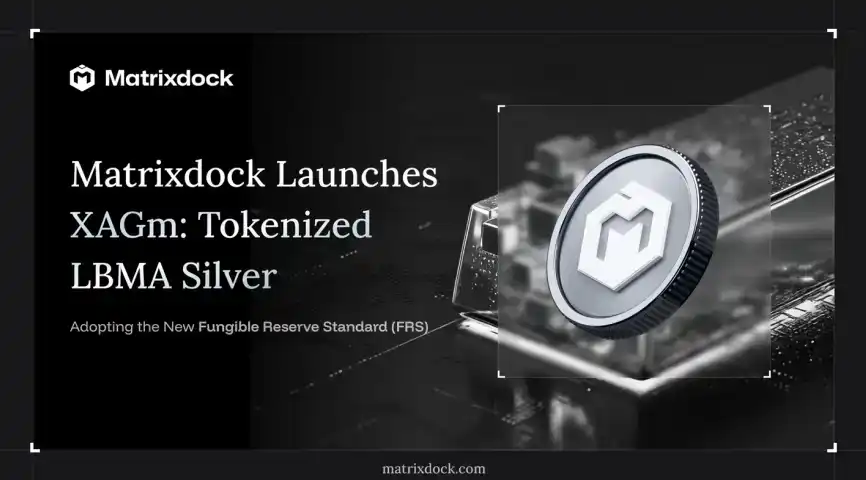
The launch of XAGm further enriches Matrixdock's on-chain precious metal asset system, allowing silver, a precious metal asset that has long played a significant role in traditional markets, to enter a programmable on-chain financial environment. It supports various financial application scenarios such as collateralization, trading, capital allocation, and DeFi.

As real-world assets continue to enter the blockchain financial system, market focus is gradually shifting from "whether assets can be on-chain" to "which assets can operate stably on-chain in the long term." Against this backdrop, precious metal assets with mature market structures, stable value foundations, and global liquidity are becoming important asset types in the on-chain financial system, featuring institutional-grade structural design.

Combining Investment and Industrial Attributes, Silver Expands On-Chain Trading and Collateral Scenarios

Unlike gold, which primarily serves as a store of value, silver is influenced by both investment demand and industrial consumption, resulting in more pronounced cyclical characteristics. This dual nature as both a financial asset and an industrial commodity enables silver to support more diverse trading, collateral, and asset allocation scenarios in the on-chain market.

If gold provides a stable value anchor for reserve assets in the on-chain financial system, then silver introduces greater market activity and cyclical characteristics to this system. The two form a complementary relationship, providing a more complete structural foundation for the on-chain precious metal asset system.

As one of the few tokenized silver products in the current market with an institutional-grade structural design, XAGm is backed by physical silver in the form of LBMA Good Delivery standard silver bars, stored in professional institutional vault facilities. Through clear asset allocation arrangements and information disclosure mechanisms, the correspondence between XAGm tokens and the underlying silver assets can be independently verified within the established framework, providing institutional participants with an auditable and verifiable channel for on-chain silver asset allocation.

FRS Issuance Framework: Supporting the Long-Term Operation of Real Assets On-Chain

In terms of asset structure design, XAGm adopts Matrixdock's FRS (Fungible Reserve Standard) issuance framework. FRS is an issuance mechanism designed by Matrixdock for RWA on-chain, establishing a transparent and verifiable correspondence between the on-chain token supply structure and the underlying asset holding structure through programmable means, enabling tokens to continuously reflect the economic attributes of the held real assets. While maintaining the integrity of the underlying assets' economic attributes, FRS also incorporates long-term operational costs such as custody and auditing into the mechanism design, thereby providing a more sustainable structural model for long-term RWA assets.

XAGm will first be deployed on the Ethereum network, with plans to gradually expand to more blockchain ecosystems in the future to further enhance the accessibility and liquidity of assets in different on-chain financial environments.

The launch of XAGm also marks the continuous expansion of Matrixdock's Reserve Layer system. With the successive introduction of gold and silver as two types of precious metal assets, Matrixdock is building an on-chain reserve structure composed of assets driven by different economic cycles, providing a more stable and diversified asset infrastructure for the on-chain financial system.

Eva Meng, Head of Matrixdock, stated: "There are still relatively few tokenized silver products in the current market that truly meet institutional-grade standards. With XAGm, we are bringing fully allocated silver assets, custodied by professional institutional vaults, on-chain, operating within a clear and verifiable framework. Gold primarily serves as a store of wealth, while silver plays a complementary role driven by both industrial demand and monetary attributes. Together, they will provide a more complete and resilient asset foundation for on-chain precious metal infrastructure."

In the future, Matrixdock will continue to expand into more high-quality real-world assets, including precious metals and other commodity assets with mature market structures, to promote the construction of a more transparent and resilient on-chain reserve asset system, providing long-term sustainable infrastructure support for the development of the on-chain financial ecosystem.

Preguntas relacionadas

QWhat is the name of the new silver token launched by Matrixdock and what standard is it built on?

AThe new silver token is called XAGm, and it is built on the FRS (Fungible Reserve Standard).

QWhat is the primary purpose of the FRS (Fungible Reserve Standard) framework used for XAGm?

AThe FRS framework is designed to establish a transparent and verifiable correspondence between the on-chain token supply structure and the underlying asset holding structure, ensuring the token continuously reflects the economic attributes of the real asset while incorporating long-term operational costs like custody and auditing.

QHow does the role of silver (XAGm) differ from that of gold in the on-chain financial system according to the article?

AGold primarily serves as a store of value, while silver, influenced by both investment demand and industrial consumption, introduces stronger market activity and cyclical characteristics, creating a complementary relationship within the on-chain precious metals system.

QWhat specific standard do the physical silver bars backing XAGm comply with, and how is the asset's authenticity verified?

AThe physical silver bars backing XAGm comply with the LBMA Good Delivery standard. The correspondence between the tokens and the underlying silver is independently verifiable within a defined framework through clear asset allocation arrangements and information disclosure mechanisms.

QOn which blockchain network will XAGm be initially deployed, and what are the plans for its future expansion?

AXAGm will first be deployed on the Ethereum network, with future plans to expand to more blockchain ecosystems to enhance its accessibility and liquidity across different on-chain financial environments.

Lecturas Relacionadas

US Stocks Hit Record Highs: Why Isn't the Market Afraid of the Flames of War?

U.S. stocks hit a record high on April 15, with the S&P 500 closing at 7,022.95, just 77 days after its previous peak. This rebound occurred in only 11 trading days—far faster than recoveries following past crises like the COVID-19 pandemic (103 days) or the 2011 debt crisis (106 days). The market's rapid recovery is attributed to "ceasefire expectations" rather than deteriorating economic fundamentals. During the sell-off triggered by the U.S.-Israel military action against Iran in late February, the S&P 500 fell nearly 10%. However, the market rallied twice on ceasefire rumors—first on March 24 and again on April 8—even before any permanent peace deal was signed. Notably, the VIX fear index fell below pre-war levels, indicating that the market had repriced the conflict from an uncertainty to a calculable risk. Major financial institutions like JPMorgan reported record trading revenues of $11.6 billion in Q1 2026, largely driven by volatility in commodities and emerging markets. Hedge funds turned net long for the first time since late 2025, while margin debt hit a record $1.28 trillion. This reflects a financial system that commercializes volatility, treating geopolitical shocks as tradable opportunities rather than systemic threats. However, the current optimism relies on assumptions of a sustained ceasefire and stable oil prices, leaving the market vulnerable if these conditions change.

marsbitHace 7 min(s)

US Stocks Hit Record Highs: Why Isn't the Market Afraid of the Flames of War?

marsbitHace 7 min(s)

Is the Rebound an Illusion? The Bond Market Has Already Given the Answer

Is the stock market's rapid rebound to pre-war levels a sign of recovery or a misleading rally driven by momentum rather than fundamentals? While the S&P 500 has fully recovered its losses from the U.S.-Iran conflict and nears all-time highs, bond and oil markets tell a different story. Key data reveals contradictions: 10-year Treasury yields have risen 30 basis points, signaling persistent inflation concerns and constrained Fed policy space. WTI crude is up 37%, indicating that geopolitical risks are not priced to resolve soon. The 2-year Treasury yield, a sensitive gauge of rate expectations, has increased nearly 40 bps, challenging the narrative of imminent Fed rate cuts. The equity market appears to be pricing in a "perfect scenario": subdued oil impact on consumption, Fed rate cuts despite hot inflation, stable corporate margins, and near-term conflict resolution. However, bonds and oil reflect a reality of sticky inflation, limited Fed flexibility, and ongoing geopolitical tension. This divergence suggests the rally may be momentum-driven rather than fundamentally justified. If upcoming CPI data exceeds expectations (e.g., above 3.5%), the 2026 rate-cut narrative could collapse. Investors chasing the rally are betting on an ideal outcome—swift conflict resolution, controlled inflation, Fed easing, and resilient earnings—while ignoring signals from more cautious asset classes. The gap will likely close either through a fundamental improvement validating stocks or a market correction aligning with bond and oil realities.

marsbitHace 14 min(s)

Is the Rebound an Illusion? The Bond Market Has Already Given the Answer

marsbitHace 14 min(s)

Trading

Spot
Futuros
活动图片