Author: David, Deep Tide TechFlow
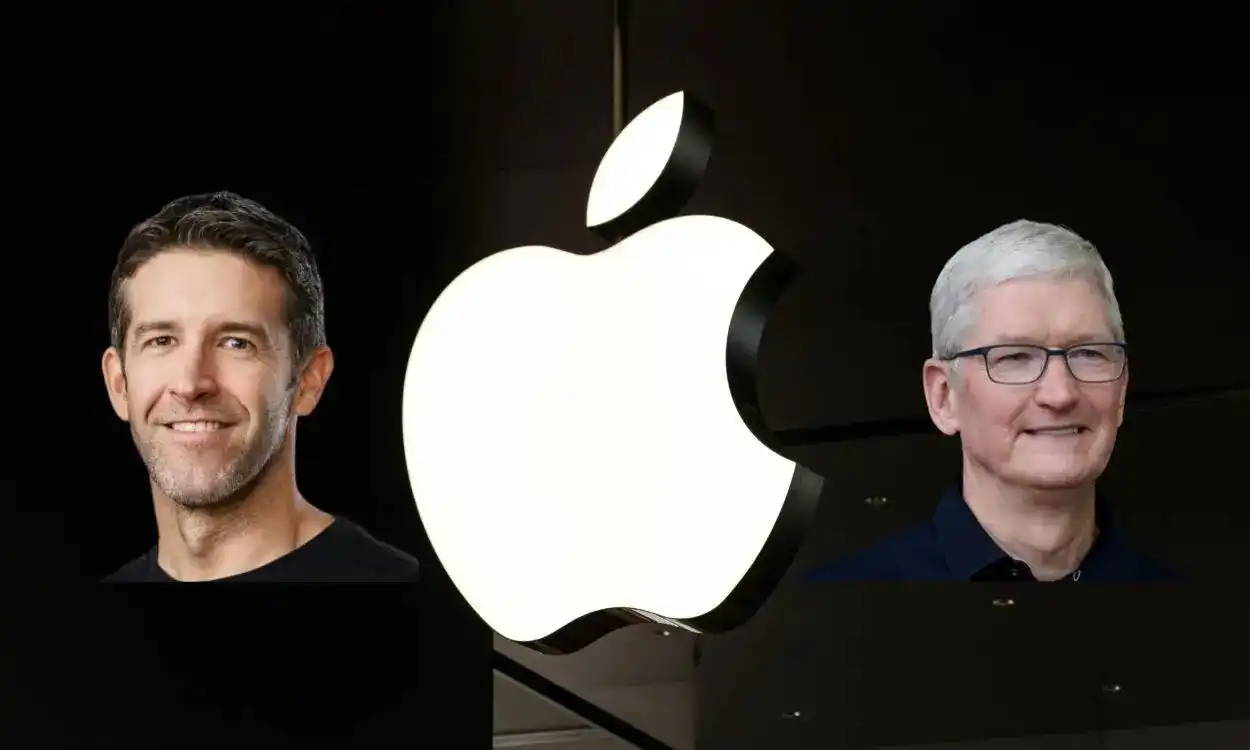
Apple, the world's highest-valued tech company, has just handed over the CEO position to someone with almost no public profile.
On April 20, Apple announced that Tim Cook will step down as CEO on September 1 and transition to the role of Executive Chairman. His successor, John Ternus, is 51 years old, has been with Apple for 25 years, and previously held the title of Senior Vice President of Hardware Engineering.
Following the announcement, Apple's stock price dipped less than 1% in after-hours trading. The market's reaction was calm, perhaps because everyone had already guessed it would be him.
Over the past year, Ternus has appeared more frequently at Apple's product launch events. Last year, when the iPhone 17 was released, he was the one greeting the first customers at the London flagship store.
According to Bloomberg reporter Mark Gurman, Apple's PR team has been deliberately shifting the spotlight to him since last year.
But if you don't pay much attention to Apple's hardware launches, you've probably never seen him. He has no social media accounts, rarely gives interviews, and when asked about succession rumors, he only said five words:
"I love my current job."
The CEOs who left their mark on Apple's history—Steve Jobs, a combination of product intuition and marketing genius, and Tim Cook, an expert in supply chain and operations—have vastly different styles but share one common trait:
Neither was an engineer.
But Ternus is. He has a background in mechanical engineering, and his career has been about parts, molds, and production lines from day one. Before joining Apple, he worked at a little-known small company developing VR headset devices, a technology that still hasn't gone mainstream today.
And at this moment, as he takes over Apple, the company's biggest anxiety might have little to do with hardware.
The Low-Profile Hardware Engineer
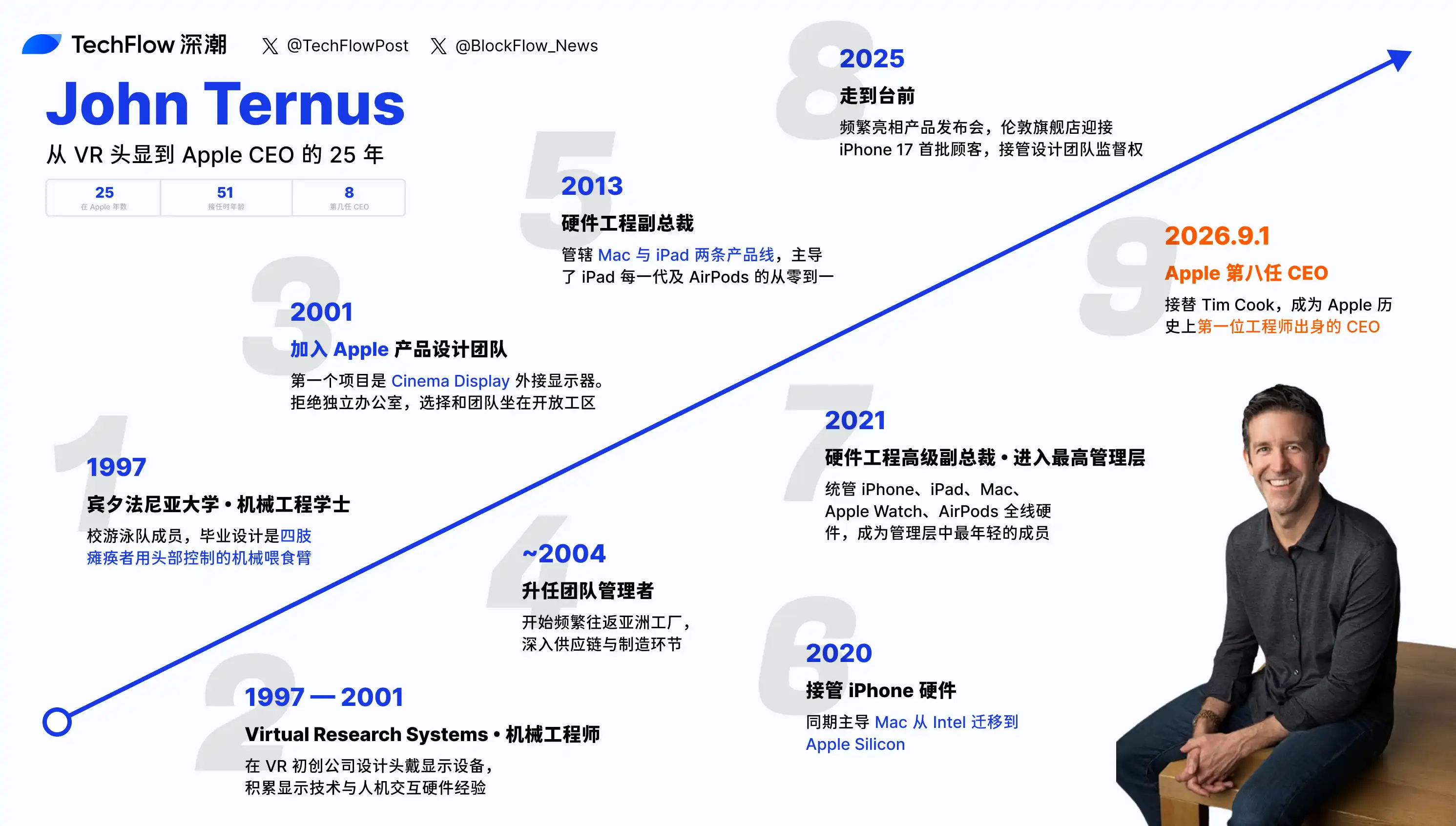
In 1997, Ternus graduated from the University of Pennsylvania with a degree in mechanical engineering. During his college years, he was a member of the university's swim team and won championships in the 50-meter freestyle and 200-meter individual medley.
Public records show that his graduation project was a mechanical feeding arm, designed to allow quadriplegic individuals to control the arm with head movements to eat independently.
After graduation, he joined a company called Virtual Research Systems, working as a mechanical engineer on VR headsets.
In 1997, the VR industry was decades away from Meta investing billions in the metaverse and even further from Apple's own Vision Pro. The company didn't achieve much success, but Ternus stayed there for four years, working daily with display technology and hardware for human-computer interaction.
In 2001, he joined Apple, entering the product design team.
That year, Steve Jobs had just pulled the company back from the brink of collapse. The iPod hadn't been released yet, and the iPhone was still six years away. Ternus's first project was working on the Cinema Display, Apple's external monitor product line at the time.
According to The New York Times, his first supervisor at Apple, Steve Siefert, recalled that when Ternus was promoted to management and offered a private office on a new floor, he chose to stay in the open workspace with his team.
When Siefert retired and offered him his office, Ternus declined again.
Starting with displays, Ternus climbed the ranks. According to Apple's official introduction, he was involved in the development of the iPad from scratch and every subsequent generation, and he led the hardware engineering for AirPods. He was promoted to Vice President of Hardware Engineering in 2013 and succeeded his predecessor as Senior Vice President of Hardware Engineering in 2021, officially entering Apple's top management.
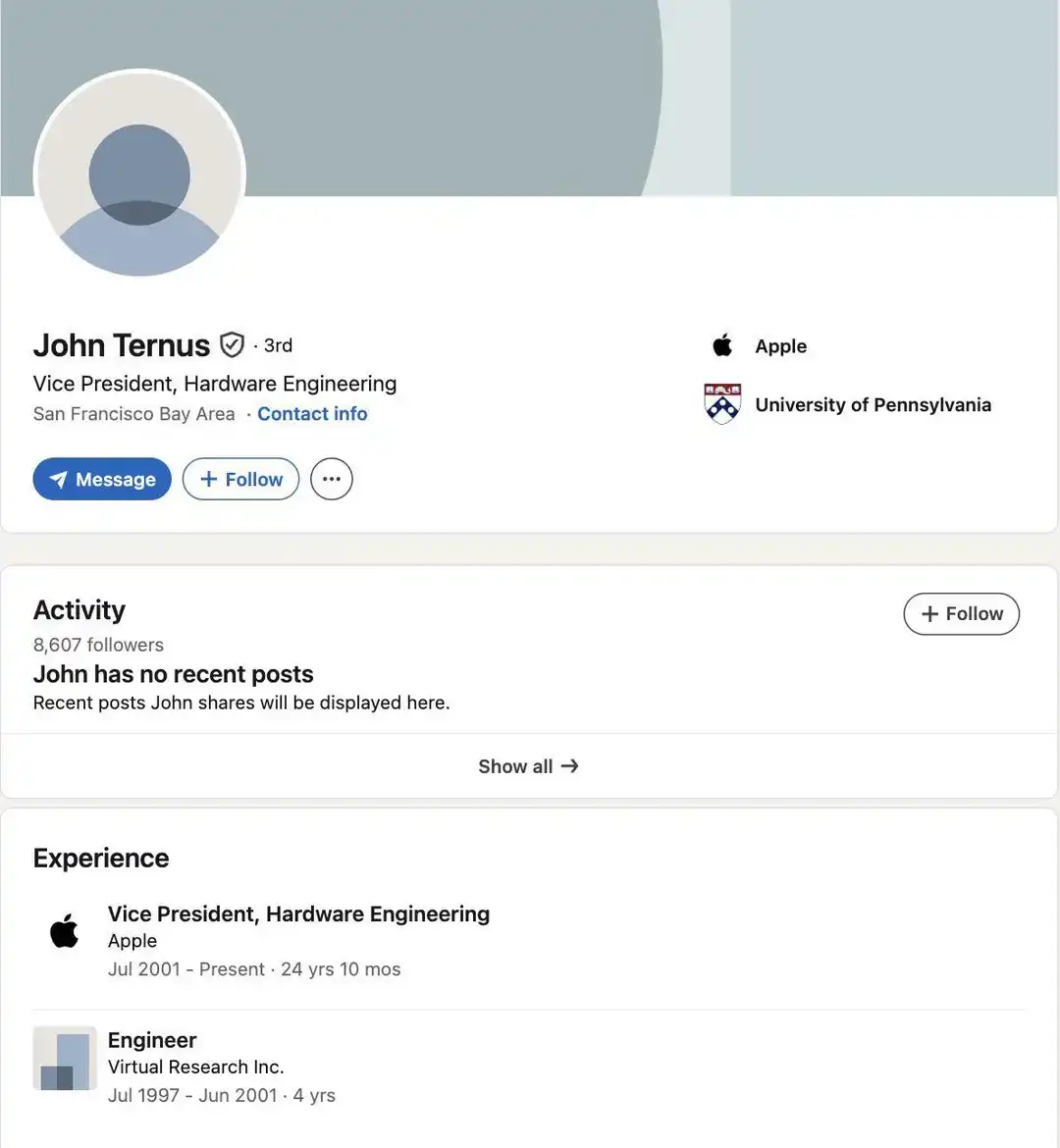
A check of his LinkedIn reveals that Ternus is incredibly low-profile—he doesn't even have a profile picture or any posts. Perhaps until today, he hasn't cared much about maintaining a public image, focusing more on working with hardware.
Internally, he also led a profoundly impactful initiative for Apple: transitioning the Mac product line from Intel chips to Apple's custom silicon.
In 2024, he returned to his alma mater, the University of Pennsylvania, to give a speech to engineering graduates. One line from that speech feels particularly worth pondering today:
"Always assume you are as smart as anyone in the room, but never assume you know more than they do."
This sounds like humility, but for someone about to take over the world's largest tech company, it might be closer to an engineer's survival instinct: you can't know everything, but you must know who does.
And the company he is now taking over has left him a legacy far more complex than an office.
After Cook
Cook served as Apple's CEO for nearly 15 years, and the report card he leaves behind is legendary by any company's standards.
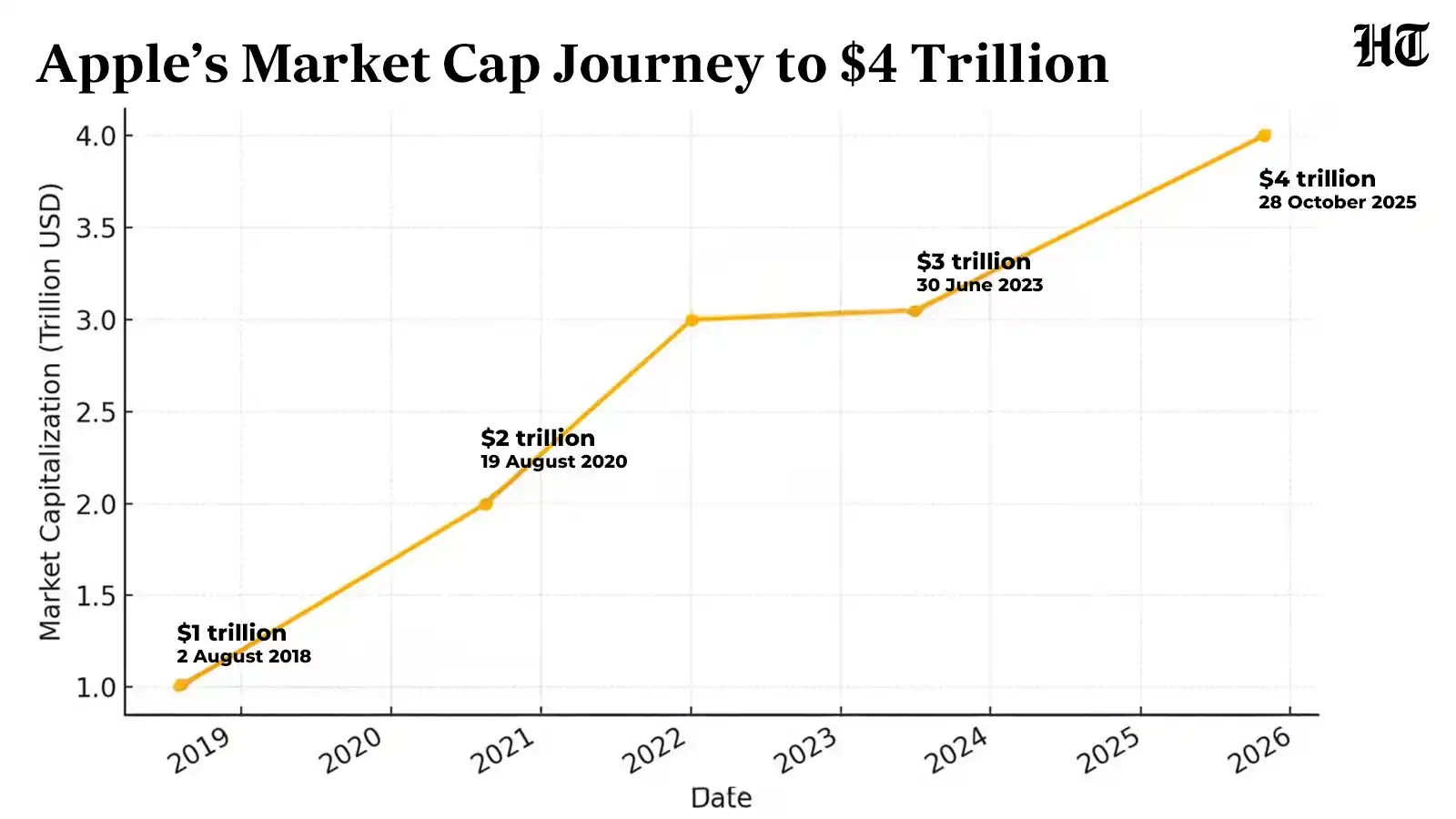
According to CNBC, when he took over the company from Steve Jobs in 2011, Apple's market capitalization was approximately $350 billion. Today, that figure is $4 trillion—an increase of over tenfold.
According to Apple's latest fiscal year data, the company's annual revenue exceeds $400 billion, nearly four times what it was when he took over. He also turned Apple's services business—App Store, iCloud, Apple Music, and other software revenues—into a business generating over $100 billion in annual revenue.
An operations-focused CEO turned a product-driven company into the world's most profitable machine. In my opinion, this alone proves the prophecy that "Apple is finished without Jobs" wrong.
But he also left some unanswered questions.
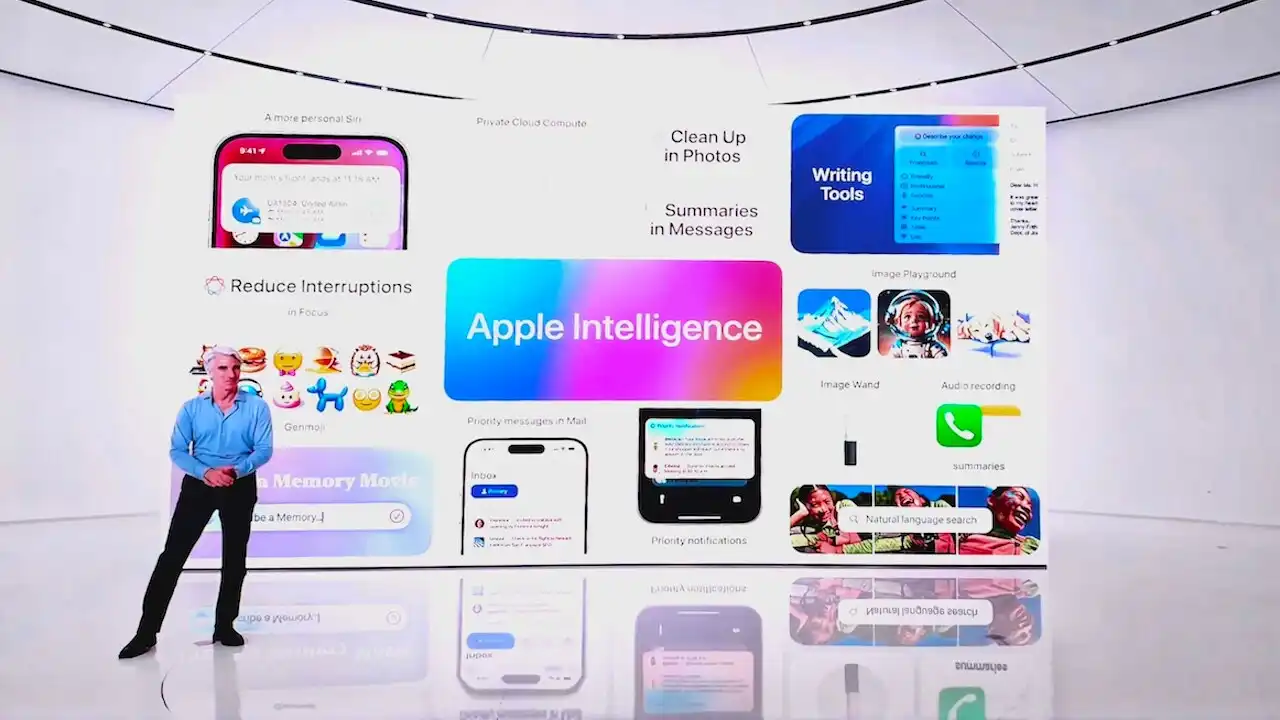
In 2024, Apple high-profile launched Apple Intelligence, the company's formal response to the AI wave. The宣传 focus at the time was a全新的, smarter Siri voice assistant.
But this promise remains unfulfilled. Siri has been mocked for years in the AI race, often failing at simple tasks like setting an alarm, while competitors' AI assistants can already write code, conduct research, and manage schedules.
In January 2026, Apple made a decision that speaks volumes.
According to CNBC, the company announced a multi-year agreement with Google, using Google's Gemini large language model as the technical foundation for Apple's base model to power the next-generation Siri. According to multiple earlier reports, Apple is paying approximately $1 billion annually for this.
Prior to this, Apple had also tested technology from OpenAI and Anthropic, ultimately choosing Google. A company famous for "doing everything itself" chose to pay an external partner for AI.
To make matters more awkward, this external solution itself is also delayed.
The new Siri powered by Gemini was originally planned to launch with iOS 26.4, but some features may now be delayed until September with the release of iOS 27. Apple has been promising core AI features since 2024, yet none have materialized.
Cook also made another less successful big bet: Vision Pro. This mixed reality headset, priced at several thousand dollars, received a lukewarm market response after its 2024 launch. Consumers weren't keen on spending that much to strap a computer weighing over a pound to their faces.
The challenge Cook couldn't solve in this category now falls to someone who understands its hardware better. But the VR headset issue can be addressed gradually; Ternus faces two more urgent matters.
On June 8, Apple will host its annual Worldwide Developers Conference (WWDC), where the new Gemini-powered Siri is expected to officially debut. This is Apple's most important public exam in the AI arena, and the person turning in the paper will be an engineer who has worked with hardware his entire life.
In September, the same month Ternus officially becomes CEO, Apple plans to release the company's first foldable iPhone, potentially priced over $2,000.
According to Bloomberg, mass production plans for this product have already been delayed due to supply chain constraints, and initial supplies will likely be limited.
One software exam, one hardware exam—both intensifying the pressure on the new CEO.
Strong on Hard, Weak on "Soft"?
Apple is handing both exams to someone who has worked in hardware for 25 years. So, the hardware exam might not be a major concern.
The mass production delay for the foldable iPhone is a supply chain issue, and Ternus has been shuttling between Asian factories and production lines since 2004—this is his most familiar battleground.
Apple's choice of him over someone with a finance or software background sends a clear signal. It suggests the board believes that, for the next few years, the physical form of products will remain Apple's core competitiveness.
But the other exam is different.
AI is currently Apple's biggest weakness and is becoming an existential-level problem. The most brutal lesson in the tech industry in recent years is that the impact of AI on software companies has far exceeded everyone's expectations.
Apple is temporarily not on the replacement list because it essentially still sells hardware. But the problem is, if the AI experience on the iPhone is always a step behind Android, consumers will eventually vote with their wallets.
And the new successor, Ternus, has no experience in software or AI in his entire resume. He is the type who can take the magnetic attachment scheme for an iPhone screen from concept to mass production, not the type who decides how Siri should understand a sentence.
All the products he has handled at Apple—iPad, AirPods, Mac, the Apple Silicon transition—are all victories defined by hardware. Whether the software is user-friendly has never been a question he needed to answer.
After September 1, that question belongs to him.
Apple's arrangements show the company is aware of this risk. After Ternus takes office, hardware engineering will be handed over to Johny Srouji, a veteran who has worked on chips for nearly 20 years at Apple, with an upgraded title to Chief Hardware Officer.
Cook remains as Executive Chairman, continuing to manage global policy and government relations. Ternus is being pulled out of the specifics of hardware; his energy must shift towards AI and overall strategy.
The CEO must answer the question of direction. What role does AI play in Apple's products? Is it an ancillary function of the hardware, like the camera, or does hardware become the carrier for AI?
Cook didn't answer this question, or rather, the market didn't buy his answer. Apple's stock price has barely moved this year, while Google's has risen over 20% in the same period.
Cook's departure at this critical moment of Apple's AI transformation itself raises questions.
This question is now passed to Ternus. Someone known internally as "the executive closest to the product" suddenly has to think about the question farthest from the product.
However, I'm actually pessimistic about this choice.
Engineers have an underestimated advantage: they are accustomed to admitting what they don't know and then finding someone who does. In an era where CEOs compete to perform "I know AI better than AI," someone willing to say "I don't know, but I know who does" might actually move more steadily.
Of course, the market and consumers won't give him much time to test this hypothesis.