The most exciting place at this World Cup isn't just on the pitch.
As interest in World Cup prediction events heats up, more and more users are participating in trading with real money. Who will win, what will the score be, will there be an upset, will there be a red card, which player will score—these topics, originally just casual pre-match chatter among fans, are now broken down into individual tradable prediction events.
When predictions become trades, users need more than just emotions and intuition: odds fluctuations, team form, injury news, head-to-head history, and market sentiment all become reference points before making a trade. In this process, AI models are being frequently brought into World Cup prediction scenarios.
Large models like Qwen, ChatGPT, Gemini, Claude, DeepSeek, Qwen, and Copilot can not only answer 'which team is more likely to win' but also provide score predictions, likelihood of upsets, red card risks, key player performances, and match flow analysis. For prediction market participants, AI's pre-match analysis is becoming another layer of reference beyond odds, news, team data, and market sentiment.
However, predictions ultimately have to be judged against the actual matches.
With the official start of the World Cup, the results of the first few matches have come in. Those AI analyses that users consulted to aid their judgments before the matches now have answers to compare against: Were the scores predicted correctly? Were upsets foreseen? How many details like red cards, last-minute winners, and match flow were actually captured by the models?
The first to go viral was, surprisingly, Qwen
The most entertaining performance on the opening day of the World Cup undoubtedly belonged to Qwen.
For the opening match between Mexico and South Africa, Qwen's pre-match prediction was Mexico 2:0 South Africa. After the match ended, the score was indeed 2:0. What's more interesting is that the match saw a total of three red cards, which also largely aligned with Qwen's pre-match risk assessment of 'South Africa's overly aggressive defending, potentially leading to playing with ten men early on.'
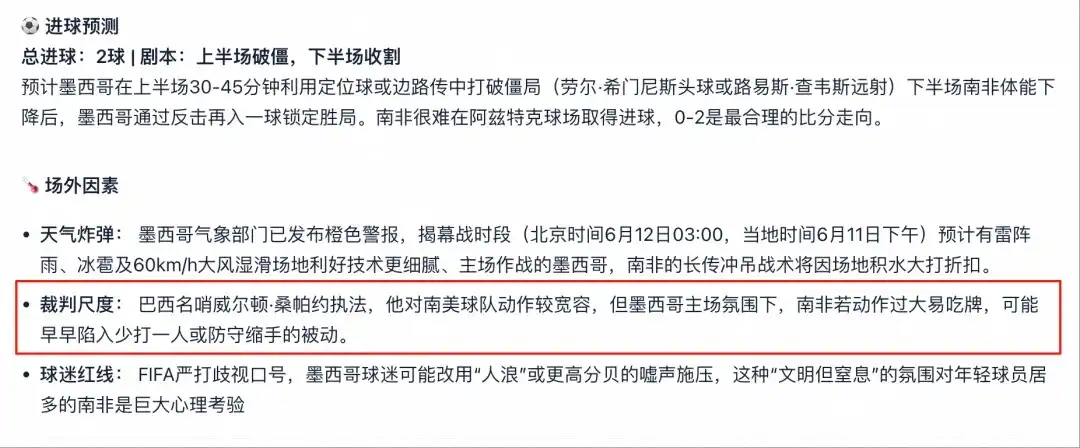
If it were just predicting a Mexico win, that wouldn't be too surprising. As one of the hosts, Mexico was favored anyway. But what Qwen nailed this time were the more specific match details: the 2:0 scoreline, South Africa's red card risk, and the pace of the game gradually opening up in the later stages.
Next, for the match between South Korea and the Czech Republic, Qwen gave a prediction of South Korea 2:1.
This match wasn't easy to call before kick-off. The Czech Republic had physicality, set-piece threats, and the usual big-tournament experience of European teams. The match process was indeed not one-sided; the Czechs took the lead first, South Korea equalized later, and the game was deadlocked at 1:1 for a long time. It wasn't until the final stages that South Korea scored the winning goal, with the final score becoming 2:1.
This gave Qwen's prediction an even stronger sense of 'scriptwriting.' Predicting the winner can rely on paper strength, score predictions can involve luck, but process details like red cards, comebacks, and last-minute winners are what truly make people think 'there's something to this.' After two matches on the opening day, Qwen first raised the profile of AI World Cup predictions.
Copilot: Moments of brilliance, but also obvious stumbles
Before the tournament, USA Today had Copilot predict all 104 matches of this World Cup. Judging from the completed matches so far, these predictions have both highlights and obvious misses.
Among them, three match predictions stood out.
For the opening match Mexico vs. South Africa, Copilot predicted Mexico 2:0, which matched the final score exactly. For South Korea vs. the Czech Republic, it predicted South Korea 2:1, again consistent with the result. For Brazil vs. Morocco, Copilot gave a 1:1 prediction, and Brazil was indeed held to a draw by Morocco.
Especially the Brazil 1:1 Morocco match, the prediction had significant merit. Brazil is, after all, a traditional powerhouse, with a squad and level of attention in the top tier.
Although Morocco reached the semi-finals in the last World Cup, predicting a draw against Brazil before the match was not a particularly safe choice. After the match, Brazil failed to get a winning start, and Morocco continued its resilience in major tournaments—Copilot's prediction for this match was indeed a 'stroke of genius.'
But Copilot's issues also became apparent quickly.
It predicted Canada would beat Bosnia and Herzegovina 2:1, but the match ended 1:1; it predicted Switzerland would edge Qatar 1:0, but Switzerland was also held to a draw; it predicted the USA would beat Paraguay 2:0—the direction was correct, but the actual score was 4:1, significantly underestimating the attacking intensity.
More obvious stumbles occurred in several matches involving upsets and strong teams being held back.
For Turkey vs. Australia, Copilot predicted Turkey would win 2:1, but Australia pulled off a 2:0 upset win. For Ecuador vs. Ivory Coast, it predicted Ecuador 2:1, but Ivory Coast won 1:0. For the Netherlands vs. Japan, it predicted the Netherlands 2:1, but Japan came back twice to level, ending in a 2:2 draw. For Sweden vs. Tunisia, it predicted 1:1, but Sweden thrashed them 5:1.
The fact that Copilot could nail the exact scores for Mexico, South Korea, and Brazil shows it doesn't just follow the favorites. But matches like Australia beating Turkey, Qatar drawing with Switzerland, and Japan drawing with the Netherlands also expose its judgments on upsets and draws as still being relatively conservative.
ChatGPT: Analysis is thorough, but not sharp enough on upsets
Compared to Copilot's full tournament predictions, ChatGPT is more like a 'pre-match analytical player.'
In its opening match prediction, ChatGPT predicted Mexico 2:0 South Africa, hitting the final score. The reasoning it provided was also quite thorough, including Mexico's home advantage, recent form, South Africa's lack of attacking threat, and factors like the high altitude of Mexico City and the home crowd atmosphere. In this prediction, ChatGPT didn't just give a result; the underlying logic also aligned with the match outcome.
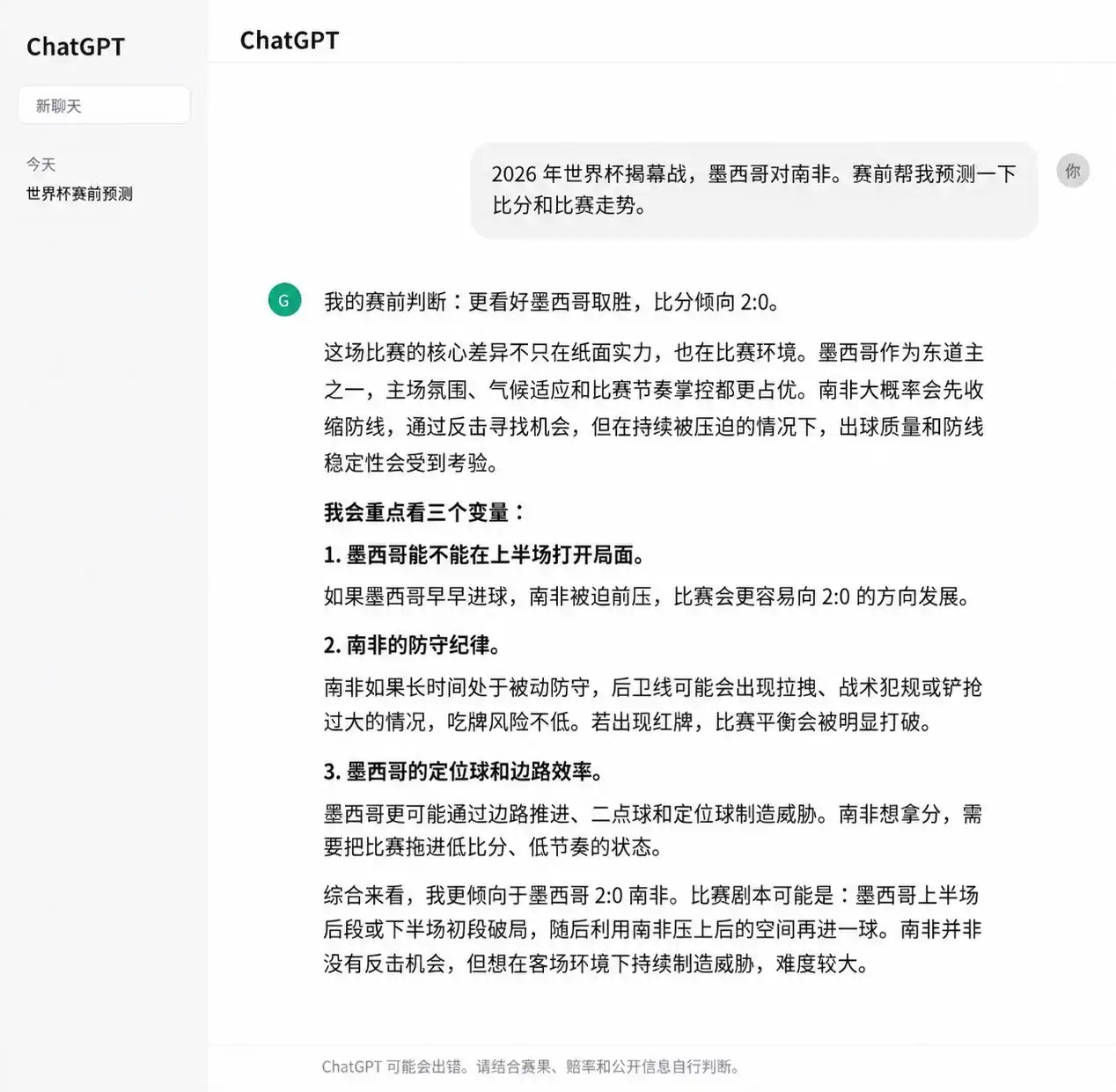
However, when it comes to full tournament predictions, ChatGPT's stability isn't as strong. While it correctly predicted Mexico 2:0 South Africa and Brazil 1:1 Morocco, and got the win/loss direction right for several matches like Scotland, Germany, and Sweden, for matches like South Korea 2:1 Czech Republic, Qatar 1:1 Switzerland, Australia 2:0 Turkey, and Japan 2:2 the Netherlands, ChatGPT's predictions favored the team with stronger paper strength. For example, it predicted Switzerland should beat Qatar, Turkey should beat Australia, and the Netherlands should edge Japan.
ChatGPT is not without predictive ability; it can break down team strength, home conditions, and recent form clearly, and can hit the score in some matches. But based on current results, it seems better at explaining 'why the favorite is more logical' rather than identifying in advance which matches might deviate from the favorite's script.
Gemini, Grok, Claude: Different models write different scripts for the same match
Besides Qwen, Copilot, and ChatGPT, some social media users have fed the same match to multiple models for pre-match predictions.
Taking the opening match Mexico vs. South Africa as an example, one blogger simultaneously tested four AI models—ChatGPT, Gemini, Grok, and Claude—for pre-match predictions. The results showed that both ChatGPT and Gemini predicted Mexico 2:0 South Africa, hitting the final score; Grok predicted Mexico 2:1, and Claude predicted Mexico 3:1. While both correctly predicted a Mexico win, they didn't nail the exact score.
For this opening match prediction, different models offered three different 'scripts.' ChatGPT Go and Gemini Pro were closer to the actual match: Mexico dominant, South Africa lacking in attack, ending with a clean sheet. Grok gave a more open scoreline, suggesting South Africa would get a goal back on the counter. Claude Sonnet set higher expectations for Mexico's attack, predicting a more open 3:1 result.
Summary
Since the number of AI prediction samples available for review is still limited at this stage, it's not yet possible to directly judge which model is the most 'football-savvy.'
But just looking at the few matches completed so far, differences are already starting to show. Qwen currently has the most memorable moments, hitting Mexico 2:0 South Africa and South Korea 2:1 Czech Republic on the opening day, and also catching red card risks and match flow, representing a standout performance in a small sample. However, whether it can sustain this accuracy requires verification from more matches.
Copilot and ChatGPT both have highlights of hitting exact scores, but they also share a common issue—their judgment remains insufficiently sensitive to matches that deviate from paper strength, like Australia beating Turkey, Qatar drawing with Switzerland, and Japan drawing with the Netherlands.
As for models like Gemini, Grok, and Claude, the publicly available samples are more focused on single matches or social media comparisons; they have reference value but are not yet suitable for direct rankings.
AI can already serve as one layer of reference for World Cup prediction market users, but it is far from being the standard answer.