Behind ZEC's Over 30% Plunge: An 'Unlimited Minting' Vulnerability with No Way to Prove if It Was Ever Exploited

marsbitPublicado a 2026-06-05Actualizado a 2026-06-05

Resumen

A critical vulnerability was discovered in Zcash's Orchard privacy pool, allowing for the theoretical creation of undetectable counterfeit ZEC. Researcher Taylor Hornby found the flaw on May 29th, 2024, within the Orchard circuit's cryptographic constraints, which could let an attacker bypass asset conservation rules. Although a rapid emergency fix was deployed within days via a coordinated soft and hard fork, a core uncertainty remains: due to Orchard's privacy features, it is impossible to cryptographically prove whether this "unlimited mint" flaw was exploited in the nearly four years since the pool's 2022 launch. This uncertainty, rather than the patched flaw itself, triggered a market panic, causing ZEC's price to drop over 30%. While the Zcash Foundation stated no evidence of exploitation was found, independent entity Shielded Labs emphasized the impossibility of definitively proving no counterfeit ZEC was ever created. The incident highlights the unique trust challenge in privacy systems. To address this, developers are proposing a new network upgrade with enhanced auditing to allow verifiable proof of supply integrity. Notably, the researcher utilized the newly released AI model Claude Opus 4.8 as a tool during the security review, signaling the growing role of advanced AI in uncovering complex cryptographic vulnerabilities.

On June 5th, Zcash founder Zooko Wilcox published a rare, detailed security retrospective.

The article disclosed that security researcher Taylor Hornby discovered a severe forging vulnerability in Orchard, Zcash's latest generation privacy pool, on May 29th. An attacker could construct a transaction that should not have passed validation, generating unlimited and undetectable counterfeit ZEC within Orchard.

This was not merely a theoretical risk. Taylor had already written a complete exploit program in a local test environment, successfully generating counterfeit ZEC. If the same program were deployed on the mainnet, an attacker could theoretically generate an unlimited quantity of counterfeit assets in their own mainnet wallet.

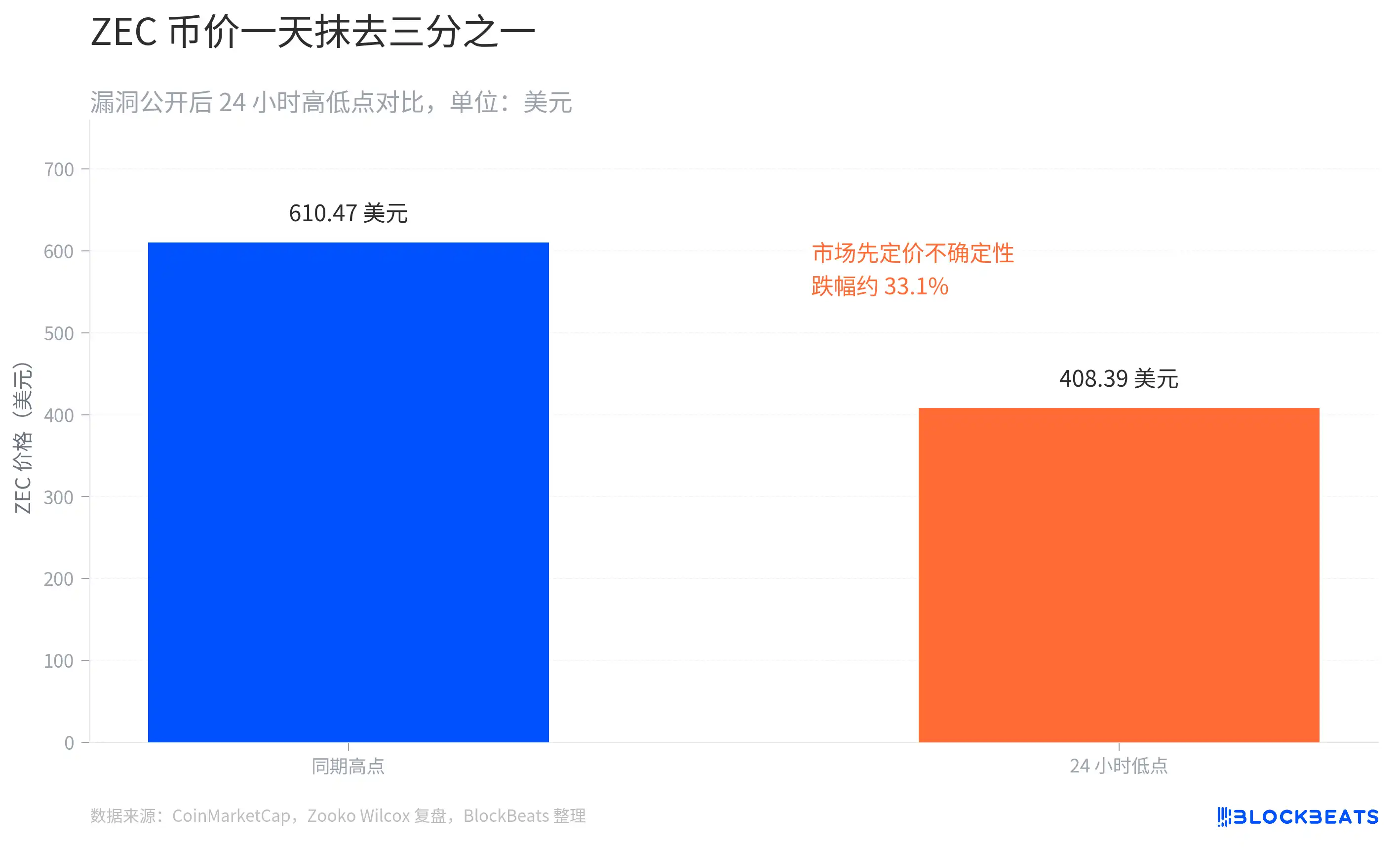
After the news became public, ZEC plunged by over 30%. Data from CoinMarketCap shows ZEC hit a 24-hour low of $408.39, down about one-third from its recent high of $610.47. Unfortunately, this was one of the few assets in the crypto space with excellent wealth effects recently, boasting a promising narrative favored by numerous industry leaders, now shattered by this vulnerability.
If one only looks at the outcome, this seems like another familiar crypto security incident: a vulnerability is discovered, developers rush to patch it, and the market panics.

However, the truly thorny aspect of the Orchard incident is that, while the vulnerability has been patched, the Zcash community cannot directly answer another, more sensitive question:

Has anyone exploited this vulnerability in the past four years?

Four-Day Emergency Patch, Orchard Briefly Suspended

Orchard is Zcash's next-generation privacy payment protocol launched in 2022 and one of the primary privacy pools currently used by Zcash. Users can hide balances, transaction amounts, and fund flows, while proving to the network via zero-knowledge proofs that transactions comply with the rules.

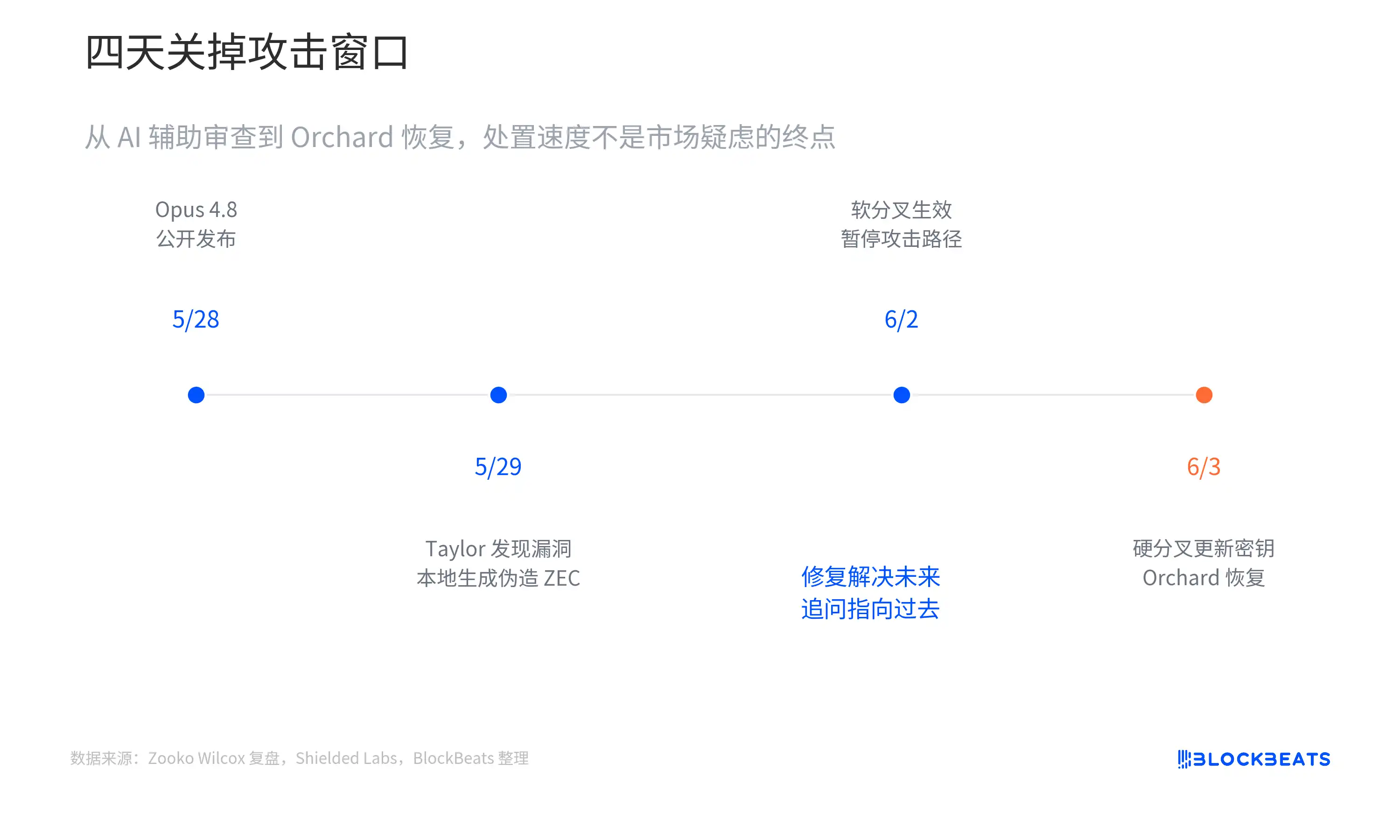
According to the timeline disclosed by Zooko, Shielded Labs, and the Zcash community, Taylor discovered anomalies during a targeted security audit of the Orchard circuit on May 29th and immediately privately disclosed the vulnerability to the Zcash Open Development Lab (ZODL). Shielded Labs is an independent, donation-funded Zcash ecosystem support organization based in Switzerland, long involved in Zcash's protocol development, security, and network sustainability efforts, and is not affiliated with the Zcash Foundation or ZODL.

ZODL engineers confirmed the issue was genuine within hours of receiving the report and began seeking a fix. To avoid exposing the vulnerability's details by directly releasing a code patch, the team first chose to temporarily shut down Orchard: prohibiting the creation of new Orchard outputs and the spending of funds already within Orchard.

After coordinating upgrades among developers, miners, node operators, exchanges, and infrastructure providers, an emergency soft fork took effect on June 2nd. Subsequently, Zcash performed a hard fork upgrade to update the verification key for the Orchard circuit and restored Orchard functionality on June 3rd. Transparent addresses and the Sapling privacy pool continued to operate during this period.

The entire process, from disclosure to remediation, took only a few days. In terms of emergency response speed, this was a remarkably successful handling.

But the market did not calm down because the vulnerability was fixed, as the fix addresses the future, not the past.
The Market Fears Not a Future Attack, But That an Attack May Have Already Happened

Ordinary security incidents usually have a relatively clear scale of loss. For a hacked smart contract, on-chain tracking can reveal how much the attacker moved; a cross-chain bridge vulnerability allows for tracking fund flows and affected addresses.

The Orchard incident is different.

According to Shielded Labs' explanation, this vulnerability could be used to generate unlimited and undetectable counterfeit ZEC within Orchard. Due to Orchard's inherent privacy properties, it is impossible for outsiders to cryptographically prove definitively whether this attack vector was exploited before the fix.

This means the market is not facing a determined loss figure but a kind of unquantifiable uncertainty:

If someone indeed found and exploited the vulnerability in the past, does counterfeit ZEC already exist within Orchard? If it exists, what is the scale? Do these assets remain in the privacy pool? Have they gradually leaked out through normal transactions?

More importantly, this risk window did not just open on May 29th. Shielded Labs stated that the vulnerability had existed since Orchard's launch in May 2022, until the emergency fix was completed in June 2026. In other words, the problem lay dormant for nearly four years.

What the market truly fears is not what happened between May 29th and June 2nd, but whether undetectable anomalies occurred during those past four years.

This is also the core reason behind ZEC's plunge of over 30%.

The market is selling off not just a vulnerability, but a repricing of the credibility of the supply.

How a Missing Mathematical Constraint Evolved into an 'Unlimited Minting' Risk

Seeing the words 'unlimited minting vulnerability,' our first thought might be that hackers gained admin privileges or some kind of protocol backdoor.

The reality is more fundamental.

Orchard's security relies on a zero-knowledge proof circuit (Orchard circuit). Users can hide specific transaction details but must prove to the network that their transaction satisfies protocol rules. One of the most important rules is asset conservation: a transaction cannot create new value out of thin air.

Simply put, users don't have to reveal how much ZEC they have or how much they send to whom, but the network must be able to confirm that:

The assets spent indeed come from legitimate inputs.
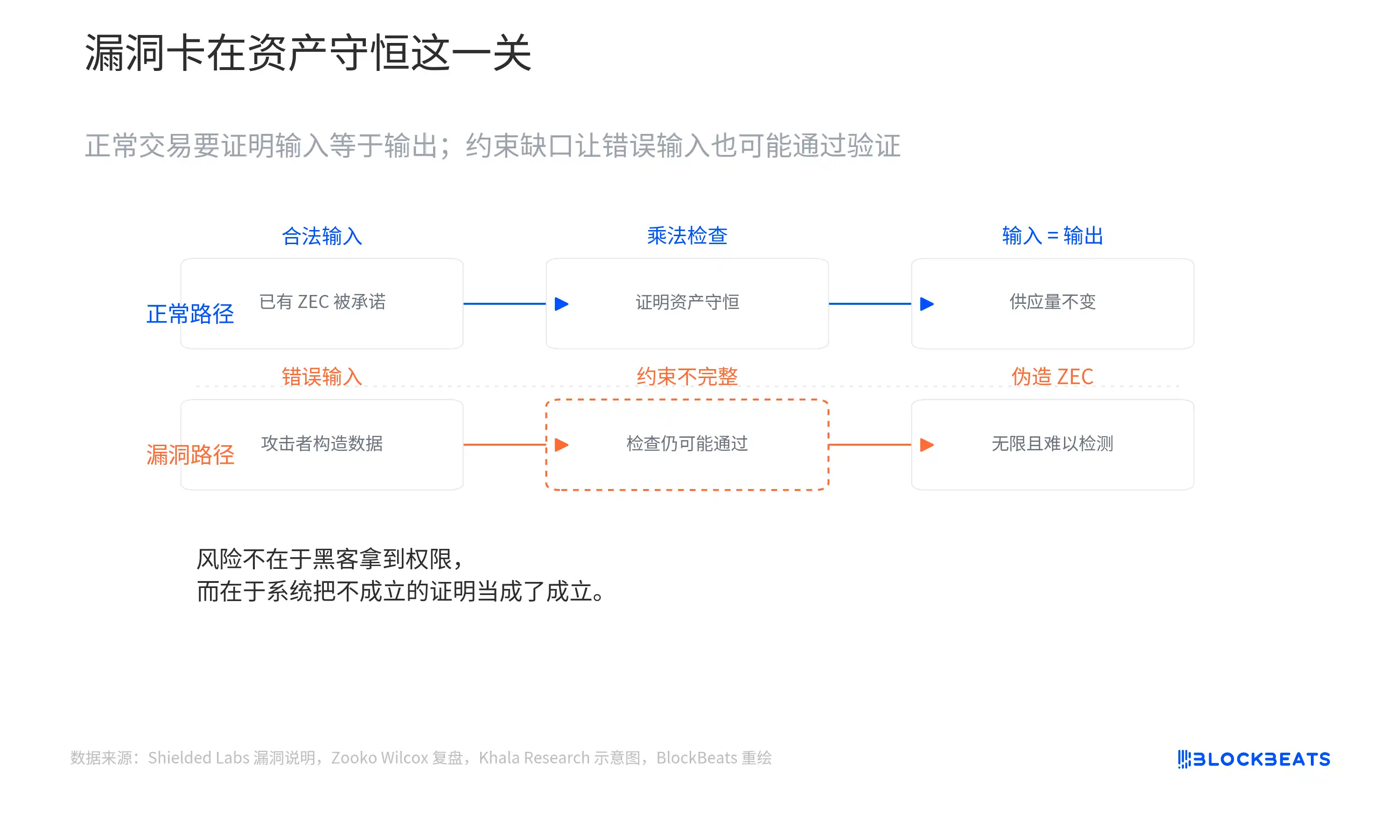
The problem Taylor discovered lies in an elliptic curve multiplication check within the Orchard circuit.

Shielded Labs describes it as an 'under-constrained element,' meaning a circuit element with incomplete constraints. Because the relevant mathematical relationship was not fully constrained, an attacker could input arbitrary erroneous data into the elliptic curve multiplication process, yet the verification process might still return a pass.

In other words, the attacker doesn't need to crack cryptographic algorithms or control network nodes.

They only need to construct a set of data that should not hold, tricking the system into erroneously believing the transaction still satisfies asset conservation.

Once this false proof is accepted by the network, the non-existent ZEC can be treated as legitimate assets, remaining within Orchard.

This is why Shielded Labs used extremely severe wording:

unlimited, undetectable counterfeit ZEC

The truly dangerous part is not just 'unlimited,' but 'undetectable.'

An Important Distinction Lies Between Two Statements

In its post-upgrade announcement, the Zcash Foundation stated that there is currently no evidence the vulnerability was exploited, no detection of unauthorized value creation, and user funds and privacy remain unaffected. The announcement also emphasized that Zcash's existing Turnstile Accounting mechanism can track value flows between different pools and protect the 21 million ZEC total supply cap.

Meanwhile, Shielded Labs clearly stated that it is impossible to cryptographically prove that counterfeit ZEC never appeared in Orchard's history.

These two statements may seem contradictory but actually address two different levels of the problem.

Zcash's original Turnstile Accounting can be understood as a 'gate' between different asset pools. The system can count how much legitimate asset entered Orchard and limit the scale of assets that can flow out of Orchard.

Suppose Orchard originally contained only 1 million legitimate ZEC; even if an attacker counterfeited more assets inside, the system would not allow assets exceeding the legitimate scale to flow out entirely. This helps prevent the total Zcash network supply cap from being easily breached.

But this mechanism cannot directly prove that counterfeit coins never appeared inside Orchard.

If counterfeit assets remain within Orchard, or gradually replace real assets within the legal outflow quota, the original statistical mechanism may not provide a definitive historical conclusion.

Regarding this arguably one of the oldest crypto privacy projects, all we know is that there is currently no evidence of abnormal minting, but the community still cannot directly prove that counterfeit assets never existed within Orchard.

This is precisely the type of risk the market finds hardest to handle.

The problem is not how many counterfeit coins have been discovered, but that no one can definitively confirm they never existed.

How Can Zcash Prove There Are No Counterfeit Coins in Orchard?

Patching the vulnerability is only the first step.

Shielded Labs has stated it is working with other Zcash developers on a new network upgrade proposal. The plan includes deploying a new privacy pool and enforcing Turnstile Accounting for all assets migrating out of Orchard.

This is akin to setting up a new migration gate for Orchard.

Assets in the old Orchard wishing to enter the new privacy pool would need to complete migration according to verifiable rules. The system could re-count the scale of legitimate assets flowing out and determine if there are any extra ZEC that cannot be migrated normally.
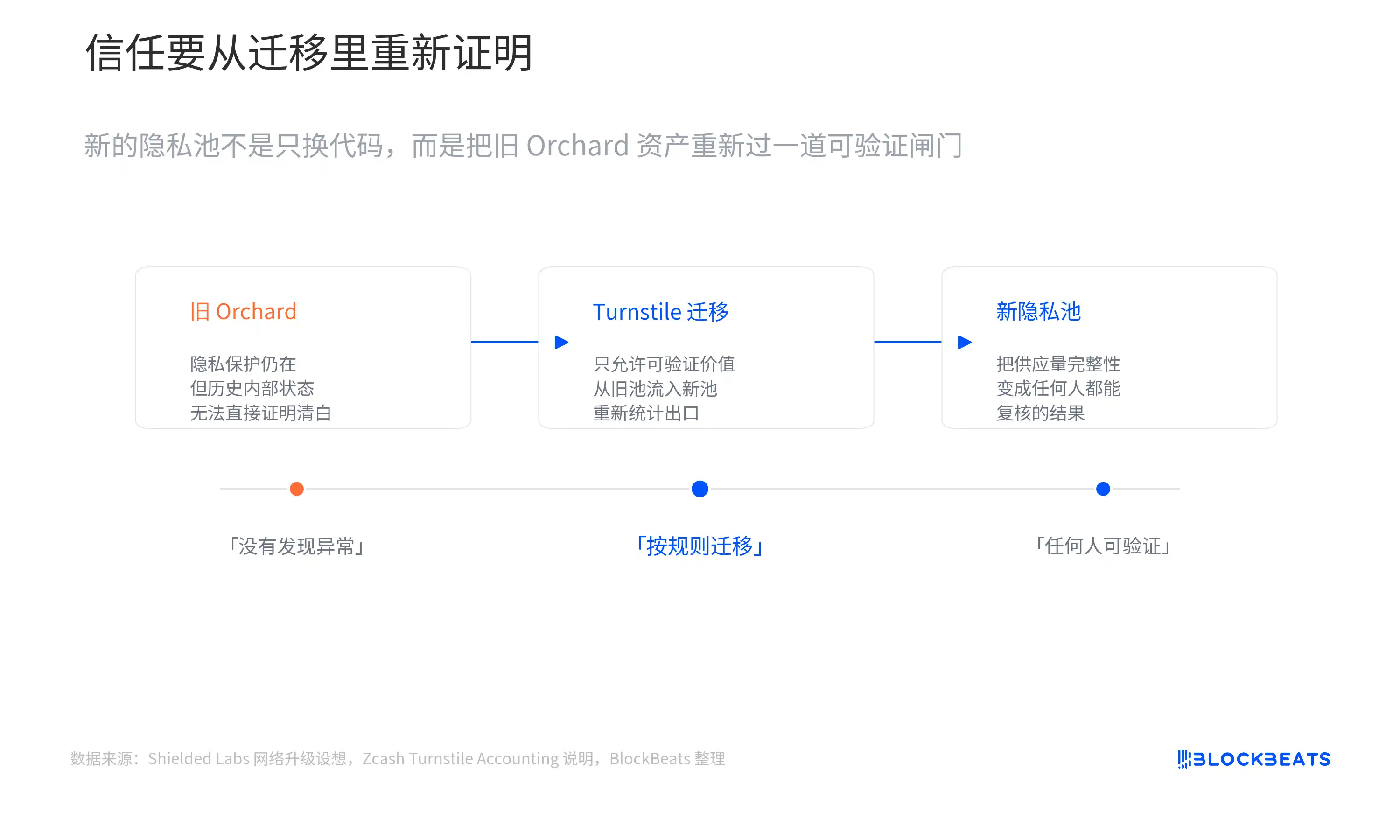
If the upgrade proceeds smoothly, anyone could verify Zcash's supply integrity and further prove no counterfeit assets exist in Orchard.

The significance of this plan is not just fixing code, but rebuilding market trust in Orchard.

Because in a privacy system, trust should not come from 'we think an attack didn't happen,' but from 'anyone can verify an attack didn't happen.'

Shielded Labs itself acknowledges the probability of prior malicious exploitation is low. The vulnerability was hidden for years and extremely difficult to discover; Taylor was actively searching for such issues in a dedicated security research project; after disclosure, the ecosystem quickly shut the attack window within days.

But Shielded Labs also emphasizes that users should not rely solely on the development team's subjective judgment.

The market needs proof.

Why Was a Four-Year-Old Vulnerability Discovered Now?

The Orchard incident has another detail easily overlooked by the market.

On May 28th, Anthropic released Claude Opus 4.8.

One day later, Taylor discovered the Orchard vulnerability.

According to the retrospective by Zooko and Shielded Labs, shortly after Opus 4.8's release, Taylor used it for a highly targeted audit of the Orchard circuit and discovered the issue on May 29th. Subsequently, with the assistance of Opus 4.8, he wrote a complete exploit program, generating unlimited, undetectable counterfeit ZEC in a local environment.

This detail is noteworthy not because AI can independently conduct cryptographic audits.

Public information does not support such an exaggerated conclusion.

Taylor himself is an experienced security researcher. Shielded Labs also mentioned he used a combination of traditional security research methods, a customized AI tool framework, and specifically designed prompts. Opus 4.8 was a crucial tool in the audit process, but not the only factor.

What is truly notable is that Taylor used not Anthropic's restricted-access, cybersecurity-focused model Claude Mythos Preview, but the newly publicly released general-purpose model Opus 4.8.

Anthropic positions Mythos Preview as an advanced model with significant vulnerability discovery and exploitation capabilities. Due to potential misuse risks, Anthropic did not release this model directly to the public but provides access to vetted partners via Project Glasswing.

In contrast, Opus 4.8 is a general-purpose model accessible to ordinary developers. Anthropic emphasized in its release notes its improvements in code analysis, complex task execution, and identifying code defects.

This makes the Orchard incident send an even more significant signal:

The capability to discover high-value vulnerabilities is diffusing from a few specialized security models to general-purpose models.

A general-purpose model released publicly for just one day, guided by a professional researcher, was able to participate in auditing a complex zero-knowledge proof circuit and help discover a critical vulnerability hidden for nearly four years.

This does not mean cryptography experts are no longer important.

On the contrary, Taylor's experience, choice of audit target, and ability to validate the model's output remain the core of the entire process.

But the combination of experts and AI is significantly lowering the cost of discovering complex vulnerabilities.

The Vulnerability is Closed, But the Market Still Awaits Answers

For Zcash, the most urgent attack window is closed.

Orchard functionality is restored, the verification circuit is updated, and there is currently no evidence the vulnerability was maliciously exploited.

But ZEC's plunge of over 30% indicates the market cares about more than just whether the code is fixed.

The market is still waiting for a more definitive answer:

In the past nearly four years, did counterfeit ZEC ever appear inside Orchard?

If the new privacy pool and Turnstile Accounting upgrade can be successfully implemented, the community will finally have a chance to prove supply integrity and rebuild market trust.

But until that proof is completed, the Orchard incident retains an unavoidable suspense:

Did those theoretically unlimited counterfeit ZEC never exist, or were they once hidden where no one could directly see?


Preguntas relacionadas

QWhat is the primary reason the ZEC price dropped over 30% despite the Orchard vulnerability being quickly patched?

AThe primary reason for the price drop was not the vulnerability itself or the risk of future attacks, but the market's inability to determine whether the vulnerability had already been exploited in the past. The vulnerability existed for nearly four years, and due to Orchard's privacy features, there is no way to cryptographically prove whether undetectable counterfeit ZEC was created during that time. This created profound uncertainty about the true supply integrity of ZEC.

QWhat specific aspect of the Orchard circuit was flawed, and what did it allow an attacker to do?

AThe flaw was an "under-constrained element" in an elliptic curve multiplication check within the Orchard zero-knowledge proof circuit. This incomplete mathematical constraint allowed an attacker to input incorrect data. The verification process could incorrectly pass, making the system believe a transaction obeyed the conservation of assets (no new value creation) when it did not. This enabled the creation of unlimited, undetectable counterfeit ZEC within the Orchard pool.

QWhat is the key difference between the statements from Zcash Foundation and Shielded Labs regarding the historical exploitation of the vulnerability?

AThe Zcash Foundation stated there is no evidence the vulnerability was exploited and that the overall 21 million ZEC supply cap remains protected by the Turnstile Accounting mechanism. Shielded Labs, however, clarified that while the supply cap is protected, it is cryptographically impossible to prove that no counterfeit ZEC was *ever* created inside Orchard in the past. Their statements address different levels: one is about the lack of observed evidence and the outer supply limit, while the other is about the fundamental impossibility of proving a negative within the private pool.

QWhat role did Anthropic's Claude Opus 4.8 play in the discovery of the Orchard vulnerability?

AAnthropic's Claude Opus 4.8, a publicly released general-purpose AI model, was used as a key tool by security researcher Taylor Hornby. The day after its release, Hornby used it to assist in a targeted security review of the Orchard circuit, which led to the discovery of the vulnerability. He then used Opus 4.8 to help write the complete exploit program. This highlights how vulnerability discovery capabilities are diffusing from specialized, restricted security models to publicly available general AI models when guided by expert researchers.

QWhat is the proposed next step by Shielded Labs to rebuild trust in Zcash's supply integrity after the patch?

AShielded Labs is working on a proposal for a new network upgrade. This involves deploying a new privacy pool and enforcing Turnstile Accounting on all assets migrating out of the old Orchard pool. This creates a new 'gate' for migration. By verifying the rules during this process, the network can effectively audit the assets leaving Orchard. If successful, this would allow anyone to verify that no extra, illegitimate ZEC existed in Orchard, moving trust from subjective assurance to objective, verifiable proof.

Lecturas Relacionadas

How Risky is the "Death Spiral" of MSTR and STRC?

Summary: This article explores the perceived "death spiral" risk between MicroStrategy (MSTR), its Bitcoin holdings, and its perpetual preferred stock (STRC), drawing comparisons to the LUNA-UST collapse. While both systems feature price anchors, high yields for holders, and potential feedback loops, their core mechanisms differ fundamentally. The MSTR-STRC structure relies on continuous financing to sustain its high dividend payouts, primarily through stock ATM offerings. A negative feedback cycle could occur: falling MSTR stock price makes raising equity capital harder, increasing pressure to sell Bitcoin, which undermines STRC confidence and further depresses MSTR. However, unlike LUNA-UST's automated, direct linkage, the MSTR-STRC loop is weaker and has brakes: STRC dividends can be deferred or rates lowered, and STRC holders have a $100/share liquidation preference in bankruptcy, providing a price floor. The company's sustainability hinges on its ability to continue financing. Its current ~$900 million USD reserves cover only about 6.3 months of its ~$1.71 billion annual interest/dividend burden. The next six months are critical, aligning with both the potential bottom in Bitcoin's four-year cycle and the depletion timeline of its reserves. While a LUNA-style catastrophic collapse is deemed highly unlikely due to structural differences, the key question is whether MicroStrategy can navigate this period through healthy deleveraging to restart its capital engine.

Foresight NewsHace 9 min(s)

How Risky is the "Death Spiral" of MSTR and STRC?

Foresight NewsHace 9 min(s)

How Much Debt Does Strategy Really Have? Is There a Risk of Implosion?

MicroStrategy's Debt Risk: A Turning Point in the "Never Sell" Strategy As of June 3, 2026, MicroStrategy holds 843,706 bitcoins (valued at ~$53.1B) but faces significant financial obligations. Its capital structure includes $6.75B in convertible notes and $15.48B in perpetual preferred stock (led by the $8.5B STRC series), creating an annual payout burden of ~$1.71B. With software revenue at only ~$500M, interest and dividend obligations far exceed operating income. A critical shift occurred in late May 2026 when the company sold 32 bitcoins for ~$2.5M to cover dividends, breaking CEO Michael Saylor's long-standing "never sell" pledge. This symbolic move triggered a sharp decline in both Bitcoin's price and MSTR stock, reflecting market fears about cash flow sustainability. The core of the strain is the STRC perpetual preferred stock, designed as a "permanent loan" with no maturity date but requiring high monthly dividends (currently 11.5%). Its business model relies on a three-part cycle: issuing new STRC shares, using proceeds to buy more Bitcoin and fund a USD reserve, and using that reserve to pay dividends. This cycle depends on continuous investor demand for STRC and Bitcoin's price appreciation. Analysis shows Bitcoin needs to appreciate at least 2.3% annually to cover the $1.71B in yearly obligations at current holdings. With Bitcoin price down ~22% from March 2026 highs, this pressure has intensified. The company's $900M USD reserve can only cover about 7 months of payments if STRC issuance stalls. Key risks are not immediate bankruptcy or forced Bitcoin liquidation (as BTC is not collateral), but rather: 1) The erosion of MSTR's premium to its Bitcoin holdings (mNAV), which would cripple its ability to raise cheap capital; 2) A vicious cycle where stagnant Bitcoin prices reduce STRC demand, draining the USD reserve and forcing BTC sales, further depressing prices. The period from February 2027 to September 2028 is a crucial test, with over $5.9B in convertible notes facing put options or maturity. In essence, MicroStrategy has evolved from a simple Bitcoin holder into a complex financial entity acting like a "private Bitcoin bank," leveraging its BTC holdings to create layered financial products. Its survival depends on maintaining Bitcoin's price trend, its stock premium, and market appetite for its preferred shares. The recent token sale marks not a betrayal of its Bitcoin thesis, but an admission that the leveraged strategy must eventually be paid for.

marsbitHace 20 min(s)

How Much Debt Does Strategy Really Have? Is There a Risk of Implosion?

marsbitHace 20 min(s)

Anthropic Cries Wolf: Is the AGI Threat Real, or Just an IPO Story?

Anthropic has published an article titled "When AI builds itself," discussing the emerging concept of "recursive self-improvement," where AI begins to actively participate in designing, training, testing, and optimizing its own subsequent versions. The company presents internal data showing that by May 2026, over 80% of code merged into its codebase was written by Claude, its AI model. Claude's capabilities have expanded to handling complex, open-ended engineering tasks, achieving a 76% success rate in such areas, and even contributing to research processes, such as optimizing code performance and conducting AI safety experiments. Anthropic outlines an evolution from human-driven development to AI-assisted workflows, culminating in the current stage where AI agents can autonomously write, run, and delegate code. The company cautions that the path toward a "closed loop," where AI continuously improves itself, is becoming visible. It calls for coordinated global mechanisms to potentially slow or pause frontier AI development to allow safety research and societal structures to catch up. However, the timing of this warning coincides with Anthropic's preparations for an IPO, framing the narrative not just as a safety concern but also as a demonstration of Claude's advanced capabilities and its integral role in accelerating Anthropic's own R&D—creating a potential "flywheel" effect for competitive advantage. This contrasts with OpenAI's recent, more policy-oriented discussion of the same risks, highlighting the competitive dynamics in the AI industry as companies position themselves in both the technological and regulatory landscape.

marsbitHace 1 hora(s)

Anthropic Cries Wolf: Is the AGI Threat Real, or Just an IPO Story?

marsbitHace 1 hora(s)

Trading

Spot
Futuros

Artículos destacados

Qué es $S$

Entendiendo SPERO: Una Visión General Completa Introducción a SPERO A medida que el panorama de la innovación continúa evolucionando, la aparición de tecnologías web3 y proyectos de criptomonedas juega un papel fundamental en la configuración del futuro digital. Un proyecto que ha atraído la atención en este campo dinámico es SPERO, denotado como SPERO,$$s$. Este artículo tiene como objetivo reunir y presentar información detallada sobre SPERO, para ayudar a entusiastas e inversores a comprender sus fundamentos, objetivos e innovaciones dentro de los dominios web3 y cripto. ¿Qué es SPERO,$$s$? SPERO,$$s$ es un proyecto único dentro del espacio cripto que busca aprovechar los principios de descentralización y tecnología blockchain para crear un ecosistema que promueva la participación, la utilidad y la inclusión financiera. El proyecto está diseñado para facilitar interacciones de igual a igual de nuevas maneras, proporcionando a los usuarios soluciones y servicios financieros innovadores. En su esencia, SPERO,$$s$ tiene como objetivo empoderar a los individuos al proporcionar herramientas y plataformas que mejoren la experiencia del usuario en el espacio de las criptomonedas. Esto incluye habilitar métodos de transacción más flexibles, fomentar iniciativas impulsadas por la comunidad y crear caminos para oportunidades financieras a través de aplicaciones descentralizadas (dApps). La visión subyacente de SPERO,$$s$ gira en torno a la inclusividad, buscando cerrar brechas dentro de las finanzas tradicionales mientras aprovecha los beneficios de la tecnología blockchain. ¿Quién es el Creador de SPERO,$$s$? La identidad del creador de SPERO,$$s$ sigue siendo algo oscura, ya que hay recursos públicos limitados que proporcionan información de fondo detallada sobre su(s) fundador(es). Esta falta de transparencia puede derivarse del compromiso del proyecto con la descentralización, una ética que muchos proyectos web3 comparten, priorizando las contribuciones colectivas sobre el reconocimiento individual. Al centrar las discusiones en torno a la comunidad y sus objetivos colectivos, SPERO,$$s$ encarna la esencia del empoderamiento sin señalar a individuos específicos. Como tal, comprender la ética y la misión de SPERO sigue siendo más importante que identificar a un creador singular. ¿Quiénes son los Inversores de SPERO,$$s$? SPERO,$$s$ cuenta con el apoyo de una diversa gama de inversores que van desde capitalistas de riesgo hasta inversores ángeles dedicados a fomentar la innovación en el sector cripto. El enfoque de estos inversores generalmente se alinea con la misión de SPERO, priorizando proyectos que prometen avances tecnológicos sociales, inclusión financiera y gobernanza descentralizada. Estas fundaciones de inversores suelen estar interesadas en proyectos que no solo ofrecen productos innovadores, sino que también contribuyen positivamente a la comunidad blockchain y sus ecosistemas. El respaldo de estos inversores refuerza a SPERO,$$s$ como un contendiente notable en el dominio de proyectos cripto que evoluciona rápidamente. ¿Cómo Funciona SPERO,$$s$? SPERO,$$s$ emplea un marco multifacético que lo distingue de los proyectos de criptomonedas convencionales. Aquí hay algunas de las características clave que subrayan su singularidad e innovación: Gobernanza Descentralizada: SPERO,$$s$ integra modelos de gobernanza descentralizada, empoderando a los usuarios para participar activamente en los procesos de toma de decisiones sobre el futuro del proyecto. Este enfoque fomenta un sentido de propiedad y responsabilidad entre los miembros de la comunidad. Utilidad del Token: SPERO,$$s$ utiliza su propio token de criptomoneda, diseñado para servir diversas funciones dentro del ecosistema. Estos tokens permiten transacciones, recompensas y la facilitación de servicios ofrecidos en la plataforma, mejorando la participación y la utilidad general. Arquitectura en Capas: La arquitectura técnica de SPERO,$$s$ apoya la modularidad y escalabilidad, permitiendo la integración fluida de características y aplicaciones adicionales a medida que el proyecto evoluciona. Esta adaptabilidad es fundamental para mantener la relevancia en el cambiante paisaje cripto. Participación de la Comunidad: El proyecto enfatiza iniciativas impulsadas por la comunidad, empleando mecanismos que incentivan la colaboración y la retroalimentación. Al nutrir una comunidad sólida, SPERO,$$s$ puede abordar mejor las necesidades de los usuarios y adaptarse a las tendencias del mercado. Enfoque en la Inclusión: Al ofrecer tarifas de transacción bajas e interfaces amigables para el usuario, SPERO,$$s$ busca atraer a una base de usuarios diversa, incluyendo a individuos que anteriormente pueden no haber participado en el espacio cripto. Este compromiso con la inclusión se alinea con su misión general de empoderamiento a través de la accesibilidad. Cronología de SPERO,$$s$ Entender la historia de un proyecto proporciona información crucial sobre su trayectoria de desarrollo y hitos. A continuación se presenta una cronología sugerida que mapea eventos significativos en la evolución de SPERO,$$s$: Fase de Conceptualización e Ideación: Las ideas iniciales que forman la base de SPERO,$$s$ fueron concebidas, alineándose estrechamente con los principios de descentralización y enfoque comunitario dentro de la industria blockchain. Lanzamiento del Whitepaper del Proyecto: Tras la fase conceptual, se lanzó un whitepaper completo que detalla la visión, los objetivos y la infraestructura tecnológica de SPERO,$$s$ para generar interés y retroalimentación de la comunidad. Construcción de Comunidad y Primeras Interacciones: Se realizaron esfuerzos de divulgación activa para construir una comunidad de primeros adoptantes y posibles inversores, facilitando discusiones en torno a los objetivos del proyecto y obteniendo apoyo. Evento de Generación de Tokens: SPERO,$$s$ llevó a cabo un evento de generación de tokens (TGE) para distribuir sus tokens nativos a los primeros seguidores y establecer liquidez inicial dentro del ecosistema. Lanzamiento de la dApp Inicial: La primera aplicación descentralizada (dApp) asociada con SPERO,$$s$ se puso en marcha, permitiendo a los usuarios interactuar con las funcionalidades centrales de la plataforma. Desarrollo Continuo y Alianzas: Actualizaciones y mejoras continuas a las ofertas del proyecto, incluyendo alianzas estratégicas con otros actores en el espacio blockchain, han moldeado a SPERO,$$s$ en un jugador competitivo y en evolución en el mercado cripto. Conclusión SPERO,$$s$ se erige como un testimonio del potencial de web3 y las criptomonedas para revolucionar los sistemas financieros y empoderar a los individuos. Con un compromiso con la gobernanza descentralizada, la participación comunitaria y funcionalidades diseñadas de manera innovadora, allana el camino hacia un paisaje financiero más inclusivo. Como con cualquier inversión en el espacio cripto que evoluciona rápidamente, se anima a los posibles inversores y usuarios a investigar a fondo y participar de manera reflexiva con los desarrollos en curso dentro de SPERO,$$s$. El proyecto muestra el espíritu innovador de la industria cripto, invitando a una mayor exploración de sus innumerables posibilidades. Mientras el viaje de SPERO,$$s$ aún se desarrolla, sus principios fundamentales pueden, de hecho, influir en el futuro de cómo interactuamos con la tecnología, las finanzas y entre nosotros en ecosistemas digitales interconectados.

72 Vistas totalesPublicado en 2024.12.17Actualizado en 2024.12.17

Qué es $S$

Qué es AGENT S

Agent S: El Futuro de la Interacción Autónoma en Web3 Introducción En el paisaje en constante evolución de Web3 y las criptomonedas, las innovaciones están redefiniendo constantemente cómo los individuos interactúan con las plataformas digitales. Uno de estos proyectos pioneros, Agent S, promete revolucionar la interacción humano-computadora a través de su marco agente abierto. Al allanar el camino para interacciones autónomas, Agent S busca simplificar tareas complejas, ofreciendo aplicaciones transformadoras en inteligencia artificial (IA). Esta exploración detallada profundizará en las complejidades del proyecto, sus características únicas y las implicaciones para el dominio de las criptomonedas. ¿Qué es Agent S? Agent S se presenta como un marco agente abierto innovador, diseñado específicamente para abordar tres desafíos fundamentales en la automatización de tareas informáticas: Adquisición de Conocimiento Específico del Dominio: El marco aprende inteligentemente de diversas fuentes de conocimiento externas y experiencias internas. Este enfoque dual le permite construir un rico repositorio de conocimiento específico del dominio, mejorando su rendimiento en la ejecución de tareas. Planificación a Largo Plazo de Tareas: Agent S emplea planificación jerárquica aumentada por la experiencia, un enfoque estratégico que facilita la descomposición y ejecución eficiente de tareas complejas. Esta característica mejora significativamente su capacidad para gestionar múltiples subtareas de manera eficiente y efectiva. Manejo de Interfaces Dinámicas y No Uniformes: El proyecto introduce la Interfaz Agente-Computadora (ACI), una solución innovadora que mejora la interacción entre agentes y usuarios. Utilizando Modelos de Lenguaje Multimodal de Gran Escala (MLLMs), Agent S puede navegar y manipular diversas interfaces gráficas de usuario sin problemas. A través de estas características pioneras, Agent S proporciona un marco robusto que aborda las complejidades involucradas en la automatización de la interacción humana con las máquinas, preparando el terreno para una multitud de aplicaciones en IA y más allá. ¿Quién es el Creador de Agent S? Si bien el concepto de Agent S es fundamentalmente innovador, la información específica sobre su creador sigue siendo elusiva. El creador es actualmente desconocido, lo que resalta ya sea la etapa incipiente del proyecto o la elección estratégica de mantener a los miembros fundadores en el anonimato. Independientemente de la anonimidad, el enfoque sigue siendo en las capacidades y el potencial del marco. ¿Quiénes son los Inversores de Agent S? Dado que Agent S es relativamente nuevo en el ecosistema criptográfico, la información detallada sobre sus inversores y patrocinadores financieros no está documentada explícitamente. La falta de información disponible públicamente sobre las bases de inversión u organizaciones que apoyan el proyecto plantea preguntas sobre su estructura de financiamiento y hoja de ruta de desarrollo. Comprender el respaldo es crucial para evaluar la sostenibilidad del proyecto y su posible impacto en el mercado. ¿Cómo Funciona Agent S? En el núcleo de Agent S se encuentra una tecnología de vanguardia que le permite funcionar de manera efectiva en diversos entornos. Su modelo operativo se basa en varias características clave: Interacción Humano-Computadora Similar a la Humana: El marco ofrece planificación avanzada de IA, esforzándose por hacer que las interacciones con las computadoras sean más intuitivas. Al imitar el comportamiento humano en la ejecución de tareas, promete elevar las experiencias de los usuarios. Memoria Narrativa: Empleada para aprovechar experiencias de alto nivel, Agent S utiliza memoria narrativa para hacer un seguimiento de las historias de tareas, mejorando así sus procesos de toma de decisiones. Memoria Episódica: Esta característica proporciona a los usuarios una guía paso a paso, permitiendo que el marco ofrezca apoyo contextual a medida que se desarrollan las tareas. Soporte para OpenACI: Con la capacidad de ejecutarse localmente, Agent S permite a los usuarios mantener el control sobre sus interacciones y flujos de trabajo, alineándose con la ética descentralizada de Web3. Fácil Integración con APIs Externas: Su versatilidad y compatibilidad con varias plataformas de IA aseguran que Agent S pueda encajar sin problemas en ecosistemas tecnológicos existentes, convirtiéndolo en una opción atractiva para desarrolladores y organizaciones. Estas funcionalidades contribuyen colectivamente a la posición única de Agent S dentro del espacio cripto, ya que automatiza tareas complejas y de múltiples pasos con una intervención humana mínima. A medida que el proyecto evoluciona, sus posibles aplicaciones en Web3 podrían redefinir cómo se desarrollan las interacciones digitales. Cronología de Agent S El desarrollo y los hitos de Agent S pueden encapsularse en una cronología que resalta sus eventos significativos: 27 de septiembre de 2024: El concepto de Agent S fue lanzado en un documento de investigación integral titulado “Un Marco Agente Abierto que Usa Computadoras Como un Humano”, mostrando las bases del proyecto. 10 de octubre de 2024: El documento de investigación fue puesto a disposición del público en arXiv, ofreciendo una exploración profunda del marco y su evaluación de rendimiento basada en el benchmark OSWorld. 12 de octubre de 2024: Se lanzó una presentación en video, proporcionando una visión visual de las capacidades y características de Agent S, involucrando aún más a posibles usuarios e inversores. Estos marcadores en la cronología no solo ilustran el progreso de Agent S, sino que también indican su compromiso con la transparencia y la participación comunitaria. Puntos Clave Sobre Agent S A medida que el marco Agent S continúa evolucionando, varios atributos clave destacan, subrayando su naturaleza innovadora y potencial: Marco Innovador: Diseñado para proporcionar un uso intuitivo de las computadoras similar a la interacción humana, Agent S aporta un enfoque novedoso a la automatización de tareas. Interacción Autónoma: La capacidad de interactuar de manera autónoma con las computadoras a través de GUI significa un salto hacia soluciones informáticas más inteligentes y eficientes. Automatización de Tareas Complejas: Con su metodología robusta, puede automatizar tareas complejas y de múltiples pasos, haciendo que los procesos sean más rápidos y menos propensos a errores. Mejora Continua: Los mecanismos de aprendizaje permiten a Agent S mejorar a partir de experiencias pasadas, mejorando continuamente su rendimiento y eficacia. Versatilidad: Su adaptabilidad en diferentes entornos operativos como OSWorld y WindowsAgentArena asegura que pueda servir a una amplia gama de aplicaciones. A medida que Agent S se posiciona en el paisaje de Web3 y criptomonedas, su potencial para mejorar las capacidades de interacción y automatizar procesos significa un avance significativo en las tecnologías de IA. A través de su marco innovador, Agent S ejemplifica el futuro de las interacciones digitales, prometiendo una experiencia más fluida y eficiente para los usuarios en diversas industrias. Conclusión Agent S representa un audaz avance en la unión de la IA y Web3, con la capacidad de redefinir cómo interactuamos con la tecnología. Aunque aún se encuentra en sus primeras etapas, las posibilidades para su aplicación son vastas y atractivas. A través de su marco integral que aborda desafíos críticos, Agent S busca llevar las interacciones autónomas al primer plano de la experiencia digital. A medida que nos adentramos más en los reinos de las criptomonedas y la descentralización, proyectos como Agent S sin duda desempeñarán un papel crucial en la configuración del futuro de la tecnología y la colaboración humano-computadora.

471 Vistas totalesPublicado en 2025.01.14Actualizado en 2025.01.14

Qué es AGENT S

Cómo comprar S

¡Bienvenido a HTX.com! Hemos hecho que comprar Sonic (S) sea simple y conveniente. Sigue nuestra guía paso a paso para iniciar tu viaje de criptos.Paso 1: crea tu cuenta HTXUtiliza tu correo electrónico o número de teléfono para registrarte y obtener una cuenta gratuita en HTX. Experimenta un proceso de registro sin complicaciones y desbloquea todas las funciones.Obtener mi cuentaPaso 2: ve a Comprar cripto y elige tu método de pagoTarjeta de crédito/débito: usa tu Visa o Mastercard para comprar Sonic (S) al instante.Saldo: utiliza fondos del saldo de tu cuenta HTX para tradear sin problemas.Terceros: hemos agregado métodos de pago populares como Google Pay y Apple Pay para mejorar la comodidad.P2P: tradear directamente con otros usuarios en HTX.Over-the-Counter (OTC): ofrecemos servicios personalizados y tipos de cambio competitivos para los traders.Paso 3: guarda tu Sonic (S)Después de comprar tu Sonic (S), guárdalo en tu cuenta HTX. Alternativamente, puedes enviarlo a otro lugar mediante transferencia blockchain o utilizarlo para tradear otras criptomonedas.Paso 4: tradear Sonic (S)Tradear fácilmente con Sonic (S) en HTX's mercado spot. Simplemente accede a tu cuenta, selecciona tu par de trading, ejecuta tus trades y monitorea en tiempo real. Ofrecemos una experiencia fácil de usar tanto para principiantes como para traders experimentados.

962 Vistas totalesPublicado en 2025.01.15Actualizado en 2026.06.02

Cómo comprar S

Discusiones

Bienvenido a la comunidad de HTX. Aquí puedes mantenerte informado sobre los últimos desarrollos de la plataforma y acceder a análisis profesionales del mercado. A continuación se presentan las opiniones de los usuarios sobre el precio de S (S).

活动图片