The More Proficient AI Becomes at Answering, Why Do Humans Need Deep Thinking More? Fudan Releases the 2026 Blue Book on Intelligent Development in Humanities and Social Sciences

marsbitPublicado a 2026-07-14Actualizado a 2026-07-14

Resumen

As AI capabilities rapidly expand, particularly in generating sophisticated text, analyzing data, and automating complex tasks, the need for human deep thinking becomes more critical, not less. The "2026 Blue Paper on Intelligent Development for Humanities and Social Sciences" from Fudan University argues that the relationship between AI and these fields is shifting from "one-way empowerment" to "bidirectional fusion." While AI transforms research methodologies, the humanities must guide its purpose, application, and governance. The core challenge is no longer processing vast information, but defining worthwhile problems, establishing genuine causal mechanisms, and constructing verifiable evidence chains. AI excels at producing coherent, fluent outputs but risks oversimplifying complex social realities into standardized formats it can easily process. For instance, in areas like climate-society systems, the difficulty lies not in handling more variables, but in understanding the fundamental mismatches between natural and social systems. Similarly, in automated research, AI can efficiently search for statistically significant results or generate papers quickly, potentially masking flawed assumptions or "packaging" statistical noise as discovery. The speed of paper production does not equate to the speed of genuine knowledge advancement. This underscores the non-transferable human responsibility for judgment. Deep thinking must be embedded into research workflows, governance s...

Once, our expectations of AI were quite simple: writing emails, translating papers, being a chat buddy... Back then, AI was like a green intern, doing exactly as told but often spouting nonsense with a straight face.

In recent years, AI development has surged forward like a tidal wave.

It is no longer content with just writing a few paragraphs for people; it has started taking over entire workflows: writing code, researching information, conducting analysis, generating proposals, and even breaking down tasks, calling tools, arranging steps, and checking results on its own.

Along with this came many amusing and ironic changes. The AI developed by programmers began taking over some of the work originally done by programmers themselves; many white-collar positions also found AI sitting at the desk next door.

The situation in academia is even more interesting. AI has greatly lowered the barrier to writing academic papers. Without needing to understand academic ideals, it can format papers with impressive solemnity.

Thus, some have begun mass-producing papers and mass-submitting them. Overworked reviewers use AI to assist in reviewing; authors, discovering this, embed prompts in their papers that are easily recognized only by machines, hoping the review AI will give positive evaluations. All participants save time, but whether knowledge itself has increased remains a matter of debate.

But the problem lies precisely here: Are we getting more knowledge, or more things that merely look like knowledge? As more and more work can be handed over to AI, what is left for humans?

The 2026 Blue Book on Intelligent Development in Humanities and Social Sciences released by Fudan University attempts to address these very questions.

Compared to the first edition, which primarily observed how AI empowers humanities and social sciences, this edition focuses on the theme of "Rediscovering the Value of Deep Thinking." It further proposes that the relationship between AI and the humanities/social sciences is moving from "one-way empowerment" to "two-way integration": AI changes how humanities and social sciences conduct research, while humanities and social sciences must participate in determining why AI is used, for what purposes, and what constraints it should be subject to.

As a special supporting unit of this book, the Shanghai Institute for Science of Intelligence is also collaborating with Fudan University to continuously explore the path of deep integration between AI and humanities/social sciences.

Why Stronger AI Makes Deep Thinking More Important

After calculators became widespread, people no longer needed to perform complex calculations by hand; after navigation appeared, people no longer needed to remember every route. Following this logic, perhaps after AI can analyze data and generate conclusions, humans could also think a little less.

Unfortunately, social problems are not arithmetic problems.

Taking the climate-society system coupling as an example, the Blue Book points out that the real difficulty is not handling more variables, but understanding the mismatches between natural and social systems in structure, variables, and scale. A model being able to compute does not mean it has understood the problem.
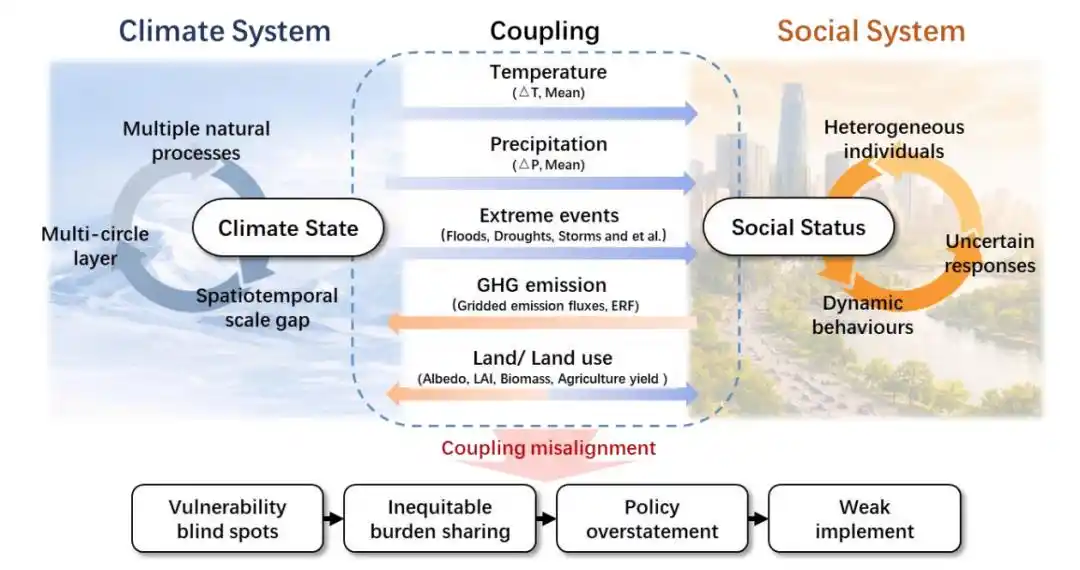
Three types of mismatches in climate-society system coupling: structure, variables, and scale.

Arithmetic problems only require judging if the answer is correct, but knowledge production and public decision-making must continue to ask: Is the reasoning process reliable? Are the underlying assumptions reasonable? Are potential risks controllable? And does the question itself have value in guiding the future?

The Blue Book argues that the research bottleneck is shifting: The past problem was whether we could process enough material; the current problem is whether we can ask good questions, establish real mechanisms, and form verifiable chains of evidence.

Judgments about what questions are worth researching, how observed patterns should be interpreted, whether a certain outcome is fair and just, and what biases are omitted or reinforced in research—these cannot be completely automated. The more capable AI becomes, the greater the human responsibility for judgment.

AI Seems Capable of Everything, But Can It Do Everything Well?

AI is becoming increasingly proficient at speaking, reasoning, and using tools, making it seem more and more like a collaborative "research partner." But is it truly understanding, or is it simulating understanding in a highly sophisticated way?

Over forty years ago, Searle used the "Chinese Room" thought experiment to question whether pure syntactic operations could produce semantic understanding. Today, large language models bring this question to everyone: How do we judge what large models actually understand and what they miss?

An important judgment in the Blue Book is that human intelligence is not a simple "input-output" process. Humans understand the world because perception and attention organize external stimuli into contexts; memory and cognitive maps organize past experiences into structures that can be transferred and reasoned about; emotions and values determine which information is more important and which goals are more worth pursuing.

The first step in human-AI collaboration is not to let AI do the work, but to first clarify the division of labor between humans and AI. AI can help us identify objects, retrieve information, and generate text, but it easily rewrites complex social experience into formats it can easily handle, turning problems that truly require understanding into problems that merely appear answered. We need to move from object recognition to contextual understanding, from information storage to experience organization, from generation to value judgment and self-reflection.

Cognitive science thus becomes particularly important. It tells us that deep thinking is not an ability opposed to AI, but an ability that needs to be more actively activated in human-machine collaboration. Truly valuable cognitive AI should not just provide a single, fluent, definitive answer, but should help people pose questions, compare evidence, and maintain the initiative in judgment.

Papers Are Written Faster and Faster, Who Ensures They Are Credible?

After AI entered scientific research, the most noticeable change is speed. Literature review, data cleaning, code generation, chart creation, and first drafts of papers can all be completed in a very short time. Researchers have no obligation to expend precious time on repetitive labor; whether a scholar has ideas should not be proven by how many times they manually adjusted a reference format.

But the speed of research and the speed of knowledge are not the same. Papers can be generated quickly, but that does not mean concepts have been clarified, data has been understood, or causal relationships have been established. Language models are especially good at organizing scattered materials into coherent narratives, and the most dangerous moment in academic research is often when the narrative appears overly coherent.

Risks also hide in seemingly "technical" steps. Choices like which variables to select, how to construct indicators, which year to start the sample from, and which cases to include all involve theoretical judgment.

The machine, of course, has no conspiracy; it only needs to make a small error in the first step and remain confident throughout the next twenty steps.

Another risk comes from automated model searching. AI can continuously try different variable combinations, parameter settings, and sample ranges until it finds results with stronger significance, better fit, and prettier charts. In the past, "trying until significance is found" was limited by time and energy; now, AI agents can search tirelessly. With increased efficiency, statistical flukes can be more efficiently packaged as theoretical discoveries.

The real challenge of automated research is not just whether machines make mistakes, but whether mistakes can be detected in time, whether the research process can be traced back, and whether final conclusions can be re-evaluated.

When AI Makes Decisions, Who Is Responsible?

AI's ability to recognize and categorize humans is rapidly increasing. It can identify claims, assess risks, review materials, match policies, and provide decision-making references for staff.

The appeal of such systems is obvious: they are faster than humans, do not get tired, and do not change their processing pace due to pressure or emotional fluctuations.

However, not getting tired is not the same as being fair.

Research cited in the Blue Book found that when analyzing health forum posts and international student interviews, human researchers could identify subtle nuances like doctor-patient interaction and cultural responsibility, while large models tended to generalize them into more ordinary, standardized categories.

The model is not completely devoid of understanding. It is just very good at rewriting things it doesn't easily understand into forms it can easily handle.

In public governance, such simplification can directly affect people's rights and treatment. The Blue Book thus distinguishes between two modes of AI embedding.

One is the "agentic" mode. The algorithm becomes the actor, moving from information input all the way to decision output, with humans reappearing only in case of system failure or appeals. The other is the "assistive" mode. AI is responsible for retrieval, calculation, risk alerts, and generating options, but the final decision is made by a human.

The difference between the two modes lies not in how much technology is used, but in whether power has been transferred.

Of course, having "human-in-the-loop" written in policy documents does not guarantee a human is actually in the loop. If staff can only click "confirm" after the algorithm's conclusion, so-called human review is merely using a human finger to execute the machine's decision.

The human role must possess the rights to intervene, correct, and explain. Otherwise, human review becomes a performance of accountability.

When AI begins to affect people's rights, the question cannot stop at "Is the model accurate?" It must also clarify who deploys, who reviews, who explains, who accepts appeals, and who bears ultimate responsibility.

Responsibilities can be divided, but they cannot evaporate simply because the division is too fine.

Deep Thinking: More Than Just "Thinking a Little Longer"

"Deep thinking" sounds like a personal virtue: faced with a problem, don't rush to answer, think a little longer. But truly meaningful deep thinking must be integrated into research processes, governance procedures, and organizational systems. It requires not only greater individual caution but also systems that preserve conditions for caution, questioning, and correction.

AI Can Help, But the Evidence Chain Cannot Be Omitted

Deep thinking does not mean rejecting AI. There is no need to insist on personally sorting through thousands of documents or spending a whole day adjusting reference formats just to prove human dignity.

The key is, work can be delegated to AI, but the evidence chain cannot be delegated along with it. AI can retrieve literature, process data, run code, but researchers still need to judge whether a question is worth asking, whether concepts are accurately translated into indicators, whether data relationships support causal explanations, and to what scope conclusions apply.

The STRIDES framework introduced in the Blue Book attempts to break down complex research into stages like theory, method, data, execution, and review, setting up checkpoints at key nodes: assumptions need to be stated, evidence must be traceable, data and code retain version records, and high-risk or low-confidence conclusions are re-submitted for human judgment.
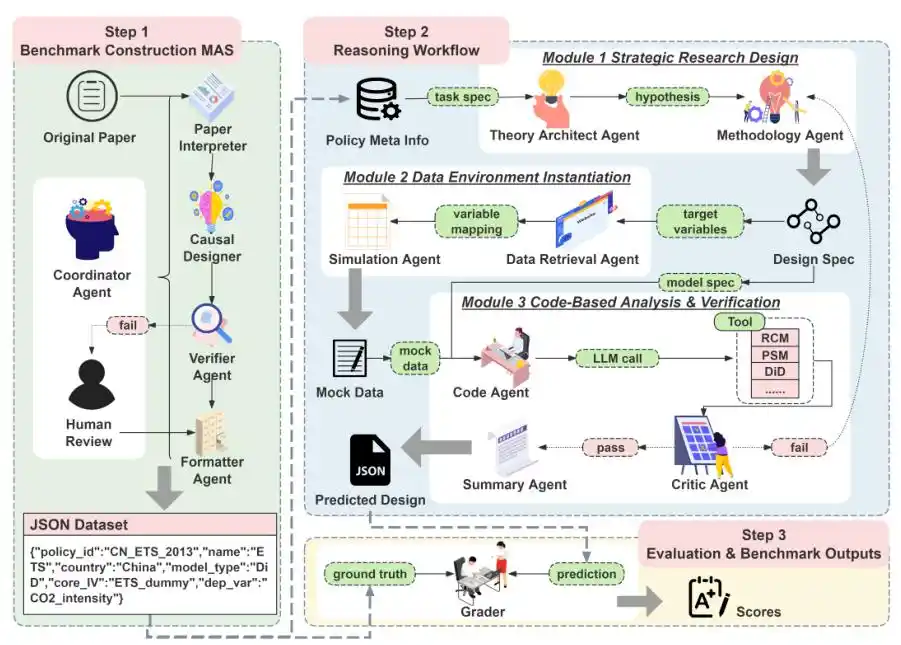
STRIDES System Overview: A workflow closed loop from research design to adversarial review.

After AI participates in research, the research output should not be just a final paper. The research question, data dictionary, analysis scripts, execution logs, review comments, and human adjudications should also be preserved, allowing others to see where results came from, at which step errors might occur, and what modifications were made.

Science is credible not because conclusions come quickly, but because others can retrace the chain of evidence.

In an interview, the team gave a simple self-check: After turning off the model, can you explain in your own words what the problem is, where the evidence comes from, what assumptions the conclusion relies on, what possible counterexamples exist, and what its boundaries of applicability are?

If you can only say "it sounds very reasonable" but cannot explain why; if the problem is gradually transformed into one the model can easily answer; if the writing becomes more fluent while your own viewpoint becomes fuzzier, then AI has likely shifted from being an expression assistant to a judgment agent.

Rules Cannot Be Just Written in Slogans

Regarding AI governance, many correct principles have been proposed: fairness, transparency, safety, human-centricity, privacy protection, accountability.

The problem is, if principles cannot be turned into procedures, they easily only exist in meetings and documents.

A system with only principles and no implementation mechanisms is like a person with only ideals and no alarm clock. They plan to do the right thing every day, but simply never wake up at the right time.

The Blue Book emphasizes that AI governance must cover the entire lifecycle of a system: assessing risks and applicable boundaries before deployment; recording key decisions, monitoring anomalies, and preserving avenues for human intervention during operation; and enabling review, correction, and accountability when problems arise.

Systems with different risk levels should not be governed identically. Ordinary information retrieval and text organization can have lower thresholds; systems involving public safety, important rights, and critical decisions should be subject to stricter testing, auditing, and deployment requirements.

Governance also cannot stop at "informed." Affected individuals should know on what basis decisions are made, what they can challenge, to whom they should raise objections, be able to request human review, and receive actual redress when errors occur. Otherwise, the duty to inform can easily become a technical document nobody understands, and appeal channels may be reduced to a mere webpage.

Of course, governance is not about putting the brakes on technology. It is more like building roads: where can speed be increased, where must it be limited, where are guardrails needed, and who is responsible after an accident. A road without rules does not represent freedom; it usually only means the strong drive faster, and everyone else must look out for themselves.

AI Can Organize Answers, But Humans Must Still Decide Direction

AI is very good at answering questions that have already been posed. But the truly difficult questions in society are often not ones without answers, but ones without a single standard answer everyone agrees on.

When efficiency conflicts with fairness, which should be prioritized? When technological innovation brings overall benefits but makes some bear greater costs, what is considered reasonable? Where should the boundary be drawn when public interest clashes with individual rights?

These problems will not disappear automatically by scaling up parameters.

The Blue Book concretely summarizes the "reverse empowerment" of AI by humanities and social sciences: It is not about standing next to technology and offering abstract moral opinions, but about transforming value conflicts into analyzable trade-offs, social consequences into measurable indicators, and providing a more directional and explanatory knowledge framework for technological development.

Models can tell us the possible consequences of different choices, but they cannot, by themselves, decide which group of people should pay the price for overall efficiency, nor can they decide if a certain price is worth paying.

The early Chinese civilization large model discussed in the Blue Book is an example. Historical documents, excavated texts, artifact images, site information, and geographical data were previously scattered across different archive systems and expert knowledge; multimodal models can organize them into the same knowledge space, allowing evidence from different sources to cross-reference each other.

Its significance lies not only in improving retrieval efficiency but in changing how evidence is organized. However, the more materials are connected, the more experts need to judge: which connections have historical significance, and which are merely superficial similarities; which narratives are built on reliable evidence, and which are merely made more fluent by the model.

This is precisely why humanities and social sciences cannot be reduced to "finding faults in AI." They are responsible not only for pointing out biases, risks, and flaws, but also for explaining value conflicts, analyzing systemic consequences, understanding specific human situations, and helping society form judgments it can collectively bear.

Technology solves "what can be done"; humanities and social sciences continue to ask "why should it be done," "to what extent should it be done," and "who bears the cost."

Relying on a Few Teams Is Not Enough

When discussing the integration of AI and humanities/social sciences, people easily think of a few labs, some star achievements, and a handful of researchers who understand both technology and social science.

This is, of course, important, but it cannot rely solely on these.

For a field to develop long-term capacity, it requires support from data, computing power, models, toolchains, talent cultivation, organizational collaboration, and evaluation systems. The Blue Book specifically reminds that AI4SSH infrastructure is not about buying more machines or putting several models on the same webpage, but the holistic construction of a multimodal data foundation, computing environment, domain-specific models, agents, toolchains, and collaboration mechanisms.

Buying computing power is relatively easy; establishing common data rules is hard. Releasing a model is relatively easy; making different disciplines truly understand each other's problems is hard. The real challenge is transforming scattered projects into sustainable organizational capabilities.

More importantly, emerging disciplines like cognitive science also need joint planning. Cognitive science connects philosophy, psychology, neuroscience, computing science, linguistics, and social sciences. It helps us understand human intelligence and also helps us reflect on and calibrate machine intelligence. For universities, building such foundational disciplines may not immediately correspond to a demonstrable application, but it determines whether future human-AI collaboration can move from tool use to paradigm innovation.

The Blue Book thus constructs the "Chinese Universities AI4SSH Index", expanding from three dimensions: core research capability, innovative development potential, and social dissemination capability, including 3 first-level indicators, 7 second-level indicators, and 10 third-level indicators.
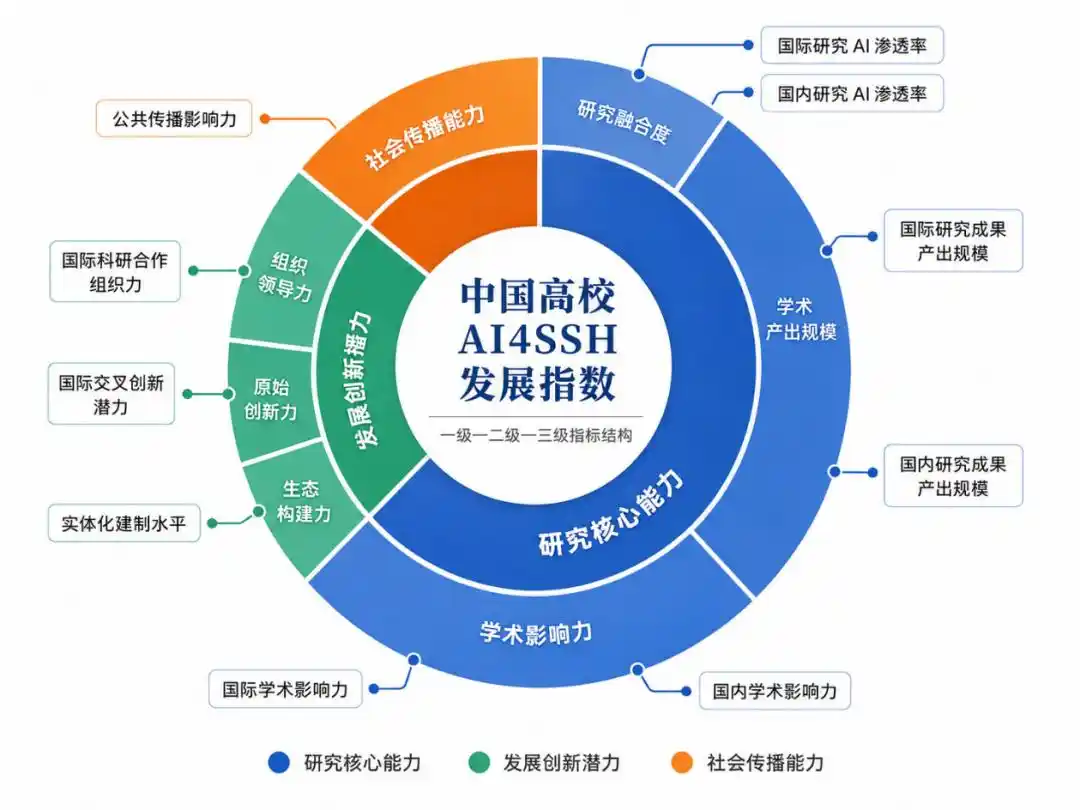
Chinese Universities AI4SSH Index Framework

It provides a structured observation window: which universities have formed stable interdisciplinary research systems, which remain at scattered project stages; which have research output but lack institutional support; which have academic achievements but have not yet translated them into public impact and social service.

The Blue Book's overall judgment is that the development of AI4SSH in Chinese universities presents a pattern of "initial system construction, distinct tiers." Research output and local integration progress relatively quickly, but international academic influence, source innovation, institutional support, and social service transformation still have shortcomings.

Therefore, measuring AI4SSH development cannot rely solely on model, paper, and project counts. One must also examine whether data, tools, norms, talent, and collaboration mechanisms can operate long-term. Technology can upgrade rapidly, but systems and organizations can only learn slowly; what truly determines how far AI and humanities/social sciences can go are precisely these parts less easily turned into demo videos.

Conclusion: The More Proficient AI Becomes at Answering, the More Humans Need to Know What to Ask

In the foreword to the Blue Book, Qiu Xin, Party Committee Secretary of Fudan University, writes to readers: in the intelligent era, we should "always safeguard thought, hone thinking, retain the composure and steadfastness for independent contemplation, rational judgment, inquiry into values, and discerning choices, guiding the transformation of intelligence with the depth of thought."

This is also the attitude this Blue Book hopes to convey. It is not merely an observation of a wave of technological change, but also a collective reflection by Fudan's humanities in facing the intelligent age.

What truly matters is judging what questions are worth posing before automatic generation; continuing to question whether evidence is credible after a model gives conclusions; clarifying its boundaries and responsibilities before technology enters society; and preserving human value judgments and directional choices among many possible futures.

We no longer need to prove in which tasks humans are faster than machines, but to reaffirm the non-transferable judgment and responsibility of humans in knowledge production and social operation.

Machines can help us reach many places. As for why we set out, where we should go, and what kind of life we want to live upon arrival—these things probably still cannot be entirely entrusted to it.

The Blue Book will be officially released on July 17 at the WAIC 2026 "Global AI Governance and Sustainable Development" forum. For the full text download, please follow the official account of the Fudan University National Development and Intelligent Governance Comprehensive Laboratory.

This article is from the WeChat public account "Almost Human" (ID: almosthuman2014), author: Focus on AI.


Criptos en tendencia

Preguntas relacionadas

QAccording to the 2026 Humanities and Social Sciences Intelligent Development Blue Paper by Fudan University, why is deep thinking becoming more important as AI becomes more capable of answering questions?

AThe Blue Paper argues that as AI takes over more procedural and information-processing tasks, the core research bottleneck shifts from handling materials to posing good questions, establishing authentic mechanisms, and forming verifiable evidence chains. Social problems are not arithmetic exercises. Tasks like judging what problems are worth studying, interpreting observed patterns, assessing the fairness of outcomes, and identifying biases or omissions in research cannot be fully automated. Therefore, the stronger AI becomes, the greater the human responsibility for judgment and direction-setting becomes, making deep thinking more critical.

QWhat are the two modes of AI embedding in public governance discussed in the Blue Paper, and what is their key difference?

AThe Blue Paper distinguishes between 'Agent-Type' and 'Assistive-Type' modes of AI embedding. The key difference is not the amount of technology used, but whether power transfer occurs. In the 'Agent-Type' mode, the algorithm acts as the decision-maker from input to output, with humans intervening only in case of system failures or appeals. In the 'Assistive-Type' mode, AI handles tasks like retrieval, calculation, risk prompting, and generating options, but the final decision is made by a human. The paper warns that simply having a human 'in the loop' on paper is not enough if they can only click 'confirm' on the algorithm's conclusion.

QWhat is the STRIDES framework mentioned in the article, and what is its main purpose in AI-assisted research?

AThe STRIDES framework is introduced as a system to decompose complex research into stages like theory, methodology, data, execution, and review. Its main purpose is to embed checks at key nodes within the research workflow. It requires explicit hypotheses, traceable evidence, versioned data and code, and mandates that high-risk or low-confidence conclusions be re-submitted for human judgment. The goal is to ensure that while work can be delegated to AI, the evidence chain and critical reasoning cannot be. It aims to preserve research integrity and verifiability in an automated context.

QHow does the Blue Paper define the 'reverse empowerment' of humanities and social sciences on AI development?

AThe 'reverse empowerment' is defined not as offering abstract moral opinions on technology, but as concretely transforming value conflicts into analyzable trade-offs, translating social consequences into measurable indicators, and providing a more directional and explanatory knowledge framework for technological development. It involves humanities and social sciences addressing fundamental questions that AI cannot answer on its own, such as 'why to do something,' 'how far it should go,' and 'who bears the costs,' thereby guiding the purpose and boundaries of AI application.

QWhat is the significance of the 'China University AI4SSH Index' constructed in the Blue Paper?

AThe 'China University AI4SSH Index' provides a structured observation framework to assess the development of AI for Social Sciences and Humanities (AI4SSH) in Chinese universities. It evaluates institutions across three dimensions: core research capability, developmental innovation potential, and social dissemination capacity, using multiple tiers of indicators. Its significance lies in moving beyond counting models, papers, or projects to reveal which universities have built sustainable interdisciplinary systems, robust institutional support, and the ability to convert academic成果 into public impact. It highlights that long-term progress depends on foundational elements like data, tools, norms, talent, and collaboration mechanisms, not just technological demonstrations.

Lecturas Relacionadas

Tensions in the Strait of Hormuz Escalate, Bitcoin Plunges to $61,700 Amid Safe-Haven Selling

Bitcoin fell sharply to around $61,700 on Monday, July 13th, as geopolitical tensions in the Strait of Hormuz triggered a broad shift toward risk-off sentiment across global markets. The decline of roughly 4% mirrored weaker performances in major U.S. stock indices. Market analysts attributed the sell-off to a confluence of factors stemming from the heightened U.S.-Iran tensions. These tensions reignited inflation concerns, reduced expectations for near-term Federal Reserve rate cuts, and prompted investors to reduce exposure to risk assets like Bitcoin. Additional pressure came from slowed institutional ETF inflows, Bitcoin's failure to breach a key resistance level, and a wave of liquidations for leveraged long positions. Despite the drop, analysts largely viewed the move as a typical macro-driven correction within a healthy long-term cycle. They emphasized that Bitcoin's underlying growth trajectory remains intact. The sell-off was seen more as a liquidation event targeting over-leveraged longs rather than a structural loss of confidence. Attention now turns to the upcoming U.S. Consumer Price Index (CPI) report. A higher-than-expected inflation reading could further delay Fed rate cuts, making safer assets like bonds more attractive and continuing to pressure volatile assets like Bitcoin. The consensus is that the current volatility reflects short-term macro and geopolitical shocks, not a fundamental breakdown in Bitcoin's long-term proposition.

Foresight NewsHace 5 min(s)

Tensions in the Strait of Hormuz Escalate, Bitcoin Plunges to $61,700 Amid Safe-Haven Selling

Foresight NewsHace 5 min(s)

BitMart Research Institute Weekly Highlights: Rising Rate Hike Expectations, Crypto Market Stabilizes Amid Fluctuations

BitMart Research Weekly Market Review: Rate Hike Expectations Rise, Crypto Market Stabilizes Macro & Traditional Markets: U.S. stocks weakened with tech and semiconductors leading losses (Nasdaq down 1.55%, Philly Semi Index down 4.78%), while Apple bucked the trend. Brent oil surged 9.3% after Middle East ceasefire破裂, but gold fell 1% as美元 strengthened. The Fed's June FOMC纪要 was hawkish, shifting market expectations toward potential rate hikes, pushing the 10-year Treasury yield to 4.56%. Crypto Market Overview: BTC saw a slight 0.2% weekly gain, trading between ~$61.3K and $64.7K and settling near $64K. ETH outperformed, rising 1.2%. Market fear eased slightly but remained in "Fear" territory. Altcoin performance was mixed, with gains concentrated in large-cap assets. Key Developments: U.S. spot Bitcoin ETFs ended an 8-week outflow streak with a $197.4M net inflow, aiding price stabilization. On-chain, stablecoin growth was minimal. Robinhood Chain's TVL surpassed $132M within two weeks, largely driven by institutional stablecoin deposits. MicroStrategy executed its first major BTC sale (3,588 BTC for $216M) to fund dividends, while maintaining a large BTC reserve. Institutional infrastructure advanced with Swift's blockchain pilot for tokenized deposits and growing Asia-Pacific stablecoin initiatives. *This is market analysis, not investment advice. Cryptocurrency investment is high-risk; assess your risk tolerance and implement strict risk management.*

marsbitHace 55 min(s)

BitMart Research Institute Weekly Highlights: Rising Rate Hike Expectations, Crypto Market Stabilizes Amid Fluctuations

marsbitHace 55 min(s)

Trading

Spot

Artículos destacados

Qué es GROK AI

Grok AI: Revolucionando la Tecnología Conversacional en la Era Web3 Introducción En el paisaje de rápida evolución de la inteligencia artificial, Grok AI se destaca como un proyecto notable que une los dominios de la tecnología avanzada y la interacción del usuario. Desarrollado por xAI, una empresa liderada por el renombrado empresario Elon Musk, Grok AI busca redefinir la forma en que interactuamos con la inteligencia artificial. A medida que el movimiento Web3 continúa floreciendo, Grok AI tiene como objetivo aprovechar el poder de la IA conversacional para responder consultas complejas, proporcionando a los usuarios una experiencia que no solo es informativa, sino también entretenida. ¿Qué es Grok AI? Grok AI es un sofisticado chatbot de IA conversacional diseñado para interactuar dinámicamente con los usuarios. A diferencia de muchos sistemas de IA tradicionales, Grok AI abraza una gama más amplia de consultas, incluyendo aquellas que normalmente se consideran inapropiadas o fuera de las respuestas estándar. Los objetivos centrales del proyecto incluyen: Razonamiento Confiable: Grok AI enfatiza el razonamiento de sentido común para proporcionar respuestas lógicas basadas en la comprensión contextual. Supervisión Escalable: La integración de asistencia de herramientas asegura que las interacciones de los usuarios sean monitoreadas y optimizadas para la calidad. Verificación Formal: La seguridad es primordial; Grok AI incorpora métodos de verificación formal para mejorar la confiabilidad de sus resultados. Comprensión de Largo Contexto: El modelo de IA sobresale en retener y recordar un extenso historial de conversaciones, facilitando discusiones significativas y contextualizadas. Robustez Adversarial: Al enfocarse en mejorar sus defensas contra entradas manipuladas o maliciosas, Grok AI busca mantener la integridad de las interacciones de los usuarios. En esencia, Grok AI no es solo un dispositivo de recuperación de información; es un compañero conversacional inmersivo que fomenta un diálogo dinámico. Creador de Grok AI La mente detrás de Grok AI no es otra que Elon Musk, una persona sinónimo de innovación en varios campos, incluyendo la automoción, los viajes espaciales y la tecnología. Bajo el paraguas de xAI, una empresa enfocada en avanzar la tecnología de IA de maneras beneficiosas, la visión de Musk busca remodelar la comprensión de las interacciones de IA. El liderazgo y la ética fundacional están profundamente influenciados por el compromiso de Musk de empujar los límites tecnológicos. Inversores de Grok AI Si bien los detalles específicos sobre los inversores que respaldan a Grok AI son limitados, se reconoce públicamente que xAI, el incubador del proyecto, está fundado y apoyado principalmente por el propio Elon Musk. Las empresas y participaciones anteriores de Musk proporcionan un respaldo robusto, fortaleciendo aún más la credibilidad y el potencial de crecimiento de Grok AI. Sin embargo, hasta ahora, la información sobre fundaciones de inversión adicionales u organizaciones que apoyan a Grok AI no está fácilmente accesible, marcando un área para una posible exploración futura. ¿Cómo Funciona Grok AI? La mecánica operativa de Grok AI es tan innovadora como su marco conceptual. El proyecto integra varias tecnologías de vanguardia que facilitan sus funcionalidades únicas: Infraestructura Robusta: Grok AI está construido utilizando Kubernetes para la orquestación de contenedores, Rust para rendimiento y seguridad, y JAX para computación numérica de alto rendimiento. Este trío asegura que el chatbot opere de manera eficiente, escale efectivamente y sirva a los usuarios de manera oportuna. Acceso a Conocimiento en Tiempo Real: Una de las características distintivas de Grok AI es su capacidad para acceder a datos en tiempo real a través de la plataforma X—anteriormente conocida como Twitter. Esta capacidad otorga a la IA acceso a la información más reciente, permitiéndole proporcionar respuestas y recomendaciones oportunas que otros modelos de IA podrían pasar por alto. Dos Modos de Interacción: Grok AI ofrece a los usuarios una elección entre “Modo Divertido” y “Modo Regular”. El Modo Divertido permite un estilo de interacción más lúdico y humorístico, mientras que el Modo Regular se centra en ofrecer respuestas precisas y exactas. Esta versatilidad asegura una experiencia personalizada que se adapta a diversas preferencias de los usuarios. En esencia, Grok AI une rendimiento con compromiso, creando una experiencia que es tanto enriquecedora como entretenida. Cronología de Grok AI El viaje de Grok AI está marcado por hitos cruciales que reflejan sus etapas de desarrollo y despliegue: Desarrollo Inicial: La fase fundamental de Grok AI tuvo lugar durante aproximadamente dos meses, durante los cuales se realizó el entrenamiento inicial y el ajuste del modelo. Lanzamiento Beta de Grok-2: En un avance significativo, se anunció la beta de Grok-2. Este lanzamiento introdujo dos versiones del chatbot—Grok-2 y Grok-2 mini—cada una equipada con capacidades para chatear, programar y razonar. Acceso Público: Tras su desarrollo beta, Grok AI se volvió disponible para los usuarios de la plataforma X. Aquellos con cuentas verificadas por un número de teléfono y activas durante al menos siete días pueden acceder a una versión limitada, haciendo que la tecnología esté disponible para un público más amplio. Esta cronología encapsula el crecimiento sistemático de Grok AI desde su inicio hasta el compromiso público, enfatizando su compromiso con la mejora continua y la interacción del usuario. Características Clave de Grok AI Grok AI abarca varias características clave que contribuyen a su identidad innovadora: Integración de Conocimiento en Tiempo Real: El acceso a información actual y relevante diferencia a Grok AI de muchos modelos estáticos, permitiendo una experiencia de usuario atractiva y precisa. Estilos de Interacción Versátiles: Al ofrecer modos de interacción distintos, Grok AI se adapta a diversas preferencias de los usuarios, invitando a la creatividad y la personalización en la conversación con la IA. Avanzada Infraestructura Tecnológica: La utilización de Kubernetes, Rust y JAX proporciona al proyecto un marco sólido para asegurar confiabilidad y rendimiento óptimo. Consideración de Discurso Ético: La inclusión de una función generadora de imágenes muestra el espíritu innovador del proyecto. Sin embargo, también plantea consideraciones éticas en torno a los derechos de autor y la representación respetuosa de figuras reconocibles—una discusión en curso dentro de la comunidad de IA. Conclusión Como una entidad pionera en el ámbito de la IA conversacional, Grok AI encapsula el potencial de experiencias transformadoras para los usuarios en la era digital. Desarrollado por xAI y guiado por el enfoque visionario de Elon Musk, Grok AI integra conocimiento en tiempo real con capacidades avanzadas de interacción. Busca empujar los límites de lo que la inteligencia artificial puede lograr mientras mantiene un enfoque en consideraciones éticas y la seguridad del usuario. Grok AI no solo encarna el avance tecnológico, sino que también representa un nuevo paradigma de conversación en el paisaje Web3, prometiendo involucrar a los usuarios con tanto conocimiento hábil como interacción lúdica. A medida que el proyecto continúa evolucionando, se erige como un testimonio de lo que la intersección de la tecnología, la creatividad y la interacción similar a la humana puede lograr.

431 Vistas totalesPublicado en 2024.12.26Actualizado en 2024.12.26

Qué es GROK AI

Qué es ERC AI

Euruka Tech: Una Visión General de $erc ai y sus Ambiciones en Web3 Introducción En el paisaje en rápida evolución de la tecnología blockchain y las aplicaciones descentralizadas, nuevos proyectos emergen con frecuencia, cada uno con objetivos y metodologías únicas. Uno de estos proyectos es Euruka Tech, que opera en el amplio dominio de las criptomonedas y Web3. El enfoque principal de Euruka Tech, particularmente su token $erc ai, es presentar soluciones innovadoras diseñadas para aprovechar las crecientes capacidades de la tecnología descentralizada. Este artículo tiene como objetivo proporcionar una visión general completa de Euruka Tech, una exploración de sus objetivos, funcionalidad, la identidad de su creador, posibles inversores y su importancia dentro del contexto más amplio de Web3. ¿Qué es Euruka Tech, $erc ai? Euruka Tech se caracteriza como un proyecto que aprovecha las herramientas y funcionalidades ofrecidas por el entorno Web3, centrándose en integrar inteligencia artificial dentro de sus operaciones. Aunque los detalles específicos sobre el marco del proyecto son algo elusivos, está diseñado para mejorar la participación del usuario y automatizar procesos en el espacio cripto. El proyecto tiene como objetivo crear un ecosistema descentralizado que no solo facilite transacciones, sino que también incorpore funcionalidades predictivas a través de inteligencia artificial, de ahí la designación de su token, $erc ai. El objetivo es proporcionar una plataforma intuitiva que facilite interacciones más inteligentes y un procesamiento eficiente de transacciones dentro de la creciente esfera de Web3. ¿Quién es el Creador de Euruka Tech, $erc ai? En la actualidad, la información sobre el creador o el equipo fundador detrás de Euruka Tech permanece no especificada y algo opaca. Esta ausencia de datos genera preocupaciones, ya que el conocimiento del trasfondo del equipo es a menudo esencial para establecer credibilidad dentro del sector blockchain. Por lo tanto, hemos categorizado esta información como desconocida hasta que se disponga de detalles concretos en el dominio público. ¿Quiénes son los Inversores de Euruka Tech, $erc ai? De manera similar, la identificación de inversores u organizaciones de respaldo para el proyecto Euruka Tech no se proporciona fácilmente a través de la investigación disponible. Un aspecto que es crucial para los posibles interesados o usuarios que consideren involucrarse con Euruka Tech es la garantía que proviene de asociaciones financieras establecidas o respaldo de firmas de inversión de renombre. Sin divulgaciones sobre afiliaciones de inversión, es difícil sacar conclusiones completas sobre la seguridad financiera o la longevidad del proyecto. De acuerdo con la información encontrada, esta sección también se encuentra en estado de desconocido. ¿Cómo Funciona Euruka Tech, $erc ai? A pesar de la falta de especificaciones técnicas detalladas para Euruka Tech, es esencial considerar sus ambiciones innovadoras. El proyecto busca aprovechar el poder computacional de la inteligencia artificial para automatizar y mejorar la experiencia del usuario dentro del entorno de las criptomonedas. Al integrar IA con tecnología blockchain, Euruka Tech tiene como objetivo proporcionar características como operaciones automatizadas, evaluaciones de riesgo e interfaces de usuario personalizadas. La esencia innovadora de Euruka Tech radica en su objetivo de crear una conexión fluida entre los usuarios y las vastas posibilidades que presentan las redes descentralizadas. A través de la utilización de algoritmos de aprendizaje automático e IA, busca minimizar los desafíos de los usuarios primerizos y optimizar las experiencias transaccionales dentro del marco de Web3. Esta simbiosis entre IA y blockchain subraya la importancia del token $erc ai, que actúa como un puente entre las interfaces de usuario tradicionales y las capacidades avanzadas de las tecnologías descentralizadas. Cronología de Euruka Tech, $erc ai Desafortunadamente, como resultado de la información limitada disponible sobre Euruka Tech, no podemos presentar una cronología detallada de los principales desarrollos o hitos en el viaje del proyecto. Esta cronología, típicamente invaluable para trazar la evolución de un proyecto y entender su trayectoria de crecimiento, no está actualmente disponible. A medida que la información sobre eventos notables, asociaciones o adiciones funcionales se haga evidente, las actualizaciones seguramente mejorarán la visibilidad de Euruka Tech en la esfera cripto. Aclaración sobre Otros Proyectos “Eureka” Es importante señalar que múltiples proyectos y empresas comparten una nomenclatura similar con “Eureka”. La investigación ha identificado iniciativas como un agente de IA de NVIDIA Research, que se centra en enseñar a los robots tareas complejas utilizando métodos generativos, así como Eureka Labs y Eureka AI, que mejoran la experiencia del usuario en educación y análisis de servicio al cliente, respectivamente. Sin embargo, estos proyectos son distintos de Euruka Tech y no deben confundirse con sus objetivos o funcionalidades. Conclusión Euruka Tech, junto con su token $erc ai, representa un jugador prometedor pero actualmente oscuro dentro del paisaje de Web3. Si bien los detalles sobre su creador e inversores permanecen no revelados, la ambición central de combinar inteligencia artificial con tecnología blockchain se presenta como un punto focal de interés. Los enfoques únicos del proyecto para fomentar la participación del usuario a través de la automatización avanzada podrían destacarlo a medida que el ecosistema Web3 progresa. A medida que el mercado cripto continúa evolucionando, los interesados deben mantener un ojo atento a los avances en torno a Euruka Tech, ya que el desarrollo de innovaciones documentadas, asociaciones o una hoja de ruta definida podría presentar oportunidades significativas en el futuro cercano. Tal como está, esperamos más información sustancial que podría revelar el potencial de Euruka Tech y su posición en el competitivo paisaje cripto.

419 Vistas totalesPublicado en 2025.01.02Actualizado en 2025.01.02

Qué es ERC AI

Qué es DUOLINGO AI

DUOLINGO AI: Integrando el Aprendizaje de Idiomas con Web3 e Innovación en IA En una era donde la tecnología redefine la educación, la integración de la inteligencia artificial (IA) y las redes blockchain anuncia una nueva frontera para el aprendizaje de idiomas. Entra DUOLINGO AI y su criptomoneda asociada, $DUOLINGO AI. Este proyecto aspira a fusionar la capacidad educativa de las principales plataformas de aprendizaje de idiomas con los beneficios de la tecnología descentralizada Web3. Este artículo profundiza en los aspectos clave de DUOLINGO AI, explorando sus objetivos, marco tecnológico, desarrollo histórico y potencial futuro, mientras mantiene claridad entre el recurso educativo original y esta iniciativa independiente de criptomoneda. Visión General de DUOLINGO AI En su esencia, DUOLINGO AI busca establecer un entorno descentralizado donde los aprendices puedan ganar recompensas criptográficas por alcanzar hitos educativos en la competencia lingüística. Al aplicar contratos inteligentes, el proyecto tiene como objetivo automatizar los procesos de verificación de habilidades y asignación de tokens, adhiriéndose a los principios de Web3 que enfatizan la transparencia y la propiedad del usuario. El modelo se aparta de los enfoques tradicionales para la adquisición de idiomas al apoyarse en gran medida en una estructura de gobernanza impulsada por la comunidad, permitiendo a los poseedores de tokens sugerir mejoras al contenido del curso y a las distribuciones de recompensas. Algunos de los objetivos notables de DUOLINGO AI incluyen: Aprendizaje Gamificado: El proyecto integra logros en blockchain y tokens no fungibles (NFTs) para representar niveles de competencia lingüística, fomentando la motivación a través de recompensas digitales atractivas. Creación de Contenido Descentralizada: Abre avenidas para que educadores y entusiastas de los idiomas contribuyan con sus cursos, facilitando un modelo de reparto de ingresos que beneficia a todos los contribuyentes. Personalización Impulsada por IA: Al emplear modelos avanzados de aprendizaje automático, DUOLINGO AI personaliza las lecciones para adaptarse al progreso de aprendizaje individual, similar a las características adaptativas que se encuentran en plataformas establecidas. Creadores del Proyecto y Gobernanza A partir de abril de 2025, el equipo detrás de $DUOLINGO AI permanece seudónimo, una práctica frecuente en el paisaje descentralizado de criptomonedas. Esta anonimidad está destinada a promover el crecimiento colectivo y la participación de los interesados en lugar de centrarse en desarrolladores individuales. El contrato inteligente desplegado en la blockchain de Solana anota la dirección de la billetera del desarrollador, lo que significa el compromiso con la transparencia en las transacciones a pesar de que la identidad de los creadores sea desconocida. Según su hoja de ruta, DUOLINGO AI aspira a evolucionar hacia una Organización Autónoma Descentralizada (DAO). Esta estructura de gobernanza permite a los poseedores de tokens votar sobre cuestiones críticas como implementaciones de características y asignaciones del tesoro. Este modelo se alinea con la ética del empoderamiento comunitario que se encuentra en diversas aplicaciones descentralizadas, enfatizando la importancia de la toma de decisiones colectiva. Inversores y Asociaciones Estratégicas Actualmente, no hay inversores institucionales o capitalistas de riesgo identificables públicamente vinculados a $DUOLINGO AI. En cambio, la liquidez del proyecto proviene principalmente de intercambios descentralizados (DEXs), marcando un contraste marcado con las estrategias de financiamiento de las empresas de tecnología educativa tradicionales. Este modelo de base indica un enfoque impulsado por la comunidad, reflejando el compromiso del proyecto con la descentralización. En su libro blanco, DUOLINGO AI menciona la formación de colaboraciones con “plataformas de educación blockchain” no especificadas, destinadas a enriquecer su oferta de cursos. Si bien aún no se han divulgado asociaciones específicas, estos esfuerzos colaborativos sugieren una estrategia para fusionar la innovación blockchain con iniciativas educativas, ampliando el acceso y la participación de los usuarios a través de diversas avenidas de aprendizaje. Arquitectura Tecnológica Integración de IA DUOLINGO AI incorpora dos componentes principales impulsados por IA para mejorar su oferta educativa: Motor de Aprendizaje Adaptativo: Este sofisticado motor aprende de las interacciones de los usuarios, similar a los modelos propietarios de las principales plataformas educativas. Ajusta dinámicamente la dificultad de las lecciones para abordar desafíos específicos de los aprendices, reforzando áreas débiles a través de ejercicios dirigidos. Agentes Conversacionales: Al emplear chatbots impulsados por GPT-4, DUOLINGO AI proporciona una plataforma para que los usuarios participen en conversaciones simuladas, fomentando una experiencia de aprendizaje de idiomas más interactiva y práctica. Infraestructura Blockchain Construido sobre la blockchain de Solana, $DUOLINGO AI utiliza un marco tecnológico integral que incluye: Contratos Inteligentes de Verificación de Habilidades: Esta característica otorga automáticamente tokens a los usuarios que superan con éxito las pruebas de competencia, reforzando la estructura de incentivos para resultados de aprendizaje genuinos. Insignias NFT: Estos tokens digitales significan varios hitos que los aprendices logran, como completar una sección de su curso o dominar habilidades específicas, permitiéndoles intercambiar o mostrar sus logros digitalmente. Gobernanza DAO: Los miembros de la comunidad con tokens pueden participar en la gobernanza votando sobre propuestas clave, facilitando una cultura participativa que fomenta la innovación en las ofertas de cursos y características de la plataforma. Línea de Tiempo Histórica 2022–2023: Conceptualización Los cimientos de DUOLINGO AI comienzan con la creación de un libro blanco, destacando la sinergia entre los avances en IA en el aprendizaje de idiomas y el potencial descentralizado de la tecnología blockchain. 2024: Lanzamiento Beta Un lanzamiento beta limitado introduce ofertas en idiomas populares, recompensando a los primeros usuarios con incentivos en tokens como parte de la estrategia de participación comunitaria del proyecto. 2025: Transición a DAO En abril, se produce un lanzamiento completo de la red principal con la circulación de tokens, lo que provoca discusiones comunitarias sobre posibles expansiones a idiomas asiáticos y otros desarrollos de cursos. Desafíos y Direcciones Futuras Obstáculos Técnicos A pesar de sus ambiciosos objetivos, DUOLINGO AI enfrenta desafíos significativos. La escalabilidad sigue siendo una preocupación constante, particularmente en equilibrar los costos asociados con el procesamiento de IA y mantener una red descentralizada y receptiva. Además, garantizar la creación y moderación de contenido de calidad en medio de una oferta descentralizada plantea complejidades en el mantenimiento de estándares educativos. Oportunidades Estratégicas Mirando hacia adelante, DUOLINGO AI tiene el potencial de aprovechar asociaciones de micro-certificación con instituciones académicas, proporcionando validaciones verificadas en blockchain de habilidades lingüísticas. Además, la expansión entre cadenas podría permitir que el proyecto acceda a bases de usuarios más amplias y a ecosistemas blockchain adicionales, mejorando su interoperabilidad y alcance. Conclusión DUOLINGO AI representa una fusión innovadora de inteligencia artificial y tecnología blockchain, presentando una alternativa centrada en la comunidad a los sistemas tradicionales de aprendizaje de idiomas. Si bien su desarrollo seudónimo y su modelo económico emergente traen ciertos riesgos, el compromiso del proyecto con el aprendizaje gamificado, la educación personalizada y la gobernanza descentralizada ilumina un camino hacia adelante para la tecnología educativa en el ámbito de Web3. A medida que la IA continúa avanzando y el ecosistema blockchain evoluciona, iniciativas como DUOLINGO AI podrían redefinir cómo los usuarios se involucran con la educación lingüística, empoderando comunidades y recompensando la participación a través de mecanismos de aprendizaje innovadores.

460 Vistas totalesPublicado en 2025.04.11Actualizado en 2025.04.11

Qué es DUOLINGO AI

Discusiones

Bienvenido a la comunidad de HTX. Aquí puedes mantenerte informado sobre los últimos desarrollos de la plataforma y acceder a análisis profesionales del mercado. A continuación se presentan las opiniones de los usuarios sobre el precio de AI (AI).

活动图片