Cyclical Stock or Growth Stock? Coinbase's Q2 Earnings Report Reveals 'Valuation Disagreement'

Odaily星球日报Publicado a 2026-07-31Actualizado a 2026-07-31

Resumen

Coinbase's Q2 2026 financial results revealed a mixed performance, reigniting debate over whether the company should be valued as a cyclical stock tied to crypto markets or a growth stock with future potential. Total revenue missed expectations at $1.22 billion, down 19% year-over-year. Transaction revenue fell to $599 million, with retail crypto spot trading revenue dropping 30% to $452 million, back to 2023 levels. The company reported a net loss of $359 million, marking its third consecutive quarterly loss. Despite CEO Brian Armstrong's positive commentary on metrics like a 10.3% overall crypto trading market share and 106% growth in prediction markets, the market reacted negatively, with shares dropping over 5% after-hours. A key issue is the decline in core retail trading. While Coinbase touted record market share, this figure includes derivatives and new products. Its traditional crypto spot trading share is likely shrinking. New ventures like prediction markets, while growing, contributed less than $30 million, insufficient to offset the core revenue decline. The valuation debate hinges on perspective. As a cyclical stock, Coinbase remains deeply tied to the crypto bear market, with user attrition and competitive pressures justifying a lower valuation. The company's strategy appears focused on surviving until the next bull cycle. Viewed as a growth stock, however, Coinbase shows promising diversification. Subscription and service revenue reached $555 million, nearl...

Original | Odaily Planet Daily (@OdailyChina)

Author | Golem (@web3_golem)

On July 31st, Coinbase announced its Q2 2026 financial report. Coinbase CEO Brian Armstrong posted on platform X, summarizing the quarter: "Despite a very difficult market environment in the second quarter, Coinbase continued to make steady progress amidst various headwinds." He highlighted Q2 achievements, such as over 90% of delegated stablecoin transaction volume concentrated on Base; crypto trading market share reached a new high of 10.3%; and prediction markets revenue doubled, growing 106% quarter-over-quarter, among others.

Overall, it was more about reporting the good news than the bad, which is Coinbase's consistent style. However, the market won't play along. Coinbase's Q2 2026 revenue still fell short of expectations.

The financial report shows that in Q2 2026, Coinbase's total revenue was $1.22 billion, a 19% year-over-year decrease and a 14% quarter-over-quarter decrease, missing market expectations ($1.29 billion); trading revenue was $599 million, also below the market expectation of $628 million; net loss reached $359 million. Coinbase has now achieved net losses for three consecutive quarters (Odaily note: Q4 2025 net loss was $666.7 million, Q1 2026 net loss was $394.1 million).

Affected by this, Coinbase (NASDAQ: COIN) fell over 5% in after-hours trading.

Market Share Hits New High, But Crypto Spot Trading Market Share Continues to Shrink

In the Q2 earnings call, Coinbase didn't even explain the reasons for this quarter's net loss, choosing instead to downplay the negative and focus on answering questions unrelated to its crypto brokerage business. In Q1 2026, Coinbase attributed the losses to weak crypto markets and crypto asset impairments, but Odaily Planet Daily previously analyzed that the essence of its net loss was due to continuous user attrition and a sharp decline in crypto trading revenue.(Related reading:Q1 Net Loss $394.1 Million, Coinbase Can Only Hold Tight to Circle's Leg)

By Q2, the situation had not improved; trading revenue continued to decline. The report shows that Coinbase's Q2 total trading revenue reached $599 million, of which the major contributor, retail trading revenue, was $452 million, down 30% year-over-year and 20% quarter-over-quarter, even falling back to 2023 revenue levels. According to the report, retail crypto spot trading volume has decreased by 24%.
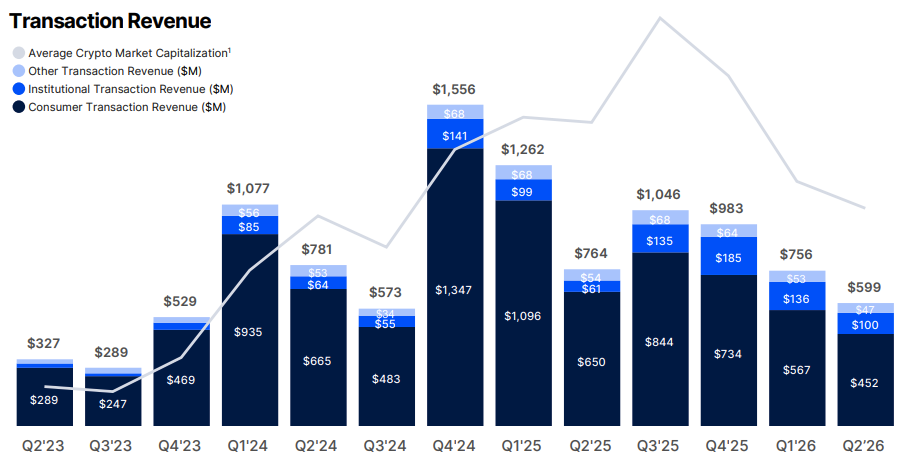
Coinbase 2026 Q2 Trading Revenue

Even with such dismal figures, retail-contributed trading revenue remained the largest single source of revenue in Coinbase's Q2 report. The second-largest source was stablecoin revenue, reaching $292 million. Since the report disclosed that Coinbase's crypto trading market share reached a new high of 10.3% in Q2, why is its trading revenue still declining sharply? Is it, as some analysts say, not due to user loss, but simply because of weak crypto sentiment reducing retail trading desire?

But the truth is that Coinbase played a word game. According to Coinbase's calculation method, this market share includes new products like derivatives trading, prediction markets, and tokenized stocks, not just cryptocurrency spot trading. Therefore, the 1% growth from 9.1% in Q1 to the current 10.3% in crypto trading market share was basically contributed by new business lines.
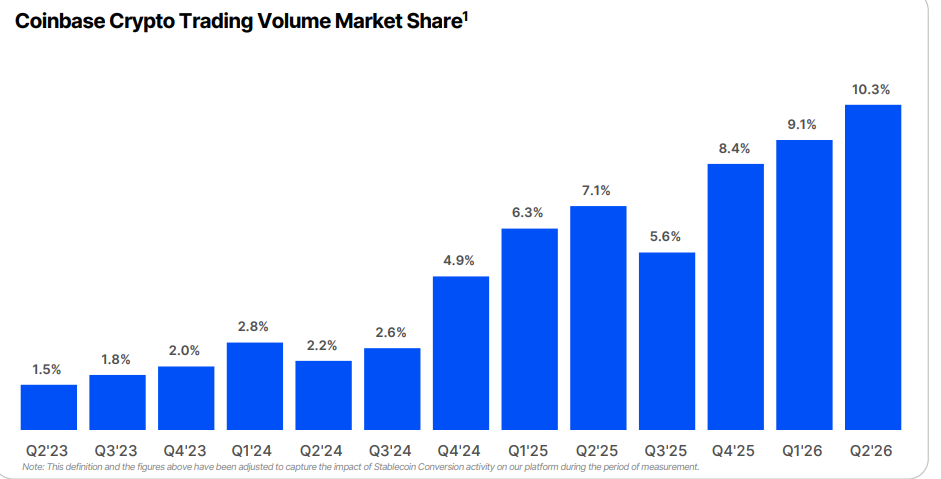
Quarterly Changes in Coinbase Crypto Trading Market Share

According to the report, growth in prediction markets has partially offset the impact of sluggish retail crypto spot trading volume on revenue. But by Coinbase's calculation, although prediction market revenue grew over 2 times quarter-over-quarter compared to Q1, its annualized revenue is only about $100 million, meaning actual revenue might be less than $30 million. Therefore, its offsetting effect on the loss of retail trading revenue can only be described as a drop in the bucket.

In summary, crypto spot trading remains the pillar of Coinbase's revenue. While Coinbase is doing its utmost to develop other businesses to create the so-called "Exchange for Everything," and has achieved growth, its growth rate and revenue levels have not satisfied the market and investors. In established market segments like prediction markets, crypto derivatives, and tokenized stock trading, Coinbase's competitiveness as a new entrant is relatively small. Its prospects for relying on new business lines for substantial growth and financial turnaround do not look optimistic at present.

Cyclical Stock or Growth Stock

However, to be fair, the current valuation of Coinbase depends on whether it is viewed as a cyclical stock or a growth stock.

If viewed as a cyclical stock, Coinbase's revenue is indeed constrained by the current crypto bear market cycle. New businesses have not freed it from cyclical limitations, and user attrition and declining competitiveness among exchanges are also obvious issues on the table.

Therefore, from this perspective, a decline in Coinbase's stock price is reasonable. In fact, everything Coinbase is doing now seems to be about surviving until the bull market cycle returns. Brian Armstrong also stated in the earnings call, "I believe Bitcoin will make a strong comeback; it has always gone through such cycles, and prices always go up and down. But we must have a strategy for diversified revenue; it is core to the exchange's operational strategy." The subtext is: when the bull market comes, everything will be fine.

If Coinbase is viewed as a future growth stock, then it is currently even undervalued.

First, looking at the revenue composition, although Coinbase has not yet achieved revenue diversification and crypto spot trading remains its main revenue source, the sources of revenue show a trend towards diversification. The report shows that Coinbase's current revenue is decoupled from Bitcoin trading fees, with 88% of net revenue coming from non-Bitcoin spot trading. In 2020, Bitcoin trading fees accounted for over 55% of revenue. Meanwhile, Coinbase's subscription and services revenue in this quarter reached $555 million, accounting for 48% of net revenue, almost on par with trading revenue ($599 million).
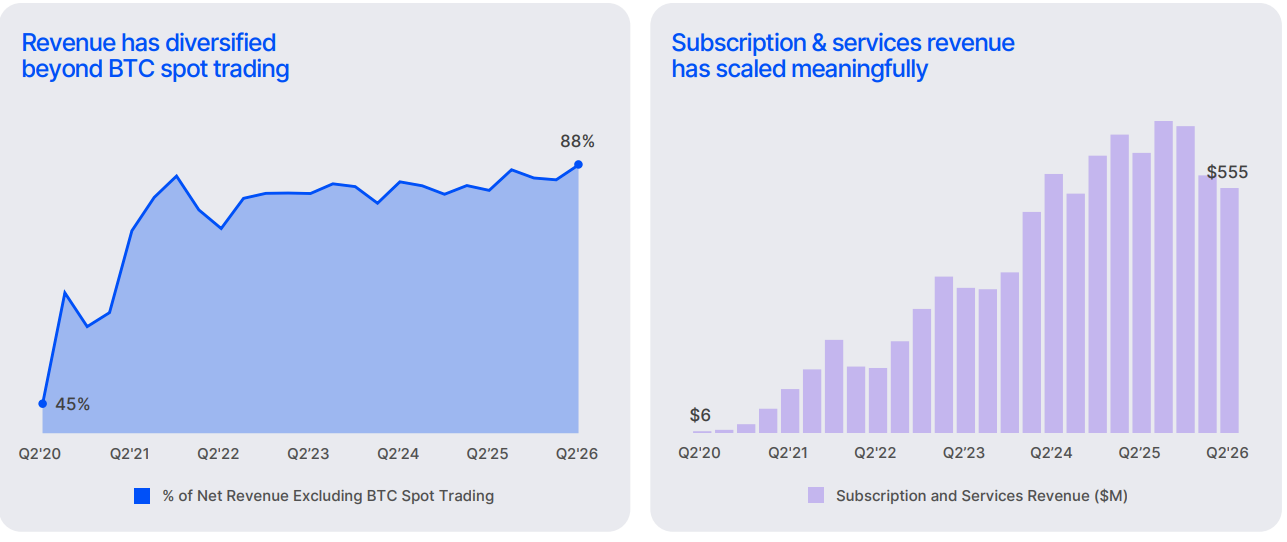
Coinbase Bitcoin Trading Fee Revenue Share & Quarterly Subscription and Services Revenue Growth

Furthermore, the number of paid users for Coinbase One hit a record high this quarter, with subscription fee revenue growing to $114 million. Crypto derivatives trading volume in Q2 did not decrease but remained largely flat with Q1 at $4.221 trillion. Coinbase has acquired Deribit and can now provide crypto derivatives trading for international users, potentially leading to another significant increase in market trading volume.
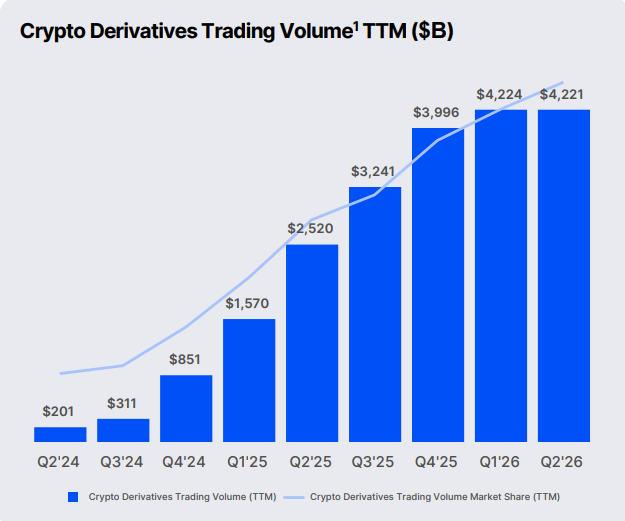
Therefore, from a developmental perspective, perhaps by Q3 2026 or Q1 2027, the total revenue from Coinbase's other businesses will replace the decisive role of crypto spot revenue in its overall revenue. The "Exchange for Everything" concept Coinbase aims to build does not necessarily mean it must excel in every field (like prediction markets, crypto derivatives, and tokenized stocks). Most investors don't have such expectations either; achieving profitability and diversified revenue would already meet expectations.

Because the future potential investors see in Coinbase lies mainly in its stablecoin business and the agent economy.

In the earnings call, CFO Alesia Haas again emphasized that Coinbase's revenue-sharing agreement with Circle will continue. Coinbase's Q2 2026 stablecoin revenue reached $292 million, still its second-largest revenue source. Meanwhile, USDC deposited on Coinbase platforms and products reached a new high, with over 30% of circulating USDC stored on Coinbase. Moreover, Coinbase disclosed in the report that over the past year, Coinbase has captured 50% of the total economic value of USDC, and broader on-chain collaboration and product integration will drive wider adoption of USDC in the future.

Simultaneously, Coinbase doesn't want to rely solely on USDC and is becoming a multi-stablecoin platform. Coinbase is a founding member of OUSD, and the variety of stablecoins supported on its platform is constantly increasing.

In the on-chain agent economy, Coinbase is a leader in the on-chain Agentic Finance (AIFi) field. Currently, according to the report, over 99% of on-chain agent transactions are completed using USDC, and over 90% of delegated stablecoin transactions are completed on Base. In Q2 2026, over 97% of on-chain agent transactions used Coinbase's x402 protocol.

Furthermore, Base's leading position in the agent economy won't be easily shaken by new market entrants competing on price because it is already cheap enough. Brian Armstrong stated in the earnings call, "Base's settlement price is below $0.01, with a settlement time under 1 second. From that perspective, it's highly competitive."

Although Base's leadership in the agent economy has not yet made a significant revenue contribution to Coinbase, this business segment holds immense future commercial value. The agent economy is widely recognized as the best intersection of blockchain and AI. Future agent economies will require payment settlement systems and identity systems, which is precisely where Base and the x402 protocol come into play. According to Coinbase's estimates, by 2030, agents will handle $3-5 trillion in agent transactions. If Base can capture 40% of this market share, even charging a 0.1% fee could generate tens of billions in revenue.

While Coinbase's current business situation is not optimistic, its future is not entirely bleak either. It depends on the perspective and investment horizon of the investor.


Preguntas relacionadas

QWhat were the key financial results for Coinbase in Q2 2026, and how did the market react?

ACoinbase reported total revenue of $1.22 billion for Q2 2026, a 19% year-over-year decline, which missed market expectations of $1.29 billion. Trading revenue was $599 million, below the expected $628 million, and the net loss was $359 million. As a result, Coinbase's stock (NASDAQ: COIN) fell over 5% in after-hours trading.

QDespite claiming a record high in overall crypto trading market share, why did Coinbase's transaction revenue decline?

ACoinbase's reported 'crypto trading market share' of 10.3% includes new products like derivatives, prediction markets, and tokenized stocks, not just spot cryptocurrency trading. The core retail spot trading volume actually declined by 24%, leading to a 30% year-over-year drop in retail transaction revenue to $452 million. Therefore, the market share growth was driven by newer, smaller-scale businesses that did not offset the significant drop in core spot trading income.

QAccording to the article, what are the two main perspectives for valuing Coinbase's stock, and what is the core argument for each?

AThe two perspectives are viewing Coinbase as a cyclical stock or a growth stock. As a cyclical stock, its revenues are heavily tied to the crypto market cycle, and its current struggles with user retention and competition justify a lower valuation during a bear market. As a future growth stock, it is argued to be undervalued due to its progress in revenue diversification (e.g., subscription services now nearly matching transaction revenue), its dominant position in stablecoin revenue and the on-chain agent economy via Base and the x402 protocol, which hold significant long-term potential.

QWhat are Coinbase's two most promising future growth areas mentioned in the article?

AThe two most promising future growth areas are its stablecoin business and its leadership in the on-chain agent economy. For stablecoins, Coinbase earns significant revenue from USDC and is expanding to support multiple stablecoins. For the agent economy, over 90% of agent stablecoin transactions occur on Base, and over 97% use Coinbase's x402 protocol. The article cites an estimate that agents could handle $3-5 trillion in transactions by 2030, representing a massive potential revenue stream for Coinbase if Base maintains its leadership.

QHow has the composition of Coinbase's revenue changed, indicating a trend towards diversification?

ACoinbase's revenue has shown a clear trend towards diversification away from a heavy reliance on Bitcoin spot trading. In Q2 2026, 88% of net revenue came from sources other than Bitcoin spot trading fees, a significant shift from 2020 when Bitcoin fees accounted for over 55%. Furthermore, subscription and service revenue reached $555 million, accounting for 48% of net revenue, nearly equaling transaction revenue ($599 million). The number of Coinbase One paying users also hit a record high.

Lecturas Relacionadas

Low Investment Isn't Apple's Immunity Pass

While Meta and Google face investor scrutiny over ballooning AI capital expenditures, Apple's minimal AI investment has paradoxically become a strength. Its market cap recently reclaimed the global top spot, surpassing $5 trillion. The irony is deep: Apple's own AI efforts have lagged, with "Apple Intelligence" delayed and core talent lost, forcing reliance on partners like Google Gemini and Alibaba's Qianwen. Its Q3 FY2026 (Q2 CY) earnings initially seemed stellar. Revenue hit $109.4B (up 16% YoY), with iPhone and Mac sales, growing 22% and 29% respectively, driving most of the growth. However, the stock fell over 8% post-earnings. The primary concern was a weaker Q4 revenue growth forecast of 9-11%, below expectations, due to looming supply chain constraints. Apple is feeling the indirect cost of the AI boom. Soaring memory and chip prices, fueled by massive data center investments from Microsoft, Amazon, and others, are forcing Apple to raise Mac and iPad prices significantly. The upcoming iPhone launch is also expected to see substantial price hikes. Despite avoiding heavy AI infrastructure spending—its capital expenditures are actually down 28%—Apple cannot escape the industry-wide supply and cost pressures. While Apple's operating cash flow remains robust, its substantial R&D spending (up 32% YoY) has yet to yield major AI breakthroughs. As Tim Cook prepares to step down as CEO, Apple faces a challenging transition: balancing its premium hardware success against the strategic and cost pressures of the AI era it has so far cautiously navigated.

marsbitHace 4 min(s)

Low Investment Isn't Apple's Immunity Pass

marsbitHace 4 min(s)

PA Graphics Explanation | One Chart to Understand the Major Web3 Events in August 2026

**PANews Crypto Calendar: Key Web3 Events in August 2026** PANews introduces its revamped crypto calendar, featuring comprehensive coverage, flexible filtering, and easy export options. The market in August will be shaped by multiple key events across macroeconomics, regulation, tokenomics, and project developments: * **Macro & Policy:** Key US economic data releases (July Non-Farm Payrolls, CPI), the Federal Reserve meeting minutes, and the Jackson Hole Economic Symposium will be in focus. On the regulatory front, the US Senate plans to release a new draft of the *CLARITY Act*, while the EU's expanded crypto ban against Belarus comes into effect. * **Token Unlocks:** Significant token unlocks are scheduled for assets including ENA, AVAX, CONX, ZRO, and KAITO, which may influence market volatility. * **Project Updates & Shutdowns:** Several services, including Exchange Art, Ctrl Wallet, Zapper, NFTfi, and Summer.fi, are set to cease operations or undergo major adjustments. Users are advised to manage their assets accordingly. * **Corporate Activity:** Q2 earnings reports from companies like SpaceX, Circle, and Nvidia are due. Unitree Robotics will initiate its IPO subscription on the STAR Market, and Moonshot AI plans to begin a Pre-IPO financing round. * **Industry Events:** Major conferences such as Bitcoin Asia 2026 and the 2026 Digital Expo will take place. The overarching market narrative for August will revolve around macroeconomic expectations, regulatory developments, token unlock schedules, and ongoing industry consolidation.

marsbitHace 15 min(s)

PA Graphics Explanation | One Chart to Understand the Major Web3 Events in August 2026

marsbitHace 15 min(s)

Wall Street's Most Famous 'Cassandra' Now Has His Sights Set on Nvidia

Michael Burry, the famed "Big Short" investor, has once again captured Wall Street's attention with a series of short positions against major tech and semiconductor stocks, most notably Nvidia. In late June and July, through his "Cassandra Unchained" newsletter, Burry disclosed short bets against Nvidia, Tesla, Applied Materials, Caterpillar, the SOXX semiconductor ETF, and later, Micron Technology. His core thesis revolves around potential distortions in the AI infrastructure boom, specifically questioning whether extended depreciation schedules (e.g., 6 years vs. a realistic 2-3 years for AI chips) by cloud giants like Microsoft and Google artificially inflate profits. He also raises concerns about possible "off-balance-sheet circular financing," where chip demand might be propped up by vendor-backed funding to clients. Nvidia's stock experienced volatility following these disclosures, briefly dipping but largely holding near Burry's reported entry points, leaving his positions roughly flat or slightly underwater as of late July. This move is part of a pattern for Burry, whose track record since his legendary 2008 bet is mixed. He has faced notable losses, such as on Tesla in 2021, while scoring on broader market turns like the 2020 pandemic crash. His methodology focuses intensely on free cash flow and scrutinizing original financial documents to spot overvaluation and structural risks, but it often struggles with timing the market. The article contrasts Burry's stance with other prominent investors. Steve Eisman, another "Big Short" figure, is not shorting Nvidia, citing strong fundamentals but expressing nervousness about sustainability. Jim Chanos agrees with the broad "accounting mismatch" concern—comparing it to the dot-com bubble—but targets financial leverage in private equity firms rather than the chip stocks themselves. While Nvidia's short interest remains relatively low at 1.3-1.4% of float, the massive stock size means absolute short losses have been significant, exceeding $5 billion earlier this year. The piece concludes that for ordinary investors, the key takeaway is not replicating specific short bets but learning from the critical frameworks these investors use: questioning rosy accounting, identifying structural vulnerabilities, and maintaining skepticism during market euphoria, even if pinpointing the exact catalyst for a downturn remains elusive.

marsbitHace 39 min(s)

Wall Street's Most Famous 'Cassandra' Now Has His Sights Set on Nvidia

marsbitHace 39 min(s)

Weekly Selection丨Epic Stock Market Volatility, Changxin Tech's IPO Reshapes Storage Landscape, Saylor Aims to Re-Anchor STRC Around September 8th

PANews Weekly Digest: Market Turmoil, Tech Breakthroughs, and Crypto Developments. The week saw significant volatility across global markets. South Korea's KOSPI index experienced extreme turbulence, including multiple trading halts, largely driven by sharp declines in AI hardware stocks like SK Hynix. In contrast, China's Changxin Xinqiao (CXC) achieved a landmark IPO with a market cap surpassing 4 trillion yuan, marking a major success for the domestic DRAM industry after a decade of losses. In the crypto and Web3 space, several key narratives emerged. AI is driving demand for new infrastructure, with projects like AI agent wallets and programmable payments gaining traction, attracting interest from firms like Coinbase. The Bitcoin mining sector is pivoting, with companies like MARA focusing on energy management as electricity becomes a core AI-era asset. Meanwhile, the RWA (Real World Assets) sector faces a "utilization puzzle," with hundreds of billions in on-chain assets remaining dormant. Notable market movements included a historic single-day surge of over 17% for the KOSPI index and a significant migration of $16.5 billion in staked ETH within the Lido ecosystem. Michael Saylor announced a target to re-peg the STRC stablecoin around September 8th. Other highlights include discussions on Ethereum's ambitious 2030 roadmap for scaling and privacy, analysis showing high protocol revenues not always translating to token price gains, and warnings from Citi about potential extreme commodity price shocks by late 2026.

marsbitHace 45 min(s)

Weekly Selection丨Epic Stock Market Volatility, Changxin Tech's IPO Reshapes Storage Landscape, Saylor Aims to Re-Anchor STRC Around September 8th

marsbitHace 45 min(s)

When the Market Begins to Question AI Capex: A Full Analysis of Q2 Earnings Reports from Five Tech Giants

In late July 2026, five major US tech giants—Alphabet, Intel, Microsoft, Meta, and Apple—released their Q2 earnings reports. While all companies exceeded revenue and profit expectations, driven by strong AI-related business growth, investor reactions diverged sharply due to concerns over escalating AI capital expenditures (capex) and their impact on free cash flow. Alphabet reported strong revenue growth and a surging cloud business, but its stock fell after announcing a doubled year-on-year capex and negative quarterly free cash flow for the first time. Intel posted its strongest revenue growth in over 15 years, but its stock experienced volatile trading after significantly raising its full-year capex guidance. Microsoft saw its stock surge after beating estimates and, crucially, lowering its capex forecast while projecting positive free cash flow. Meta faced the most severe sell-off as its profits declined despite revenue beats, with free cash flow plunging over 90% and its capex guidance raised. Apple reported record June-quarter results, but its stock plummeted after providing Q4 revenue guidance that fell short of expectations, citing supply chain constraints and forex headwinds. The overall takeaway is that the market's focus has shifted from validating AI demand to scrutinizing the timeline for returns on massive AI investments. Companies demonstrating a clearer path to managing capex and preserving free cash flow, like Microsoft, were rewarded, while those signaling continued aggressive spending faced investor skepticism.

Odaily星球日报Hace 54 min(s)

When the Market Begins to Question AI Capex: A Full Analysis of Q2 Earnings Reports from Five Tech Giants

Odaily星球日报Hace 54 min(s)

Trading

Spot
活动图片




