Less Money, More Problems: Maple's Opaque Buybacks, Uniswap V4 Fees Kick In, Sky's Unreadable Ledger

marsbitPublicado a 2026-07-15Actualizado a 2026-07-15

Resumen

The article discusses a shift in the crypto industry from vanity metrics like TVL to a focus on real revenue generation and how that value is distributed. It highlights three key examples: * **Maple's Opaque Buybacks:** While implementing a revenue-linked token buyback program, the purchased tokens go to a Strategic Fund for undefined uses, leading to community concerns about a lack of true value accrual for holders. * **Uniswap V4 Fees & LP Concerns:** With fees activated on Uniswap V4, there is a risk that liquidity providers (LPs) may migrate to avoid them. Proposals suggest making fees conditional on LP profitability. * **Sky's Complex Value Flow:** Despite strong revenue, Sky’s structure involving Prime Agents makes it difficult for token holders to track and claim their share of value, as profits can flow to various ecosystem entities. The piece also notes the trend of tokenized assets (like Fidelity's fund in Theo's thBILL) evolving from simple issuance to becoming useful components in DeFi products, and covers other developments like Ondo's new perps product using tokenized stocks as collateral.

Author: Castle Labs

Compiled by: Deep Chao TechFlow

Deep Chao Introduction: The crypto industry used to rely on vanity metrics like TVL and trading volume to put on a show. Now, investors are starting to ask the hard questions about real money: Where does the profit you earn go? Maple uses revenue to buy back tokens but doesn't disclose what happens to the purchased coins. Uniswap V4's fee extraction from LPs might drive liquidity away. Sky's ledger is so complex that token holders can't figure out what rights they have. When protocols start talking about revenue distribution, the rules of the game change.

For years, the crypto industry has used on-chain activity metrics as benchmarks for success: TVL, trading volume, user count, transaction count, and active addresses.

This cycle, a more critical question is rapidly gaining consensus: Are these businesses sustainable? Can the activity be translated into actual revenue? And who gets to keep that revenue?

This is the focus of this week's Chronicle:

  • Maple's new rule-based buybacks
  • Uniswap turning on the fee switch for v4 pools
  • Sky's strong revenue numbers but complicated accounting
  • Theo adds Fidelity's FILQ to thBILL
  • OndoPerps turns tokenized stocks into collateral

Revenue alone is not enough: It needs a clear path to value accrual.

Does it flow to token holders, stakers, LPs, or treasury? Or is it captured by other layers in the stack before holders see it?

We'll revisit a similar question in the upcoming Castle x Kaiko report later this week: How do blockchains make money? It's becoming increasingly clear that despite raising massive capital and having huge valuations, very few are running sustainable, profitable businesses.

Maple's Revenue-Linked Buybacks

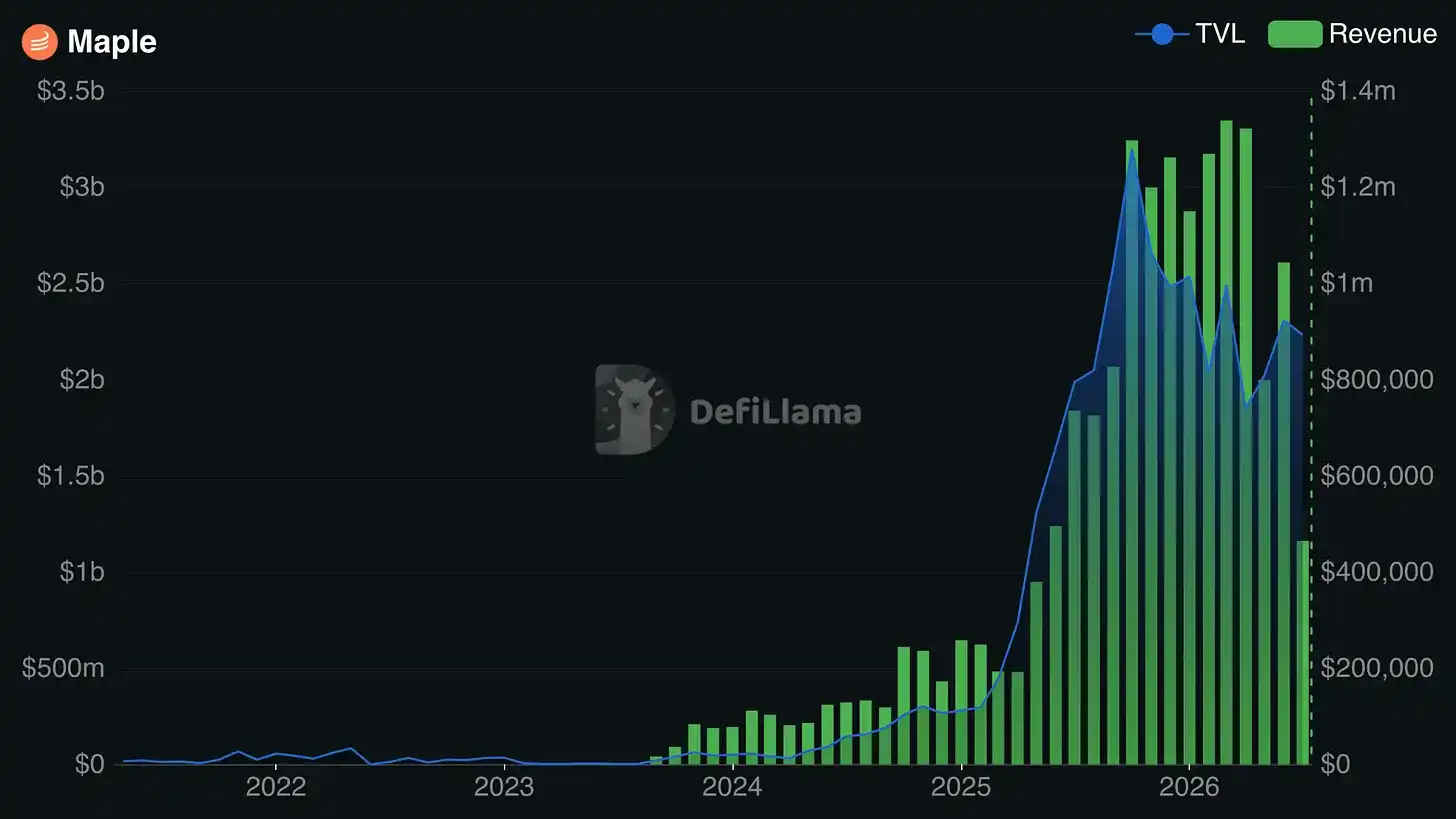
Maple has recently been a huge success story in crypto, offering professionally managed, permissioned, and secure lending services to sophisticated allocators. They just finished a record-breaking first half, with AUM at $4.6B (up 81% YoY) and Q2 revenue at $4.4M (up 47% YoY), while their business grew 22% even as DeFi lending contracted 31%.
Following that, Q3 has started strongly with the launch of syrupUSDG, Maple's first new Syrup asset in two years. syrupUSDG brings Maple's on-chain credit engine to Global Dollar (USDG) and Robinhood Chain, giving holders exposure to lending strategies originated by Maple.

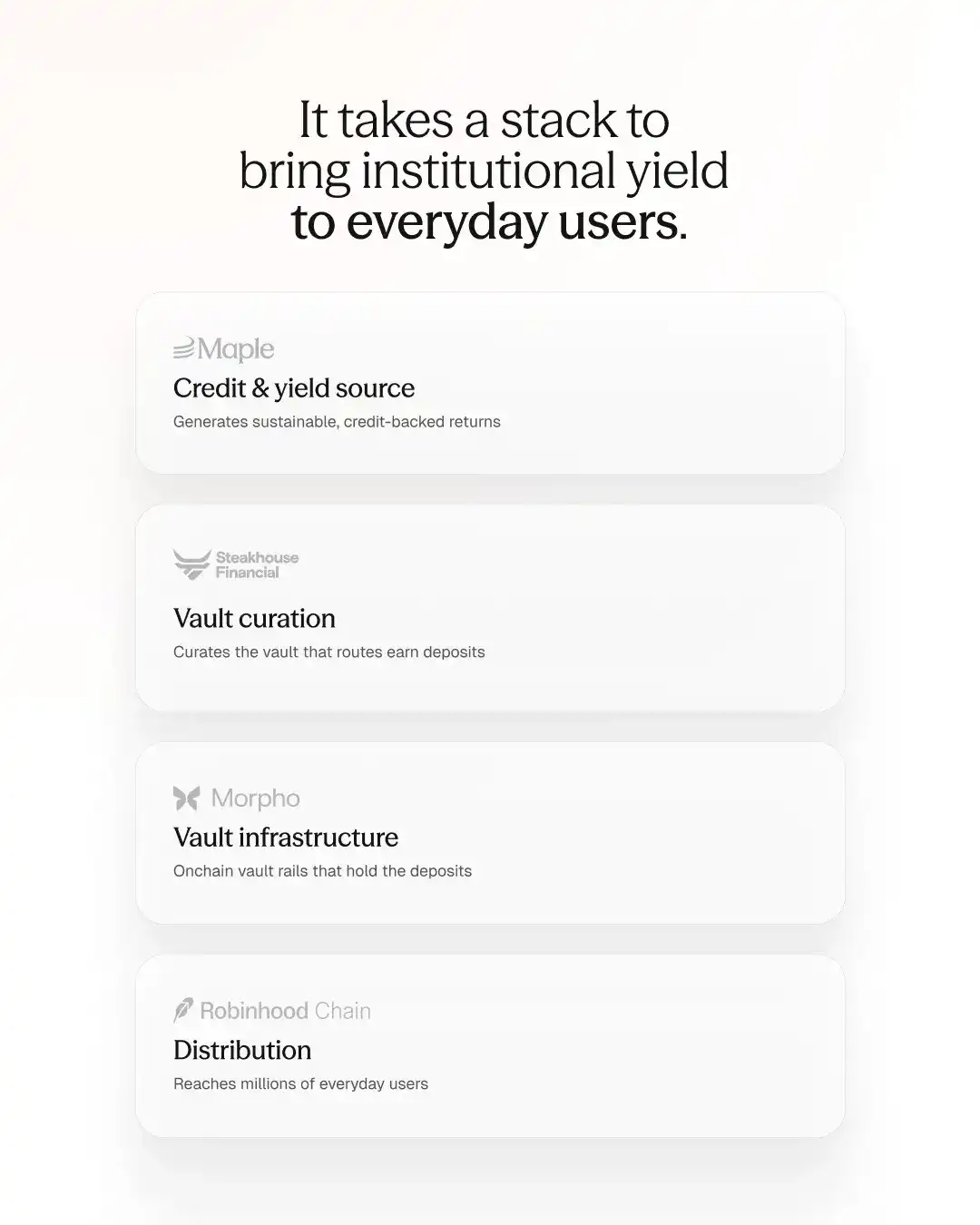
syrupUSDG can be placed in Robinhood Earn, offering up to 7% APY. This APY bundles Robinhood's distribution, Morpho's vault infrastructure, Steakhouse Financial's curation, and Maple's institutional credit as the yield source.
So how do SYRUP holders benefit from all this?

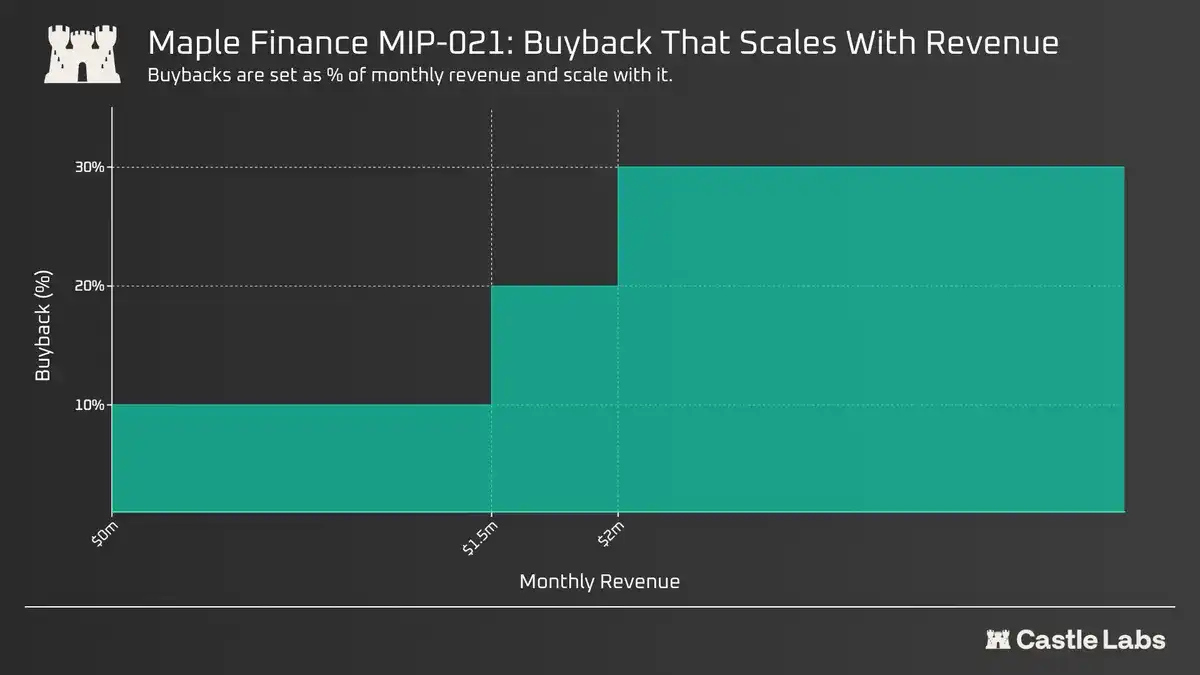
Recently, Maple implemented discretionary buybacks (MIP-019) but is now preparing to replace them with a rule-based framework (MIP-021). This will tie the buyback ratio directly to monthly gross revenue:

  • Below $1.5M: 10% allocated to SYRUP buybacks
  • $1.5M to $2M: 20% allocated to buybacks
  • Above $2M: 30% allocated to buybacks

Buybacks occur at the end of each month after monthly revenue is finalized. The purchased SYRUP is allocated to the SYRUP Strategic Fund (SSF), which Maple defines as working capital for strategic growth, token liquidity, capital reserves, and buybacks.

Most buybacks aim to distribute profits (dividends), cancel shares (burn supply), or reduce float (lock supply). Maple's route doesn't really do these things, making it look more like a treasury management strategy.

This has been raised in the forum, with community members asking for purchased SYRUP to be held in a public reserve address and treated as non-circulating, non-voting, and non-transferable unless a new governance proposal is made. However, these safeguards do not seem to be included in the current proposal.

Thus, the definition and use of these strategically recaptured SYRUP remain up in the air. This is likely to color public perception of this buyback framework, causing it to be seen more as a treasury management action rather than any real value accrual for SYRUP holders.

Follow the snapshot vote here.

Uniswap Brings Fees to V4

Yesterday, Uniswap's Hayden shared that the protocol is now collecting over $5 million in fees per day, second only to USDT and USDC.
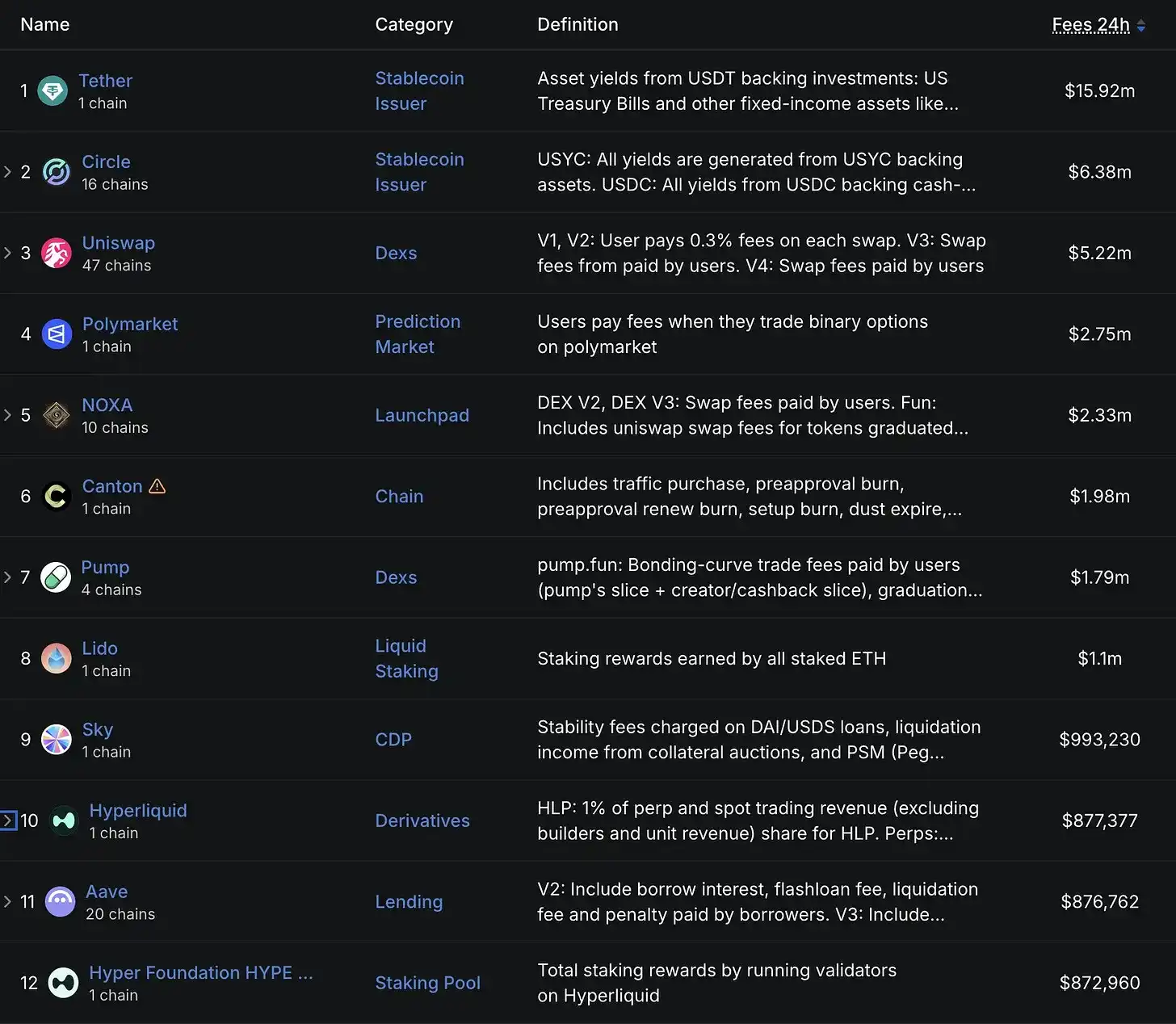
Much of this revenue growth came from the launch of Robinhood Chain. However, while very popular, these statistics are neither annualized nor likely to last long. In fact, we expect Robinhood to internalize these fees as soon as possible.

In recent years, there has been considerable debate about UNI's utility and its revenue and fee distribution.

Ultimately, Uniswap is also activating protocol fees on V4.
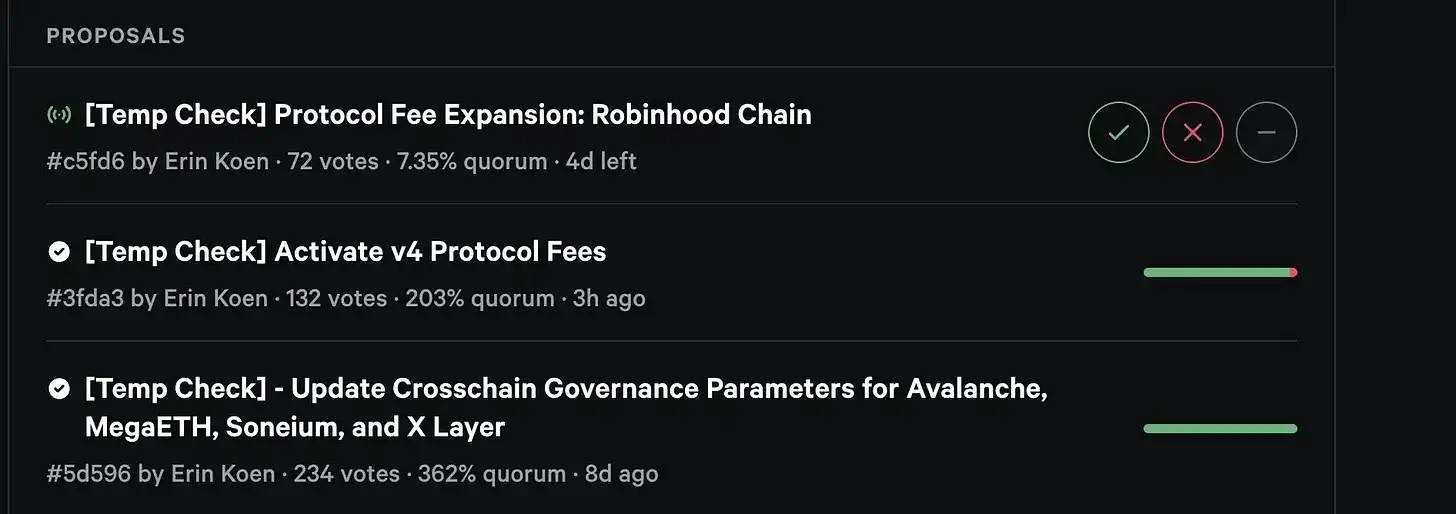
Previously, turning on the fee switch on V2/V3 led many LPs to migrate to V4, an incentive to encourage capital migration. How will this change affect LPs now? Will it increase Uniswap's overall capital efficiency, helping deprecate V2 and V3 in favor of V4?

Due to its architecture, V4 requires a more flexible and customizable approach to the fee switch. This is primarily due to the Hook architecture and dynamic fees, allowing for multiple fee tiers.

Therefore, governance rules in V4 will be defined by a "fee controller system," a practical approach ensuring governance can set rules for different "pool families" (V4FeePolicy) while still retaining enough flexibility to override or adjust these policies at any time (V4FeeAdapter).

The question remains: How will this change affect LPs?

Previous fee switches on V2 and V3 resulted in a 25% cut to LPs, prompting them to move to V4.

Now that V4 fees are active, can Uniswap retain LPs, or will they move to other fee-less trading venues?

Governance participants have already expressed these concerns.

A proposed solution is to conditionally enable the fee switch for V4. That is, enable it only when LPs are profitable.

One user suggested as follows: "If a pool's implied volatility is consistently higher than its realized volatility, then governance can take a cut without breaking LP trading.

Conversely, if RV > IV, then LPs are already undercompensated. Taking 25% of their fees won't make the protocol money. It will push LPs further into negative expected value."

We will closely monitor capital flows to V4 to answer this question.

V4 fees will be used for LP rewards/buyback distribution, with a split ratio closer to 5-25% / 75%-95%. Here's a comparison with Hyperliquid buybacks:
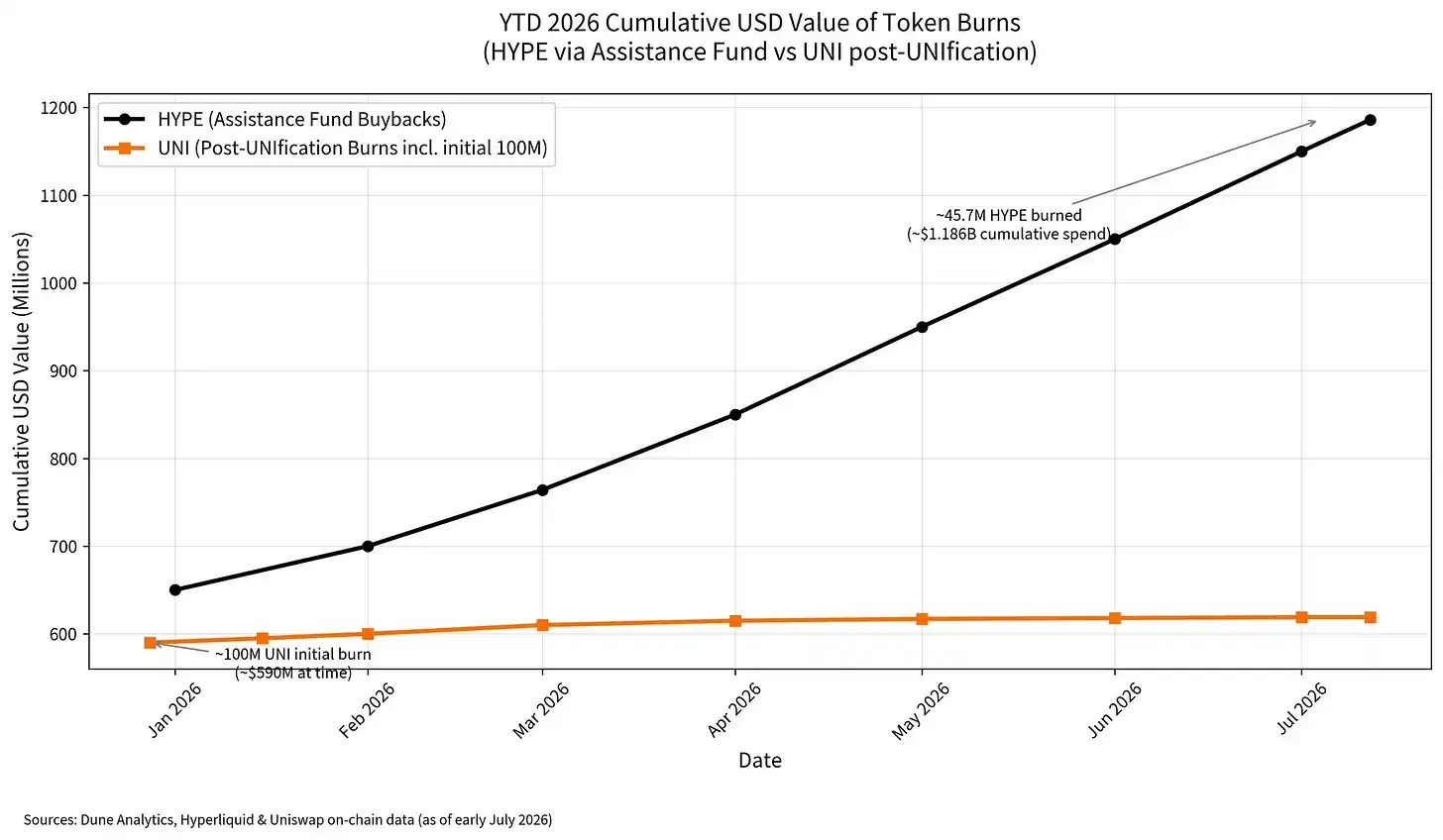
To date, Uniswap has burned over 6 million UNI tokens.
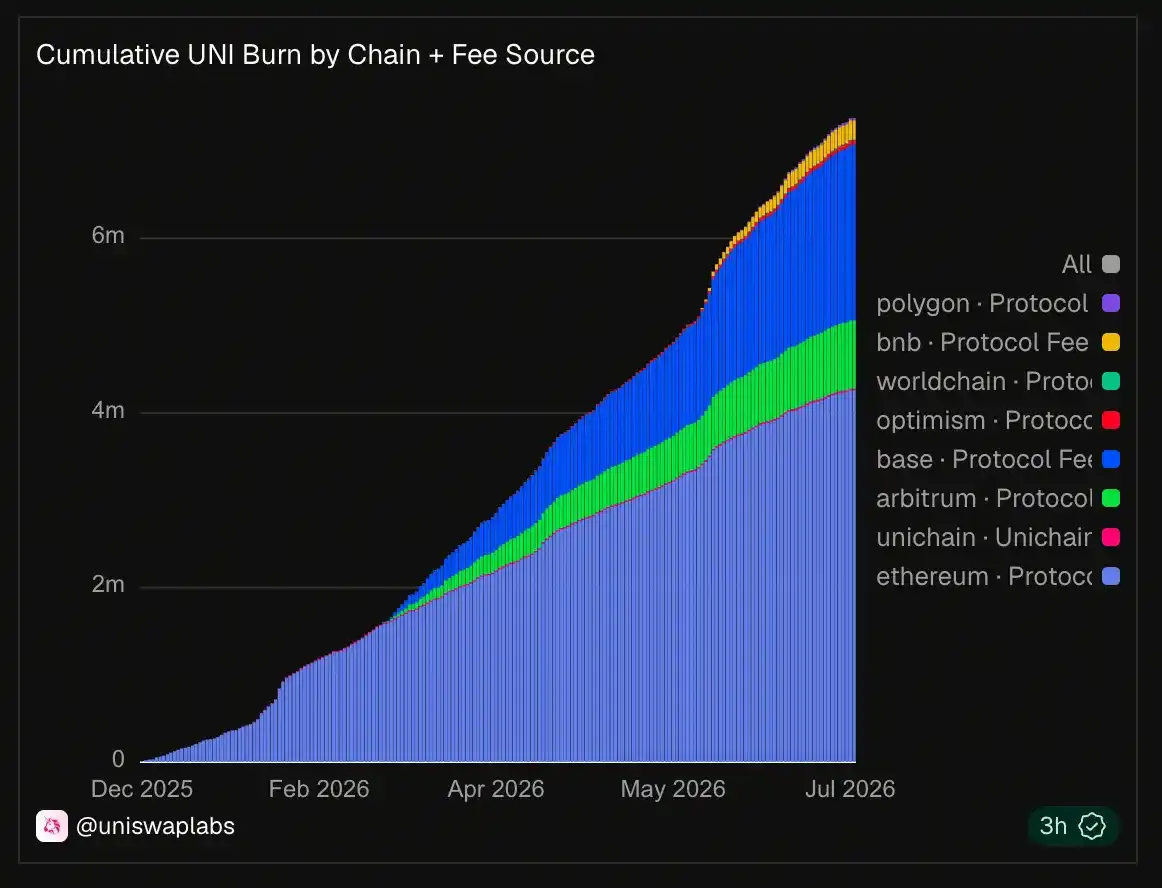
More statistics on UNI burns are available here.

Another noteworthy point is the impact of these buybacks, along with overall revenue and fees for token holders.

Projects allocate these in very different ways.

Stay tuned; we are writing a related report.

Sky Posts Record Revenue

June was a record month for Sky! In case you missed it:

  • Record revenue run rate of $419M
  • USDS yield distribution exceeding $250M
  • Sky Reserve continues to grow
  • Increased activity in the Sky Agent Network
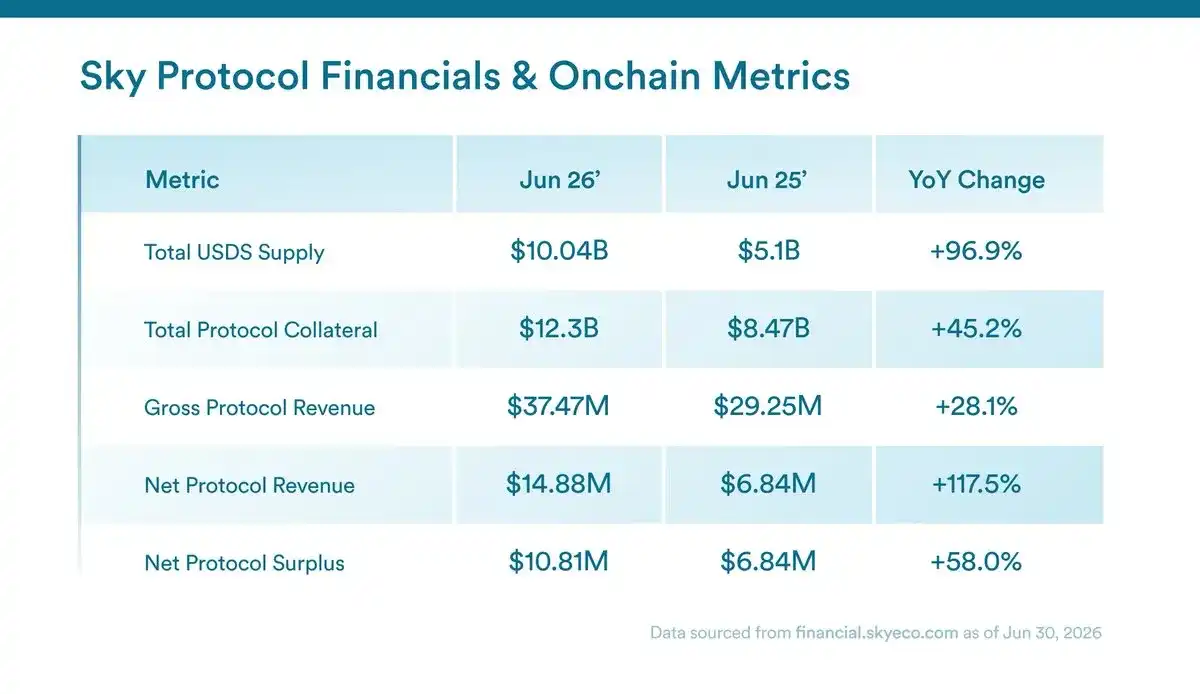
Without a doubt, Sky is generating revenue, building new products, and driving more activity through Spark, Grove, and the broader Prime Agent structure.

But what do these record numbers mean for SKY holders?
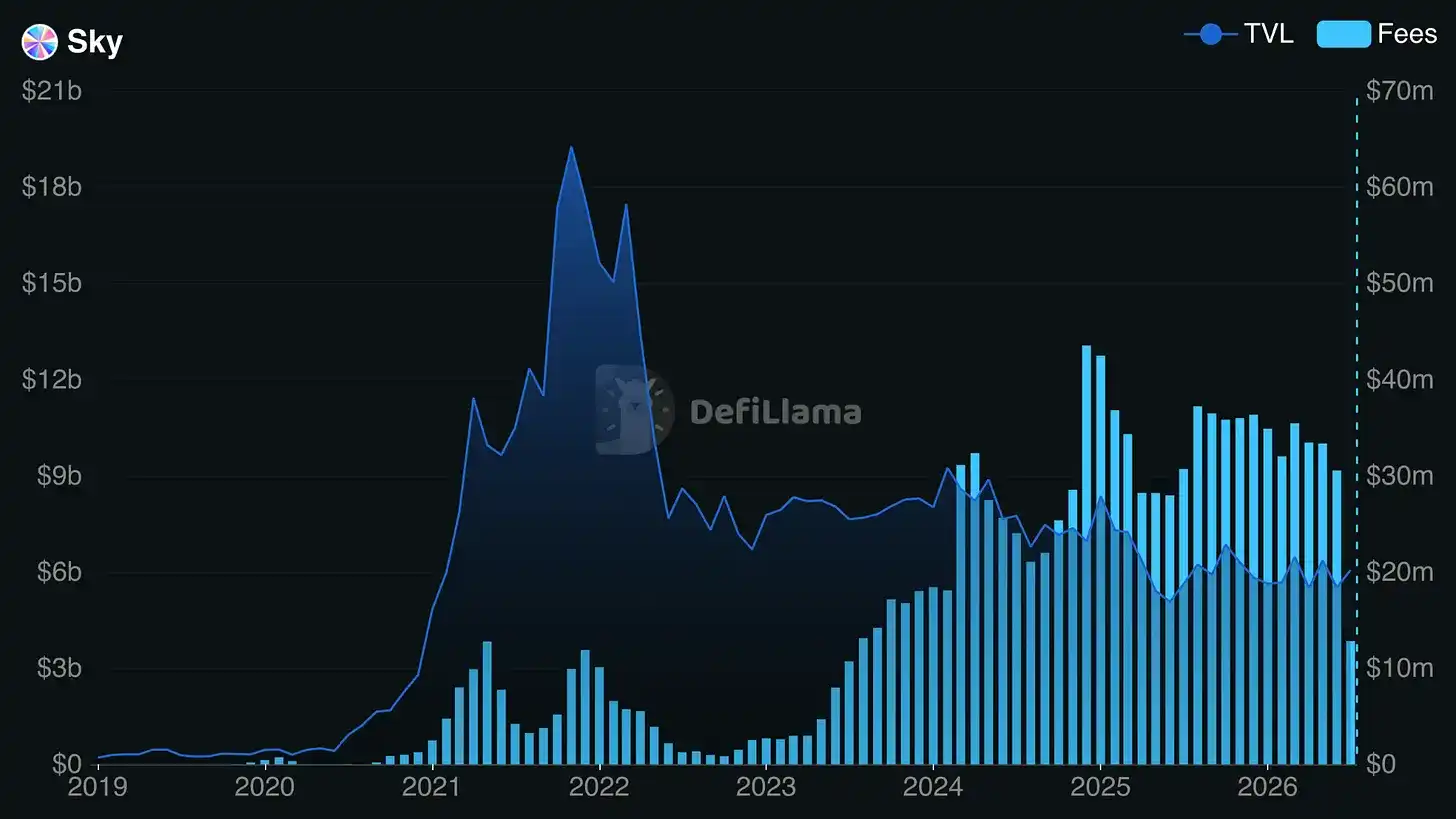
SKY does have an accrual mechanism. Protocol revenue from stability fees and Sky Agent performance is used to buy back SKY on the open market, and these tokens are distributed to participants in the Sky Staking Engine. However, Sky is not a simple single-token, single-balance-sheet story. Prime Agents have their own roles, tokens, holders, and economics. For context, Prime Agents are professional capital allocators within the Sky ecosystem. Sky can fund or support them, they can owe money to Sky, their performance can be factored into protocol profit. This profit should then support the SKY buyback and staking reward mechanism.

This makes the question for token holders harder to answer clearly. You can look at protocol revenue, cost of revenue, reserves, staking rewards, and token holder income. But once Prime Agents are around the core protocol, the balance sheet becomes harder to read. Some value might accrue to SKY. Some might stay with the agents. Some might flow through sUSDS or ecosystem rewards. Some might accrue to SPK, GROVE, or future agent tokens.

PaperImperium wrote a useful post this week about exactly this, arguing that Sky's financials are difficult to interpret because Prime Agents aren't treated consistently in the accounts. If it's too complex to determine what token holders are entitled to, the value proposition itself might be undermined.

OndoPerps Launches, Using Tokenized Stocks as Collateral

Ondo just launched OndoPerps, its perpetual contract product for trading stock perps with leverage up to 20x.
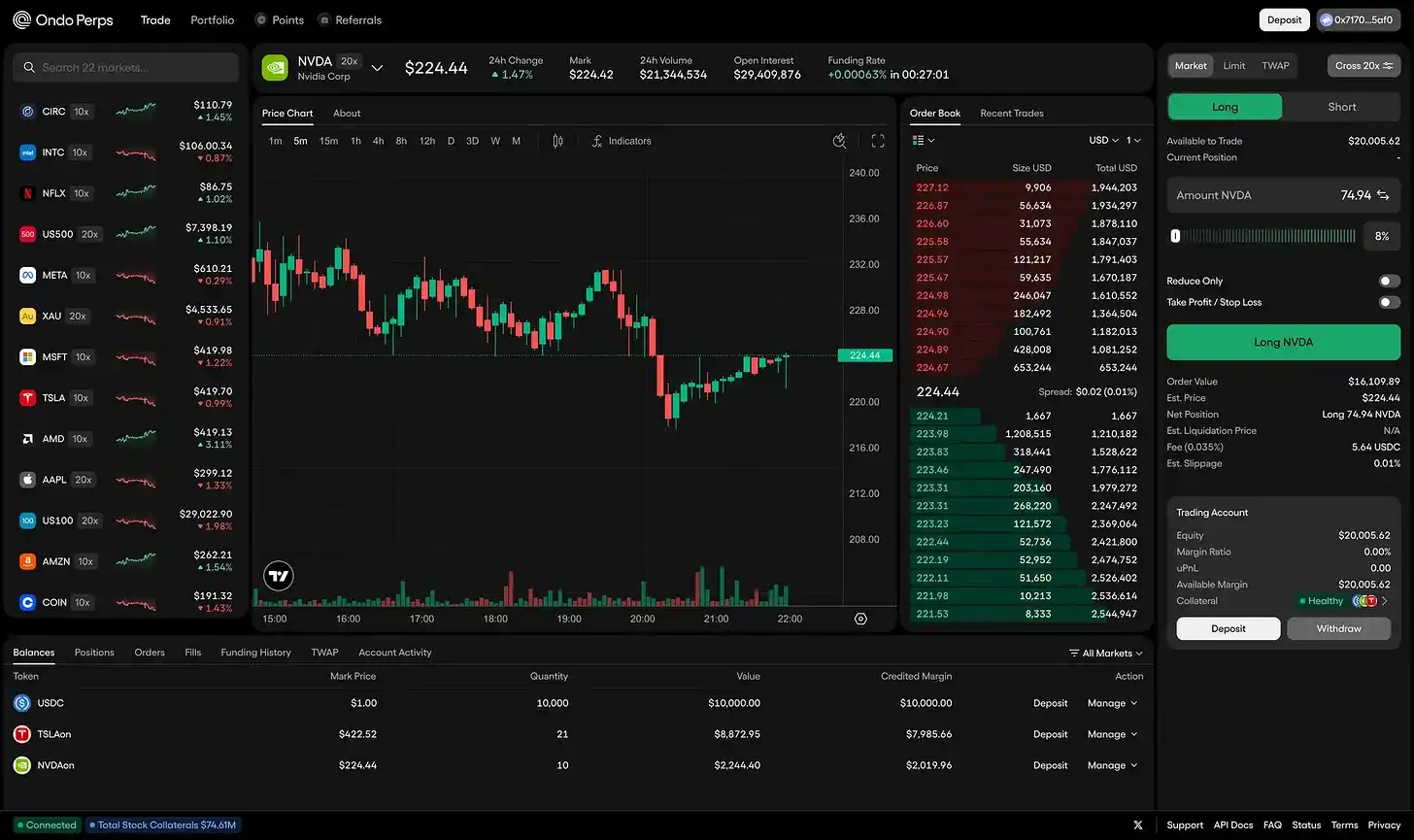
This complements Ondo's spot stock products and allows it to compete with venues like Trade.xyz, which have already captured the majority of perpetual open interest in RWAs.

Listed markets include commodities like oil, gold, silver; stocks like Apple, Tesla, Nvidia, Microsoft, Amazon, Alphabet, Meta, Netflix, Intel, AMD, Oracle, Micron, Palantir, SpaceX, Strategy, Coinbase, Circle, Robinhood; and indices like US100 and US500.
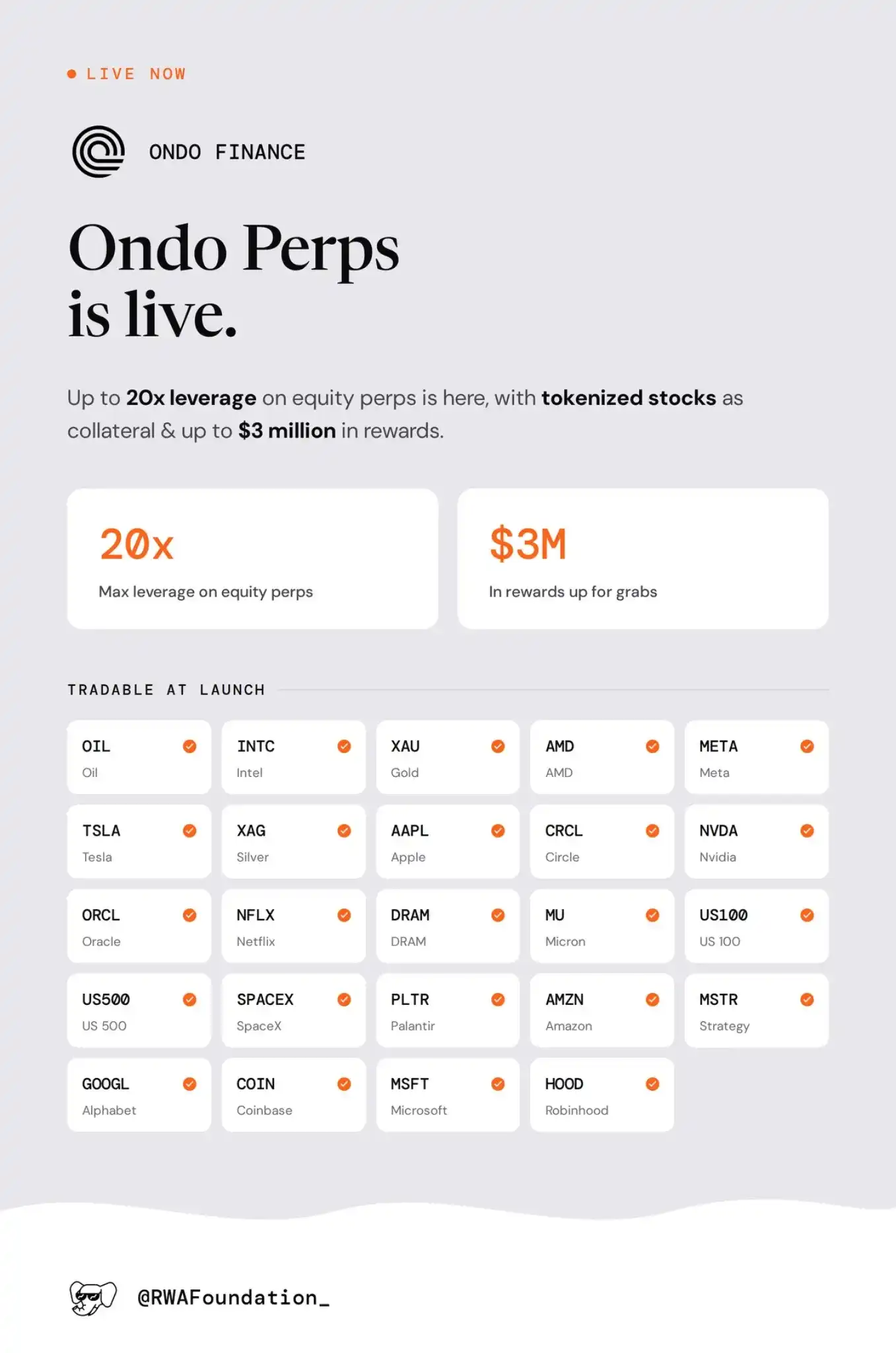
What's special about this launch is that it complements Ondo's existing offerings, allowing tokenized stocks to be used as collateral for 24/7 perpetual exposure to commodities, stocks, or indices. This is a key differentiator from Hyperliquid and other trading platforms: unified margin across all products, supporting a wider range of strategies including hedging, delta-neutral, etc.

Now Ondo spot stock holders will be able to use these as collateral and hedge or leverage their current exposure.

There's still a long way to go in perpetual markets, and we can expect RWA perpetual trading to be one of the fastest-growing segments in the near term. The trend is clear.
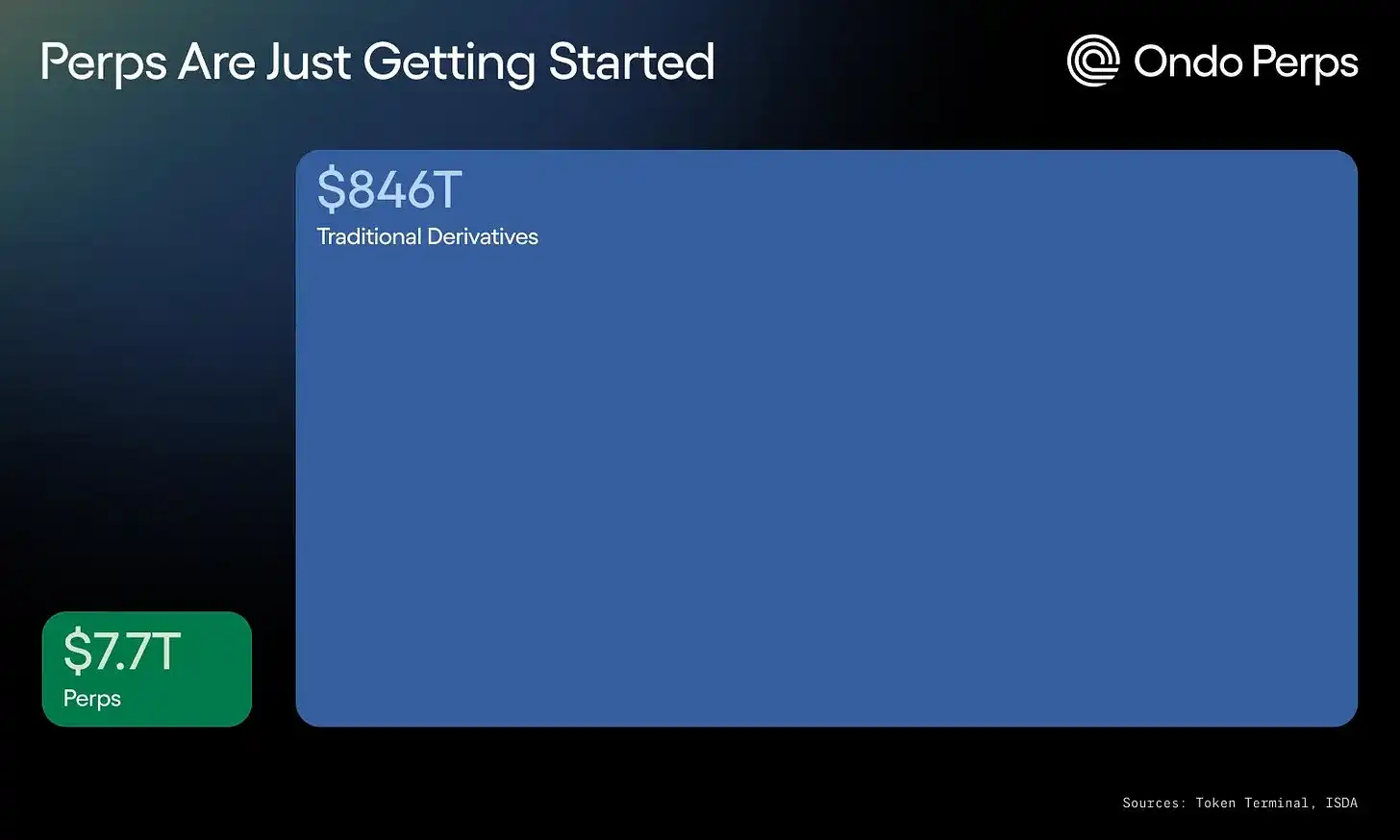
On the backend, liquidity is ensured by a combination of institutional market makers and user flow.

Tokenized Funds Are Moving From Issuance to Utility

Over the past two years, the RWA market has largely measured progress by what gets issued on-chain.

Another fund tokenized, another asset manager onboarded, another chain supported.

The next stage is about what these assets are used for.

That's why we sat down with Theo today to discuss their FILQ integration.

Theo invested $20M in Fidelity International's tokenized U.S. Dollar Digital Liquidity Fund (FILQ) via Sygnum, adding FILQ as the second institutional underlying asset in its existing product thBILL.

While direct holding is the familiar starting point, once a fund is on-chain, the more interesting question is where else it can sit: inside stablecoins, treasury products, collateral systems, lending markets, vaults, or settlement flows.

"Most investors don't want a money market fund; they want yield, and in a form they can actually use."

Evan, Theo's GTM and Chief of Staff, said: "Direct holding only gets you returns and nothing else. Wrapping it into a composable product allows the same dollar to make money and be liquid at the same time... Tokenizing the fund gets it to an institutional grade; the on-chain product makes it useful."

thBILL previously integrated Wellington's tokenized treasury fund. Adding FILQ now introduces Fidelity International as the second institutional manager. This gives thBILL a broader foundation and shows the structure can add new managers without rebuilding the entire product each time.

If tokenized funds remain standalone wrappers, the market will only compete on issuer brand, AUM, and supported chains. But if they become inputs into more customizable on-chain products, competition shifts to what additional value can be built around them.

Fidelity International's own messaging follows a similar line. Emma Pecenicic, Head of Digital Assets Distribution at Fidelity International, said the firm sees tokenization as a "fundamental shift in how global financial markets operate," combining investment expertise with digital-native infrastructure to "bring regulated, institution-grade on-chain liquidity to markets that operate 24/7."

So what is the shift we expect?

Theo's view is: "Direct holding is step one because it's familiar. It maps to how funds work today. But the value of putting assets on-chain is what you can do next: use them as collateral, import strategies, instant settlement."

The end goal for these assets is clearly utility.

Can they sit in a treasury product? Back a stablecoin? Serve as collateral? Flow through lending markets, vaults, or structured products without becoming a compliance headache?

The integration of FILQ into thBILL is a small but useful example of this shift. The fund isn't the end product; it's a balance sheet item for Theo, strengthening their product, readying them for growth and expansion into places Fidelity can't easily reach.

The next wave of tokenized fund adoption will be driven less by direct holders of these institutional assets and more by their embedded use in on-chain products.

What We're Watching

Circle and agent payments: Jeremy Allaire posted an article about the Circle Agent Stack, suggesting that if agents take on more corporate work and value flows natively across programmable networks, the agent economy and the on-chain economy begin to overlap. The thing to watch is whether this becomes real payment flows. Do agents actually hold balances, pay for services, rebalance wallets, settle bills, or trigger transactions in USDC? Will developers build around Circle's stack instead of generic wallets and APIs?

Castle x Kaiko Revenue Report: We will be releasing a report later this week with Kaiko on how operating a blockchain business is changing. Chains used to rely primarily on block space fees but are now forced to diversify into other vertical revenue streams—MEV, sequencer economics, app capture—and ensure they can capture value where it truly accrues.

Robinhood Chain's Staying Power: Robinhood Chain's first week made a considerable splash in the on-chain landscape. We flagged it as the 5th largest chain by 24h DEX volume shortly after launch, with over $370M in daily volume, $1.35B cumulative volume, driven largely by CASHCAT. It later rose to 2nd in 24h DEX volume, behind only Solana. While Robinhood has everything it needs to be a serious consumer distribution channel for on-chain finance, they are leaning into the meme world, hence seeing great early on-chain metrics. We'll watch to see how these two worlds find a better balance over the coming months.

SEC Public Market Access Roundtable on IPOs: Clearly, cryptocurrency is having an impact on traditional financial markets, with multiple large trading platforms opening doors, more assets being tokenized, and even IPOs coming on-chain. Now, the SEC is hosting a virtual roundtable on modernizing IPOs and expanding public market access.

Criptos en tendencia

Preguntas relacionadas

QAccording to the article, what is the main problem with Maple's new rule-based share buyback framework (MIP-021)?

AThe main problem is that the purchased SYRUP tokens are allocated to the SYRUP Strategic Fund (SSF) for ambiguous "strategic purposes" like growth, liquidity, and treasury management, instead of being clearly distributed to token holders (e.g., as dividends), burned, or permanently locked. This lack of transparency and clear value accumulation for holders makes it appear more like a treasury management tactic.

QWhat concern does the article raise about Uniswap V4 activating protocol fees?

AThe article raises the concern that activating fees on V4 might drive liquidity providers (LPs) away to other fee-free trading venues, similar to what happened when fees were activated on V2/V3. A proposed solution is to conditionally enable the fee switch only when LPs are profitable to avoid pushing them into negative returns.

QWhy is it difficult for SKY token holders to understand their rights and value accumulation from Sky's record revenues?

AIt's difficult because Sky has a complex multi-token ecosystem involving Prime Agents with their own tokens, economics, and balance sheets. Protocol profits that should support SKY buybacks flow through this network, and value can be captured by various ecosystem actors (like agents, sUSDS, SPK, GROVE), making the overall financial statements and value flow to SKY holders opaque and hard to interpret.

QWhat key differentiation does OndoPerps offer compared to other perpetual trading platforms, as mentioned in the article?

AA key differentiation of OndoPerps is unified margin, allowing tokenized stocks (from Ondo's existing spot product) to be used as collateral for trading perpetual contracts on commodities, stocks, or indices. This enables more complex strategies like hedging or leveraging existing stock exposure.

QWhat shift in the RWA (Real-World Assets) market does the article's discussion about Theo and FILQ illustrate?

AIt illustrates a shift from focusing primarily on the issuance of tokenized funds (e.g., which fund is on-chain) to focusing on the utility and composability of these assets. The integration of Fidelity's FILQ into Theo's thBILL product shows that tokenized funds are becoming inputs for building more useful, yield-generating, and liquid on-chain products (like stablecoins, collateral, vaults) rather than just being standalone holdings.

Lecturas Relacionadas

From Being Ignored to the Venture Capital Queen Investing: Has AI Revived This Ultra-Niche Sector?

From obscurity to receiving investment from the "queen of venture capital," AI has revitalized the ultra-niche social networking track. In recent years, the social networking sector experienced a deep freeze in venture capital, with high-profile projects like the video social app "Huayin" (founded by a former WeChat core team member) and the offline-online dating app "Single's Tavern" ultimately failing. These failures underscored the immense difficulty of challenging WeChat's dominance in熟人社交 (close-contact social networking) and the general lack of scalable monetization paths for niche concepts like metaverse, female-only, or Muslim community apps. However, a shift emerged in 2025. "Liangpei," an AI-powered matchmaking company, secured a $2 million angel round from Today Capital, led by renowned investor Xu Xin. Its approach uses AI conversational profiling to create detailed user matches and charges only upon successful connections. Similarly, projects like "Pixel Rhythm" (reportedly focused on AI-assisted content creation for Gen Z overseas) and "Moobius" (AI-native group chat) signal a new trend. The investment logic has fundamentally changed. Instead of pursuing broad, traffic-driven "platform dreams" to compete with giants like WeChat, Douyin, or Soul, the new wave focuses on using AI as a tool to solve specific, high-pain-point problems for targeted, niche user segments. The path to viability now lies in achieving healthy cash flow by solving a concrete problem rather than chasing massive scale.

marsbitHace 42 min(s)

From Being Ignored to the Venture Capital Queen Investing: Has AI Revived This Ultra-Niche Sector?

marsbitHace 42 min(s)

From TrueFi to Elara: Why the Next Stop for On-Chain Finance is Liquidity Infrastructure?

From TrueFi to Elara: Why On-Chain Finance's Next Stage is Liquidity Infrastructure? The article analyzes the evolving focus in decentralized finance, shifting from narrative-driven expansion to robust, operationally sound infrastructure. The author, drawing from experience at TrueFi and building Elara, argues that early DeFi incorrectly assumed technological superiority alone would force adoption. Instead, financial systems evolve through workflow compatibility. Traditional finance prioritizes stability and predictability, creating intentional "viscosity" (friction) through controls, which slows execution but ensures durability. Crypto-native systems minimized friction for rapid experimentation and iteration but often lacked operational safeguards, leading to reflexive liquidity that can disintegrate under stress. The core insight is that sustainable on-chain finance cannot rely solely on isolated products like RWA lending or token incentives. The real opportunity lies in a coordinated financial architecture for liquidity management, collateral coordination, and capital deployment. Elara is presented as an example of this next-generation "programmable treasury infrastructure"—a yield-bearing, dollar-pegged collateral asset designed for capital efficiency and operational flexibility within fragmented digital markets. A key architectural decision separates liquidity from yield generation, allowing the collateral to remain liquid and programmable while accruing value. The funding environment has also shifted. Investors now prioritize operational proof—working systems, integrations, and controls—over visionary narratives. Competitive advantage comes from building systems that endure under real market conditions, not just launching quickly. Ultimately, the path forward is not a sudden replacement of traditional finance but a selective hybridization. Lasting infrastructure will combine the iterative speed of digital assets with the control architecture of traditional finance. Systems like Elara are built to operate efficiently in today's low-viscosity crypto markets while embedding the operational discipline—compliance, reporting, risk management—required to eventually support institutional capital as it gradually integrates with on-chain settlement rails. The focus is not on who launches first, but on who can build infrastructure capable of managing both high-speed digital-native liquidity and the slower, more deliberate flow of institutional capital.

marsbitHace 52 min(s)

From TrueFi to Elara: Why the Next Stop for On-Chain Finance is Liquidity Infrastructure?

marsbitHace 52 min(s)

Trading

Spot

Artículos destacados

Qué es $S$

Entendiendo SPERO: Una Visión General Completa Introducción a SPERO A medida que el panorama de la innovación continúa evolucionando, la aparición de tecnologías web3 y proyectos de criptomonedas juega un papel fundamental en la configuración del futuro digital. Un proyecto que ha atraído la atención en este campo dinámico es SPERO, denotado como SPERO,$$s$. Este artículo tiene como objetivo reunir y presentar información detallada sobre SPERO, para ayudar a entusiastas e inversores a comprender sus fundamentos, objetivos e innovaciones dentro de los dominios web3 y cripto. ¿Qué es SPERO,$$s$? SPERO,$$s$ es un proyecto único dentro del espacio cripto que busca aprovechar los principios de descentralización y tecnología blockchain para crear un ecosistema que promueva la participación, la utilidad y la inclusión financiera. El proyecto está diseñado para facilitar interacciones de igual a igual de nuevas maneras, proporcionando a los usuarios soluciones y servicios financieros innovadores. En su esencia, SPERO,$$s$ tiene como objetivo empoderar a los individuos al proporcionar herramientas y plataformas que mejoren la experiencia del usuario en el espacio de las criptomonedas. Esto incluye habilitar métodos de transacción más flexibles, fomentar iniciativas impulsadas por la comunidad y crear caminos para oportunidades financieras a través de aplicaciones descentralizadas (dApps). La visión subyacente de SPERO,$$s$ gira en torno a la inclusividad, buscando cerrar brechas dentro de las finanzas tradicionales mientras aprovecha los beneficios de la tecnología blockchain. ¿Quién es el Creador de SPERO,$$s$? La identidad del creador de SPERO,$$s$ sigue siendo algo oscura, ya que hay recursos públicos limitados que proporcionan información de fondo detallada sobre su(s) fundador(es). Esta falta de transparencia puede derivarse del compromiso del proyecto con la descentralización, una ética que muchos proyectos web3 comparten, priorizando las contribuciones colectivas sobre el reconocimiento individual. Al centrar las discusiones en torno a la comunidad y sus objetivos colectivos, SPERO,$$s$ encarna la esencia del empoderamiento sin señalar a individuos específicos. Como tal, comprender la ética y la misión de SPERO sigue siendo más importante que identificar a un creador singular. ¿Quiénes son los Inversores de SPERO,$$s$? SPERO,$$s$ cuenta con el apoyo de una diversa gama de inversores que van desde capitalistas de riesgo hasta inversores ángeles dedicados a fomentar la innovación en el sector cripto. El enfoque de estos inversores generalmente se alinea con la misión de SPERO, priorizando proyectos que prometen avances tecnológicos sociales, inclusión financiera y gobernanza descentralizada. Estas fundaciones de inversores suelen estar interesadas en proyectos que no solo ofrecen productos innovadores, sino que también contribuyen positivamente a la comunidad blockchain y sus ecosistemas. El respaldo de estos inversores refuerza a SPERO,$$s$ como un contendiente notable en el dominio de proyectos cripto que evoluciona rápidamente. ¿Cómo Funciona SPERO,$$s$? SPERO,$$s$ emplea un marco multifacético que lo distingue de los proyectos de criptomonedas convencionales. Aquí hay algunas de las características clave que subrayan su singularidad e innovación: Gobernanza Descentralizada: SPERO,$$s$ integra modelos de gobernanza descentralizada, empoderando a los usuarios para participar activamente en los procesos de toma de decisiones sobre el futuro del proyecto. Este enfoque fomenta un sentido de propiedad y responsabilidad entre los miembros de la comunidad. Utilidad del Token: SPERO,$$s$ utiliza su propio token de criptomoneda, diseñado para servir diversas funciones dentro del ecosistema. Estos tokens permiten transacciones, recompensas y la facilitación de servicios ofrecidos en la plataforma, mejorando la participación y la utilidad general. Arquitectura en Capas: La arquitectura técnica de SPERO,$$s$ apoya la modularidad y escalabilidad, permitiendo la integración fluida de características y aplicaciones adicionales a medida que el proyecto evoluciona. Esta adaptabilidad es fundamental para mantener la relevancia en el cambiante paisaje cripto. Participación de la Comunidad: El proyecto enfatiza iniciativas impulsadas por la comunidad, empleando mecanismos que incentivan la colaboración y la retroalimentación. Al nutrir una comunidad sólida, SPERO,$$s$ puede abordar mejor las necesidades de los usuarios y adaptarse a las tendencias del mercado. Enfoque en la Inclusión: Al ofrecer tarifas de transacción bajas e interfaces amigables para el usuario, SPERO,$$s$ busca atraer a una base de usuarios diversa, incluyendo a individuos que anteriormente pueden no haber participado en el espacio cripto. Este compromiso con la inclusión se alinea con su misión general de empoderamiento a través de la accesibilidad. Cronología de SPERO,$$s$ Entender la historia de un proyecto proporciona información crucial sobre su trayectoria de desarrollo y hitos. A continuación se presenta una cronología sugerida que mapea eventos significativos en la evolución de SPERO,$$s$: Fase de Conceptualización e Ideación: Las ideas iniciales que forman la base de SPERO,$$s$ fueron concebidas, alineándose estrechamente con los principios de descentralización y enfoque comunitario dentro de la industria blockchain. Lanzamiento del Whitepaper del Proyecto: Tras la fase conceptual, se lanzó un whitepaper completo que detalla la visión, los objetivos y la infraestructura tecnológica de SPERO,$$s$ para generar interés y retroalimentación de la comunidad. Construcción de Comunidad y Primeras Interacciones: Se realizaron esfuerzos de divulgación activa para construir una comunidad de primeros adoptantes y posibles inversores, facilitando discusiones en torno a los objetivos del proyecto y obteniendo apoyo. Evento de Generación de Tokens: SPERO,$$s$ llevó a cabo un evento de generación de tokens (TGE) para distribuir sus tokens nativos a los primeros seguidores y establecer liquidez inicial dentro del ecosistema. Lanzamiento de la dApp Inicial: La primera aplicación descentralizada (dApp) asociada con SPERO,$$s$ se puso en marcha, permitiendo a los usuarios interactuar con las funcionalidades centrales de la plataforma. Desarrollo Continuo y Alianzas: Actualizaciones y mejoras continuas a las ofertas del proyecto, incluyendo alianzas estratégicas con otros actores en el espacio blockchain, han moldeado a SPERO,$$s$ en un jugador competitivo y en evolución en el mercado cripto. Conclusión SPERO,$$s$ se erige como un testimonio del potencial de web3 y las criptomonedas para revolucionar los sistemas financieros y empoderar a los individuos. Con un compromiso con la gobernanza descentralizada, la participación comunitaria y funcionalidades diseñadas de manera innovadora, allana el camino hacia un paisaje financiero más inclusivo. Como con cualquier inversión en el espacio cripto que evoluciona rápidamente, se anima a los posibles inversores y usuarios a investigar a fondo y participar de manera reflexiva con los desarrollos en curso dentro de SPERO,$$s$. El proyecto muestra el espíritu innovador de la industria cripto, invitando a una mayor exploración de sus innumerables posibilidades. Mientras el viaje de SPERO,$$s$ aún se desarrolla, sus principios fundamentales pueden, de hecho, influir en el futuro de cómo interactuamos con la tecnología, las finanzas y entre nosotros en ecosistemas digitales interconectados.

122 Vistas totalesPublicado en 2024.12.17Actualizado en 2024.12.17

Qué es $S$

Qué es AGENT S

Agent S: El Futuro de la Interacción Autónoma en Web3 Introducción En el paisaje en constante evolución de Web3 y las criptomonedas, las innovaciones están redefiniendo constantemente cómo los individuos interactúan con las plataformas digitales. Uno de estos proyectos pioneros, Agent S, promete revolucionar la interacción humano-computadora a través de su marco agente abierto. Al allanar el camino para interacciones autónomas, Agent S busca simplificar tareas complejas, ofreciendo aplicaciones transformadoras en inteligencia artificial (IA). Esta exploración detallada profundizará en las complejidades del proyecto, sus características únicas y las implicaciones para el dominio de las criptomonedas. ¿Qué es Agent S? Agent S se presenta como un marco agente abierto innovador, diseñado específicamente para abordar tres desafíos fundamentales en la automatización de tareas informáticas: Adquisición de Conocimiento Específico del Dominio: El marco aprende inteligentemente de diversas fuentes de conocimiento externas y experiencias internas. Este enfoque dual le permite construir un rico repositorio de conocimiento específico del dominio, mejorando su rendimiento en la ejecución de tareas. Planificación a Largo Plazo de Tareas: Agent S emplea planificación jerárquica aumentada por la experiencia, un enfoque estratégico que facilita la descomposición y ejecución eficiente de tareas complejas. Esta característica mejora significativamente su capacidad para gestionar múltiples subtareas de manera eficiente y efectiva. Manejo de Interfaces Dinámicas y No Uniformes: El proyecto introduce la Interfaz Agente-Computadora (ACI), una solución innovadora que mejora la interacción entre agentes y usuarios. Utilizando Modelos de Lenguaje Multimodal de Gran Escala (MLLMs), Agent S puede navegar y manipular diversas interfaces gráficas de usuario sin problemas. A través de estas características pioneras, Agent S proporciona un marco robusto que aborda las complejidades involucradas en la automatización de la interacción humana con las máquinas, preparando el terreno para una multitud de aplicaciones en IA y más allá. ¿Quién es el Creador de Agent S? Si bien el concepto de Agent S es fundamentalmente innovador, la información específica sobre su creador sigue siendo elusiva. El creador es actualmente desconocido, lo que resalta ya sea la etapa incipiente del proyecto o la elección estratégica de mantener a los miembros fundadores en el anonimato. Independientemente de la anonimidad, el enfoque sigue siendo en las capacidades y el potencial del marco. ¿Quiénes son los Inversores de Agent S? Dado que Agent S es relativamente nuevo en el ecosistema criptográfico, la información detallada sobre sus inversores y patrocinadores financieros no está documentada explícitamente. La falta de información disponible públicamente sobre las bases de inversión u organizaciones que apoyan el proyecto plantea preguntas sobre su estructura de financiamiento y hoja de ruta de desarrollo. Comprender el respaldo es crucial para evaluar la sostenibilidad del proyecto y su posible impacto en el mercado. ¿Cómo Funciona Agent S? En el núcleo de Agent S se encuentra una tecnología de vanguardia que le permite funcionar de manera efectiva en diversos entornos. Su modelo operativo se basa en varias características clave: Interacción Humano-Computadora Similar a la Humana: El marco ofrece planificación avanzada de IA, esforzándose por hacer que las interacciones con las computadoras sean más intuitivas. Al imitar el comportamiento humano en la ejecución de tareas, promete elevar las experiencias de los usuarios. Memoria Narrativa: Empleada para aprovechar experiencias de alto nivel, Agent S utiliza memoria narrativa para hacer un seguimiento de las historias de tareas, mejorando así sus procesos de toma de decisiones. Memoria Episódica: Esta característica proporciona a los usuarios una guía paso a paso, permitiendo que el marco ofrezca apoyo contextual a medida que se desarrollan las tareas. Soporte para OpenACI: Con la capacidad de ejecutarse localmente, Agent S permite a los usuarios mantener el control sobre sus interacciones y flujos de trabajo, alineándose con la ética descentralizada de Web3. Fácil Integración con APIs Externas: Su versatilidad y compatibilidad con varias plataformas de IA aseguran que Agent S pueda encajar sin problemas en ecosistemas tecnológicos existentes, convirtiéndolo en una opción atractiva para desarrolladores y organizaciones. Estas funcionalidades contribuyen colectivamente a la posición única de Agent S dentro del espacio cripto, ya que automatiza tareas complejas y de múltiples pasos con una intervención humana mínima. A medida que el proyecto evoluciona, sus posibles aplicaciones en Web3 podrían redefinir cómo se desarrollan las interacciones digitales. Cronología de Agent S El desarrollo y los hitos de Agent S pueden encapsularse en una cronología que resalta sus eventos significativos: 27 de septiembre de 2024: El concepto de Agent S fue lanzado en un documento de investigación integral titulado “Un Marco Agente Abierto que Usa Computadoras Como un Humano”, mostrando las bases del proyecto. 10 de octubre de 2024: El documento de investigación fue puesto a disposición del público en arXiv, ofreciendo una exploración profunda del marco y su evaluación de rendimiento basada en el benchmark OSWorld. 12 de octubre de 2024: Se lanzó una presentación en video, proporcionando una visión visual de las capacidades y características de Agent S, involucrando aún más a posibles usuarios e inversores. Estos marcadores en la cronología no solo ilustran el progreso de Agent S, sino que también indican su compromiso con la transparencia y la participación comunitaria. Puntos Clave Sobre Agent S A medida que el marco Agent S continúa evolucionando, varios atributos clave destacan, subrayando su naturaleza innovadora y potencial: Marco Innovador: Diseñado para proporcionar un uso intuitivo de las computadoras similar a la interacción humana, Agent S aporta un enfoque novedoso a la automatización de tareas. Interacción Autónoma: La capacidad de interactuar de manera autónoma con las computadoras a través de GUI significa un salto hacia soluciones informáticas más inteligentes y eficientes. Automatización de Tareas Complejas: Con su metodología robusta, puede automatizar tareas complejas y de múltiples pasos, haciendo que los procesos sean más rápidos y menos propensos a errores. Mejora Continua: Los mecanismos de aprendizaje permiten a Agent S mejorar a partir de experiencias pasadas, mejorando continuamente su rendimiento y eficacia. Versatilidad: Su adaptabilidad en diferentes entornos operativos como OSWorld y WindowsAgentArena asegura que pueda servir a una amplia gama de aplicaciones. A medida que Agent S se posiciona en el paisaje de Web3 y criptomonedas, su potencial para mejorar las capacidades de interacción y automatizar procesos significa un avance significativo en las tecnologías de IA. A través de su marco innovador, Agent S ejemplifica el futuro de las interacciones digitales, prometiendo una experiencia más fluida y eficiente para los usuarios en diversas industrias. Conclusión Agent S representa un audaz avance en la unión de la IA y Web3, con la capacidad de redefinir cómo interactuamos con la tecnología. Aunque aún se encuentra en sus primeras etapas, las posibilidades para su aplicación son vastas y atractivas. A través de su marco integral que aborda desafíos críticos, Agent S busca llevar las interacciones autónomas al primer plano de la experiencia digital. A medida que nos adentramos más en los reinos de las criptomonedas y la descentralización, proyectos como Agent S sin duda desempeñarán un papel crucial en la configuración del futuro de la tecnología y la colaboración humano-computadora.

533 Vistas totalesPublicado en 2025.01.14Actualizado en 2025.01.14

Qué es AGENT S

Cómo comprar S

¡Bienvenido a HTX.com! Hemos hecho que comprar Sonic (S) sea simple y conveniente. Sigue nuestra guía paso a paso para iniciar tu viaje de criptos.Paso 1: crea tu cuenta HTXUtiliza tu correo electrónico o número de teléfono para registrarte y obtener una cuenta gratuita en HTX. Experimenta un proceso de registro sin complicaciones y desbloquea todas las funciones.Obtener mi cuentaPaso 2: ve a Comprar cripto y elige tu método de pagoTarjeta de crédito/débito: usa tu Visa o Mastercard para comprar Sonic (S) al instante.Saldo: utiliza fondos del saldo de tu cuenta HTX para tradear sin problemas.Terceros: hemos agregado métodos de pago populares como Google Pay y Apple Pay para mejorar la comodidad.P2P: tradear directamente con otros usuarios en HTX.Over-the-Counter (OTC): ofrecemos servicios personalizados y tipos de cambio competitivos para los traders.Paso 3: guarda tu Sonic (S)Después de comprar tu Sonic (S), guárdalo en tu cuenta HTX. Alternativamente, puedes enviarlo a otro lugar mediante transferencia blockchain o utilizarlo para tradear otras criptomonedas.Paso 4: tradear Sonic (S)Tradear fácilmente con Sonic (S) en HTX's mercado spot. Simplemente accede a tu cuenta, selecciona tu par de trading, ejecuta tus trades y monitorea en tiempo real. Ofrecemos una experiencia fácil de usar tanto para principiantes como para traders experimentados.

1.1k Vistas totalesPublicado en 2025.01.15Actualizado en 2026.06.02

Cómo comprar S

Discusiones

Bienvenido a la comunidad de HTX. Aquí puedes mantenerte informado sobre los últimos desarrollos de la plataforma y acceder a análisis profesionales del mercado. A continuación se presentan las opiniones de los usuarios sobre el precio de S (S).

活动图片