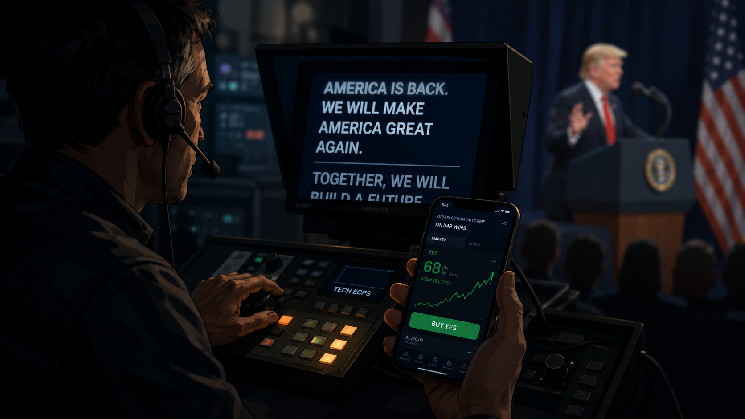
Tether CEO: ‘Demand for dollar settlement is a wages story’ – $7M Pact Labs investment proves it

ambcryptoPublicado a 2026-07-15Actualizado a 2026-07-15

Resumen

Tether is expanding the utility of stablecoins beyond crypto trading, targeting everyday financial infrastructure like payroll and real-time payments. Its $7 million investment in Pact Labs underscores a strategy to address the $11 trillion U.S. payroll system, where legacy settlement delays wage access. CEO Paolo Ardoino states that demand for dollar settlement is fundamentally a "wages story." This shift focuses on generating consistent, recurring payment flows rather than competing for trading volume. For this expansion to succeed, enterprise adoption in payroll and daily transactions is crucial. Tether is bolstering this push with compliance infrastructure, highlighted by Chainalysis's support for the USDT-native Stable network, providing real-time transaction screening and monitoring. The combination of faster settlement and robust compliance aims to overcome regulatory hurdles, encouraging businesses to move beyond pilot programs. Ultimately, the goal is to embed stablecoins like USA₮ into mainstream finance, transforming them from speculative assets into trusted infrastructure for recurring financial services.

Tether is shifting stablecoin adoption from crypto markets toward everyday financial infrastructure. By leading Pact Labs’ $7 million Series A, the company is targeting payroll, earned wage access, and real-time payments through USA₮.

That strategy addresses a U.S. payroll system processing more than $11 trillion annually, where legacy settlement still delays access to earned wages.

Supporting this, Tether CEO Paolo Ardoino noted,

This confirms what our transaction data has shown for years: the demand for dollar-denominated settlement is a wages story.
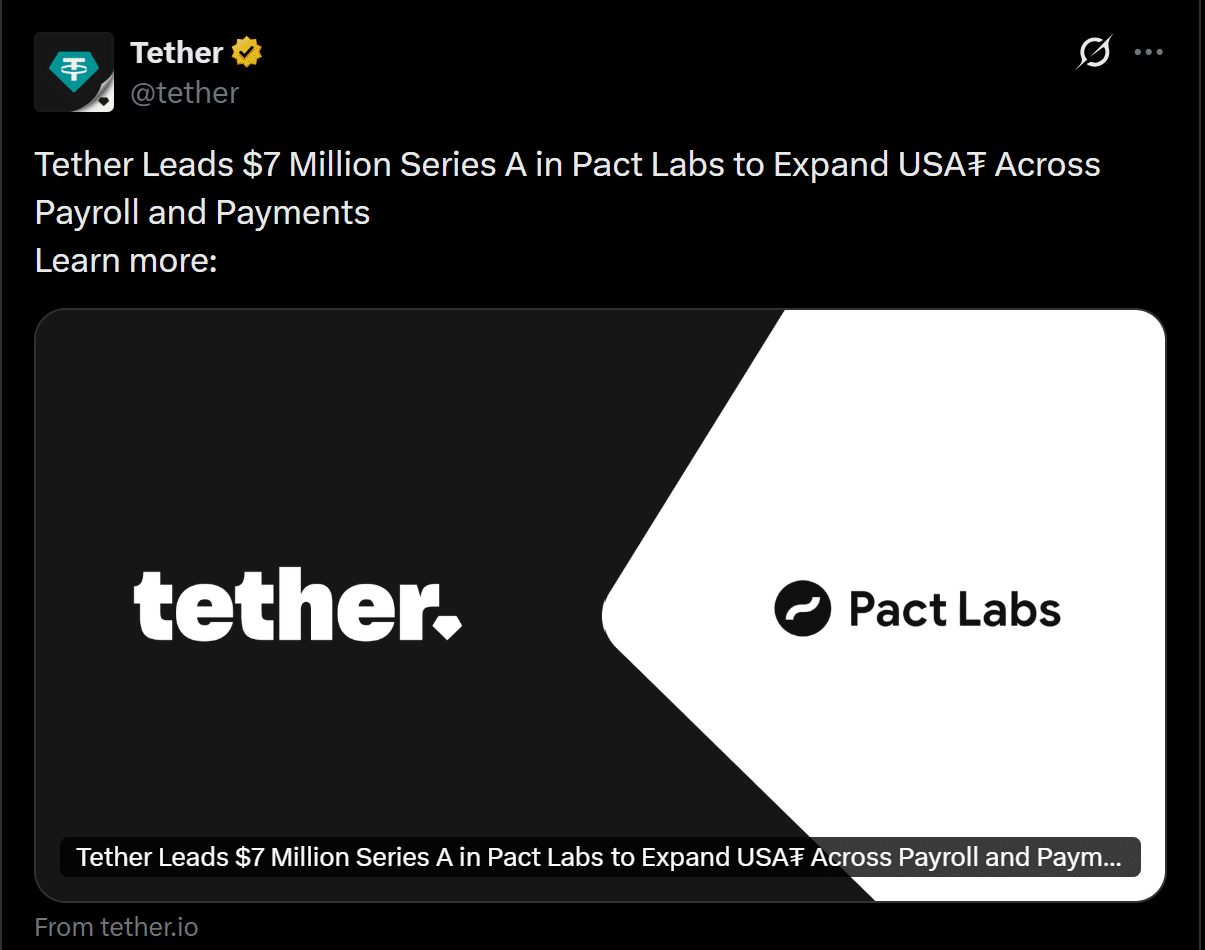
Source: Tether on X

Rather than competing for trading volume, Tether is pursuing recurring payment flows that generate consistent stablecoin demand. This marks a structural expansion of stablecoin utility beyond speculative markets.

Still, enterprise integrations, payroll adoption, and transaction growth will determine whether USA₮ becomes embedded in mainstream finance or remains a niche payment alternative.

Compliance reinforces Tether’s expansion

On one hand, building payment rails addresses just one-half of the problem. That makes Chainalysis’ support for Stable, a USDT-native Layer 1, more significant than another blockchain integration.

As Tether continues to push stablecoins into payroll and daily transactions, institutions will require continuous monitoring prior to committing larger transactional volume on-chain.

Chainalysis provides this critical layer. This is via real-time transaction screening, entity monitoring, and fund flow analysis.


Source: Chainalysis

Chainalysis’s automatic support for additional ERC-20 and ERC-721 tokens enables Stable to continue to grow. It does so while providing ongoing compliance coverage. Thus, the opportunities for Stable extend far beyond fast settlement.

If payment activity and institutional adoption grow together, compliance could become the catalyst that transforms stablecoins into trusted financial infrastructure.

Payment infrastructure now faces its most important challenge. It must show resilience in generating sustained real-world activity. Faster settlement and strong compliance have removed many of the regulatory hurdles for enterprises to adopt blockchain technology.

Rising enterprise wallets, larger transaction sizes, and expanding payment flows would signal businesses are moving beyond pilot programs.

That momentum gradually shifts blockchain’s role from facilitating digital asset transfers to supporting everyday financial services.

The competitive advantage is also changing. Networks that attract recurring payment activity, rather than simply launching new infrastructure, are increasingly positioning themselves at the center of mainstream finance.


Final Summary

  • Tether is expanding beyond trading by positioning stablecoins as infrastructure for payroll and everyday payments.
  • Stablecoin adoption now depends on recurring payment activity supported by scalable infrastructure and institutional-grade compliance.


Preguntas relacionadas

QAccording to the article, what strategic shift is Tether making in stablecoin adoption?

ATether is shifting stablecoin adoption from crypto markets towards everyday financial infrastructure, specifically targeting payroll, earned wage access, and real-time payments through USA₮.

QWhat does Tether CEO Paolo Ardoino identify as the core driver for dollar-denominated settlement demand?

APaolo Ardoino identifies the demand for dollar-denominated settlement as 'a wages story,' a conclusion supported by Tether's transaction data over years.

QHow does Chainalysis's role support Tether's expansion into payroll and daily transactions?

AChainalysis provides a critical compliance layer through real-time transaction screening, entity monitoring, and fund flow analysis, enabling institutions to commit larger transactional volume with continuous monitoring.

QWhat will determine whether USA₮ becomes embedded in mainstream finance according to the article?

AEnterprise integrations, payroll adoption, and transaction growth will determine whether USA₮ becomes embedded in mainstream finance or remains a niche payment alternative.

QWhat is changing in terms of competitive advantage for networks in the financial space, as mentioned in the article?

AThe competitive advantage is shifting towards networks that attract recurring payment activity, rather than simply launching new infrastructure, positioning themselves at the center of mainstream finance.

Lecturas Relacionadas

Founder of Real Vision: We Are Living in the Era of Exponential Growth

Real Vision founder Raoul Pal argues that humanity is now in an "Age of Exponential Growth," a reality the human brain's linear intuition struggles to comprehend. The core drivers are the convergence of multiple, mutually-reinforcing technological curves: Artificial Intelligence, robotics, solar & storage, biotechnology, and blockchain networks. He notes that while his 2021 analysis correctly identified fiat currency debasement and assets like Bitcoin as inflation hedges, he underestimated the scale of change. Beyond monetary liquidity, a more profound force is at work: these key technologies have moved from theoretical promise into simultaneous, accelerating commercialization. They are no longer growing in parallel but are fusing, creating a "double exponential" growth curve. AI and robotics create an "artificial labor supply," breaking the cycle of debt-driven growth needed to offset aging demographics. Energy, particularly solar power guided by Wright's Law, is seeing collapsing costs, removing a key bottleneck for compute-hungry AI. Cryptocurrencies are evolving from monetary assets into the essential, programmable settlement layer for transactions between future AI agents. This fusion creates a feedback loop: AI optimizes energy grids, cheaper energy powers more compute, which builds better AI, and crypto networks settle the transactions. This leads to "Reed's Law" playing out at scale, where intelligent nodes (AI agents) form and re-form groups at machine speed, creating network value that grows at 2^n. Pal concludes that the critical question is no longer how to protect jobs from machines, but how to own a share of the machines and their foundational infrastructure. He sees the 2030-2032 period as a potential "Economic Singularity" where these trends fully merge, fundamentally transforming the economy. The data, he asserts, shows this is not a bubble but an observable, quantifiable new era.

Foresight NewsHace 39 min(s)

Founder of Real Vision: We Are Living in the Era of Exponential Growth

Foresight NewsHace 39 min(s)

Golden Age VS Crisis Era? Bank of Korea Set to Hike Rates, Brokerage Margin Requirements May Increase 5-Fold

South Korea's financial authorities are taking coordinated action to cool an overheated and volatile stock market. The Bank of Korea is widely expected to raise its benchmark interest rate by 25 basis points to 2.75% on Thursday, which would be its first hike in approximately three and a half years since January 2023. Analysts predict further increases, potentially bringing the rate to 3.00% by year-end. This move aims to tighten market liquidity, raising costs for leveraged investments. Concurrently, major Korean brokerages have agreed to raise the minimum investment requirement for single-stock leveraged ETFs fivefold, from 10 million won to 50 million won, to curb excessive retail speculation. This follows extreme market swings focused on major chip stocks like Samsung Electronics and SK Hynix, which together account for nearly half of the KOSPI index's weight. The index itself has seen a dramatic 204% surge from its recent low. President Yoon Suk Yeol acknowledged market instability and urged regulators to address risks from leveraged products. Meanwhile, financial watchdogs are imposing new limits on stock-backed loans to individual investors to prevent bubble formation. These measures come as foreign investors have been massive net sellers this year, offloading a record $110 billion in assets, while domestic retail investors, using significant leverage, have been the primary buyers, absorbing the sales pressure. The government's multi-pronged strategy seeks to stabilize the market by restricting leverage, raising barriers, and tightening monetary policy.

Odaily星球日报Hace 48 min(s)

Golden Age VS Crisis Era? Bank of Korea Set to Hike Rates, Brokerage Margin Requirements May Increase 5-Fold

Odaily星球日报Hace 48 min(s)

From Being Ignored to the Venture Capital Queen Investing: Has AI Revived This Ultra-Niche Sector?

From obscurity to receiving investment from the "queen of venture capital," AI has revitalized the ultra-niche social networking track. In recent years, the social networking sector experienced a deep freeze in venture capital, with high-profile projects like the video social app "Huayin" (founded by a former WeChat core team member) and the offline-online dating app "Single's Tavern" ultimately failing. These failures underscored the immense difficulty of challenging WeChat's dominance in熟人社交 (close-contact social networking) and the general lack of scalable monetization paths for niche concepts like metaverse, female-only, or Muslim community apps. However, a shift emerged in 2025. "Liangpei," an AI-powered matchmaking company, secured a $2 million angel round from Today Capital, led by renowned investor Xu Xin. Its approach uses AI conversational profiling to create detailed user matches and charges only upon successful connections. Similarly, projects like "Pixel Rhythm" (reportedly focused on AI-assisted content creation for Gen Z overseas) and "Moobius" (AI-native group chat) signal a new trend. The investment logic has fundamentally changed. Instead of pursuing broad, traffic-driven "platform dreams" to compete with giants like WeChat, Douyin, or Soul, the new wave focuses on using AI as a tool to solve specific, high-pain-point problems for targeted, niche user segments. The path to viability now lies in achieving healthy cash flow by solving a concrete problem rather than chasing massive scale.

marsbitHace 1 hora(s)

From Being Ignored to the Venture Capital Queen Investing: Has AI Revived This Ultra-Niche Sector?

marsbitHace 1 hora(s)

Trading

Spot
活动图片