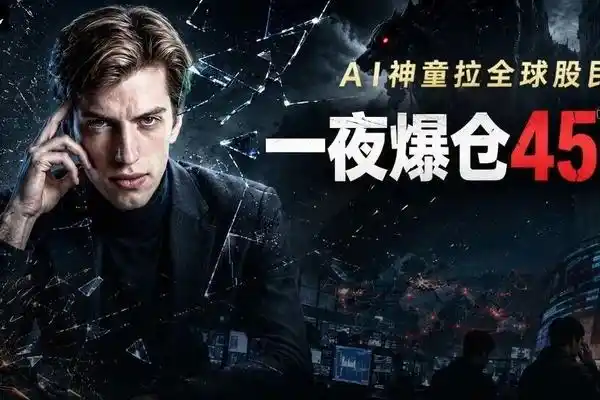
Now the Greatest Regret Is to My Family: Crypto Experts Took a Stumble in the Stock Market

marsbitPublicado a 2026-07-30Actualizado a 2026-07-30

Resumen

Summary: This article examines the significant losses recently suffered by cryptocurrency traders and influencers who ventured into the stock market, specifically by heavily investing in AI-related and semiconductor storage stocks. The narrative centers on the dramatic reversal in the Korean and US equity markets in late July, with stocks like SK Hynix and related leveraged ETFs experiencing historic plunges, erasing massive gains. The analysis highlights several key factors behind the "flip." Traders, accustomed to crypto's high volatility and frustrated by a stagnant market, chased the apparent momentum in AI-themed equities. Many made fatal mistakes: applying high-leverage strategies common in crypto (e.g., 2x ETFs, on-chain perpetual contracts) to stocks, and failing to understand the distinct rules of different stock markets (like Korean pre-market trading). This led to widespread liquidations, especially when a thin Korean pre-market trade triggered a cascading flash crash on a decentralized exchange. Post-crash reflections from prominent figures reveal deep regret and self-criticism. They acknowledge misjudging their expertise, overestimating their edge against sophisticated institutional players, and the dangers of leverage. The article concludes that while such setbacks are part of trading, surviving long-term requires recognizing one's limitations and the inherent risks of cross-market strategies.

"Now, the greatest regret is to my family."

Lately, the frequency of hearing this phrase is no less than that of "Do you believe in the light?" and "You should stand in the light, not let the light stand there" from two months ago.

These two short sentences encapsulate a 180-degree reversal in the market and a landscape of shattered hearts.

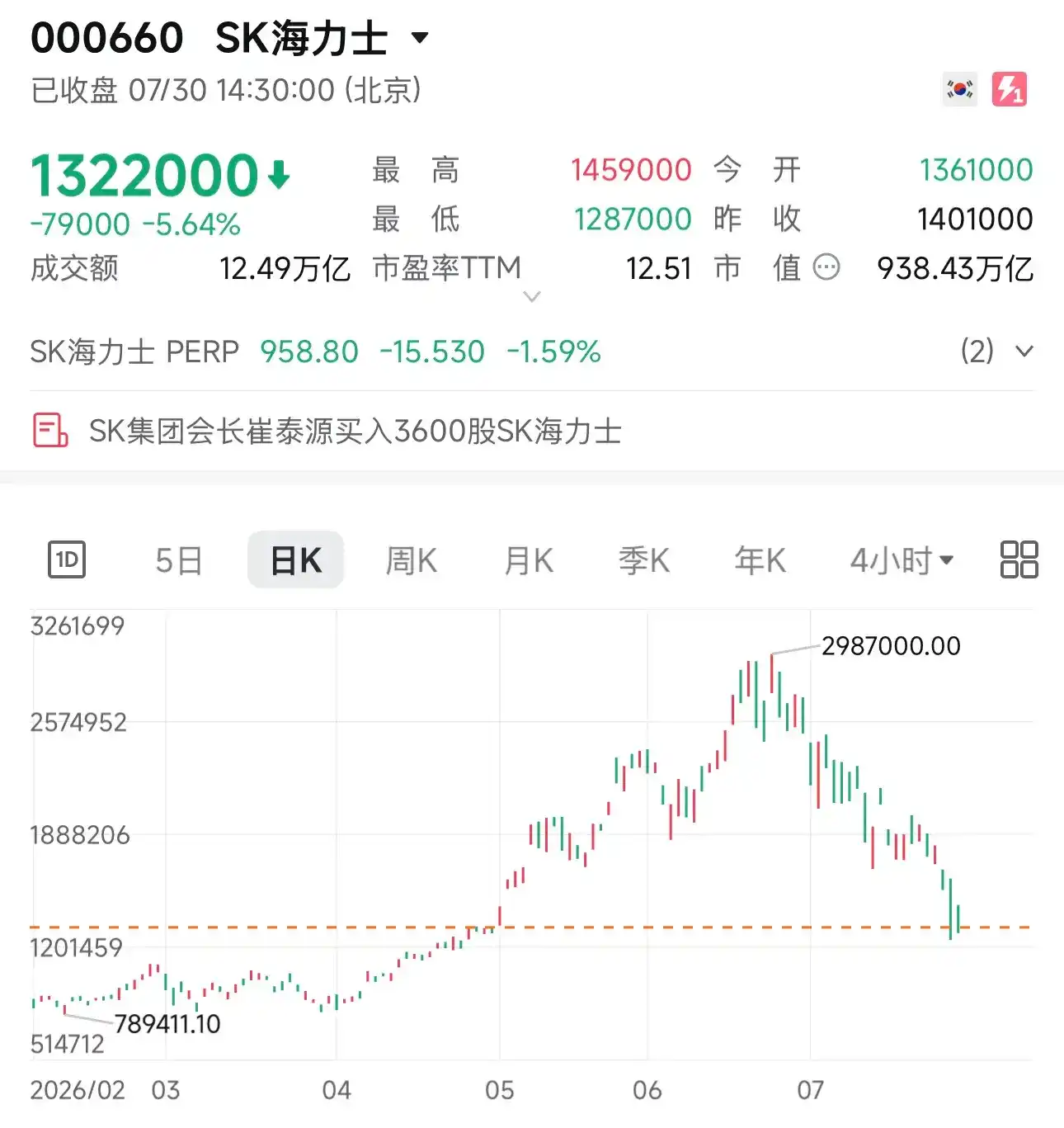
According to public data, South Korean stock SK Hynix has halved from its June high, erasing over 1,000 trillion won (approximately $800 billion) in market capitalization. The KOSPI index has retreated about 30% from its peak and has experienced 9 trading halts this year.

On July 28th, SK Hynix fell over 10%. U.S. memory stocks also plunged collectively, with SanDisk, Western Digital, Seagate, and Micron dropping 8% to 13% in a single day.

On July 29th, SK Hynix fell sharply again, dropping nearly 20% intraday, while a 2x long Hynix ETF plummeted over 30%, both setting their largest single-day declines in history.
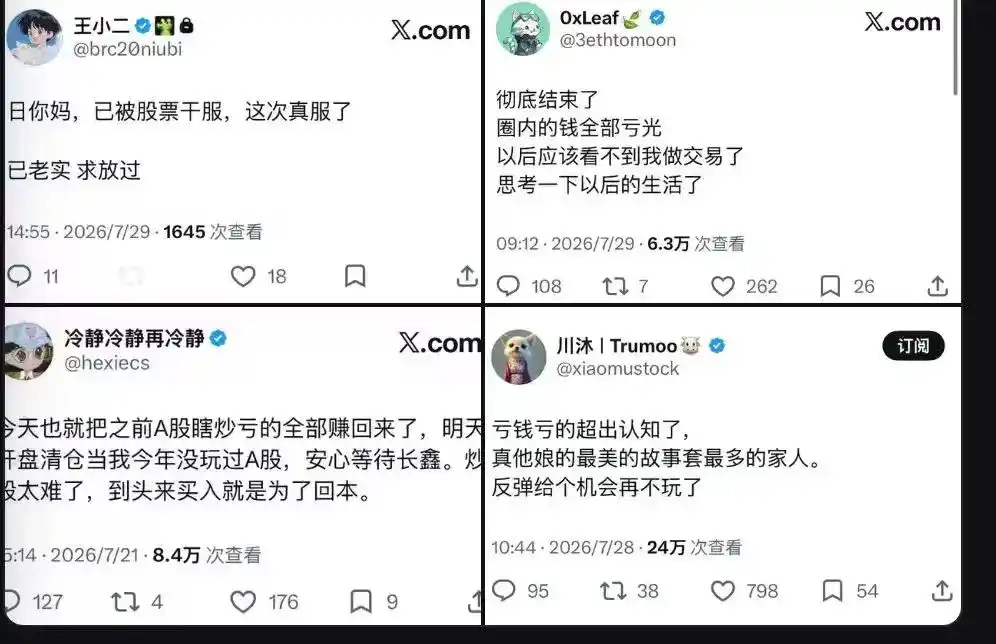
A cross-market bloodbath thus unfolded. The extreme volatility flushed out numerous big V's and traders from the crypto circle. Among them were those who had earned their first pot of gold in the crypto market and those who had already achieved financial freedom. Now, all that's left are reflections and declarations of leaving the scene.
Half Market Conditions, Half Human Nature

Perhaps because the crypto market had been too quiet for too long, memory stocks became the best destination for active capital.

Dp Dapeng (@Dp520888) posted that from the end of last year to the first half of this year, the crypto market was in a constant downtrend. Bitcoin barely caught its breath around $60,000, while South Korean and U.S. stock markets soared on the AI narrative during the same period. Major exchanges, in their efforts to expand markets, had also opened up stock trading access.

He noted that he saw many crypto peers painfully cut losses on their crypto assets and go all-in on Micron and SanDisk at highs, only to lose over 30% subsequently. Had this money stayed in crypto, they could have at least held on until Bitcoin fell to $40,000.

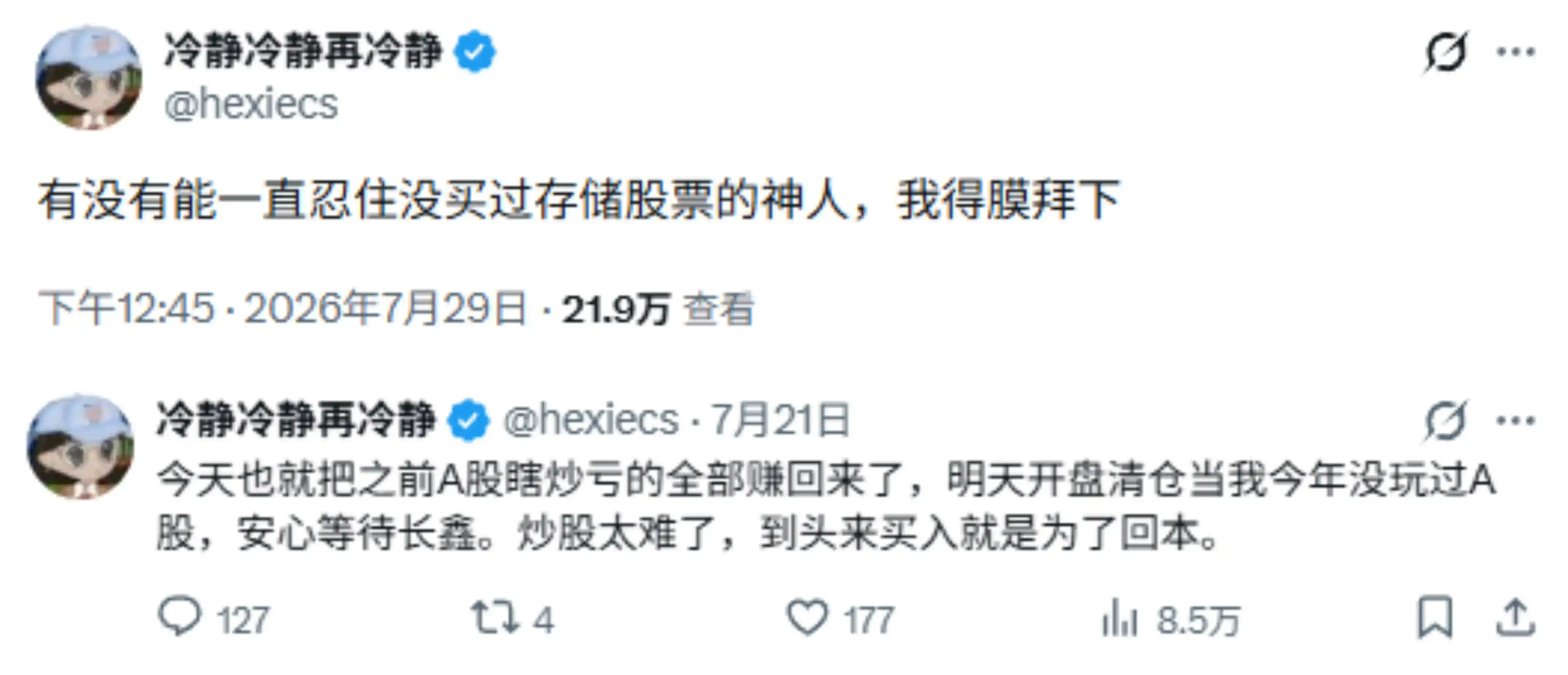
People accustomed to high volatility and tormented by the lack of profit-making opportunities for over half a year found it hard to resist chasing the market that seemed more lucrative. As @hexiecs posted, "Is there any god who has always resisted buying memory stocks? I need to worship them."
However, narratives like AI, GPU, and storage come and go quickly in capital markets. Nvidia's stock price peaked in May and has already wiped out this year's gains, with its total market cap recently overtaken again by Apple. Now it's just storage's turn.

So, the starting point of this crash is half market conditions, half human nature.

Why the Crash This Time?

People transitioning from the crypto circle to the stock market are prone to culture shock.

On one hand, it's the leverage habit. Many start with 2x long positions or add even higher leverage via on-chain perpetual contracts. The same bearish candle that represents a mere pullback in a spot account becomes a liquidation event in a leveraged account.

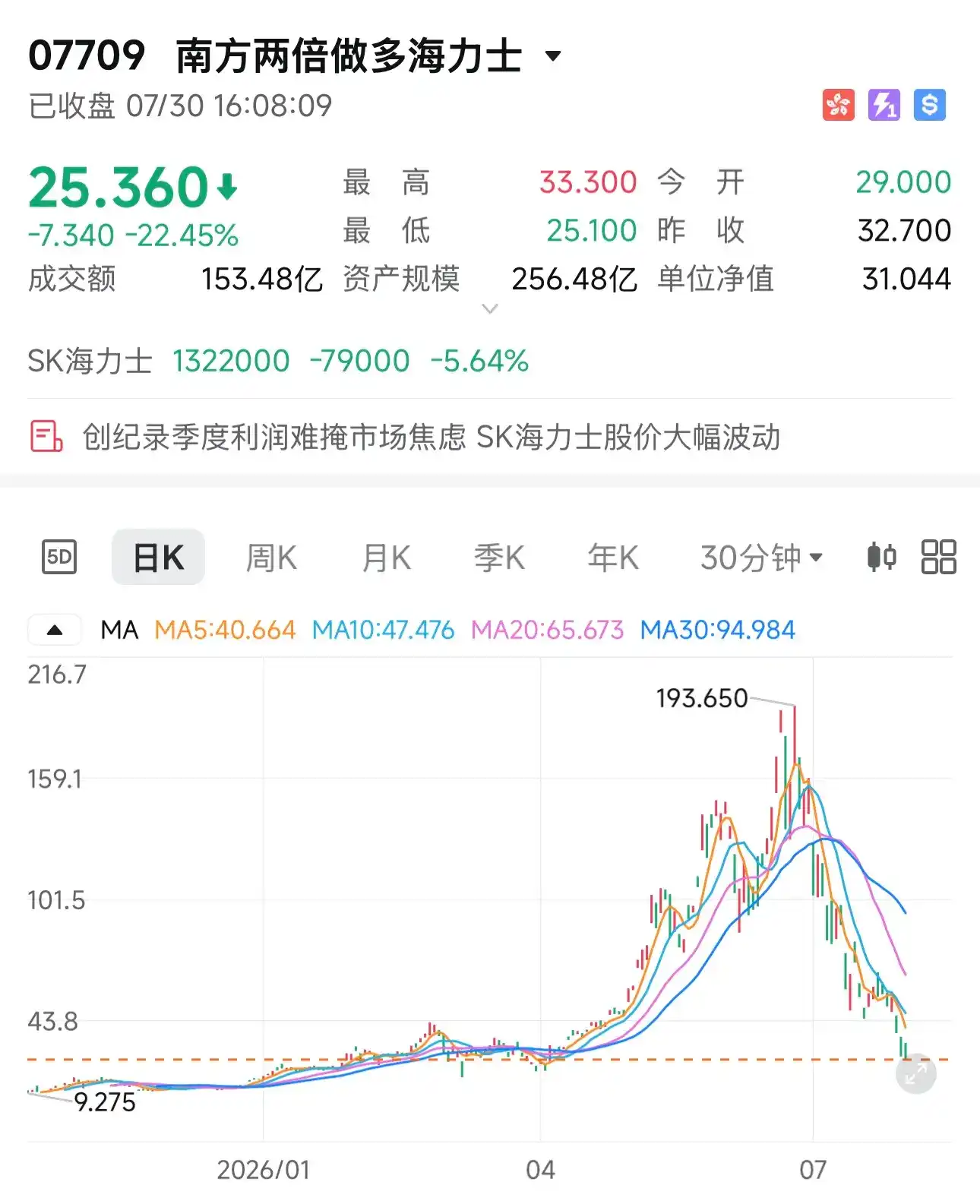
How severe the damage to leveraged products was this round can be seen by looking at the South Korean 2x Long Hynix ETF. This fund was once the world's largest single-stock leveraged product, with peak assets around 130 billion HKD. Its cumulative decline since July has exceeded 80%, with assets now down to 25.6 billion HKD. Another 2x Long Samsung Electronics ETF also fell about 70% this month.
According to Hyperliquid data, on July 29th, the combined 24-hour trading volume for Hynix-related contracts SKHX and SKHY on the platform reached $1.765 billion, becoming the most actively traded asset on the platform, with heat and volume even surpassing BTC.

On the other hand, it's the rule differences. The stock market itself has several sets of rules: U.S. stocks have after-hours trading, South Korean stocks have NXT pre-market, A-shares have price limits, Hong Kong stocks have another set, each with its own trading hours, price bands, and settlement rhythms.

When these underlying assets are packaged into on-chain perpetual contracts, the extreme rules of other markets are bundled in as well. The wick on Hyperliquid on July 28th is a living example.

It is reported that on that day, only one lot of SK Hynix traded in the South Korean pre-market at around $868, about 30% lower than the previous close, right near the lower limit of the price band. This less than $900 real transaction was fed into the chain via the oracle, causing the SKHX perpetual contract to flash crash about 18% in one minute.

According to on-chain data, approximately $80 million was liquidated in the subsequent four hours, with open interest evaporating about $150 million.
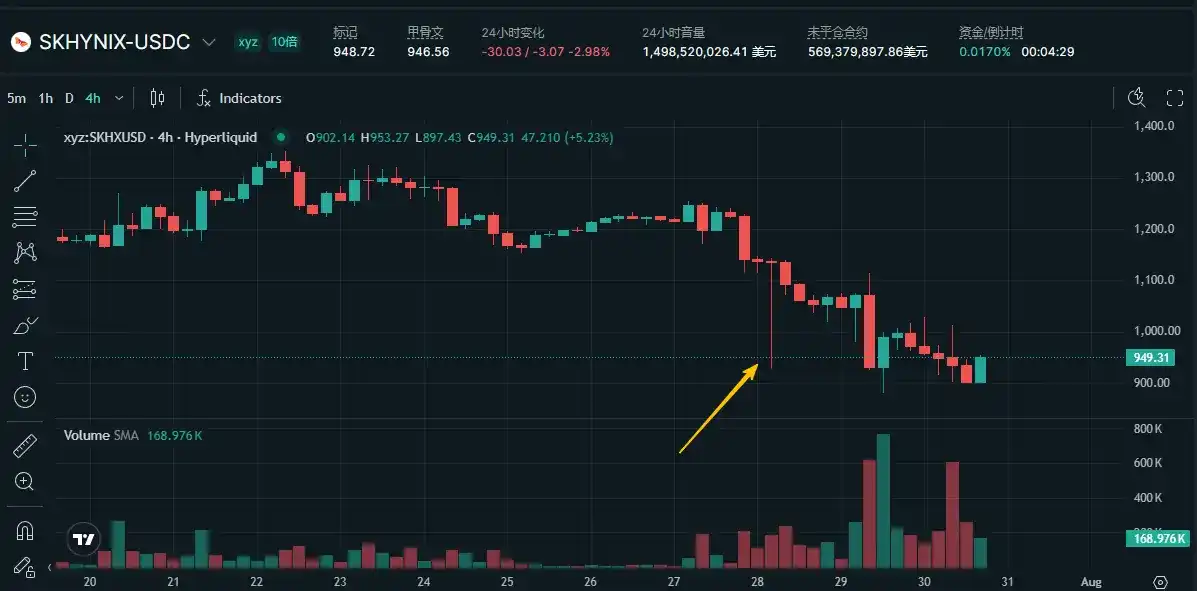
Trade.xyz announced that this price was synchronized from that real transaction in the South Korean pre-market, with the oracle operating according to specifications and no technical error. Although Trade.xyz decided to fully compensate for the liquidation losses this time, it specifically stated this does not constitute a guarantee for similar situations in the future.

Reflections After the Bloodbath

After this bloodbath, many big V's on X began to reflect. Their review focus largely fell on whether the methods they had relied on to make money over the years were still effective after switching markets.

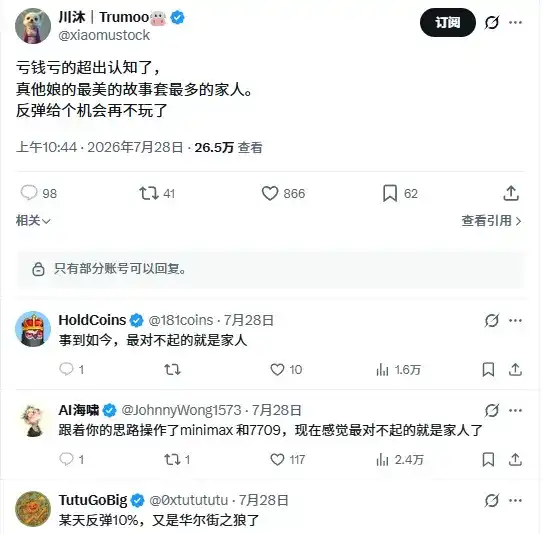
Chuanmu (@xiaomustock) stated that he made and lost money on storage stocks this year. The reason Buffett has survived in the capital market for so long is inseparable from his style of avoiding leverage, not going all-in, and always holding significant idle cash. Ordinary people either lose sleep from anxiety over using leverage to get rich quickly, or continue using leverage after making money, anxious in both profit and loss.
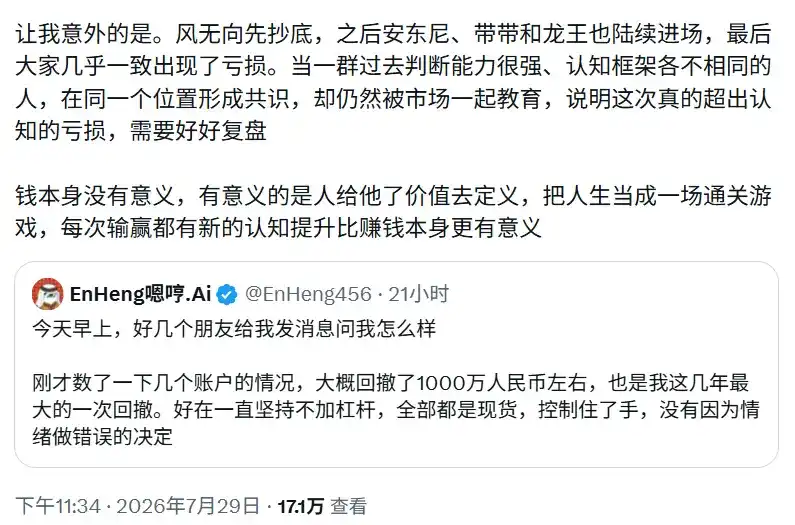
KOL En Heng (@EnHeng456) recounted his three major losses since entering the industry, with this storage wave being the heaviest, resulting in a combined drawdown of over ten million across several accounts, but fortunately, it was all spot trading with no leverage.

He also pointed out that multiple traders with consistently strong judgment and different cognitive frameworks successively entered the market, yet almost all ended up losing. When such a group forms a consensus at the same position but is collectively taught a lesson by the market, it indicates that this loss indeed exceeded their original understanding.
Zishi (@silverfang888), who claimed to have been liquidated for $20 million in semiconductors, also said his biggest regret was moving from crypto to trading stocks. In his view, he is merely a crypto player with limited insight, sitting across from people in the U.S. stock market arena whose cognition and capital far surpass his own.

After being liquidated, many fell into intense self-negation, attributing the losses of these months to their own shallow insight and low cognition. The concentrated outbreak of such emotions also serves as a reminder to everyone using leverage as an amplifier: what the market takes is never just the principal.

Some offered comfort, saying whose trading career hasn't experienced a few such drawdowns? Money lost can be treated as tuition paid. As long as one is still here with spirit intact, there will always be another journey ahead.

In truth, there are very few who can consistently win in the market. Those who can journey a bit further are often those who can still see their own boundaries at different stages.


Criptos en tendencia

Preguntas relacionadas

QAccording to the article, what is the main reason behind the significant losses of crypto traders in the stock market?

AThe main reasons are a combination of market conditions and human nature. Crypto traders, accustomed to high volatility, moved to the AI-driven stock market for better returns. However, they faced issues like improper use of leverage and unfamiliarity with the different trading rules of stock markets (like pre-market sessions and price bands), which led to severe losses when the storage sector crashed.

QHow did the specific event on Hyperliquid on July 28th cause major liquidations?

AOn July 28th, a single SK Hynix share traded for around $868 in the Korean pre-market, about 30% lower than the previous close. This price, fed into the chain via an oracle, caused the SKHX perpetual contract on Hyperliquid to flash-crash by about 18% in one minute. This led to approximately $80 million in liquidations and a $150 million drop in open interest over the next four hours.

QWhat is one key trading habit from the crypto world that proved detrimental in the stock market?

AOne key detrimental habit was the immediate use of high leverage. Many traders started with 2x leveraged ETFs or even higher leverage on perpetual contracts. This meant that a price decline that would be a simple drawdown in a spot account resulted in margin calls and liquidations in leveraged positions.

QWhat major reflection did trader '川沐' (@xiaomustock) share after the losses?

ATrader '川沐' reflected that his gains and losses this year both came from the storage sector. He noted that Warren Buffett's longevity in the market is tied to his style of avoiding leverage, not going all-in, and always keeping a large amount of cash on hand. In contrast, ordinary people either lose sleep over leverage-driven anxiety to get rich or continue using leverage after profits, leading to anxiety in both winning and losing.

QWhat was the final attitude or lesson some traders expressed after the market crash?

AAfter the crash, some traders expressed a lesson in humility and recognizing one's boundaries. They acknowledged that moving from the crypto circle to the stock market meant competing against players with far superior knowledge and capital. While some fell into self-doubt, others offered comfort, stating that such drawdowns are part of a trading career, and as long as one's spirit remains, there will always be another opportunity.

Lecturas Relacionadas

Global Market Share Survey: Japanese Firms Lead in Semiconductor Materials

Global Market Share Survey: Japanese Firms Lead in Semiconductor Materials According to the 2025 "Major Goods and Services Market Share Survey" by Nikkei, Japanese companies maintain strong positions in semiconductor-related materials. In silicon wafers, Shin-Etsu Chemical ranks first with a 26.3% share, followed by SUMCO at 17.8%. Together, they hold 44.1% of the market, widening their lead over competitors from Taiwan, Germany, and South Korea. In photoresists, Tokyo Ohka Kogyo, JSR, and Shin-Etsu Chemical occupy the top three spots, with a combined share of 60.5%. Despite their strength in materials, Japanese firms have a weaker presence in core semiconductor segments like DRAM and NAND flash memory, where South Korean and U.S. companies dominate. For instance, SK Hynix and Samsung lead in DRAM, while China’s CXMT doubled its share to 6% in 2025. The semiconductor market is projected to grow rapidly, with WSTS forecasting a 90% increase to $1.5112 trillion by 2026. Major players like Samsung, SK Hynix, and Micron are making massive investments to expand capacity. To maintain their edge in materials, Japanese companies must similarly commit to large-scale, risk-taking investments. In contrast, Japan’s automotive sector shows stagnation. Toyota remains the global leader but with only a slight share increase to 12.3%, while Japanese brands are absent from the top five in the EV market. In shipbuilding, Imabari Shipbuilding rose to third place globally with a 7.2% share, benefiting from large container ship deliveries. However, Chinese and South Korean firms dominate the sector, holding the top two positions. Japan aims to revitalize its shipbuilding industry through government and corporate efforts, targeting a near doubling of output by 2035. Addressing labor shortages and adopting advanced technologies like physical AI will be critical for competitiveness.

marsbitHace 5 min(s)

Global Market Share Survey: Japanese Firms Lead in Semiconductor Materials

marsbitHace 5 min(s)

STRC Major De-pegging's First Financial Report, How Will Strategy Repair Its Capital Flywheel?

Bitcoin treasury company Strategy released its Q2 2026 earnings report on July 31. Despite a 6.9% year-over-year revenue increase to $122 million, the company recorded a net loss of $8.22 billion, largely due to $8.32 billion in unrealized losses from Bitcoin price fluctuations. As of quarter-end, Strategy holds 843,775 BTC with an average cost of $75,000 per coin, and Bitcoin per share increased. The report highlights a critical shift in Strategy's capital model following the de-pegging of its key financing tool, STRC (Strategic Coin), which fell below its $100 target. Management's top priority is restoring STRC to its target value, aiming for a recovery by September 8. They rule out discounted STRC issuances and plan to maintain its dividend yield at 12%, instead focusing on bolstering its $3.75 billion cash reserve. Strategy has moved from a one-way "buy-and-hold" Bitcoin strategy to active capital management. This new approach, part of its "Digital Credit Capital Framework," involves flexibly managing its balance sheet across four elements: BTC, USD cash, common stock (MSTR), and digital credit securities like STRC. This allows for BTC monetization (having sold $218.4 million in BTC so far), strategic repurchases of discounted securities, and debt optimization, as seen with a $1.5 billion convertible bond buyback. The company's future hinges on two key tests: successfully re-pegging STRC to restore market confidence in its digital credit system, and a long-term recovery in Bitcoin's price to ultimately support its growth thesis.

marsbitHace 50 min(s)

STRC Major De-pegging's First Financial Report, How Will Strategy Repair Its Capital Flywheel?

marsbitHace 50 min(s)

STRC's First Financial Report Post-Depegging, How is Strategy Restoring the Capital Flywheel?

On July 31, 2026, Bitcoin treasury company Strategy released its Q2 financial report. Despite a 6.9% year-over-year increase in revenue to $122 million, the company recorded a substantial net loss of $8.22 billion, primarily due to $8.32 billion in unrealized losses from Bitcoin holdings. While Strategy's core Bitcoin strategy remains intact—its holdings grew 11% to 843,775 BTC—the company is undergoing a fundamental shift in its capital model. Following the de-pegging of its key financing tool, the STRCoin (STRC), from its $100 target in May, Strategy has pivoted from a one-directional "raise funds, buy Bitcoin" cycle to a more dynamic, multi-asset capital management approach. A key part of this new framework is the "Monetization Program," through which Strategy has sold approximately $218.4 million worth of BTC to bolster liquidity. The company's top priority is repairing STRC's peg, committing not to issue discounted shares until it returns to its target range. It has initiated a $1 billion buyback program for discounted digital credit securities, having repurchased $28.9 million face value of STRC so far. Management aims to restore the peg around September 8, 2026. Strategy now actively manages a matrix of assets: Bitcoin (for accumulation or strategic sales), USD cash reserves (now at $3.75 billion), common stock (MSTR), and digital credit securities like STRC. This allows for tactical moves like repurchasing discounted debt or equity to capture value. The future success of Strategy's "capital flywheel" hinges on two factors: the short-term ability to successfully re-peg STRC to restore market confidence in its digital credit system, and the long-term price trajectory of Bitcoin, upon which its entire investment thesis ultimately depends.

Odaily星球日报Hace 55 min(s)

STRC's First Financial Report Post-Depegging, How is Strategy Restoring the Capital Flywheel?

Odaily星球日报Hace 55 min(s)

Trading

Spot

Artículos destacados

Cómo comprar T

¡Bienvenido a HTX.com! Hemos hecho que comprar Threshold Network Token (T) sea simple y conveniente. Sigue nuestra guía paso a paso para iniciar tu viaje de criptos.Paso 1: crea tu cuenta HTXUtiliza tu correo electrónico o número de teléfono para registrarte y obtener una cuenta gratuita en HTX. Experimenta un proceso de registro sin complicaciones y desbloquea todas las funciones.Obtener mi cuentaPaso 2: ve a Comprar cripto y elige tu método de pagoTarjeta de crédito/débito: usa tu Visa o Mastercard para comprar Threshold Network Token (T) al instante.Saldo: utiliza fondos del saldo de tu cuenta HTX para tradear sin problemas.Terceros: hemos agregado métodos de pago populares como Google Pay y Apple Pay para mejorar la comodidad.P2P: tradear directamente con otros usuarios en HTX.Over-the-Counter (OTC): ofrecemos servicios personalizados y tipos de cambio competitivos para los traders.Paso 3: guarda tu Threshold Network Token (T)Después de comprar tu Threshold Network Token (T), guárdalo en tu cuenta HTX. Alternativamente, puedes enviarlo a otro lugar mediante transferencia blockchain o utilizarlo para tradear otras criptomonedas.Paso 4: tradear Threshold Network Token (T)Tradear fácilmente con Threshold Network Token (T) en HTX's mercado spot. Simplemente accede a tu cuenta, selecciona tu par de trading, ejecuta tus trades y monitorea en tiempo real. Ofrecemos una experiencia fácil de usar tanto para principiantes como para traders experimentados.

660 Vistas totalesPublicado en 2024.12.10Actualizado en 2026.06.02

Cómo comprar T

Discusiones

Bienvenido a la comunidad de HTX. Aquí puedes mantenerte informado sobre los últimos desarrollos de la plataforma y acceder a análisis profesionales del mercado. A continuación se presentan las opiniones de los usuarios sobre el precio de T (T).

活动图片