Author: Zach Pandl (Head of Grayscale Research)
Compiled by: Shenchao TechFlow
Shenchao's Guide: Grayscale Research has released its latest research report, listing the top 15 on-chain protocols by revenue and comparing their valuation multiples. The core finding is that a large number of protocols generating hundreds of millions of dollars in annual revenue are trading at single-digit or even 1x revenue multiples. The market capitalization of Pump.fun, PancakeSwap, and Meteora is nearly equal to their annual revenue. Grayscale believes the CLARITY Act could pass next month, which would open the door for institutional funds to flow into these DeFi financial protocols. However, it is important to note that Grayscale is a crypto asset management firm, and its "undervalued" conclusion aligns with its commercial interests. Investors should exercise independent judgment.
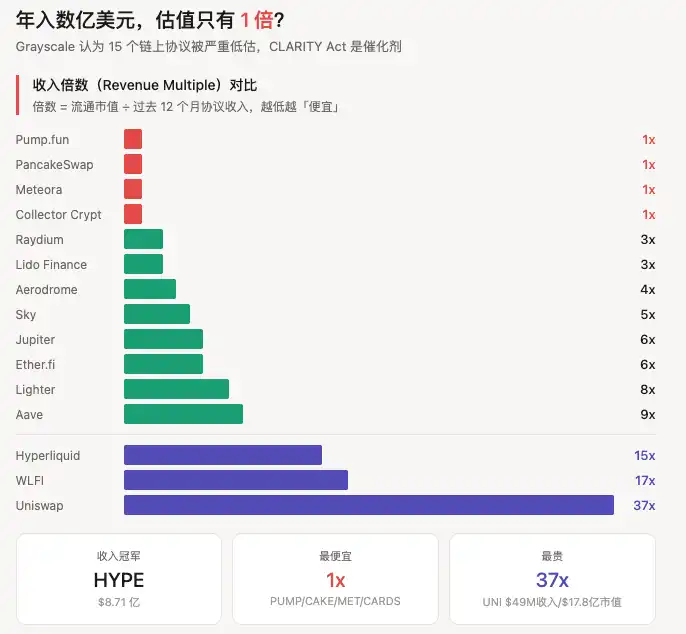
After a prolonged bear market, many revenue-generating on-chain applications appear quite cheap from a fundamental perspective.
Among the top 15 on-chain protocols by revenue (including Hyperliquid), the vast majority have seen their trailing twelve-month revenue multiples fall to single digits, with many at just 1x. Since most protocols have minimal operating expenses, they also look cheap when measured by profit or cash flow.
Grayscale believes the potential passage of the CLARITY Act (possibly as early as next month) will help unlock this value. The reason is: if this law is enacted, it will introduce traditional financial regulatory frameworks to crypto assets, representing a significant positive catalyst for these applications.
Specifically, the CLARITY Act is expected to drive the growth of tokenized assets and on-chain finance. Nearly all of the top 15 revenue-generating protocols are either directly linked to financial use cases or related critical infrastructure (like oracles and staking). Grayscale believes these protocols will significantly benefit from the anticipated increase in on-chain transaction activity following the passage of the CLARITY Act.
Grayscale's 'Bargain List': A Look at Each of the 15 Protocols
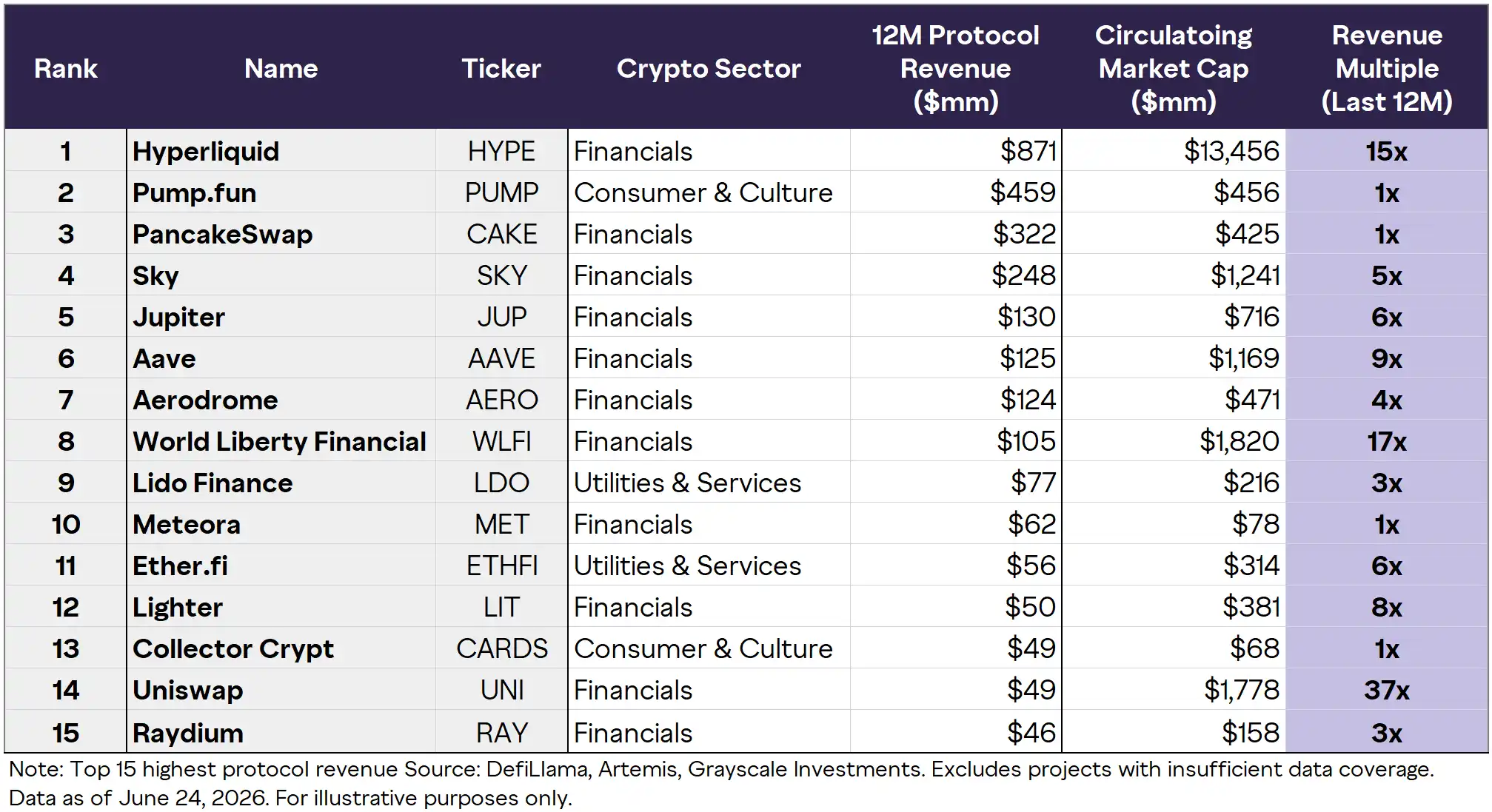
Caption: Top 15 On-Chain Protocols by Revenue. Data as of June 24, 2026. Sources: DefiLlama, Artemis, Grayscale Investments. Excludes projects with insufficient data coverage. Chainlink is not included due to its mix of on-chain and off-chain revenue.
This table is information-dense. Let's break it down layer by layer.
The "1x Club": Market Cap ≈ Annual Revenue
Most notable in the table are the four protocols with a Revenue Multiple of just 1x:
Pump.fun (PUMP) — $459M in trailing twelve-month protocol revenue, $456M circulating market cap. A software business generating nearly $500M in annual revenue with virtually no operating costs, valued at just one year's revenue, would immediately attract value investors in traditional markets. However, Pump.fun's revenue is highly dependent on meme coin speculation; this trading volume could evaporate instantly if sentiment shifts. The 1x valuation could either be the market overlooking real cash flows or correctly discounting unsustainable revenue.
PancakeSwap (CAKE) — $322M revenue, $425M market cap, 1x multiple. The largest DEX on BNB Chain, with diversified business lines including AMM trading, liquidity mining, and prediction markets. Its revenue sources are more diversified than Pump.fun's, with a solid user base in Asia-Pacific.
Meteora (MET) — $62M revenue, $78M market cap, 1x multiple. A liquidity infrastructure project on Solana, also a project co-founded by Meow, founder of Jupiter. Note the team risk following the resignation of Meteora co-founder Ben Chow over allegations of financial misconduct.
Collector Crypt (CARDS) — $49M revenue, $68M market cap, 1x multiple. Belongs to the "Consumer & Culture" category and is the least well-known among the 15 protocols.
Mid-Tier: Single-Digit Multiples, Hard-Cash DeFi Protocols
Raydium (RAY) — $46M revenue, $158M market cap, 3x multiple. A core AMM on Solana, benefiting from Solana ecosystem trading activity and new token launches.
Lido Finance (LDO) — $77M revenue, $216M market cap, 3x multiple. The largest liquid staking protocol on Ethereum, representing the on-chain staking infrastructure within the "Tools & Services" category.
Aerodrome (AERO) — $124M revenue, $471M market cap, 4x multiple. The DEX with the largest TVL and trading volume on the Base chain, employing a ve(3,3) tokenomics model with concentrated liquidity. It serves as the liquidity hub for the Coinbase L2 ecosystem.
Sky (SKY) — $248M revenue, $1.241B market cap, 5x multiple. Formerly known as MakerDAO, an on-chain lending and stablecoin protocol.
Jupiter (JUP) — $130M revenue, $716M market cap, 6x multiple. The largest DEX aggregator on Solana, recently surpassing Uniswap and PancakeSwap in daily fee revenue on multiple occasions.
Ether.fi (ETHFI) — $56M revenue, $314M market cap, 6x multiple. A leading protocol in the Restaking sector.
Lighter (LIT) — $50M revenue, $381M market cap, 8x multiple.
Aave (AAVE) — $125M revenue, $1.169B market cap, 9x multiple. The largest on-chain lending protocol. Grayscale conducted a detailed DCF (Discounted Cash Flow) analysis on AAVE in another research report, representing a methodological breakthrough in the crypto industry, detailed later.
High Multiple Zone: Paying for Narrative and Optionality
Hyperliquid (HYPE) — Topping the list with $871M in revenue, a circulating market cap of $13.456B, and a 15x multiple. Its revenue scale far exceeds the second place, but its valuation multiple is also relatively high. Hyperliquid's story extends beyond being a perpetual contract exchange: the HIP-3 proposal launched in October 2025 allows third parties to permissionlessly deploy perpetual contract markets on Hyperliquid, expanding underlying assets to stocks, commodities, indices, and Pre-IPO stocks. In March this year, S&P Dow Jones Indices licensed the S&P 500 index to a HIP-3 deployer, creating the first S&P 500 perpetual contract product. HIP-3 markets peaked at $3.2B in open interest, with cumulative trading volume around $200B. 99% of protocol fees flow back to the protocol via buybacks. Grayscale has launched a Nasdaq-listed staking ETF (HYPG) for HYPE.
World Liberty Financial (WLFI) — $105M revenue, $1.82B market cap, 17x multiple. The valuation is noticeably high, reflecting more the political association with the Trump family and market visibility than fundamental output.
Uniswap (UNI) — $49M revenue (second lowest), $1.778B market cap, 37x multiple (the highest in the table). This reflects a long-standing structural issue: UNI holders are primarily paying a premium for governance rights and the optionality of a "fee switch" (distributing protocol revenue to token holders), not for current cash flows. The market is pricing UNI for what it "could become," not what it "is now."
CLARITY Act: The Catalyst for These Protocols
Grayscale's thesis is not merely that "these protocols are cheap," but that "they are cheap ahead of a regulatory catalyst."
Of the 15 protocols in the table, 12 are financial protocols: decentralized exchanges, lending platforms, liquid staking, and yield infrastructure. The CLARITY Act (short for Digital Asset Market Clarity Act) is precisely the regulatory framework targeting these financial use cases.
The core of this law is to delineate the jurisdictional boundaries between the SEC and CFTC, establishing a framework to distinguish between "investment contracts" and "digital commodities." It has already passed the Senate Banking Committee with a 15:9 vote (including 2 votes from Democrats), and Polymarket gives it a 67% probability of passing within the year.
The logical chain is straightforward: Clear regulatory rules → Reduced compliance friction for institutions → Growth in on-chain activity and TVL → Increased revenue for these protocols → Re-rating of the current low valuation multiples.
[Compilation Supplement] Grayscale's DCF Valuation for AAVE: One-Year Target Price of $175
The following content is from Grayscale's associated mid-June research report "Guide to Buying the Dip: Valuing Crypto with Cash Flows" and is not part of the original article. It is integrated here by the compiler.
Grayscale places crypto assets on a valuation spectrum: on one end are purely commodity-like assets like Bitcoin, priced by supply and demand; on the other end are protocols with substantial revenue like Hyperliquid and Aave, suitable for traditional Discounted Cash Flow (DCF) models.
Analytical framework for Aave:
Aave Labs essentially functions like a permissionless on-chain bank, earning the spread between depositors and borrowers, plus fee and stablecoin (GHO) revenue. Grayscale estimates Aave's protocol profit for 2026 to be approximately $60M, with an operating margin around 50%.
Using comparable valuation multiples for fintech companies (20-25x P/E), AAVE's fair value is calculated to be around $80-$100, while it was trading at about $75 at the time of the report's release. AAVE's current forward P/E is about 18x, lower than comparable fintech companies.
Under a base case scenario (accelerated tokenization adoption, regulatory clarity progresses), Grayscale sets a one-year target price of approximately $175, representing an upside of about 130% from current levels.
Valuing crypto protocols involves several special considerations not covered by traditional tools:
Varied token value accrual mechanisms — Buybacks (AAVE), token burns (HYPE), fee rebates (CoW), staking rewards (CRV). The efficiency of value transfer to holders differs for each mechanism.
Unique expense items — Including supply-side fees (portions paid to liquidity providers), token emissions (ongoing inflationary dilution), and DAO capital expenditures.
Legal structural uncertainty — Holding governance tokens typically does not confer legally enforceable rights to protocol assets. Different DAOs employ varying legal structures to align protocol operations with applicable laws.
[Compilation Supplement] Macro Context: Market Divergence Since the Iran War
The following content is from Grayscale's concurrent weekly report, providing macro context.
Since the outbreak of the Iran war in late February, US stocks have risen 9% (boosted by AI spending), Bitcoin has fallen 1%, and gold has fallen 20%. Part of the reason for BTC and gold's underperformance is market expectations that the Federal Reserve might raise rates to combat inflation—one-year federal funds rate expectations have risen about 60 basis points, with roughly half of Fed officials believing a 2026 rate hike might be appropriate. The European Central Bank has already raised rates.
Grayscale disagrees with this expectation; its base case is for the Fed to hold rates steady. If this view is correct, BTC prices could catch up to US stocks.
In this risk-off macro environment, the valuations of on-chain protocols have been further compressed, which also defines the time window for Grayscale's "bear market multiples + regulatory catalyst" thesis.
How to Objectively View This Report
The picture Grayscale paints is indeed noteworthy: high-margin protocols trading at compressed valuation multiples, a potential regulatory tailwind seemingly imminent, while the overall market remains in a risk-off state. This is a rare, fundamentally-based crypto investment thesis in a market often driven by sentiment.
But two things must be made clear:
First, the catalyst is conditional. Neither the timeline nor the final form of the CLARITY Act is guaranteed. An investment thesis built on a legislative event naturally carries the risk of that event being delayed or disappointing. A 67% probability of passing also implies a 33% chance of not passing.
Second, Grayscale has a vested interest. It is a crypto asset management firm whose business model relies on investors increasing their exposure to these assets. It has already launched a Nasdaq-listed staking ETF for Hyperliquid. Its conclusion that "now is an attractive entry point" should be read within this context of interest, not as neutral analysis.
The valuation data is verifiable, and the anomalies are real. But whether this marks a bottom or the market correctly pricing the risks it perceives is a question each investor must answer for themselves.
For those tracking the CLARITY Act, the signal to watch is not just whether the bill itself passes, but whether institutional capital truly flows into these protocols in the weeks following its passage—that would be the real validation of Grayscale's thesis.