SBF: FTX Pre-Mortem Overview

SBFPublicado a 2023-01-13Actualizado a 2023-01-13

Resumen

The FTX saga, at the end of the day, is somewhere between that of Voyager and Celsius.

Summary

In mid November, FTX International became effectively insolvent. The FTX saga, at the end of the day, is somewhere between that of Voyager and Celsius.

Three things combined together to cause the implosion:

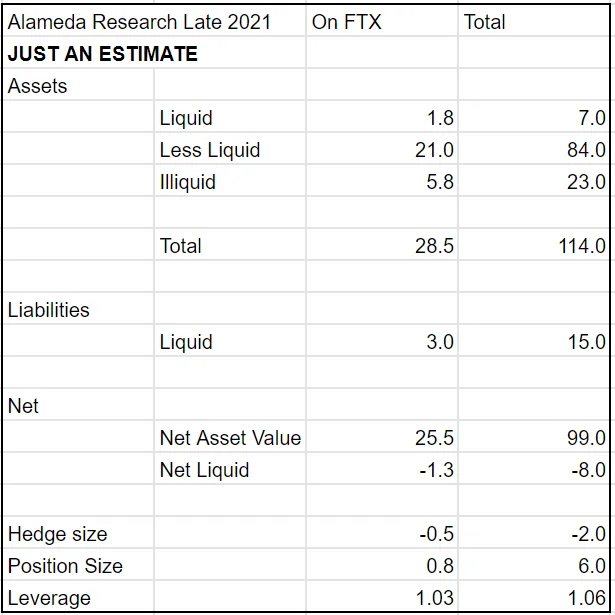
a) Over the course of 2021, Alameda’s balance sheet grew to roughly $100b of Net Asset Value, $8b of net borrowing (leverage), and $7b of liquidity on hand.

b) Alameda failed to sufficiently hedge its market exposure. Over the course of 2022, a series of large broad market crashes came–in stocks and in crypto–leading to a ~80% decrease in the market value of its assets.

c) In November 2022, an extreme, quick, targeted crash precipitated by the CEO of Binance made Alameda insolvent.

And then Alameda’s contagion spread to FTX and other places, similarly to how Three Arrows etc. ultimately impacted Voyager, Genesis, Celsius, BlockFi, Gemini, and others.

Despite this, very substantial recovery remains potentially available. FTX US remains fully solvent and should be able to return all customers’ funds. FTX International has many billions of dollars of assets, and I am dedicating nearly all of my personal assets to customers.

Notes

This post is about FTX International’s (in)solvency.

It’s not about FTX US, because FTX US is fully solvent and always has been

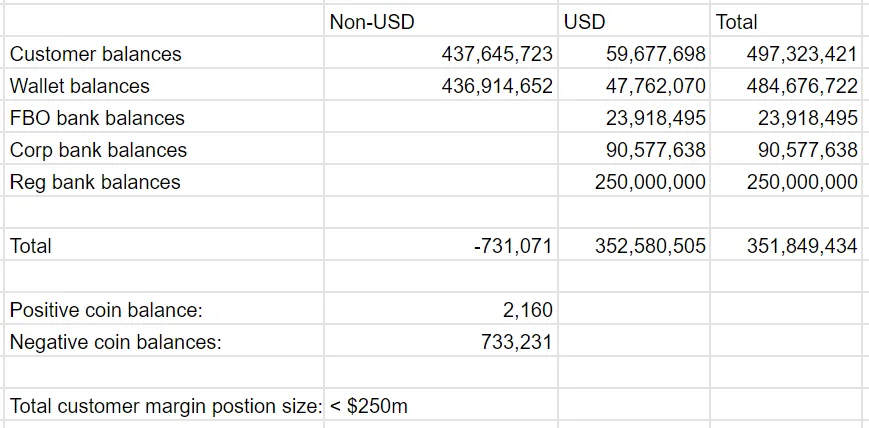
When I passed FTX US off to Mr. Ray and the Chapter 11 team, it had around +$350m net cash on hand beyond customer balances. Its funds and customers were segregated from FTX International.

It’s ridiculous that FTX US users haven’t been made whole and gotten their funds back yet.

Here is my record of FTX US’s balance sheet as of when I handed it off:

FTX International was a non-US exchange. It was run outside the US, regulated outside the US, incorporated outside the US, and took non-US customers.

(In fact, it was primarily headquartered, run from, and incorporated in The Bahamas, as FTX Digital Markets LTD.)

US customers were onboarded to the (still solvent) FTX US exchange.

Senators have raised concerns about a potential conflict of interest from Sullivan & Crowell (S&C). Contrary to S&C’s statement that they “had a limited and largely transactional relationship with FTX”, S&C was one of FTX International’s two primary law firms prior to bankruptcy, and were FTX US’s primary law firm. FTX US’ GC came from S&C, they worked with FTX US in its most important regulatory application, they worked with FTX International on some of its most important regulatory concerns, and they worked with FTX US on its most important transaction. When I would visit NYC, I would sometimes work out of S&C’s office.

S&C and the GC were the primary parties strong-arming and threatening me into naming the candidate they themselves chose as CEO of FTX--including for a solvent entity in FTX US--who then filed for Chapter 11 and chose S&C as counsel to the debtor entities.

Despite its insolvency, and despite processing roughly $5b of withdrawals over its last few days of operation, FTX International retains significant assets–roughly $8b of assets of varying liquidity as of when Mr. Ray took over.

In addition to that, there were numerous potential funding offers–including signed LOIs post chapter 11 filing totaling over $4b. I believe that, had FTX International been given a few weeks, it could likely have utilized its illiquid assets and equity to raise enough financing to make customers substantially whole.

Since S&C pressured FTX into Chapter 11 filings, however, I worry that those pathways may have been abandoned. Even now, I believe that if FTX International were to reboot, there would be a real possibility of customers being made substantially whole.

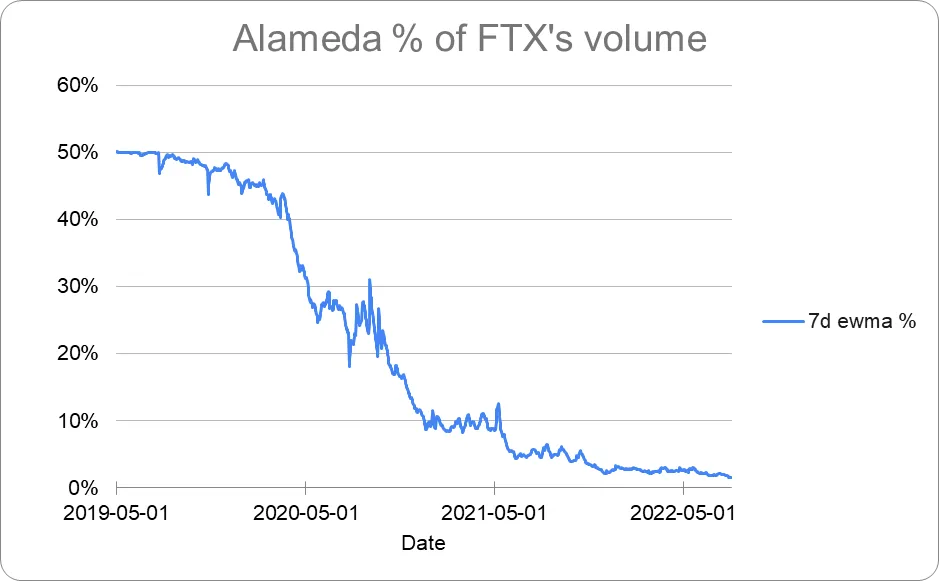
While FTX’s liquidity had started off in 2019 as largely dependent on Alameda, by 2022 it had greatly diversified, with Alameda falling to around 2% of volume on FTX.

I didn’t steal funds, and I certainly didn’t stash billions away. Nearly all of my assets were and still are utilizable to backstop FTX customers. I have, for instance, offered to contribute nearly all of my personal shares in Robinhood to customers–or 100%, if the Chapter 11 team would honor my D&O legal expense indemnification.

FTX International and Alameda were both legitimately and independently profitable businesses in 2021, each making billions.

And then Alameda lost about 80 percent of its assets’ value over the course of 2022, due to a series of market crashes–as did Three Arrows Capital (3AC) and other crypto firms last year–and after that its assets fell even more from a targeted attack. FTX was impacted by Alameda’s decline, as Voyager and others were earlier by 3AC and others.

Note that, in many places here, I’m still forced to make approximations. Many of my personal passwords are still being held by the Chapter 11 team–to say nothing about data. If the Chapter 11 team wants to add their data to the conversation, I would welcome that.

Also–I haven’t run Alameda for the past few years.

So much of this is pieced together post-hoc, coming from models and approximations, generally based on data that I had prior to resigning as CEO and modeling and estimations based on that data.

Overview of what happened

2021

Over the course of 2021, Alameda’s Net Asset Value skyrocketed, to roughly $100b marked to market by the end of the year by my model. Even if you ignore assets like SRM that had much larger fully diluted than circulating supplies, I think it was still roughly $50b.

And over the course of 2021, Alameda’s positions grew, too.

In particular, I think it had about $8b of net borrowing, which I believe was spent on:

a) ~$1b interest payments to lenders

b) ~$3b buying out Binance from FTX’s cap table

c) ~$4b venture investments

(By ‘net borrowing’, I mean, basically, borrowing minus liquid assets on hand that could be used to return the loans. This net borrowing in 2021 came primarily from third party borrow-lending desks–Genesis, Celsius, Voyager, etc., rather than from margin trading on FTX.)

So by the start of 2022, I believe that Alameda’s balance sheet looked roughly like the following:

a) ~$100b NAV

b) ~$12b liquidity from 3rd party desks (Genesis, etc.)

c) ~$10b more liquidity it likely could have gotten from them

d) ~1.06x leverage

In that context, the ~$8b illiquid position (with tens of billions of dollars of available credit/margin from third party lenders) seemed reasonable and not very risky. I think that Alameda’s SOL alone was enough to cover the net borrowing. And it was coming from third party borrow-lending desks, who were all–I was told–sent accurate balance sheets from Alameda.

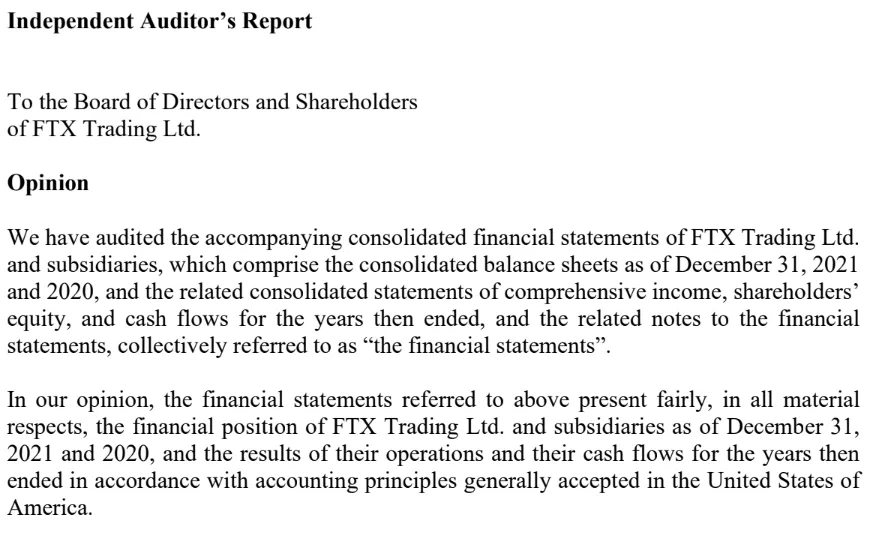
I think its position on FTX International was reasonable at the time–about $1.3b by my model, collateralized with tens of billions of dollars of assets–and FTX successfully passed a GAAP audit as of then.

As of the end of 2021, then, it would have taken a ~94% market crash to drag Alameda underwater! And not just in SRM and assets like it–Alameda was still massively overcollateralized if you ignore those. I think that its SOL position alone was larger than its leverage.

But Alameda failed to sufficiently hedge against the risk of an extreme market crash: the hundred billion of assets had only a few billion dollars of hedges. It had a net leverage–[net position - hedges]/NAV–of roughly 1.06x; it was long the market.

As a result, Alameda was in theory exposed to an extreme market crash–but it would take something like a 94% crash to bankrupt it.

2022 Market Crashes

Alameda, then, entered 2022 with roughly:

$100b NAV

$8b net borrow

1.06x leverage

Tens of billions of dollars of liquidity

Then, over the course of the year, markets crash–again and again and again. And Alameda repeatedly fails to sufficiently hedge its position until mid summer.

–BTC crashed 30%

–BTC crashed another 30%

–BTC crashed another 30%

–rising interest rates curtailed global financial liquidity

–Luna went to $0

–3AC blew out

–Alameda’s co-CEO quit

–Voyager blew out

–BlockFi almost blew out

–Celsius blew out

–Genesis started shutting down

–Alameda’s borrow/lending liquidity went from ~$20b in late 2021 to ~$2b by late 2022

And so Alameda’s assets get hit, again and again and again. But this part isn’t specific to Alameda’s assets. Bitcoin, Ethereum, Tesla, and Facebook are all down more than 60% on the year; Coinbase and Robinhood are down about 85% from their peaks last year.

Remember that, at the end of 2021, Alameda had roughly $8b of net borrowing:

a) ~$1b interest payments to lenders

b) ~$3b buying out Binance from FTX’s cap table

c) ~$4b venture investments

That $8b of net borrowing, less the few billion of hedges it had on, resulted in around $6b of excess leverage/net position, backed by ~$100b of assets.

And as markets crashed, so did those assets. Alameda’s assets–a combination of altcoins, crypto companies, public equities, and venture investments–fell around 80% over the course of the year, raising its leverage bit by bit.

And over the same period, liquidity dried up–in borrow-lending markets, public markets, credit, private equity, venture, and pretty much everything else. Nearly every liquidity source in crypto–including nearly all of the borrow-lending desks–blew out over the course of the year.

Which means that Alameda’s liquidity–tens of billions of dollars at the end of 2021–dropped to single digit billions by fall 2022. Most of the other platforms in the space had already gone under or were in the process of doing so, leaving FTX as the last man standing.

In the summer of 2022, Alameda finally put on substantial hedges, in some combination of BTC, ETH, and QQQ (a NASDAQ ETF).

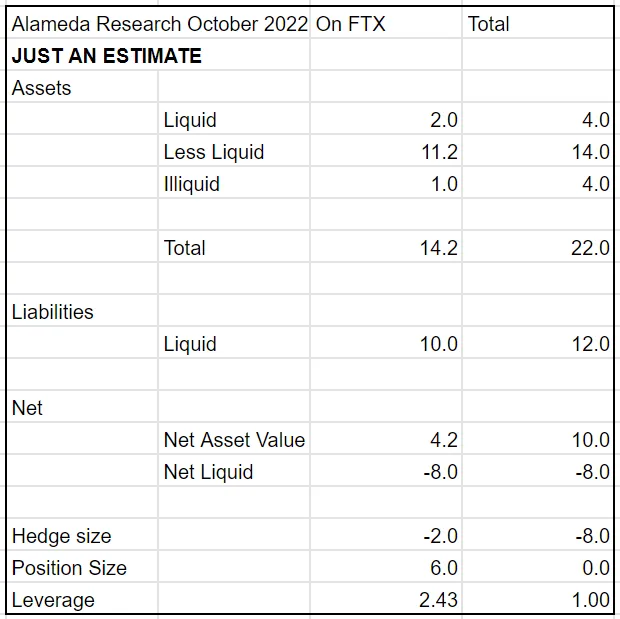
But even after all the market crashes of 2022, shortly before November Alameda still had ~$10b of net asset value; it was positive even if you excluded SRM and tokens like it, and it was finally hedged.

Margin Trading

Over the course of 2022, a number of crypto platforms became insolvent due to margin positions blowing out, likely including Voyager, Celsius, BlockFi, Genesis, Gemini, and ultimately FTX.

This is a fairly common on margin platforms; among others, it’s happened on:

Traditional Finance:

LME

MF Global

LTCM

Lehman

Crypto:

OKEx

OKEx again, and basically every week for a year

CoinFlex

EMX

Voyager, Celsius, BlockFi, Genesis, Gemini, etc.

The November Crash

Then came CZ’s fateful tweet, following an extremely effective months-long PR campaign against FTX–and the crash.

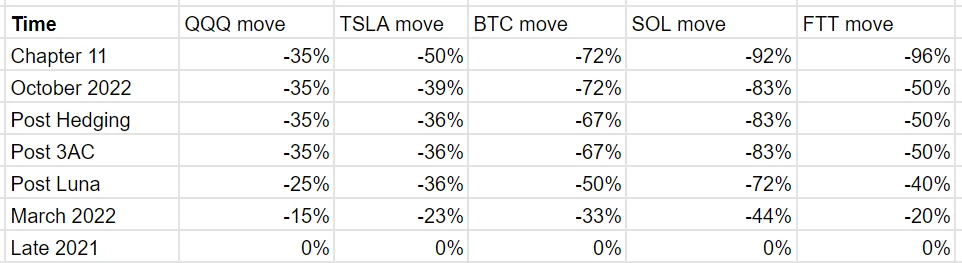
Up until that final crash in November, QQQ had moved roughly half as much as Alameda’s portfolio, and BTC/ETH had moved roughly 80% as much–meaning that Alameda’s hedges (QQQ/BTC/ETH), to the extent they existed, had worked. Unfortunately the hedges hadn’t been sufficiently large until after the 3AC crash–but as of October 2022, they finally were.

But the November crash was a targeted attack on assets held by Alameda, not a broad market move. Over the few days in November, Alameda’s assets fell roughly 50%; BTC fell about 15%--only 30% as much as Alameda’s assets–and QQQ didn’t move at all. As a result, the larger hedge that Alameda had finally put on that summer didn’t end up helping. It would have for every previous crash that year–but not for this one.

Over the course of November 7th and 8th, things went from stressful but mostly under control to clearly insolvent.

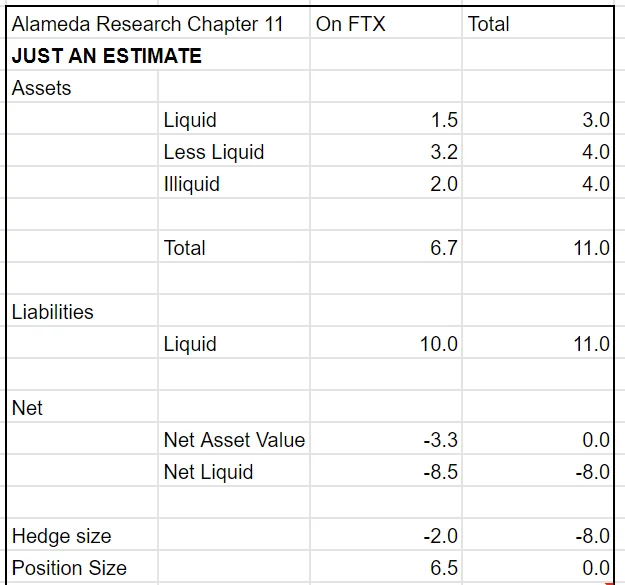
By November 10th, 2022, Alameda’s balance sheet had only ~$8b of (only semi-liquid) assets left, versus roughly the same ~$8b of liquid liabilities:

And a run on the bank required immediate liquidity—liquidity that Alameda no longer had.

Credit Suisse fell nearly 50% this autumn on the threat of a run on the bank. At the end of the day, its run on the bank fell short. FTX’s didn’t.

And so, as Alameda became illiquid, FTX International did as well, because Alameda had a margin position open on FTX; and the run on the bank turned that illiquidity into insolvency.

Meaning that FTX joined Voyager, Celsius, BlockFi, Genesis, Gemini, and others that experienced collateral damage from the liquidity crunch of their borrowers.

All of which is to say: no funds were stolen. Alameda lost money due to a market crash it was not adequately hedged for–as Three Arrows and others have this year. And FTX was impacted, as Voyager and others were earlier.

Coda

Even then, I think it’s likely that FTX could have made all customers whole if a concerted effort had been made to raise liquidity.

There were billions of dollars of funding offers when Mr. Ray took over, and more than $4b that came in after.

If FTX had been given a few weeks to raise the necessary liquidity, I believe it would have been able to make customers substantially whole. I didn’t realize at the time that Sullivan & Cromwell—via pressure to instate Mr. Ray and file Chapter 11, including for solvent companies like FTX US–would potentially quash those efforts. I still think that, if FTX International were to reboot today, there would be a real possibility of making customers substantially whole. And even without that, there are significant assets available for customers.

I’ve been, regrettably, slow to respond to public misperceptions and material misstatements. It took me some time to piece together what I could–I don’t have access to much of the relevant data, much of which is for a company (Alameda) I wasn’t running at the time.

I had been planning to give my first substantive account of what happened in testimony to the US House Financial Services Committee on December 13th. Unfortunately, the DOJ moved to arrest me the night before, preempting my testimony with an entirely different news cycle. For what it’s worth, a draft of the testimony I planned to give leaked out here.

I have a lot more to say–about why Alameda failed to hedge, what happened with FTX US, what led to the Chapter 11 process, S&C, and more. But at least this is a start.


Criptos en tendencia

Lecturas Relacionadas

The Full Story Behind Encryption Unicorn Blockstream's Deep Entanglement in Serious Fraud Allegations

This article details allegations of serious fraud surrounding the crypto company Blockstream, founded by Bitcoin pioneer Adam Back. Investigation account NatInfoSec accuses Blockstream of raising billions through its Blockstream Mining Note (BMN) products, which offer high fixed yields of up to 20% from purported mining revenue. The core allegations are: 1) Blockstream's public mining hash rate (15 EH/s) appears insufficient to cover the massive payout obligations from sold BMN notes, raising questions about the true source of investor payouts. 2) Key executive Christopher William Cook, central to the mining operations, has a prior federal conviction for mail fraud, a fact not disclosed to investors. Cook's background and lavish lifestyle are highlighted as red flags. 3) The structure allows payouts from any source of BTC, not necessarily mining revenue, which critics argue gives it Ponzi-like characteristics. The controversy also touches on Bitcoin Standard Treasury Company (BSTR), a related entity planning a SPAC上市. Critics question whether BMN's liabilities and Cook's record should be disclosed in BSTR's filings. BitMEX Research offered a tempered analysis, confirming Cook's criminal record is likely true and the high yields concerning, but found other claims like insufficient抵押证据 less substantiated. Community debate centers on the need for verifiable proof of Blockstream's mining output and revenue. The article concludes that while fraud is not proven, BMN presents significant, unresolved questions regarding its actual scale, the source of its high fixed returns, the verifiability of its mining operations and payouts, and the full disclosure of associated risks and personnel backgrounds. Blockstream has not yet issued a formal response.

链捕手Hace 1 hora(s)

The Full Story Behind Encryption Unicorn Blockstream's Deep Entanglement in Serious Fraud Allegations

链捕手Hace 1 hora(s)

a16z: In the AI Era, Company Competition for Talent Starts with Job Title Naming

The article discusses how companies in the AI era are competing for talent through strategic "title arbitrage," or the renaming of key roles to reflect and attract new, high-value capabilities. It uses Palantir's creation of the "Forward-Deployed Engineer" (FDE) as a prime example. This title reframed client-facing technical work from a peripheral "implementation" role into a core, high-status engineering function. The move was strategic, allowing Palantir to attract talent that blended technical skill with business acumen and to dominate the market's perception of this capability. The piece argues that job titles are an organizational language that signals the value and authority of certain work. Effective new titles, like "Data Scientist" or "Site Reliability Engineer," emerge when a role's strategic importance genuinely outgrows its old name. Conversely, mere title inflation without substantive change is ineffective. For AI companies, particularly in B2B, this is a crucial strategy. AI transformation creates new high-leverage roles (e.g., "Legal Engineer," "GTM Engineer") that combine domain expertise with technical automation. By naming these roles, a company can help clients internally legitimize these change-makers. This, in turn, builds market mindshare, associating the company with the new capability. In conclusion, as AI blurs the lines between product and service, the ability to accurately name and organize the critical, client-adjacent work that defines product learning will be a key competitive advantage. The first to define this new organizational language plants a flag in the market's mind.

marsbitHace 2 hora(s)

a16z: In the AI Era, Company Competition for Talent Starts with Job Title Naming

marsbitHace 2 hora(s)

Trading

Spot
Futuros

Artículos destacados

Qué es BITCOIN

Entendiendo HarryPotterObamaSonic10Inu (ERC-20) y Su Posición en el Espacio Cripto En los últimos años, el mercado de criptomonedas ha sido testigo de un aumento en la popularidad de las monedas meme, capturando el interés no solo de los comerciantes, sino también de aquellos que buscan compromiso comunitario y valor de entretenimiento. Entre estos tokens únicos se encuentra HarryPotterObamaSonic10Inu (ERC-20), un proyecto intrigante que mezcla referencias culturales en el tejido de las criptomonedas. Este artículo profundiza en los aspectos clave de HarryPotterObamaSonic10Inu, explorando sus mecanismos, ethos impulsado por la comunidad y su relación con el paisaje cripto más amplio. ¿Qué es HarryPotterObamaSonic10Inu (ERC-20)? Como su nombre sugiere, HarryPotterObamaSonic10Inu es una moneda meme construida sobre la blockchain de Ethereum, clasificada bajo el estándar ERC-20. A diferencia de las criptomonedas tradicionales que pueden enfatizar la utilidad práctica o el potencial de inversión, este token prospera en el valor de entretenimiento y la fuerza de su comunidad. El proyecto tiene como objetivo fomentar un entorno donde los usuarios comprometidos puedan reunirse, compartir ideas y participar en actividades inspiradas por diversos fenómenos culturales. Una característica notable de HarryPotterObamaSonic10Inu es su cero impuestos en las transacciones. Este atractivo elemento tiene como objetivo incentivar el comercio y la participación comunitaria, sin cargos adicionales que puedan disuadir a los comerciantes de pequeña escala. El suministro total de la moneda está establecido en mil millones de tokens, una cifra que marca su intención de mantener una circulación sustancial dentro de la comunidad. Creador de HarryPotterObamaSonic10Inu (ERC-20) Los orígenes de HarryPotterObamaSonic10Inu están algo envueltos en misterio; los detalles sobre el creador siguen siendo desconocidos. El desarrollo de este token carece de un equipo identificable o de un plan explícito, lo cual no es inusual dentro del sector de monedas meme. En cambio, el proyecto ha surgido de manera orgánica, con su progreso muy dependiente del entusiasmo y la participación de su comunidad. Inversores de HarryPotterObamaSonic10Inu (ERC-20) En cuanto a inversiones externas y respaldo, HarryPotterObamaSonic10Inu también sigue siendo ambiguo. El token no lista ninguna fundación de inversión conocida o apoyo organizacional significativo. En cambio, la savia del proyecto es su comunidad de base, que informa su crecimiento y sostenibilidad a través de la acción colectiva y el compromiso en el espacio cripto. ¿Cómo Funciona HarryPotterObamaSonic10Inu (ERC-20)? Como una moneda meme, HarryPotterObamaSonic10Inu opera principalmente fuera de los marcos tradicionales que a menudo rigen el valor de los activos. Hay varios aspectos distintivos que definen cómo funciona el proyecto: Transacciones Sin Impuestos: Sin tarifas impositivas en las transacciones, los usuarios pueden comprar y vender el token libremente sin preocuparse por costos ocultos. Compromiso Comunitario: El proyecto prospera en la interacción comunitaria, aprovechando plataformas de redes sociales para crear entusiasmo y facilitar la participación. Las discusiones, el intercambio de contenido y el compromiso son elementos cruciales que ayudan a expandir su alcance y fomentar la lealtad entre los seguidores. Sin Utilidad Práctica: Cabe señalar que HarryPotterObamaSonic10Inu no ofrece utilidad concreta dentro del ecosistema financiero. Más bien, se clasifica como un token principalmente para actividades de entretenimiento y comunitarias. Referencia Cultural: El token incorpora astutamente elementos de la cultura popular para atraer interés, conectando con entusiastas de los memes y seguidores de las criptomonedas por igual. HarryPotterObamaSonic10Inu ejemplifica cómo las monedas meme operan de manera diferente a los proyectos de criptomonedas más tradicionales, ingresando al mercado como construcciones sociales innovadoras en lugar de activos utilitarios. Cronología de HarryPotterObamaSonic10Inu (ERC-20) La historia de HarryPotterObamaSonic10Inu está marcada por varios hitos notables: Creación: El token surgió de un meme viral, capturando la imaginación de muchos entusiastas de las criptomonedas. Las fechas específicas de creación no están disponibles, subrayando su ascenso orgánico. Listado en Exchanges: HarryPotterObamaSonic10Inu ha llegado a varios exchanges, permitiendo un acceso y comercio más fácil por parte de la comunidad. Iniciativas de Compromiso Comunitario: Actividades continuas destinadas a mejorar la interacción comunitaria, incluyendo concursos, campañas en redes sociales y generación de contenido por parte de fanáticos y defensores. Planes de Expansión Futuros: La hoja de ruta del proyecto incluye el lanzamiento de una colección de NFT, mercancía y un sitio de comercio electrónico relacionado con sus temas culturales, involucrando aún más a la comunidad e intentando añadir más dimensiones a su ecosistema. Puntos Clave Sobre HarryPotterObamaSonic10Inu (ERC-20) Naturaleza Impulsada por la Comunidad: El proyecto prioriza la participación colectiva y la creatividad, asegurando que la involucración de los usuarios esté a la vanguardia de su desarrollo. Clasificación como Moneda Meme: Representa la epítome de las criptomonedas basadas en el entretenimiento, diferenciándose de los vehículos de inversión tradicionales. Sin Afiliación Directa con Bitcoin: A pesar de la similitud en el nombre del ticker, HarryPotterObamaSonic10Inu es distinto y no tiene relación con Bitcoin u otras criptomonedas establecidas. Enfoque en la Colaboración: HarryPotterObamaSonic10Inu está diseñado para crear un espacio para la colaboración y el intercambio de historias entre sus poseedores, proporcionando una vía para la creatividad y el vínculo comunitario. Perspectivas Futuras: La ambición de expandirse más allá de su premisa inicial hacia NFTs y mercancías describe un camino para que el proyecto potencialmente ingrese a avenidas más tradicionales dentro de la cultura digital. A medida que las monedas meme continúan capturando la imaginación de la comunidad de criptomonedas, HarryPotterObamaSonic10Inu (ERC-20) se destaca debido a sus lazos culturales y su enfoque centrado en la comunidad. Si bien puede no encajar en el molde típico de un token impulsado por la utilidad, su esencia radica en la alegría y la camaradería fomentadas entre sus seguidores, destacando la naturaleza en evolución de las criptomonedas en una era cada vez más digital. A medida que el proyecto continúa desarrollándose, será importante observar cómo las dinámicas comunitarias influyen en su trayectoria en el cambiante paisaje de la tecnología blockchain.

1.8k Vistas totalesPublicado en 2024.04.01Actualizado en 2024.12.03

Qué es BITCOIN

Cómo comprar BTC

¡Bienvenido a HTX.com! Hemos hecho que comprar Bitcoin (BTC) sea simple y conveniente. Sigue nuestra guía paso a paso para iniciar tu viaje de criptos.Paso 1: crea tu cuenta HTXUtiliza tu correo electrónico o número de teléfono para registrarte y obtener una cuenta gratuita en HTX. Experimenta un proceso de registro sin complicaciones y desbloquea todas las funciones.Obtener mi cuentaPaso 2: ve a Comprar cripto y elige tu método de pagoTarjeta de crédito/débito: usa tu Visa o Mastercard para comprar Bitcoin (BTC) al instante.Saldo: utiliza fondos del saldo de tu cuenta HTX para tradear sin problemas.Terceros: hemos agregado métodos de pago populares como Google Pay y Apple Pay para mejorar la comodidad.P2P: tradear directamente con otros usuarios en HTX.Over-the-Counter (OTC): ofrecemos servicios personalizados y tipos de cambio competitivos para los traders.Paso 3: guarda tu Bitcoin (BTC)Después de comprar tu Bitcoin (BTC), guárdalo en tu cuenta HTX. Alternativamente, puedes enviarlo a otro lugar mediante transferencia blockchain o utilizarlo para tradear otras criptomonedas.Paso 4: tradear Bitcoin (BTC)Tradear fácilmente con Bitcoin (BTC) en HTX's mercado spot. Simplemente accede a tu cuenta, selecciona tu par de trading, ejecuta tus trades y monitorea en tiempo real. Ofrecemos una experiencia fácil de usar tanto para principiantes como para traders experimentados.

5.2k Vistas totalesPublicado en 2024.12.12Actualizado en 2026.06.02

Cómo comprar BTC

Qué es $BITCOIN

ORO DIGITAL ($BITCOIN): Un Análisis Integral Introducción al ORO DIGITAL ($BITCOIN) ORO DIGITAL ($BITCOIN) es un proyecto basado en blockchain que opera en la red Solana, cuyo objetivo es combinar las características de los metales preciosos tradicionales con la innovación de las tecnologías descentralizadas. Aunque comparte un nombre con Bitcoin, a menudo referido como “oro digital” debido a su percepción como un refugio de valor, ORO DIGITAL es un token separado diseñado para crear un ecosistema único dentro del paisaje Web3. Su meta es posicionarse como un activo digital alternativo viable, aunque los detalles sobre sus aplicaciones y funcionalidades aún están en desarrollo. ¿Qué es ORO DIGITAL ($BITCOIN)? ORO DIGITAL ($BITCOIN) es un token de criptomoneda diseñado explícitamente para su uso en la blockchain de Solana. A diferencia de Bitcoin, que proporciona un papel de almacenamiento de valor ampliamente reconocido, este token parece centrarse en aplicaciones y características más amplias. Aspectos notables incluyen: Infraestructura Blockchain: El token está construido sobre la blockchain de Solana, conocida por su capacidad para manejar transacciones de alta velocidad y bajo costo. Dinámicas de Suministro: ORO DIGITAL tiene un suministro máximo limitado a 100 cuatrillones de tokens (100P $BITCOIN), aunque los detalles sobre su suministro circulante no se han divulgado actualmente. Utilidad: Si bien las funcionalidades precisas no están delineadas explícitamente, hay indicios de que el token podría ser utilizado para diversas aplicaciones, potencialmente involucrando aplicaciones descentralizadas (dApps) o estrategias de tokenización de activos. ¿Quién es el Creador de ORO DIGITAL ($BITCOIN)? En la actualidad, la identidad de los creadores y el equipo de desarrollo detrás de ORO DIGITAL ($BITCOIN) sigue siendo desconocida. Esta situación es típica entre muchos proyectos innovadores dentro del espacio blockchain, particularmente aquellos alineados con las finanzas descentralizadas y fenómenos de monedas meme. Si bien tal anonimato puede fomentar una cultura impulsada por la comunidad, intensifica las preocupaciones sobre la gobernanza y la responsabilidad. ¿Quiénes son los Inversores de ORO DIGITAL ($BITCOIN)? La información disponible indica que ORO DIGITAL ($BITCOIN) no tiene patrocinadores institucionales conocidos ni inversiones destacadas de capital de riesgo. El proyecto parece operar en un modelo de peer-to-peer centrado en el apoyo y la adopción de la comunidad en lugar de rutas de financiamiento tradicionales. Su actividad y liquidez se sitúan principalmente en intercambios descentralizados (DEX), como PumpSwap, en lugar de plataformas de trading centralizadas establecidas, lo que resalta aún más su enfoque de base. Cómo Funciona ORO DIGITAL ($BITCOIN) Los mecanismos operativos de ORO DIGITAL ($BITCOIN) pueden elaborarse en función de su diseño blockchain y atributos de red: Mecanismo de Consenso: Al aprovechar el único proof-of-history (PoH) de Solana combinado con un modelo de proof-of-stake (PoS), el proyecto asegura una validación de transacciones eficiente que contribuye al alto rendimiento de la red. Tokenómica: Si bien los mecanismos deflacionarios específicos no se han detallado extensamente, el vasto suministro máximo de tokens implica que podría atender microtransacciones o casos de uso nicho que aún están por definirse. Interoperabilidad: Existe el potencial de integración con el ecosistema más amplio de Solana, incluyendo varias plataformas de finanzas descentralizadas (DeFi). Sin embargo, los detalles sobre integraciones específicas permanecen no especificados. Cronología de Eventos Clave Aquí hay una cronología que destaca hitos significativos relacionados con ORO DIGITAL ($BITCOIN): 2023: El despliegue inicial del token ocurre en la blockchain de Solana, marcado por su dirección de contrato. 2024: ORO DIGITAL gana visibilidad al estar disponible para trading en intercambios descentralizados como PumpSwap, permitiendo a los usuarios comerciar contra SOL. 2025: El proyecto presencia actividad de trading esporádica y potencial interés en compromisos liderados por la comunidad, aunque no se han documentado asociaciones notables o avances técnicos hasta el momento. Análisis Crítico Fortalezas Escalabilidad: La infraestructura subyacente de Solana soporta altos volúmenes de transacciones, lo que podría mejorar la utilidad de $BITCOIN en varios escenarios de transacción. Accesibilidad: El potencial bajo precio de trading por token podría atraer a inversores minoristas, facilitando una participación más amplia debido a oportunidades de propiedad fraccionada. Riesgos Falta de Transparencia: La ausencia de patrocinadores, desarrolladores o un proceso de auditoría conocidos públicamente puede generar escepticismo sobre la sostenibilidad y confiabilidad del proyecto. Volatilidad del Mercado: La actividad de trading depende en gran medida del comportamiento especulativo, lo que puede resultar en una volatilidad de precios significativa y en incertidumbre para los inversores. Conclusión ORO DIGITAL ($BITCOIN) surge como un proyecto intrigante pero ambiguo dentro del ecosistema de Solana en rápida evolución. Si bien intenta aprovechar la narrativa del “oro digital”, su alejamiento del papel establecido de Bitcoin como refugio de valor subraya la necesidad de una diferenciación más clara de su utilidad y estructura de gobernanza previstas. La aceptación y adopción futura dependerán probablemente de abordar la actual opacidad y de definir sus estrategias operativas y económicas de manera más explícita. Nota: Este informe abarca información sintetizada disponible hasta octubre de 2023, y pueden haber ocurrido desarrollos más allá del período de investigación.

96 Vistas totalesPublicado en 2025.05.13Actualizado en 2025.05.13

Qué es $BITCOIN

Discusiones

Bienvenido a la comunidad de HTX. Aquí puedes mantenerte informado sobre los últimos desarrollos de la plataforma y acceder a análisis profesionales del mercado. A continuación se presentan las opiniones de los usuarios sobre el precio de BTC (BTC).

活动图片