The Full Story Behind Encryption Unicorn Blockstream's Deep Entanglement in Serious Fraud Allegations

链捕手Publicado a 2026-06-24Actualizado a 2026-06-24

Resumen

This article details allegations of serious fraud surrounding the crypto company Blockstream, founded by Bitcoin pioneer Adam Back. Investigation account NatInfoSec accuses Blockstream of raising billions through its Blockstream Mining Note (BMN) products, which offer high fixed yields of up to 20% from purported mining revenue. The core allegations are: 1) Blockstream's public mining hash rate (15 EH/s) appears insufficient to cover the massive payout obligations from sold BMN notes, raising questions about the true source of investor payouts. 2) Key executive Christopher William Cook, central to the mining operations, has a prior federal conviction for mail fraud, a fact not disclosed to investors. Cook's background and lavish lifestyle are highlighted as red flags. 3) The structure allows payouts from any source of BTC, not necessarily mining revenue, which critics argue gives it Ponzi-like characteristics. The controversy also touches on Bitcoin Standard Treasury Company (BSTR), a related entity planning a SPAC上市. Critics question whether BMN's liabilities and Cook's record should be disclosed in BSTR's filings. BitMEX Research offered a tempered analysis, confirming Cook's criminal record is likely true and the high yields concerning, but found other claims like insufficient抵押证据 less substantiated. Community debate centers on the need for verifiable proof of Blockstream's mining output and revenue. The article concludes that while fraud is not proven, BMN presents si...

Author: Zhou, ChainCatcher


This year, Bitcoin pioneer Adam Back and the company he founded, Blockstream, have repeatedly found themselves at the center of discussions within the crypto community.

In February, documents related to Epstein released by the U.S. Department of Justice disclosed that Jeffrey Epstein had invested in Blockstream in 2014 through a fund related to Joichi Ito.

In April, an investigative report published by The New York Times listed Adam Back as one of the strongest candidates for being Bitcoin's inventor, Satoshi Nakamoto.

Simultaneously, the Bitcoin treasury company BSTR, which he is involved in promoting, is preparing to go public via a SPAC merger.

However, new controversies soon emerged. Earlier this month, the investigative account NatInfoSec published a lengthy article alleging that Blockstream may be raising billions of dollars from investors under the guise of mining revenue, but the actual mining facilities and supporting hash rate are questionable, and the structure resembles a Ponzi scheme.

The article used strong language. Although some inferences still require independent verification, the several points of doubt it raised have prompted the market to re-examine Blockstream.
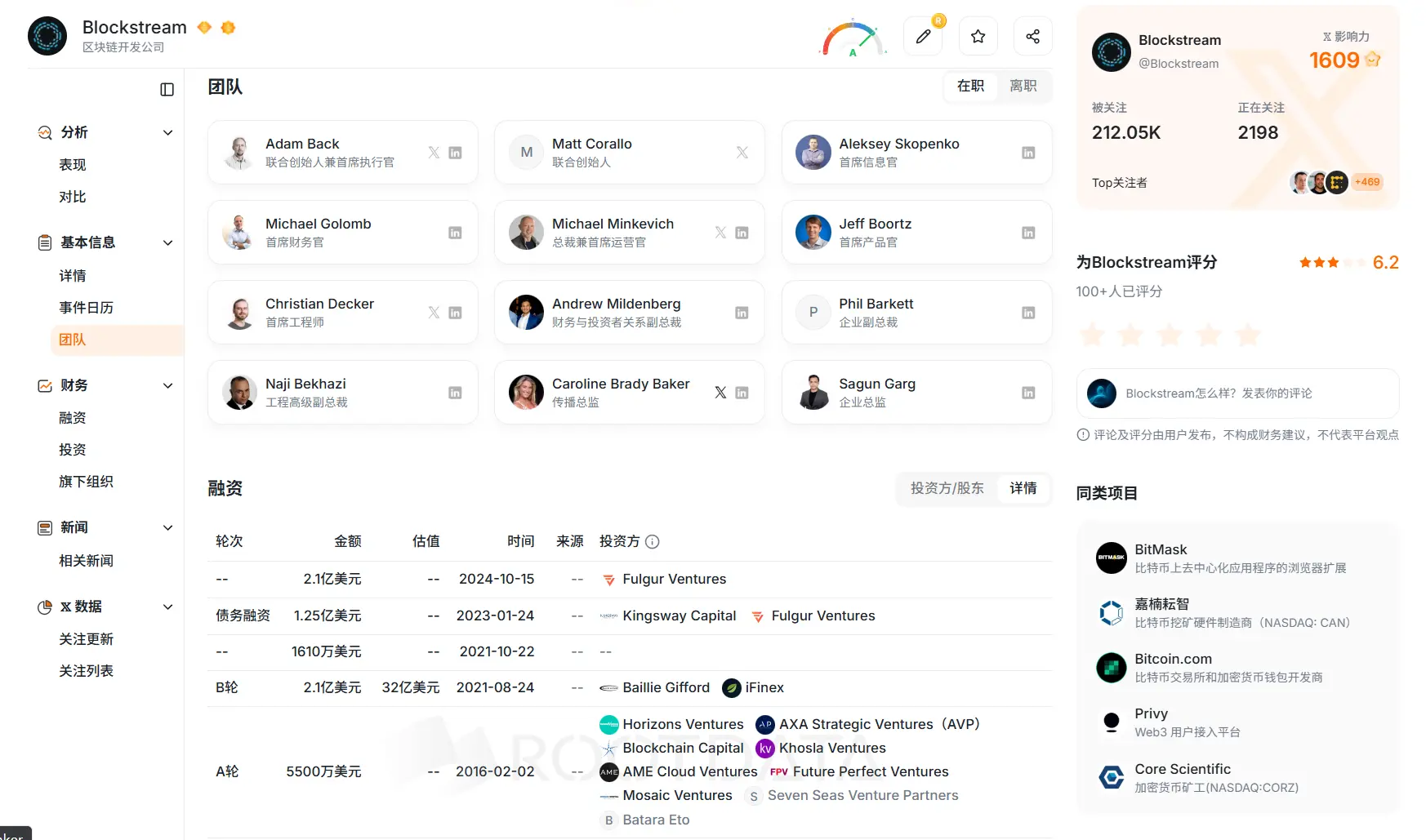
Image source:RootData


Chain of Allegations: Hash Rate, Revenue, and Disclosure Doubts

1. Doubts About Hash Rate and Payment Capacity

This is the most solid part of the financial logic in the allegations. NatInfoSec points out that to meet the obligations of the currently issued BMNs (Blockstream Mining Notes), Blockstream would need to operate over 20 EH/s of hash rate. If contract buffer clauses are included, the required hash rate could be as high as 35 to 45 EH/s. However, Blockstream's own dashboard shows its current actual hash rate is only 15 EH/s.

A mining facility of that scale should appear in public records such as ERCOT grid connection filings in Texas, power purchase agreements with Hydro-Québec, customs import data for ASIC equipment, hash rate attribution on mining pools, and coinbase signatures on-chain. NatInfoSec claims it could not find evidence matching the scale of Blockstream's notes in the aforementioned public channels.

In NatInfoSec's view, if mining output cannot cover payment obligations, it is necessary to question where the BTC ultimately received by investors comes from. The article specifically mentions the 'Substitute Performance BTC' mechanism in the BMN2 terms, stating that this clause allows Blockstream to fulfill its delivery obligations with BTC from any source during the 48-month contract period, without prior notice, without disclosing the source, and with no upper limit on quantity.

The article also claims that BMN1 once made up for payment shortfalls by purchasing BTC on the open market. This shifts the core question of BMNs from "is the mining revenue sufficient" to "is the source of payments verifiable."

2. High Returns and High-Risk Debt

The article mentions that Blockstream has issued related notes of different tiers through platforms like STOKR, with yields gradually increasing from about 9.775% to 18%, with the latest tier approaching 20%.However, some maturity arrangements are reportedly not direct principal repayments but are rolled over into new notes with higher yields. However, these claims still need further verification against the original issuance documents.

It is well known that Bitcoin mining is a highly cyclical industry, with real-time fluctuations in miner prices, network hash rate, difficulty adjustments, electricity prices, and BTC prices, making it difficult for mining companies to promise static fixed returns externally. Fixed annualized returns around 20%, in this industry context, require the issuer to provide a clear source explanation.

3. Chris Cook's Past Conviction and Disclosure Issues

The most impactful part of the allegations concerns the background of Christopher William Cook.

NatInfoSec states that Cook was once an important person in charge of Blockstream's mining business and currently serves as the CEO of Exacore. The article points out that Exacore is a related operating entity spun off from Blockstream's mining business. After reviewing U.S. federal court records, NatInfoSec claims to have found that Cook was sentenced in 2008 by the U.S. District Court for the Southern District of Florida to 41 months in federal prison for mail fraud (case number 06-80187) and ordered to pay approximately $1.85 million in restitution.

The core method of the case was commercial credit fraud: registering multiple shell companies, forging financial statements and bank information to defraud goods worth over $1.8 million from more than 30 retailers, then reselling them for cash.

The article notes that this conviction record does not appear in any BMN issuance documents. Furthermore, Blockstream's marketing materials on the STOKR platform allegedly claimed Cook "formerly worked at NASA," but his actual connection to NASA was reportedly only a student tour project he participated in at age 18.

Additionally, NatInfoSec further listed clues about Cook's recent purchases of mansions, airplanes, yachts, investments in Trump Media stock, and several supplier lawsuits, alleging funding flow and governance risks behind the BMNs.
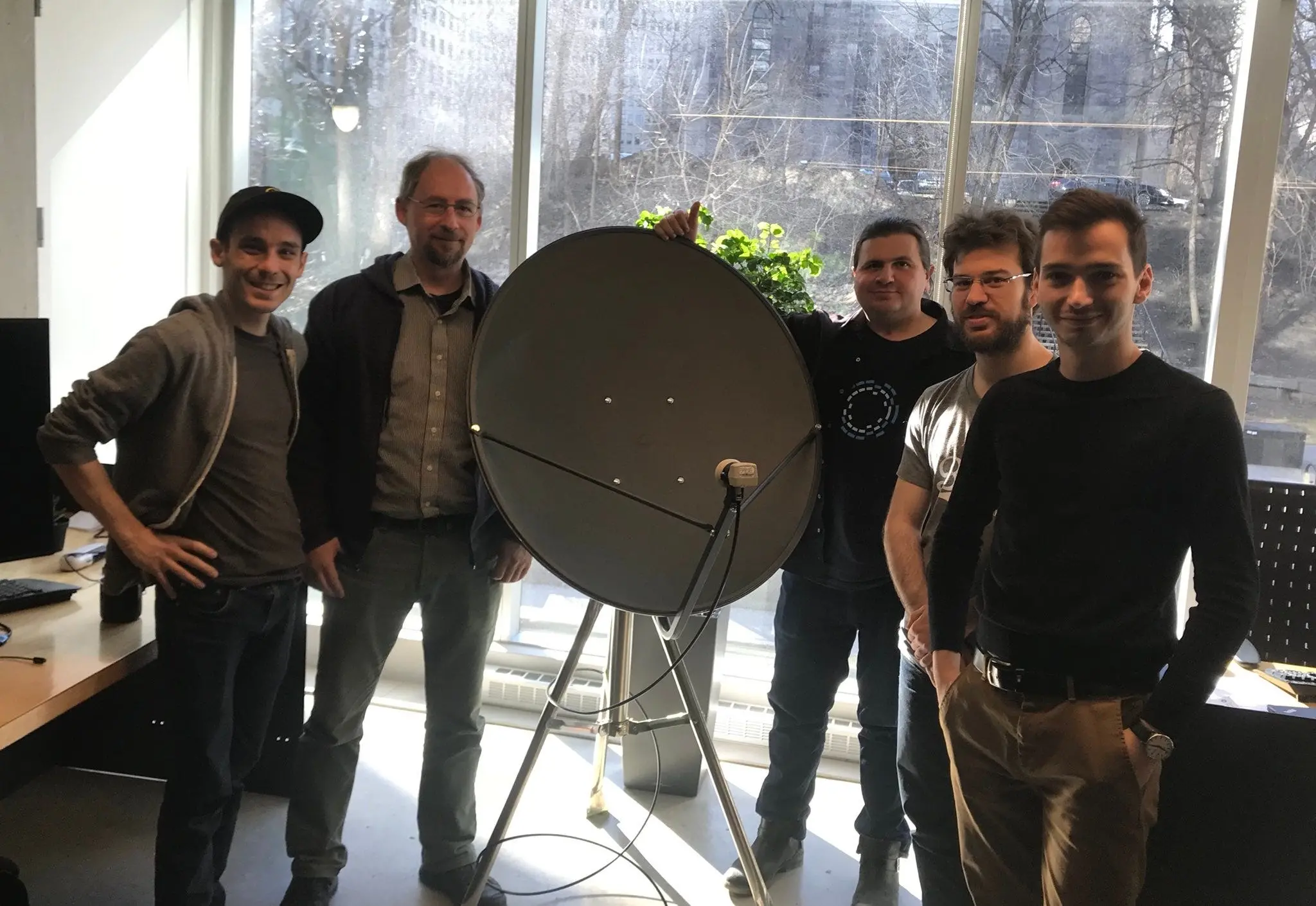
4. BSTR/SPAC Controversy and Linkage

NatInfoSec also attempts to extend the BMN controversy to Bitcoin Standard Treasury Company (referred to as BSTR). The company, related to Adam Back, is reportedly preparing to go public via a SPAC merger. NatInfoSec questions why Cook's conviction record and the BMNs' massive potential liabilities do not appear in SEC registration filings and raises concerns about BSTR's governance structure, including Adam Back signing agreements representing both sides of the transaction and custodian Komainu having equity ties with Blockstream.

However, this is the part of the allegations most easily rebutted. The legal relationships, guarantee structures, and liability boundaries between BMNs, Blockstream, Exacore, and BSTR are currently not clear. If the related notes have no group guarantee and are not included in the BSTR listing entity, directly equating BMN risk with BSTR risk may involve excessive extrapolation.


BitMEX Cools the Waters, Community Demands Verifiability

On June 21, BitMEX Research published a commentary article addressing NatInfoSec's allegations point by point. BitMEX acknowledged that Cook's criminal past is likely true and that NatInfoSec probably identified the same person. Regarding the nearly 20% yield, BitMEX also expressed concern, stating it requires further explanation from the issuer.

However, for the other allegations, BitMEX considered the evidence insufficient or misleading. Regarding the non-disclosure of Cook's past in BSTR SEC filings, BitMEX's judgment was that Cook is not a director of BSTR, and the mining business is not expected to be included in the listing entity, so there is no mandatory disclosure obligation. Regarding whether BMN liabilities should be counted in BSTR, BitMEX believes there are no group guarantee clauses in the BMN documents, making them legally independent structures. Regarding the allegation of insufficient L-BTC collateral, BitMEX considered that the original article cited data from a code error on the liquid.network website, which has been fixed and now displays normally.

Furthermore, the debate continues at the community level. Former Blockstream CSO, now Jan3 CEO, Samson Mow, defended the BSTR narrative on X. He argued that the market should not focus only on short-term controversies but see that more Bitcoin treasury companies are about to enter the market. Mow stated that BSTR is about to enter the market with $1.5 billion in funds and will become an important competitor in the BTC asset accumulation race.

But critics quickly brought the question back to the BMNs themselves. Prominent Bitcoin commentator Matthew R. Kratter responded by directly questioning whether Adam Back's so-called "cloud mining Ponzi" allegations would affect BSTR's launch. He then further questioned which mining pool Blockstream actually uses, whether the public can verify pool shares accordingly, and demanded a response on whether Cook's background should have been disclosed in SEC filings.
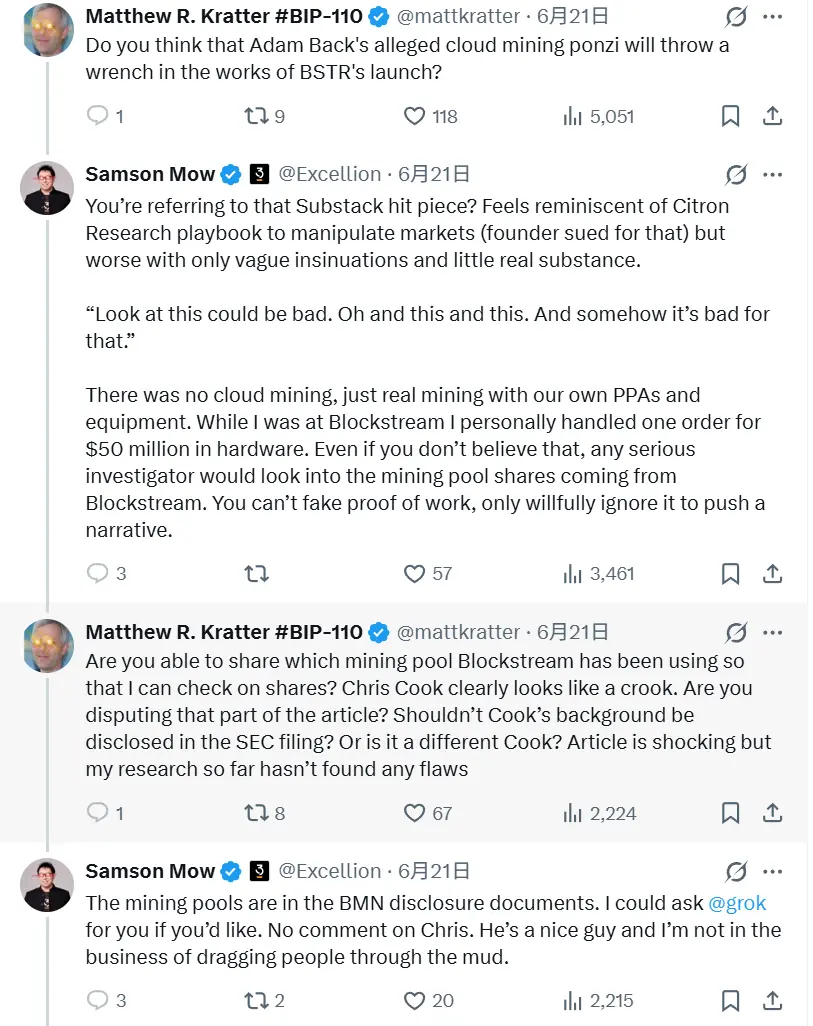
The debate escalated further around hash rate verifiability. Mow responded that the term "cloud mining" is not accurate; Blockstream is engaged in real mining using its own PPAs and equipment. He also mentioned that during his tenure at Blockstream, he personally handled a $50 million hardware order and stated that serious investigators should look at the mining pool shares from Blockstream, not ignore PoW evidence.

However, skeptics did not accept this explanation. Developer Chris Guida countered, asking where the public can openly verify hash rate from Blockstream. He argued that merely knowing which mining pools are mentioned in BMN documents does not prove that the valid shares in those pools actually come from Blockstream, unless Blockstream or the pools publicly label the source of that hash rate.

This debate compresses the core issue of BMNs to one point: Whether Blockstream is engaged in real mining is not the only problem; the real problem is whether investors and external observers can independently verify this hash rate, revenue, and source of payments.


BMNs Still Await Answers: Real Assets and Liability Boundaries

Despite the evident polarization of community views on this incident, it has not resolved the questions surrounding the BMNs themselves. Regarding this mining note product, the market still lacks several key pieces of information.

First, what exactly are the actual issuance scale, outstanding obligations, and liability boundaries of the BMNs? Authorized issuance scale, actual issuance scale, outstanding scale, maturity structure, and related guarantees are not the same thing. The market needs to know where the risk of this mining note actually resides and whether it could spill over to Blockstream or other related companies.

Second, does the mining facility's hash rate suffice to support payment expectations? If the publicly visible mining facility locations, power contracts, miner scale, pool revenue, and historical output do not match the issuance scale and payment arrangements, the natural question becomes whether the revenue truly comes from mining or from other funding sources.

Third, where exactly does the nearly 20% fixed return come from? High returns themselves do not equal fraud, but in a highly cyclical industry, they necessitate higher transparency.

Fourth, are the BTC or L-BTC payments to investors verifiable? If BMN payments involve L-BTC on the Liquid network, then on-chain transparency, peg-out risks, and proof-of-reserves will all become real concerns for investors.

Fifth, what are Cook's actual authority and beneficial relationship within the BMNs and Exacore? If he holds a core position in fund usage, mining assets, or note design, the importance of disclosure increases.

These questions currently do not directly prove fraudulent activity by Blockstream. Objectively speaking, as a mining note product for investors, its premium and relatively high yield carry relatively obvious risks. This means BMNs still have considerable room for further explanation regarding their actual scale, fund usage, source of returns, and governance disclosure.

As of publication, Blockstream has not yet issued a systematic official response to the related controversies.


 

Criptos en tendencia

Preguntas relacionadas

QWhat are the main accusations against Blockstream's Blockstream Mining Note (BMN) program?

AThe main accusations center on the program's potential inability to meet its payment obligations. It is alleged that the required mining hashrate to cover BMN obligations is between 20-45 EH/s, while Blockstream's public dashboard only shows around 15 EH/s. Furthermore, it is claimed that public data cannot verify the existence of corresponding mining infrastructure (electricity contracts, ASIC imports, pool contributions). The high promised fixed yields (up to ~20%) are also flagged as suspicious for a cyclical industry. A key personnel risk is highlighted, as Christopher Cook, a former lead for Blockstream's mining operations, is reported to have a federal conviction for mail fraud, a fact allegedly not disclosed in offering documents.

QHow did BitMEX Research evaluate the accusations made by NatInfoSec?

ABitMEX Research confirmed that Christopher Cook's criminal record was likely true and expressed concern over the ~20% yield. However, they found other accusations lacking evidence or potentially misleading. They stated that Cook's record was not required to be disclosed in BSTR's SEC filings as he was not a director, and that BMN liabilities are legally separate from BSTR with no group guarantee. They also attributed claims about insufficient L-BTC collateral to a temporary bug on the liquid.network website which has since been fixed. Overall, BitMEX Research provided a more tempered view, separating the risks of BMN from the unrelated BSTR SPAC.

QWhat is the core issue raised about the verifiability of Blockstream's mining operations?

AThe core issue is that investors and external observers cannot independently verify if the bitcoin used for BMN payouts genuinely comes from Blockstream's own mining activities. While Blockstream claims to conduct real mining with its own hardware and power agreements, critics argue there is no public way to link specific mining pool shares or block rewards definitively to Blockstream's operations. The contract clause allowing Blockstream to use BTC from any source (Substitute Performance BTC) further complicates verification. The debate centers on the lack of transparent, auditable proof linking promised yields to actual mining output.

QWhat is the connection, if any, between the BMN controversy and the Bitcoin Standard Treasury Company (BSTR) SPAC?

AThe connection is primarily through Adam Back, who is a key figure in both Blockstream and BSTR. Critics have raised concerns that the potential liabilities and reputational risks from the BMN program could spill over and affect the BSTR SPAC. However, according to legal analyses like the one from BitMEX Research, there is no direct financial link: BMN obligations reportedly have no group guarantee from Blockstream, and the mining operations are not expected to be part of the BSTR上市 entity. Therefore, while the controversy creates negative associations, the direct legal and financial risk transfer to BSTR is considered limited.

QWhat key questions about BMN remain unanswered according to the article?

AThe article identifies several key unanswered questions: 1) The exact scale, outstanding obligations, and legal boundaries of BMN liabilities. 2) Whether the actual mining hashrate and infrastructure can support the promised payouts. 3) The source of the high, fixed yields in a volatile industry. 4) The verifiability of the BTC or L-BTC used for investor payouts, including reserve proof for L-BTC. 5) The precise role, authority, and beneficial relationships of Christopher Cook within the BMN program and Exacore. The article concludes that these questions create significant uncertainty and require further clarification from Blockstream.

Lecturas Relacionadas

a16z: In the AI Era, Company Competition for Talent Starts with Job Title Naming

The article discusses how companies in the AI era are competing for talent through strategic "title arbitrage," or the renaming of key roles to reflect and attract new, high-value capabilities. It uses Palantir's creation of the "Forward-Deployed Engineer" (FDE) as a prime example. This title reframed client-facing technical work from a peripheral "implementation" role into a core, high-status engineering function. The move was strategic, allowing Palantir to attract talent that blended technical skill with business acumen and to dominate the market's perception of this capability. The piece argues that job titles are an organizational language that signals the value and authority of certain work. Effective new titles, like "Data Scientist" or "Site Reliability Engineer," emerge when a role's strategic importance genuinely outgrows its old name. Conversely, mere title inflation without substantive change is ineffective. For AI companies, particularly in B2B, this is a crucial strategy. AI transformation creates new high-leverage roles (e.g., "Legal Engineer," "GTM Engineer") that combine domain expertise with technical automation. By naming these roles, a company can help clients internally legitimize these change-makers. This, in turn, builds market mindshare, associating the company with the new capability. In conclusion, as AI blurs the lines between product and service, the ability to accurately name and organize the critical, client-adjacent work that defines product learning will be a key competitive advantage. The first to define this new organizational language plants a flag in the market's mind.

marsbitHace 2 hora(s)

a16z: In the AI Era, Company Competition for Talent Starts with Job Title Naming

marsbitHace 2 hora(s)

Trading

Spot
Futuros

Artículos destacados

Qué es $S$

Entendiendo SPERO: Una Visión General Completa Introducción a SPERO A medida que el panorama de la innovación continúa evolucionando, la aparición de tecnologías web3 y proyectos de criptomonedas juega un papel fundamental en la configuración del futuro digital. Un proyecto que ha atraído la atención en este campo dinámico es SPERO, denotado como SPERO,$$s$. Este artículo tiene como objetivo reunir y presentar información detallada sobre SPERO, para ayudar a entusiastas e inversores a comprender sus fundamentos, objetivos e innovaciones dentro de los dominios web3 y cripto. ¿Qué es SPERO,$$s$? SPERO,$$s$ es un proyecto único dentro del espacio cripto que busca aprovechar los principios de descentralización y tecnología blockchain para crear un ecosistema que promueva la participación, la utilidad y la inclusión financiera. El proyecto está diseñado para facilitar interacciones de igual a igual de nuevas maneras, proporcionando a los usuarios soluciones y servicios financieros innovadores. En su esencia, SPERO,$$s$ tiene como objetivo empoderar a los individuos al proporcionar herramientas y plataformas que mejoren la experiencia del usuario en el espacio de las criptomonedas. Esto incluye habilitar métodos de transacción más flexibles, fomentar iniciativas impulsadas por la comunidad y crear caminos para oportunidades financieras a través de aplicaciones descentralizadas (dApps). La visión subyacente de SPERO,$$s$ gira en torno a la inclusividad, buscando cerrar brechas dentro de las finanzas tradicionales mientras aprovecha los beneficios de la tecnología blockchain. ¿Quién es el Creador de SPERO,$$s$? La identidad del creador de SPERO,$$s$ sigue siendo algo oscura, ya que hay recursos públicos limitados que proporcionan información de fondo detallada sobre su(s) fundador(es). Esta falta de transparencia puede derivarse del compromiso del proyecto con la descentralización, una ética que muchos proyectos web3 comparten, priorizando las contribuciones colectivas sobre el reconocimiento individual. Al centrar las discusiones en torno a la comunidad y sus objetivos colectivos, SPERO,$$s$ encarna la esencia del empoderamiento sin señalar a individuos específicos. Como tal, comprender la ética y la misión de SPERO sigue siendo más importante que identificar a un creador singular. ¿Quiénes son los Inversores de SPERO,$$s$? SPERO,$$s$ cuenta con el apoyo de una diversa gama de inversores que van desde capitalistas de riesgo hasta inversores ángeles dedicados a fomentar la innovación en el sector cripto. El enfoque de estos inversores generalmente se alinea con la misión de SPERO, priorizando proyectos que prometen avances tecnológicos sociales, inclusión financiera y gobernanza descentralizada. Estas fundaciones de inversores suelen estar interesadas en proyectos que no solo ofrecen productos innovadores, sino que también contribuyen positivamente a la comunidad blockchain y sus ecosistemas. El respaldo de estos inversores refuerza a SPERO,$$s$ como un contendiente notable en el dominio de proyectos cripto que evoluciona rápidamente. ¿Cómo Funciona SPERO,$$s$? SPERO,$$s$ emplea un marco multifacético que lo distingue de los proyectos de criptomonedas convencionales. Aquí hay algunas de las características clave que subrayan su singularidad e innovación: Gobernanza Descentralizada: SPERO,$$s$ integra modelos de gobernanza descentralizada, empoderando a los usuarios para participar activamente en los procesos de toma de decisiones sobre el futuro del proyecto. Este enfoque fomenta un sentido de propiedad y responsabilidad entre los miembros de la comunidad. Utilidad del Token: SPERO,$$s$ utiliza su propio token de criptomoneda, diseñado para servir diversas funciones dentro del ecosistema. Estos tokens permiten transacciones, recompensas y la facilitación de servicios ofrecidos en la plataforma, mejorando la participación y la utilidad general. Arquitectura en Capas: La arquitectura técnica de SPERO,$$s$ apoya la modularidad y escalabilidad, permitiendo la integración fluida de características y aplicaciones adicionales a medida que el proyecto evoluciona. Esta adaptabilidad es fundamental para mantener la relevancia en el cambiante paisaje cripto. Participación de la Comunidad: El proyecto enfatiza iniciativas impulsadas por la comunidad, empleando mecanismos que incentivan la colaboración y la retroalimentación. Al nutrir una comunidad sólida, SPERO,$$s$ puede abordar mejor las necesidades de los usuarios y adaptarse a las tendencias del mercado. Enfoque en la Inclusión: Al ofrecer tarifas de transacción bajas e interfaces amigables para el usuario, SPERO,$$s$ busca atraer a una base de usuarios diversa, incluyendo a individuos que anteriormente pueden no haber participado en el espacio cripto. Este compromiso con la inclusión se alinea con su misión general de empoderamiento a través de la accesibilidad. Cronología de SPERO,$$s$ Entender la historia de un proyecto proporciona información crucial sobre su trayectoria de desarrollo y hitos. A continuación se presenta una cronología sugerida que mapea eventos significativos en la evolución de SPERO,$$s$: Fase de Conceptualización e Ideación: Las ideas iniciales que forman la base de SPERO,$$s$ fueron concebidas, alineándose estrechamente con los principios de descentralización y enfoque comunitario dentro de la industria blockchain. Lanzamiento del Whitepaper del Proyecto: Tras la fase conceptual, se lanzó un whitepaper completo que detalla la visión, los objetivos y la infraestructura tecnológica de SPERO,$$s$ para generar interés y retroalimentación de la comunidad. Construcción de Comunidad y Primeras Interacciones: Se realizaron esfuerzos de divulgación activa para construir una comunidad de primeros adoptantes y posibles inversores, facilitando discusiones en torno a los objetivos del proyecto y obteniendo apoyo. Evento de Generación de Tokens: SPERO,$$s$ llevó a cabo un evento de generación de tokens (TGE) para distribuir sus tokens nativos a los primeros seguidores y establecer liquidez inicial dentro del ecosistema. Lanzamiento de la dApp Inicial: La primera aplicación descentralizada (dApp) asociada con SPERO,$$s$ se puso en marcha, permitiendo a los usuarios interactuar con las funcionalidades centrales de la plataforma. Desarrollo Continuo y Alianzas: Actualizaciones y mejoras continuas a las ofertas del proyecto, incluyendo alianzas estratégicas con otros actores en el espacio blockchain, han moldeado a SPERO,$$s$ en un jugador competitivo y en evolución en el mercado cripto. Conclusión SPERO,$$s$ se erige como un testimonio del potencial de web3 y las criptomonedas para revolucionar los sistemas financieros y empoderar a los individuos. Con un compromiso con la gobernanza descentralizada, la participación comunitaria y funcionalidades diseñadas de manera innovadora, allana el camino hacia un paisaje financiero más inclusivo. Como con cualquier inversión en el espacio cripto que evoluciona rápidamente, se anima a los posibles inversores y usuarios a investigar a fondo y participar de manera reflexiva con los desarrollos en curso dentro de SPERO,$$s$. El proyecto muestra el espíritu innovador de la industria cripto, invitando a una mayor exploración de sus innumerables posibilidades. Mientras el viaje de SPERO,$$s$ aún se desarrolla, sus principios fundamentales pueden, de hecho, influir en el futuro de cómo interactuamos con la tecnología, las finanzas y entre nosotros en ecosistemas digitales interconectados.

87 Vistas totalesPublicado en 2024.12.17Actualizado en 2024.12.17

Qué es $S$

Qué es AGENT S

Agent S: El Futuro de la Interacción Autónoma en Web3 Introducción En el paisaje en constante evolución de Web3 y las criptomonedas, las innovaciones están redefiniendo constantemente cómo los individuos interactúan con las plataformas digitales. Uno de estos proyectos pioneros, Agent S, promete revolucionar la interacción humano-computadora a través de su marco agente abierto. Al allanar el camino para interacciones autónomas, Agent S busca simplificar tareas complejas, ofreciendo aplicaciones transformadoras en inteligencia artificial (IA). Esta exploración detallada profundizará en las complejidades del proyecto, sus características únicas y las implicaciones para el dominio de las criptomonedas. ¿Qué es Agent S? Agent S se presenta como un marco agente abierto innovador, diseñado específicamente para abordar tres desafíos fundamentales en la automatización de tareas informáticas: Adquisición de Conocimiento Específico del Dominio: El marco aprende inteligentemente de diversas fuentes de conocimiento externas y experiencias internas. Este enfoque dual le permite construir un rico repositorio de conocimiento específico del dominio, mejorando su rendimiento en la ejecución de tareas. Planificación a Largo Plazo de Tareas: Agent S emplea planificación jerárquica aumentada por la experiencia, un enfoque estratégico que facilita la descomposición y ejecución eficiente de tareas complejas. Esta característica mejora significativamente su capacidad para gestionar múltiples subtareas de manera eficiente y efectiva. Manejo de Interfaces Dinámicas y No Uniformes: El proyecto introduce la Interfaz Agente-Computadora (ACI), una solución innovadora que mejora la interacción entre agentes y usuarios. Utilizando Modelos de Lenguaje Multimodal de Gran Escala (MLLMs), Agent S puede navegar y manipular diversas interfaces gráficas de usuario sin problemas. A través de estas características pioneras, Agent S proporciona un marco robusto que aborda las complejidades involucradas en la automatización de la interacción humana con las máquinas, preparando el terreno para una multitud de aplicaciones en IA y más allá. ¿Quién es el Creador de Agent S? Si bien el concepto de Agent S es fundamentalmente innovador, la información específica sobre su creador sigue siendo elusiva. El creador es actualmente desconocido, lo que resalta ya sea la etapa incipiente del proyecto o la elección estratégica de mantener a los miembros fundadores en el anonimato. Independientemente de la anonimidad, el enfoque sigue siendo en las capacidades y el potencial del marco. ¿Quiénes son los Inversores de Agent S? Dado que Agent S es relativamente nuevo en el ecosistema criptográfico, la información detallada sobre sus inversores y patrocinadores financieros no está documentada explícitamente. La falta de información disponible públicamente sobre las bases de inversión u organizaciones que apoyan el proyecto plantea preguntas sobre su estructura de financiamiento y hoja de ruta de desarrollo. Comprender el respaldo es crucial para evaluar la sostenibilidad del proyecto y su posible impacto en el mercado. ¿Cómo Funciona Agent S? En el núcleo de Agent S se encuentra una tecnología de vanguardia que le permite funcionar de manera efectiva en diversos entornos. Su modelo operativo se basa en varias características clave: Interacción Humano-Computadora Similar a la Humana: El marco ofrece planificación avanzada de IA, esforzándose por hacer que las interacciones con las computadoras sean más intuitivas. Al imitar el comportamiento humano en la ejecución de tareas, promete elevar las experiencias de los usuarios. Memoria Narrativa: Empleada para aprovechar experiencias de alto nivel, Agent S utiliza memoria narrativa para hacer un seguimiento de las historias de tareas, mejorando así sus procesos de toma de decisiones. Memoria Episódica: Esta característica proporciona a los usuarios una guía paso a paso, permitiendo que el marco ofrezca apoyo contextual a medida que se desarrollan las tareas. Soporte para OpenACI: Con la capacidad de ejecutarse localmente, Agent S permite a los usuarios mantener el control sobre sus interacciones y flujos de trabajo, alineándose con la ética descentralizada de Web3. Fácil Integración con APIs Externas: Su versatilidad y compatibilidad con varias plataformas de IA aseguran que Agent S pueda encajar sin problemas en ecosistemas tecnológicos existentes, convirtiéndolo en una opción atractiva para desarrolladores y organizaciones. Estas funcionalidades contribuyen colectivamente a la posición única de Agent S dentro del espacio cripto, ya que automatiza tareas complejas y de múltiples pasos con una intervención humana mínima. A medida que el proyecto evoluciona, sus posibles aplicaciones en Web3 podrían redefinir cómo se desarrollan las interacciones digitales. Cronología de Agent S El desarrollo y los hitos de Agent S pueden encapsularse en una cronología que resalta sus eventos significativos: 27 de septiembre de 2024: El concepto de Agent S fue lanzado en un documento de investigación integral titulado “Un Marco Agente Abierto que Usa Computadoras Como un Humano”, mostrando las bases del proyecto. 10 de octubre de 2024: El documento de investigación fue puesto a disposición del público en arXiv, ofreciendo una exploración profunda del marco y su evaluación de rendimiento basada en el benchmark OSWorld. 12 de octubre de 2024: Se lanzó una presentación en video, proporcionando una visión visual de las capacidades y características de Agent S, involucrando aún más a posibles usuarios e inversores. Estos marcadores en la cronología no solo ilustran el progreso de Agent S, sino que también indican su compromiso con la transparencia y la participación comunitaria. Puntos Clave Sobre Agent S A medida que el marco Agent S continúa evolucionando, varios atributos clave destacan, subrayando su naturaleza innovadora y potencial: Marco Innovador: Diseñado para proporcionar un uso intuitivo de las computadoras similar a la interacción humana, Agent S aporta un enfoque novedoso a la automatización de tareas. Interacción Autónoma: La capacidad de interactuar de manera autónoma con las computadoras a través de GUI significa un salto hacia soluciones informáticas más inteligentes y eficientes. Automatización de Tareas Complejas: Con su metodología robusta, puede automatizar tareas complejas y de múltiples pasos, haciendo que los procesos sean más rápidos y menos propensos a errores. Mejora Continua: Los mecanismos de aprendizaje permiten a Agent S mejorar a partir de experiencias pasadas, mejorando continuamente su rendimiento y eficacia. Versatilidad: Su adaptabilidad en diferentes entornos operativos como OSWorld y WindowsAgentArena asegura que pueda servir a una amplia gama de aplicaciones. A medida que Agent S se posiciona en el paisaje de Web3 y criptomonedas, su potencial para mejorar las capacidades de interacción y automatizar procesos significa un avance significativo en las tecnologías de IA. A través de su marco innovador, Agent S ejemplifica el futuro de las interacciones digitales, prometiendo una experiencia más fluida y eficiente para los usuarios en diversas industrias. Conclusión Agent S representa un audaz avance en la unión de la IA y Web3, con la capacidad de redefinir cómo interactuamos con la tecnología. Aunque aún se encuentra en sus primeras etapas, las posibilidades para su aplicación son vastas y atractivas. A través de su marco integral que aborda desafíos críticos, Agent S busca llevar las interacciones autónomas al primer plano de la experiencia digital. A medida que nos adentramos más en los reinos de las criptomonedas y la descentralización, proyectos como Agent S sin duda desempeñarán un papel crucial en la configuración del futuro de la tecnología y la colaboración humano-computadora.

497 Vistas totalesPublicado en 2025.01.14Actualizado en 2025.01.14

Qué es AGENT S

Cómo comprar S

¡Bienvenido a HTX.com! Hemos hecho que comprar Sonic (S) sea simple y conveniente. Sigue nuestra guía paso a paso para iniciar tu viaje de criptos.Paso 1: crea tu cuenta HTXUtiliza tu correo electrónico o número de teléfono para registrarte y obtener una cuenta gratuita en HTX. Experimenta un proceso de registro sin complicaciones y desbloquea todas las funciones.Obtener mi cuentaPaso 2: ve a Comprar cripto y elige tu método de pagoTarjeta de crédito/débito: usa tu Visa o Mastercard para comprar Sonic (S) al instante.Saldo: utiliza fondos del saldo de tu cuenta HTX para tradear sin problemas.Terceros: hemos agregado métodos de pago populares como Google Pay y Apple Pay para mejorar la comodidad.P2P: tradear directamente con otros usuarios en HTX.Over-the-Counter (OTC): ofrecemos servicios personalizados y tipos de cambio competitivos para los traders.Paso 3: guarda tu Sonic (S)Después de comprar tu Sonic (S), guárdalo en tu cuenta HTX. Alternativamente, puedes enviarlo a otro lugar mediante transferencia blockchain o utilizarlo para tradear otras criptomonedas.Paso 4: tradear Sonic (S)Tradear fácilmente con Sonic (S) en HTX's mercado spot. Simplemente accede a tu cuenta, selecciona tu par de trading, ejecuta tus trades y monitorea en tiempo real. Ofrecemos una experiencia fácil de usar tanto para principiantes como para traders experimentados.

1.0k Vistas totalesPublicado en 2025.01.15Actualizado en 2026.06.02

Cómo comprar S

Discusiones

Bienvenido a la comunidad de HTX. Aquí puedes mantenerte informado sobre los últimos desarrollos de la plataforma y acceder a análisis profesionales del mercado. A continuación se presentan las opiniones de los usuarios sobre el precio de S (S).

活动图片