Ethereum Bullish Signal: Whales And Sharks Continue To Add To Their Holdings

newsbtcPublicado a 2022-12-09Actualizado a 2022-12-12

Resumen

Data shows the Ethereum whales and sharks have continued to fill up their bags recently, a sign that may prove to be bullish for the price of the crypto. Ethereum...

Data shows the Ethereum whales and sharks have continued to fill up their bags recently, a sign that may prove to be bullish for the price of the crypto.
Ethereum Whales And Sharks Bought 561k ETH In A Single Day
As per data from analytics firm Santiment, ETH whale and shark addresses are accumulating back towards pre-Merge levels.
The relevant indicator here is the “ETH supply distribution,” which tells us which wallet groups are currently holding what percentage of the total Ethereum supply.
Wallet addresses are divided into these groups based on the total number of coins that they are holding currently.
For example, the 1-10 coins group includes all addresses that are carrying between 1 and 10 ETH right now.
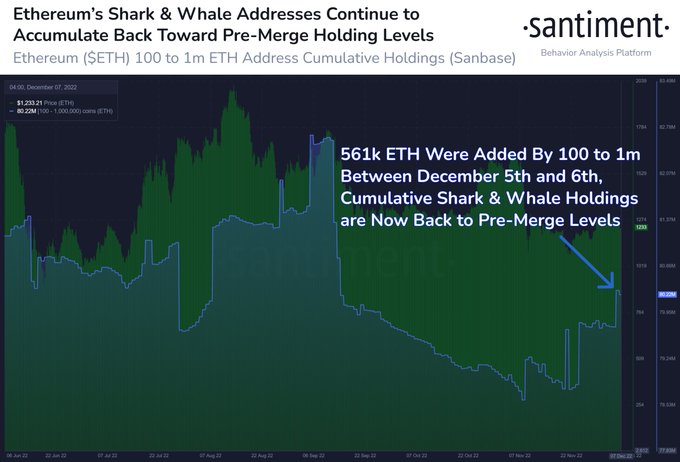
In the current discussion, the holders of interest are those with at least 100 ETH and at most 1 million ETH in their balances. Here is a chart that shows the trend in the combined Ethereum supply distribution for all the wallet groups falling into this range:
Ethereum Whales And Sharks

The value of the metric seems to have shown some sharp uptrend in recent days | Source: Santiment
As you can see in the above graph, the percentage of the Ethereum supply held by wallets in the 100-1m coins range has observed rapid growth recently.
Between the 5th and the 6th of this month alone, the indicator saw its value go up by 561k ETH.
The holder cohorts with wallet balances lying in the range are sharks and whales. Movements from these investors (especially the whales) can have noticeable impacts on the market.
The latest uptrend suggests that these groups have been filling up their bags with more Ethereum recently. Such an accumulation implies the ETH whales and sharks are bullish on the crypto right now.
Earlier in the year, these humongous investors accumulated during the Merge hype, and subsequently dumped the crypto in a sell-the-news event as soon as the actual PoS transition took place (which can be seen by the sharp plunge in the chart).
After the recent accumulation, the whale and shark holdings have now returned close to the levels they were before the Merge leadup.
ETH Price
At the time of writing, Ethereum’s price floats around $1.2k, down 1% in the last week. Over the past month, the crypto has lost 21% in value.
The below chart shows the trend in the price of the coin over the last five days.

Ethereum Price Chart

Looks like the value of the crypto has struggled in the last few days | Source: ETHUSD on TradingView

Lecturas Relacionadas

Why is Step Fun So Perfect?

The article analyzes StepFun's recent, meticulously orchestrated product launch on July 13th, framing it as a strategic maneuver rather than a conventional unveiling. Facing intense pressure in China's AI landscape, the startup preemptively announced its AI terminal brand STEPX, Step AOS operating system, Amoo personal agent, and the "world's first" Agent Phone, STEPX Neo—just days before a major competitor's launch at WAIC. The author argues this "perfect" presentation, addressing prior industry critiques around agent security, permissions, and ecosystem partnerships upfront, serves as a "perfect defense" aimed at regulators, investors, and the market. Its core purpose is to seize the narrative and define standards for the emerging "Agent Phone" category before giants like ByteDance (with its Doubao phone), Apple, or Huawei solidify control. Behind this move lies StepFun's precarious position. Despite a high valuation and revenue from supplying AI models to phone makers, its business is seen as vulnerable—akin to a "MediaTek of AI," with little pricing power as capabilities commoditize. CEO Yin Qi, drawing from his experience at Megvii, is betting that transitioning from a pure AI model supplier to an integrated "terminal platform" with its own hardware, OS, and ecosystem is essential for survival and sustaining its valuation narrative ahead of a potential IPO. The article concludes that StepFun's launch is a symptom of a broader trend: AI startups are forced to "release the future" and sell ambitious platform visions, often with products still in development, because "today" (current metrics, API revenue) has diminishing value in a market racing toward oligopoly. The very perfection of the presentation underscores the urgency of their fight for a seat at the table.

marsbitHace 5 min(s)

Why is Step Fun So Perfect?

marsbitHace 5 min(s)

Trillion-Dollar Stablecoin Surge Challenges Traditional Payments, US Banking Sector Launches Largest Coordinated Counterattack in History

U.S. banks are launching their largest coordinated effort yet to counter the rise of stablecoins, which now facilitate trillions in annual payments. Major institutions including JPMorgan Chase, Bank of America, and Citigroup, coordinated by The Clearing House (TCH), plan to build an interoperable network for tokenized bank deposits. This move, inspired by the successful collaboration that created Zelle, aims to leverage blockchain for faster, cheaper transfers while keeping funds within the regulated banking system. The initiative responds to the rapid growth of stablecoins like USDT and USDC, whose transaction volume surged 72% to approximately $33 trillion last year. Banks see a direct threat as these digital dollars, usable 24/7 across borders, are increasingly adopted by payment firms and financial institutions. The TCH-led network seeks to connect various bank-led blockchain systems, offering scale, deposit insurance, and interoperability that individual bank platforms lack. The goal is to launch next year, initially targeting wholesale payments and tokenized securities settlement. However, the banking consortium faces significant challenges. The sector is fragmented with multiple competing digital currency projects (e.g., from SWIFT and other bank alliances), and historical collaborations like Zelle took years to materialize. While banks hold advantages in trust and regulatory compliance, their slow decision-making contrasts with the crypto industry's pace. Analysts note that although stablecoin issuers currently dominate, if banks successfully unite and execute, their vast resources and existing customer base could pose a formidable challenge in the digital payments race.

marsbitHace 8 min(s)

Trillion-Dollar Stablecoin Surge Challenges Traditional Payments, US Banking Sector Launches Largest Coordinated Counterattack in History

marsbitHace 8 min(s)

Walsh's Hearing Debut, 'New Fed Insider': Emphasizes Zero Tolerance for High Inflation but No Hint on Interest Rate Path

Federal Reserve Chairman Wash's inaugural congressional monetary policy hearing delivered his "new Fed policy declaration," avoiding any clear signals on future interest rate moves—whether cuts or hikes—that the market sought. Instead, he consistently emphasized the Fed's commitment to restoring price stability, maintaining central bank independence, and pledged full advance communication for any future adjustments to the balance sheet. Nick Timiraos, often called the "new Fed whisperer," noted that Wash deliberately avoided hinting at future rate paths, focusing the hearing on reaffirming the Fed's long-term goal of controlling inflation. This stance persisted even after the release of a lower-than-expected June CPI report just before the hearing, which Wash downplayed, stating he did not view the inflation mission as accomplished. Timiraos observed that Wash refrained from using the data to signal any policy inclination, instead stressing that the Fed would rely on economic data to decide how to use its policy tools—interest rates and the balance sheet—to achieve price stability. Bloomberg's analysis suggested the hearing outlined the framework of the "new Fed": upholding monetary policy independence, adhering to the 2% inflation target, rejecting the notion of a trade-off between employment and inflation, and leaving room for future balance sheet and governance reforms. Wash asserted that restoring price stability is foundational for sustained economic growth and job creation, denying any "cruel choice" between the two mandates. Regarding balance sheet reform, a key agenda item, Wash declined to prejudge an ongoing working group's conclusions but promised ample advance communication to the market to prevent sudden disruptions, reaffirming that the balance sheet should serve monetary policy, not fiscal functions. He also strongly defended the Fed's operational independence from political influence, which received positive remarks from some lawmakers across party lines. In summary, Wash's testimony did not alter the near-term interest rate outlook but reinforced a "data-dependent" communication framework. The focus remains on achieving price stability, with future policy actions hinging on incoming economic data rather than a preset path, while the Fed continues its internal reforms and emphasizes transparent communication to manage market expectations.

marsbitHace 13 min(s)

Walsh's Hearing Debut, 'New Fed Insider': Emphasizes Zero Tolerance for High Inflation but No Hint on Interest Rate Path

marsbitHace 13 min(s)

10000 Hours of Human Data, Trains the World's First Whole-Body Mobile Manipulation Implicit World-Action Model

"Being-M0.7" is the world's first latent world-action model for whole-body mobile manipulation in humanoid robots, developed by Zhi Zai Wu Jie (Beyond Being). Trained on over 10,000 hours of human-centric multimodal data, it aims to overcome key industry challenges: the high cost and scarcity of real robot demonstration data, the computational inefficiency of pixel-level video prediction models, and the lack of full-body coordination in existing approaches. The model is based on a Vision-Motion Mixture-of-Transformers (MoT) architecture, which allows training on a mixture of paired video-motion data, pure video data, and pure motion sequences. A key design is a unified motion representation that bridges human and robot morphology, enabling knowledge transfer from vast human behavioral data to specific robot control. After pre-training on human data, the model is adapted to a real robot (Unitree G1) using a small amount of teleoperated demonstration data via a lightweight "Action Expert" module. This process decouples low-frequency world planning from high-frequency motion control. The model was tested in four challenging real-world demos: fishing a toy fish from water (liquid interaction), retrieving an object using a mirror (visual reasoning), a multi-step pick-and-place task, and obstacle avoidance while carrying a box. In comparative tests against other models, Being-M0.7 showed stronger performance in tasks requiring indirect reasoning and full-body coordination. This work represents a shift in humanoid robotics competition from hardware spectacle to model capabilities rooted in scalable data and training paradigms, using human experience as a foundation for physical world understanding and action.

marsbitHace 23 min(s)

10000 Hours of Human Data, Trains the World's First Whole-Body Mobile Manipulation Implicit World-Action Model

marsbitHace 23 min(s)

Trading

Spot
活动图片