DeFi sparks new investments despite turbulent market: Finance Redefined

CointelegraphPublicado a 2022-11-26Actualizado a 2022-11-26

Resumen

The last week of November remained turbulent for the crypto market as majority of the DeFi tokens struggled with the market volatility.

Welcome to Finance Redefined, your weekly dose of essential decentralized finance (DeFi) insights — a newsletter crafted to bring you significant developments over the last week.

The prolonged crypto winter aided by the collapse of FTX has kept investors from backing a new protocol that merges DeFi and the foreign exchange market. A new Cosmos blockchain-based DeFi protocol has caught the eyes of investors who have put $10 million behind the project.

Cardano-based leading stablecoin ecosystem Ardana abruptly stopped its development after several launch delays. However, the project remains open-source for others to add to it until they restart the development process.

Aave community has now proposed a governance change after a failed $60 million short attack. The short attack was later traced to the Mango Markets exploiter, as one of the wallets involved in the attack belonged to the same exploiter.

The crypto market remained turbulent throughout the week and the majority of the top 100 DeFi tokens traded in red, barring a few.

DeFi protocol raises $10M from Bitfinex, Ava Labs despite turbulent market

Onomy, a Cosmos blockchain-based ecosystem, just secured millions from investors for the development of its new protocol. The project merges DeFi and the foreign exchange market to bring the latter on-chain.

According to the developers, the latest funding round garnered $10 million from big industry players such as Bitfinex, Ava Labs, the Maker Foundation and CMS Holdings, among others.

Leading Cardano stablecoin project shuts down after excruciating launch delays

On Nov. 24, Ardana, a leading DeFi and stablecoin ecosystem building on Cardano, abruptly halted development, citing “funding and project timeline uncertainty.” The project will remain open-source for builders while treasury balances and remaining funds will be held by Ardana Labs “until another competent dev team in the community comes forward to continue our work.”

The move came as a shock to many due to the sudden nature of the announcement. However, it appears that issues were already present for some time. Beginning July 4, Ardana has held an ongoing initial stake pool offering, or ISPO, to fund its operations. Unlike traditional fundraising mechanisms, developers do not receive the Cardano delegated by users but instead the staking rewards.

Aave proposes governance changes after failed $60M short attack

On Nov. 23, one day after Mango Markets’ exploiter Avraham Eisenberg attempted to use a series of sophisticated short sales to exploit decentralized finance protocol Aave, project contributors put forth a series of proposals to deal with the aftermath. As told by protocol engineering developer Llama and financial modeling platform Gauntlet, both of whom are deployed on Aave.

Llama wrote that the user had been liquidated but at the cost of $1.6 million in bad debt, likely due to slippage. “This excess debt is isolated only to the CRV market,” the firm wrote. “While this is a small amount relative to the total debt of Aave, and well within the limits of Aave's Safety Module, it is best practice to recapitalize the system to make whole the CRV market.”

Crypto awakening: Researcher explains ETH exodus from exchanges

Nansen research analyst Sandra Leow posted a thread on Twitter unpacking the current state of DeFi with a specific focus on the movement of Ether and stablecoins from exchanges.

As it stands, the Ethereum 2.0 deposit contract contains over 15 million ETH, while some 4 million Wrapped Ether (wETH) is held in the wETH deposit contract. Web3 infrastructure development and investment firm Jump Trading holds over 2 million ETH tokens and is the third largest holder of ETH in the ecosystem.

DeFi market overview

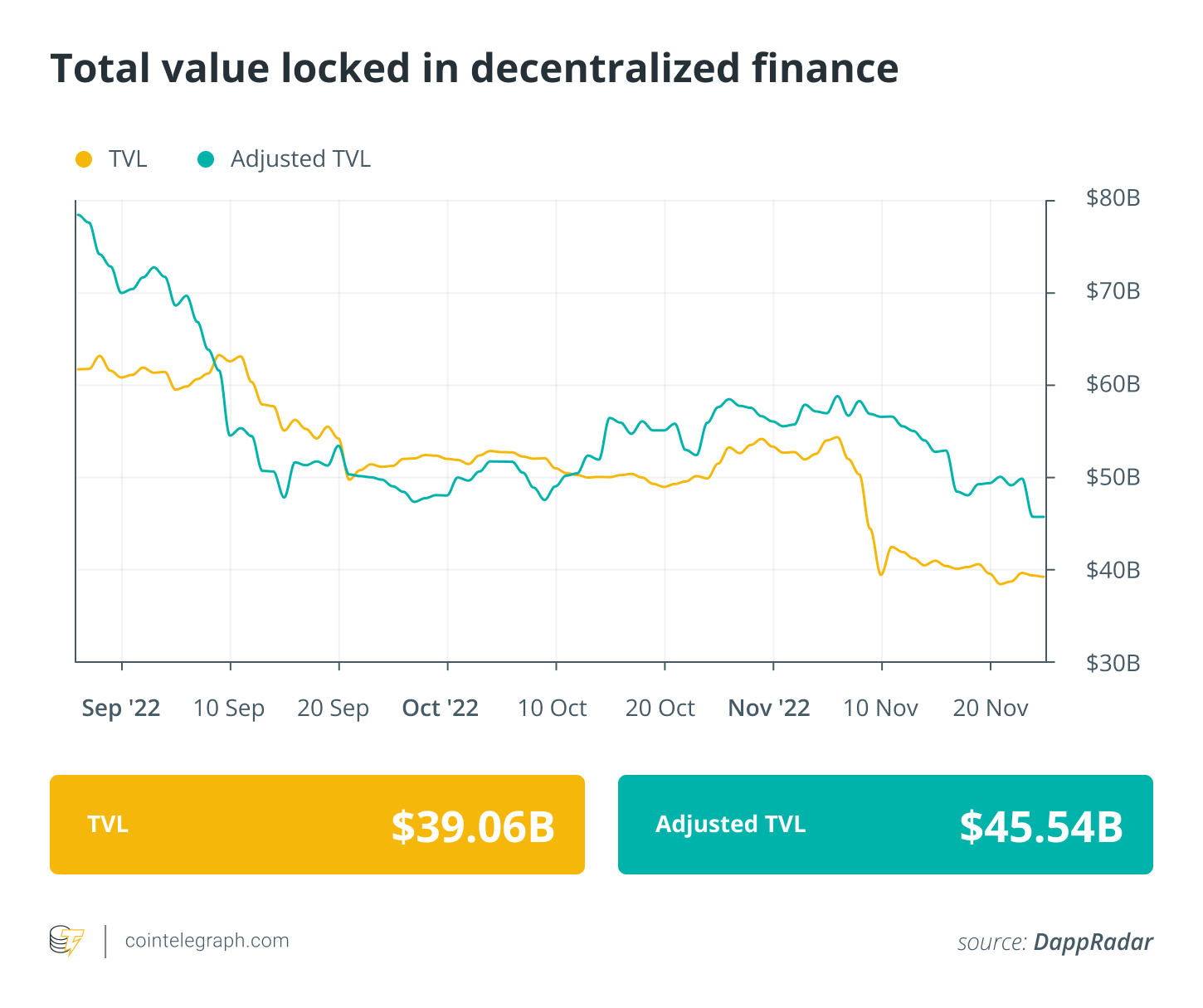
Analytical data reveals that DeFi’s total value locked plunged below $40 billion. Data from Cointelegraph Markets Pro and TradingView show that DeFi’s top 100 tokens by market capitalization had a volatile bearish week due to the FTX saga, with the majority of the tokens bleeding throughout the week.
Curve DAO Token (CRV) was the biggest gainer among the top 100 DeFi tokens, registering a surge of 23.8% over the past week, followed by Chainlink with an 8% surge. The rest of the tokens in the top 100 traded in red on the weekly charts.

Thanks for reading our summary of this week’s most impactful DeFi developments. Join us next Friday for more stories, insights and education in this dynamically advancing space.


Criptos en tendencia

Lecturas Relacionadas

Second Half of U.S. Crypto Policy: The Clarity Act Aims for 60 Votes, CFTC's "One-Person Commission" Becomes Biggest Variable

In a pivotal year for US crypto policy, the "CLARITY Act" is advancing in the Senate but faces a high hurdle, needing 60 votes to pass. Key challenges include bridging partisan divides on ethics and swaying undecided Republican senators within a tight legislative calendar of only about 40 working days. The policy "second half" involves intense negotiations on a broader framework for Web3 and DeFi, including crypto tax reforms and the Blockchain Regulatory Certainty Act. A significant uncertainty is the understaffed CFTC, operating with four commissioner vacancies, which complicates regulatory clarity. Meanwhile, the departure of key "crypto champions"—SEC Commissioner Hester Peirce and Senator Cynthia Lummis—will impact ongoing policy efforts. Industry experts are cautiously optimistic but realistic. Sara K. Weed notes that while progress is being made, CLARITY is unlikely to pass this Congress, pushing agencies like the SEC and CFTC to provide more guidance. Sulolit Mukherjee suggests meaningful crypto tax legislation is more likely to be attached to larger must-pass bills. Rashan Colbert discusses the jurisdictional debate over prediction markets, emphasizing the need for a regulatory framework that fosters their development as financial tools rather than treating them broadly as gambling. The clock is ticking, but opportunities remain for substantive progress through continued bipartisan dialogue and pragmatic efforts.

marsbitHace 1 hora(s)

Second Half of U.S. Crypto Policy: The Clarity Act Aims for 60 Votes, CFTC's "One-Person Commission" Becomes Biggest Variable

marsbitHace 1 hora(s)

Dan Koe's New Essay: Escaping the Fate of the Wage Slave, How to Survive the AI Replacement Wave?

Dan Koe argues that the true threat in the AI era isn't technology itself, but a reliance on others for one's livelihood and happiness. The core problem is "wage slavery"—spending life on unfulfilling work. To survive and thrive, one must escape this by building their own enterprise. The key is developing five elements: Agency (initiative), Taste (discernment), Persuasion, Persistence, and Iteration. These boil down to problem-solving skills and experiential knowledge, which cannot be learned passively but only through doing your own projects. The solution is to become "unemployable" by shifting your identity. This requires: 1) Radically changing your environment to force growth, 2) Choosing a medium (like content creation) that provides real feedback through trial and error, and 3) Mastering either code or, preferably, media (content). Content creation is more valuable because its subjective nature and need for human perspective create a durable advantage over generic AI output. To start, define your life's work by answering foundational questions about your innate knowledge, unique abilities, and contrarian beliefs. Then, immediately act by publishing your first piece of content. The cycle of creating, receiving feedback, and iterating is the essential path to developing the skills needed for an independent, meaningful career and financial resilience.

marsbitHace 2 hora(s)

Dan Koe's New Essay: Escaping the Fate of the Wage Slave, How to Survive the AI Replacement Wave?

marsbitHace 2 hora(s)

Research Report Analysis: Morgan Stanley Details SanDisk SNDK, The Truth About Cloud Data Center Pricing Power and AI Inference Benefits

Morgan Stanley raised its price target for SanDisk (SNDK) from $1100 to $1750 on June 22, maintaining an Overweight rating. The upgrade is driven by AI inference demand reshaping the NAND market, particularly for KV Cache and context window storage in cloud data centers. These cloud clients exhibit price inelasticity and sign long-term contracts, granting SanDisk significant pricing power. SanDisk's New Business Model (NBM) agreements, covering over one-third of FY27 bit shipments with 3-5 year terms and fixed price/price collar structures, are crucial. They are projected to sustain gross margins around 80% even at floor prices, providing a buffer against cyclical downturns. Morgan Stanley forecasts gross margins to surge from 30.3% in FY25 to 86.7% in FY27e. With NAND supply expected to remain tight into 2026/2027 and cloud/data centers becoming the largest end-market, SanDisk holds supply-side pricing power. The company targets 15-19% bit growth via technology transitions, not capacity expansion. Revenue is projected to grow ~6.6x from FY25 to FY27, with EPS rising from $2.74 to $14.73, driven by high-margin cloud business. Key upside catalysts include faster enterprise SSD adoption and edge AI growth. Downside risks involve slower industry growth, competitor capex increases, market share loss, and competition from Chinese players like YMTC. The investment thesis rests on AI-driven structural demand, NBM's margin protection, and sustained supply tightness. The $1750 target implies ~28x FY27e P/E.

marsbitHace 2 hora(s)

Research Report Analysis: Morgan Stanley Details SanDisk SNDK, The Truth About Cloud Data Center Pricing Power and AI Inference Benefits

marsbitHace 2 hora(s)

Trading

Spot
Futuros

Artículos destacados

Cómo comprar CRV

¡Bienvenido a HTX.com! Hemos hecho que comprar Curve DAO Token (CRV) sea simple y conveniente. Sigue nuestra guía paso a paso para iniciar tu viaje de criptos.Paso 1: crea tu cuenta HTXUtiliza tu correo electrónico o número de teléfono para registrarte y obtener una cuenta gratuita en HTX. Experimenta un proceso de registro sin complicaciones y desbloquea todas las funciones.Obtener mi cuentaPaso 2: ve a Comprar cripto y elige tu método de pagoTarjeta de crédito/débito: usa tu Visa o Mastercard para comprar Curve DAO Token (CRV) al instante.Saldo: utiliza fondos del saldo de tu cuenta HTX para tradear sin problemas.Terceros: hemos agregado métodos de pago populares como Google Pay y Apple Pay para mejorar la comodidad.P2P: tradear directamente con otros usuarios en HTX.Over-the-Counter (OTC): ofrecemos servicios personalizados y tipos de cambio competitivos para los traders.Paso 3: guarda tu Curve DAO Token (CRV)Después de comprar tu Curve DAO Token (CRV), guárdalo en tu cuenta HTX. Alternativamente, puedes enviarlo a otro lugar mediante transferencia blockchain o utilizarlo para tradear otras criptomonedas.Paso 4: tradear Curve DAO Token (CRV)Tradear fácilmente con Curve DAO Token (CRV) en HTX's mercado spot. Simplemente accede a tu cuenta, selecciona tu par de trading, ejecuta tus trades y monitorea en tiempo real. Ofrecemos una experiencia fácil de usar tanto para principiantes como para traders experimentados.

495 Vistas totalesPublicado en 2024.12.11Actualizado en 2026.06.02

Cómo comprar CRV

Discusiones

Bienvenido a la comunidad de HTX. Aquí puedes mantenerte informado sobre los últimos desarrollos de la plataforma y acceder a análisis profesionales del mercado. A continuación se presentan las opiniones de los usuarios sobre el precio de CRV (CRV).

活动图片