Disgraced FTX Founder SBF to Speak At at New York Times DealBook Summit

CoingapePublicado a 2022-11-24Actualizado a 2022-11-24

Resumen

FTX founder Sam Bankman-Fried to make first public appearance after the bankruptcy filing. "Nothing is off limits" said NY Times reporter

Sam Bankman-Fried, the disgraced founder of bankrupt crypto exchange FTX will be speaking at the New York Times’ annual DealBook Summit next week, as per the earlier schedule. SBF himself confirmed the same on his Twitter timeline a few hours back.
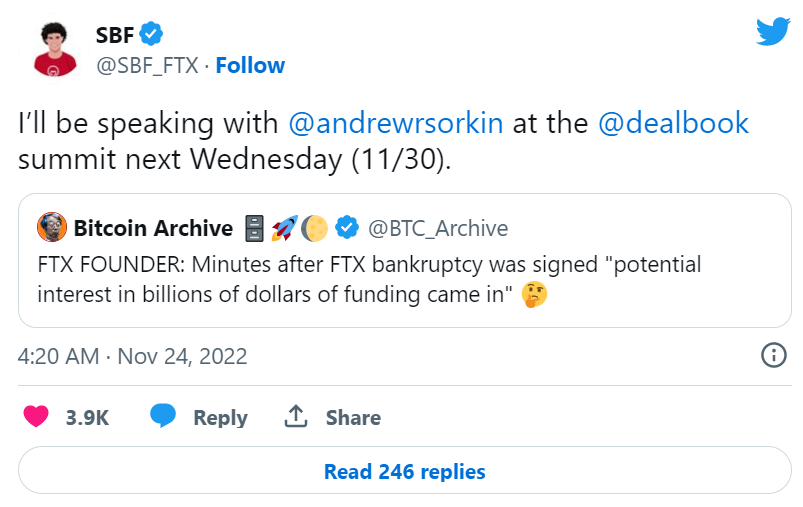
This would be SBF’s first public appearance since crypto exchange FTX sought bankruptcy protection. The bankruptcy proceedings have uncovered a lot of dark details about FTX. This involves the misappropriate use of customer funds, using company funds to buy personal properties, and much more.

Due to this irrational behavior with customers’ funds, FTX faced a $51 billion crash in its collateral. Speaking on this, SBF said:

“I didn’t mean for any of this to happen, and I would give anything to be able to go back and do things over again. I did not realize the full extent of the margin position, nor did I realize the magnitude of the risk posed by a hyper-correlated crash”.

What to Expect from FTX Chief At the Summit?

One of the spokespersons at the New York Times stated that SBF will participate from the island nation of the Bahamas where the crypto exchange is based. The crypto community has accused the NY Times of its soft reporting on the entire FTX episode. But in his tweet, Sorkin said:

“There are a lot of important questions to be asked and answered. Nothing is off limits.”

With the bankruptcy proceedings over the last week, SBF has already resigned as the CEO of the company. His public persona has also been muted. Instead of appearing on TV, SBF has chosen to make long tweet threads. But this social media presence has also brought trouble for the FTX founder.

In the court hearing, lawyers said that SBF’s “incessant and disruptive tweeting” were undermining their restructuring efforts. Law firm Paul Weiss noted that they have stopped representing SBF citing “conflicts”. Top U.S. regulatory agencies are now seeking help from new FTX Chief Executive Officer John J. Ray III.


Criptos en tendencia

Lecturas Relacionadas

Second Half of U.S. Crypto Policy: The Clarity Act Aims for 60 Votes, CFTC's "One-Person Commission" Becomes Biggest Variable

In a pivotal year for US crypto policy, the "CLARITY Act" is advancing in the Senate but faces a high hurdle, needing 60 votes to pass. Key challenges include bridging partisan divides on ethics and swaying undecided Republican senators within a tight legislative calendar of only about 40 working days. The policy "second half" involves intense negotiations on a broader framework for Web3 and DeFi, including crypto tax reforms and the Blockchain Regulatory Certainty Act. A significant uncertainty is the understaffed CFTC, operating with four commissioner vacancies, which complicates regulatory clarity. Meanwhile, the departure of key "crypto champions"—SEC Commissioner Hester Peirce and Senator Cynthia Lummis—will impact ongoing policy efforts. Industry experts are cautiously optimistic but realistic. Sara K. Weed notes that while progress is being made, CLARITY is unlikely to pass this Congress, pushing agencies like the SEC and CFTC to provide more guidance. Sulolit Mukherjee suggests meaningful crypto tax legislation is more likely to be attached to larger must-pass bills. Rashan Colbert discusses the jurisdictional debate over prediction markets, emphasizing the need for a regulatory framework that fosters their development as financial tools rather than treating them broadly as gambling. The clock is ticking, but opportunities remain for substantive progress through continued bipartisan dialogue and pragmatic efforts.

marsbitHace 10 min(s)

Second Half of U.S. Crypto Policy: The Clarity Act Aims for 60 Votes, CFTC's "One-Person Commission" Becomes Biggest Variable

marsbitHace 10 min(s)

Dan Koe's New Essay: Escaping the Fate of the Wage Slave, How to Survive the AI Replacement Wave?

Dan Koe argues that the true threat in the AI era isn't technology itself, but a reliance on others for one's livelihood and happiness. The core problem is "wage slavery"—spending life on unfulfilling work. To survive and thrive, one must escape this by building their own enterprise. The key is developing five elements: Agency (initiative), Taste (discernment), Persuasion, Persistence, and Iteration. These boil down to problem-solving skills and experiential knowledge, which cannot be learned passively but only through doing your own projects. The solution is to become "unemployable" by shifting your identity. This requires: 1) Radically changing your environment to force growth, 2) Choosing a medium (like content creation) that provides real feedback through trial and error, and 3) Mastering either code or, preferably, media (content). Content creation is more valuable because its subjective nature and need for human perspective create a durable advantage over generic AI output. To start, define your life's work by answering foundational questions about your innate knowledge, unique abilities, and contrarian beliefs. Then, immediately act by publishing your first piece of content. The cycle of creating, receiving feedback, and iterating is the essential path to developing the skills needed for an independent, meaningful career and financial resilience.

marsbitHace 46 min(s)

Dan Koe's New Essay: Escaping the Fate of the Wage Slave, How to Survive the AI Replacement Wave?

marsbitHace 46 min(s)

Research Report Analysis: Morgan Stanley Details SanDisk SNDK, The Truth About Cloud Data Center Pricing Power and AI Inference Benefits

Morgan Stanley raised its price target for SanDisk (SNDK) from $1100 to $1750 on June 22, maintaining an Overweight rating. The upgrade is driven by AI inference demand reshaping the NAND market, particularly for KV Cache and context window storage in cloud data centers. These cloud clients exhibit price inelasticity and sign long-term contracts, granting SanDisk significant pricing power. SanDisk's New Business Model (NBM) agreements, covering over one-third of FY27 bit shipments with 3-5 year terms and fixed price/price collar structures, are crucial. They are projected to sustain gross margins around 80% even at floor prices, providing a buffer against cyclical downturns. Morgan Stanley forecasts gross margins to surge from 30.3% in FY25 to 86.7% in FY27e. With NAND supply expected to remain tight into 2026/2027 and cloud/data centers becoming the largest end-market, SanDisk holds supply-side pricing power. The company targets 15-19% bit growth via technology transitions, not capacity expansion. Revenue is projected to grow ~6.6x from FY25 to FY27, with EPS rising from $2.74 to $14.73, driven by high-margin cloud business. Key upside catalysts include faster enterprise SSD adoption and edge AI growth. Downside risks involve slower industry growth, competitor capex increases, market share loss, and competition from Chinese players like YMTC. The investment thesis rests on AI-driven structural demand, NBM's margin protection, and sustained supply tightness. The $1750 target implies ~28x FY27e P/E.

marsbitHace 1 hora(s)

Research Report Analysis: Morgan Stanley Details SanDisk SNDK, The Truth About Cloud Data Center Pricing Power and AI Inference Benefits

marsbitHace 1 hora(s)

A Threefold Performance Leap! NEAR Achieves 200ms Physical Block Time Limit with SPICE

NEAR's core development team, Near One, has announced its next major protocol evolution: SPICE (Separation of Consensus and Execution). Currently in development, SPICE represents the most significant upgrade before the full implementation of Nightshade 3.0. Its core innovation is decoupling the consensus layer, responsible for ordering transactions, from the execution layer, which processes them. This allows the consensus layer to run at full speed without waiting for transaction execution to complete. Once deployed, SPICE is projected to triple NEAR's block production speed, achieving a 200ms block time, which is considered the physical limit due to the speed of light and network latency. This leap will dramatically reduce transaction latency and finality, with transactions confirming in roughly 0.4 seconds—faster than a typical card payment. The upgrade also enables more complex, long-running transactions and significantly improves user experience for applications like NEAR Intents and near.com. Beyond raw speed, SPICE enhances network scalability and security. It enables deeper parallelism, efficiently distributing workload across shards and improving resource utilization. The simpler block structure and lighter contracts also facilitate formal verification and security auditing. Furthermore, SPICE lays the critical groundwork for future Nightshade 3.0 features, most notably atomic cross-shard transactions, which would simplify complex contract logic and eliminate development hurdles caused by asynchronous execution. The Near One team is actively developing SPICE, targeting deployment in the coming months.

Foresight NewsHace 2 hora(s)

A Threefold Performance Leap! NEAR Achieves 200ms Physical Block Time Limit with SPICE

Foresight NewsHace 2 hora(s)

Trading

Spot
Futuros

Artículos destacados

Cómo comprar FTT

¡Bienvenido a HTX.com! Hemos hecho que comprar FTX Token (FTT) sea simple y conveniente. Sigue nuestra guía paso a paso para iniciar tu viaje de criptos.Paso 1: crea tu cuenta HTXUtiliza tu correo electrónico o número de teléfono para registrarte y obtener una cuenta gratuita en HTX. Experimenta un proceso de registro sin complicaciones y desbloquea todas las funciones.Obtener mi cuentaPaso 2: ve a Comprar cripto y elige tu método de pagoTarjeta de crédito/débito: usa tu Visa o Mastercard para comprar FTX Token (FTT) al instante.Saldo: utiliza fondos del saldo de tu cuenta HTX para tradear sin problemas.Terceros: hemos agregado métodos de pago populares como Google Pay y Apple Pay para mejorar la comodidad.P2P: tradear directamente con otros usuarios en HTX.Over-the-Counter (OTC): ofrecemos servicios personalizados y tipos de cambio competitivos para los traders.Paso 3: guarda tu FTX Token (FTT)Después de comprar tu FTX Token (FTT), guárdalo en tu cuenta HTX. Alternativamente, puedes enviarlo a otro lugar mediante transferencia blockchain o utilizarlo para tradear otras criptomonedas.Paso 4: tradear FTX Token (FTT)Tradear fácilmente con FTX Token (FTT) en HTX's mercado spot. Simplemente accede a tu cuenta, selecciona tu par de trading, ejecuta tus trades y monitorea en tiempo real. Ofrecemos una experiencia fácil de usar tanto para principiantes como para traders experimentados.

147 Vistas totalesPublicado en 2024.12.12Actualizado en 2025.03.21

Cómo comprar FTT

Discusiones

Bienvenido a la comunidad de HTX. Aquí puedes mantenerte informado sobre los últimos desarrollos de la plataforma y acceder a análisis profesionales del mercado. A continuación se presentan las opiniones de los usuarios sobre el precio de FTT (FTT).

活动图片